Write your answer on paper. Then open the answer to check it.
Section A
Diagram 1 shows a sector OPR with centre O inscribed in a trapezium OPQR. OP = 12 cm, PQ = 5 cm, angle ORQ and angle PQR are right angles, angle POR = θ. [Use π = 3.142]
Easy4 marks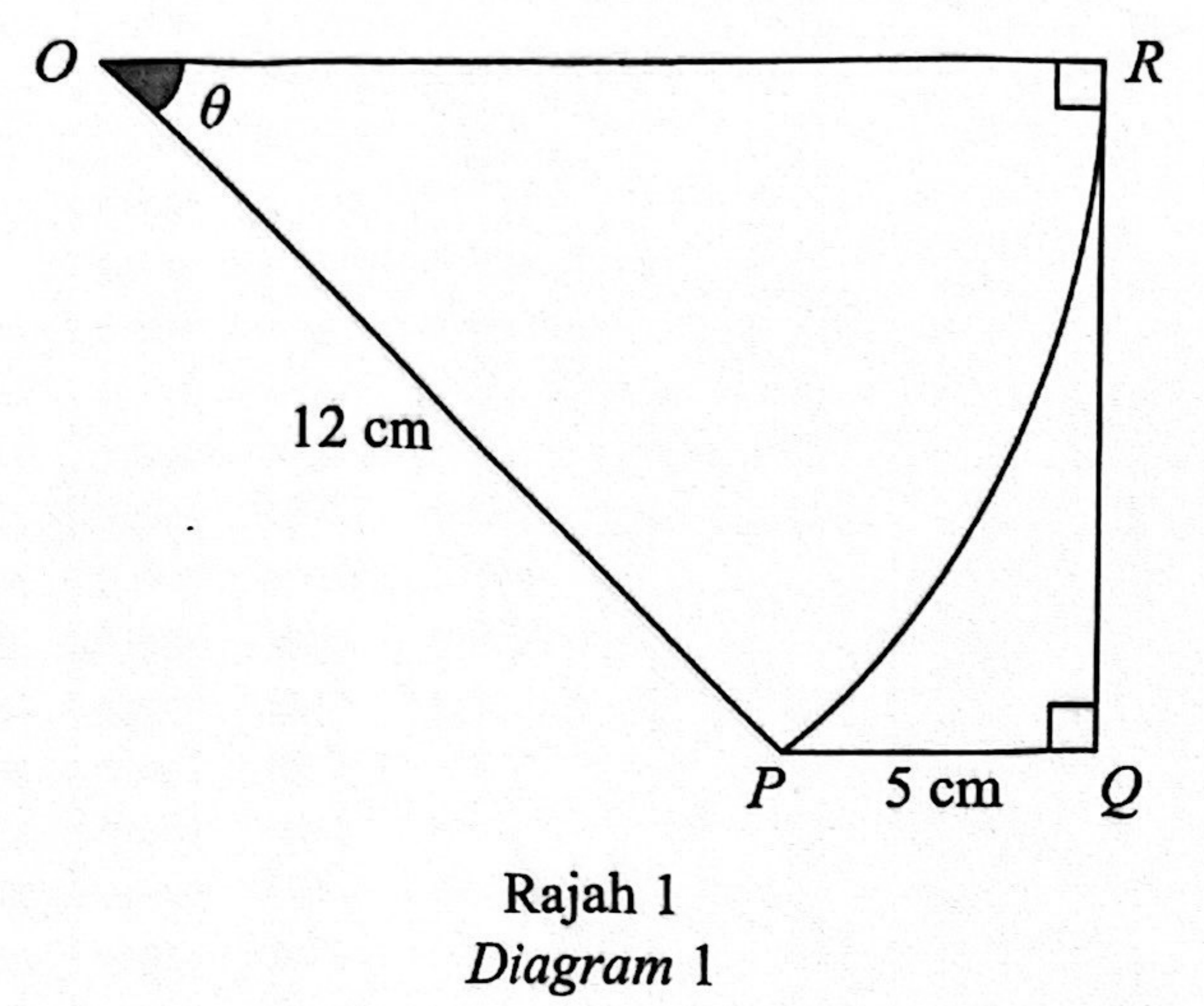
- (a)
Show that θ = 0.948 radian.
[2] - (b)
Hence, calculate the length of arc PR.
[2]
Diagram 2 shows the graph of ln y against x, a straight line passing through (0, p) and (q, 2). The variables x and y are related by the equation y = e^(4x − 1). Find the value of p and of q.
Easy4 marks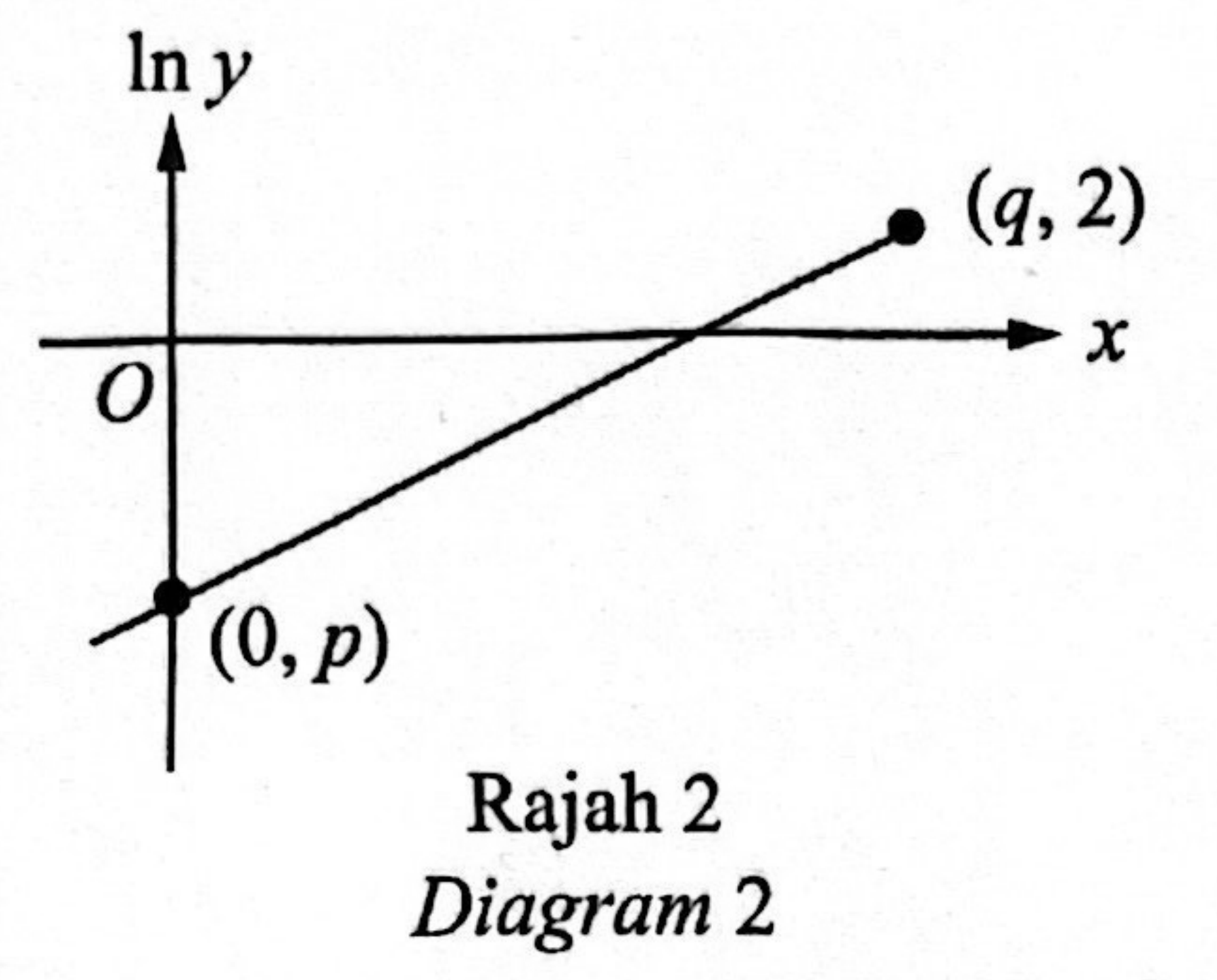
Find the value of p and of q.
[4]
(a) Determine whether the sequence 6π, 9π, 12π, 15π, .... is a geometric progression or not. Give your justification. (b) If a is the first term and r is the common ratio of a geometric progression, show that the sum of the first n terms is Sₙ = a(rⁿ − 1)/(r − 1).
Easy5 marks- (a)
Determine whether the sequence 6π, 9π, 12π, 15π, .... is a geometric progression or not. Give your justification.
[2] - (b)
If a is the first term and r is the common ratio of a geometric progression, show that the sum of the first n terms is Sₙ = a(rⁿ − 1)/(r − 1).
[3]
(a) Alvin undergoes two running training sessions. In each session, Alvin runs for a distance of 5 km. In the first session, Alvin runs at an average speed of x km h⁻¹. In the second session, Alvin decreases his average speed by 2 km h⁻¹, and finishes the training 3 minutes later compared to the first session. Calculate Alvin's average speed in the first session. (Give your answer correct to four significant figures.) (b) Given α and β are the roots of the quadratic equation 3x² − 4x + 9 = 0. Find the new quadratic equation which has the roots 1/α and 1/β. Give your answer in the form ax² + bx + c = 0 where a, b and c are integers.
Medium7 marks- (a)
Calculate Alvin's average speed in the first session, given the conditions above. (Give your answer correct to four significant figures.)
[4] - (b)
Given α and β are the roots of 3x² − 4x + 9 = 0, find the new quadratic equation which has the roots 1/α and 1/β, in the form ax² + bx + c = 0 where a, b and c are integers.
[3]
(a) Determine whether the quantity in the following statement is a scalar quantity or a vector quantity. Give your justification. "During landing on the ground, paratroopers bend their legs. In this way, it is possible to reduce the impulse force by extending the impact time of the foot with the ground." (b) Diagram 3 shows a triangle OPR. The straight lines OQ and PS intersect at point T. It is given that 5OT→ = 2OQ→, 8PQ→ = 3PR→, PR→ = 8**x**, OP→ = **y**, PS→ = kPT→, OS→ = hOR→. (i) Express PS→ in terms of k, **x** and **y**. (ii) Express PS→ in terms of h, **x** and **y**. (iii) Hence, find the value of h and of k.
Medium7 marks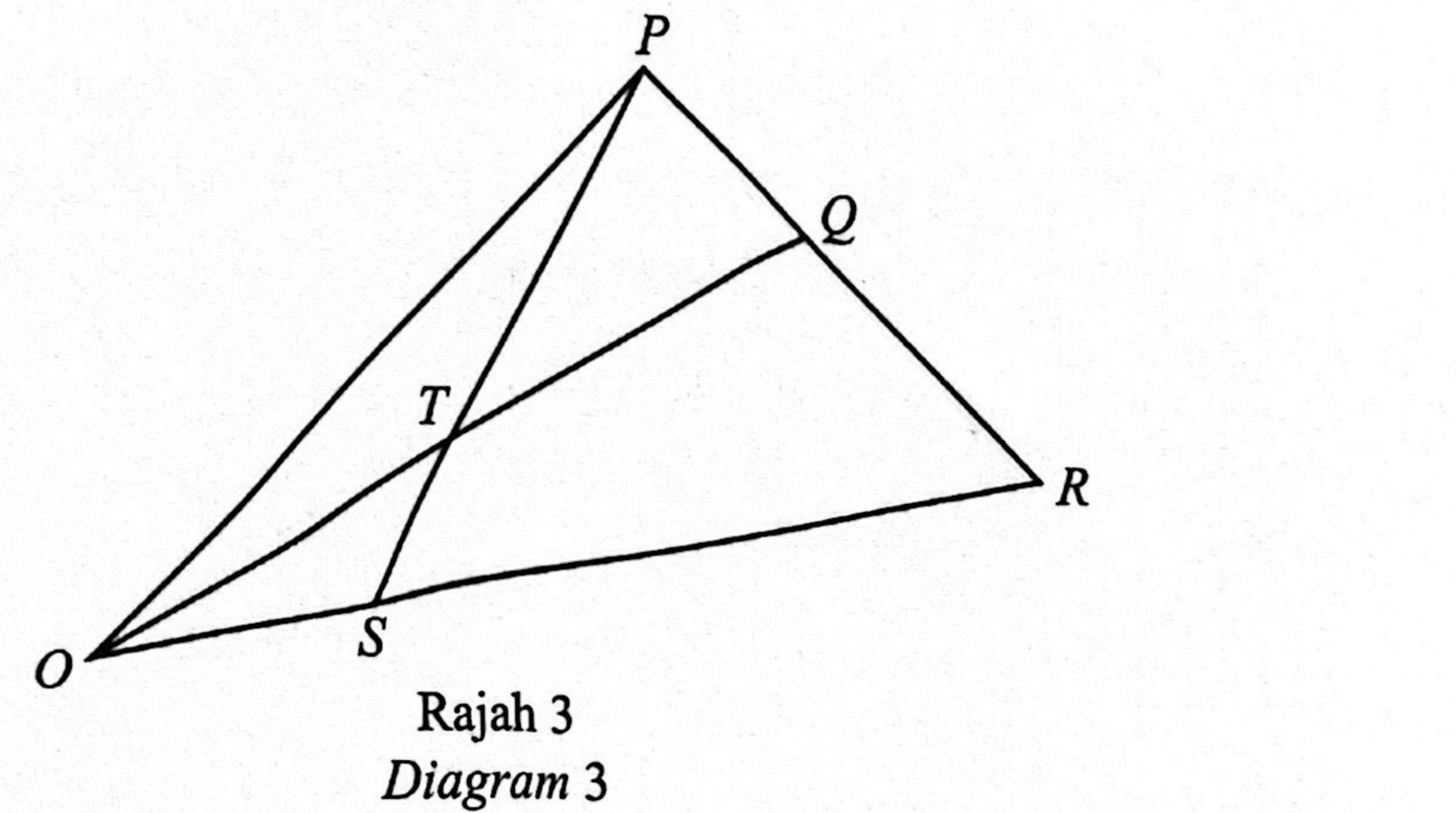
- (a)
Determine whether the quantity (impulse force when paratroopers bend their legs on landing) is a scalar quantity or a vector quantity. Give your justification.
[1] - (b)(i)
Express PS→ in terms of k, **x** and **y**.
[2] - (b)(ii)
Express PS→ in terms of h, **x** and **y**.
[1] - (b)(iii)
Hence, find the value of h and of k.
[3]
(a) Given y = x(5 − x), express y d²y/dx² + (dy/dx)² + 15 in its simplest form. (b) The area of a square with side x cm increases at a rate of 3 cm² s⁻¹. Find the rate of change of its side when the area is 9 cm².
Medium5 marks- (a)
Given y = x(5 − x), express y d²y/dx² + (dy/dx)² + 15 in its simplest form.
[3] - (b)
The area of a square with side x cm increases at a rate of 3 cm² s⁻¹. Find the rate of change of its side when the area is 9 cm².
[2]
Diagram 4 shows the circular pattern on the wall tiles using eight congruent sectors with a radius of 10 cm. Find the area of the shaded region. [Use π = 3.142]
Medium4 marks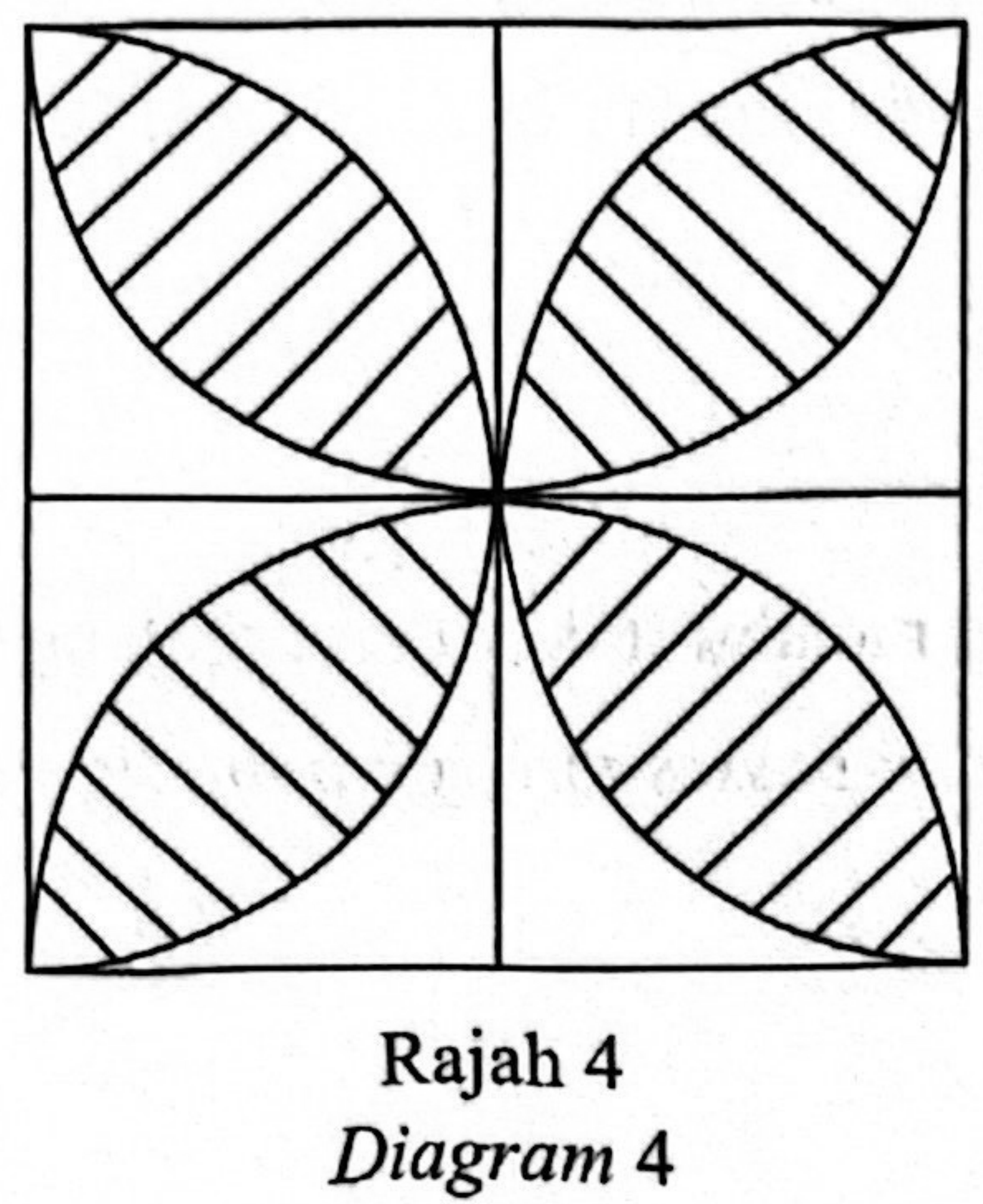
Find the area of the shaded region.
[4]
Solutions by scale drawing and vectors are not accepted. The coordinates of points A, B and C are (0, 1), (2, 5) and (6, −1) respectively. Find (a) the straight line equation that passes through point A and the midpoint BC, (b) the area of triangle ABC, (c) the equation of locus of a moving point P(x, y) such that its distance from point A and point C are the same.
Medium8 marks- (a)
Find the straight line equation that passes through point A and the midpoint BC.
[4] - (b)
Find the area of triangle ABC.
[2] - (c)
Find the equation of locus of a moving point P(x, y) such that its distance from point A and point C are the same.
[2]
(a) Find the number of odd numbers that can be formed from all the digits 5, 2, 4, 6 and 8 with all the digits except 5 appearing exactly twice. (b) Diagram 5 shows three straight lines, l₁, l₂ and l₃. It is given that 3 points lie on line l₁, 3 points lie on line l₂, and 2 points lie on line l₃. If the points from each line are used to form a polygon, find the number of (i) triangles that can be formed, (ii) quadrilaterals that can be formed.
Medium7 marks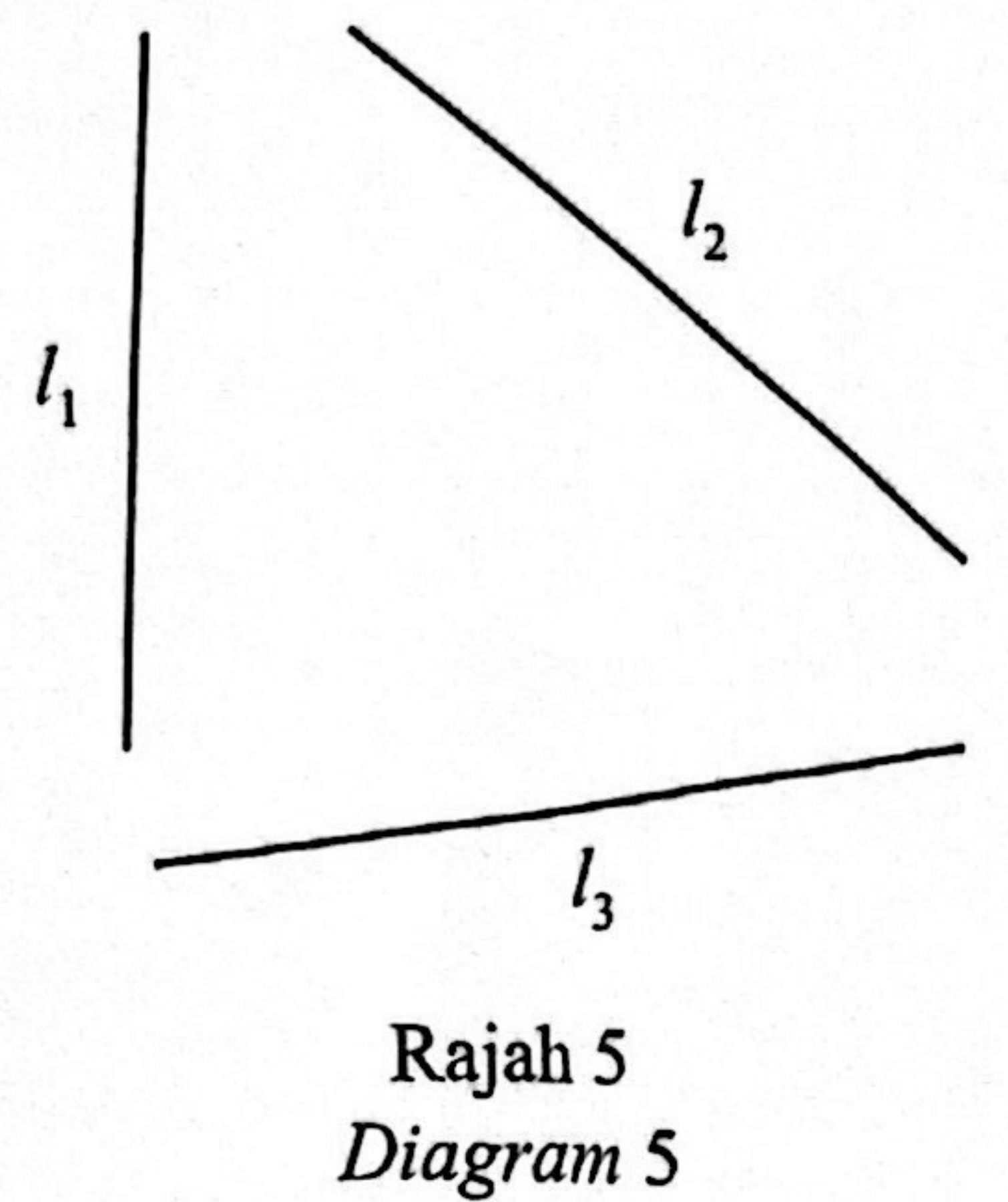
- (a)
Find the number of odd numbers that can be formed from all the digits 5, 2, 4, 6 and 8 with all the digits except 5 appearing exactly twice.
[2] - (b)(i)
Find the number of triangles that can be formed.
[2] - (b)(ii)
Find the number of quadrilaterals that can be formed.
[3]
It is given that d/dx (2x/(1 − 3x) − 5) = f(x), find ∫ from −2 to 1 of 3f(x) dx.
Easy3 marksFind ∫ from −2 to 1 of 3f(x) dx.
[3]
A curve with gradient function x − 27/x², has a stationary point (m, 3). (a) Find the value of m. (b) Hence, determine the nature of the stationary point.
Easy5 marks- (a)
Find the value of m.
[2] - (b)
Hence, determine the nature of the stationary point.
[3]
In a survey, it is found that 3 out of 4 brand A car tyres have a life span of more than 4 years. A sample consisting of n car tyres of brand A is chosen at random. If the probability that all the car tyres lasted more than 4 years is 0.5625, (a) find the value of n, (b) calculate the mean of life span for brand A car tyres.
Easy5 marks- (a)
Find the value of n.
[3] - (b)
Calculate the mean of life span for brand A car tyres.
[2]
Section B
(a) Diagram 6 shows the graph of function f(x) = |3x − 2| for the domain −1 ≤ x ≤ 6. (i) Find the image of −1 and of 6. (ii) Sketch the graph g(x) = 2 − f(x) for the domain −1 ≤ x ≤ 6. (b) Given that composite function hk: x → 3x + 5 and h: x → 2/(x − 3), x ≠ 3, determine the function k(x).
Medium8 marks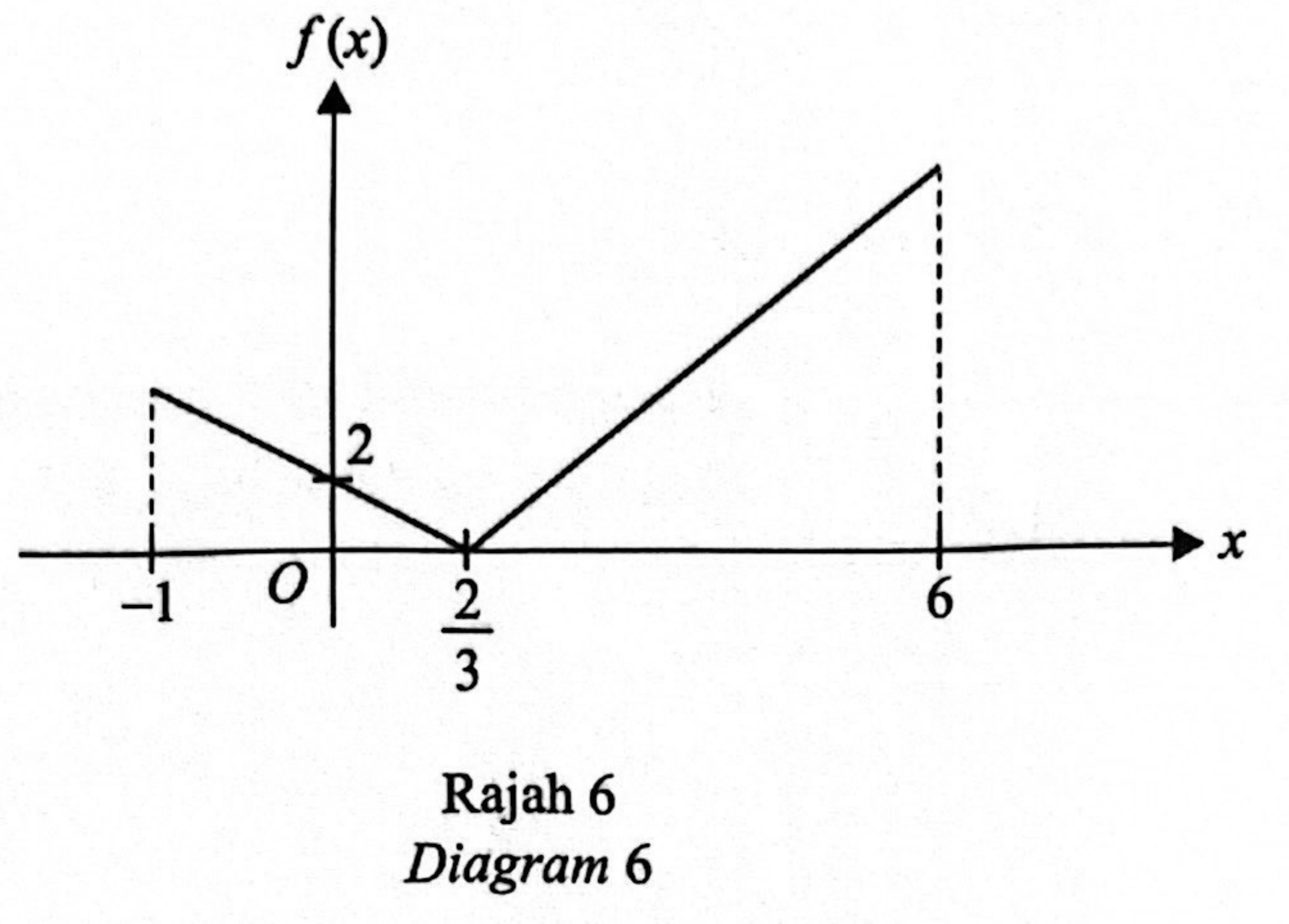
- (a)(i)
Find the image of −1 and of 6.
[2] - (a)(ii)
Sketch the graph g(x) = 2 − f(x) for the domain −1 ≤ x ≤ 6.
[2]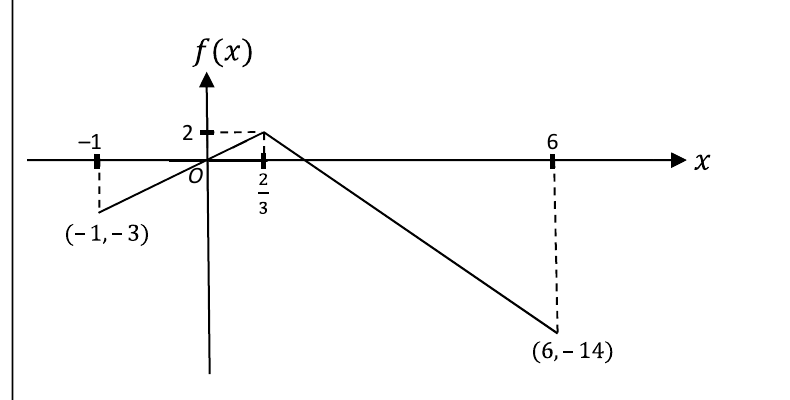
- (b)
Given that composite function hk: x → 3x + 5 and h: x → 2/(x − 3), x ≠ 3, determine the function k(x).
[4]
(a) Solve the equation 2^(x+6) − 2^(x+5) = 4. (b) It is given that log₂ m − log₁₆ n = 4, express m in terms of n. (c) Rationalise the denominator (2 + √5)/(2 − √5).
Medium8 marks- (a)
Solve the equation 2^(x+6) − 2^(x+5) = 4.
[3] - (b)
It is given that log₂ m − log₁₆ n = 4, express m in terms of n.
[3] - (c)
Rationalise the denominator (2 + √5)/(2 − √5).
[2]
(a) It is given that sin α = p, where α is an acute angle. Express sec α in terms of p. (b) Prove that (1 − sin x)/(2 cos x) + cos x/(2 − 2 sin x) = sec x. (c) By using trigonometric ratio, find the value of cos 840°.
Medium8 marks- (a)
Express sec α in terms of p.
[2] - (b)
Prove that (1 − sin x)/(2 cos x) + cos x/(2 − 2 sin x) = sec x.
[3] - (c)
By using trigonometric ratio, find the value of cos 840°.
[3]