Write your answer on paper. Then open the answer to check it.
Section A
Diagram 1 shows the composite function gf : x → 6x + 5 that maps set A to set C. Given f : x → (2x + 3)/4 (f maps A to B, g maps B to C).
Easy4 marks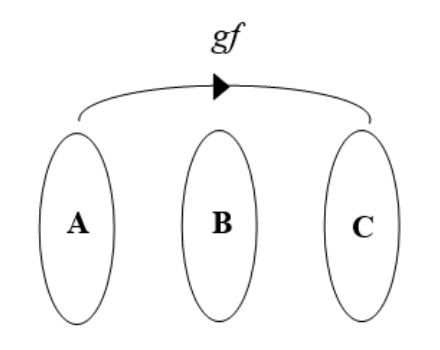
- (a)
The function which maps set B to set C.
[3] - (b)
fg
[1]
Simplify the following algebraic expression: (6^(a−2) + 6^(a+3))/216.
Easy3 marksSimplify (6^(a−2) + 6^(a+3))/216.
[3]
Diagram 2 shows a trapezium PQRST. RT is parallel to PQ. Given the area of the trapezium is 15√5 + 20√2 cm², RT = √5 cm and PQ = √2 cm. Find the height of the trapezium in the form a + b√10.
Medium5 marks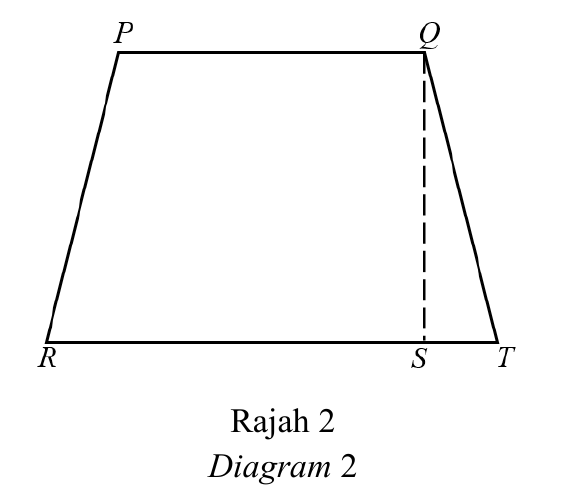
Find the height of the trapezium in the form a + b√10.
[5]
The tangent to the curve y = 2x² + px − 4 at x = 1 is parallel to the line y = 2x.
Easy7 marks- (a)
Find the value of p.
[3] - (b)
Find the coordinates of the turning point of the curve. Hence, using the sketching of tangents method, determine the type of the turning point.
[4]
Diagram 3 shows point A(7, 12) on the Cartesian plane.
Easy5 marks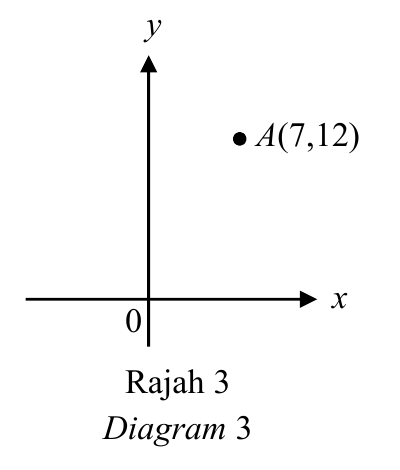
- (a)
State OA→ in the form of a column vector.
[1] - (b)
Point A is reflected about the x-axis to point A′. Given OB→ = h i + 5 j and the unit vector of A′B→ is k [[10], [17]], where h and k are constants. Find the value of h and k.
[4]
The variables x and y are related by y = px³ + qx², where p and q are constants. Diagram 4 shows a straight line graph of y/x² against x. The line passes through (2, 8) and (4, 2).
Easy5 marks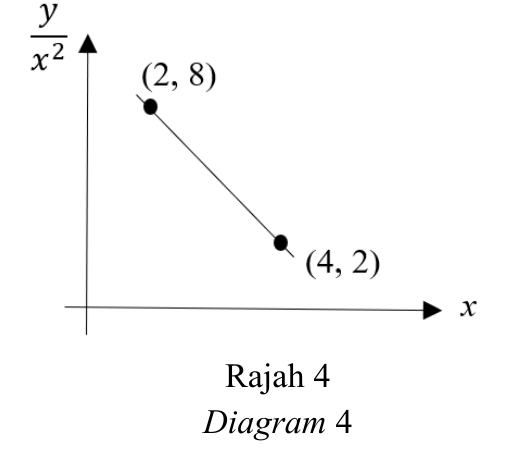
- (a)
Express y = px³ + qx² in linear form.
[1] - (b)
Find the value of p and q.
[4]
Diagram 5 shows part of the graph of the probability distribution of X: P(X = 0) = 16/81, P(X = 1) = a, P(X = 2) = 8/27, P(X = 3) = b, P(X = 4) = 1/81. The random variable X has a binomial distribution with 4 trials, probability of success p and probability of failure q.
Medium5 marks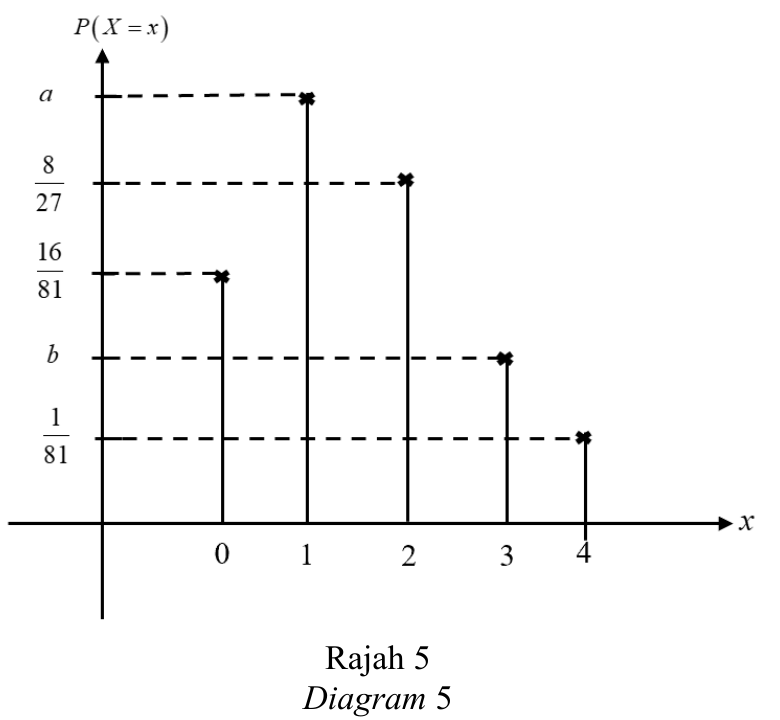
- (a)
Find the value of a + b in fraction form.
[2] - (b)
Hence, show that pq(p² + q²) = 10/81.
[3]
(a) Find ∫4(x + 1)² dx. (b) Hence, find the equation of the curve that passes through the point (0, −1).
Easy5 marks- (a)
Find ∫4(x + 1)² dx.
[2] - (b)
Hence, find the equation of the curve that passes through the point (0, −1).
[3]
Given a is the first term and d is the common difference of an arithmetic progression.
Medium5 marks- (a)
Show that the n-th term of the progression is Tₙ = a + (n − 1)d.
[3] - (b)
Hence, find the sum of the first 5 terms in terms of a and d.
[2]
SMK Bunga Emas held a school canteen day. Adam, Sofea and Aufa have remaining coupons of RM16.00, RM20.00 and RM18.00 respectively. They need to spend the coupon. Adam bought two doughnuts, a carton of fresh milk and a packet of fries. Sofea bought a doughnut, two cartons of fresh milk and a packet of fries. Aufa bought a doughnut, a carton of fresh milk and two packets of fries. Form three linear equations, hence find the price of each type of food.
Medium8 marksForm three linear equations, hence find the price of each type of food.
[8]
A geometric progression has first term log₂ 36 and common ratio log₂ y.
Medium7 marks- (a)(i)
Find the range of y for which the geometric progression has a sum to infinity.
[2] - (a)(ii)
Find the value of y such that the sum to infinity of the geometric progression is 2.
[3] - (b)(i)
It is given that the nth term of a geometric progression is Tₙ = 8rⁿ⁻¹/5, r ≠ m. State the values of m.
[1] - (b)(ii)
State the first term of the progression.
[1]
Given a quadratic function f(x) = (x + 1)(1 − 3x).
Medium5 marks- (a)
By using the method of completing the square, find the maximum value of f(x).
[3] - (b)
Hence, sketch the graph of f(x) for the domain −2 ≤ x ≤ 1.
[2]
Section B
(a) Solve the following equations for 0° ≤ x ≤ 360°: (i) sec θ cosec θ = 4; (ii) 5 sec²θ + 14 tan θ = 8. (b) If sin θ = p for 0° ≤ x ≤ 90°, express tan(θ + 225°) in terms of p.
Medium8 marks- (a)(i)
Solve sec θ cosec θ = 4 for 0° ≤ θ ≤ 360°.
[2] - (a)(ii)
Solve 5 sec²θ + 14 tan θ = 8 for 0° ≤ θ ≤ 360°.
[3] - (b)
If sin θ = p for 0° ≤ θ ≤ 90°, express tan(θ + 225°) in terms of p.
[3]
Diagram 6 shows a rectangle ABCD and a square KLMC. AD = (15 + x) cm, DC = 10x cm and LM = (x + 5) cm. The total area of the entire diagram is 1100 cm².
Medium8 marks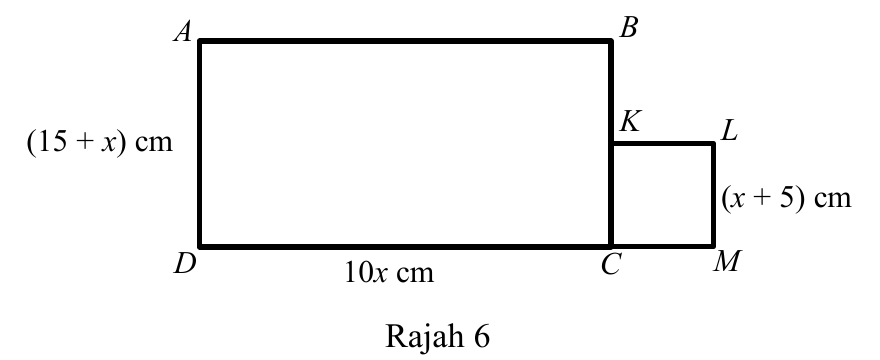
- (a)
Find the value of x.
[4] - (b)
Hence, find the length of the square KLMC that needs to be added so that its area is equal to the area of the rectangle ABCD. Round off your answer to the nearest integer.
[4]
Permutation and combination problems on arrangements of girls and boys, bracelets of beads and selection of students.
Medium8 marks- (a)(i)
In how many ways can three girls and two boys be arranged in a row if the boys sit together?
[2] - (a)(ii)
Puan Haliza has 2 red beads, 3 blue beads and 4 yellow beads. How many different bracelets can be formed from all these beads?
[2] - (b)(i)
How many different ways are there to select a group of three from a class of 31 students?
[1] - (b)(ii)
In another class, there are 253 ways of selecting a group of two students. How many students are there in the class?
[3]