Write your answer on paper. Then open the answer to check it.
Section A
Diagram 1 shows a graph of g(x) = |5 − px| for −1 ≤ x ≤ 2. The graph meets the x-axis at x = 5/8 and the y-axis at q. Find the value of p and of q.
Easy2 marks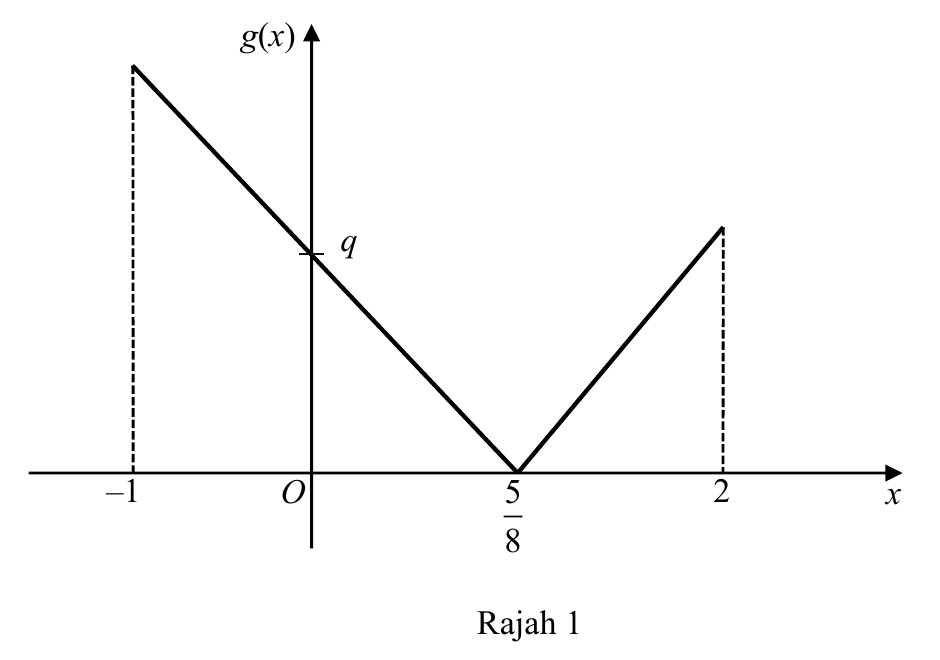
Find the value of p and of q.
[2]
(a) The quadratic equation px² − 9qx + 9p = 0, where p and q are constants, has two equal roots. (b) One root of x² − 12x + k = 0 is three times the other root.
Medium4 marks- (a)
Find p : q.
[2] - (b)
Find the value of constant k.
[2]
Diagram 2 shows two vectors OA→ = m and OB→ = n (not parallel). Find the value of a and of b such that (a − 2)m = (3a + b)n.
Easy3 marks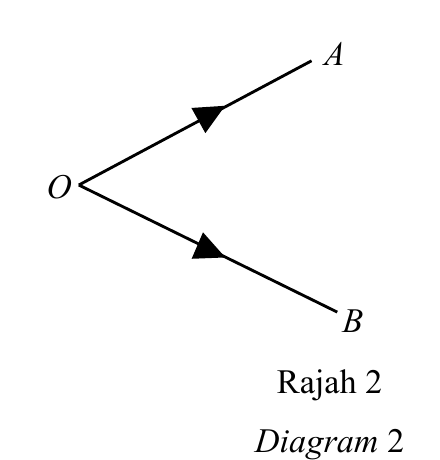
Find the value of a and of b such that (a − 2)m = (3a + b)n.
[3]
Given y = (3 − 2x³)². Find (a) dy/dx, giving the answer in the form dy/dx = ax^b(3 − 2x³)^c where a, b and c are constants; (b) the small change in y when x increases from 1 to 1.03.
Easy4 marks- (a)
Find dy/dx in the form ax^b(3 − 2x³)^c.
[2] - (b)
Find the small change in y when x increases from 1 to 1.03.
[2]
(a) Diagram 3 shows part of the curve x = g(y) from y = 0 to y = 5. Region A (to the left of the y-axis, between y = 2 and y = 5) has area 10 unit² and region B (between y = 0 and y = 2, to the right of the y-axis) has area 4 unit². Find ∫ from 0 to 5 of g(y) dy. (b) Given d/dx [x²/(x + 5)] = g(x), find ∫ from 0 to 2 of [x² + g(x)] dx.
Medium5 marks- (a)
Given the area of region A is 10 unit² and the area of region B is 4 unit², find ∫₀⁵ g(y) dy.
[2]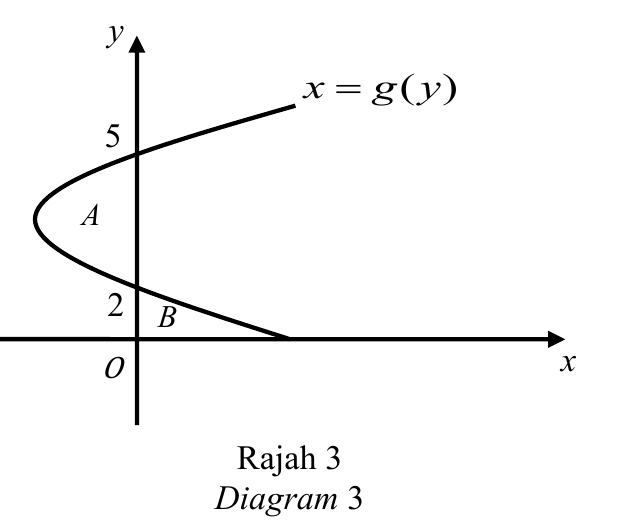
- (b)
Given d/dx [x²/(x + 5)] = g(x), find ∫₀² [x² + g(x)] dx.
[3]
Diagram 4 shows a quadrilateral PQRS. The coordinates of R are (h, −h) where h > 0, the length of SR is √128 and O is the midpoint of SR. Right angles are at P and R.
Medium7 marks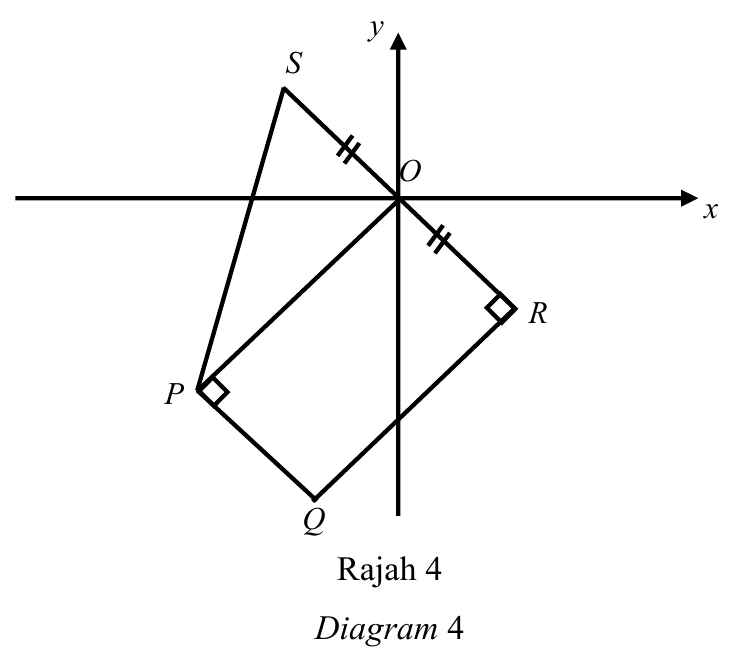
- (a)
Calculate the value of h.
[2] - (b)(i)
Given that the equation of PQ is y + x = −14, find the coordinates of Q.
[3] - (b)(ii)
Given that the equation of PQ is y + x = −14, find the equation of SP.
[2]
Diagram 5 shows a straight line graph of y/x against 1/x. The straight line passes through (4, 16) and meets the y/x axis at 1. The variables x and y are related by y = pq + px, where p and q are constants.
Easy6 marks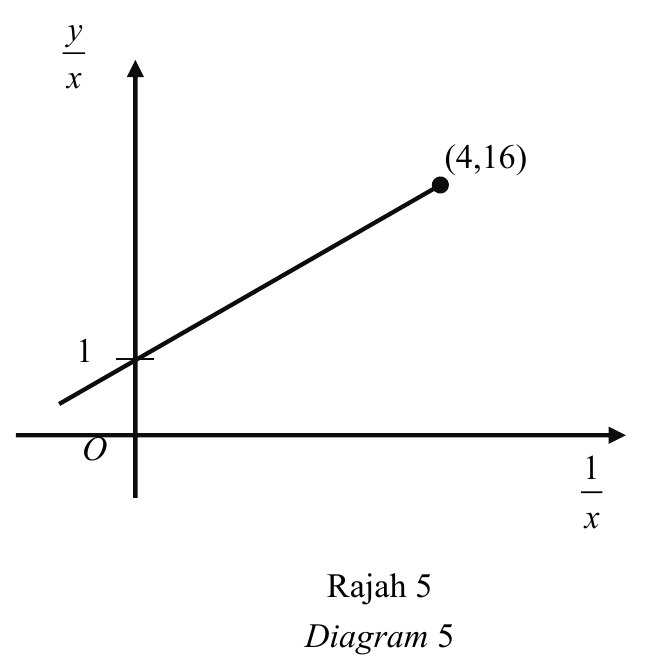
- (a)
Find the value of p and of q. Hence, find the X-intercept (of the graph shown).
[5] - (b)
Express y in terms of x.
[1]
Diagram 6 shows a semicircle EDA with centre O and a right-angled triangle OBC (right angle at B, with E, O, A, B in a straight line). The length of arc ED is 26 cm. AB = 12 cm and is equal to the radius of the semicircle EDA. [Use π = 3.142]
Medium6 marks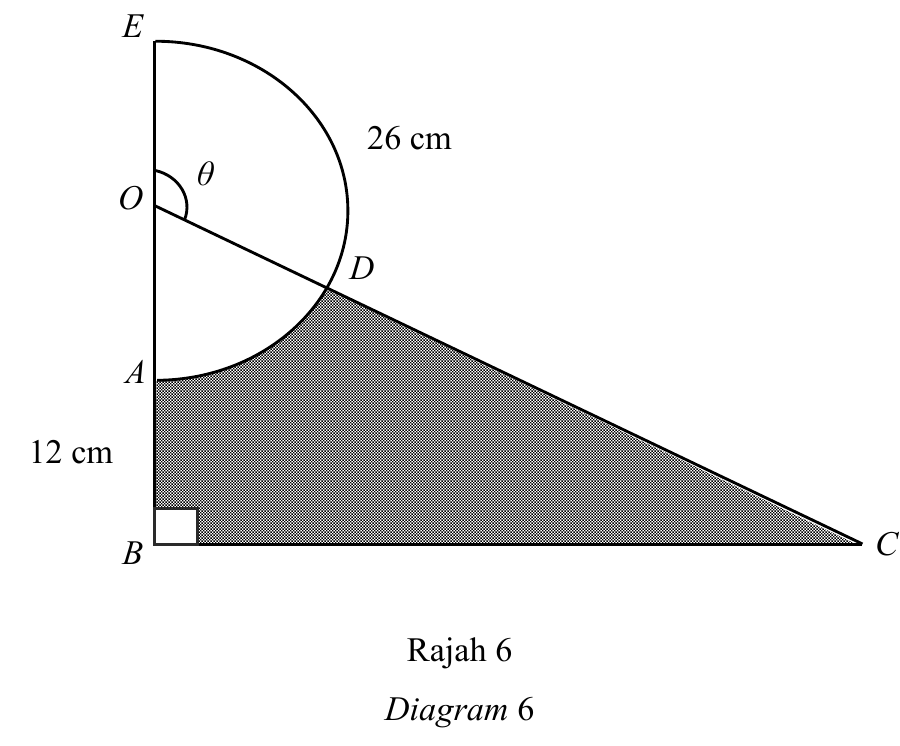
- (a)
Find the length, in cm, of BC.
[2] - (b)
Find the area, in cm², of the shaded region.
[4]
Diagram 7 shows a probability distribution graph for a random variable X ~ B(n, p). The vertical axis marks 1/16, 1/4 and 5/16. Find the value of (a) μ, (b) σ².
Easy5 marks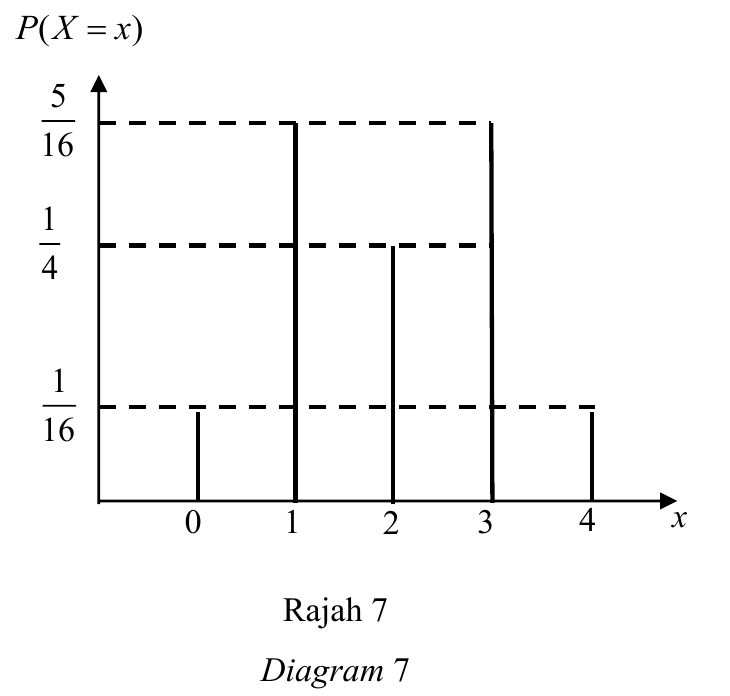
- (a)
Find the value of μ.
[3] - (b)
Find the value of σ².
[2]
(a) Ali wants to form a password using the letters 'ALI' and the digits 1, 9, 8 and 3. Repetition of letters and digits is not allowed. He wants to find the number of possible passwords if (i) the password consists of 5 characters, (ii) the password contains all the letters and two digits only. Which of the two methods is more secure as a password? Give your reasons. (b) Six letters from the word 'MARIAM' are arranged in a row without repetition. Find the number of words that can be formed if (i) there is no restriction, (ii) the vowels must be placed together.
Medium8 marks- (a)(i)
Number of passwords if the password consists of 5 characters.
[1] - (a)(ii)
Number of passwords if the password contains all the letters and two digits only.
[2] - (a)
Which method is more secure? Give your reasons.
[1] - (b)(i)
Number of words if there is no restriction.
[2] - (b)(ii)
Number of words if the vowels must be placed together.
[2]
Diagram 8 shows a folding fan OAB which encompasses two sectors, OHK and OPQ. Given OB = 21 cm, 7OK = 3OB. P and Q are the midpoints of AH and BK respectively.
Medium8 marks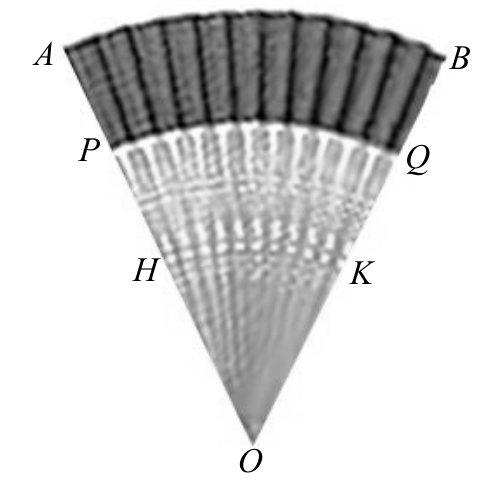
- (a)
Find ∠HOK, in radians, if HK = 8.4834 cm.
[2] - (b)
Determine the ratio of PQ to AB.
[3] - (c)
Calculate the difference in area between ABQP and PQKH.
[3]
Azman has a collection of books that he accumulates every month. The number of books increases every month following an arithmetic progression. The total number of books in the first six months is four times the number of books in the fifth month. (a) If d is the common difference, show that d = 2a, where a is the number of books in the first month. Then find d if the number of books in the first month is 3. (b) He decides to sell part of his book collection in the 10th month to buy a bicycle that costs RM1200. If he sells 30% of the total number of books accumulated in 10 months, with an average price of RM12.50 per book, can he buy the bicycle? Provide your justification.
Medium6 marks- (a)
Show that d = 2a. Then find d if a = 3.
[3] - (b)
Can he buy the bicycle costing RM1200? Provide your justification.
[3]
Section B
Given the function g: x → 2/(3 + 2x), x ≠ −3/2 and the function gf: x → 2/(2x² + 3). (a)(i) Find the object of g(x) if the image is 1/3. (ii) Given x maps to itself under the function g, find the possible values of x. (b)(i) Find f(x). (ii) Hence, determine whether the inverse function of f(x) exists or not. Give your justification.
Medium8 marks- (a)(i)
Find the object of g(x) if the image is 1/3.
[2] - (a)(ii)
Given x maps to itself under g, find the possible values of x.
[2] - (b)(i)
Find f(x).
[2] - (b)(ii)
Hence, determine whether the inverse function of f(x) exists. Give your justification.
[2]
(a) Given log₅ 3 = j and log₅ 4 = k, express log₅ 36 in terms of j and k. (b) Given that 9^a = √(3^b) = 3^c, find a : b : c. (c) Solve the simultaneous equations log₃ x − 2 log₉ y = 1 and log₂(4y + 2) + log₂(1/(2x)) = 2.
Medium8 marks- (a)
Express log₅ 36 in terms of j and k.
[2] - (b)
Given 9^a = √(3^b) = 3^c, find a : b : c.
[2] - (c)
Solve the simultaneous equations log₃ x − 2 log₉ y = 1 and log₂(4y + 2) + log₂(1/(2x)) = 2.
[4]
Table 1 shows the values of x for the equations y² + x² = 16 and 2y − x = 0. (a) Complete the values of y in Table 1. (b) Use the graph page provided. Using a scale of 2 cm to 1 unit on both axes, draw the graphs of y² + x² = 16 and 2y − x = 0 for −4 ≤ x ≤ 4. (c) Hence, state the values of y.
Medium8 marks- (a)
Complete the values of y in Table 1 (x = −4 to 4; rows y = √(16 − x²), y = −√(16 − x²), y = x/2).
[2]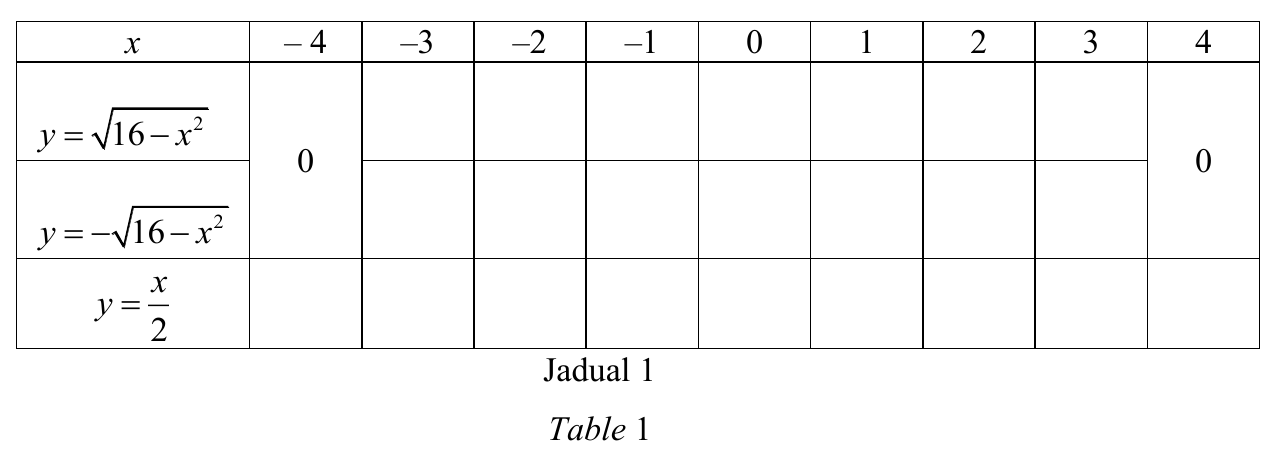
- (b)
Draw the graphs of y² + x² = 16 and 2y − x = 0 for −4 ≤ x ≤ 4 (scale 2 cm to 1 unit on both axes).
[5]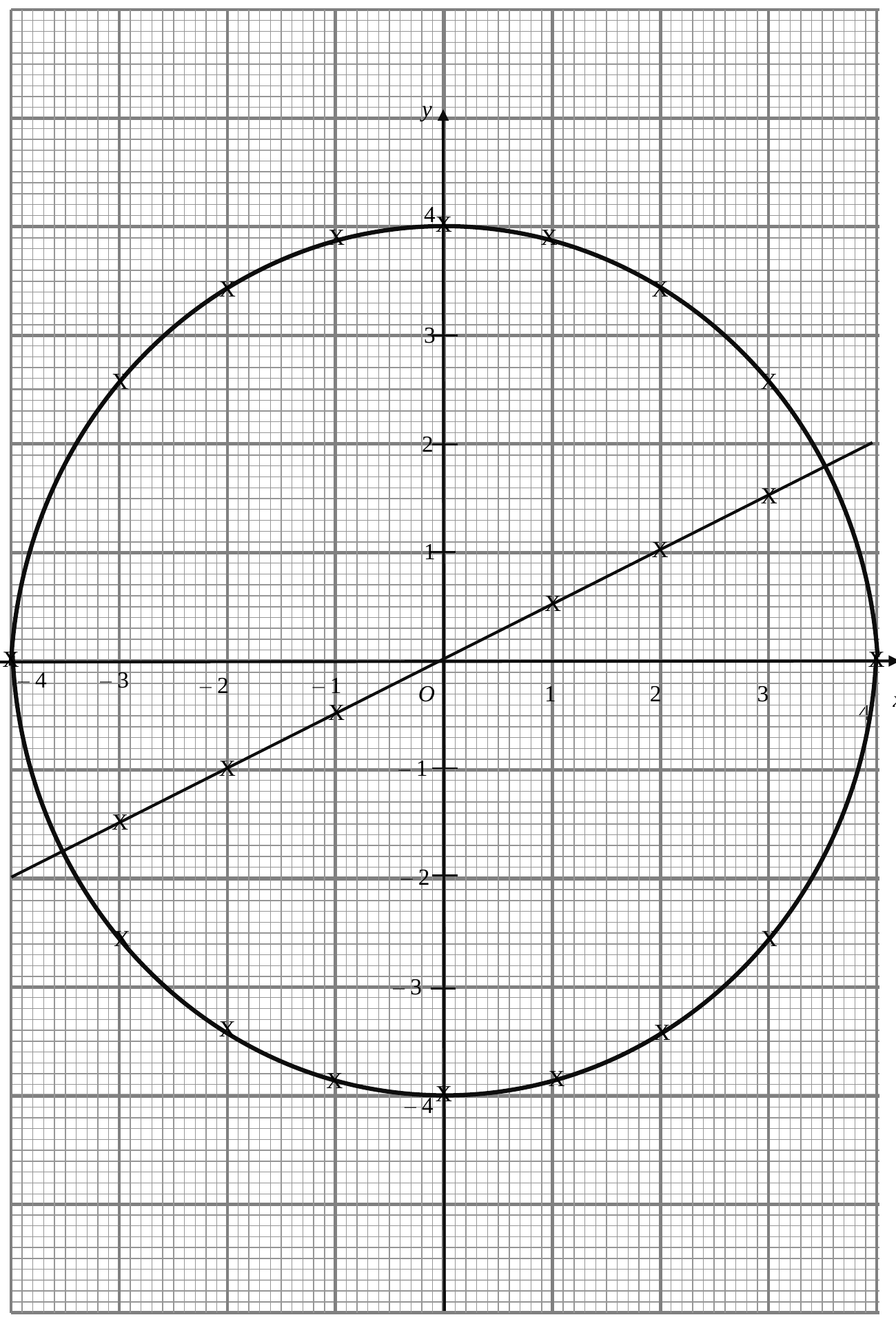
- (c)
Hence, state the values of y.
[1]