Write your answer on paper. Then open the answer to check it.
Section A
The line y = 16x − 5 is a tangent to the curve y = h(x) at the point (−2, −37). The gradient function is px² + 4, where p is a constant. Find (a) the value of p, (b) h(x).
Easy5 marks- (a)
Find the value of p.
[2] - (b)
Find h(x).
[3]
Diagram 2 shows an eight-oar rowing team. The boat is operated by a crew chosen from 6 men under 30 years old and 5 men over 30 years old. One man acts as coxswain (helmsman) and 8 men row. The diagram labels the Left Rowers, the Right Rowers and the Helmsman.
Medium7 marks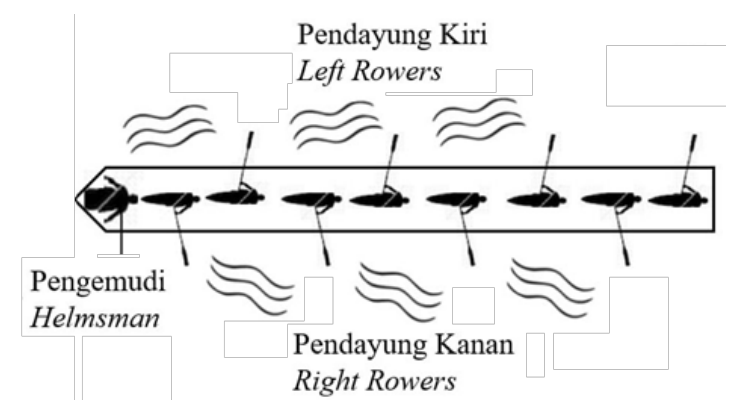
- (a)(i)
Prove that n!/n = (n − 1)!
[1] - (a)(ii)
Hence, find the number of ways for 6 members to sit at a round table during a dinner banquet.
[1] - (b)
Find the number of ways to select the crew if at least 3 players over 30 years old are required for this event.
[2] - (c)(i)
Find the number of ways to arrange 9 crews if there are no restrictions.
[1] - (c)(ii)
Find the number of ways to arrange 9 crews if 3 crews can act as coxswains but cannot row, while the others cannot act as coxswains and can only row. Of those who can row, 2 crews are only able to row on the right side.
[2]
In a survey, 35% of students from SMK Harmoni do not have a scientific calculator. A sample of 3 pupils is randomly selected from the school. X is the number of pupils who do not have a scientific calculator. (a) Complete the binomial probability distribution table (r = 0, 1, 2, 3; P(X = r) blank). (b) From the table, find the probability that (i) at most 2 pupils do not have a scientific calculator, (ii) all the pupils have a scientific calculator.
Easy6 marks- (a)
Complete the binomial probability distribution table for the number of pupils who do not have a scientific calculator. Table: r = 0, 1, 2, 3 with P(X = r) to be filled.
[3] - (b)(i)
Find the probability that at most 2 pupils do not have a scientific calculator.
[2] - (b)(ii)
Find the probability that all the pupils have a scientific calculator.
[1]
A straight line graph is obtained by plotting log₁₀ y against log₁₀ x. Given that the X-intercept and Y-intercept are 2 and 1 respectively. Express y in terms of x.
Easy4 marksExpress y in terms of x.
[4]
Given that log_a b = √5, find the value of 1/log_ab b − 1/log_ab a.
Medium4 marksFind the value of 1/log_ab b − 1/log_ab a.
[4]
Diagram 6 shows a unit circle drawn on a Cartesian plane, with point P(−h, k) on the circle and angle β measured at the origin from the positive y-axis to OP. (a) Show that sin²β + cos²β = 1. (b) Hence, determine through calculation whether the equation sin²x/(1 + cos x) = 2 has solutions in the domain 0 ≤ x ≤ 2π.
Medium5 marks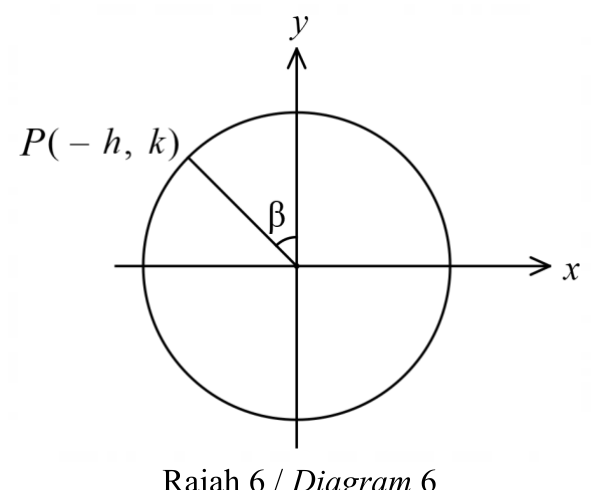
- (a)
Show that sin²β + cos²β = 1.
[2] - (b)
Hence, determine through calculation whether sin²x/(1 + cos x) = 2 has solutions in the domain 0 ≤ x ≤ 2π.
[3]
The quadratic equation 3x² − 4x + c = 0 has no real roots and c is a positive integer. (a) C₁ and C₂ are the two smallest values of c. State the possible values of C₁ and C₂. (b) Hence, if c is the difference between C₁ and C₂ in (a), determine the type of roots of 3x² − 4x + c = 0.
Easy4 marks- (a)
State the possible values of C₁ and C₂, the two smallest values of c.
[2] - (b)
Determine the type of roots of 3x² − 4x + c = 0 when c = C₂ − C₁.
[2]
Diagram 8 shows Cecilia kayaking in a lake. P is her starting point, A is the jetty and C is the rest house. PA = 5 km and PA is perpendicular to AC; AB = x km and AC = 6 km. She kayaks from P to B at 2 km/h, then walks from B to C at 4 km/h.
Medium6 marks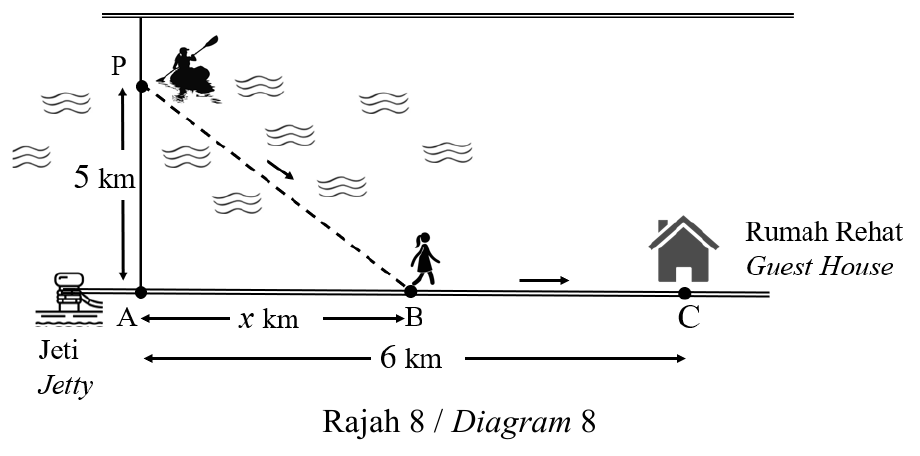
- (a)
Show that the time T, in hours, taken by Cecilia is T = (2√(25 + x²) + 6 − x)/4.
[2] - (b)
Using the tangent sketch method, prove that the time taken by Cecilia is the shortest time. (Answer in the table: x, dT/dx, sign of dT/dx, sketch of the tangent, sketch of the graph.)
[4]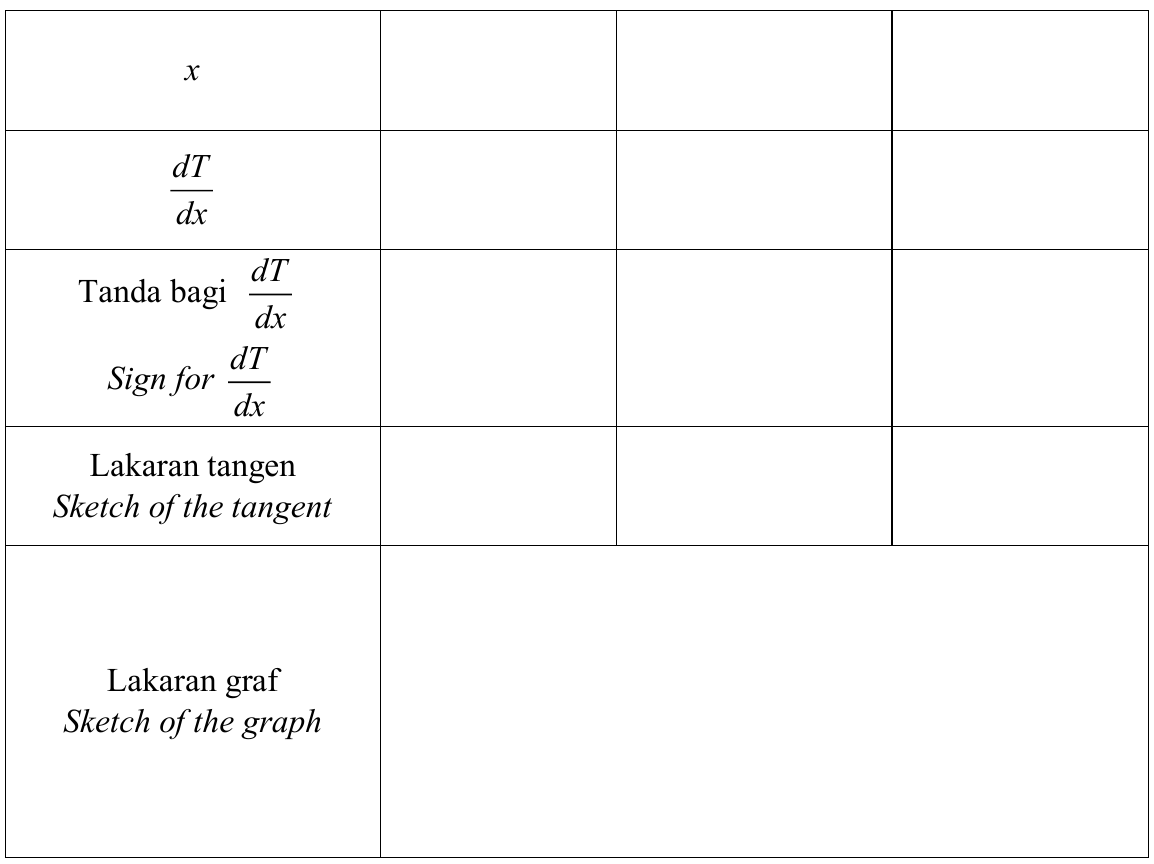
Solve the simultaneous equations by substitution and/or elimination: 4x − 3y + 2z = −5, 5x − y + 5z = 7, −4y + 3z + 6x = 9.
Easy5 marksSolve 4x − 3y + 2z = −5, 5x − y + 5z = 7, −4y + 3z + 6x = 9.
[5]
Solutions by scale drawing are not accepted. Diagram 10 shows two parallel lines AC and ED, with E(2, 3), D(6, 9), A(4, −4); B lies on AC and on the locus of P (dashed line). The point P(x, y) moves such that it is always equidistant from E and D. (a) Find the equation of the locus of P. (b) Find the equation of the line AC. (c) Hence, find the coordinates of B.
Medium6 marks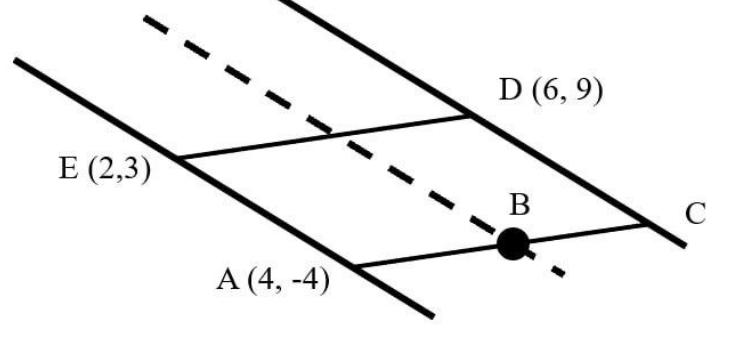
- (a)
Find the equation of the locus of the moving point P.
[2] - (b)
Find the equation of the line AC.
[2] - (c)
Hence, find the coordinates of B.
[2]
Diagram 11 shows a circular Golden Jubilee Park KATBL with centre O and radius 6 m. KOL is an arc of a circle with centre T. AB is parallel to KL and AB = 6 m. The shaded region KLBA is the main stage; the area above KL is the front stage and the area below AB is behind the stage. (a) Find ∠AOB. (b) Calculate the area, in m², behind the stage.
Medium5 marks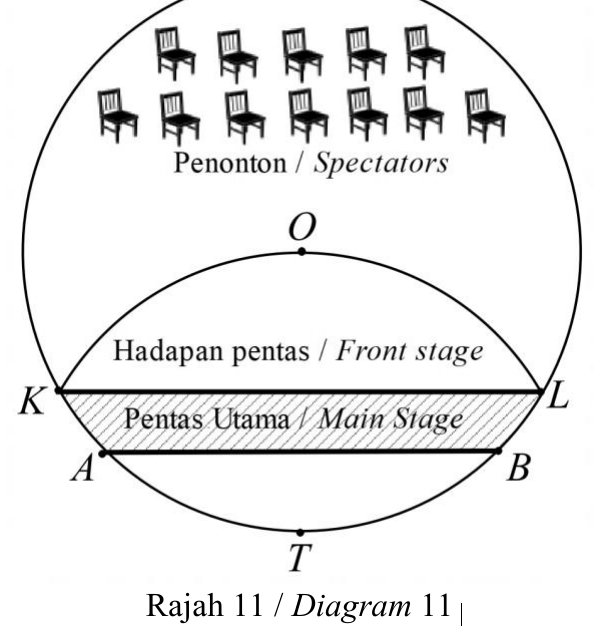
- (a)
Find ∠AOB.
[1] - (b)
Calculate the area, in m², behind the stage.
[4]
Given that f(x) = p − 3x and gf(x) = x. (a) Find the value of p, if g(2) = 5. (b) Sketch the graph of y = f(x) for 0 ≤ x ≤ 6. Hence, by using the horizontal line test, give your justification that the inverse function of f(x) exists.
Medium7 marks- (a)
Find the value of p, if g(2) = 5.
[4] - (b)
Sketch the graph of y = f(x) for 0 ≤ x ≤ 6. Hence, by using the horizontal line test, justify that the inverse function of f(x) exists.
[3]
Section B
Diagram 13 shows four consecutive terms of a progression: …, m², m⁴, m⁶, m⁸, …. (a) State whether the sequence is a geometric progression or an arithmetic progression. Give your justification. (b) In 2025, two palm oil factories, Factory A and Factory B, process 5200 and 4500 metric tons of palm oil respectively. The amount decreases following a geometric progression: Factory A decreases by 12% and Factory B by 9% each year. In which year will the amount in Factory A be less than that in Factory B for the first time?
Medium8 marks- (a)
State whether the sequence is a geometric progression or an arithmetic progression. Give your justification.
[2] - (b)
In which year will the metric tons in Factory A be less than in Factory B for the first time?
[6]
The differentiation method is not accepted for this question. Diagram 14 gives the annual profit function U(x) = −2x² + 16x − 24 (in millions of Malaysian Ringgit) of a company that sells an AI technology product, where x is the selling price (in thousands of Malaysian Ringgit). (a) Determine the range of selling prices for the company to avoid incurring losses. (b) Find the optimal selling price and the expected maximum annual profit.
Medium8 marks- (a)
Determine the range of selling prices for the company to avoid incurring losses.
[4] - (b)
Find the optimal selling price and the expected maximum annual profit.
[4]
Diagram 15 shows roads of a residential area forming rectangle OABC. The surau S is on road OB, the public hall R is on road OA, and the police outpost P is on AB extended with AB = 2BP. Given OA→ = 4x, OC→ = 4y, OS→ = 3x + 3y, OR = RA and OS : OB = m : n. (a) Express in terms of x and y (i) RS→, (ii) OP→. (b) Find the ratio m : n. (c) Prove that R, S and P lie on the same straight line.
Medium8 marks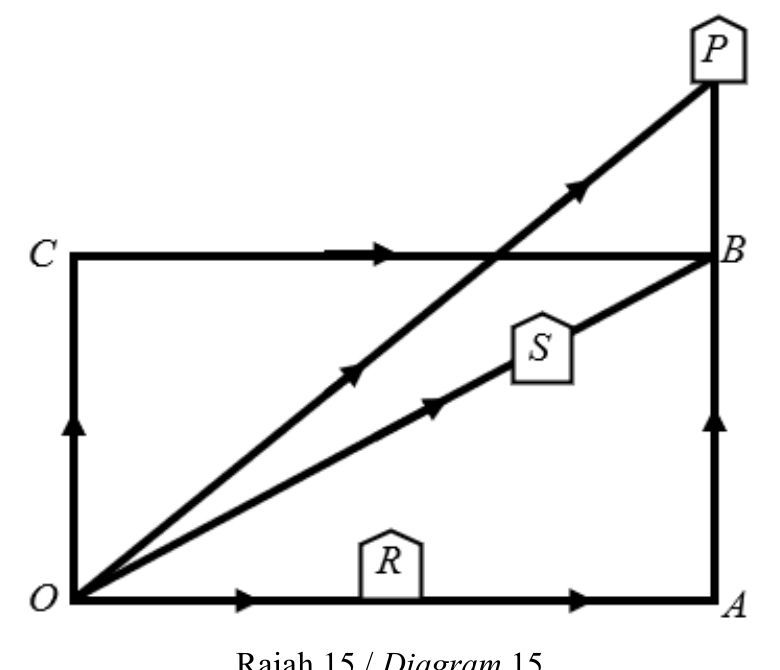
- (a)(i)
Express RS→ in terms of x and y.
[2] - (a)(ii)
Express OP→ in terms of x and y.
[1] - (b)
Find the ratio m : n.
[3] - (c)
Prove that R, S and P lie on the same straight line.
[2]