Write your answer on paper. Then open the answer to check it.
Section A
(a) Rationalise the denominator and simplify 5/(√5 − 5). (b) Given 2^(4x) = r, 2^y = s and 4^(2x+y) = 7 + 16^x, express r in terms of s.
Easy5 marks- (a)
Rationalise the denominator and simplify 5/(√5 − 5).
[2] - (b)
Given 2^(4x) = r, 2^y = s and 4^(2x+y) = 7 + 16^x, express r in terms of s.
[3]
Given the function f(x) = 3x + 2c, where c is a constant. (a) Express c in terms of k when f(k − 1) = 5c. (b) Determine the value of c if (i) the image of the function is always three times its object under the mapping of f(x), (ii) f⁻¹(c + 1) = c − 1.
Easy5 marks- (a)
Express c in terms of k when f(k − 1) = 5c.
[2] - (b)(i)
Determine the value of c if the image is always three times its object under f(x).
[1] - (b)(ii)
Determine the value of c if f⁻¹(c + 1) = c − 1.
[2]
At the start of 2020, Farah invested RM1 500 in a savings scheme that gives annual dividends of 8%. Each year, Farah reinvested the original investment together with all the dividends she received. Calculate (a) the ratio of Farah's investment at the start of 2021 to her investment at the start of 2020, (b) the year when Farah's investment exceeds RM2 500 for the first time.
Easy5 marks- (a)
Find the ratio of the investment at the start of 2021 to that at the start of 2020.
[2] - (b)
Find the year when the investment exceeds RM2 500 for the first time.
[3]
It is given that the curve y = 2x(3 − x)⁴ passes through the point Q(2, 4). Find (a) the gradient of the tangent to the curve at point Q, (b) the equation of the normal to the curve at point Q.
Medium7 marks- (a)
Find the gradient of the tangent to the curve at Q(2, 4).
[4] - (b)
Find the equation of the normal to the curve at Q.
[3]
Diagram 1 shows seven letter cards: B, R, I, G, H, T, S. A five-letter code is to be formed using five of these cards. Find (a) the number of different five-letter codes that can be formed, (b) the number of different five-letter codes which begin with a vowel and end with a consonant.
Easy4 marks
- (a)
Find the number of different five-letter codes that can be formed.
[1] - (b)
Find the number of different five-letter codes which begin with a vowel and end with a consonant.
[3]
85% of the customers in a supermarket enjoy vanilla ice cream. A sample of n customers is randomly selected from the supermarket. (a) If the probability that all the selected customers enjoy vanilla ice cream is 0.1038, find the value of n. (b) Based on the answer in (a), find the probability that there are less than three customers who enjoy vanilla ice cream.
Easy6 marks- (a)
Find n if the probability that all n selected customers enjoy vanilla ice cream is 0.1038.
[3] - (b)
Find the probability that less than three customers enjoy vanilla ice cream.
[3]
Diagram 2 shows the trajectory of a kicked football which follows a parabolic curve. The ball is kicked from the ground; the maximum height is 2 m and the horizontal distance from the kick to where the ball lands is 8 m. Given that the horizontal distance from where the ball is kicked is x m and the height of the ball from the ground is y m, express the trajectory in the form y = a(x − h)² + k.
Easy4 marks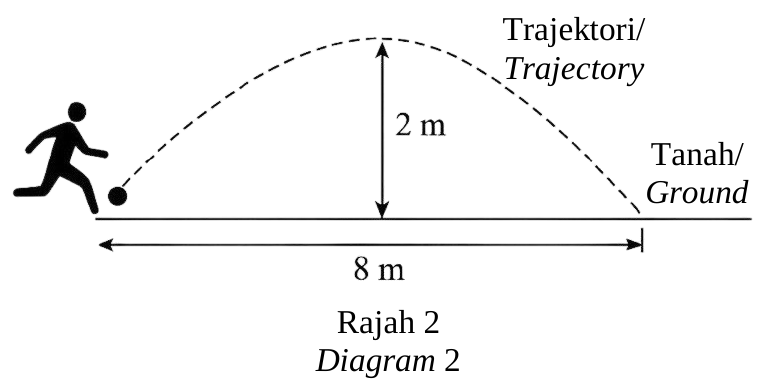
Express the trajectory in the form y = a(x − h)² + k.
[4]
It is given that tan A = 5/12 and tan B = −8/15, such that A is an acute angle and B is a reflex angle. Find (a) sin(A + B), (b) tan(A − B).
Medium5 marks- (a)
Find sin(A + B).
[3] - (b)
Find tan(A − B).
[2]
The position vectors of S, T and U are i + j, 3i − 2j and 6i + kj respectively. Find (a) the vector ST→ in the form xi + yj, (b) the value of k if TU→ is parallel to the x-axis.
Easy5 marks- (a)
Find ST→ in the form xi + yj.
[2] - (b)
Find k if TU→ is parallel to the x-axis.
[3]
(a) Given ∫ from 1 to m of (2x − 6) dx = −4, find the value of m. (b) Diagram 3 shows the straight-line graph obtained by plotting (y − x) against x². The line cuts the (y − x)-axis at 6 and the x²-axis at −2. Express y in terms of x.
Medium6 marks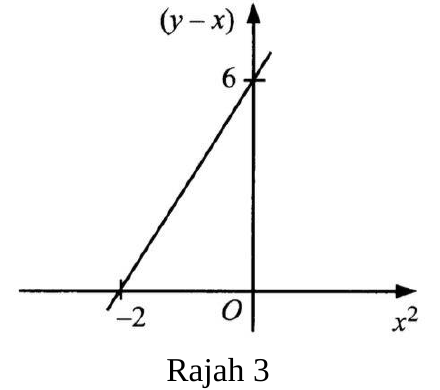
- (a)
Given ∫₁ᵐ (2x − 6) dx = −4, find the value of m.
[3] - (b)
From the graph of (y − x) against x², express y in terms of x.
[3]
Diagram 4 shows a T-junction without traffic lights. The roads travelled by car N and car M are represented by the equations y = 2x + 6 and y = −x/2 + 10. Car N moves at a speed of 60 km h⁻¹ while car M moves at a speed of 30 km h⁻¹ at the same time from a junction. If car M does not stop and continues to turn right when it arrives at the junction, find (a) the coordinates of the collision point between car N and car M, (b) the distance between car N and the collision point if the coordinates of car M are (10, 0).
Medium6 marks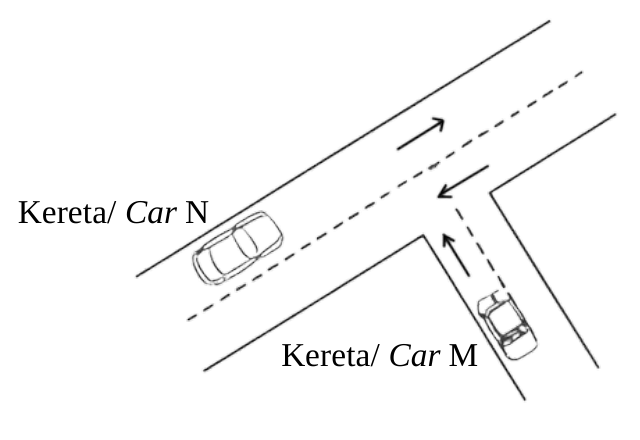
- (a)
Find the coordinates of the collision point.
[2] - (b)
Find the distance between car N and the collision point if car M is at (10, 0).
[4]
(a) Given h = 3x − 2 and k = x² − 1, find the value of dk/dh when x = 2. (b) Diagram 5 shows a closed box with a square base of side x cm and height h cm, with a total surface area of 216 cm². Find the value of x when its volume is maximum.
Medium6 marks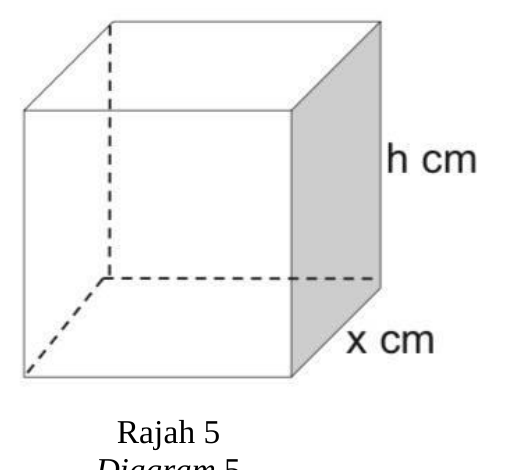
- (a)
Find dk/dh when x = 2.
[3] - (b)
Find x when the volume of the box is maximum.
[3]
Section B
Diagram 6 shows the graph of the absolute function g(x) = |2x − 3| + m for the domain 0 ≤ x ≤ 4 (the graph cuts the y-axis at 2 and has its minimum point at y = −1). (a) State the value of m. (b) Find the x-intercept of the graph. (c) Find the domain of g(x) ≤ 1. (d) Find the value of x that is mapped onto itself in the given domain.
Medium8 marks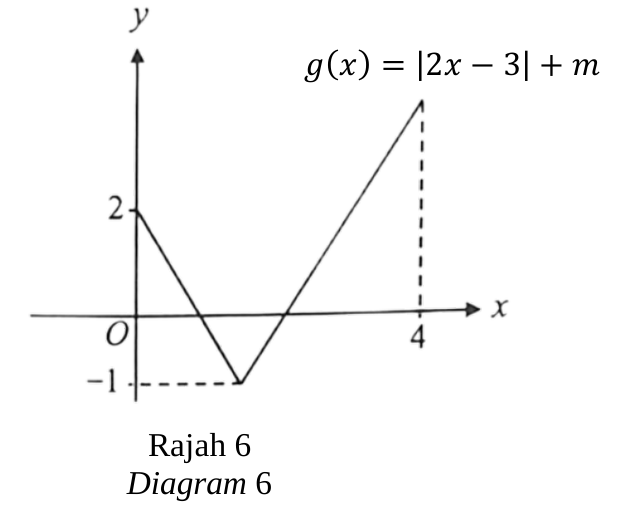
- (a)
State the value of m.
[1] - (b)
Find the x-intercept of the graph.
[3] - (c)
Find the domain of g(x) ≤ 1.
[2] - (d)
Find the value of x that is mapped onto itself.
[2]
Diagram 7 shows the curve y = 36 − x² and the straight line EFG is tangent to the curve at point F (where x = 2). G is the point (p, 0) on the x-axis. (a) Find (i) the equation of straight line EFG, (ii) the value of p. (b) Calculate the area of the shaded region.
Medium8 marks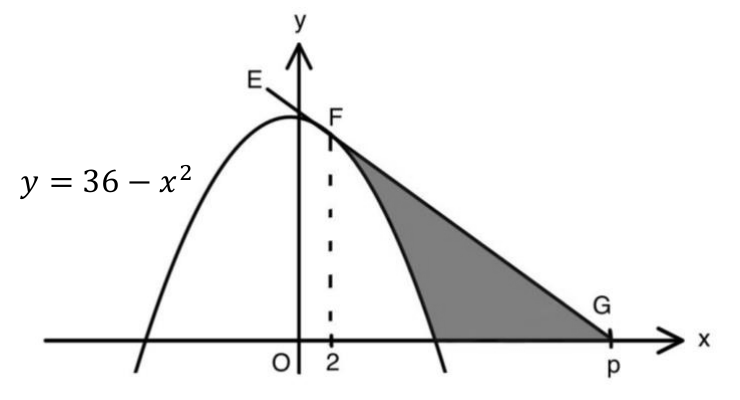
- (a)(i)
Find the equation of straight line EFG.
[3] - (a)(ii)
Find the value of p.
[1] - (b)
Calculate the area of the shaded region.
[4]
Diagram 8 shows two straight lines on a Cartesian plane. The straight lines AB and BC are perpendicular to each other. The line AB is y = −2x + 3 and A lies on the line x = k. Given that the coordinates of C are (k, 0), find (a) the value of k, (b) the coordinates of A, (c) the area of triangle ABC, (d) the equation of the locus of S if the point S moves such that its distance from point B is always the same as the distance between point B and point C.
Medium8 marks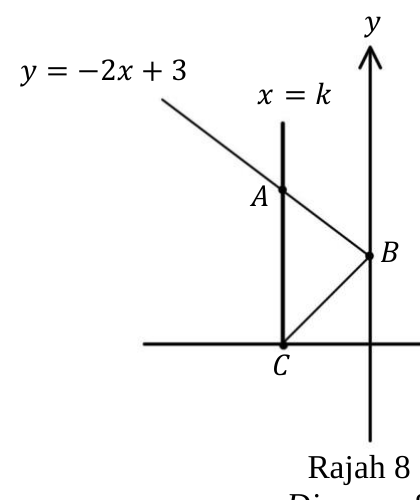
- (a)
Find the value of k.
[2] - (b)
Find the coordinates of A.
[1] - (c)
Find the area of triangle ABC.
[2] - (d)
Find the equation of the locus of S.
[3]