Write your answer on paper. Then open the answer to check it.
Section A
Diagram 1 shows a sector AOB with centre O and radius 10 cm, and angle AOB = 1.501 rad. D and C are the midpoints of OA and OB respectively. [Use π = 3.142] Find (a) the perimeter, in cm, of the shaded region, (b) the area, in cm², of the shaded region. (The shaded region is the sector AOB with triangle ODC removed.)
Medium6 marks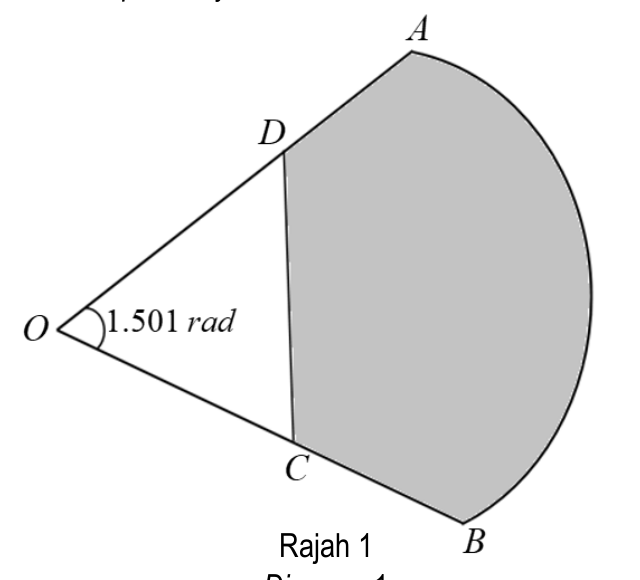
- (a)
Find the perimeter, in cm, of the shaded region.
[3] - (b)
Find the area, in cm², of the shaded region.
[3]
(a) It is given that ∫ from 3m − n to m + 5 of y dx = 0. Express m in terms of n. (b) Diagram 2 shows a part of the curve y = (x − 1)² + 1 and a straight line PQ such that P and Q have coordinates (0, 2) and (k, 2) respectively. (i) Determine the value of k. (ii) Calculate the volume generated when the shaded region is revolved through 360° about the x-axis.
Medium8 marks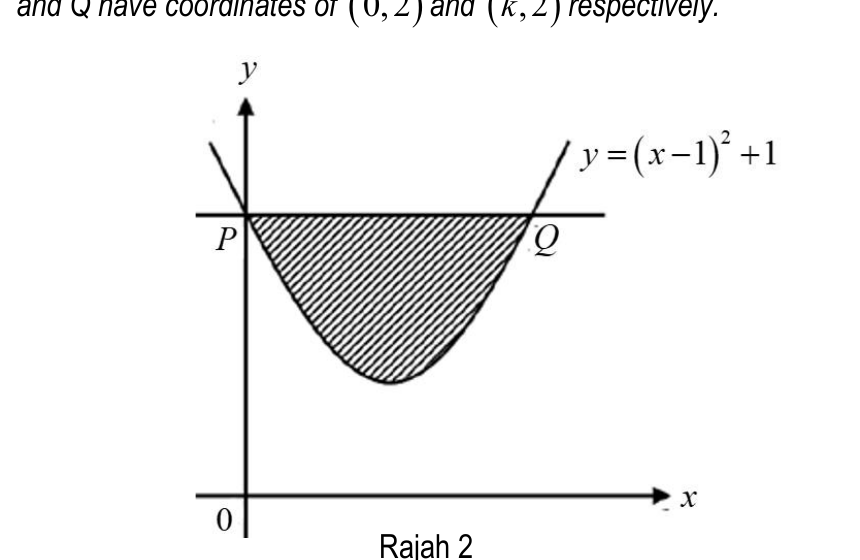
- (a)
Express m in terms of n.
[2] - (b)(i)
Determine the value of k.
[1] - (b)(ii)
Calculate the volume generated when the shaded region is revolved through 360° about the x-axis.
[5]
Solve the following equations by using the elimination method: p − q = 2, p² + 4pq = 8. Give your answers correct to three significant figures.
Easy5 marksSolve p − q = 2 and p² + 4pq = 8 by elimination. Give answers to 3 significant figures.
[5]
The quadratic function f(x) = 2x² − 6x + 7 has roots α and β. (a) Form a quadratic equation g(x) with roots 3α + 1 and 3β + 1. Hence, by using the method of completing the square, express the equation in vertex form. (b) If |x| > h is the solution of the inequality f(x) + 6x > x² + 16, where h is a constant, find the value of h.
Hard8 marks- (a)
Form the quadratic equation with roots 3α + 1 and 3β + 1, then write it in vertex form by completing the square.
[5] - (b)
If |x| > h is the solution of f(x) + 6x > x² + 16, find h.
[3]
Diagram 3 shows triangle RST with T(8, 7), R(−2, 5) and M(2, 1). The straight line TS is perpendicular to the straight line PR. The straight lines TM and PR intersect at point N. Given that TN : TM = 2 : 3, find (a) the coordinates of N, (b) the equation of the straight line TS, (c) the equation of the locus of a moving point K such that its distances from points T and R are in the ratio 3 : 2.
Medium8 marks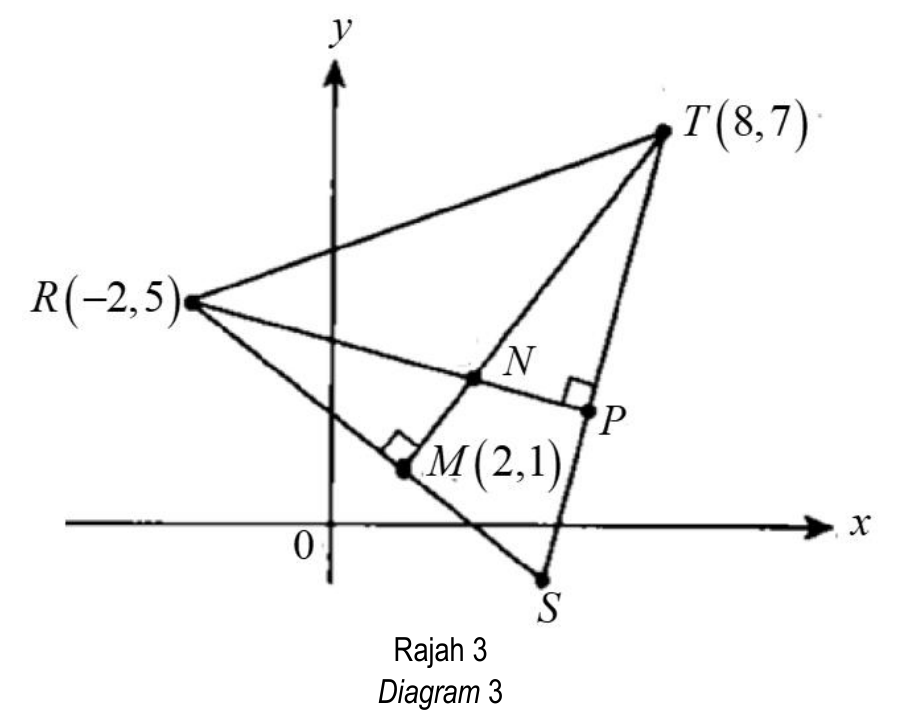
- (a)
Find the coordinates of N.
[2] - (b)
Find the equation of the straight line TS.
[3] - (c)
Find the equation of the locus of K such that KT : KR = 3 : 2.
[3]
(a) Given y = (x − 4)³. (i) Find dy/dx when y = 8. (ii) Hence, calculate the small change in x when y increases from 8 to 8.2. (b) The volume of a hemisphere is decreasing at a constant rate of 1.02π cm³ s⁻¹. Find the radius of the hemisphere at the instant when the radius is decreasing at a rate of 0.1 cm s⁻¹.
Medium7 marks- (a)(i)
Find dy/dx when y = 8.
[2] - (a)(ii)
Hence, find the small change in x when y increases from 8 to 8.2.
[2] - (b)
Find the radius when the radius is decreasing at 0.1 cm s⁻¹ and the volume at 1.02π cm³ s⁻¹.
[3]
Farhana joins a fitness program and records the number of exercise steps she takes each month. The number of steps she takes increases every month following a geometric progression. The total number of steps in the first four months is ten times the total number of steps in the first two months. (a) If r represents the common ratio, show that r⁴ − 10r² + 9 = 0. Hence, find the positive value of r. (b) Calculate the total calories burned by Farhana over the six months if she starts with 2000 steps in the first month and burns an average of 0.05 calories per step.
Medium8 marks- (a)
Show that r⁴ − 10r² + 9 = 0 and find the positive value of r.
[5] - (b)
Calculate the total calories burned over six months.
[3]
Section B
Diagram 4 shows quadrilateral OPQR. Diagonal OQ and diagonal PR intersect at point S. It is given that OR→ = −3x, RQ→ = 6y and PQ→ = y − 2x. (a) Express the following vectors in terms of x and y: (i) OQ→, (ii) RP→. (b) If the points O, S and Q are collinear, RS = 2SP and OS : SQ = k : h, find the value of h and of k. (c) Given that x = 3i + 2j and y = i + 2j, find the unit vector in the direction of OQ→.
Hard10 marks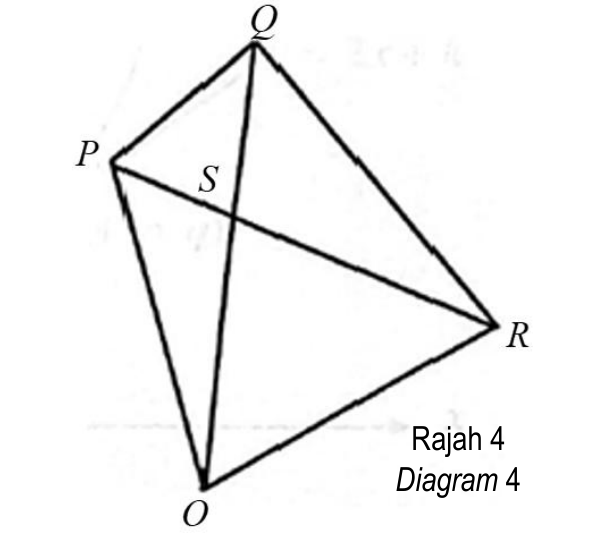
- (a)(i)
Express OQ→ in terms of x and y.
[2] - (a)(ii)
Express RP→ in terms of x and y.
[1] - (b)
Find h and k when O, S, Q are collinear, RS = 2SP and OS : SQ = k : h.
[5] - (c)
Find the unit vector in the direction of OQ→.
[2]
(a) The Environmental Association at SMK Sri Tanjung conducted a survey on the lifespan of certain trees. A sample of 4 trees was randomly selected. Diagram 5 shows the probability distribution P(X = r), where X is the number of trees with a lifespan of less than 5 years: P(X = 0) = 0.03k, P(X = 1) = k/25, P(X = 2) = 0.20, P(X = 3) = 0.35, P(X = 4) = 2k/25. (i) Find the value of k. (ii) Find the probability that more than 3 trees have a lifespan of less than 5 years. (iii) Find the probability that at most 2 trees have a lifespan of less than 5 years. (b) The Additional Mathematics end-of-year examination marks of 120 students at SMK Sri Tanjung are normally distributed with a mean of 86 and a standard deviation of 10. (i) Represent the probability that a randomly selected student scores between 80 and 90 by sketching a graph of the standard normal distribution. (ii) Students whose marks are not less than 80 will be selected to join a Mathematics quiz. Calculate the number of students selected. [Normal distribution table on the last page of the paper.]
Medium10 marks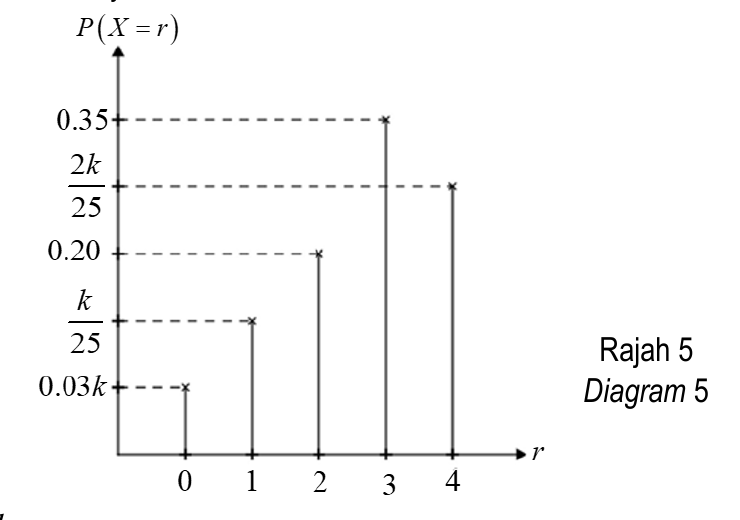
- (a)(i)
Find the value of k.
[2] - (a)(ii)
Find P(X > 3).
[1] - (a)(iii)
Find P(X ≤ 2).
[2] - (b)(i)
Sketch the standard normal graph representing P(80 ≤ X ≤ 90).
[2]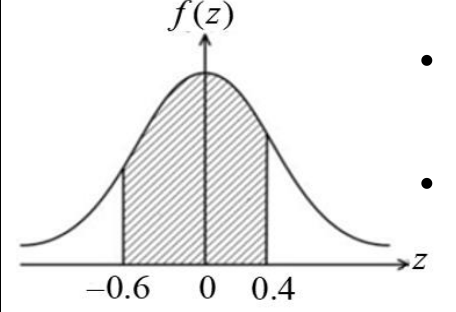
- (b)(ii)
Calculate the number of students with marks not less than 80.
[3]
Use graph paper to answer this question. Table 1 shows the corresponding values of two variables, x and y, obtained from an experiment. The variables x and y are related by the equation y = e^(2qx)/p, where p and q are constants and e is the exponential constant. Table 1: x = 0.1, 0.2, 0.3, 0.4, 0.5, 0.6; y = 0.78, 2.23, 6.05, 18.18, 54.60, 148.42. (a) Plot ln y against x, using a scale of 2 cm to 0.1 unit on the x-axis and 2 cm to 1 unit on the ln y-axis. Hence, draw a line of best fit. (b) By using the graph in (a), find (i) the value of x when y = e^3.2, (ii) the value of p and of q.
Medium10 marks
- (a)
Plot ln y against x (2 cm to 0.1 on the x-axis, 2 cm to 1 unit on the ln y-axis) and draw the line of best fit.
[4]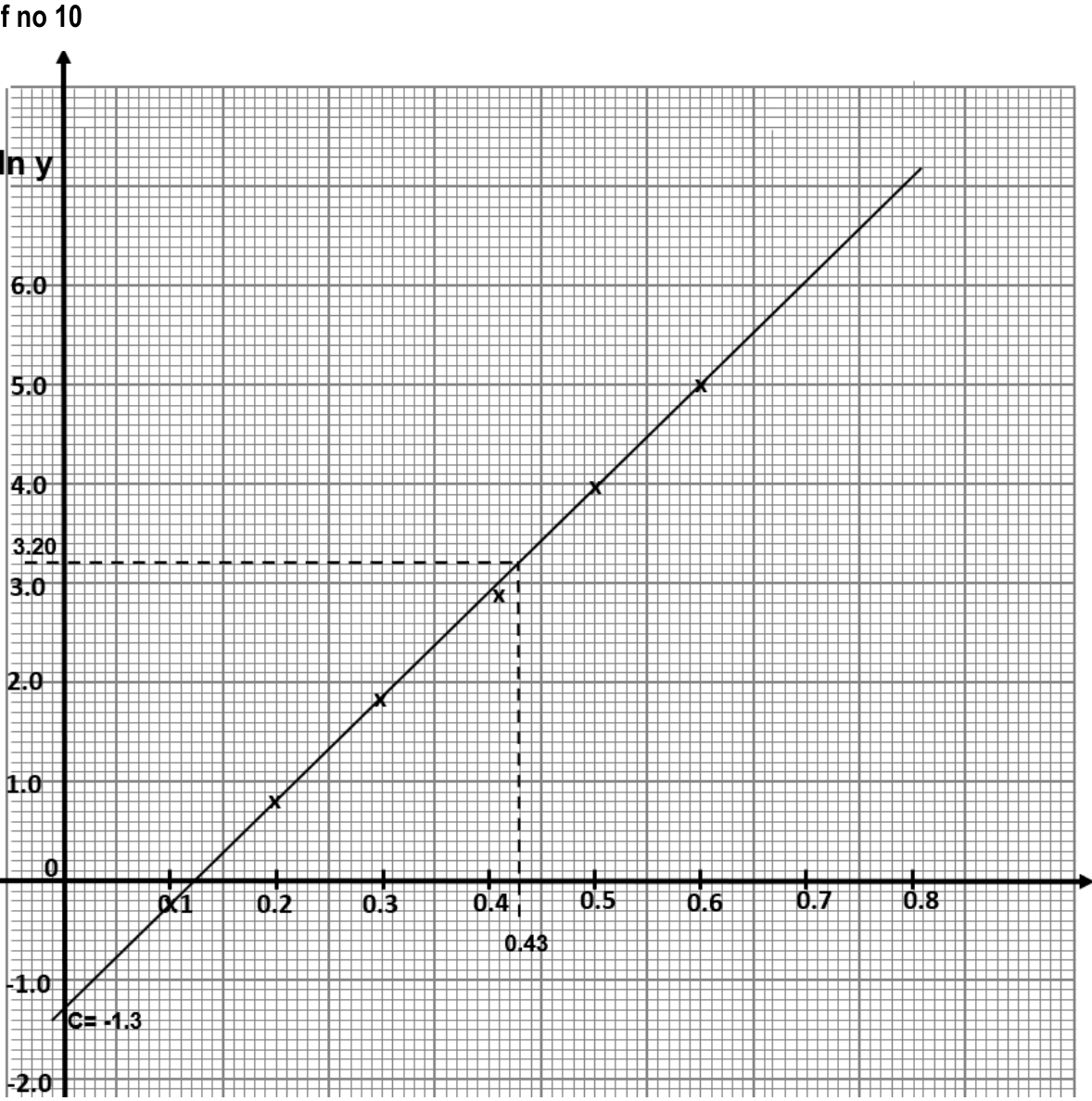
- (b)(i)
Find the value of x when y = e^3.2.
[1] - (b)(ii)
Find the value of p and of q.
[5]
(a) (i) Prove that 2 cot x sin²x = sin 2x. (ii) Hence, solve the equation cot x sin²x = 1/4 for 0 ≤ x ≤ 2π. (b) Given f(x) = m sin nx + p for 0° ≤ x ≤ 360°. If the amplitude of the graph is 4, its period is 120° and the minimum value of f(x) is −3, state the values of m, n and p. Hence, sketch the graph of the function.
Medium10 marks- (a)(i)
Prove that 2 cot x sin²x = sin 2x.
[2] - (a)(ii)
Hence, solve cot x sin²x = 1/4 for 0 ≤ x ≤ 2π.
[3] - (b)
State m, n and p, then sketch the graph of f(x) = m sin nx + p.
[5]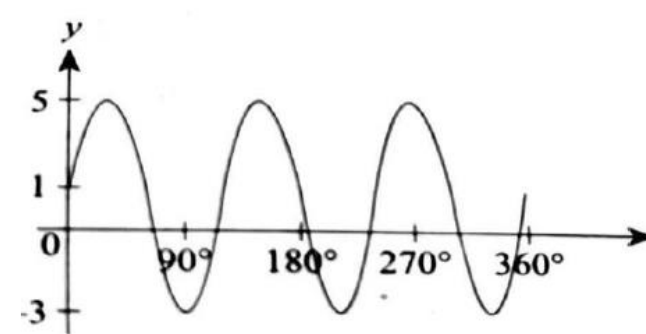
Section C
Table 2 shows information related to four main ingredients and the recipe used in 100 g by Arissa to prepare a type of pudding. Ingredient P: price per kg RM2.50 (2024), RM2.85 (2025), price index in 2025 = 114 (2024 = 100), recipe m g. Q: RM6.00, RM7.80, index a, recipe 8 g. R: RM3.00, RM b, index 150, recipe 4 g. S: RM c, RM8.20, index 113, recipe 16 g. (a) Find the value of a, of b and of c. (b) Calculate the composite index for the cost of making the pudding in the year 2025 based on the year 2024. (c) In the year 2024, Arissa sold a pack of pudding at RM11.50 with a profit of 20%. Calculate the selling price of a pack of pudding if Arissa wants to obtain a profit of 25% in the year 2025.
Medium10 marks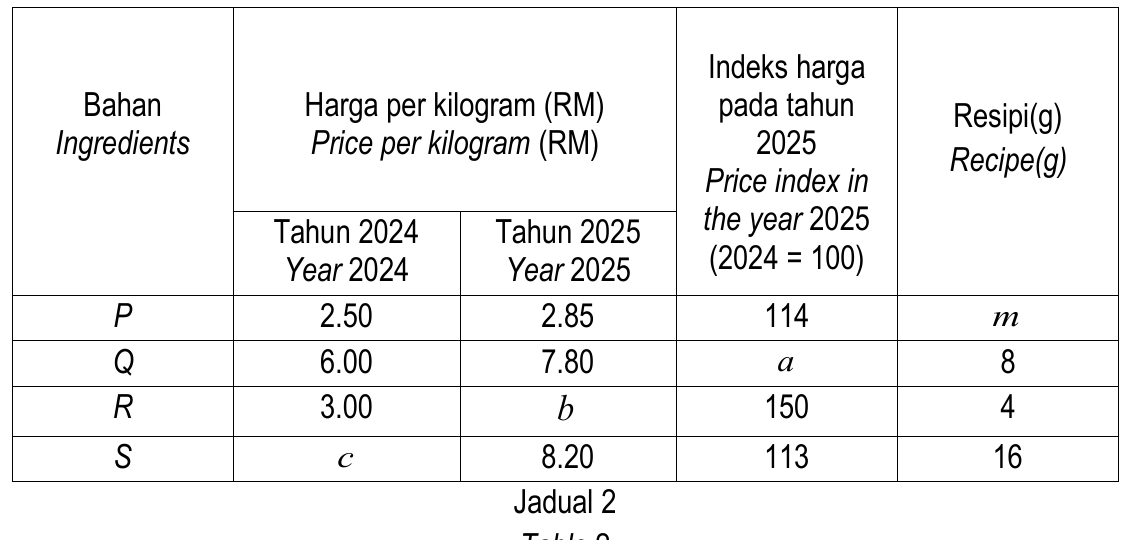
- (a)
Find a, b and c.
[3] - (b)
Calculate the composite index for 2025 (2024 = 100).
[3] - (c)
Find the selling price of a pack in 2025 for a profit of 25%.
[4]
Solution by graph sketching is not accepted. A particle moves along a straight line with its velocity, v m s⁻¹, given by v = t(h − kt), where t is the time in seconds after passing a fixed point O, while h and k are constants. The particle stops momentarily when t = 2 s and its distance at that time is 4 m to the right of O. [Assume motion to the right is positive] (a) Find the value of h and of k. (b) By using the values of h and k in (a), (i) find the value of t when the particle passes the point O again, (ii) sketch the velocity-time graph of the motion of the particle for 0 ≤ t ≤ 3, (iii) find the total distance travelled by the particle in the first three seconds.
Medium10 marks- (a)
Find h and k.
[3] - (b)(i)
Find t when the particle passes O again.
[2] - (b)(ii)
Sketch the velocity-time graph for 0 ≤ t ≤ 3.
[2]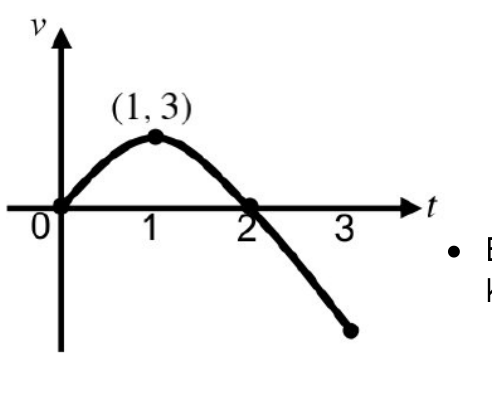
- (b)(iii)
Find the total distance travelled in the first three seconds.
[3]
Diagram 6 shows a circle with radius 7 cm centred at O. The angle PQR is an obtuse angle and angle QPR = 25°. Given the length of chord PQ = 8.14 cm, (a) (i) find the length in cm of chord QR, (ii) hence, find the area of triangle OQR by using Heron's formula. (b) Given that the area of triangle PQR is 20.98 cm², calculate ∠PQR. (c) Sketch a triangle P′Q′R′ which has a different shape from triangle PQR such that Q′R′ = QR, P′Q′ = PQ and ∠Q′P′R′ = ∠QPR. Hence, find the value of ∠Q′R′P′.
Medium10 marks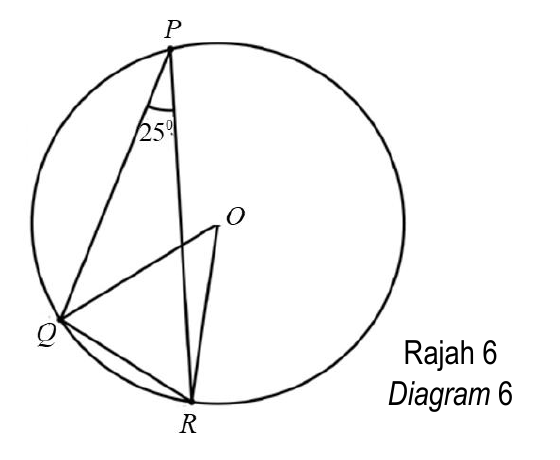
- (a)(i)
Find the length of chord QR in cm.
[2] - (a)(ii)
Find the area of triangle OQR by Heron's formula.
[3] - (b)
Given the area of triangle PQR is 20.98 cm², calculate ∠PQR.
[2] - (c)
Sketch triangle P′Q′R′ (different shape, Q′R′ = QR, P′Q′ = PQ, ∠Q′P′R′ = ∠QPR) and find ∠Q′R′P′.
[3]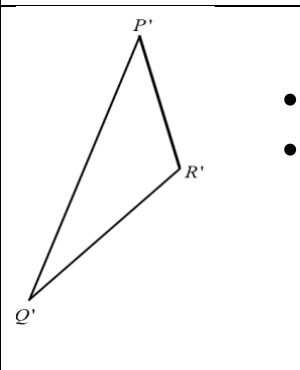
Use the graph paper provided to answer this question. Mak Siti buys x kg of shrimp and y kg of squid at a wholesale market. The price of shrimp and squid is RM25.00 per kg and RM20.00 per kg respectively. The purchase is based on three constraints, two of which are: I The mass of squid is not more than 3 times the mass of shrimp. II The total amount of shrimp and squid purchased is RM800 or more. (a) Write two inequalities, other than x ≥ 0 and y ≥ 0, which satisfy the two constraints. (b) The third constraint is represented by the coloured region on the graph on page 31. Write in words the constraint. (c) Use the graph on page 31. Hence, construct and shade the region R which satisfies all the above constraints. (d) By using the graph constructed in 15(c), find (i) the minimum mass of shrimp purchased if 20 kg of squid is purchased, (ii) the maximum amount of money paid by Mak Siti.
Medium11 marks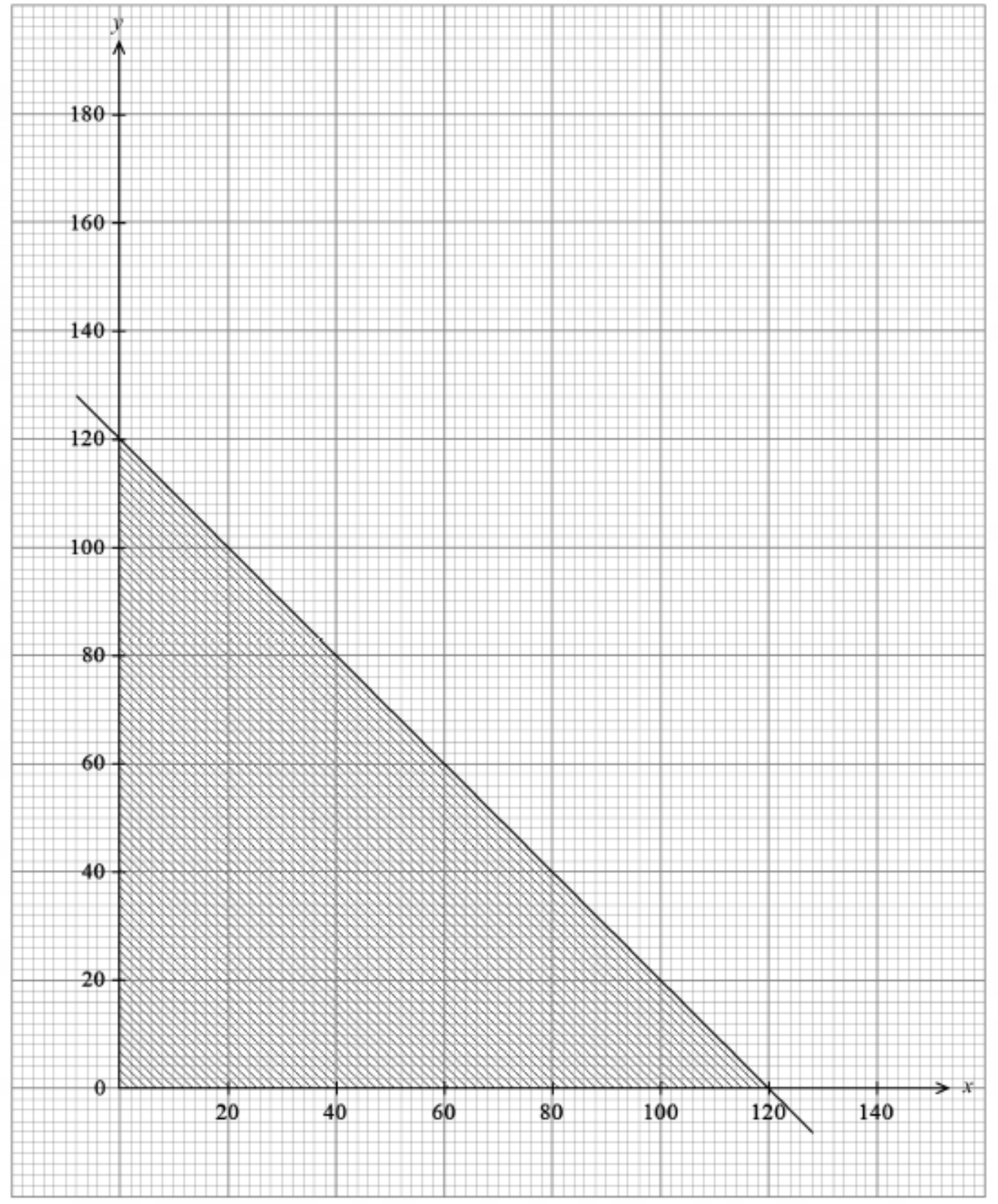
- (a)
Write the two inequalities for constraints I and II.
[2] - (b)
Write in words the third constraint (coloured region).
[1] - (c)
Construct and shade the region R which satisfies all the constraints.
[3]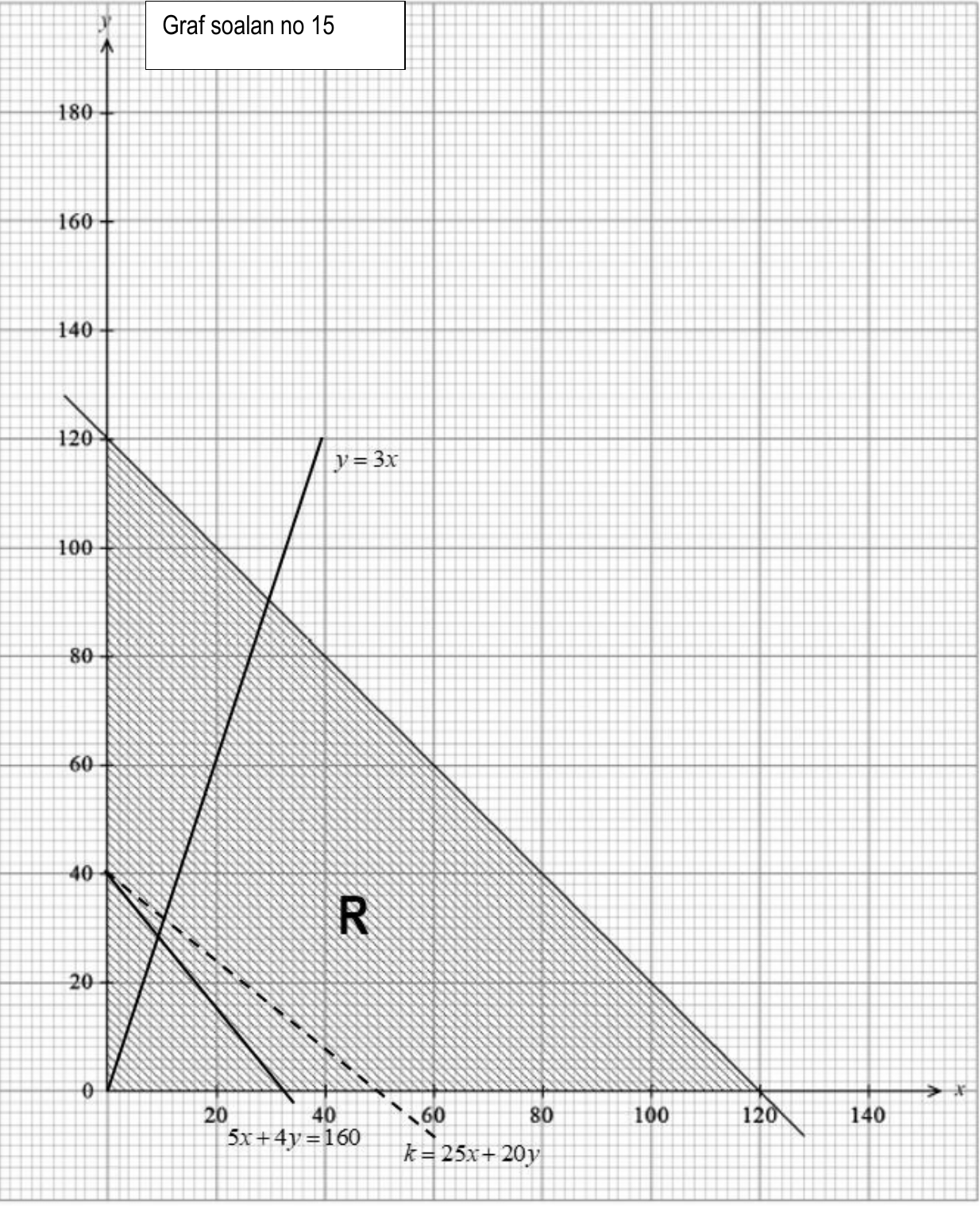
- (d)(i)
Find the minimum mass of shrimp purchased if 20 kg of squid is purchased.
[1] - (d)(ii)
Find the maximum amount of money paid by Mak Siti.
[4]