Write your answer on paper. Then open the answer to check it.
Section A
Diagram 1(a) shows the variables x and y connected by the equation y = x² − 8x + 16, while Diagram 1(b) is a graph of a linear equation formed, represented by the Y-axis and the X-axis, with gradient 1 and Y-intercept −4.
Easy4 marks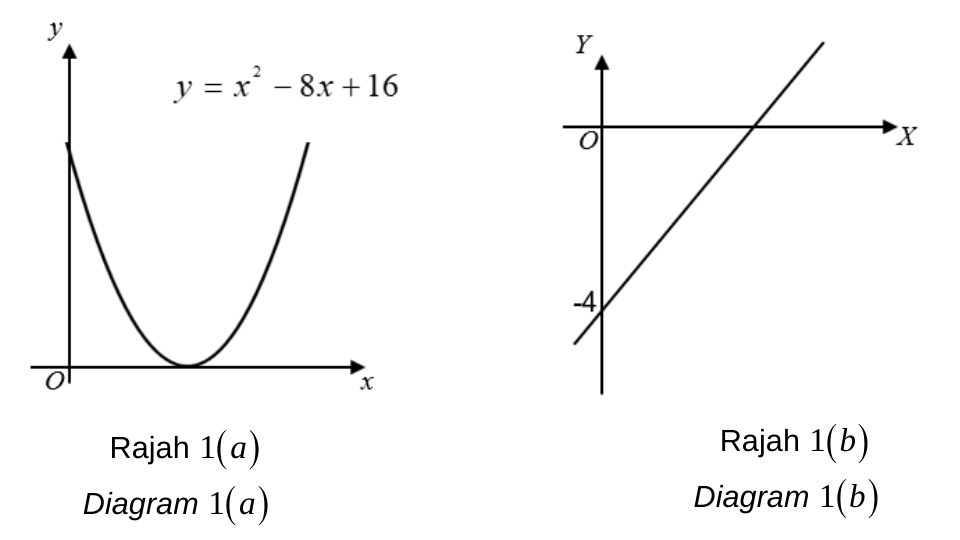
- (a)
Express X and Y in terms of x and/or y.
[2] - (b)
Determine whether (10, 4) is located on that straight line or not. Give your reasons.
[2]
Vectors written as column vectors or in terms of i and j. k is a constant.
Easy6 marks- (a)
Given that a unit vector in the direction of the vector MN = ki − 4j is (1/(3k)) [[k], [−4]], find the value of k.
[3] - (b)
It is given that the point P(2, 5) and vector PQ = 7i + 9j. Find the terminal point of the vector PQ.
[3]
Differentiation and limits.
Easy6 marks- (a)
The straight line y = 3x − 2 is tangent to the curve y = px² + qx, where p and q are constants, at x = 4. Find the values of p and of q.
[4] - (b)
Determine the limit value of lim(x→−3) (2x² + 3x − 9)/(x + 3).
[2]
Diagram 2 shows the binomial graph with the distribution X ~ B(n, p). The graph shows P(X = r) against r: bars at r = 0 and r = 4 of height k, r = 1 of height 1/8, r = 2 of height 1/4, r = 3 of height 1/2.
Easy4 marks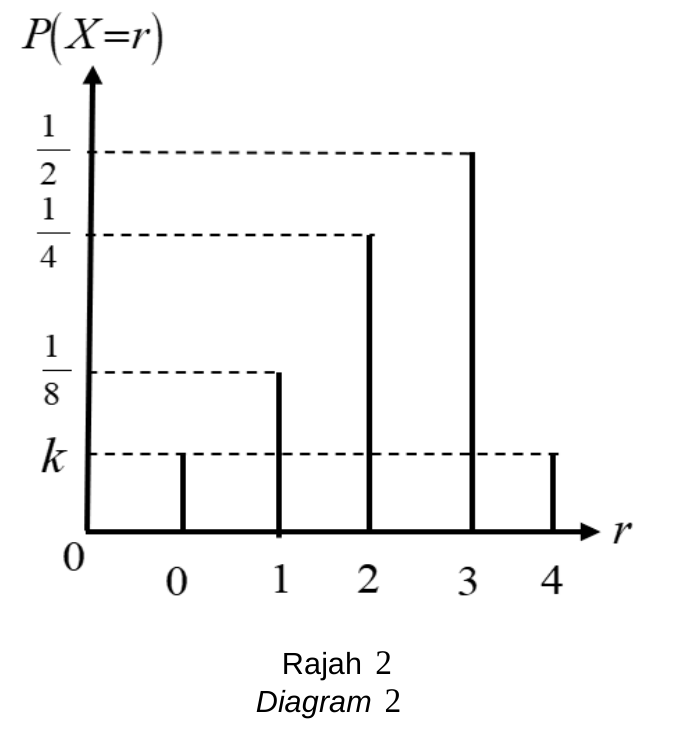
- (a)
Determine the value of k.
[1] - (b)
Find the values of n and of p.
[3]
Find unknown values.
Medium6 marks- (a)
Given that h/k = 1/3 + 0.0454545…, find the values of h and of k without using the progression method.
[3] - (b)
Given that q√2 = 7/(3 − √2) − p, find the values of p and of q.
[3]
Indices and logarithms. Table 1(a) shows x = 1, 9 and y = 8, 16. Table 1(b) shows log_q x = 0, 2 and log_p y = 3, 4.
Medium6 marks- (a)
Given the equation 4(3^(2x+1)) + 17(3^x) − 7 = 0. By using the indices law method, show that the value of x = −1 satisfies the equation.
[3] - (b)
Table 1(a) shows the variables x and y, while Table 1(b) represents the variables log_q x and log_p y. Find the values of p and of q. [Table 1(a): x = 1, 9; y = 8, 16. Table 1(b): log_q x = 0, 2; log_p y = 3, 4]
[3]
Diagram 3 shows two circles with centres P and Q and radii 6 cm and 10 cm respectively. The two circles touch each other at R. TS is a tangent to both circles (T on the circle with centre P, S on the circle with centre Q). The region bounded by TS and the two arcs TR and RS is shaded.
Medium4 marks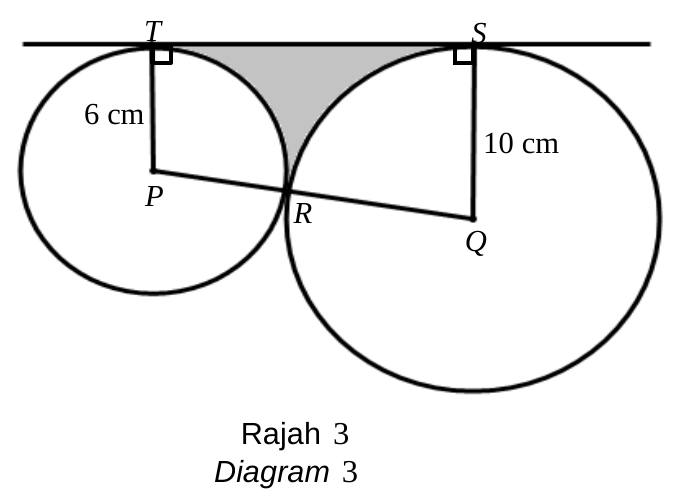
- (a)
Show that ∠PQS is approximately 75°31′.
[2] - (b)
Calculate the perimeter of the shaded area.
[2]
Given cosec(90° − α) = 13/5. [Printed as 'kosek(90° − θ)' in the BM text; the scheme uses α.]
Easy5 marks- (a)
Find sin α.
[2] - (b)
Hence, prove that 1 − cos²α = 144/169.
[3]
Systems of equations.
Medium6 marks- (a)
State the difference between infinite solutions and no solution for a system of linear equations with three variables.
[1] - (b)
Solve the following equations by using the elimination method: 3x − 2y = 6 and 2x² + 4xy = 2. Give your answers correct to three decimal places.
[5]
Arithmetic progressions.
Easy6 marks- (a)
The first three terms of an arithmetic progression are 2x, 2x + 5 and 4x. Find (i) the value of x. Hence, determine the arithmetic mean value. (ii) the sum of the first 8 terms of the progression.
[3] - (b)
Given that the nth term of an arithmetic progression is given by Tₙ = 5n − 8. Find (i) the common difference of the progression. (ii) the value of n if Tₙ = 47.
[3]
A tennis team consisting of 4 men and 4 women was selected from 6 men and 7 women including a pair of twins Dania and Damia.
Easy6 marks- (a)
Find the number of ways the team can be formed if there is no restriction.
[2] - (b)
If Dania and Damia either must be selected together or both are not selected, find the number of possible ways.
[2] - (c)
The selected team including Dania and Damia are lined up for a photo session. Find the number of ways if Dania and Damia do not want to sit together.
[2]
Functions.
Easy5 marks- (a)
Given a function represented by m(x) = x² − 4x + 3 with the domain x ≥ p has an inverse function. Find the corresponding value of p.
[2] - (b)
Given that g⁻¹h(x) = 5x + 4 and fg(x) = 1 + 2x, find the value of fh(5).
[3]
Section B
Diagram 4 shows the quadratic function f(x) = x² − (p − 2)x + 4, which has a minimum point (h, −k). The graph y = f(x) cuts the x-axis at two points and the y-axis above the origin.
Medium8 marks- (a)(i)
Express p in terms of h.
[2]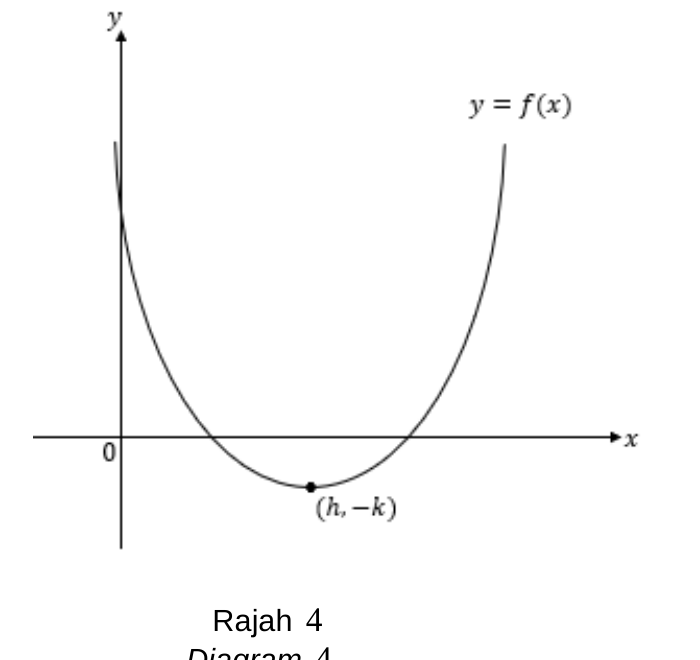
- (a)(ii)
By using the number line method, find the range of values of p, if the minimum point is (h, k), the y-intercept does not change.
[3] - (b)(i)
Given that 2 + 2i and 2 − 2i are the roots of a quadratic equation. Find the value of the discriminant of the quadratic equation.
[1] - (b)(ii)
Form the quadratic equation.
[2]
Given P(1, p) and Q(q, 2) are two points on the curve y = 8/x.
Medium8 marks- (a)
Find the values of p and q.
[2] - (b)
Find the equation of the straight line PQ.
[2] - (c)
Using the coordinate geometry method, find the equations of the tangents to the curve that are parallel to the straight line PQ.
[4]
Integration.
Medium8 marks- (a)
Given that ∫ 3/(2x + 7)³ dx = a/(b(2x + 7)²) + c, find the value of a and of b.
[2] - (b)
If 3 − 4x + dy/dx = 3x², where dy/dx is the gradient function of a curve passing through the origin, find the value of ∫₁³ y dx.
[4] - (c)
Given that ∫ from (3k + 2) to (2q − k) of x² dx = 0, express k in terms of q.
[2]