Write your answer on paper. Then open the answer to check it.
Section A
Diagram 1 shows the vertices of rectangle ABCD on the Cartesian plane: A(1, 5), B(4, 2), C(h, k) and D on the x-axis.
Medium7 marks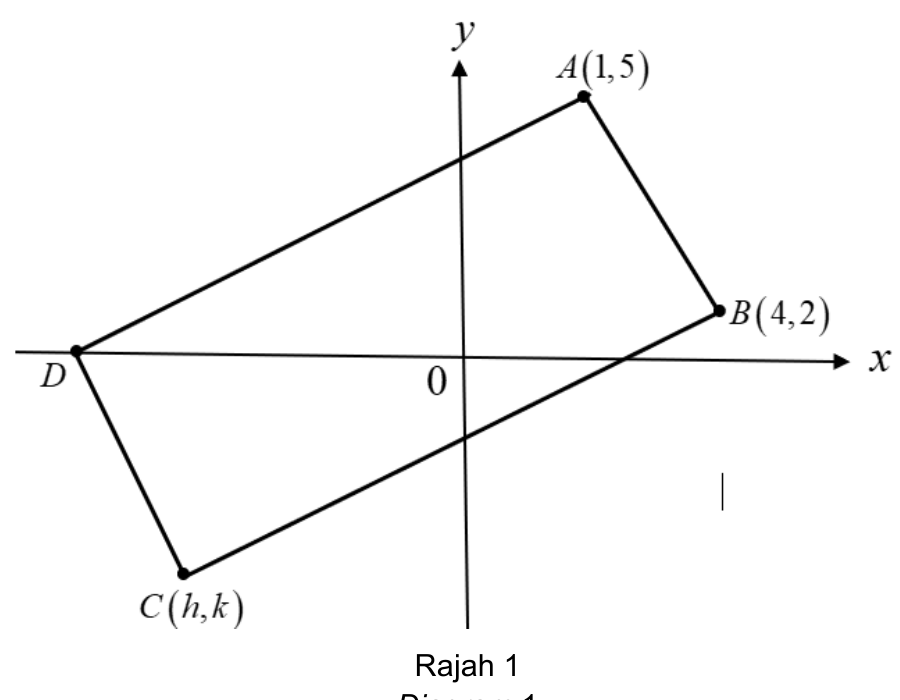
- (a)
Find the equation of AB in the x/a + y/b = 1 form.
[2] - (b)
Show that the area of triangle ABC is 9 − (3/2)(h + k). Hence, find the coordinates of C(h, k) if the area of triangle ABC is 30 unit² and k = h − 2.
[5]
Quadratic equations and functions.
Medium8 marks- (a)
Given a quadratic equation ax² + bx + c = 0, by using completing the square, derive the formula x = (−b ± √(b² − 4ac))/(2a).
[3] - (b)
Express f(x) = 3x² + 15x − 18 in the form f(x) = a(x + p)(x + q). Hence, find the turning point and sketch the graph of the quadratic function.
[5]
Definite integrals and volume of revolution.
Medium7 marks- (a)
Given that ∫₂⁵ f(x) dx = 5 and ∫₅⁹ f(x) dx = 3. Find the value of p if ∫₂⁹ [f(x) + p] dx = 24.
[2] - (b)(i)
Diagram 2 shows x = 3y² + 2 and the line y = p intersects the curve at the point (3, p) [the shaded region lies between the curve, the y-axis, the x-axis and the line y = p, above the x-axis]. Show that the line y = √3/3.
[2]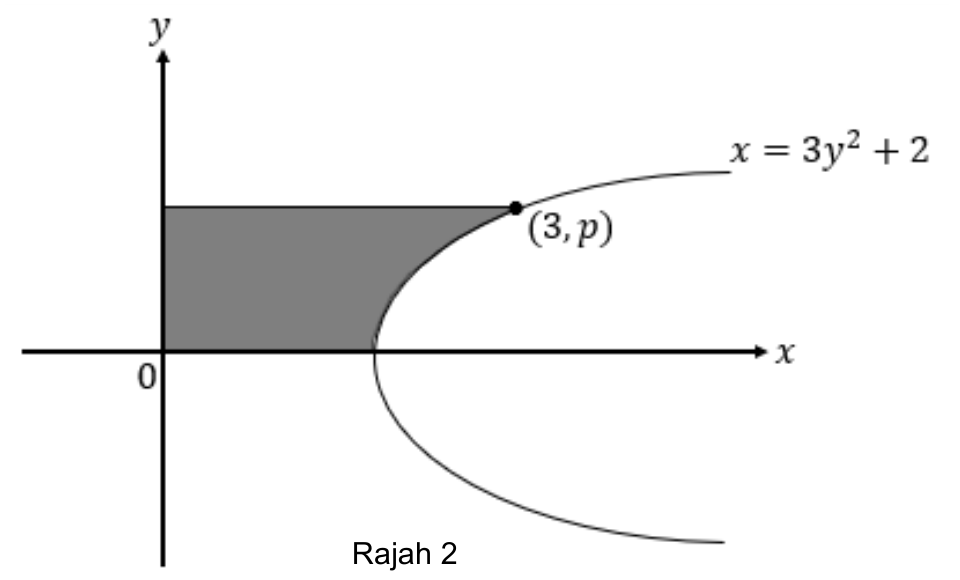
- (b)(ii)
Find the volume of the shaded region that is generated when it is rotated through 4 right angles (360°) about the x-axis.
[3]
Diagram 3 shows a kite having an axis of symmetry BQ. ABCE is a semicircle centred at E with diameter 20 cm. ADC and PQR are arcs of circles centred at O, with radius 25 cm and 15 cm respectively.
Medium6 marks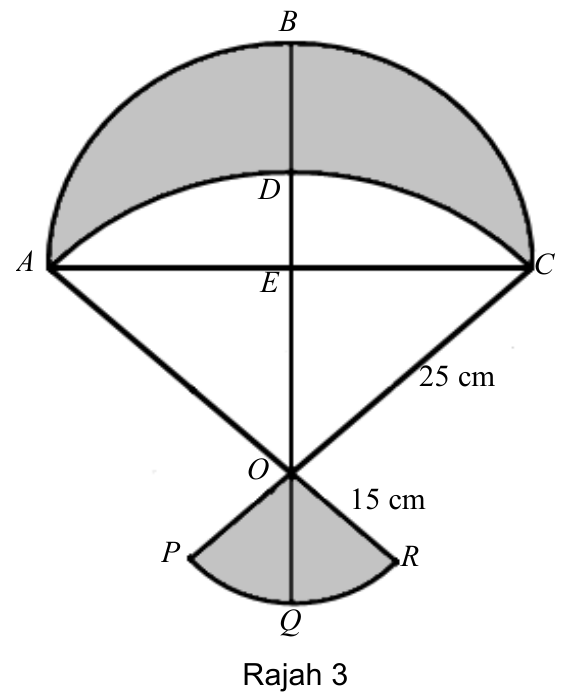
- (a)
Find ∠AOC in degrees and minutes.
[2] - (b)
Calculate the area of the shaded region.
[4]
A function is defined by f(x) = −2x for x ≥ 0 and f(x) = 2x for x < 0, for domain −3 ≤ x ≤ 4 [equivalently f(x) = −|2x|].
Medium7 marks- (a)
Sketch the graph for this function.
[3]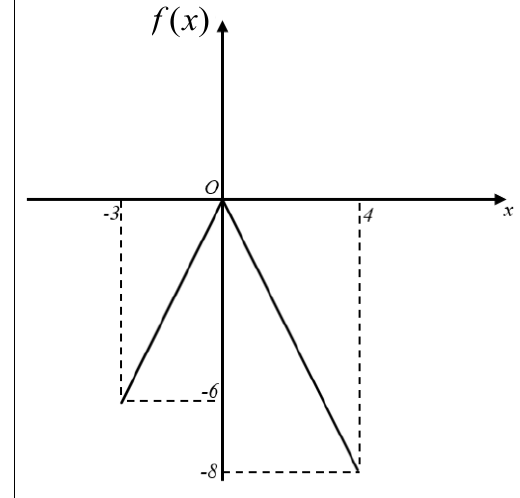
- (b)
Hence, state the corresponding range of the given domain.
[1] - (c)
The domains that correspond to the range −6 ≤ f(x) ≤ −2.
[3]
Diagram 4 shows the origin O, while points ADB, OXB, OYC and DXY are straight lines. Given OA = h**x** + k**y**, OB = 3h**x** + 4k**y**, OC = h**x** − 5k**y** and OD = (3/2)h**x** + (7/2)k**y**. Given OY : OC = 2 : 5, XB : OX = 3 : 2 and AD : AB = p : q.
Medium8 marks- (a)(i)
Express AB in terms of h, k, x and y.
[2]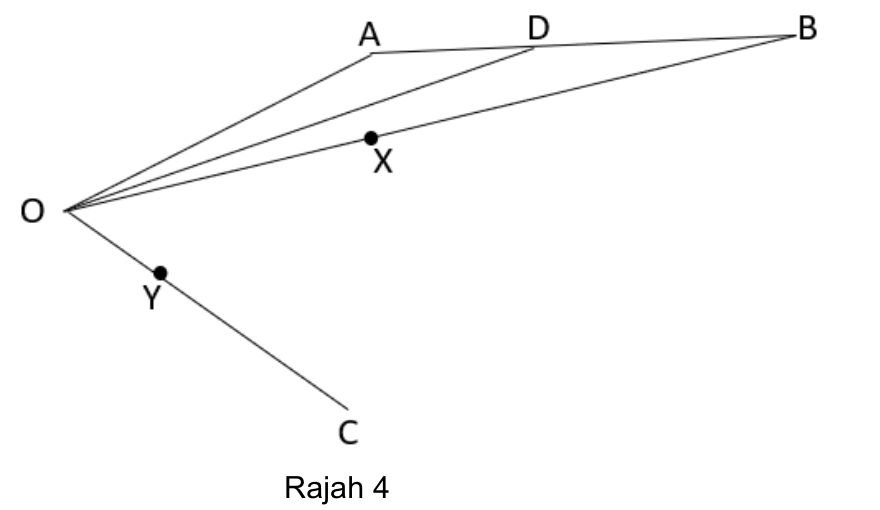
- (a)(ii)
Express XY in terms of h, k, x and y.
[2] - (b)
Find the values of p and of q.
[4]
Diagram 5 shows a composite solid consisting of a hemisphere and a cylinder. The diameter of both the hemisphere and the cylinder is 2r cm. The total surface area, A cm² is given by A = √3π(√3r² + 18/r).
Medium7 marks- (a)
When heated, the solid expands such that the rate of change of the radius is 0.2 cm s⁻¹. Find the rate of change of the total surface area of the composite solid, in terms of π, given that the curved surface area of the hemisphere is 32π cm².
[4]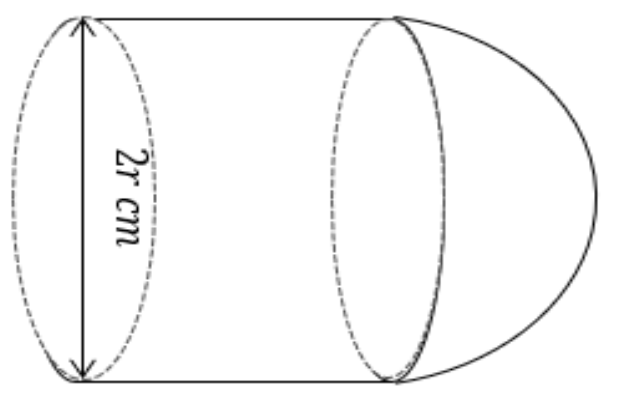
- (b)
Find the radius that makes the total surface area of the solid minimum.
[3]
Section B
The lifespan of lamps produced by a factory is normally distributed, X ~ N(1375, 124²). The lamps produced are classified into three quality levels, namely standard, good and high, based on their lifespan: Standard < Good < High.
Medium10 marks- (a)(i)
The minimum lifespan of a high-quality light bulb is 1600 hours. If a light bulb is randomly selected from the factory, find the probability that the light bulb is high-quality.
[2] - (a)(ii)
Find the minimum lifespan, in hours, of a good-quality bulb if 25% of the bulbs produced are of standard quality.
[3] - (b)(i)
In a lamp shop, the probability of buying a broken lamp is 20%. Zaim has bought n bulbs. The probability of Zaim getting a good bulb is 20 times the probability of him getting a broken bulb in each purchase. Find the value of n.
[3] - (b)(ii)
Calculate the standard deviation for purchases of defective bulbs.
[2]
Geometric progressions.
Medium10 marks- (a)(i)
A piece of wire is cut into several pieces. The length of the first piece is (x + 3) cm, the second piece is (5x + 3) cm, the third piece is (11x + 3) cm and so on. The length of each piece forms a geometric progression. Find the value of x for which x > 0 and hence, calculate the length of the shortest section of wire.
[2] - (a)(ii)
If the wire is cut into 10 pieces, find the length of the wire, in metres. Give the answer to one decimal place.
[3] - (b)(i)
Given that the nth term of a geometric progression is Tₙ = (5/2)rⁿ⁻¹, r ≠ k. State the value of k.
[1] - (b)(ii)
State the first term of the progression.
[1] - (b)(iii)
State the sum to infinity if the third term is 1/10 and r is greater than 0.
[3]
Trigonometric identities, graphs and equations. m and n are non-zero real numbers.
Hard10 marks- (a)
Prove that (m cos x + n sin x)² + (m sin x − n cos x)² = (m + n)² − 2mn, if m and n are non-zero real numbers.
[3] - (b)
On the same graph, sketch the graphs of y = cos x and y = −sin x for the values of angle −π ≤ x ≤ π.
[4]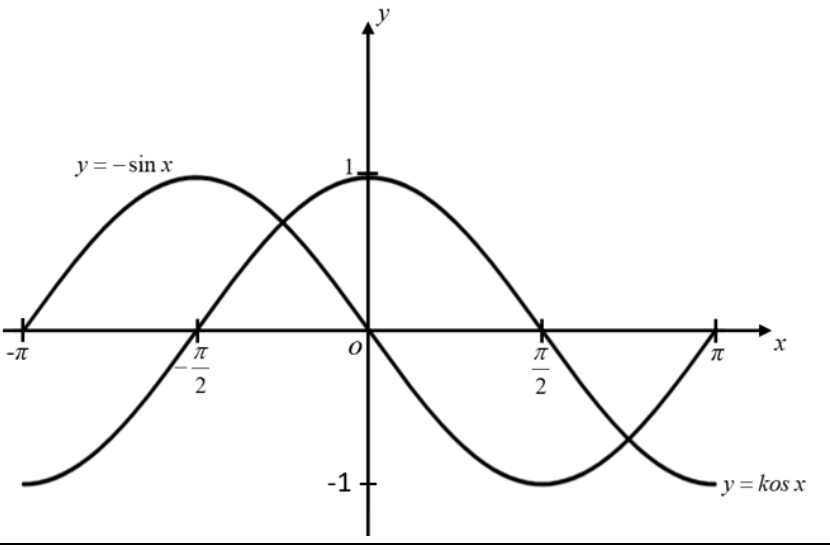
- (c)
Solve the equation −sin x = cos x for the value of angle −π ≤ x ≤ π. Give the answer in terms of π.
[3]
Use graph paper to answer this question. Table 1 shows the corresponding values of the two variables ln x and ln T obtained from one experiment: ln x = 0.693, 0.875, 1.131, 1.335, 1.609, 1.792 and ln T = 0.577, 1.125, 1.895, 2.505, 3.328, 3.875. The variables ln x and ln T are related by the equation ln T = ln(x^N / e^K), where N and K are constants and e is the exponential constant.
Medium10 marks- (a)
Complete the following table by giving the answers to 2 decimal places (rows x and T for the six given values).
[2]
- (b)
Plot ln T against ln x using a scale of 2 cm to 0.2 unit on the ln x-axis and 2 cm to 0.5 unit on the ln T-axis. Hence, draw a line of best fit.
[3] - (c)(i)
Use your graph from (b) to find the value of K.
[2] - (c)(ii)
Use your graph from (b) to find the value of N.
[2] - (c)(iii)
Hence, find the value of T when x = 5.5.
[1]
Section C
An early acceleration workshop for Additional Mathematics will be held, involving Form 5 and Form 4 students from SMK Sri Delima. The number of selected Form 5 and Form 4 students are x and y respectively. The number of Form 5 students must not exceed twice the number of Form 4 students. The total number of students must not exceed 90, and the number of Form 4 students must exceed the number of Form 5 students by at most 10.
Medium10 marks- (a)
Write three inequalities, other than x ≥ 0 and y ≥ 0, that satisfy all the above constraints.
[3] - (b)
Using a scale of 2 cm to represent 10 students on both axes, construct and shade the region R that satisfies all the above constraints.
[3] - (c)(i)
Using the graph constructed in 12(b), find the range of the number of Form 4 students if the number of Form 5 students is 20.
[1] - (c)(ii)
Using the graph constructed in 12(b), find the maximum total participation fee that can be collected if the fee for a Form 5 student and a Form 4 student is RM120 and RM100 respectively.
[3]
A particle moves along a straight line. The displacement, s m, from a fixed point O is given by s = (1/3)t³ − 3t² + 5t, where t is the time, in seconds, after passing through O. [Assume motion to the right is positive.]
Medium10 marks- (a)
Find the initial acceleration, in m s⁻², of the particle.
[3] - (b)
Determine the acceleration, in m s⁻², of the particle at the moment the particle reverses its direction of motion.
[3] - (c)
Find the distance at the time t = 7 s.
[4]
Solution of triangles.
Hard10 marks- (a)
Diagram 6 shows a cyclic quadrilateral PQRS. The lengths of the straight lines RS and SP are 3 cm and 6 cm respectively; PQ = 5 cm and RQ = 8 cm; ∠PSR = m and ∠PQR = n. Express PR in terms of (i) m (ii) n. Hence show that cos m = −11/29.
[6]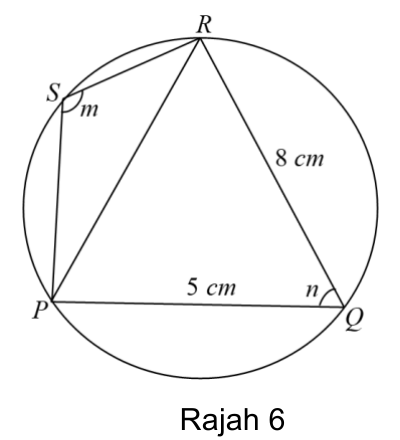
- (b)(i)
Diagram 7 shows AB = 4 cm, AC = 7 cm, ∠AOC = 22° and ∠BAC = 37° (O, A, B lie on a straight line). Calculate the length of OA.
[2]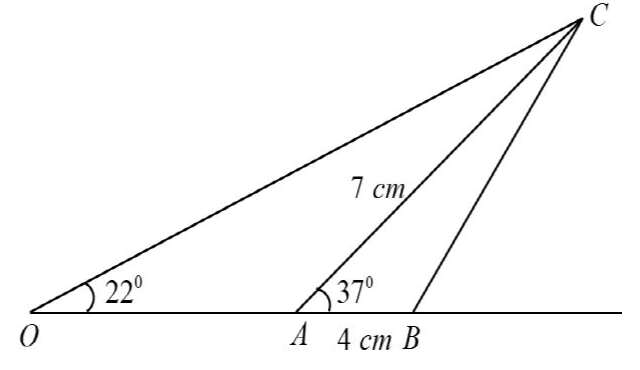
- (b)(ii)
Calculate the area of triangle ABC, using Heron's formula.
[2]
Table 2 shows the monthly expenses of Encik Afham. The price index in 2022 based on 2020, the change of price index from 2022 to 2024 and the weightage are: Transport: 130, increase 20%, weightage 7 − m; Utility bills: 115, increase 10%, weightage 5 − m; Groceries: 120, decrease 5%, weightage m; Rental: 125, unchanged, weightage 1 + m; Other expenses: 110, decrease 5%, weightage m.
Medium10 marks- (a)(i)
Based on the information for 2022 based on 2020, it was found that Σw = 15 and ΣIw = 1830. Find the value of m.
[2] - (a)(ii)
Find the composite index for the year 2022 based on the year 2020.
[1] - (b)
Based on Table 2, find the composite index for the monthly expenses of Encik Afham for the year 2024 based on the year 2020.
[4] - (c)
If the total monthly expenditure for the above items for Encik Afham in 2020 is RM550, calculate the total monthly expenditure for the same items for Encik Afham in 2024. State the change in total monthly expenses between 2020 and 2024.
[3]