Write your answer on paper. Then open the answer to check it.
Section A
Diagram 1 shows two functions, h and g, that map set Q to set P and set Q to set R respectively. Given h(x) = (2x + 1)/4 and g(x) = 2x − 3. Find (a) the function that maps set P to set Q, (b) the composite function that maps set P to set R.
Easy3 marks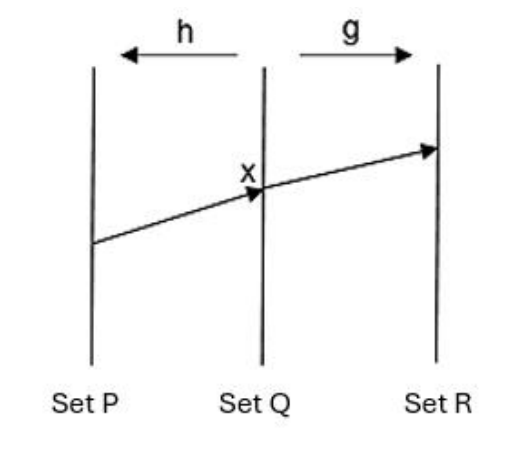
- (a)
The function that maps set P to set Q.
[1] - (b)
The composite function that maps set P to set R.
[2]
(a) Express the quadratic equation 3(3x + 4) = (x − 3)(x − 5) − x in the general form ax² + bx + c = 0. Hence, if α and β are the roots of the equation, state the value of α + β and αβ. (b) Given that (x + h)² − j = 0 is a quadratic equation where h = 4 and j = 64, determine the type of roots of the equation.
Easy5 marks- (a)
Express 3(3x + 4) = (x − 3)(x − 5) − x in the form ax² + bx + c = 0. Hence state α + β and αβ.
[3] - (b)
Given (x + h)² − j = 0 with h = 4 and j = 64, determine the type of roots.
[2]
(a) Simplify (7²ⁿ × 7ᵐ)/7ⁿ. (b) Given log₂ b = x and log₂ c = y, express log₄ (8b/c) in terms of x and y.
Easy5 marks- (a)
Simplify (7²ⁿ × 7ᵐ)/7ⁿ.
[2] - (b)
Given log₂ b = x and log₂ c = y, express log₄ (8b/c) in terms of x and y.
[3]
A rope is cut into a few parts. 10p cm, (4p + 20) cm and (3p − 10) cm are the three consecutive parts of a geometric progression. Find the longest part if 10p is the third longest term.
Easy5 marksFind the longest part if 10p is the third longest term.
[5]
Solve the following simultaneous equations. 3r + 3s − 2t = −5, 2r − s + 3t = 5, r + 2s = t.
Medium5 marksSolve 3r + 3s − 2t = −5, 2r − s + 3t = 5, r + 2s = t.
[5]
Diagram 2 shows a straight line AB which intersects the straight line CD at point C. A is (0, 6) on the y-axis, B is (9, 0) on the x-axis and D is (5, 7). Point C divides the line segment AB in the ratio 1 : 2. (a) Find the equation of the locus of a point that moves such that its distance from point D is constantly 4 units. (b) Hence, determine whether the locus passes through point C. Justify your answer.
Medium6 marks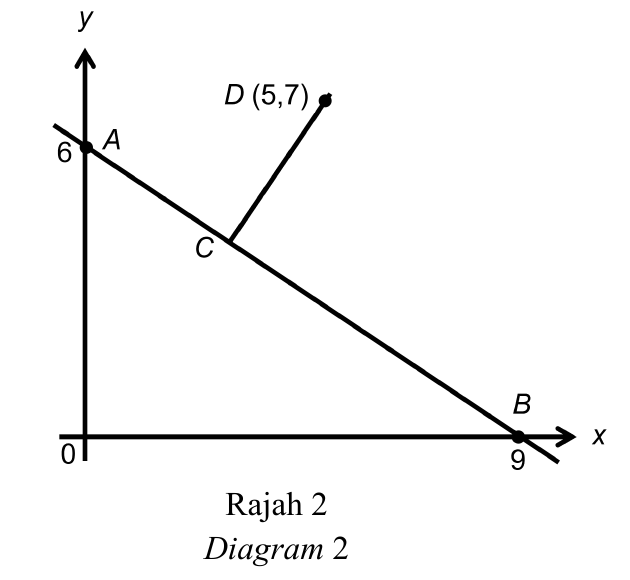
- (a)
Find the equation of the locus of a point P(x, y) whose distance from D(5, 7) is always 4 units.
[2] - (b)
Hence, determine whether the locus passes through point C. Justify your answer.
[4]
Diagram 3 shows the straight line QR obtained by plotting xy against x². The variables x and y are related by the equation y + 3x = 4/x. R is (0, 6t) on the vertical axis and Q is (m, n) on the horizontal-axis side (below the x² axis). (a) Express the equation y + 3x = 4/x in its linear form, which is used to obtain the straight line graph as shown. (b) Hence, (i) find the value of t, (ii) express m in terms of n.
Medium5 marks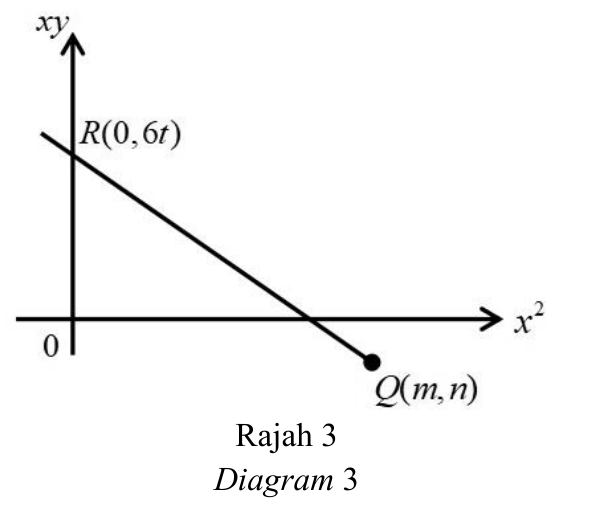
- (a)
Express y + 3x = 4/x in the linear form used for the graph of xy against x².
[1] - (b)(i)
Find the value of t.
[2] - (b)(ii)
Express m in terms of n.
[2]
(a) Determine the limit value of lim (x→2) (2x² + 1). (b) Find dy/dx for y = 2x² + 1 by using first principles.
Easy4 marks- (a)
Determine lim (x→2) (2x² + 1).
[1] - (b)
Find dy/dx for y = 2x² + 1 by using first principles.
[3]
(a) Given d/dx[(4x − 1)/(2x + 7)²] = 8(4 − x)/(2x + 7)³, find ∫ 4(4 − x)/(2x + 7)³ dx. (b) Given that the coordinates of the turning point of a curve with the gradient function 3x − 3/x² are (h, 8). Find the value of h. Hence, find the equation of the curve.
Medium7 marks- (a)
Given d/dx[(4x − 1)/(2x + 7)²] = 8(4 − x)/(2x + 7)³, find ∫ 4(4 − x)/(2x + 7)³ dx.
[2] - (b)
The gradient function is 3x − 3/x² and the turning point is (h, 8). Find h and hence the equation of the curve.
[5]
(a) Solve the quadratic inequality x² − 2x > 35 by using the number line method. (b) A quadratic function, g(x) = (x + p)(x + q) intersects the x-axis at points M and N. The distance of point M is 5 units to the left of the y-axis while the distance of point N is 3 units to the right of the y-axis. State the minimum point.
Medium7 marks- (a)
Solve x² − 2x > 35 by the number line method.
[3] - (b)
g(x) = (x + p)(x + q) cuts the x-axis at M (5 units left of the y-axis) and N (3 units right of the y-axis). State the minimum point.
[4]
A robotics team consisting of 6 students will be selected from 4 boys and 3 girls. Find (a) the number of different teams that can be selected if (i) there is no restriction, (ii) the team consists of at least 3 boys. (b) the number of ways to choose and arrange all boys and 2 girls for a photography session in a line, with the condition that all boys must sit next to each other.
Medium6 marks- (a)(i)
Number of different teams if there is no restriction.
[1] - (a)(ii)
Number of different teams if the team has at least 3 boys.
[2] - (b)
Number of ways to choose and arrange all 4 boys and 2 girls in a line with all boys next to each other.
[3]
Diagram 4 shows the curve y = 5/(2x − 1)². A region is bounded by the curve, the x-axis and the straight lines x = 1 and x = 3. (a) Find the area of the region. (b) The region is revolved through 360° about the x-axis. Find the volume generated in terms of π.
Medium6 marks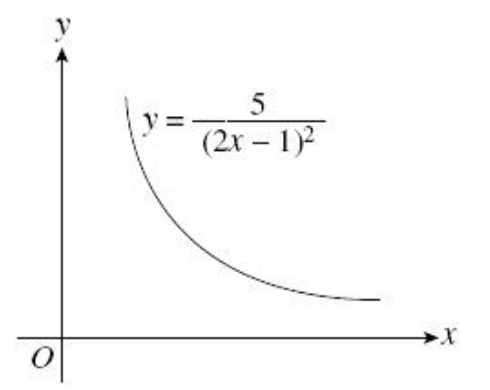
- (a)
Find the area of the region.
[3] - (b)
The region is revolved through 360° about the x-axis. Find the volume generated in terms of π.
[3]
Section B
(a) Diagram 5 shows a triangle PQR, where point S is the midpoint of line PR. Given QP→ = 4p and QR→ = 5r. Find QS→. (b) Given that point D(−2, 1) and point E(−7, 13) are two points on the Cartesian plane. Find (i) DE→, (ii) the unit vector of DE→, in terms of i and j.
Medium8 marks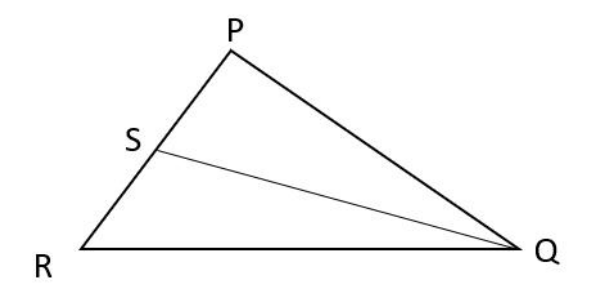
- (a)
Given QP→ = 4p and QR→ = 5r, S the midpoint of PR. Find QS→.
[3] - (b)(i)
Find DE→ for D(−2, 1) and E(−7, 13).
[3] - (b)(ii)
Find the unit vector of DE→ in terms of i and j.
[2]
Diagram 6 shows sector JOK with centre O and a radius of 24 cm. Point L lies on the straight line OJ such that OL : OJ = 3 : 4 and angle OLK is a right angle. [Use π = 3.142] Calculate (a) the value of θ, in radians, (b) the perimeter of the shaded region, (c) the area of the shaded region.
Medium8 marks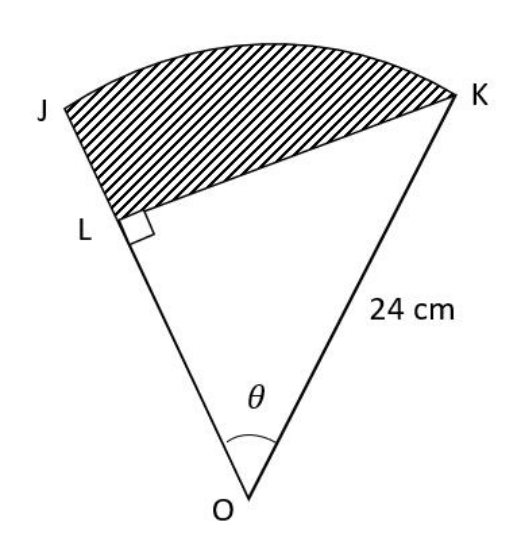
- (a)
Calculate the value of θ, in radians.
[2] - (b)
Calculate the perimeter of the shaded region.
[3] - (c)
Calculate the area of the shaded region.
[3]
(a) A workshop is conducting an inspection on newly installed batteries. Statistics show that 2 out of 5 batteries function well after one year. A random sample of n batteries is selected. It is given that the probability that all selected batteries function well after a year is 0.0256. Find (i) the value of n, (ii) the probability that all the batteries do not function well after a year. (b) (i) If X ~ N(56, 16), find the value of P(X > 64). (ii) Diagram 7 shows a standard normal distribution graph. The probability represented by the area of the shaded region (between k and 0) is 36.65%. Find the value of k.
Medium8 marks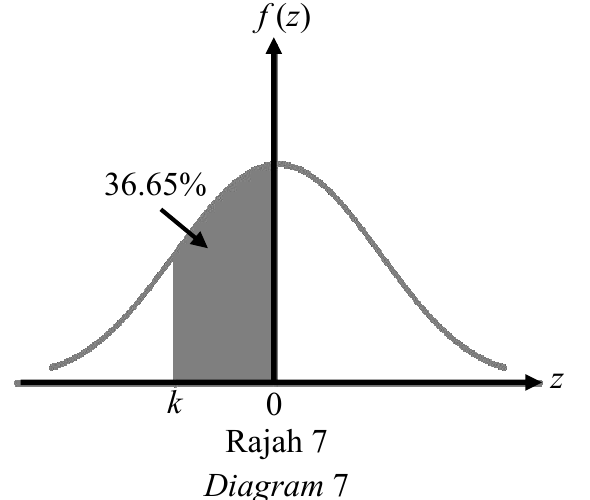
- (a)(i)
Find the value of n.
[2] - (a)(ii)
Find the probability that all the batteries do not function well after a year.
[2] - (b)(i)
If X ~ N(56, 16), find P(X > 64).
[2] - (b)(ii)
Diagram 7: the shaded area between k and 0 is 36.65%. Find k.
[2]