Write your answer on paper. Then open the answer to check it.
Section A
(a) Rationalise the denominator and simplify (5 + √3)/√3. (b) Solve the equation (k/169)^(1/2) × √k = 6. (c) Without using a calculator, solve the equation log₄ [log₃ (5 − 2x)] = log₁₆ 4.
Medium7 marks- (a)
Rationalise the denominator and simplify (5 + √3)/√3.
[2] - (b)
Solve (k/169)^(1/2) × √k = 6.
[2] - (c)
Without a calculator, solve log₄ [log₃ (5 − 2x)] = log₁₆ 4.
[3]
Diagram 1 shows the cross-section of a semi-circular concrete seat. Given that h(x) = −2x² + 19x − 42 represents the curve of the outer part of the concrete seat, with A and B the end points on the base line. (a) Find the distance AB of the seat. (b) By using the method of completing the square, find the maximum distance of the outside of the curve from AB.
Medium7 marks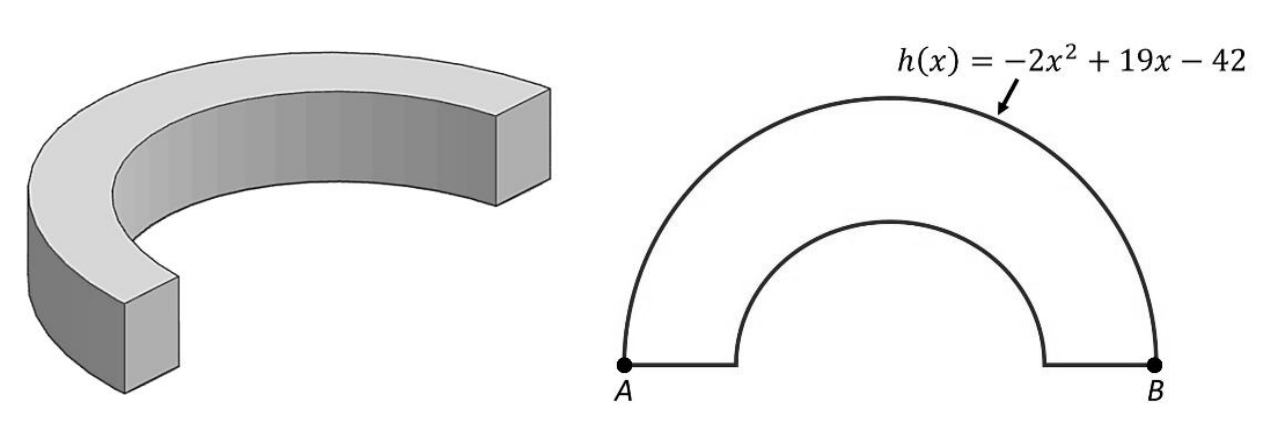
- (a)
Find the distance AB of the seat.
[4] - (b)
By completing the square, find the maximum distance of the outside of the curve from AB.
[3]
It is given that …, 145, x, y, 138, … is part of an arithmetic progression and the 16th term of the progression is 138. Find (a) the first term and the common difference, (b) the smallest value of n such that the nth term is negative, (c) the sum of the 41st term to the 70th term.
Medium7 marks- (a)
Find the first term and the common difference.
[2] - (b)
Find the smallest value of n such that the nth term is negative.
[2] - (c)
Find the sum of the 41st term to the 70th term.
[3]
Amira wants to make jelly to be given as souvenirs for her wedding by using a mould in the shape of a right prism, as shown in Diagram 2. The total length of the sides of the right prism is 75 cm, PT = QU = 13 cm, PQ = QR and UR > QR. Determine whether the mould is suitable to be used for producing jelly with a volume of 155 cm³. Give your justification.
Medium7 marks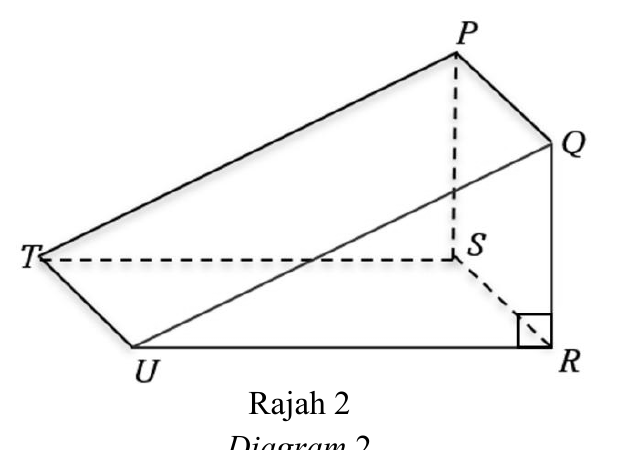
Determine whether the mould is suitable for jelly of volume 155 cm³. Give your justification.
[7]
(a) Given that f : x → m/x + n, x ≠ 0 and ff(x) = f⁻¹(x). Show that m + n² = 0. (b) Given f(x) = 2x − 3, find the values of p if ff⁻¹(p − 2) = 3/p, p ≠ 0.
Medium7 marks- (a)
Given f : x → m/x + n, x ≠ 0 and ff(x) = f⁻¹(x), show that m + n² = 0.
[4] - (b)
Given f(x) = 2x − 3, find the values of p if ff⁻¹(p − 2) = 3/p, p ≠ 0.
[3]
In Diagram 3, ABCD is a quadrilateral. AED, CFE and BFD are straight lines. Given AB→ = 20x, AE→ = 4y, BC→ = 5x + 4y, BD→ = −20x + 16y and BD→ = 4BF→. (a) Express in terms of x and/or y (i) CD→, (ii) CF→. (b) Given CF→ = kCE→, where k is a constant, find the value of k. (c) If |x| = 1, |y| = 3 and ∠DAB = 90°, find |BC→|.
Medium7 marks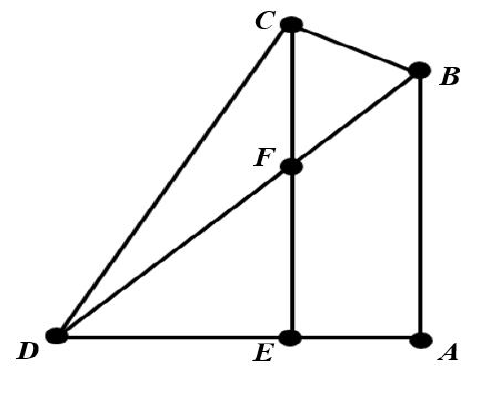
- (a)
Express in terms of x and/or y: (i) CD→, (ii) CF→.
[3] - (b)
Given CF→ = kCE→, find the value of k.
[2] - (c)
If |x| = 1, |y| = 3 and ∠DAB = 90°, find |BC→|.
[2]
Diagram 4 shows a circle with centre O and a radius of 7 cm. It is given that the perimeter of the triangle AOB is 21 cm (A and B are on the circle; the shaded region is the whole circle except triangle AOB). [Use π = 3.142] Calculate (a) ∠AOB in radians, (b) the perimeter of the minor segment AB, (c) the area of the shaded region.
Medium8 marks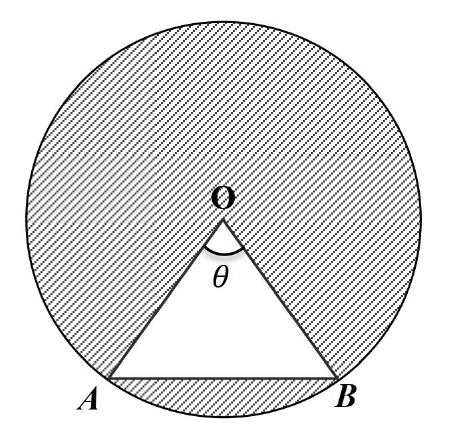
- (a)
Calculate ∠AOB in radians.
[2] - (b)
Calculate the perimeter of the minor segment AB.
[3] - (c)
Calculate the area of the shaded region.
[3]
Section B
Diagram 5 shows a trapezium STUV, with ST parallel to UV and point S lies on the x-axis. Given the equation UT is parallel with the x-axis and the equation of the line UV is y + 2x + 8 = 0. S is (6, 0), T is (2, 8) and ∠SVU = 90° (right angle at V). (a) Find the equation of straight line SV. (b) (i) Find the coordinates of V and U. (ii) Hence, find the area of trapezium STUV.
Medium10 marks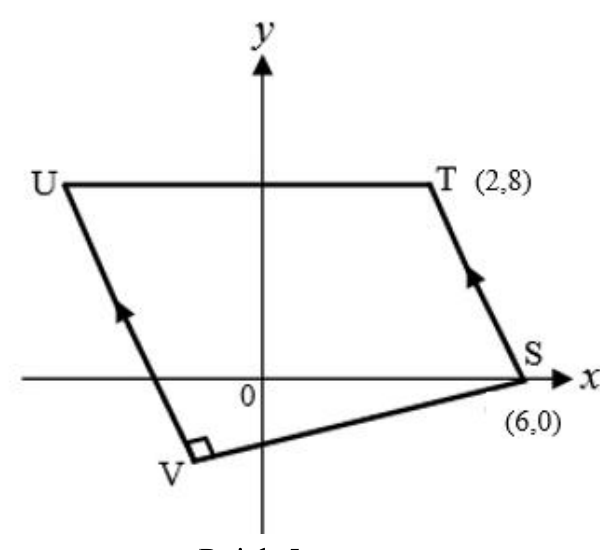
- (a)
Find the equation of straight line SV.
[3] - (b)(i)
Find the coordinates of V and U.
[5] - (b)(ii)
Hence, find the area of trapezium STUV.
[2]
A company wants to build an open-top cylindrical tank with a volume of 1000 m³. The radius is r m and the height is h m. The cost to build the base is RM5 per square metre and the cylindrical wall is RM2 per square metre. (a) Express the cost to build the tank, C, in terms of r and π. (b) Find the radius and height that minimise the construction cost. Hence, find the minimum construction cost. [Use π = 3.142] (c) After the tank is built, the tank starts being filled with water at a rate of 20 m³ per minute. Find the rate of change of the water height in the tank when the water reaches a height of 8 metres.
Hard10 marks- (a)
Express the cost C in terms of r and π.
[3] - (b)
Find the radius and height that minimise the cost, and the minimum cost.
[5] - (c)
Find the rate of change of the water height when the water height is 8 m.
[2]
(a) Prove that cot x − tan x = 2/(tan 2x). (b) Hence, solve the equation cot x − tan x = 3 for 0° ≤ x ≤ 360°. (c) (i) Sketch the graph y = −2 sin (3x/2) + 1 for 0 ≤ x ≤ 2π. (ii) There is one solution obtained if y = t is sketched on the same axes in 10(c)(i), such that t is a constant. State the value of t.
Medium10 marks- (a)
Prove that cot x − tan x = 2/(tan 2x).
[2] - (b)
Hence, solve cot x − tan x = 3 for 0° ≤ x ≤ 360°.
[4] - (c)(i)
Sketch the graph y = −2 sin (3x/2) + 1 for 0 ≤ x ≤ 2π.
[3]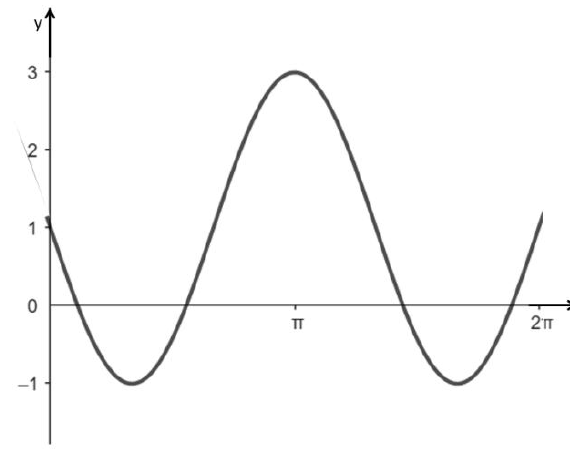
- (c)(ii)
State the value of t.
[1]
Use graph paper to answer this question. Table 1(a) shows the values of two variables, x and y, obtained from an experiment. Variables x and y are related by the equation y = r/d^(−√x), where r and d are constants. Table 1(a): x = 4, 16, 36, 64, 100, 144; y = 1.86, 2.63, 3.85, 5.50, 7.94, 11.22. (a) Based on Table 1, fill in Table 1(b) (√x and log₁₀ y) in the answer space provided. (b) Plot log₁₀ y against √x, using a scale of 2 cm to 2 units on the √x-axis and 2 cm to 0.1 unit on the log₁₀ y-axis. Hence, draw the line of best fit. (c) Use your graph in (b) to find the value of (i) r, (ii) d.
Medium10 marks
- (a)
Fill in Table 1(b): √x and log₁₀ y for each value.
[2]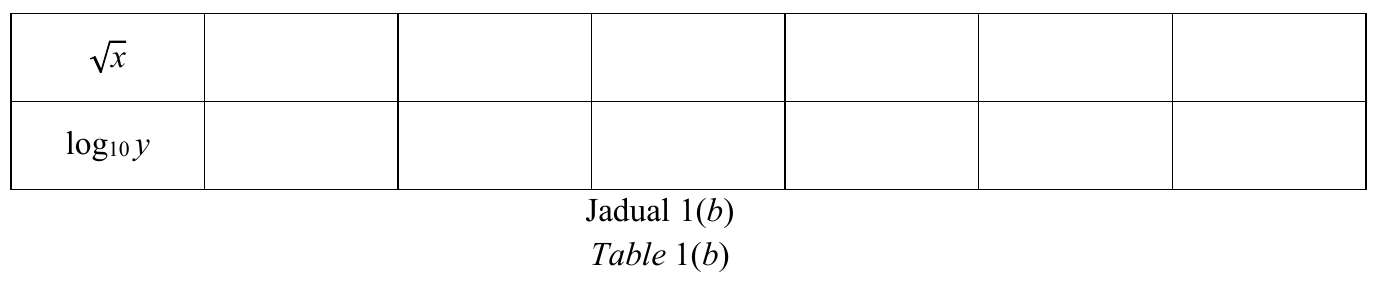
- (b)
Plot log₁₀ y against √x (scales 2 cm to 2 units on the √x-axis, 2 cm to 0.1 unit on the log₁₀ y-axis) and draw the line of best fit.
[3]
- (c)
Use your graph to find (i) r, (ii) d.
[5]
Section C
Diagram 6 shows a cyclic quadrilateral PQRS. QR = 7.5 cm and ∠PQR = 85°. (a) It is given that the length of PQ = 9 cm and RS = 4 cm. Calculate (i) the length, in cm, of PR, (ii) ∠PRS. (b) Find (i) the area, in cm², of △PQR, (ii) the shortest distance, in cm, from point Q to PR.
Medium10 marks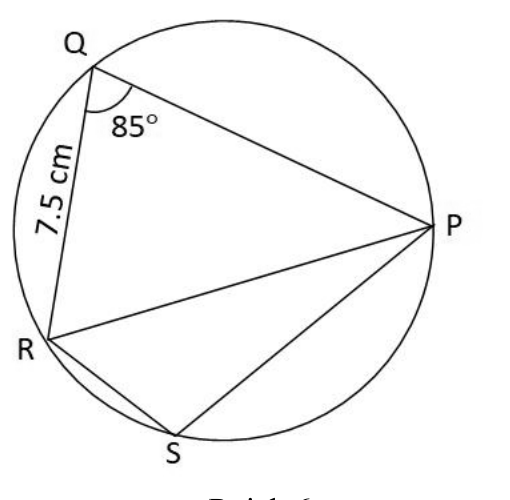
- (a)(i)
Calculate the length of PR in cm.
[2] - (a)(ii)
Calculate ∠PRS.
[4] - (b)(i)
Calculate the area of △PQR in cm².
[2] - (b)(ii)
Find the shortest distance from Q to PR in cm.
[2]
Table 2 shows the information related to the four main ingredients and quantity used by Puan Norsiah to make Kuih Bakar Manis. Corn flour: price per kg 2023 = 4.80, 2024 = 6.00, price index 2024 based on 2023 = x, quantity 150 g. Coconut milk: 2023 = y, 2024 = 3.00, index 109, quantity 150 g. Sugar: 2023 = 4.00, 2024 = 4.20, index 105, quantity 100 g. Wheat flour: 2023 = 3.00, 2024 = 3.60, index 120, quantity z. (a) Find the value of x and y. (b) The composite index for the cost of producing Kuih Bakar Manis in the year 2024 based on the year 2023 is 116. Find the value of z. (c) The increment of the cost of producing Kuih Bakar Manis in 2025 from 2024 is the same as the increment of the cost of producing Kuih Bakar Manis from 2023 to 2024. The cost price of Kuih Bakar Manis in 2023 is RM4.00. Find the selling price of Kuih Bakar Manis if Puan Norsiah wants to obtain a profit of 30% in the year 2025.
Medium10 marks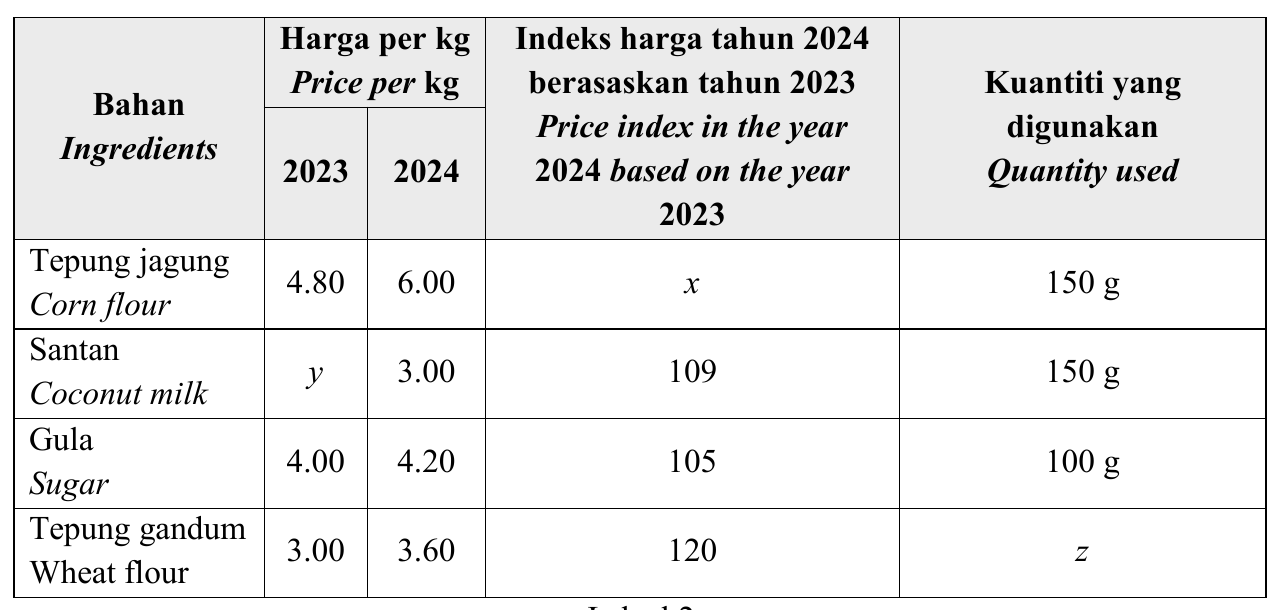
- (a)
Find the value of x and y.
[3] - (b)
Find the value of z given the composite index is 116.
[3] - (c)
Find the selling price for a profit of 30% in 2025.
[4]
A robot moves along a straight line and passes through a fixed point O. After t seconds of moving, its displacement, s metre, is based on the function s = t³ − 16t² + 60t. Find (a) the time, in seconds, when the robot passes through the fixed point O again, (b) the acceleration, in m s⁻², of the robot when t = 6 s, (c) the maximum velocity, in m s⁻¹, of the robot.
Medium10 marks- (a)
Find the time when the robot passes through O again.
[2] - (b)
Find the acceleration when t = 6 s.
[4] - (c)
Find the maximum velocity of the robot.
[4]
Use graph paper to answer this question. A private higher education institution A offers two courses, Engineering and Medicine. The number of students for the Engineering course is x while the number of students for the Medicine course is y. The intake of students for each course is based on the following constraints: I The minimum number of students in the Engineering course is 200 while the maximum number is 500. II The total number of students in both courses does not exceed 700. III The number of Engineering students exceeds two times the number of Medicine students by at most 200. (a) Write three inequalities, other than x ≥ 0 and y ≥ 0, that satisfy all the above constraints. (b) Using a scale of 2 cm to 100 students on both axes, construct and shade the region R which satisfies all of the above constraints. (c) Using the graph constructed in 15(b), find (i) the maximum number of students that can be taken into the Medicine course if the number of Engineering students is 250, (ii) the maximum amount of fees that can be collected per semester if the fee for each Engineering student for one semester is RM600 and for a Medicine student is RM800.
Medium10 marks- (a)
Write three inequalities (other than x ≥ 0, y ≥ 0) for constraints I, II and III.
[3] - (b)
Construct and shade the region R (scale 2 cm to 100 students on both axes).
[3]
- (c)(i)
Find the maximum number of Medicine students if the number of Engineering students is 250.
[1] - (c)(ii)
Find the maximum fees per semester (Engineering RM600, Medicine RM800 per student).
[3]