Write your answer on paper. Then open the answer to check it.
Section A
Diagram 1 shows the sector AOB with centre O. Given that the length of arc AB is 12.707 cm and the area of the sector AOB is 88.95 cm², find the radius of the sector, in cm, and the value of θ, in radians.
Easy4 marks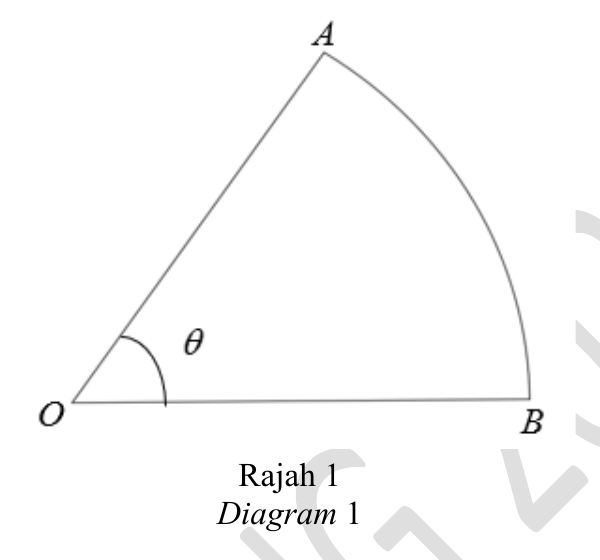
- (a)
Find the radius of the sector, in cm.
[2] - (b)
Find the value of θ, in radians.
[2]
Solve the equation: 2^(3x) = 8 + 2^(3x−1).
Easy4 marksSolve the equation 2^(3x) = 8 + 2^(3x−1).
[4]
(a) Find the range of x of −5x − 2 ≤ 5x² + 6x. (b) The quadratic equation 3x² + 4 = 2kx − k, where k is a constant, has roots m and n. Given m² + n² = (4/3)², (i) state the type of root of the quadratic equation, (ii) find the values of the constant k.
Medium6 marks- (a)
Find the range of x of −5x − 2 ≤ 5x² + 6x.
[2] - (b)(i)
State the type of root of the quadratic equation.
[1] - (b)(ii)
Find the values of the constant k.
[3]
Find the equation of the straight line which is parallel to x/4 + y/3 = 1 that passes through the midpoint of A(−2, 3) and B(6, 9).
Easy4 marksFind the equation of the straight line.
[4]
(a) Given log₃ p − log₃ q = ½, express p in terms of q. (b) Express 4√2/(3 + √2) + 6/√2 in the form (a√2 − b)/c.
Easy5 marks- (a)
Given log₃ p − log₃ q = ½, express p in terms of q.
[2] - (b)
Express 4√2/(3 + √2) + 6/√2 in the form (a√2 − b)/c.
[3]
(a) Given QR→ = 2i − 4j and PS→ = hi − 12j, where h is a constant and PS→ is parallel to QR→, find the value of h. (b) Given u and v are non-zero and non-parallel vectors, find the value of m and of n if (2m + 1)u − (n − 3)v = 0.
Medium6 marks- (a)
Find the value of h.
[3] - (b)
Find the value of m and of n.
[3]
(a) Sketch the graph of y = 2 − tan(x/2) for 0 ≤ x ≤ 2π. (b) Hence, on the same graph in 7(a), sketch y = p, where p is a constant, such that two solutions are obtained. State the value of p.
Medium5 marks- (a)
Sketch the graph of y = 2 − tan(x/2) for 0 ≤ x ≤ 2π.
[3] - (b)
Sketch the straight line y = p so that two solutions are obtained. State p.
[2]
Diagram 2(a) shows part of the curve y = 4p^(x+1). The straight line in Diagram 2(b) is obtained when the curve is reduced to a linear form. The straight line in Diagram 2(b) intercepts the log₂ y-axis at q. The line passes through (4, 14). (a) Write X in terms of x. (b) Find the value of p and of q.
Easy4 marks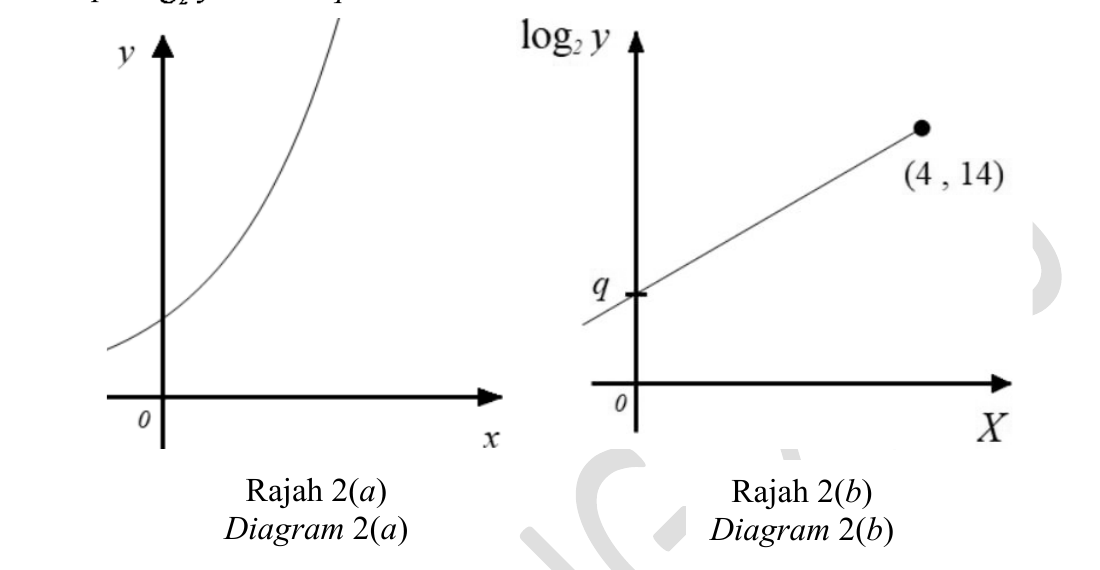
- (a)
Write X in terms of x.
[2] - (b)
Find the value of p and of q.
[2]
In a survey, k% of the teachers in a school own a tablet computer. Table 1 shows part of the binomial distribution of X when a sample of 4 teachers is selected at random. X is the number of teachers who own a tablet computer. Table 1: X = 0, 1; P(X = x) = 0.0081, 0.0756. (a)(i) In set notation, list all possible values of X. (ii) State the value of P(X ≥ 2). (b) Find the value of k.
Medium4 marks- (a)(i)
In set notation, list all possible values of X.
[1] - (a)(ii)
State the value of P(X ≥ 2).
[1] - (b)
Find the value of k.
[2]
Diagram 3 shows part of the curve y = f(x) which passes through R(h, 1) and cuts the y-axis at y = 10. The straight line RS is parallel to the y-axis (S is on the x-axis). The curve has a gradient function of −2x. Find (a) the value of h, (b) the area of the shaded region (bounded by the curve, the axes and RS) which is integrated with respect to x.
Medium7 marks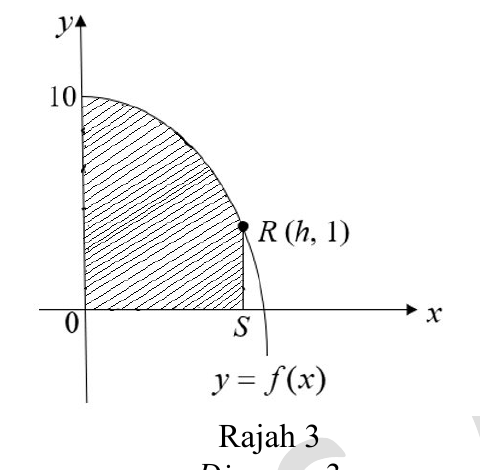
- (a)
Find the value of h.
[4] - (b)
Find the area of the shaded region, integrated with respect to x.
[3]
Diagram 4(a) shows a cylindrical scented candle of radius x cm and height y cm that needs to be placed in a cuboidal box as shown in Diagram 4(b) (13 cm by y cm by 2x cm) before being sold. Given that the total surface area of the scented candle is 968 cm² and the perimeter of the box is 168 cm, find the value of x and of y. Hence, state whether the box can accommodate the scented candle or not. [Use π = 22/7]
Medium8 marks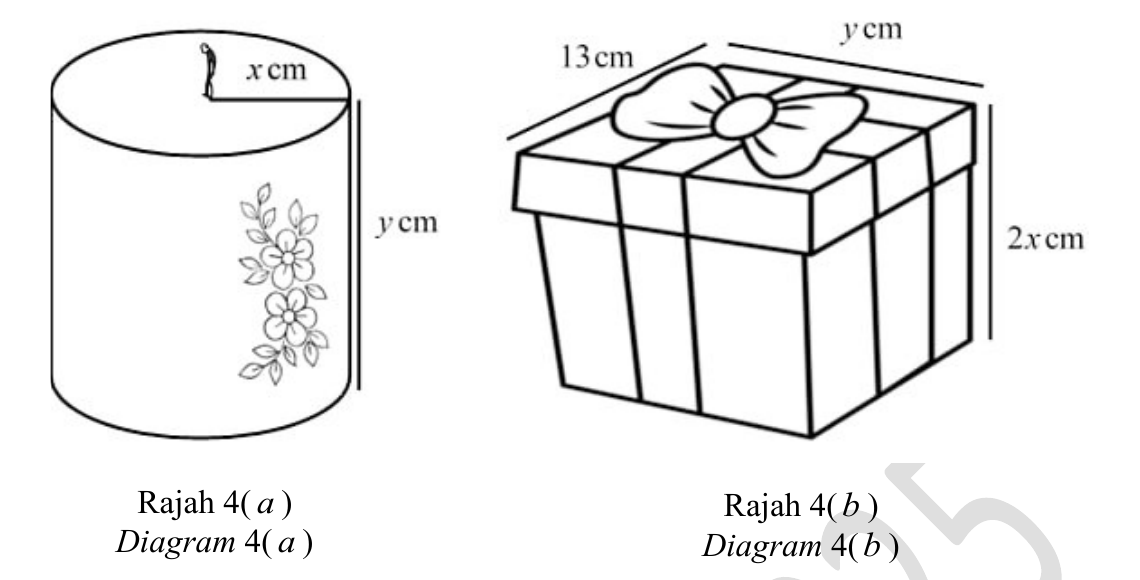
Find x and y, and state whether the box can accommodate the candle.
[8]
The Pahang state chess contingent sends 10 teachers consisting of a married couple (husband and wife), 5 male teachers and 3 female teachers to attend a meeting in Kuala Lumpur. 6 teachers travel in an MPV car and 4 in a regular car. (a) Calculate the number of ways the teachers travel to the meeting place if the husband and wife must be in the same car. (b) Diagram 5 shows the seating of the MPV (three rows of two seats). The married couple and 4 male teachers ride in the MPV. The married couple must sit in the same row. The remaining teachers ride in a normal car. Both vehicles must be driven by male teachers. Calculate the number of different ways to arrange the positions of the teachers in both vehicles.
Medium7 marks- (a)
Number of ways if the husband and wife must be in the same car.
[3] - (b)
Number of different ways to arrange the teachers in both cars.
[4]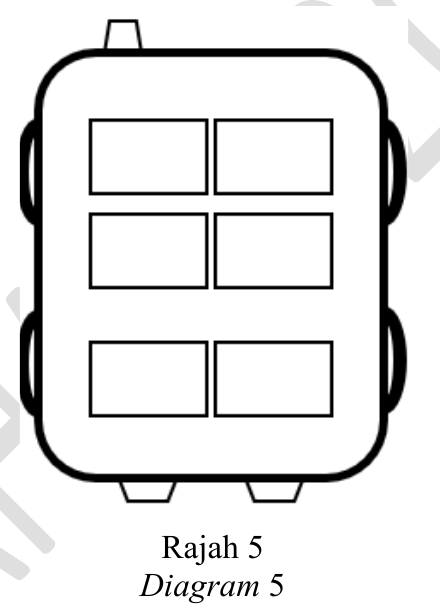
Section B
Diagram 6 shows four circles of different sizes. The largest circle has a radius of k cm. The radius of each circle is half of the radius of the previous one. The areas of the circles in descending order form a geometric progression. (a) Given that the sum of the areas of the four circles is 132 13/16 π cm², find the area of the first circle in terms of π. (b) The area of the nth circle is 25/4 π cm². Determine the value of n. (c) Find the sum to infinity of the areas, in cm², of the circles.
Medium8 marks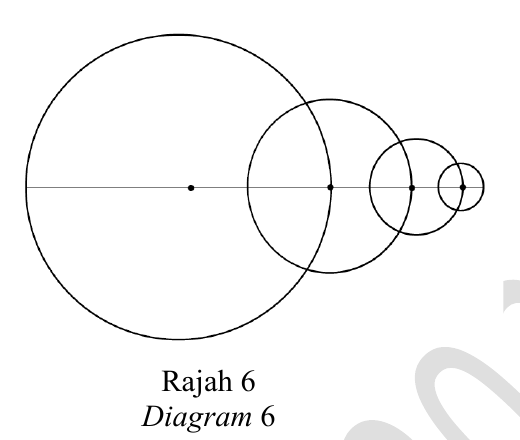
- (a)
Find the area of the first circle in terms of π.
[4] - (b)
Determine the value of n.
[2] - (c)
Find the sum to infinity of the areas.
[2]
Diagram 7 shows a piece of thin rectangular metal PQRS with PQ = x cm and height h cm (PS = x cm, SR = h cm). Sides PQ and SR are joined to form an open cylinder of height h cm. The perimeter of PQRS is 60 cm and the volume of the cylinder is V cm³. (a) Show that V = x²/(4π) (30 − x). Hence, find the height and the radius of the cylinder when its volume is maximum. (b) The cylinder is closed at the bottom and filled with oil at a rate of 4 cm³ s⁻¹. Find the rate of change of the height of oil in the cylinder if its radius is 5 cm.
Medium8 marks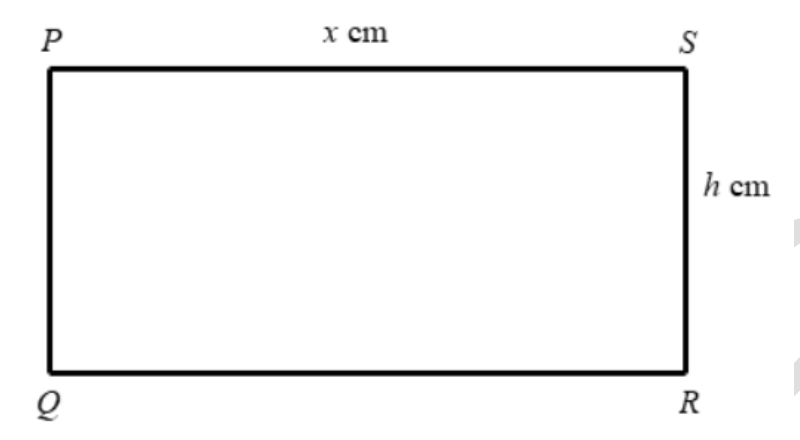
- (a)
Show that V = x²/(4π)(30 − x). Find the height and radius when V is maximum.
[5] - (b)
Find the rate of change of the height of oil if the radius is 5 cm.
[3]
Solution by scale drawing will not be accepted. Diagram 7 shows the vertices of a kite PQRS on a Cartesian plane, with Q(−1, 3), S(3, 1), R(x, y) and diagonals QS and PR meeting at N. QR is parallel to the y-axis. Find (a) the coordinates of point R, (b) the area of the kite PQRS if the ratio PN : NR is 1 : 2.
Medium8 marks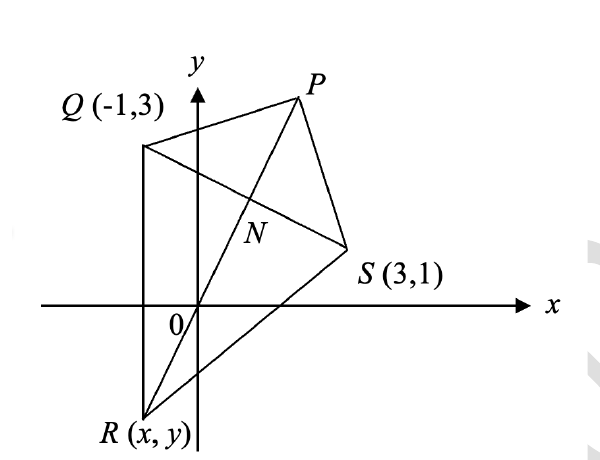
- (a)
Find the coordinates of point R.
[4] - (b)
Find the area of the kite PQRS if PN : NR = 1 : 2.
[4]