Write your answer on paper. Then open the answer to check it.
Section A
Diagram 1 shows the graph of the function f : x → |1 − 2x| for the domain −3 ≤ x ≤ 5. The graph starts at (−3, 7), has its vertex on the x-axis and ends at (5, 9). State (a)(i) the object of 9, (ii) the image of 2, (b) the vertex, (c) the domain of 0 ≤ f(x) ≤ 7.
Easy4 marks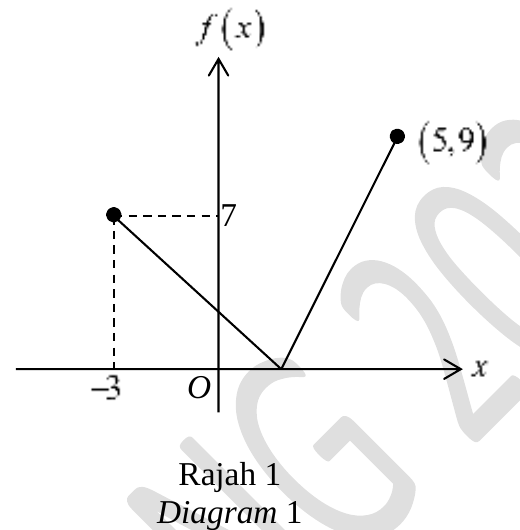
- (a)(i)
State the object of 9.
[1] - (a)(ii)
State the image of 2.
[1] - (b)
State the vertex.
[1] - (c)
State the domain of 0 ≤ f(x) ≤ 7.
[1]
The roots of the quadratic equation x(x − 6) = 4 + p are 3α and 3β respectively, where p is a constant. (a) Find the range of p if α ≠ β. (b) Given that α/2 and β/2 are the roots of another quadratic equation 2x² + qx + 1/3 = 0, with q a constant, find the values of p and q.
Easy5 marks- (a)
Find the range of p if α ≠ β.
[2] - (b)
Given that α/2 and β/2 are the roots of 2x² + qx + 1/3 = 0, find the values of p and q.
[3]
The first three terms of a sequence are log₁₀ p, log₁₀ pq and log₁₀ pq². (a) Show that the sequence is an arithmetic progression. (b) Find the sum of the first six terms.
Easy4 marks- (a)
Show that the sequence is an arithmetic progression.
[2] - (b)
Find the sum of the first six terms.
[2]
Diagram 2 shows a straight line AB with A(−6, 0) and B(3/2, 9). The point C divides the line segment AB such that 2AB = 3AC. Find (a) the coordinates of C, (b) the equation of the straight line which is perpendicular to AB and passing through C.
Easy5 marks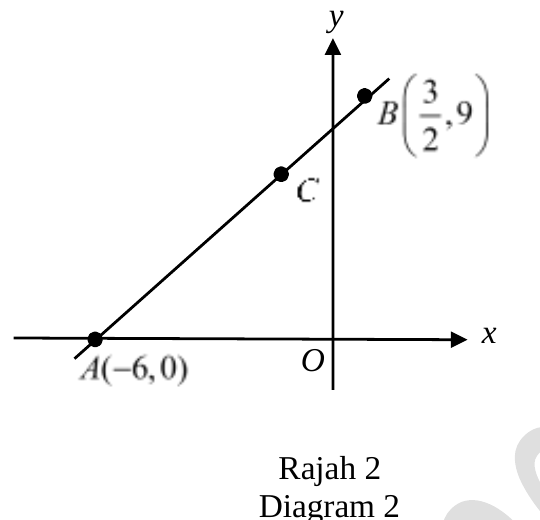
- (a)
Find the coordinates of C.
[2] - (b)
Find the equation of the straight line which is perpendicular to AB and passing through C.
[3]
Diagram 3 shows a straight line graph of y/x against 1/x². The line has y-intercept 4 and passes through (4, 12). (a) Express y in terms of x. (b) Hence, state the value of y if x = 3.5.
Easy4 marks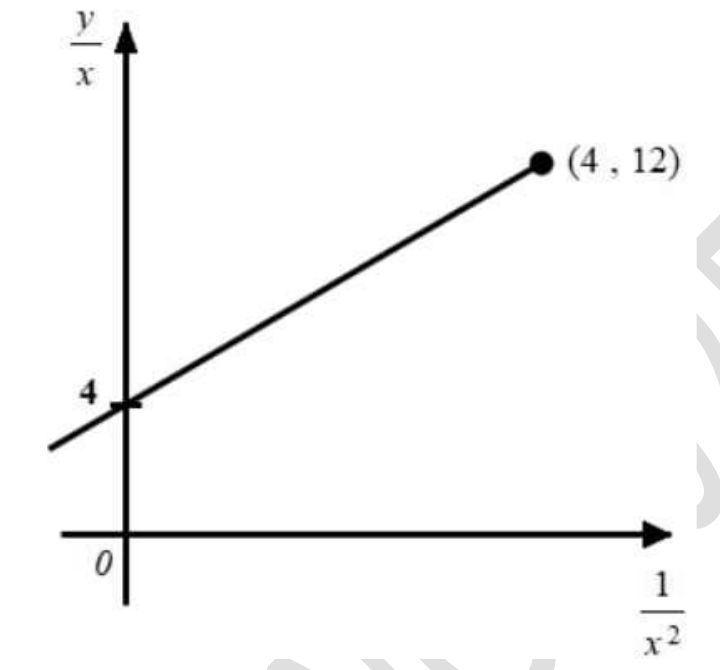
- (a)
Express y in terms of x.
[3] - (b)
Hence, state the value of y if x = 3.5.
[1]
Diagram 4 shows three vectors OA, OB and OC drawn on a Cartesian plane with A(1, 3), B(6, 4) and C(11, −3). It is given that OB : OE = 2 : 3 and O, B, E are collinear. (a)(i) On Diagram 4, mark and label the coordinates of E. (ii) State CE. (b) Given AN = m**i** − 3**j**, such that m is a constant and AN is parallel to CE, by using vectors find the value of m.
Medium5 marks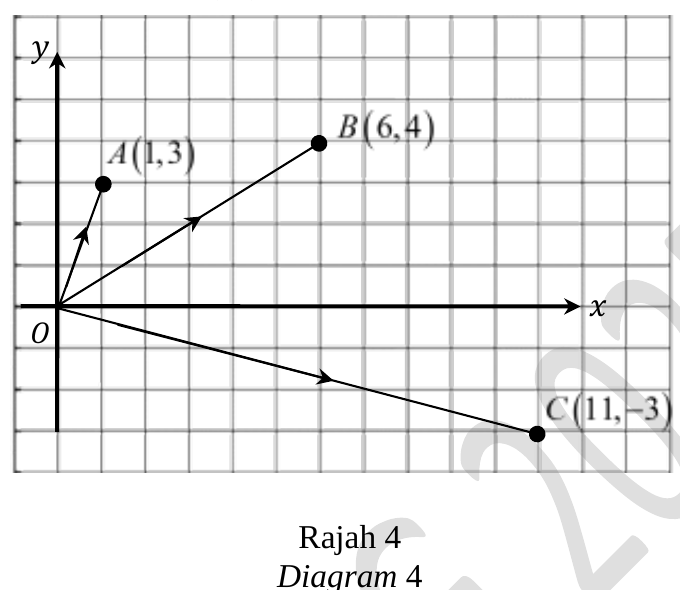
- (a)(i)
On Diagram 4, mark and label the coordinates of E.
[1] - (a)(ii)
State CE.
[1] - (b)
Given AN = m**i** − 3**j**, such that m is a constant and AN is parallel to CE, by using vectors find the value of m.
[3]
(a) Given that ∫ 1/(1 − 2x)³ dx = (1/p)(1 − 2x)^q + c, find the values of p and q. (b) Hence, find the value of ∫ from −1 to 1 of 1/(1 − 2x)³ dx.
Medium5 marks- (a)
Given that ∫ 1/(1 − 2x)³ dx = (1/p)(1 − 2x)^q + c, find the values of p and q.
[3] - (b)
Hence, find the value of ∫ from −1 to 1 of 1/(1 − 2x)³ dx.
[2]
(a) Find lim (x → 3) of (x² − 4x + 3)/(2x² − 5x − 3). (b) Given y = (2x + 1)/(x² − 3), find dy/dx.
Easy5 marks- (a)
Find lim (x → 3) of (x² − 4x + 3)/(2x² − 5x − 3).
[3] - (b)
Given y = (2x + 1)/(x² − 3), find dy/dx.
[2]
The school prefect has arranged chairs for an assembly for 15 teachers. The front row has 7 chairs while the back row has 8 chairs. 3 administrators will sit in the middle of the front row. (a) Calculate the numbers of different seat that Cikgu Hamdan and Cikgu Azlan can choose if they are not administrators and not sitting side by side. (b) There are 6 teachers including Cikgu Hamdan who want to give a speech. Calculate the number of ways to arrange the order of the teachers speaking if Cikgu Hamdan does not to be the first and last person to speak.
Medium7 marks- (a)
Calculate the numbers of different seat that Cikgu Hamdan and Cikgu Azlan can choose if they are not administrators and not sitting side by side.
[4] - (b)
There are 6 teachers including Cikgu Hamdan who want to give a speech. Calculate the number of ways to arrange the order of the teachers speaking if Cikgu Hamdan does not to be the first and last person to speak.
[3]
Given that log_c (pq) = 2 and log_c (p²q³) = 3. (a) Find the values of log_c p and log_c q. (b) Hence, state the values of p and q when c = 2.
Easy5 marks- (a)
Find the values of log_c p and log_c q.
[4] - (b)
Hence, state the values of p and q when c = 2.
[1]
Shahrul has a toy car collection which he collects every month. The number of toy cars increases every month according to geometric progression. The total number of toy cars in the first four months is ten times the total number of toy cars in the first two months. (a) If r represents the common ratio, show that r⁴ − 10r² + 9 = 0. Hence, find the positive values of r. (b) Calculate the expenses paid by Shahrul in the 6 months if he started to buy 3 toy cars and the average price of a toy car is RM7.25.
Medium8 marks- (a)
If r represents the common ratio, show that r⁴ − 10r² + 9 = 0. Hence, find the positive values of r.
[5] - (b)
Calculate the expenses paid by Shahrul in the 6 months if he started to buy 3 toy cars and the average price of a toy car is RM7.25.
[3]
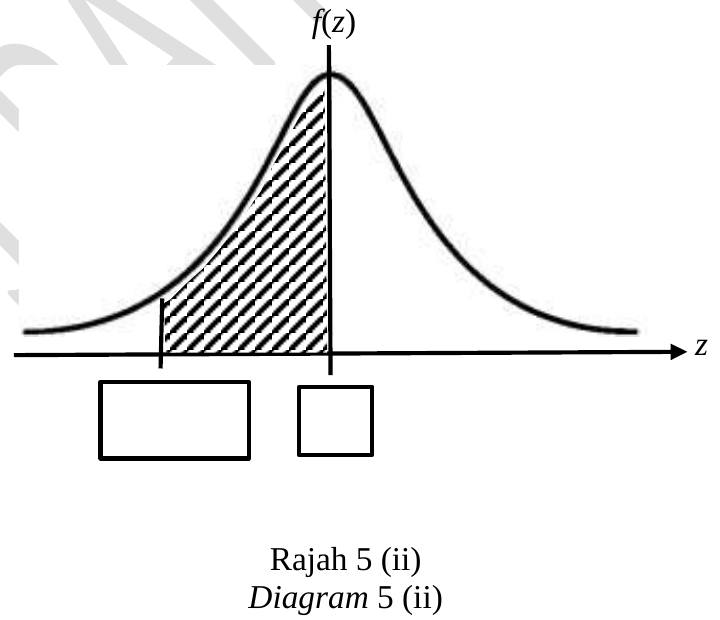
Diagram 5(i) shows the normal distribution curve for random variable X that represents the mass of orange, in gram, sold at a fruit stall with mean 350 g and standard deviation 40 g. Diagram 5(ii) shows the standard normal distribution curve corresponding to the graph in Diagram 5(i). Given the area of the shaded region is 37.29%. (a) On Diagram 5(ii), fill in the blanks with the value or expression in terms of k which corresponds to Diagram 5(i). (b)(i) Express the area of the shaded region in Diagram 5(ii) as probability notation. (ii) Hence, find the value of k.
Medium7 marks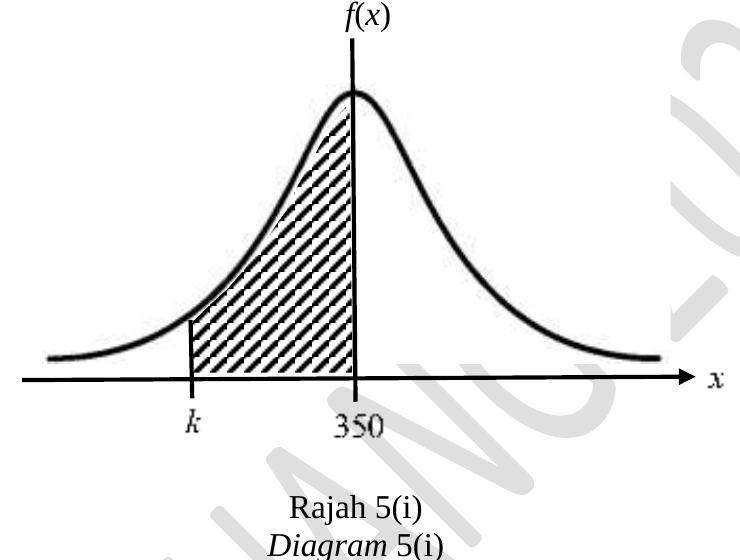
- (a)
On Diagram 5(ii), fill in the blanks with the value or expression in terms of k which corresponds to Diagram 5(i).
[2] - (b)(i)
Express the area of the shaded region in Diagram 5(ii) as probability notation.
[1] - (b)(ii)
Hence, find the value of k.
[4]
Section B
(a) Given the equation 2^(2x+1) × 3^(x−1) = 8ˣ × 3^(2x). Show that 6ˣ = 2/3. (b) Express 3/(3 − √6) + (3/2)√(8/27) in the form a + b√6.
Medium8 marks- (a)
Given the equation 2^(2x+1) × 3^(x−1) = 8ˣ × 3^(2x). Show that 6ˣ = 2/3.
[4] - (b)
Express 3/(3 − √6) + (3/2)√(8/27) in the form a + b√6.
[4]
(a) Find the value of cosec 120° in surd form. (b) Given that cos x = 2t, such that x is an acute angle, express cos 2x in terms of t. (c) Given that sin x = 15/17 for π/2 ≤ x ≤ π and cos y = −3/5 for π ≤ y ≤ 3π/2, find cos(x + y).
Medium8 marks- (a)
Find the value of cosec 120° in surd form.
[4] - (b)
Given that cos x = 2t, such that x is an acute angle, express cos 2x in terms of t.
[2] - (c)
Given that sin x = 15/17 for π/2 ≤ x ≤ π and cos y = −3/5 for π ≤ y ≤ 3π/2, find cos(x + y).
[2]
Diagram 6 shows a right-angled triangle AOB and a sector COB with centre O. Angle BOC = 3α rad. It is given that OB = r cm and OC = 4CA. The perimeter of the shaded region is 20 cm. (a) Show that r = 20/(3α + 1). (b) Hence, find the area of the shaded region in terms of α.
Medium8 marks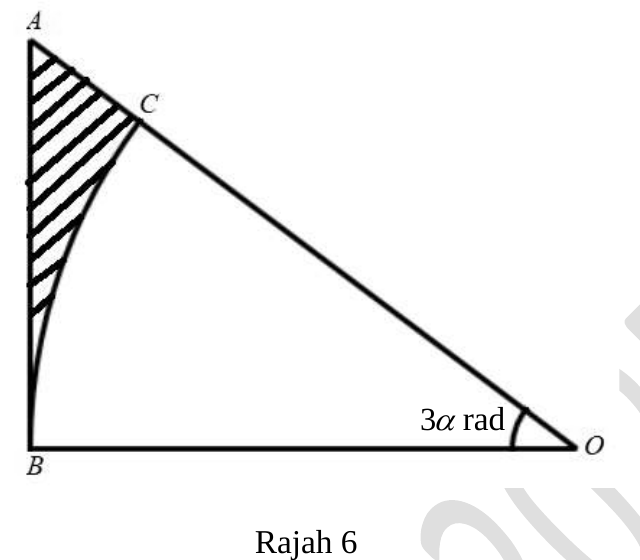
- (a)
Show that r = 20/(3α + 1).
[4] - (b)
Hence, find the area of the shaded region in terms of α.
[4]