Write your answer on paper. Then open the answer to check it.
Section A
Solve the following simultaneous equations: x + y + z = −10, 2x − y + 3z = 1, −x + 4y − 2z = −29.
Easy5 marksSolve x + y + z = −10, 2x − y + 3z = 1, −x + 4y − 2z = −29.
[5]
Diagram 1 shows the relation between set P, set Q and set R. Set P maps to set Q by the function (x + 1)/2 and maps to set R by fg : x → x² + 2x + 4. The diagram shows arrows P → Q, Q → R and P → R (fg). (a) Write the function which maps set P to set Q by using the function notation. (b)(i) Find the function which maps set Q to set R. (ii) Find the values of x when f(x) = 19.
Medium6 marks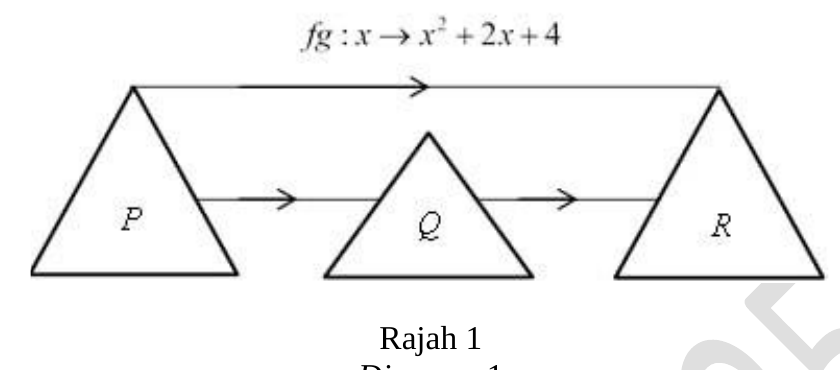
- (a)
Write the function which maps set P to set Q by using the function notation.
[1] - (b)(i)
Find the function which maps set Q to set R.
[3] - (b)(ii)
Find the values of x when f(x) = 19.
[2]
Diagram 2 shows sector OAB and sector ODC with centre O. It is given that OA = 4 cm, the ratio OA : OD = 2 : 3 and the area of the shaded region is 11.25 cm². Find (a) θ, in radians, (b) the perimeter, in cm, of the shaded region.
Medium6 marks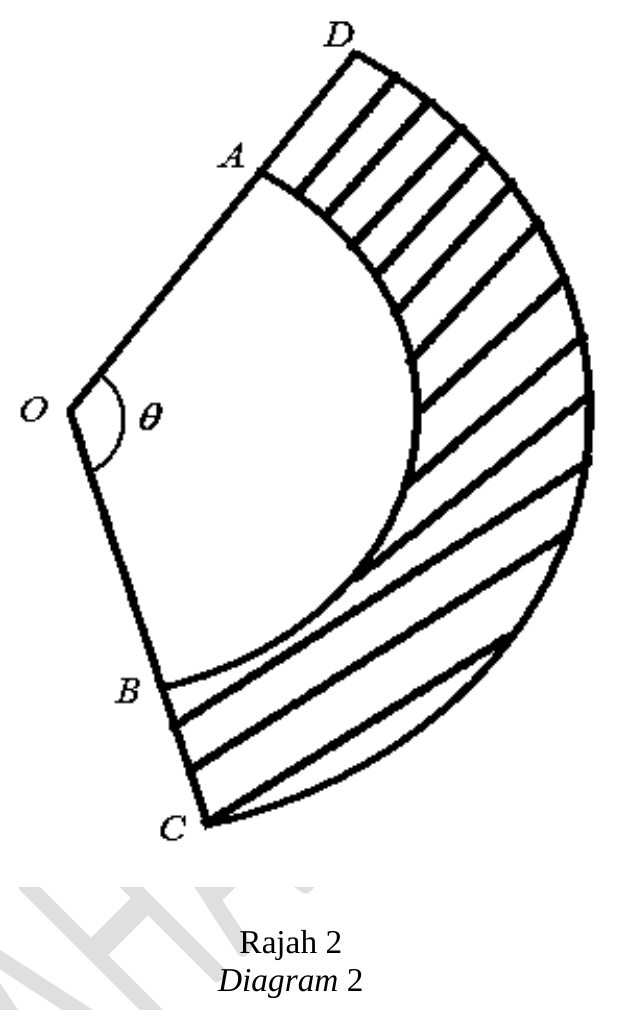
- (a)
Find θ, in radians.
[3] - (b)
Find the perimeter, in cm, of the shaded region.
[3]
Diagram 3 shows rectangle PQRS. The equation of the straight line PS is y = 2x − 7, with Q(−1, 1) and S(6, 5). (a) Find (i) the coordinates of P, (ii) the area, in unit², of rectangle PQRS. (b) A point T moves such that its distance from point S is always 5 units. Find the equation of the locus of T.
Medium8 marks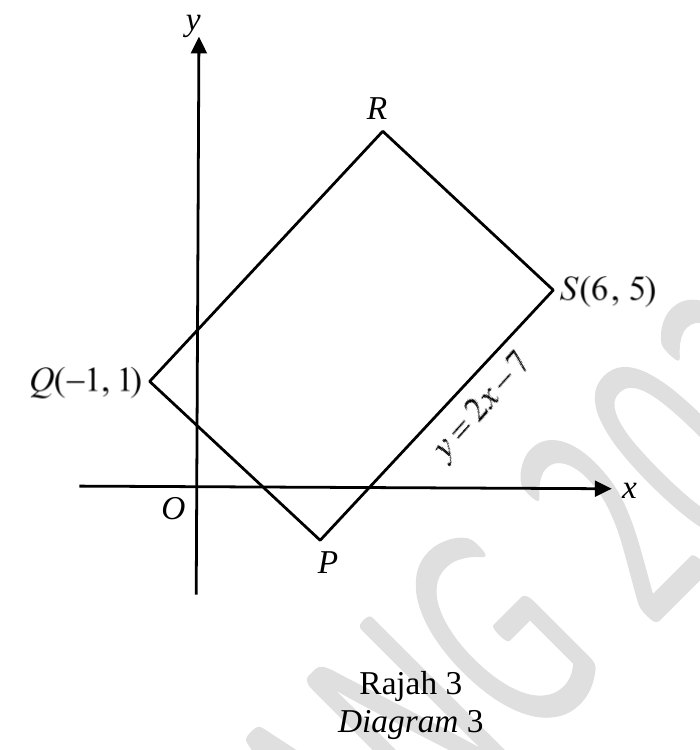
- (a)(i)
Find the coordinates of P.
[3] - (a)(ii)
Find the area, in unit², of rectangle PQRS.
[3] - (b)
Find the equation of the locus of T.
[2]
(a) Given px² + qx − 3 = 0, with x = α and x = β as the solutions of the quadratic equation, (i) express α²β + β²α in terms of p and q, (ii) form a quadratic equation with the roots 6α and 6β in terms of p and q; give the answer in general form. (b) The curve of the graph of f(x) = 3x² − 12x − 36 intersects the x-axis at two different points. (i) State the coordinates of the intersection points. (ii) Express f(x) in vertex form by completing the square. Hence, state the function g(x) if g(x) is the function f(x) reflected on the y-axis.
Medium8 marks- (a)(i)
Express α²β + β²α in terms of p and q.
[2] - (a)(ii)
Form a quadratic equation with the roots 6α and 6β in terms of p and q. Give the answer in general form.
[2] - (b)(i)
State the coordinates of the intersection points.
[1] - (b)(ii)
Express f(x) in vertex form by using of completing the square. Hence, state the function g(x) if g(x) is the function f(x) reflected on the y-axis.
[3]
Diagram 4 shows a rectangular sheet of metal, 8 m by 3 m, and a square of side x m is cut out from each corner. The remaining piece is folded to make an open box. Given the height of the metal box is x. (a) Show that the volume of the box, V m³, is given by V = 4x³ − 22x² + 24x. (b) Find the maximum volume, in m³, of the box. (c) Given the sides of the square cut out increase from 1 m to 1.09 m, find the approximate change in the volume, in m³, of the box. (d) Encik Amin fills the chemical liquid in the metal box with rate 0.1 m³s⁻¹. Calculate the rate of change of height, in ms⁻¹, of the liquid in the metal box when x = 0.5 m.
Medium10 marks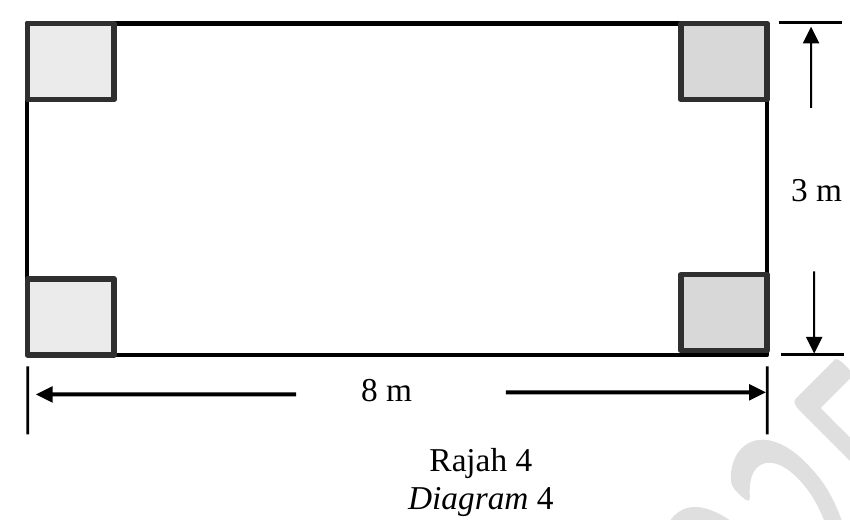
- (a)
Show that the volume of the box, V m³, is given by V = 4x³ − 22x² + 24x.
[2] - (b)
Find the maximum volume, in m³, of the box.
[4] - (c)
Given the sides of the square cut out increase from 1 m to 1.09 m, find the approximate change in the volume, in m³, of the box.
[2] - (d)
Calculate the rate of change of height, in ms⁻¹, of the liquid in the metal box when x = 0.5 m.
[2]
(a) Prove sin 2x = 2 tan x/(1 + tan² x). (b) Hence, solve the equation 4 tan x/(1 + tan² x) = −√3 for 0 ≤ x ≤ 2π. Give the answer in π. (c) If 4 tan(x/2)/(1 + tan²(x/2)) = −√3, state the corresponding values of x.
Medium7 marks- (a)
Prove sin 2x = 2 tan x/(1 + tan² x).
[2] - (b)
Hence, solve the equation 4 tan x/(1 + tan² x) = −√3 for 0 ≤ x ≤ 2π. Give the answer in π.
[3] - (c)
If 4 tan(x/2)/(1 + tan²(x/2)) = −√3, state the corresponding values of x.
[2]
Section B
(a) The president of a basketball club organises a practice session for trainees on scoring goals. Each trainee takes 6 trial throws. The probability that a trainee scores a goal is p. After the session, it is found that the mean number of goals scored by a trainee is 2.85. (i) State the value of p. (ii) A trainee is chosen at random; find the probability that the trainee scores at least 2 goals. (b) Factory M produces a type of toy car. Given X represents the assembly time for this toy car, in minutes. The assembly time is normally distributed with a mean of 55 minutes and a standard deviation of 4 minutes. (i) Factory M closes at 5 p.m. every day. If one worker starts to assemble a toy car at 4 p.m., what is the probability that he will finish this job before the factory closes for the day? (ii) Calculate the value of k if 26.8% of the workers take more than k minutes to finish their assembling job.
Medium10 marks- (a)(i)
State the value of p.
[1] - (a)(ii)
A trainee is chosen at random, find the probability that the trainee scores at least 2 goals.
[3] - (b)(i)
What is the probability that he will finish this job before the factory closes for the day?
[2] - (b)(ii)
Calculate the value of k if 26.8% of the workers take more than k minutes to finish their assembling job.
[4]
Diagram 5 shows part of the curve y = 3/(2x − 1)², which passes through the y-axis at p. (a) Find the equation of the tangent to the curve at p. (b)(i) Find the area bounded by the curve y = 3/(2x − 1)², the x-axis and the straight lines x = −3 and x = −1. (ii) Find the volume, in terms of π, when the region is revolved through 90° about the x-axis.
Medium10 marks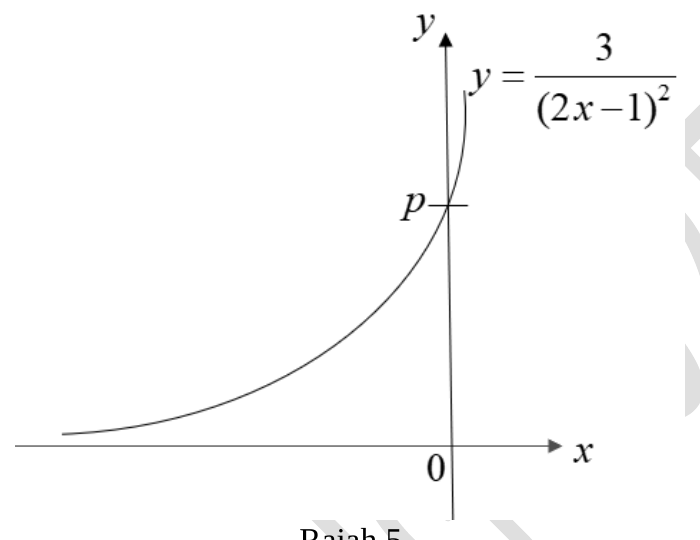
- (a)
Find the equation of the tangent to the curve at p.
[4] - (b)(i)
Find the area bounded by the curve y = 3/(2x − 1)², the x-axis and the straight lines x = −3 and x = −1.
[3] - (b)(ii)
Find the volume, in terms of π, when the region is revolved through 90° about the x-axis.
[3]
Diagram 6 shows a quadrilateral PQRS. The straight line PR intersects the straight line QS at point T. It is given that QT : TS = 2 : 3, PQ = 10**u**, PS = 25**v** and QR = −**u** + 15**v** (vectors PQ, PS, QR). (a) Express in terms of **u** and **v** (i) QS, (ii) PT. (b)(i) Find the ratio PT : TR. (ii) Hence, find the area of triangle STR, given that the area of triangle PSR is 6.05 units².
Medium10 marks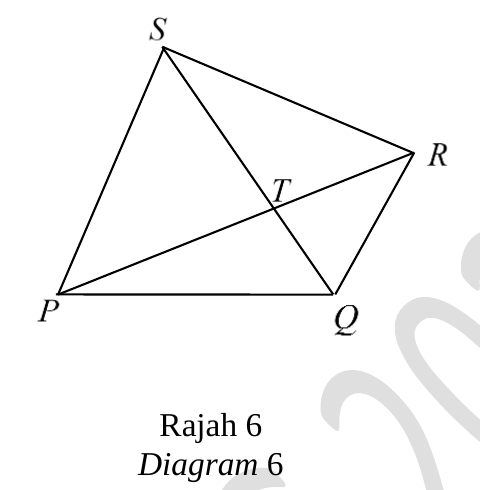
- (a)(i)
Express QS in terms of **u** and **v**.
[1] - (a)(ii)
Express PT in terms of **u** and **v**.
[2] - (b)(i)
Find the ratio PT : TR.
[4] - (b)(ii)
Hence, find the area of triangle STR, given that the area of triangle PSR is 6.05 units².
[3]
Use the graph paper provided to answer this question. Table 1 shows the values of two variables, x and y, obtained from an experiment. The variables x and y are related by the equation y = a/bˣ, such that a and b are constants. x: 1, 2, 3, 4, 5, 6; y: 2.27, 3.00, 3.97, 5.26, 6.96, 9.39. (a) Based on Table 1, construct a table for the values of ln y. (b) Plot the graph of ln y against x, using a scale of 2 cm to 1 unit on the x-axis and 2 cm to 0.2 unit on the ln y-axis. Hence, draw the line of best fit. (c) Use your graph from 11(b) to find the value of (i) y when x = 3.6, (ii) a, (iii) b.
Medium10 marks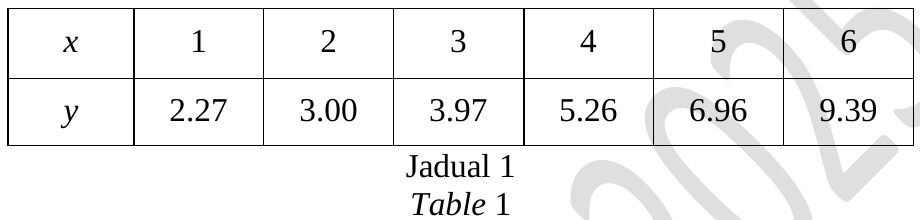
- (a)
Based on Table 1, construct a table for the values of ln y.
[1] - (b)
Plot the graph of ln y against x, using a scale of 2 cm to 1 unit on the x-axis and 2 cm to 0.2 unit on the ln y-axis. Hence, draw the line of best fit.
[3] - (c)(i)
Use your graph from 11(b) to find the value of y when x = 3.6.
[1] - (c)(ii)
Use your graph from 11(b) to find the value of a.
[3] - (c)(iii)
Use your graph from 11(b) to find the value of b.
[2]
Section C
A particle moves along a straight line with an initial velocity of 15 ms⁻¹. Its acceleration, a ms⁻², is given by a = 2t − 8, where t is the time, in seconds, after passing through a fixed point O. [Assume motion to the right is positive] (a) Find (i) the minimum velocity, in ms⁻¹, of the particle, (ii) the time range during which the particle moves towards the right. (b) Sketch the velocity-time graph of the motion of the particle for 0 ≤ t ≤ 8. (c) Calculate the distance, in m, travelled by the particle during the third second.
Hard10 marks- (a)(i)
Find the minimum velocity, in ms⁻¹, of the particle.
[3] - (a)(ii)
Find the time range during which the particle moves towards the right.
[2] - (b)
Sketch the velocity-time graph of the motion of the particle for 0 ≤ t ≤ 8.
[2] - (c)
Calculate the distance, in m, travelled by the particle during the third second.
[3]
Diagram 7 shows a triangle WXY with XY = 19 cm, XW = 26 cm and angle YXW = 72°. (a) Calculate the length, in cm, of WY. (b) A quadrilateral WXYZ is formed such that WY is a diagonal. Given that ∠WYZ = 50° and WZ = 22 cm. (i) Find the possible values of ∠WZY. (ii) Calculate the length of YZ when ∠WZY < 90°. (iii) Calculate the area of the quadrilateral WXYZ.
Medium10 marks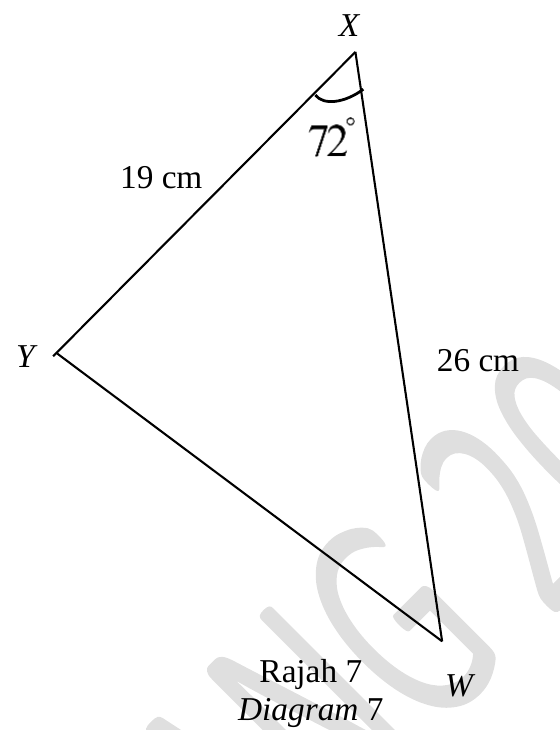
- (a)
Calculate the length, in cm, of WY.
[2] - (b)(i)
Find the possible values of ∠WZY.
[3] - (b)(ii)
Calculate the length of YZ when ∠WZY < 90°.
[2] - (b)(iii)
Calculate the area of the quadrilateral WXYZ.
[3]
Table 2 shows the price index of the three materials, P, Q and R that are used to produce a type of bag. Item P: 125 (2022 based on 2020), a (2024 based on 2022). Item Q: 116, 140. Item R: x, 120. (a)(i) Find the price index of item P in the year 2024 based on the year 2020 in terms of a. (ii) Hence, given the price index of the item P in the year 2024 based on the year 2022 is 116.92, find the price of the item P in the year 2020 if the price in the year 2024 is RM9.50. (b)(i) The composite index for the production cost of the bag in the year 2022 based on the year 2020 is 124.5. The costs of the items P, Q and R used are in the ratio 4 : 2 : 6. Find the value of x. (ii) The price of the bag in 2020 was RM47.40. Hadi has collected RM60.00 in 2022 to buy the bag. Can Hadi buy the bag?
Medium10 marks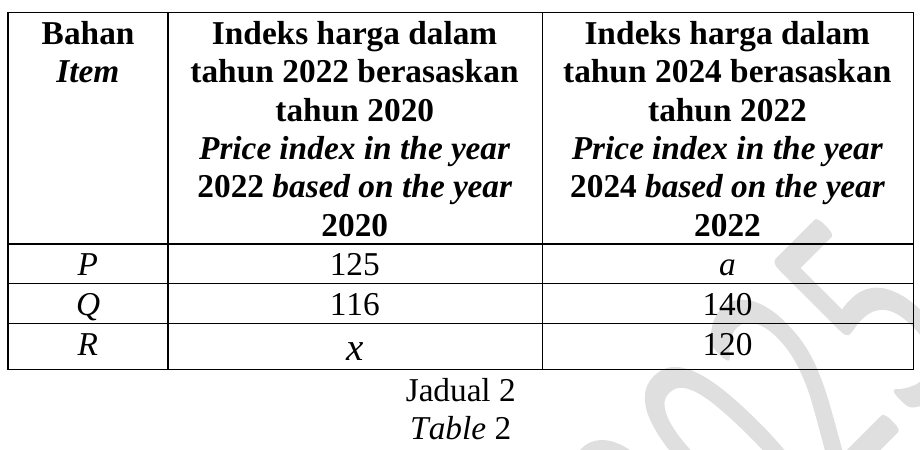
- (a)(i)
Find the price index of item P in the year 2024 based on the year 2020 in terms of a.
[2] - (a)(ii)
Hence, given the price index of the item P in the year 2024 based on the year 2022 is 116.92, find the price of the item P in the year 2020 if the price in the year 2024 is RM9.50.
[3] - (b)(i)
The composite index for the production cost of the bag in the year 2022 based on the year 2020 is 124.5. The costs of the items P, Q and R used are in the ratio 4 : 2 : 6. Find the value of x.
[2] - (b)(ii)
The price of the bag in 2020 was RM47.40. Hadi has collected RM60.00 in 2022 to buy the bag. Can Hadi buy the bag?
[3]
Amir produces two types of beverage products, Apple Juice and Orange Juice. The cost of selling x units of Apple Juice is RM12.50 per bottle, and the cost of selling y units of Orange Juice is RM10.00 per bottle. The beverages produced by Amir are based on the following constraints: I The total number of bottles of Apple Juice and Orange Juice produced is less than m units. II The number of bottles of Orange Juice produced is more than n units. III The number of bottles of Orange Juice produced does not exceed twice the number of bottles of Apple Juice. (a) Constraints I and II have been drawn on a graph, and the shaded region represents the points that satisfy both constraints. State the value of m and the value of n. (b) Write an inequality for Constraint III, other than x > 0 and y > 0. Hence, construct and label the Region R that satisfies all the given constraints. (c)(i) On a certain day, the ratio of the number of bottles of Orange Juice to the number of bottles of Apple Juice produced is 5 : 3. Determine the possible number of bottles of Apple Juice produced on that day. (ii) Given that the total cost of producing Apple Juice and Orange Juice is RMk, express k in terms of x and y. Hence, draw the objective function and find the maximum cost.
Medium10 marks- (a)
State the value of m and the value of n.
[1]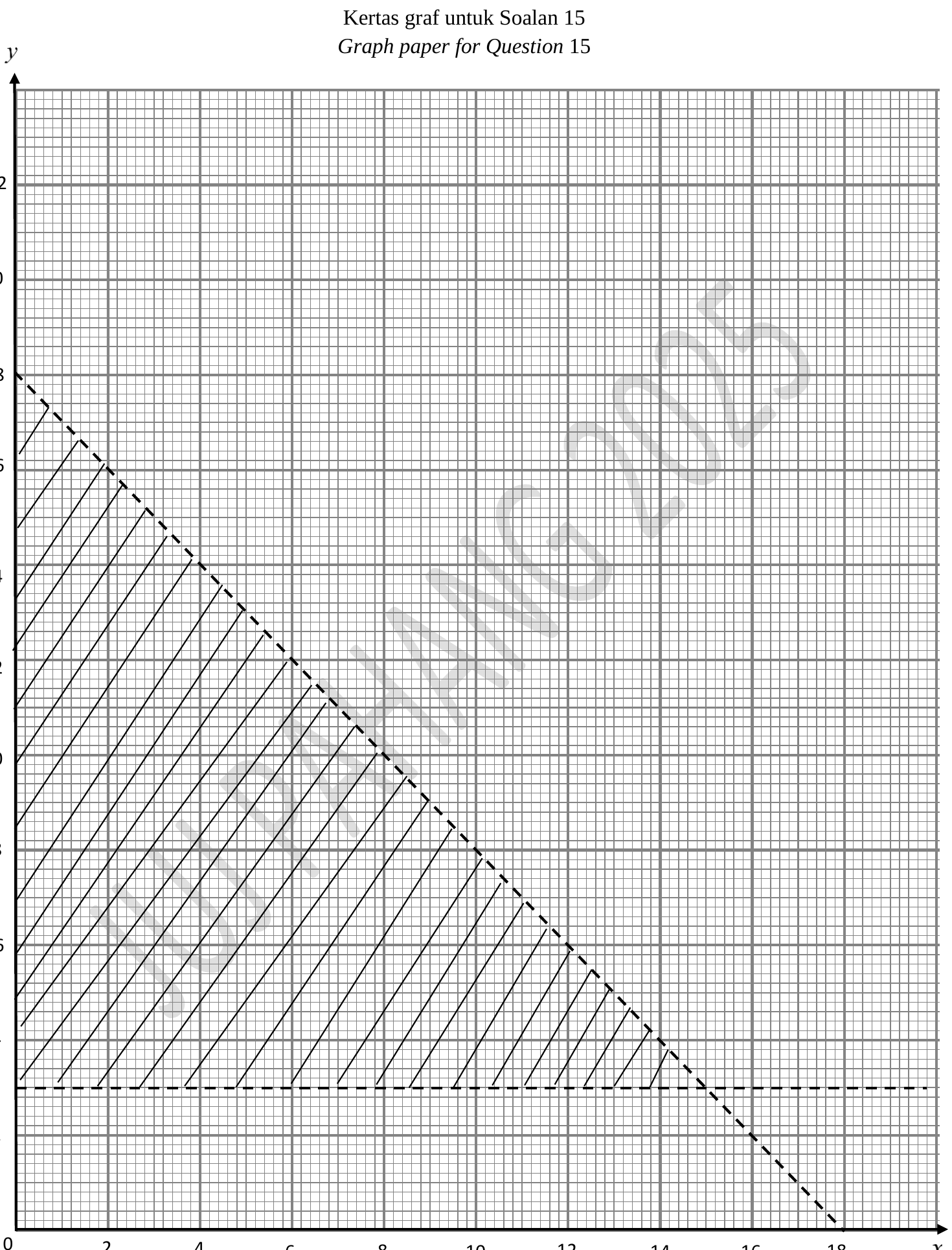
- (b)
Write an inequality for Constraint III, other than x > 0 and y > 0. Hence, construct and label the Region R that satisfies all the given constraints.
[3] - (c)(i)
Determine the possible number of bottles of Apple Juice produced on that day.
[2] - (c)(ii)
Given that the total cost of producing Apple Juice and Orange Juice is RMk, express k in terms of x and y. Hence, draw the objective function and find the maximum cost.
[4]