Write your answer on paper. Then open the answer to check it.
Section A
Diagram 1 shows a rhombus ABCD. The equations of the straight lines AB and BC are 2y − x − 8 = 0 and 2y + x − 4 = 0 respectively. The straight line DB is extended to a point N such that DB : BN = 2 : 1. D is (−2, −1). Find (a) the coordinates of N, (b) the equation of the straight line AD.
Medium6 marks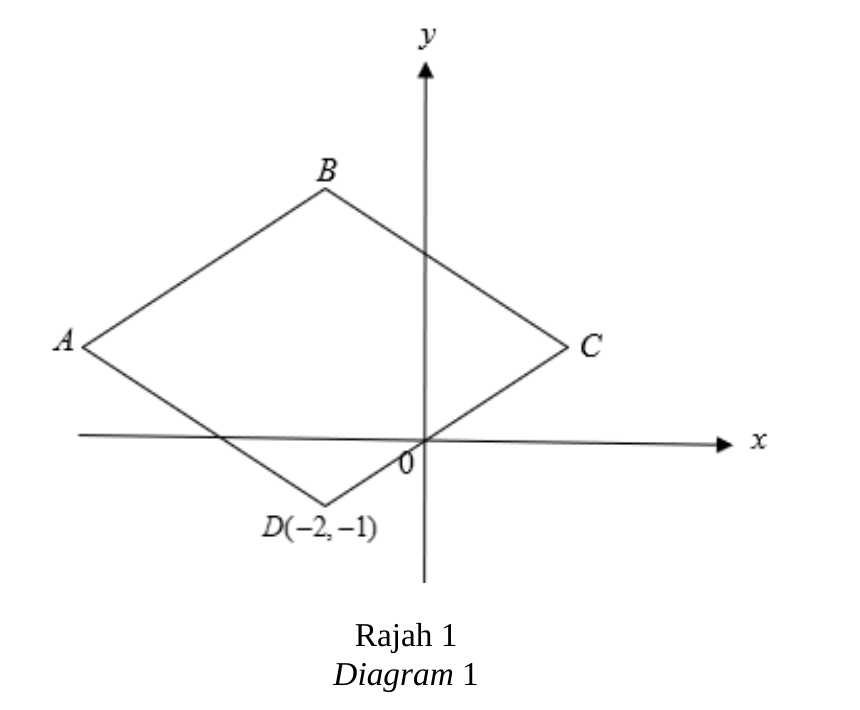
- (a)
Find the coordinates of N.
[4] - (b)
Find the equation of the straight line AD.
[2]
(a) Given h(x) = (1 − 2x)³, evaluate h′(1). (b) A curve has the equation y = 3x + 4/x. If x is decreasing at a constant rate of 3 units per second, find the rate of change of y when x = 2.
Medium7 marks- (a)
Given h(x) = (1 − 2x)³, evaluate h′(1).
[3] - (b)
A curve has the equation y = 3x + 4/x. If x is decreasing at a constant rate of 3 units per second, find the rate of change of y when x = 2.
[4]
The variables x and y are related by the equation x/y = ax² + bx, where a and b are constants. Two straight line graphs are obtained by plotting relations from the equation. Table 1.1 and Table 1.2 show the coordinates of points on the respective lines. Table 1.1: x = 0, 1/y = −2k. Table 1.2: 1/x = 0, 1/(xy) = k − 4. Express a in terms of b.
Easy3 marks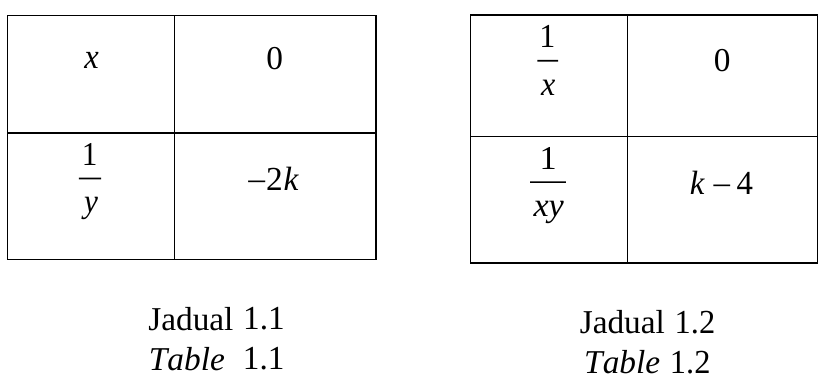
Express a in terms of b.
[3]
Solve the following system of linear equations using the elimination method and/or substitution: 2x − 3y + z = 16, 3x − y + 2z = 19, 4x + 3y + 3z = 18.
Easy5 marksSolve the system 2x − 3y + z = 16, 3x − y + 2z = 19, 4x + 3y + 3z = 18.
[5]
(a) Sketch the graph of y = 2 + tan 2x for 0 ≤ x ≤ π. (b) Diagram 2 shows an angle of −(10/9)π rad on a Cartesian plane. State the reference angle in terms of π rad.
Easy4 marks- (a)
Sketch the graph of y = 2 + tan 2x for 0 ≤ x ≤ π.
[3]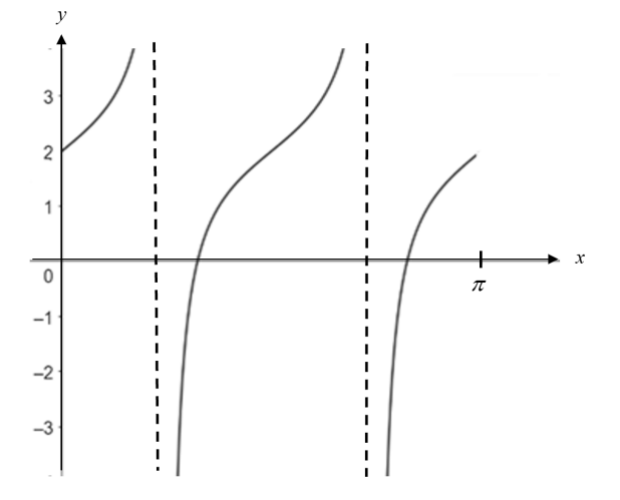
- (b)
State the reference angle in terms of π rad.
[1]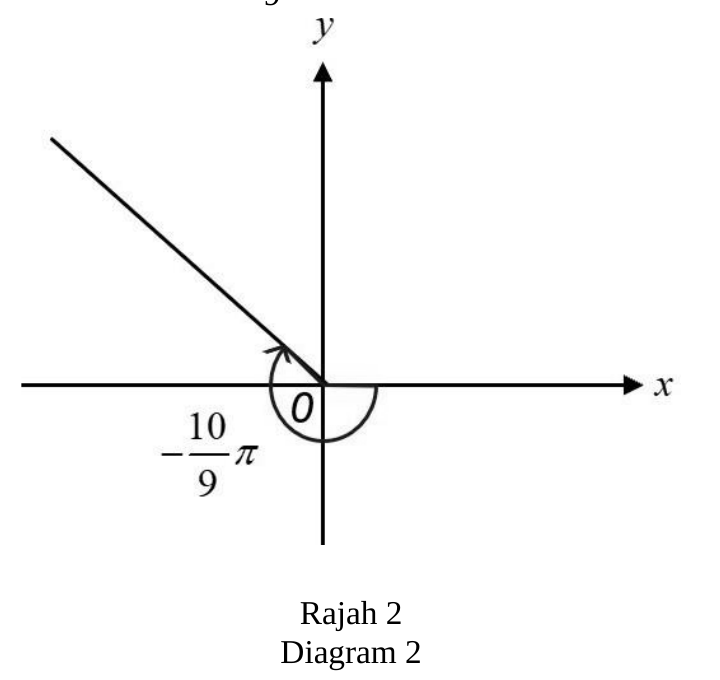
(a) Diagram 3.1 shows a sector of a circle with centre O and an arc AD which subtends an angle of θ rad at O. The radius is r unit and the area of sector AOD is A unit². Based on Diagram 3.1, derive A = ½r²θ. (b) Diagram 3.2 shows another arc EF with the same centre O and radius 16 cm drawn on Diagram 3.1. OBE and OCF are two straight lines such that B and C lie on arc AD. Arc lengths AB, BC and CD are equal. AE and DF are tangents to arc AD at A and D respectively. [Use π = 3.142] Given OA = 12 cm, calculate the area, in cm², of the whole Diagram 3.2.
Medium5 marks- (a)
Based on Diagram 3.1, derive A = ½r²θ.
[2]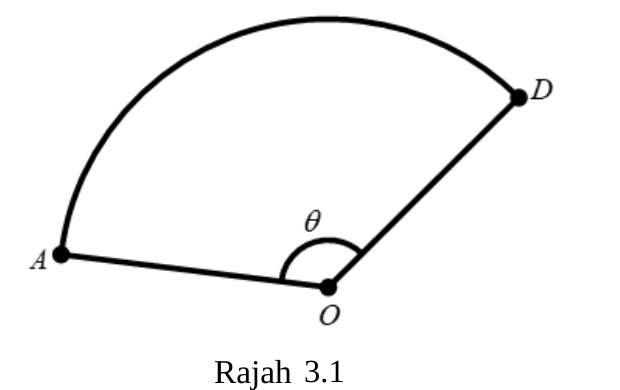
- (b)
Given OA = 12 cm, calculate the area, in cm², of the whole Diagram 3.2. [Use π = 3.142]
[3]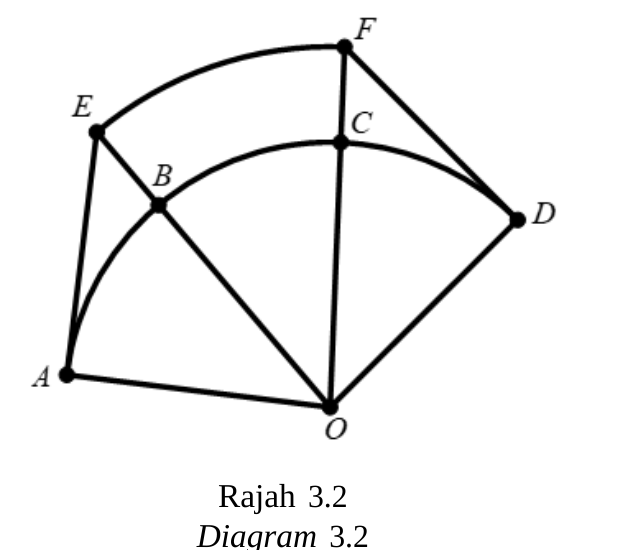
The function h is defined by h(x) = |2x − 5|. (a) State h(1). (b) (i) Find the domain for h(x) ≤ 5. (ii) Hence, sketch the graph of the function h(x).
Easy5 marks- (a)
State h(1).
[1] - (b)(i)
Find the domain for h(x) ≤ 5.
[2] - (b)(ii)
Hence, sketch the graph of the function h(x).
[2]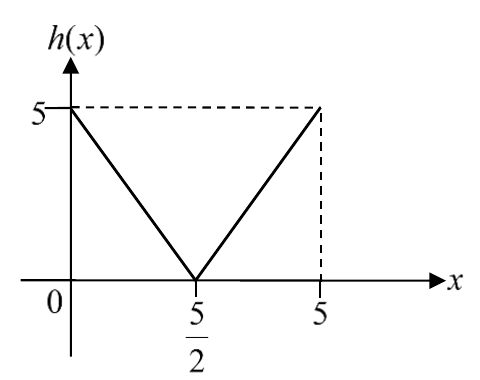
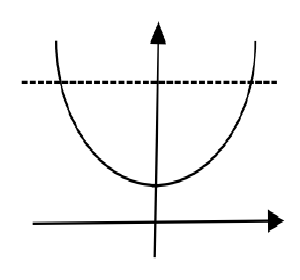
(a) Diagram 4 shows a standard normal distribution curve. Given P(0 < z < k) = 0.3125, state P(z > k). (b) The mass of students in a school has a normal distribution with mean 55 kg and standard deviation 10 kg. Find (i) the mass of the students which give a standard score of 0.5, (ii) the percentage of students with mass greater than 48 kg.
Medium6 marks- (a)
Given P(0 < z < k) = 0.3125, state P(z > k).
[1]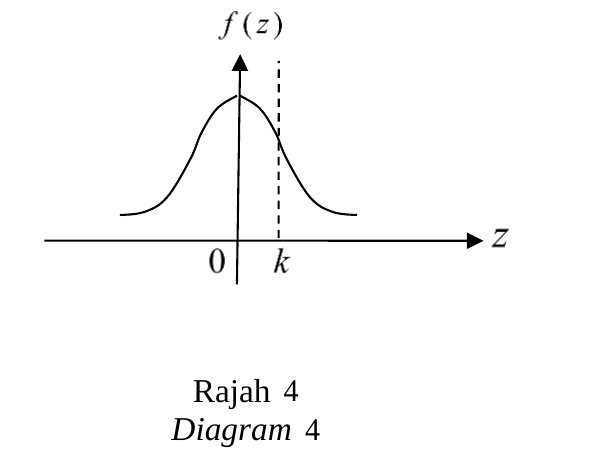
- (b)(i)
Find the mass of the students which give a standard score of 0.5.
[2] - (b)(ii)
Find the percentage of students with mass greater than 48 kg.
[3]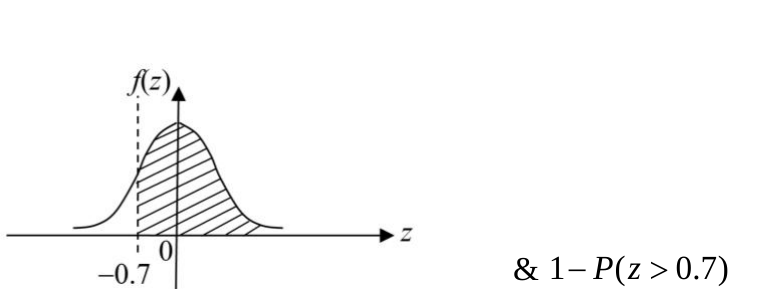
(a) The amount of caffeine in a person's body after drinking coffee is C = C₀e^(−0.15t), where C₀ is the initial caffeine content, in mg, and C is the caffeine content, in mg, after t hours. Find the time needed for the caffeine level to reduce to half of its original value. Round off your answer to the nearest whole number. (b) Diagram 5 shows a triangular metal ABC designed by an engineer to support a building structure. AC = √6 m, BC = √2/(√3 + √2) m, AB = √(16 − 4√6) m. Determine whether triangle ABC is a right-angled triangle at C or not. Show your calculations.
Medium6 marks- (a)
Find the time needed for the caffeine level to reduce to half of its original value. Round off to the nearest whole number.
[3] - (b)
Determine whether triangle ABC is a right-angled triangle at C or not. Show your calculations.
[3]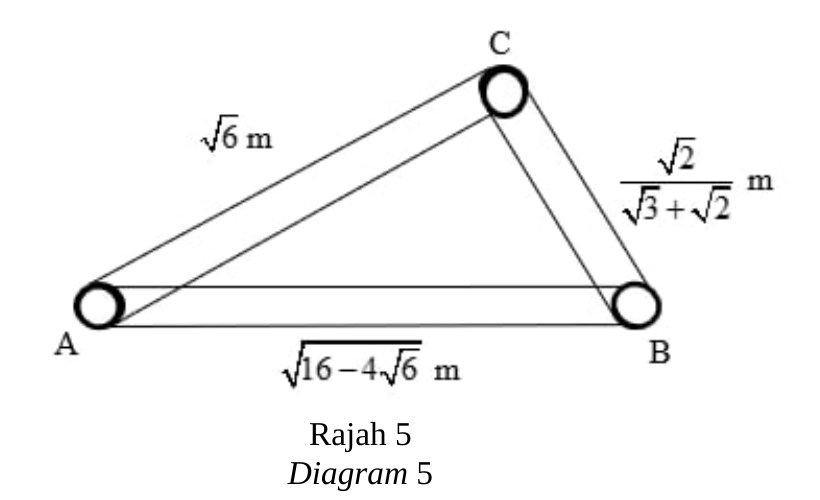
(a) Find the equation of the curve that has the gradient function dy/dx = 4x + 9 and passes through the point A(2, −3). (b) Given ∫₁³ f(x) dx = 4, ∫₃⁶ f(x) dx = 5 and ∫₁⁶ f(x) dx = k. Find (i) the value of k, (ii) ∫₁³ [7 − 2f(x)] dx.
Easy7 marks- (a)
Find the equation of the curve that has the gradient function dy/dx = 4x + 9 and passes through the point A(2, −3).
[3] - (b)(i)
Find the value of k.
[1] - (b)(ii)
Find ∫₁³ [7 − 2f(x)] dx.
[3]
The graph of the quadratic function f(x) = px² − 8x + q, where p and q are constants, has a maximum point. (a) Given p is an integer such that −2 < p < 2, state the value of p. (b) Using the answer from 11(a), find the value of q when the graph touches the x-axis at one point.
Easy3 marks- (a)
Given p is an integer such that −2 < p < 2, state the value of p.
[1] - (b)
Using the answer from 11(a), find the value of q when the graph touches the x-axis at one point.
[2]
A teacher plans to save money over a period of 2 years. Plan A: He saves RM x in the first month and increases the amount by RM20 every month thereafter. Plan B: He saves RM2100 in the first year and increases the savings in the following year by RM400. (a) For Plan A, if he saves RM240 in the 3rd month, calculate his savings in the 6th month. (b) Determine which plan allows the teacher to reach the savings target of RM10320 earlier. Justify your answer.
Medium7 marks- (a)
For Plan A, if he saves RM240 in the 3rd month, calculate his savings in the 6th month.
[3] - (b)
Determine which plan allows the teacher to reach the savings target of RM10320 earlier. Justify your answer.
[4]
Section B
(a) Given that the graph of the quadratic function f(x) = rx² + 2x + r does not intersect the x-axis, find the range of values of r by using the number line method. (b) (i) Diagram 6 shows the graph of f(x) = 2x² − 4mx + 2m² + 2n with a = 2, b = −4m and c = 2m² + 2n. The graph meets the x-axis at x = 1 and x = 5 and has minimum value −8 (line y = −8). On Diagram 6, sketch the graph of y = g(x) when the variable a becomes 1. (ii) Express f(x) = 2x² − 4mx + 2m² + 2n in the form a(x − h)² + k, where h and k are constants. Hence, find the value of m and of n.
Medium8 marks- (a)
Given that the graph of f(x) = rx² + 2x + r does not intersect the x-axis, find the range of values of r by using the number line method.
[3] - (b)(i)
On Diagram 6, sketch the graph of y = g(x) when the variable a becomes 1.
[1]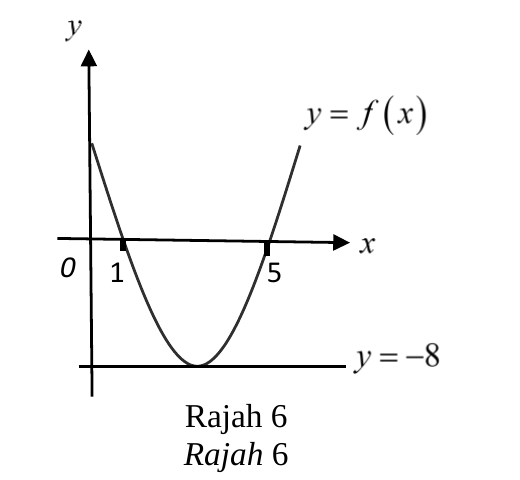
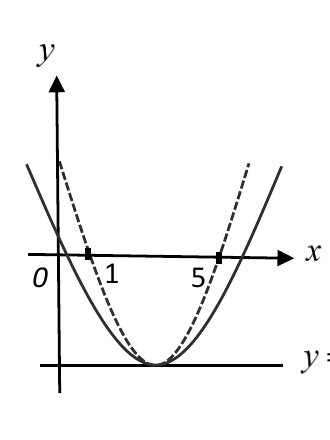
- (b)(ii)
Express f(x) = 2x² − 4mx + 2m² + 2n in the form a(x − h)² + k. Hence, find the value of m and of n.
[4]
(a) Diagram 7 shows a parallelogram DEFG. Point P lies on the straight line DE and point Y lies on the straight line GF. PT is a straight line that passes through the point F. Given DY→ = **a** + 6**b** and DT→ = (3/2)**a** + 9**b**. A straight line is drawn by connecting point D to point T. Using the vector method, determine whether the line passes through point Y or not. (b) Diagram 8 shows a regular hexagon PQRSTU drawn on a Cartesian plane with centre at the origin O. (i) Express PQ→ + TS→ as a single vector. (ii) Given OR→ = 5**i**, OT→ = −(5/2)**i** − (5√3/2)**j**, find the unit vector in the direction of RT→, in terms of **i** and **j**.
Medium8 marks- (a)
Using the vector method, determine whether the straight line from D to T passes through point Y or not.
[4]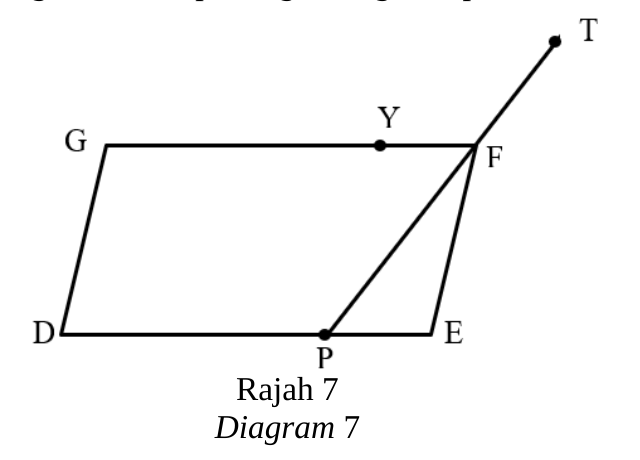
- (b)(i)
Express PQ→ + TS→ as a single vector.
[1]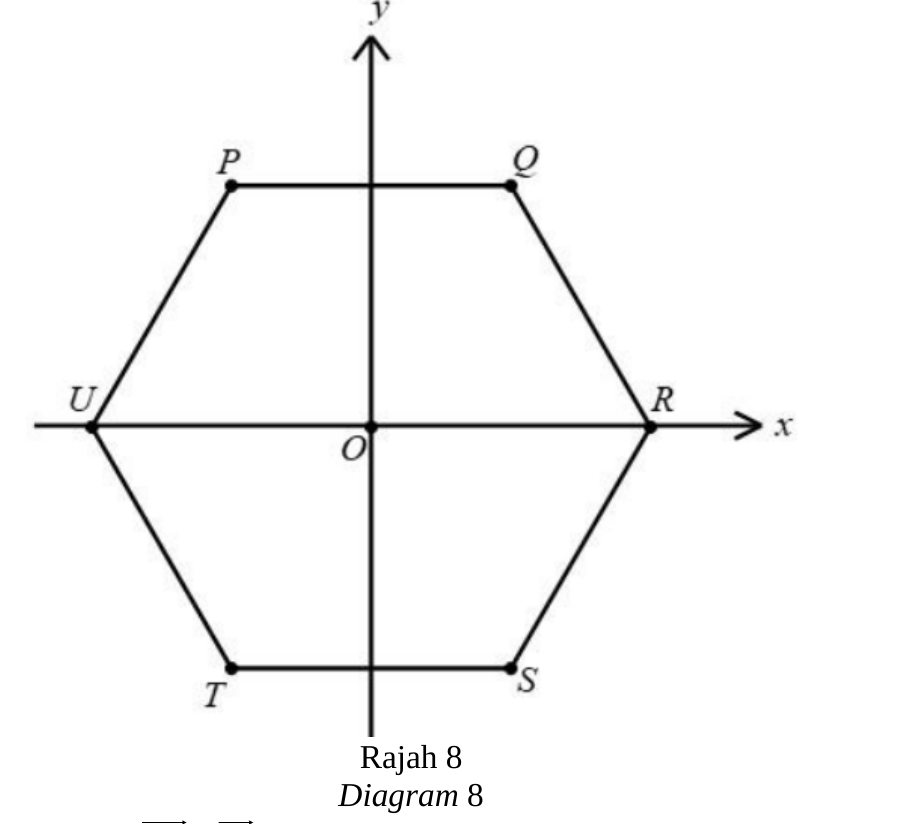
- (b)(ii)
Given OR→ = 5**i**, OT→ = −(5/2)**i** − (5√3/2)**j**, find the unit vector in the direction of RT→, in terms of **i** and **j**.
[3]
It is given that f⁻¹(x) = (k + x)/(3x), x ≠ 0 and fg(x) = 2/(3x² + 2), find (a) f(x) in terms of k, (b) the value of k such that f(1) = 4fg(√2), (c) hence, find g(x) and determine whether the inverse function of g(x) exists or not by using the horizontal line test. Give your justification.
Medium8 marks- (a)
Find f(x) in terms of k.
[2] - (b)
Find the value of k such that f(1) = 4fg(√2).
[2] - (c)
Hence, find g(x) and determine whether the inverse function of g(x) exists or not by using the horizontal line test. Give your justification.
[4]