Write your answer on paper. Then open the answer to check it.
Section A
(a) Given the quadratic equation x(x − 5) = 4. (i) Express the equation in the form ax² + bx + c = 0. (ii) State the sum of roots and the product of roots of the equation. (b) Express h(x) = −x² − 8x + 9 in the form h(x) = −(x + p)² + q. Hence state the maximum value of h(x) and the corresponding value of x.
Medium6 marks- (a)(i)
Express x(x − 5) = 4 in the form ax² + bx + c = 0.
[1] - (a)(ii)
State the sum of roots and the product of roots of the equation.
[2] - (b)
Express h(x) = −x² − 8x + 9 in the form h(x) = −(x + p)² + q. Hence state the maximum value of h(x) and the corresponding value of x.
[3]
Diagram 1 shows a triangle OPQ. It is given that OP→ = **a**, OQ→ = **b** and OR : RM = 3 : 2. M is the midpoint of PQ. N is a point on OQ and P, R, N are collinear. (a) Find (i) OM→, (ii) PR→. (b) If PN→ = −**a** + λ**b** and PR→ = kPN→, find ON : NQ.
Medium8 marks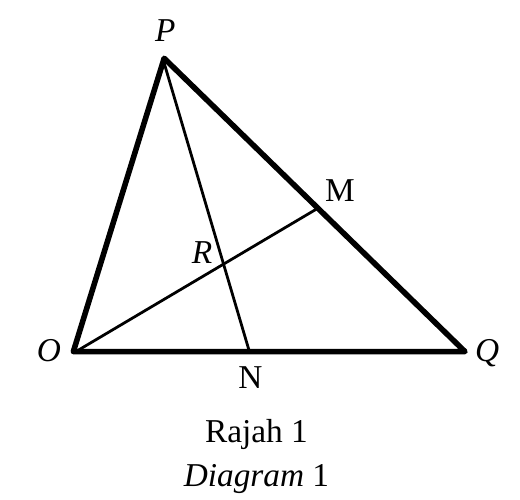
- (a)(i)
Find OM→.
[3] - (a)(ii)
Find PR→.
[2] - (b)
If PN→ = −**a** + λ**b** and PR→ = kPN→, find ON : NQ.
[3]
Diagram 2 shows a circle with centre O and radius x. The arc PQ subtends an angle of θ at O. [Use π = 3.142] (a) If θ = 1 rad, state the relationship between the arc length of PQ and its radius. (b) (i) If θ = 60°, calculate the minor arc length of PQ in terms of π and x. (ii) Hence, find the radius, in cm, if the minor arc length of PQ is 12 cm.
Medium5 marks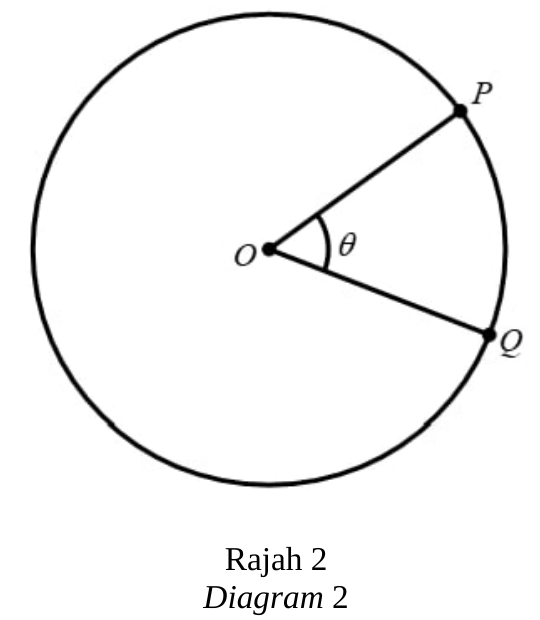
- (a)
If θ = 1 rad, state the relationship between the arc length of PQ and its radius.
[1] - (b)(i)
If θ = 60°, calculate the minor arc length of PQ in terms of π and x.
[2] - (b)(ii)
Hence, find the radius, in cm, if the minor arc length of PQ is 12 cm.
[2]
Solve the following equations. (a) (i) 49^(3x) · √(3^(12x)) = 21. (ii) y√12 = 6 − √3. (b) Given log₃ r = m and log₉ s = n, express log₃ (r² s³) in terms of m and/or n.
Medium7 marks- (a)(i)
Solve 49^(3x) · √(3^(12x)) = 21.
[2] - (a)(ii)
Solve y√12 = 6 − √3.
[2] - (b)
Given log₃ r = m and log₉ s = n, express log₃ (r² s³) in terms of m and/or n.
[3]
(a) Solve the equation ²ⁿPₙ/(2n − 2)! = 10n/n!. (b) Find the number of ways Balqis arranges 8 beads to form a bracelet. (c) Yusof owns 5 shirts, 7 pairs of long pants and 4 pairs of shoes. In how many ways can Yusof choose two from each item to pack for a vacation?
Medium7 marks- (a)
Solve the equation ²ⁿPₙ/(2n − 2)! = 10n/n!.
[3] - (b)
Find the number of ways Balqis arranges 8 beads to form a bracelet.
[2] - (c)
Yusof owns 5 shirts, 7 pairs of long pants and 4 pairs of shoes. In how many ways can he choose two from each item?
[2]
A soy sauce factory produces 5000 litres of soy sauce on the first day of operations. On each subsequent day, the volume of production decreases by 2% from the previous day. (a) (i) Calculate the volume of production of soy sauce on the fourth day. (ii) Hence, find the total volume of production in the first week of operation. (b) It is given that x, 6, 10, 14, ..., 54 is an arithmetic progression. (i) State the value of x. (ii) Find the number of terms of the sequence.
Medium8 marks- (a)(i)
Calculate the volume of production of soy sauce on the fourth day.
[3] - (a)(ii)
Hence, find the total volume of production of soy sauce in the first week of operation.
[2] - (b)(i)
State the value of x.
[1] - (b)(ii)
Find the number of terms of the sequence.
[2]
(a) Awang's hobby is fishing. When fishing, the chance for Awang to get a fish is 40%. Calculate (i) the probability that Awang will get exactly 3 fishes in 7 throws, (ii) the number of throws made by Awang so that the probability of getting at least a fish is greater than 0.95. (b) Diagram 3 shows the probability distribution of X, where X is a discrete random variable (P(X = 0) = 1/27, P(X = 1) = 2/9, P(X = 2) = 4/9, P(X = 3) = 8/27). Find the standard deviation.
Medium9 marks- (a)(i)
Calculate the probability that Awang will get exactly 3 fishes in 7 throws.
[2] - (a)(ii)
Find the number of throws so that the probability of getting at least a fish is greater than 0.95.
[3] - (b)
Diagram 3 shows the probability distribution of X, where X is a discrete random variable. Find the standard deviation.
[4]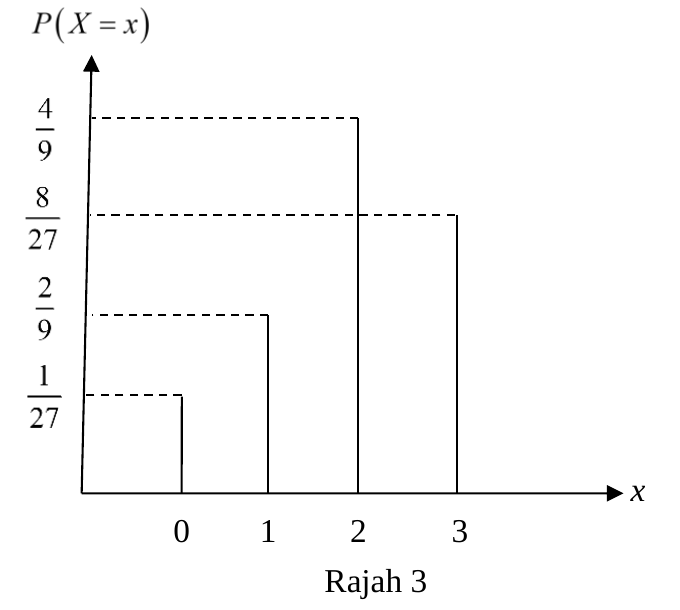
Section B
(a) Diagram 4 shows the graph of y = 2 sin bx + c for 0 ≤ x ≤ 2π. (i) State the value of b and c. (ii) By marking the solution on Diagram 4, state the number of solutions for 2 sin bx = 1/2. (b) Prove that tan x(1 + cos 2x) = sin 2x. (c) Solve the equation 3 cos 2x − sin x = 2 for 0° ≤ x ≤ 360°.
Hard10 marks- (a)(i)
State the value of b and c.
[2]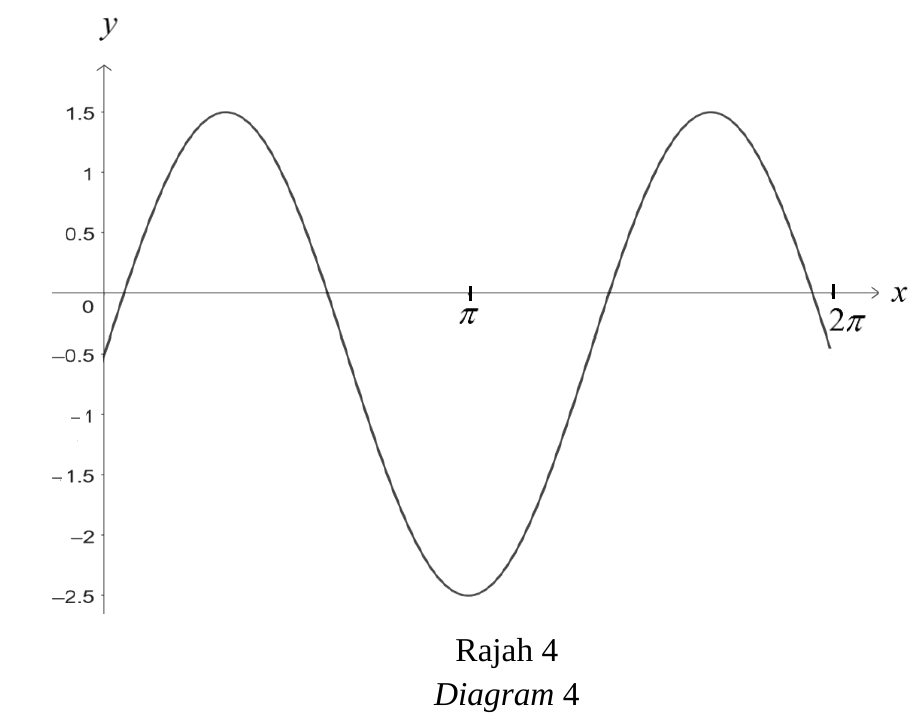
- (a)(ii)
By marking the solution on Diagram 4, state the number of solutions for 2 sin bx = 1/2.
[2] - (b)
Prove that tan x(1 + cos 2x) = sin 2x.
[2] - (c)
Solve the equation 3 cos 2x − sin x = 2 for 0° ≤ x ≤ 360°.
[4]
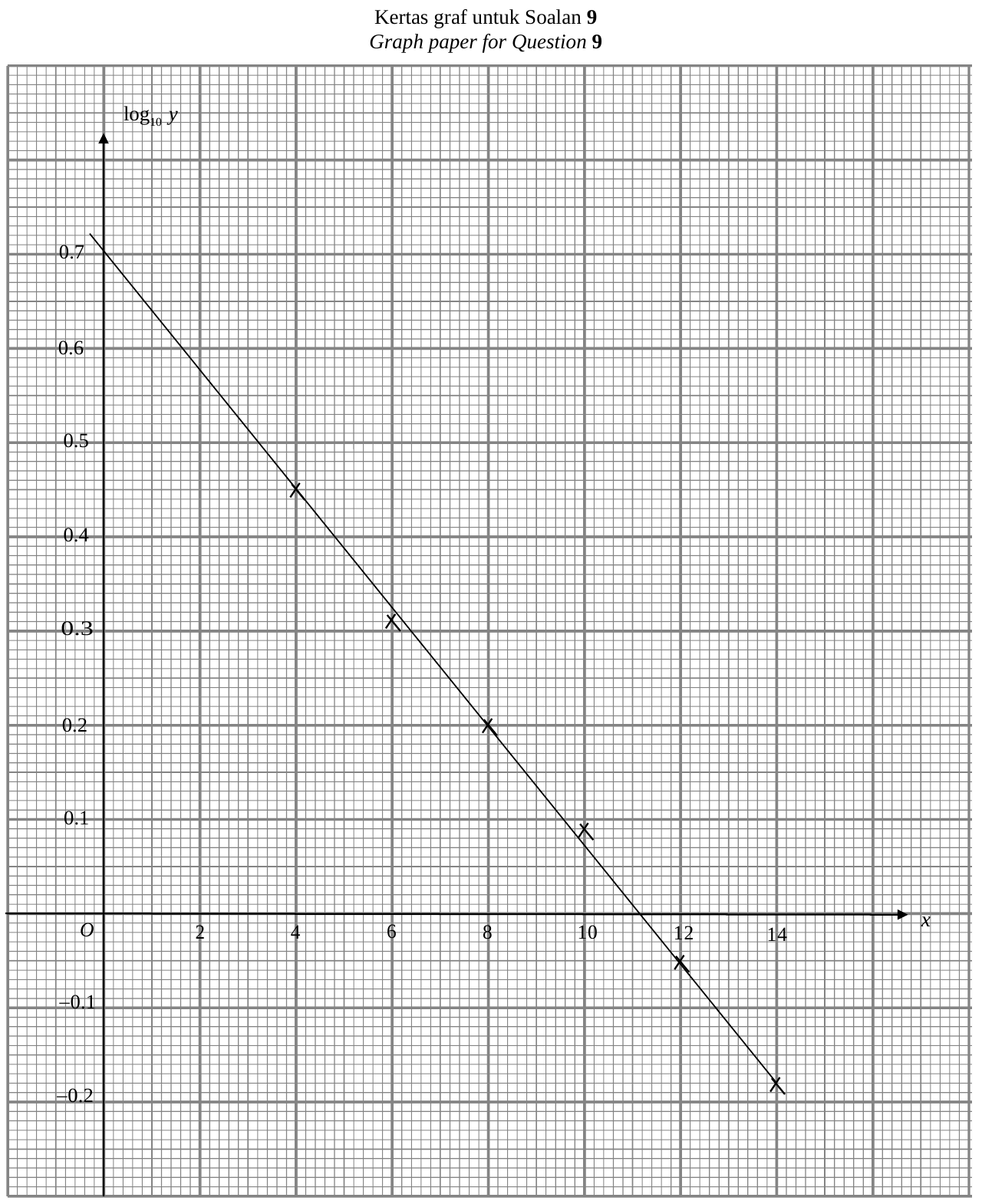
Table 1.1 shows the values of two variables, x and y, obtained from an experiment. The variables x and y are related by the equation y = p/qˣ, where p and q are constants. x: 4, 6, 8, 10, 12, 14; y: 2.82, 2.05, 1.58, 1.23, 0.89, 0.66. (a) Based on Table 1.1, fill in Table 1.2 (log₁₀ y). (b) Plot log₁₀ y against x, using a scale of 2 cm to 2 units on the x-axis and 2 cm to 0.1 unit on the log₁₀ y-axis. Hence, draw the line of best fit. (c) Using the graph in (b), find the value of (i) y when x = 2, (ii) p and q.
Medium10 marks
- (a)
Based on Table 1.1, fill in Table 1.2 (values of log₁₀ y).
[1]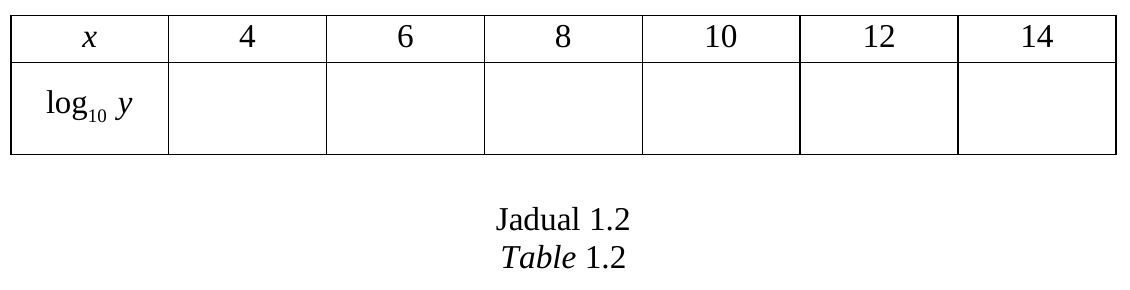
- (b)
Plot log₁₀ y against x, using a scale of 2 cm to 2 units on the x-axis and 2 cm to 0.1 unit on the log₁₀ y-axis. Hence, draw the line of best fit.
[3]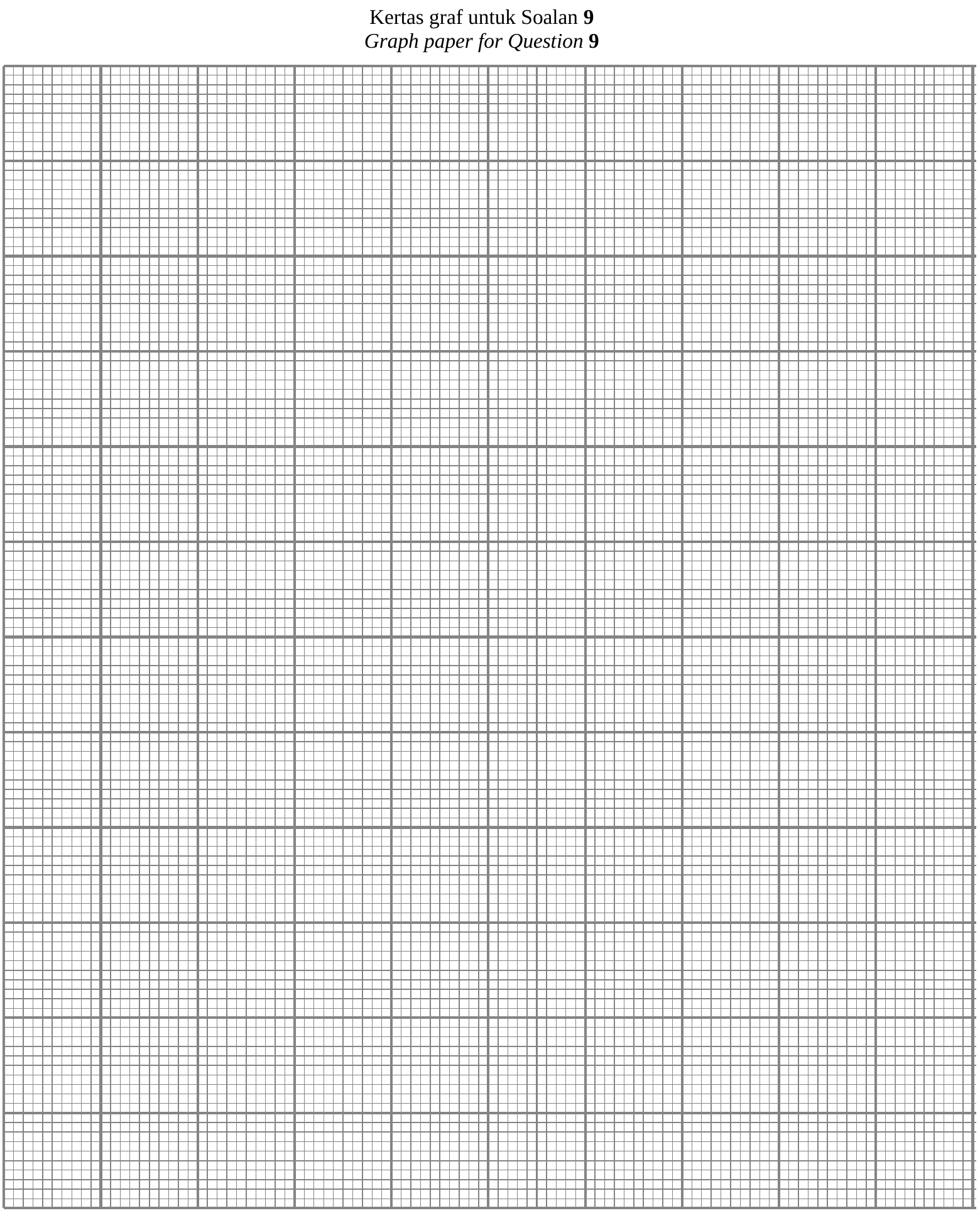
- (c)(i)
Using the graph in (b), find the value of y when x = 2.
[1] - (c)(ii)
Using the graph in (b), find the value of p and of q.
[5]
Diagram 5 shows a triangle ABC with A(3, 5), B(−8, −2) and C(7, 3). The straight line CA is extended to point E such that the straight line BE is perpendicular to the straight line CE. (a) Find the equation of the straight line CE. (b) (i) Find the area of triangle ABC, hence find the ratio of EA to AC if it is given that the area of triangle ABE is 37½ unit². (ii) Hence, find the coordinates of E. (c) Point R moves such that its distance from E is always 3/2 times its distance from C. Find the equation of the locus of R.
Medium10 marks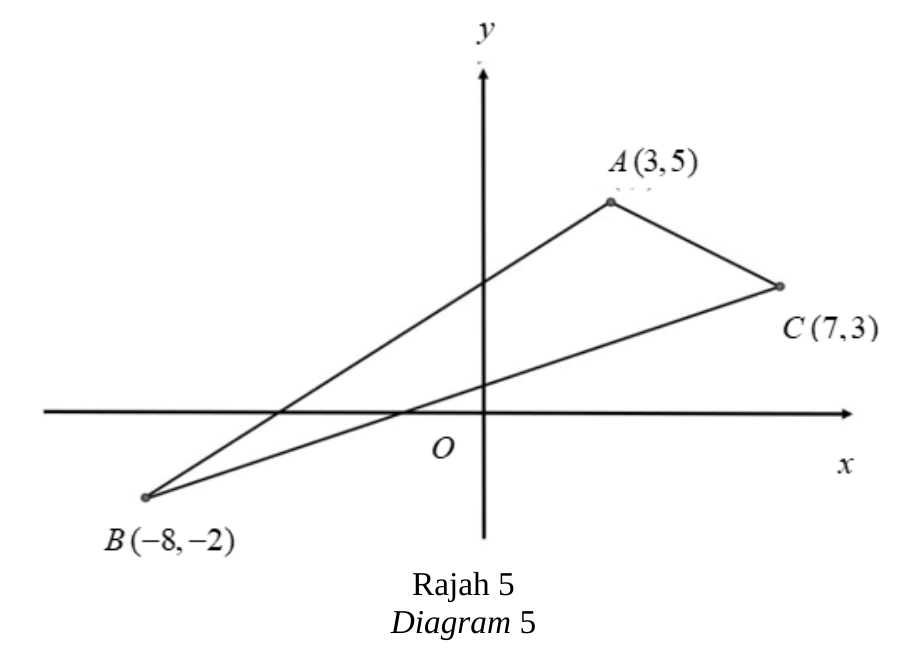
- (a)
Find the equation of the straight line CE.
[2] - (b)(i)
Find the area of triangle ABC, hence find the ratio of EA to AC if the area of triangle ABE is 37½ unit².
[4] - (b)(ii)
Hence, find the coordinates of E.
[2] - (c)
Point R moves such that its distance from E is always 3/2 times its distance from C. Find the equation of the locus of R.
[2]
A contractor builds a curved skateboard ramp at a sports school. Diagram 6 shows the cross-section of the curve of the ramp drawn on a Cartesian plane, where y is the vertical distance of the player from the ground and x is the horizontal distance of the player from the y-axis. The ramp has a height of 8 metres above ground level and has handrails at both ends that are 20 metres apart. The gradient function of the curve forming the ramp is (4/25)x. (a) Determine the equation of the curve represented by the skateboard ramp. (b) Calculate the area bounded by the curve of the skateboard ramp and y = 8. (c) For a long term plan, the ramp will be modified into a covered structure and used as a water storage tank. Calculate the maximum volume of water, in terms of π, when the region bounded by the curve y = f(x), the straight line y = 8 and the y-axis is rotated through 360° about the y-axis.
Hard10 marks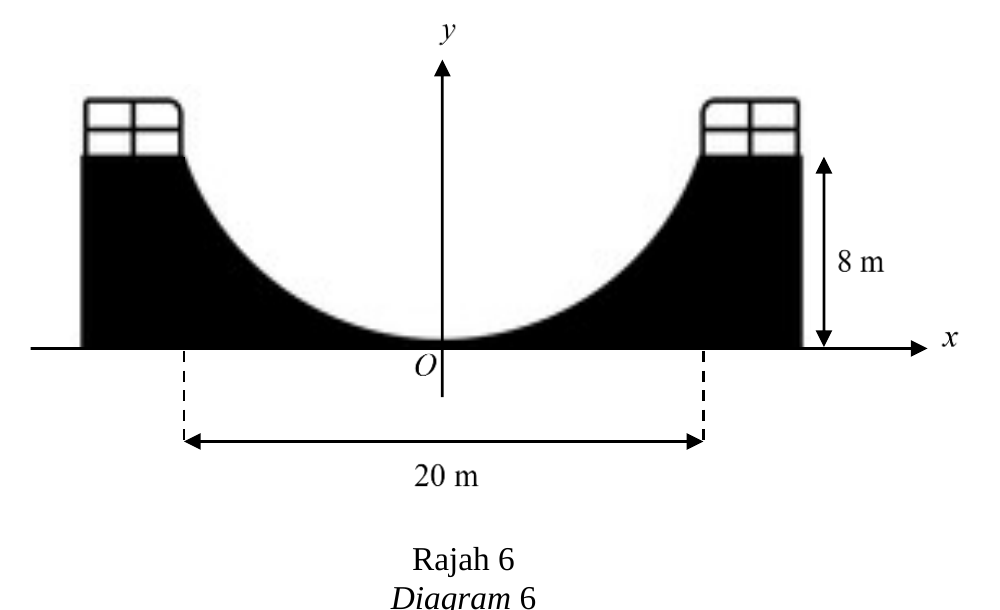
- (a)
Determine the equation of the curve represented by the skateboard ramp.
[3] - (b)
Calculate the area bounded by the curve of the skateboard ramp and y = 8.
[4] - (c)
Calculate the maximum volume of water, in terms of π, when the region bounded by the curve y = f(x), the straight line y = 8 and the y-axis is rotated through 360° about the y-axis.
[3]
Section C
A particle moves along a straight line and passes through a fixed point O. Its velocity, v m s⁻¹, is given by v = 10 + 3t − t², where t is the time taken, in seconds, after passing through O. Find (a) the initial velocity, in m s⁻¹, of the particle, (b) the value of t, in seconds, when the particle stops instantaneously, (c) the maximum velocity, in m s⁻¹, of the particle, (d) the total distance, in m, travelled by the particle in the first 8 seconds.
Medium10 marks- (a)
Find the initial velocity, in m s⁻¹, of the particle.
[1] - (b)
Find the value of t, in seconds, when the particle stops instantaneously.
[2] - (c)
Find the maximum velocity, in m s⁻¹, of the particle.
[3] - (d)
Find the total distance, in m, travelled by the particle in the first 8 seconds.
[4]
Table 2 shows the information related to five ingredients used to make a Tiramisu cake. Ingredient (price in 2021, price in 2023, price index in 2023 based on 2021, percentage of usage): A (16.00, 19.20, 120, 25); B (p, 16.10, 115, 15); C (12.00, q, 110, 10); D (9.00, 9.45, r, s); E (13.00, 16.90, 130, 30). (a) Find the value of p, q and r. (b) Calculate the composite index of the ingredients price in the year 2023 based on the year 2021. (c) The total cost of all ingredients in the year 2021 was RM2560. Calculate the corresponding total cost in the year 2023. (d) The composite index is expected to decrease by m% from the year 2023 to 2025. Given that the composite index in the year 2025 based on the year 2021 is 117, find the value of m.
Medium10 marks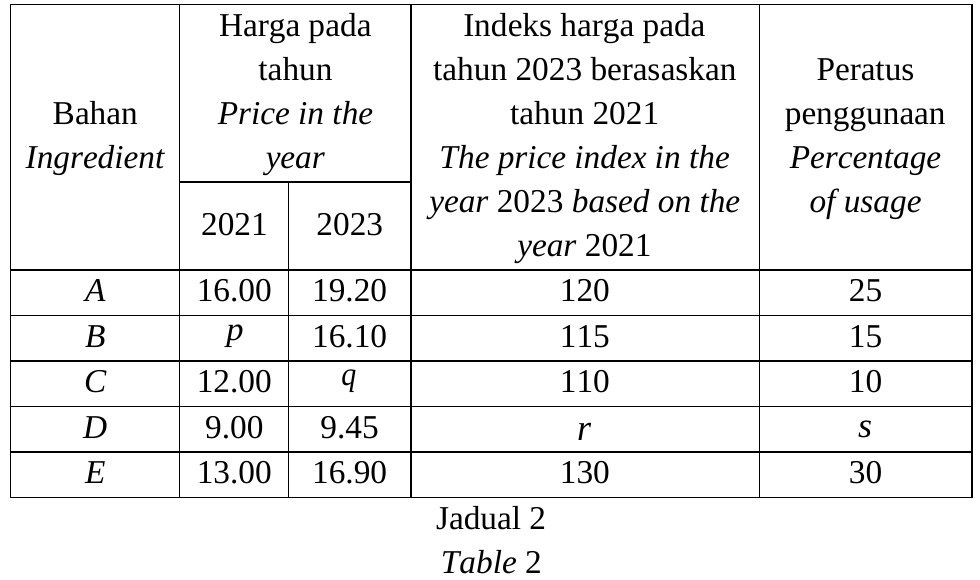
- (a)
Find the value of p, q and r.
[3] - (b)
Calculate the composite index of the ingredients price in the year 2023 based on the year 2021.
[3] - (c)
The total cost of all ingredients in 2021 was RM2560. Calculate the corresponding total cost in 2023.
[2] - (d)
The composite index decreases by m% from 2023 to 2025. Given the composite index in 2025 based on 2021 is 117, find m.
[2]
(a) Sketch a triangle ABC with side a = BC, b = AC and angle C = ∠ACB. Hence, by using the concept of trigonometry and area of a triangle, derive the formula Area = ½ab sin C. (b) Diagram 7 shows the positions of a boat, an aircraft, an oil rig station and a shark. The distance between the boat and the aircraft is 24 units and the distance between the oil rig and the shark is 12 units, while the angle between the boat, the aircraft and the oil rig is 32°. The distance between the oil rig and the aircraft is equal to the distance between the boat and the oil rig. The positions of the shark, the oil rig and the aircraft are in a straight line. (i) Find the distance, in units, between the aircraft and the oil rig. (ii) Find the distance, in units, between the boat and the shark. (iii) Calculate the area of the triangle bounded by the positions of the boat, the aircraft and the shark.
Medium10 marks- (a)
Sketch a triangle ABC with side a = BC, b = AC and angle C = ∠ACB. Hence, derive the formula Area = ½ab sin C.
[4]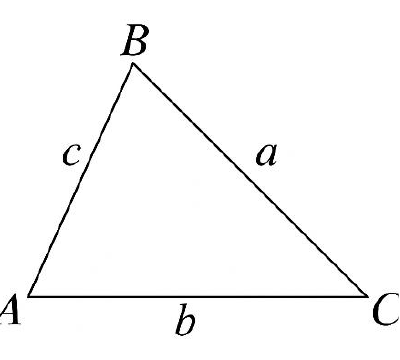
- (b)(i)
Find the distance, in units, between the aircraft and the oil rig.
[2]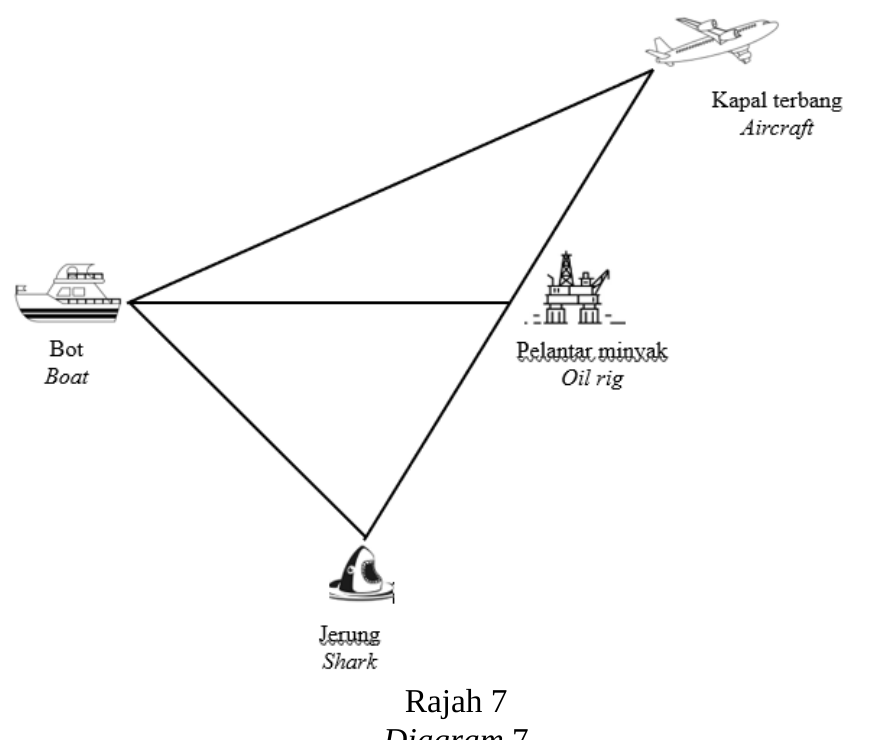
- (b)(ii)
Find the distance, in units, between the boat and the shark.
[2] - (b)(iii)
Calculate the area of the triangle bounded by the positions of the boat, the aircraft and the shark.
[2]
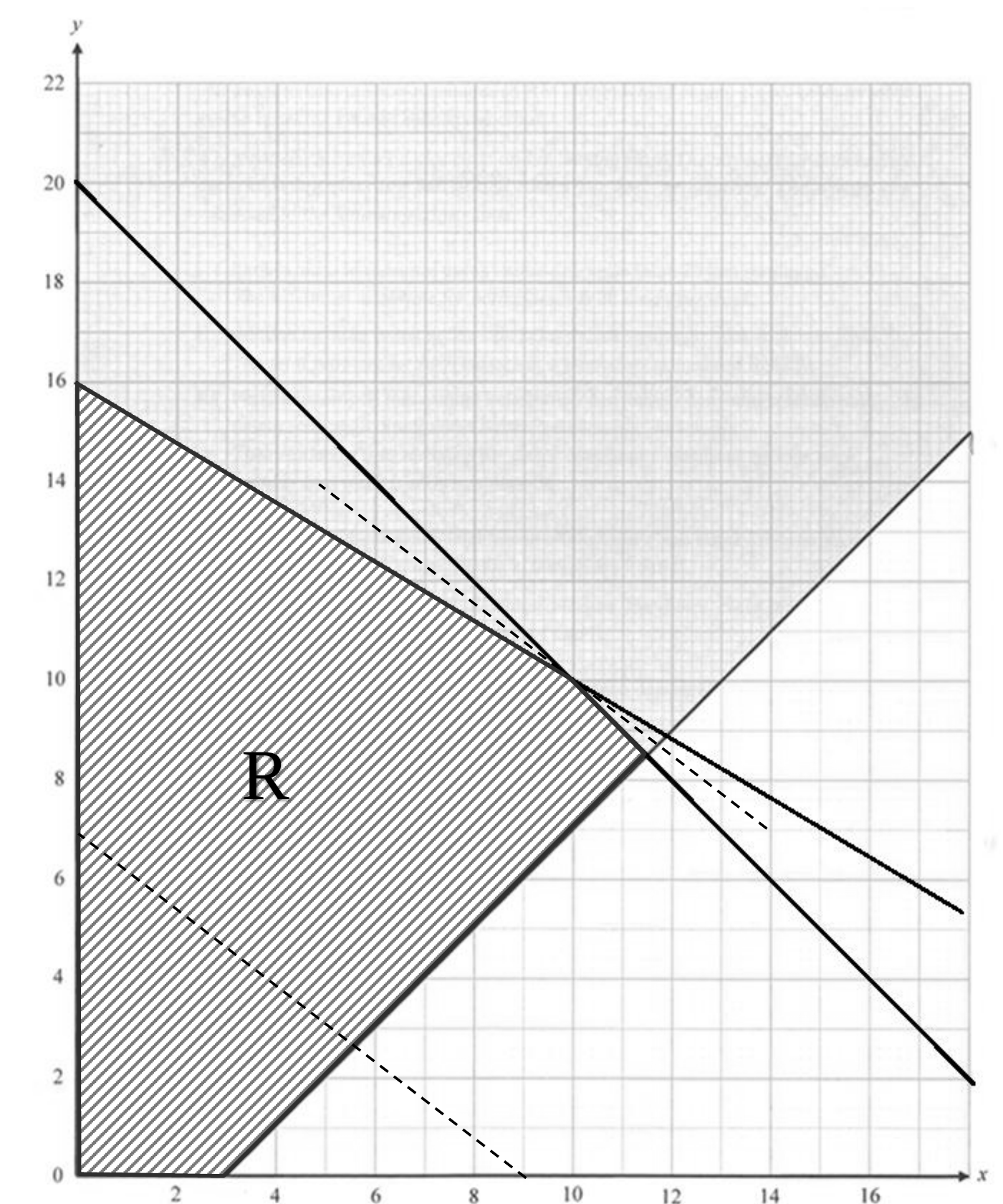
A skills training centre offers cooking and sewing classes. The fees for the cooking class and the sewing class are RM15 per hour and RM25 per hour respectively. The classes are subject to these constraints: I The maximum total time that can be allocated to both classes is 20 hours per week. II The total fee for both classes in a week must not exceed RM400. III The relationship between the time allocated for cooking and sewing classes that each participant must follow is shown on the graph (page 31): the line through (3, 0) and (18, 15), that is y = x − 3. (a) In one week, a participant allocates x hours for the cooking class and y hours for the sewing class. Write the inequalities for constraints I and II. (b) Write constraint III as an inequality and explain its meaning in words. (c) On the graph, construct and label the region R that satisfies all the constraints and x ≥ 0, y ≥ 0. (d) Using the graph from (c), it is given that, on average, cooking burns 350 calories per hour, while sewing burns 450 calories per hour. By drawing the objective function, find the maximum number of calories that can be burned in one week.
Hard10 marks- (a)
Write the inequalities for constraints I and II.
[2] - (b)
Write constraint III as an inequality and explain its meaning in words.
[2] - (c)
On the graph, construct and label the region R that satisfies all the constraints and x ≥ 0, y ≥ 0.
[3]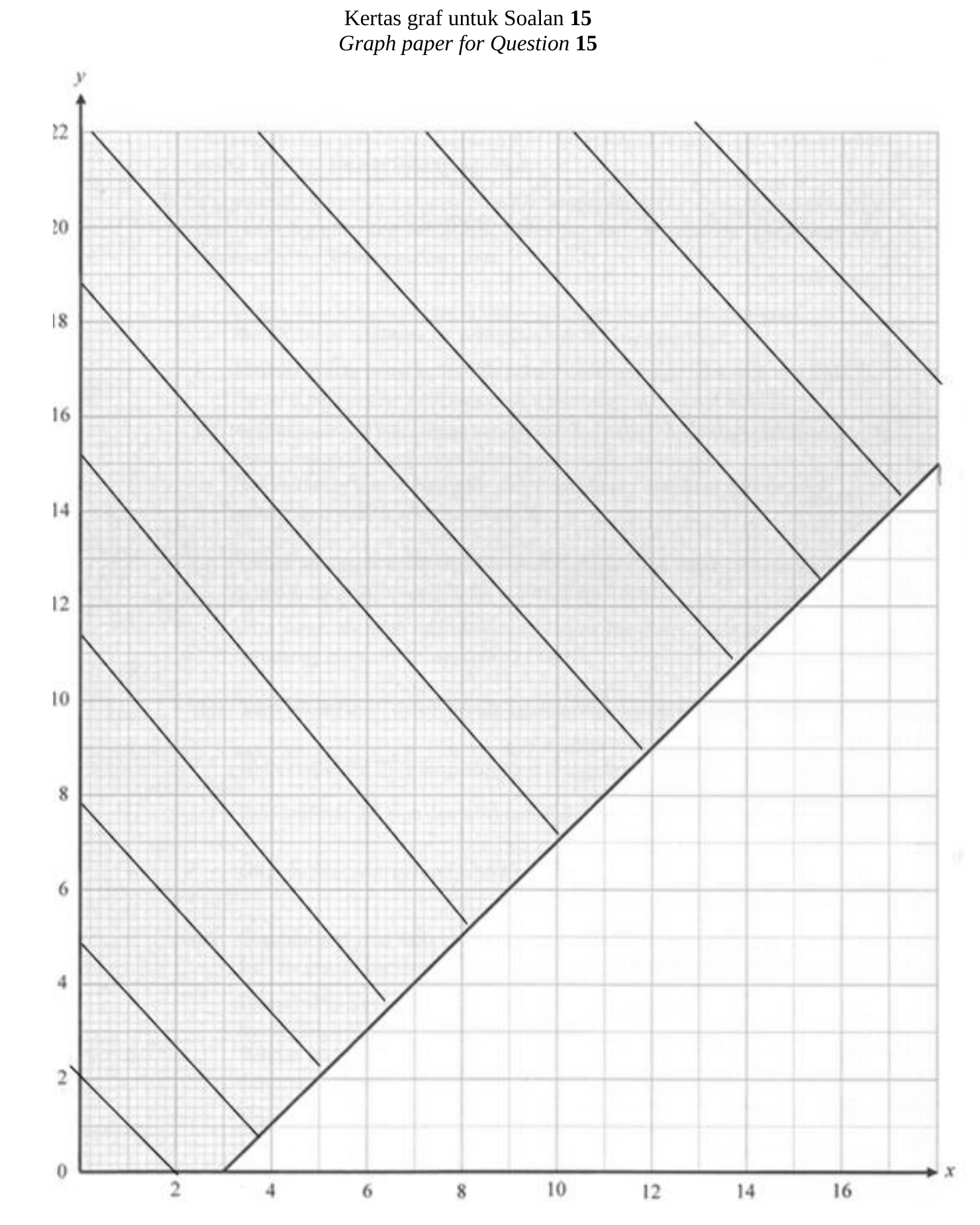
- (d)
Given cooking burns 350 calories per hour and sewing burns 450 calories per hour, find, by drawing the objective function, the maximum number of calories that can be burned in one week.
[3]