Write your answer on paper. Then open the answer to check it.
Section A
Diagram 1 shows a sector POQ of a circle with centre O. It is given that OR = 8 cm and OP = 10 cm. (Use π = 3.142)
Easy4 marks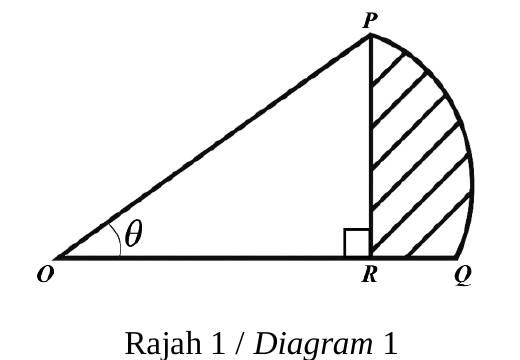
- (a)
Find the value of θ, in radian.
[2] - (b)
Find the perimeter, in cm, of the shaded region.
[2]
(a) It is given that the functions g(x) = 4x − 7 and h(x) = 2x. Find the value of gh(2). (b) The inverse function h⁻¹ is defined h⁻¹: x → 2/(3 − x), x ≠ 3. Find (i) h(x), (ii) the value of x such that h(x) = −5.
Medium6 marks- (a)
Find the value of gh(2).
[2] - (b)(i)
Find h(x).
[2] - (b)(ii)
Find the value of x such that h(x) = −5.
[2]
Diagram 3 shows the graph of the quadratic function f(x) = x² + 6x + 2k − 3, where k is a constant. The minimum value of the function is 4 (marked on the f(x)-axis).
Easy5 marks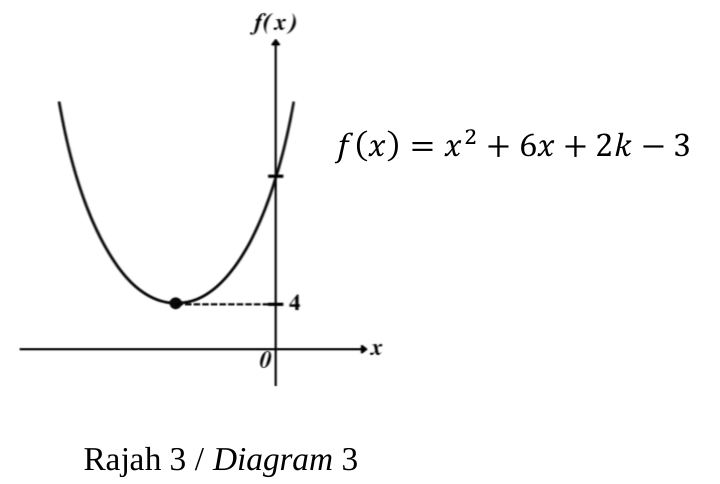
- (a)
By using the method of completing the square, convert the function f(x) to vertex form. Hence, state the equation of the axis of symmetry of the curve.
[3] - (b)
Given that the minimum value of the function is 4, find the value of k.
[2]
(a) The quadratic equation mx² + (1 + 2m)x + m − 1 = 0 has two equal roots. Find the value of m. (b) By using number line method, find the range of values of x for 3x² − 5x − 16 ≤ x(2x + 1).
Medium6 marks- (a)
The quadratic equation mx² + (1 + 2m)x + m − 1 = 0 has two equal roots. Find the value of m.
[3] - (b)
By using number line method, find the range of values of x for 3x² − 5x − 16 ≤ x(2x + 1).
[3]
(a) Solve the equation 2^(3x) = 8 + 2^(3x−1). (b) Given that log₂ x = h and log₂ y = k, express log₂ (x³/y) in terms of h and k.
Medium6 marks- (a)
Solve the equation 2^(3x) = 8 + 2^(3x−1).
[3] - (b)
Given that log₂ x = h and log₂ y = k, express log₂ (x³/y) in terms of h and k.
[3]
(a) It is given that x, 5, 8, …, 41, … is an arithmetic progression. (i) State the value of x. (ii) Write the three consecutive terms after 41. (b) The second term of an arithmetic progression is −3 and the sixth term is 13. Find the first term and the common difference of the progression.
Medium6 marks- (a)(i)
State the value of x.
[2] - (a)(ii)
Write the three consecutive terms after 41.
[1] - (b)
The second term of an arithmetic progression is −3 and the sixth term is 13. Find the first term and the common difference.
[3]
(a) It is given that x², x⁴, x⁶, x⁸, … is a geometric progression such that 0 < x < 1. The sum to infinity of this progression is 1/3. Find (i) the common ratio of this progression in terms of x, (ii) the value of x. (b) In a geometric progression, the first term is a and the common ratio is r. Given that the third term exceeds the second term by 12a, find the values of r.
Medium6 marks- (a)(i)
Find the common ratio in terms of x.
[1] - (a)(ii)
Find the value of x, given that the sum to infinity is 1/3.
[2] - (b)
The first term is a and the common ratio is r. The third term exceeds the second term by 12a. Find the values of r.
[3]
(a) Given y = 5x/(x² + 1) and dy/dx = g(x), find the value of ∫₀³ 2g(x) dx. (b) Find ∫₄ᵃ (x + 1) dx, in terms of a.
Medium6 marks- (a)
Given y = 5x/(x² + 1) and dy/dx = g(x), find the value of ∫₀³ 2g(x) dx.
[3] - (b)
Find ∫₄ᵃ (x + 1) dx, in terms of a.
[3]
It is given that y = 10 − 12/x. Find the small change in x, in terms of p, when the value of y changes from 4 to 4 + p.
Easy3 marksFind the small change in x, in terms of p, when y changes from 4 to 4 + p.
[3]
Diagram 10 shows seven letter cards: F, O, R, M, U, L, A. A five-letter code is to be formed using five of these cards. Find (a) the number of different five-letter codes that can be formed, (b) the number of different five-letter codes which begin with a consonant and end with a vowel.
Easy4 marks- (a)
Find the number of different five-letter codes that can be formed.
[1] - (b)
Find the number of different five-letter codes which begin with a consonant and end with a vowel.
[3]
(a) Diagram 11(a) shows the graph of a binomial distribution of X: P(X = 0) = m, P(X = 1) = 12/27, P(X = 2) = 6/27, P(X = 3) = 1/27. Find (i) P(X ≥ 1), (ii) the value of m. (b) Diagram 11(b) shows the normal distribution of the duration of a song produced by a record company (mean 198, shaded region between 198 and k). Given the standard deviation of the distribution is 0.12 seconds and the area of the shaded region is 20.33 unit², find the value of k.
Medium7 marks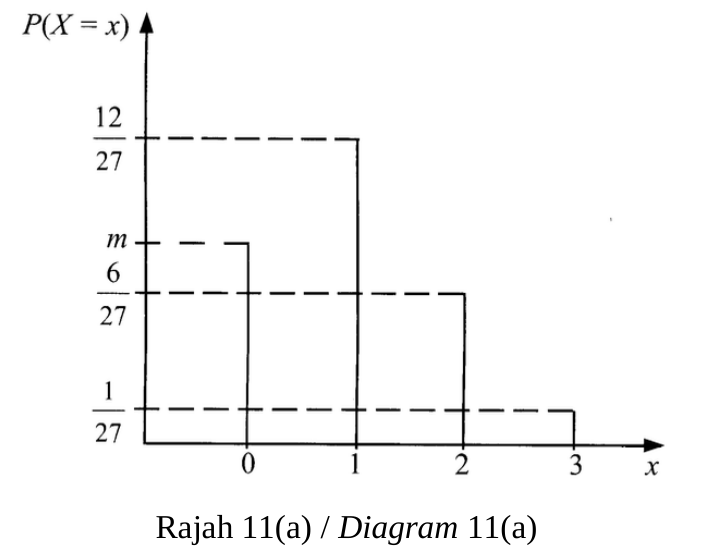
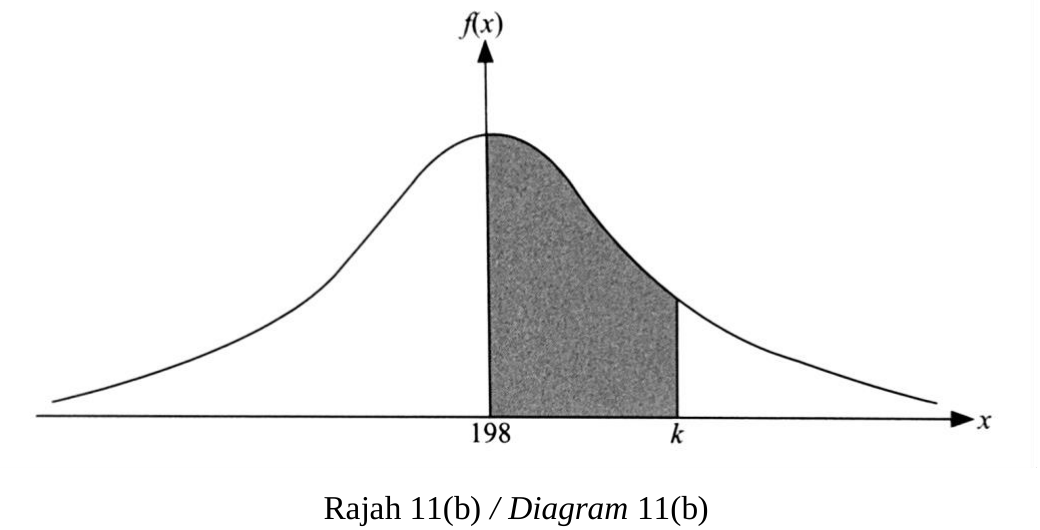
- (a)(i)
Find P(X ≥ 1).
[1] - (a)(ii)
Find the value of m.
[2] - (b)
Given the standard deviation is 0.12 seconds and the area of the shaded region is 20.33 unit², find the value of k.
[4]
Solve the following system of linear equations in three variables: 2x + 3y − z = 3; x + y + z = −1; −x − 2y + 3z = 4.
Easy5 marksSolve the system 2x + 3y − z = 3; x + y + z = −1; −x − 2y + 3z = 4.
[5]
Section B
(a) The variables x and y are related by the equation 3y = (p − 1)x + 12/x, where p is a constant. Diagram 13(a) shows the straight line QR obtained by plotting xy against x². R is (0, 6t). (b) When a graph of 1/y against 1/x is plotted, a straight line that passes through the points (0, 4) and (3, 0) is obtained.
Medium8 marks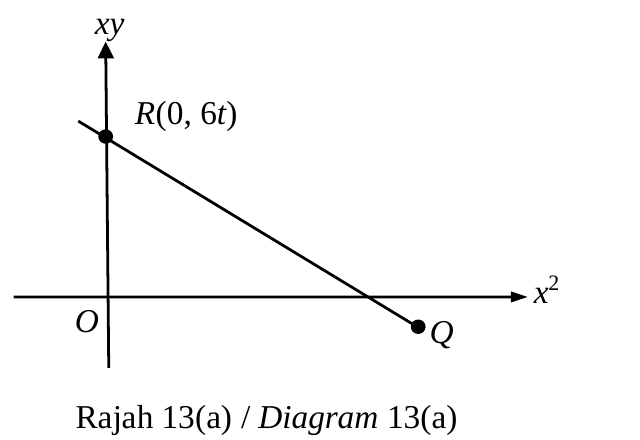
- (a)(i)
Express the equation 3y = (p − 1)x + 12/x in its linear form, which is used to obtain the straight line graph shown in Diagram 13(a).
[2] - (a)(ii)
Given that the gradient of QR is −2, find the value of p and of t.
[2] - (b)(i)
Find the gradient of the straight line.
[1] - (b)(ii)
Express y in terms of x.
[2] - (b)(iii)
If x = 4, find the value of y.
[1]
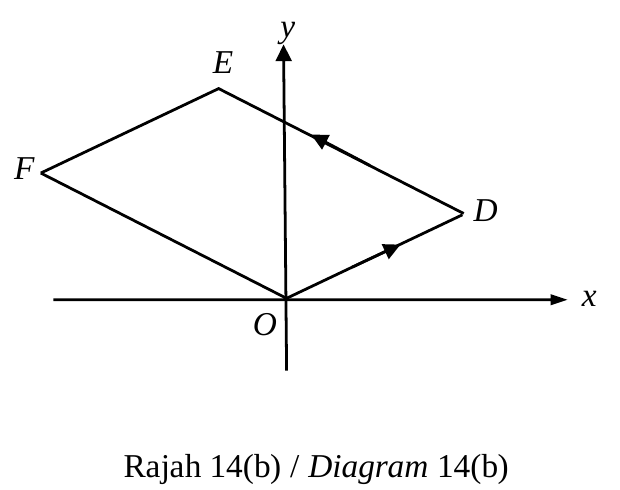
(a) Diagram 14(a) shows vector OA drawn on a Cartesian plane (O at the origin, A at (10, 5)). (b) Diagram 14(b) shows a parallelogram ODEF drawn on a Cartesian plane. (c) It is given that vector r = (8, −2) and vector s = (h, 7), where h is a constant.
Medium8 marks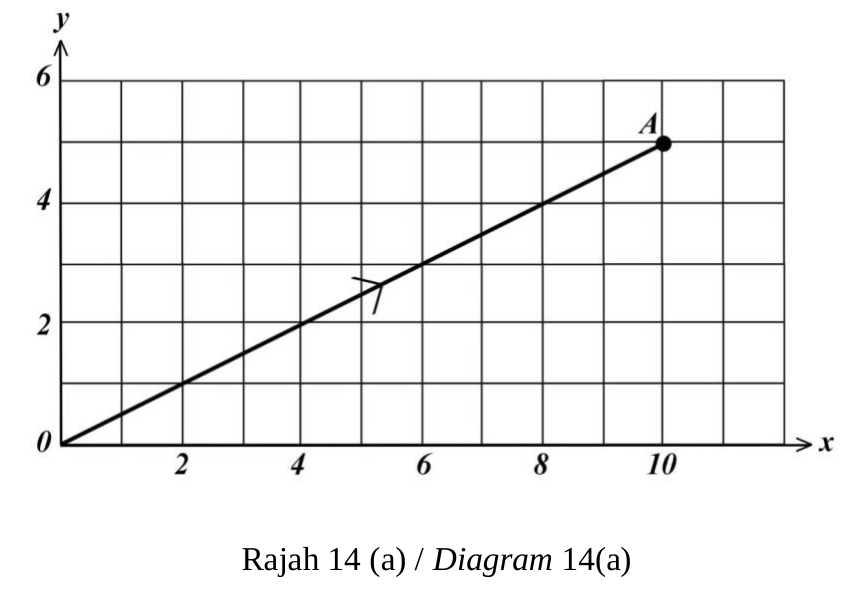
- (a)(i)
Express OA→ in the form (x, y) (column vector).
[1] - (a)(ii)
Find the unit vector in the direction of OA→.
[1] - (b)
It is given that OD→ = 3i + 2j and DE→ = −5i + 3j. Find DF→.
[3] - (c)(i)
Express vector r + s in terms of h.
[1] - (c)(ii)
Given |r + s| = 13 units, find the positive value of h.
[2]
(a) Solve the equation sin 2θ = cos θ for 0° ≤ θ ≤ 360°. (b) It is given that tan A = 3/4 and tan B = 7/24, where A is an acute angle and B is a reflex angle. Find (i) cot A, (ii) sin(A + B).
Medium8 marks- (a)
Solve the equation sin 2θ = cos θ for 0° ≤ θ ≤ 360°.
[4] - (b)(i)
Find cot A.
[1] - (b)(ii)
Find sin(A + B).
[3]