Write your answer on paper. Then open the answer to check it.
Section A
(a) Simplify log₂(2x + 1) − 5 log₄ x² + 4 log₂ x. (b) Hence, solve the equation log₂(2x + 1) − 5 log₄ x² + 4 log₂ x = 3.
Medium7 marks- (a)
Simplify log₂(2x + 1) − 5 log₄ x² + 4 log₂ x.
[4] - (b)
Hence, solve the equation log₂(2x + 1) − 5 log₄ x² + 4 log₂ x = 3.
[3]
It is given that …, 1701, y, 15309, … is a part of a geometric progression and the sum of the first five terms of the progression is 847. Find (a) the common ratio, (b) the first term, (c) the smallest value of n such that the nth term exceeds 75000.
Medium7 marks- (a)
Find the common ratio.
[2] - (b)
Find the first term.
[2] - (c)
Find the smallest value of n such that the nth term exceeds 75000.
[3]
Solution by scale drawing is not accepted. Diagram 1 shows the points A(−3, 4), O (origin) and B(6, −2). (a) Calculate the area of triangle AOB. (b) Point C divides the straight line AB internally in the ratio AC : CB = 3 : 2. Find the coordinates of point C. (c) Point P moves such that its distance from A is always twice its distance from B. Find the equation of the locus P. Hence, determine whether locus P intersects the x-axis.
Medium9 marks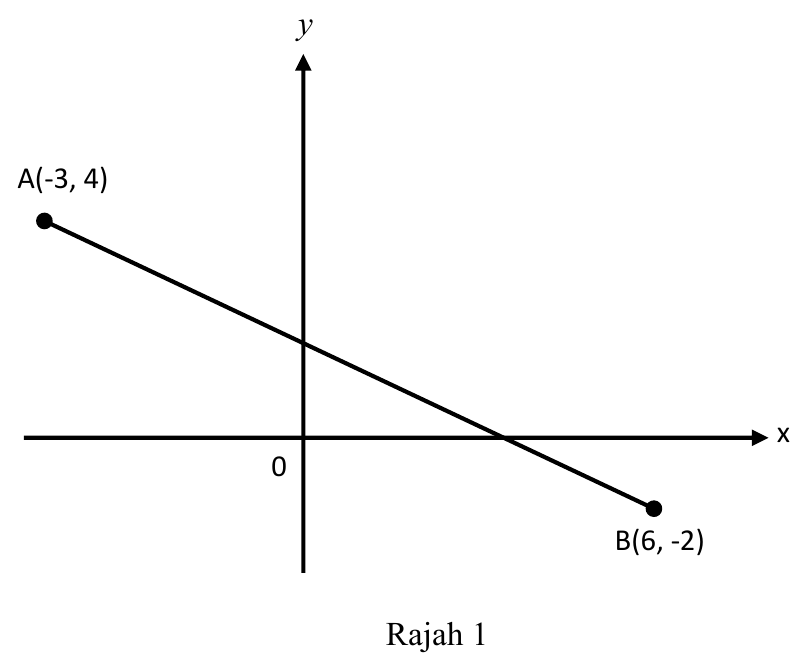
- (a)
Calculate the area of triangle AOB.
[2] - (b)
Point C divides AB internally in the ratio AC : CB = 3 : 2. Find the coordinates of C.
[2] - (c)
Point P moves such that its distance from A is always twice its distance from B. Find the equation of the locus P. Hence, determine whether locus P intersects the x-axis.
[5]
In Diagram 4, AOBC is a semicircle with centre O and radius 4 cm. APD is a sector of a circle with centre P and radius 6 cm. It is given that OC is perpendicular to AOB. (Use π = 3.142) Calculate (a) the value of θ, in radians, (b) the area, in cm², of the shaded region.
Medium7 marks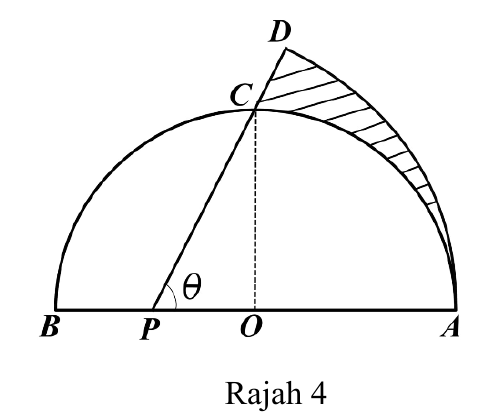
- (a)
Calculate the value of θ, in radians.
[3] - (b)
Calculate the area, in cm², of the shaded region.
[4]
(a) Prove that 2/(cos 2x + 1) = sec² x. (b) (i) Sketch the graph of y = cos 2x + 1 for 0 ≤ x ≤ 2π. (ii) Hence, using the same axes, sketch a suitable straight line to find the number of solutions to the equation 2/sec² x = x/(4π) + 1 for 0 ≤ x ≤ 2π.
Medium8 marks- (a)
Prove that 2/(cos 2x + 1) = sec² x.
[2] - (b)(i)
Sketch the graph of y = cos 2x + 1 for 0 ≤ x ≤ 2π.
[3] - (b)(ii)
Hence, using the same axes, sketch a suitable straight line to find the number of solutions to 2/sec² x = x/(4π) + 1 for 0 ≤ x ≤ 2π.
[3]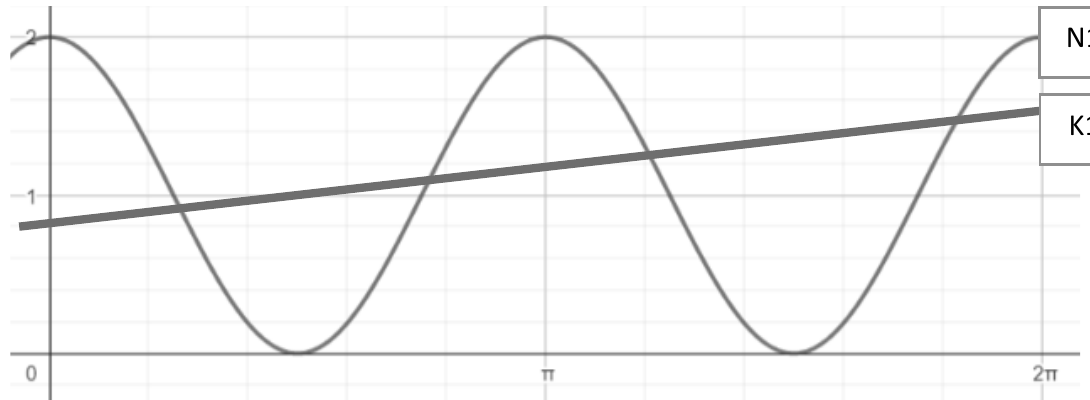
Given a curve y = −2x³ + 6x² + 1. Find (a) the gradient function of the curve, (b) the turning points of the curve, (c) Hence, determine whether each of the turning points is a maximum or minimum.
Medium6 marks- (a)
Find the gradient function of the curve.
[2] - (b)
Find the turning points of the curve.
[2] - (c)
Hence, determine whether each of the turning points is a maximum or minimum.
[2]
Given the equations M = 2x − y, N = 3x + 1, R = xy − 8. Find the values of x and y so that 2M = N = R.
Medium6 marksFind the values of x and y so that 2M = N = R.
[6]
Section B
Use the graph paper provided. Table 8 shows the values of two variables, x and y, obtained from an experiment. The variables x and y are related by the equation n/y = px + 1, where n and p are constants. Table 8: x = 0.1, 0.2, 0.3, 0.4, 0.5, 0.6; y = 0.303, 0.364, 0.465, 0.588, 0.909, 1.818.
Medium10 marks
- (a)
Based on Table 8, construct a table for the values of 1/y.
[1] - (b)
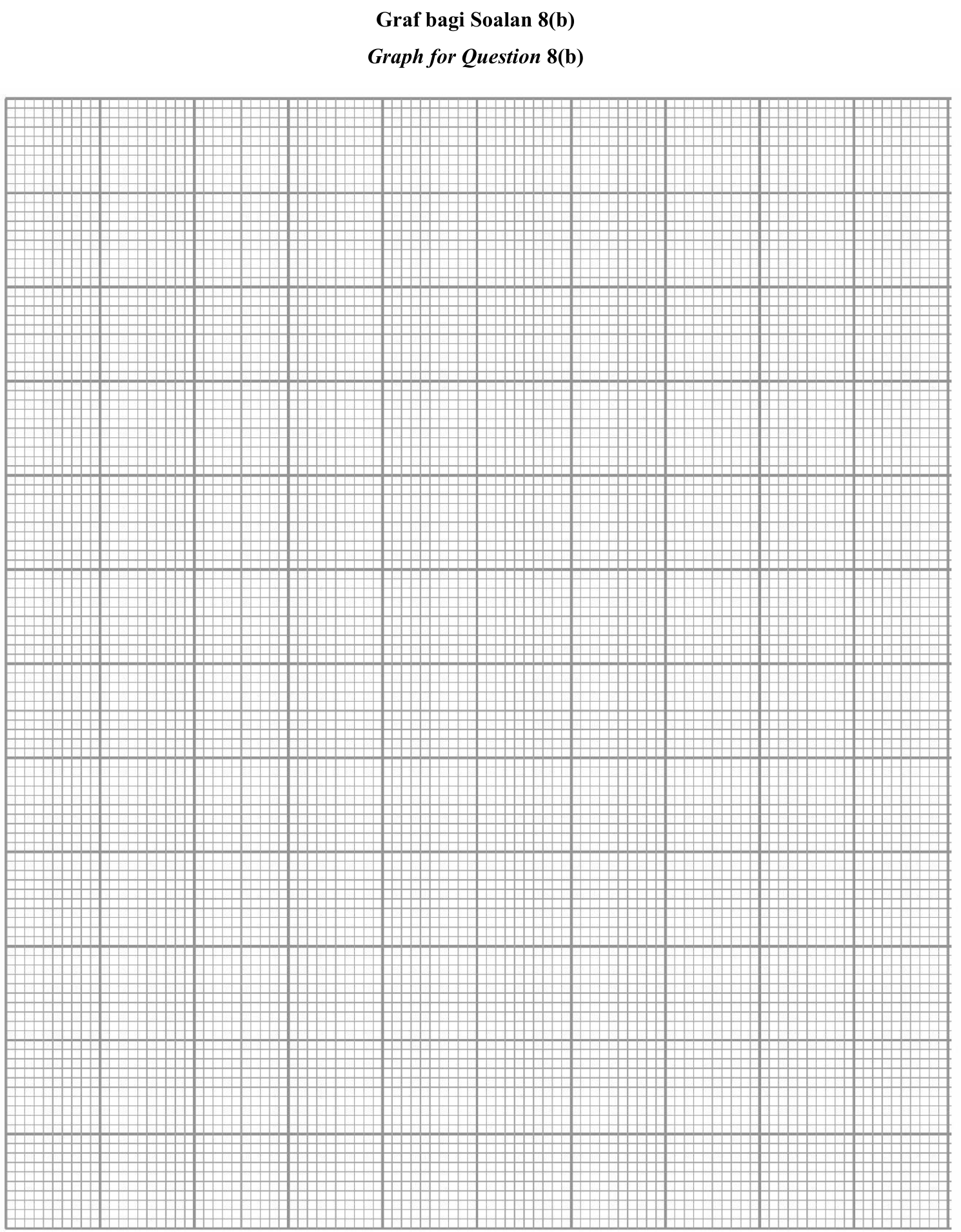
Plot 1/y against x, using a scale of 2 cm to 0.1 unit on the x-axis and 2 cm to 0.5 unit on the 1/y-axis. Hence, draw the line of best fit.
[3] - (c)(i)
Use the graph in 8(b) to find the value of n and of p.
[5]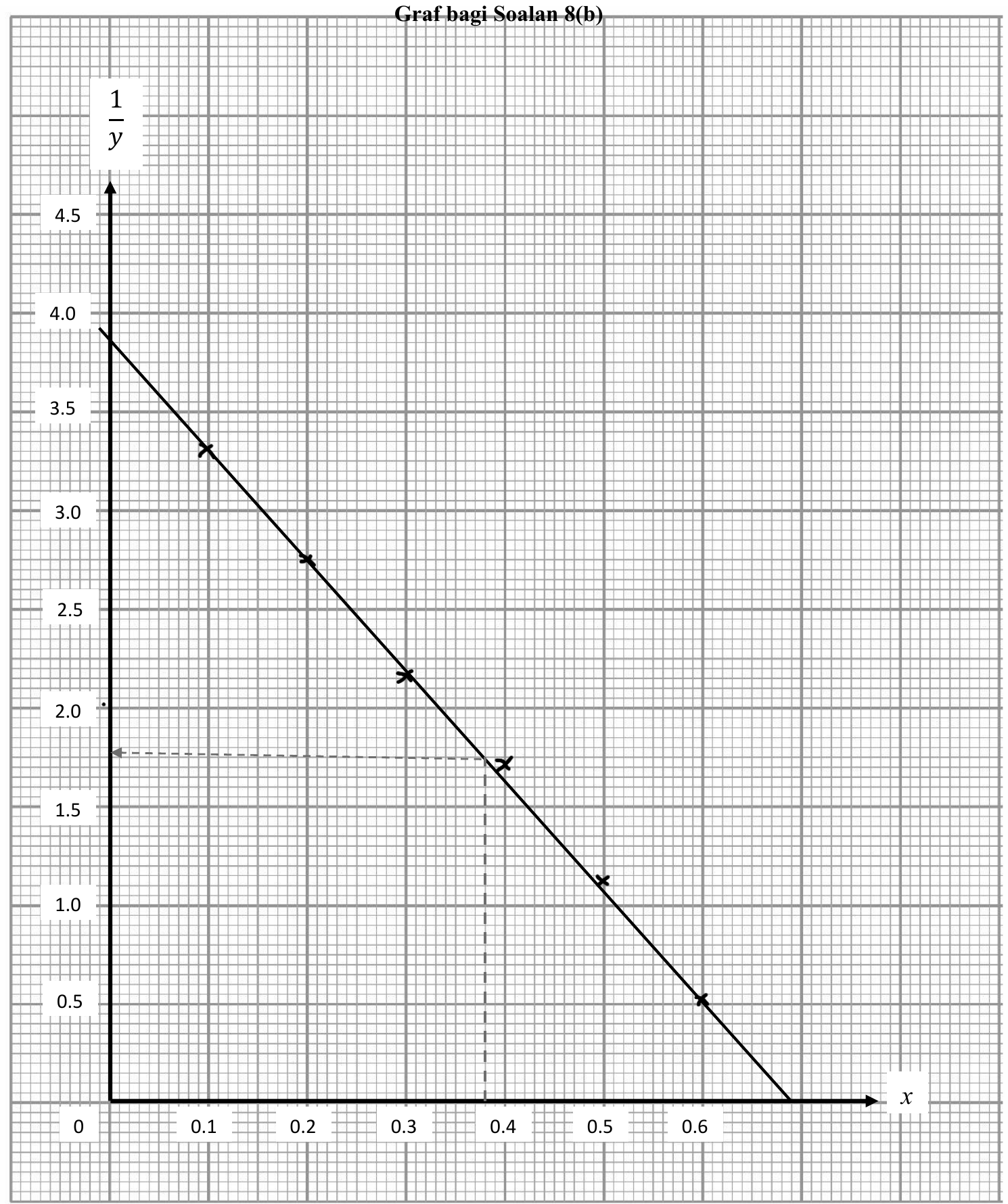
- (c)(ii)
Use the graph in 8(b) to find the value of y when x = 0.38.
[1]
Diagram 9 shows part of curve y = f(x) which passes through Q(1, 3). The straight line PQ is parallel to the x-axis. The curve has a gradient function of 2x. Find (a) the equation of the curve, (b) the area of the shaded region, (c) the volume of revolution, in terms of π, when the shaded region is revolved through 360° about the y-axis.
Medium10 marks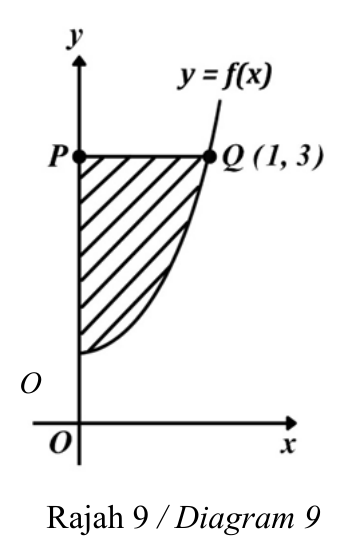
- (a)
Find the equation of the curve.
[3] - (b)
Find the area of the shaded region.
[4] - (c)
Find the volume of revolution, in terms of π, when the shaded region is revolved through 360° about the y-axis.
[3]
Diagram 10 shows a parallelogram ABCD. Point P lies on the straight line BC and point Q lies on the straight line AD. The straight line CQ is extended to the point R such that CQ = 2QR. It is given that BP : PC = 1 : 3, AQ : QD = 1 : 3, CP→ = 6u and CD→ = v. (a) Express, in terms of u and v, (i) CQ→, (ii) PA→. Hence, show that the points P, A and R are collinear. (b) It is given that u = −3i and v = −2i + 5j. (i) Express PA→ in terms of i and j. (ii) Find the unit vector in the direction of PA→. (u, v, i, j are vectors, written with a tilde under the letter in the paper.)
Medium10 marks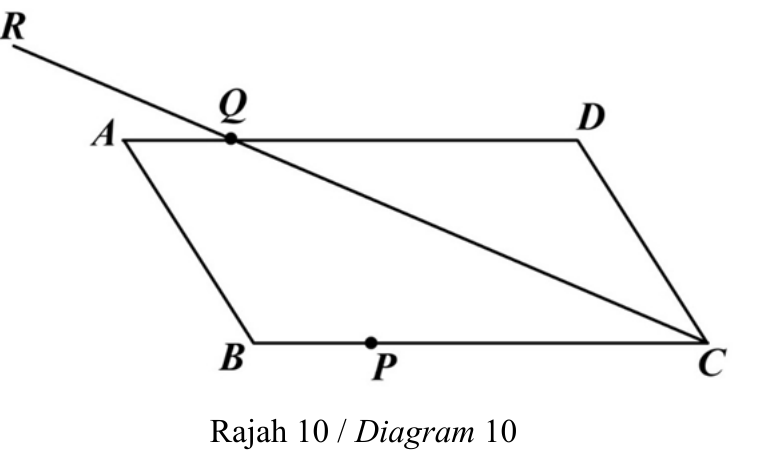
- (a)(i)
Express CQ→ in terms of u and v.
[2] - (a)(ii)
Express PA→ in terms of u and v. Hence, show that the points P, A and R are collinear.
[4] - (b)(i)
Express PA→ in terms of i and j.
[2] - (b)(ii)
Find the unit vector in the direction of PA→.
[2]
(a) It is found that 80% of university graduates in a state are employed. If 10 university graduates from the state are selected at random, find the probability that (i) exactly 9 of them are employed, (ii) at most 2 of them are unemployed. (b) In a cross country event participated by 500 students, the time taken for the run follows a normal distribution with a mean of 20 minutes and a standard deviation of 10 minutes. Participants will not be given any point if they take more than 32 minutes to complete the run. (i) If a participant is chosen at random, find the probability that the participant does not get any point. (ii) Medals were awarded to the first 80 participants who took less than t minutes to complete the run. Find the value of t.
Medium10 marks- (a)(i)
Find the probability that exactly 9 of the 10 graduates are employed.
[2] - (a)(ii)
Find the probability that at most 2 of them are unemployed.
[2] - (b)(i)
Find the probability that a participant chosen at random does not get any point.
[2] - (b)(ii)
Find the value of t, given that medals are awarded to the first 80 of the 500 participants who took less than t minutes.
[4]
Section C
Table 12 shows the price and price indices of four ingredients used to make a kind of food. Ingredient / Price 2021 (RM) / Price 2023 (RM) / Price index in 2023 based on 2021 / Percentage usage (%): P: 4.00, 5.00, x, w; Q: 3.00, y, 150, 12; R: 8.00, 10.00, 125, 48; S: z, 3.00, 120, 25. (a) Find the value of w, x, y and z. (b) Calculate the composite index for the cost of making the food in year 2023 based on the year 2021. (c) Calculate the corresponding cost in the year 2021 if the cost of making a packet of the food in the year 2023 was RM50.00. (d) Find the composite index for the year 2024 based on 2023 if the cost of all the ingredients increases by 15% from the year 2021 to the year 2024.
Medium10 marks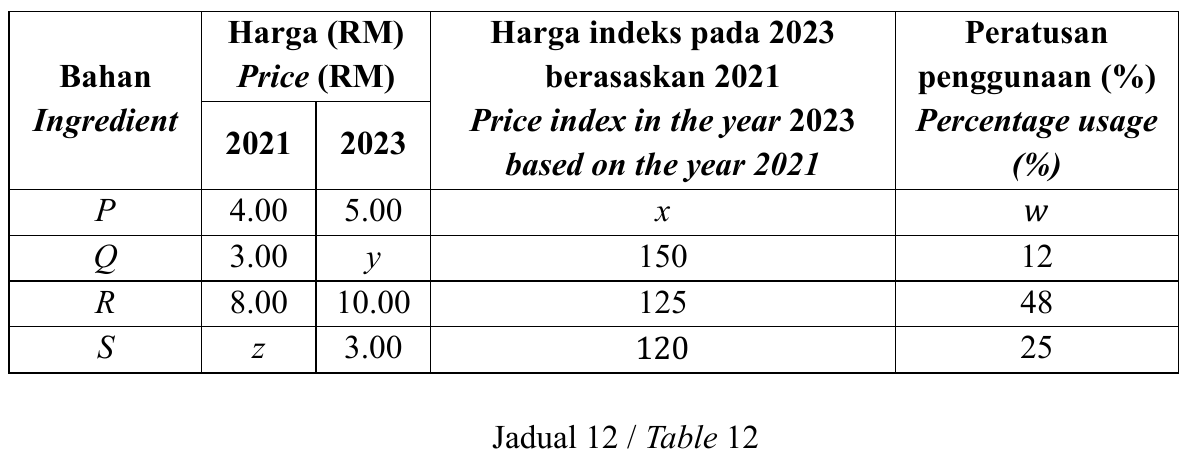
- (a)
Find the value of w, x, y and z.
[4] - (b)
Calculate the composite index for the cost of making the food in year 2023 based on the year 2021.
[2] - (c)
Calculate the corresponding cost in the year 2021 if the cost in 2023 was RM50.00.
[2] - (d)
Find the composite index for the year 2024 based on 2023 if the cost of all ingredients increases by 15% from 2021 to 2024.
[2]
Diagram 13 shows triangle ABC, which has been divided into two parts. ADC is a straight line. AB = 10 cm, BC = 7 cm, AC = 12 cm. Given that ∠BDC = 40.37°. Find (a) ∠ACB, (b) ∠BAC, (c) the length, in cm, of DC, (d) the area of ΔABD.
Medium10 marks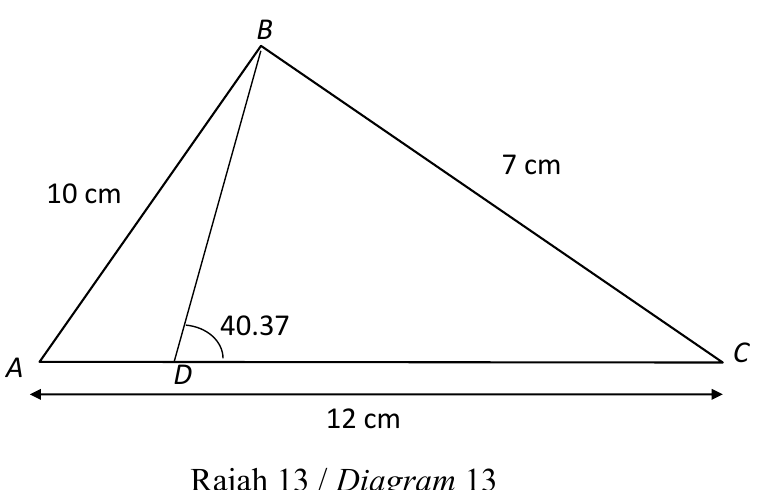
- (a)
Find ∠ACB.
[2] - (b)
Find ∠BAC.
[2] - (c)
Find the length, in cm, of DC.
[4] - (d)
Find the area of ΔABD.
[2]
A particle moves along a straight line with an initial velocity of 5 m s⁻¹. Its acceleration a m s⁻², is given by a = 19 − 8t, where t is the time, in seconds, after passing through a fixed point O. Find (a) the time, in seconds, when its acceleration is zero, (b) the maximum velocity, in m s⁻¹, of the particle, (c) the time, in seconds, when the particle stops instantaneously, (d) the total distance, in m, travelled by the particle in the first 4 seconds.
Medium10 marks- (a)
Find the time, in seconds, when its acceleration is zero.
[1] - (b)
Find the maximum velocity, in m s⁻¹, of the particle.
[3] - (c)
Find the time, in seconds, when the particle stops instantaneously.
[3] - (d)
Find the total distance, in m, travelled by the particle in the first 4 seconds.
[3]
A company has allocated at least RM1,200 to buy x units of type A paint and y units of type B paint. The price of a unit of type A is RM30 and of type B is RM20. The total number of paints must not exceed 60 units. The number of type B paint is not more than twice the number of type A. (a) Write down three inequalities, other than x ≥ 0 and y ≥ 0, that satisfy all the above conditions. (b) Using a scale of 2 cm to 10 units on both axes, construct and shade the region R that satisfies all the above conditions. (c) Based on the graph drawn in (b), find (i) the maximum cost to buy the paints, (ii) the range of the number of type B paints that can be purchased when 30 units of type A paints have been purchased.
Medium10 marks- (a)
Write down three inequalities, other than x ≥ 0 and y ≥ 0, that satisfy all the conditions.
[3] - (b)
Using a scale of 2 cm to 10 units on both axes, construct and shade the region R.
[3]
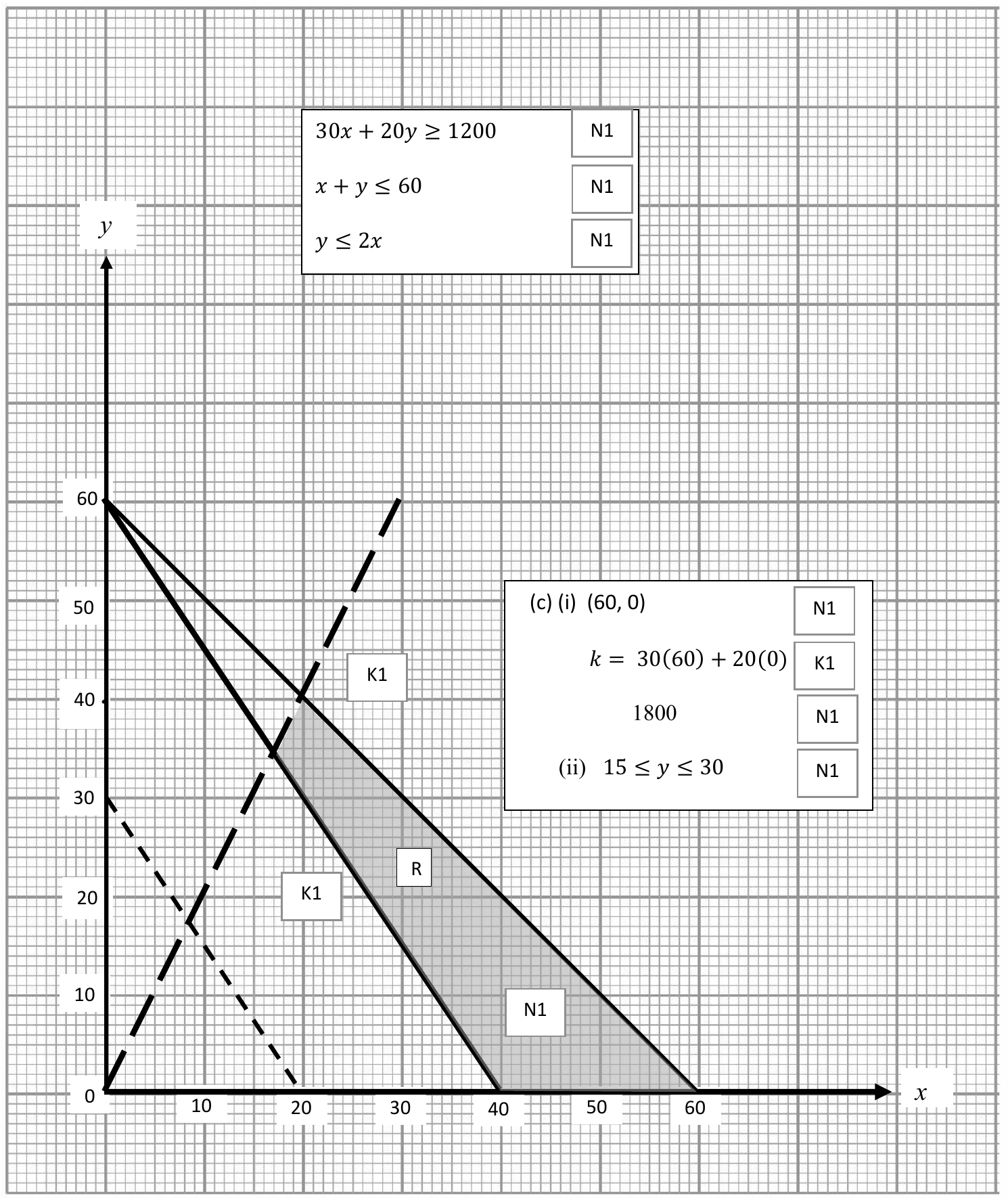
- (c)(i)
Find the maximum cost to buy the paints.
[3] - (c)(ii)
Find the range of the number of type B paints that can be purchased when 30 units of type A paints have been purchased.
[1]