Write your answer on paper. Then open the answer to check it.
Section A
Diagram 1 shows trapezium SPQR and point T lies on PR. It is given that SR→ = 10b, SP→ = 8a, SR : PQ = 2 : 1 and PT : PR = 1 : 3.
Medium6 marks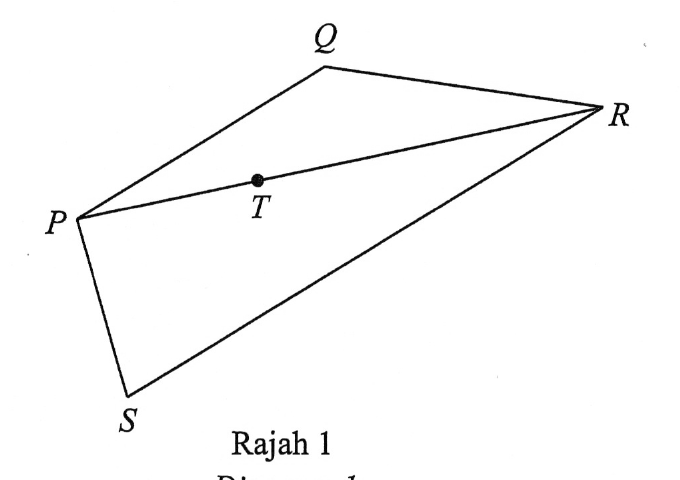
- (a)
Express SQ→ in terms of a and b.
[2] - (b)(i)
If ST→ = hSQ→, express ST→ in terms of h, a and b.
[1] - (b)(ii)
Find the value of h if the points S, T and Q are collinear.
[3]
(a) In a factory, there is a cutting machine that cuts a cuboid shaped wooden block into smaller pieces. The volume of the wooden block is represented by the equation V = (39/2)(x² − 12x), such that x is the length of the wooden block and x > 12 cm. When the cutting machine is turned on, given that the length of the wooden block decreases at the rate of 0.5 cm s⁻¹, find the rate of change of its volume, in cm³ s⁻¹, when the length of the wooden block is 15 cm. (b) By using the concept of calculus, find the percentage change in the volume of a sphere when there is a small change in radius by 3.6%. [Volume of sphere = (4/3)πr³]
Medium7 marks- (a)
Find the rate of change of its volume, in cm³ s⁻¹, when the length is 15 cm.
[3] - (b)
Find the percentage change in the volume of a sphere when the radius changes by 3.6%.
[4]
Diagram 2 shows two concentric circles, PRU and QST with centre O. PQR is a tangent to the smaller circle at point Q. Given that OP = PR = OR and OS = 8 cm. [Use π = 3.142] (a) Show that the area of sector OPR can be written as A = (1/2)r²θ. (b) Hence, find the area, in cm², of the shaded region.
Medium6 marks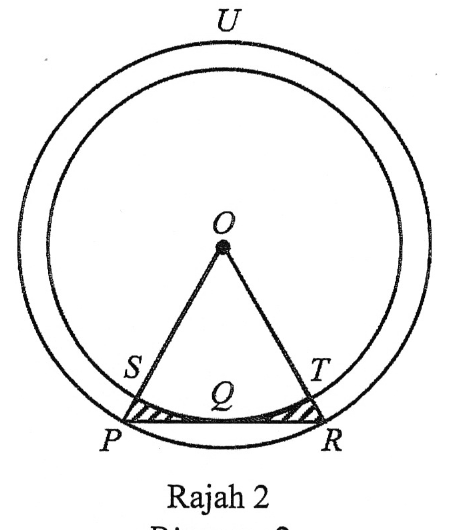
- (a)
Show that the area of sector OPR can be written as A = (1/2)r²θ.
[2] - (b)
Hence, find the area, in cm², of the shaded region.
[4]
(a) Simplify 49ⁿ × 1/(16807)^(n/3) × ∛(7^(5n)). Hence, show that the answer is always positive for all values of n. (b) (i) Given 9^(x+1) / 729^(√y−2) = 1, express y in terms of x. (ii) Rationalise the denominator and simplify 7/(7 + √7).
Medium8 marks- (a)
Simplify 49ⁿ × 1/(16807)^(n/3) × ∛(7^(5n)). Hence, show that the answer is always positive for all values of n.
[3] - (b)(i)
Given 9^(x+1) / 729^(√y−2) = 1, express y in terms of x.
[3] - (b)(ii)
Rationalise the denominator and simplify 7/(7 + √7).
[2]
A laboratory uses an automatic heater that is controlled based on time and temperature. The temperature of the room after the heater has been on for x minutes is represented by the function f : x → √(5x + 6) while the cooling system responds to the temperature by a function g : x → x² + 4 that shows the power rate of the cooling system based on the current temperature. (a) Find the time in minutes when the value is the same as the room temperature. (b) Write an expression for the cooling power rate, in the form of a composite function. (c) Calculate the cooling power rate when the heater has been operating for 3 minutes.
Medium7 marks- (a)
Find the time in minutes when the value is the same as the room temperature.
[2] - (b)
Write an expression for the cooling power rate, in the form of a composite function.
[3] - (c)
Calculate the cooling power rate when the heater has been operating for 3 minutes.
[2]
(a) (i) Prove that 2 tan θ cos²θ = sin 2θ. (ii) Hence, solve the equation 6 tan θ cos²θ = −1 for 0° ≤ θ ≤ 360°. (b) Diagram 3 shows a right-angled triangle ABD. BCD is a straight line. In the diagram, ∠ADB = 30°, AC = 25 cm, CB = 7 cm, ∠ABD = 90° and ∠CAB = θ. Without finding ∠CAD, calculate the value of cos ∠CAD.
Medium8 marks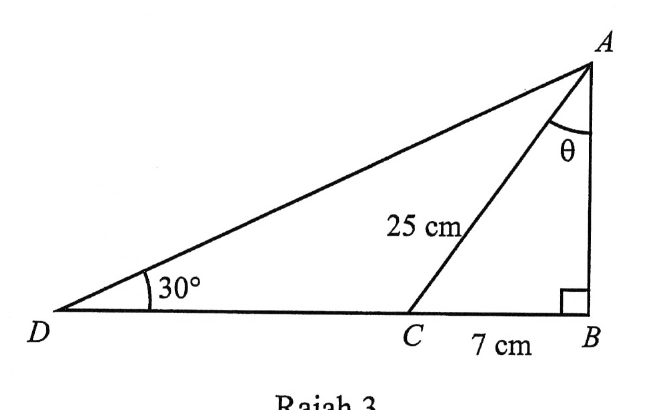
- (a)(i)
Prove that 2 tan θ cos²θ = sin 2θ.
[2] - (a)(ii)
Hence, solve 6 tan θ cos²θ = −1 for 0° ≤ θ ≤ 360°.
[3] - (b)
Without finding ∠CAD, calculate the value of cos ∠CAD.
[3]
It is given that f(x) = 4px − 5p² − 1 − x² has a maximum value −q² − 2p, such that p and q are constants. (a) By using completing the square, show that q = p − 1. (b) Hence, find the value of p and q if the graph of the function is symmetrical about the axis x = q² − 1, such that p > 0. (c) By using the value of p in (b), calculate the value of discriminant of the function.
Medium8 marks- (a)
By using completing the square, show that q = p − 1.
[4] - (b)
Hence, find the value of p and q.
[2] - (c)
Calculate the value of the discriminant.
[2]
Section B
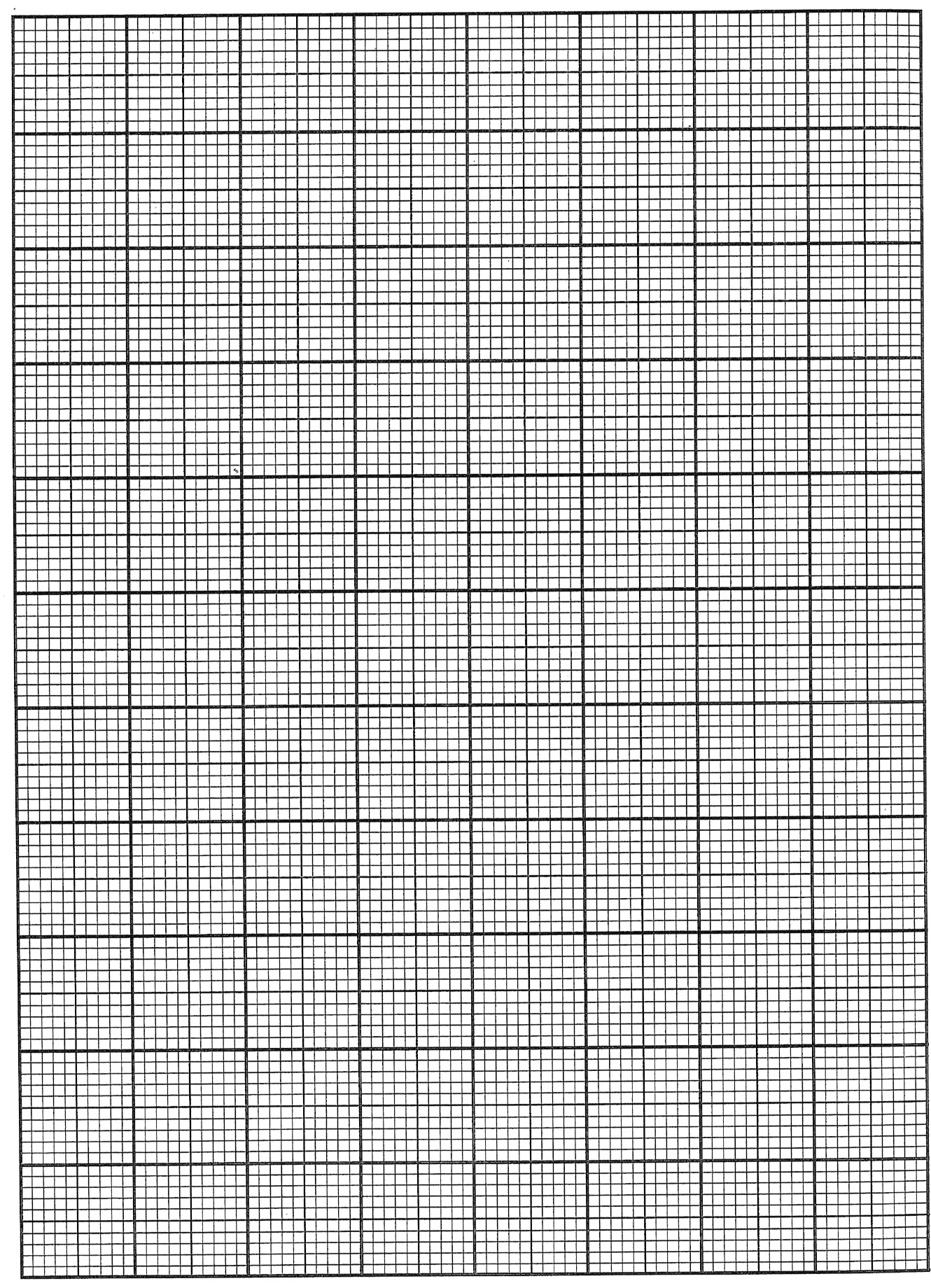
Table 1 shows the values of two variables, x and y, obtained from an experiment. The variables x and y are related by the equation y = pq^(x−1), such that p and q are constants. x: 4.0, 4.5, 5.0, 5.5, 6.0, 6.6; y: 25.1, 33.9, 48, 67.9, 96, 138.1. (a) Plot log10 y against (x − 1), using a scale of 2 cm to 1 unit on the (x − 1)-axis and 2 cm to 0.2 unit on the log10 y-axis. Hence, draw the line of best fit. (b) Using the graph in 8(a), find (i) the value of p and of q, (ii) the value of x when y = 15.85.
Medium10 marks
- (a)
Plot log10 y against (x − 1) and draw the line of best fit.
[5]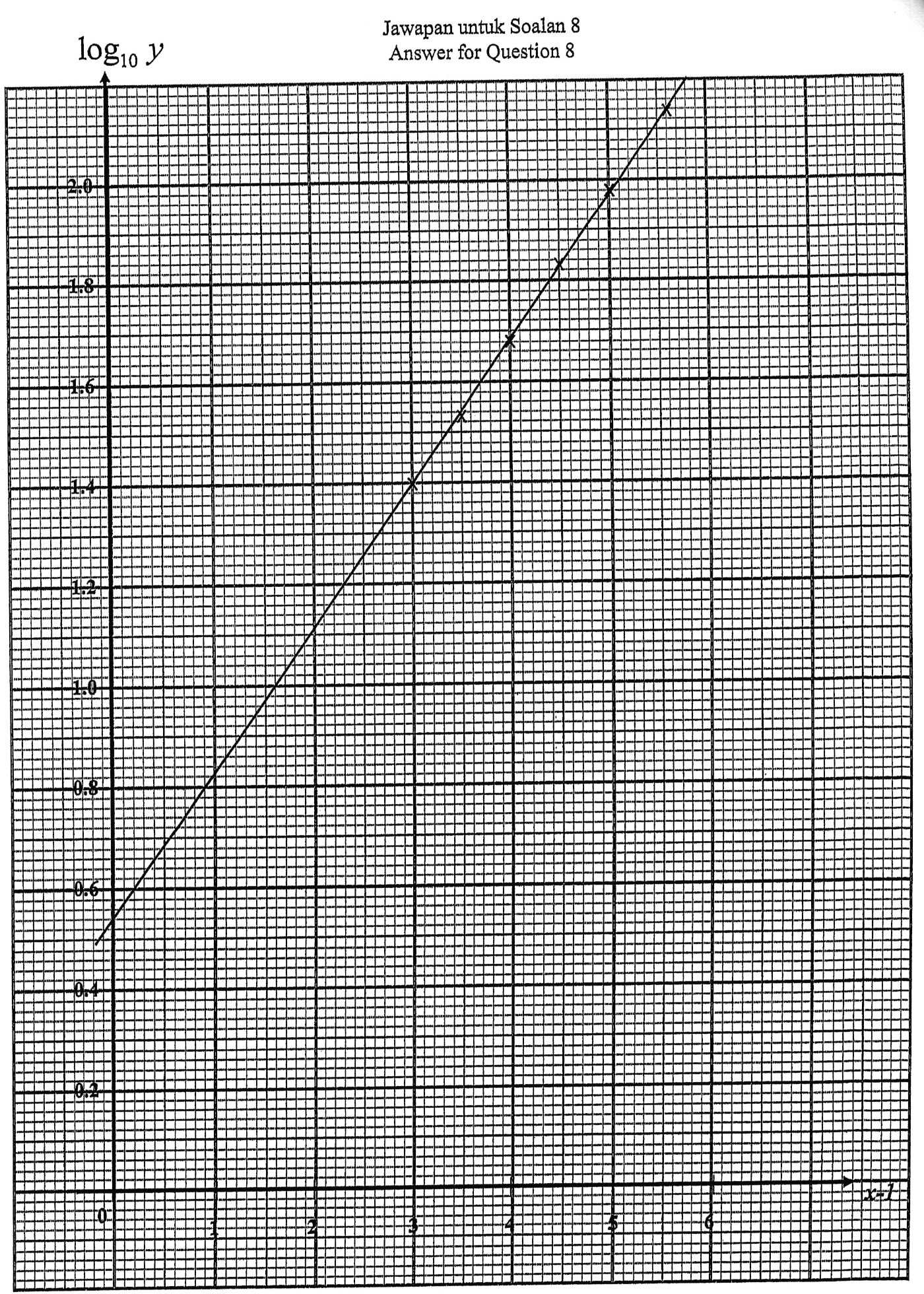
- (b)(i)
Find the value of p and of q.
[4] - (b)(ii)
Find the value of x when y = 15.85.
[1]
(a) The probability of a student owns a smart phone is p. A sample of 7 students is selected at random. (i) If the probability of all students owned a smart phone is 0.02799, find the value of p. Give your answer correct to one decimal place. (ii) Find the probability that at least 2 students owned a smart phone. (b) In a charity running event with 300 participants, the time taken to run is normally distributed with a mean of 25 minutes and a variance of 81 minutes². Participants will not be awarded any points if their running time exceeds 34 minutes. (i) If a participant is chosen at random, find the probability that the participant does not get any points. (ii) Medals are awarded to the first 48 participants who take less than h minutes to finish the run. Find the value of h.
Medium10 marks- (a)(i)
Find the value of p, correct to one decimal place.
[2] - (a)(ii)
Find the probability that at least 2 students owned a smart phone.
[3] - (b)(i)
Find the probability that a randomly chosen participant does not get any points.
[2] - (b)(ii)
Find the value of h.
[3]
Diagram 4 shows part of a curve f(x) = −(x + 4)(x − 1)(x − 3) and PQR is the curve g(x) = −(1/3)(−2x + 6)². Both curves intersect y-axis and x-axis at point P and point Q. Find (a) the coordinates of P, (b) the area of the shaded region, (c) the volume generated, in terms of π, when the region bounded by the curve y = g(x), y-axis and x-axis is revolved through 360° about the x-axis.
Hard10 marks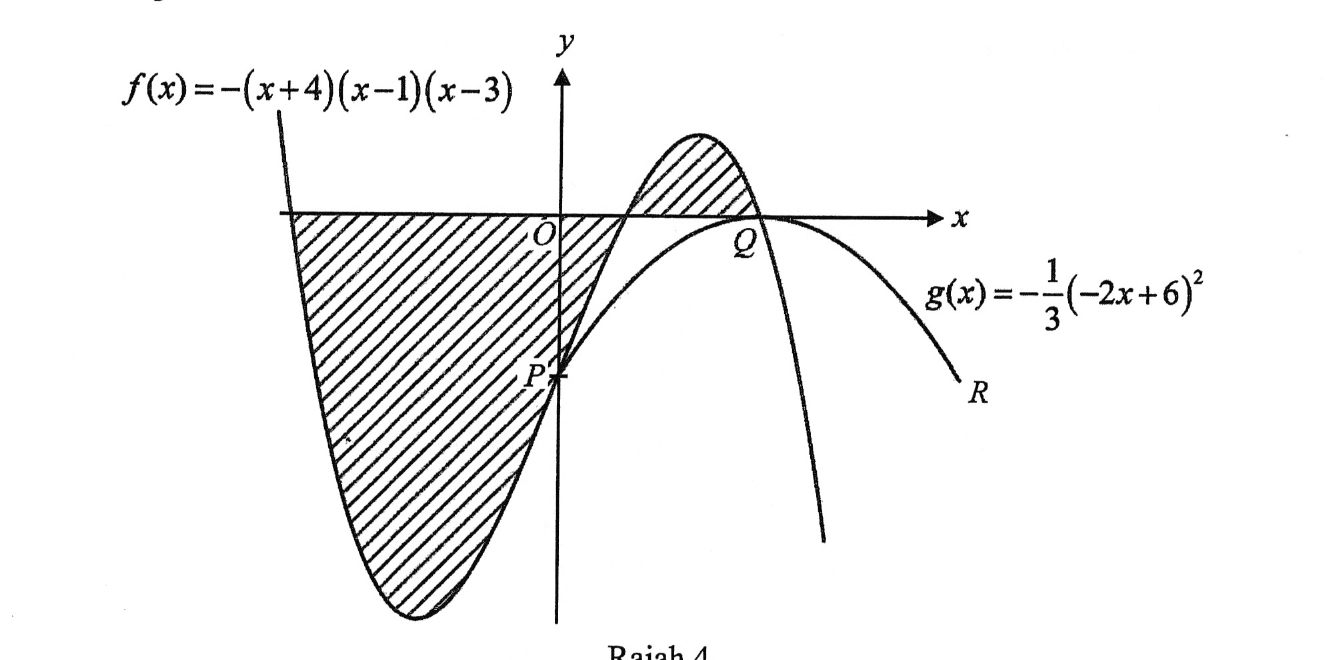
- (a)
Find the coordinates of P.
[2] - (b)
Find the area of the shaded region.
[4] - (c)
Find the volume generated, in terms of π.
[4]
Diagram 5 shows an isosceles triangle RST, where RS = ST and point M(2, 0) is the midpoint of RT. It is given that ∠RMO = 45°, and S is the point (k, 5). (a) Given that the equation of the straight line MS is y − x + 2 = 0, find (i) the value of k, (ii) the equation of the straight line parallel to MS and passes through point R. (b) It is given that RT is the diagonal of parallelogram RSTU. (i) Find the area of the parallelogram RSTU. (ii) Point K moves such that its distance from point S is always 4/3 times its distance from point R. Find the equation of the locus of K.
Medium10 marks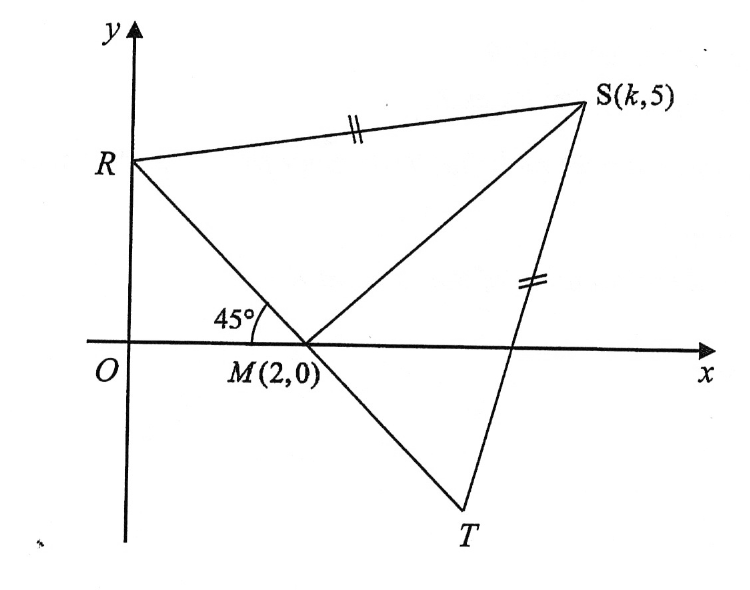
- (a)(i)
Find the value of k.
[2] - (a)(ii)
Find the equation of the straight line parallel to MS and passes through point R.
[3] - (b)(i)
Find the area of the parallelogram RSTU.
[2] - (b)(ii)
Find the equation of the locus of K.
[3]
Section C
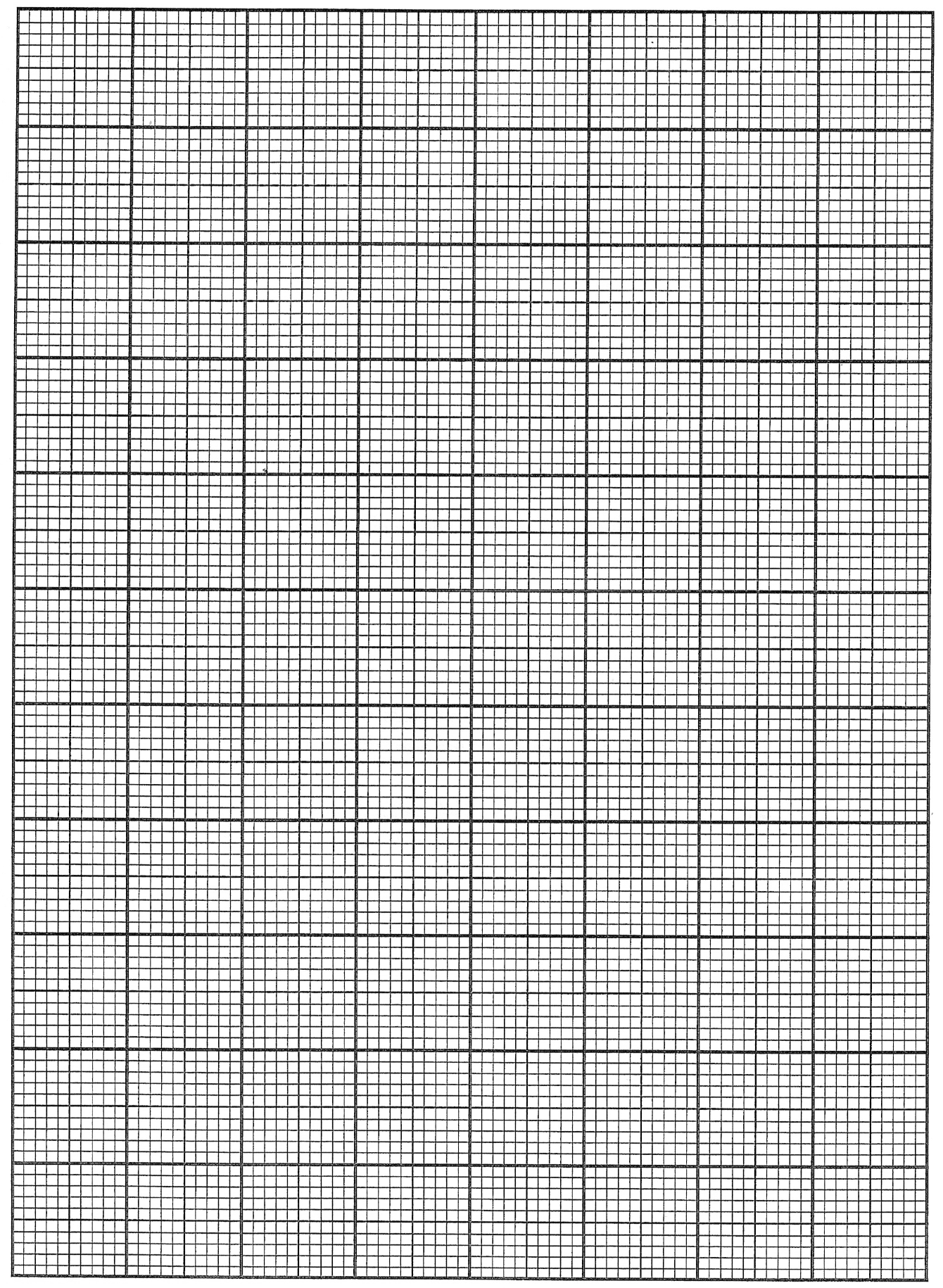
Puan Sabariah wants to sell x jar of biscoff biscuit and y jar of chocolate biscuit during the festive season. The biscuits are sold based on the following constraints: I: The total number of jar of biscuit does not exceed 400 jars. II: The number of jar of chocolate biscuit is at most 2 times of the number of jar of biscoff biscuit. III: The number of jar of chocolate biscuit exceeds one third of the number of jar of biscoff biscuit at least by 60 jars. (a) Write three inequalities, other than x ≥ 0 and y ≥ 0, which satisfy all the above constraints. (b) By using a scale of 2 cm to 50 jars of biscuit on both axes, construct and shade the region R which satisfies the inequalities in 12(a). (c) Using the graph constructed in 12(b), find (i) the range of number of jars of chocolate biscuit if the number of jars of biscoff biscuit is 150 jars, (ii) the maximum profit if the profit per jar of biscoff biscuit is RM5 and the profit per jar of chocolate biscuit is RM2.
Medium10 marks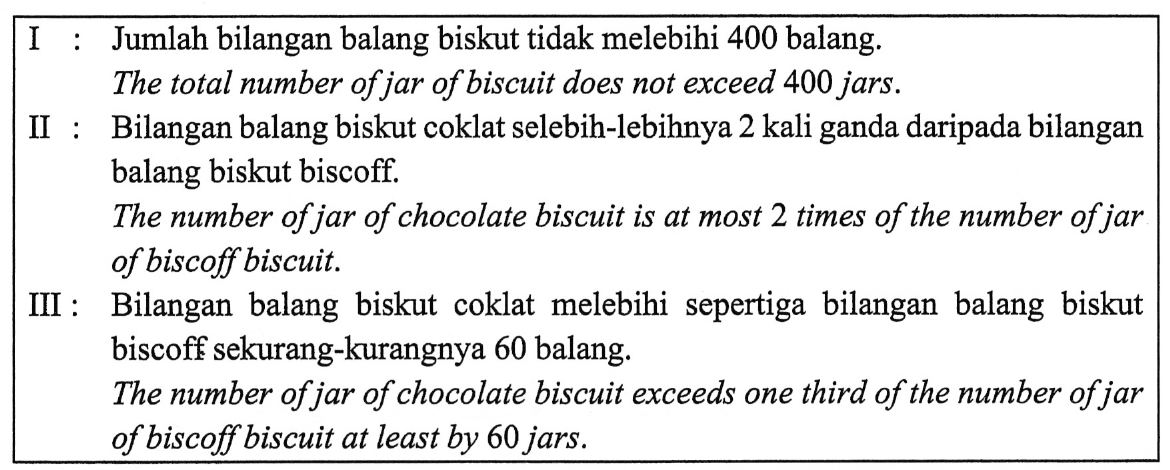
- (a)
Write three inequalities, other than x ≥ 0 and y ≥ 0.
[3] - (b)
Construct and shade the region R.
[3]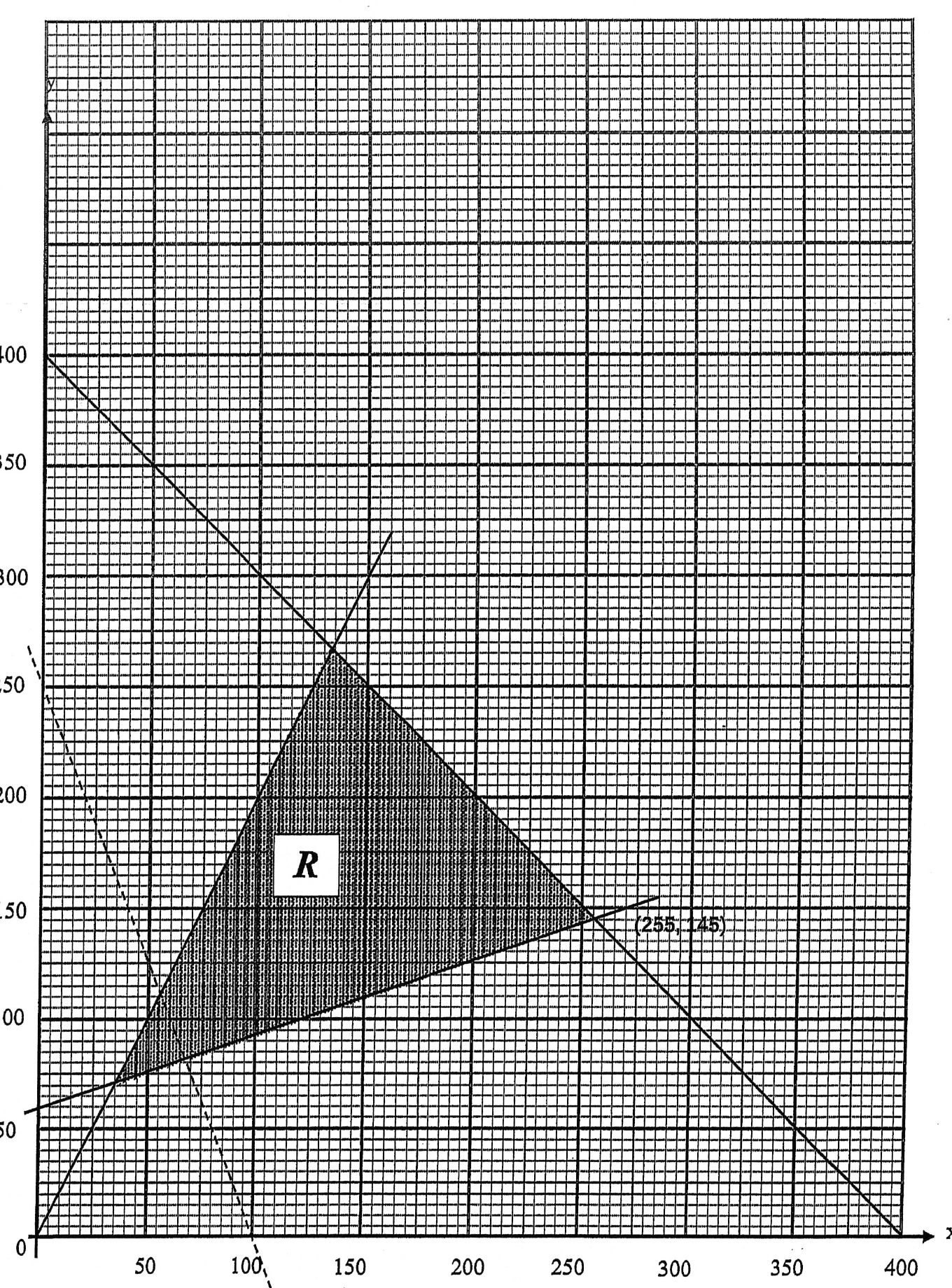
- (c)(i)
Find the range of the number of jars of chocolate biscuit if the number of jars of biscoff biscuit is 150.
[1] - (c)(ii)
Find the maximum profit.
[3]
Solution by graph sketching is not accepted. A particle starts at rest from a fixed point O, moves along a straight line with velocity v m s⁻¹. Given that v = qt² − rt where t is the time, in seconds, q and r are constants after the motion starts. The particle is at rest momentarily when t = 1 s and its distance at the instant is 2 m to the left of the point O. [Assume its motion to the right is positive] (a) Calculate the value of q and r. (b) Hence, by using the value of q and of r from 13(a), (i) find the initial acceleration, (ii) sketch the velocity-time graph of the particle for 0 ≤ t ≤ 2, (iii) calculate the total distance travelled by the particle in the first 2 seconds.
Medium10 marks- (a)
Calculate the value of q and r.
[4] - (b)(i)
Find the initial acceleration.
[2] - (b)(ii)
Sketch the velocity-time graph of the particle for 0 ≤ t ≤ 2.
[2]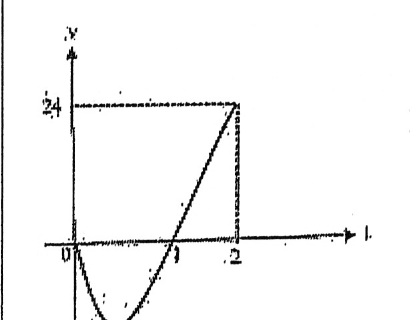
- (b)(iii)
Calculate the total distance travelled by the particle in the first 2 seconds.
[2]
Table 2 shows the ingredients used to make a loaf of raisin bread. The percentage of change in the price of goods and the percentage of consumption of each ingredient in the year 2024 compared to the year 2022 in producing a loaf of raisin bread are stated in the second and third column respectively. Flour: increase 20%, 65. Sugar: increase 30%, 4p. Yeast: decrease 20%, p/2. Oil: increase 10%, 3p/2. Raisin: decrease 10%, p. (a) Calculate the price of flour in the year 2024 if its price in the year 2022 is RM3.00. (b) Calculate the composite index for the cost of production of a loaf of raisin bread in the year 2024 based on the year 2022. (c) The production cost of a loaf of raisin bread in the year 2024 is RM10. The price of each ingredient is expected to increase by 33% from the year 2022 to the year 2026. In the year 2026, if RM2200 is allocated to produce 200 loaves of raisin bread, determine whether the allocation is enough or not.
Medium10 marks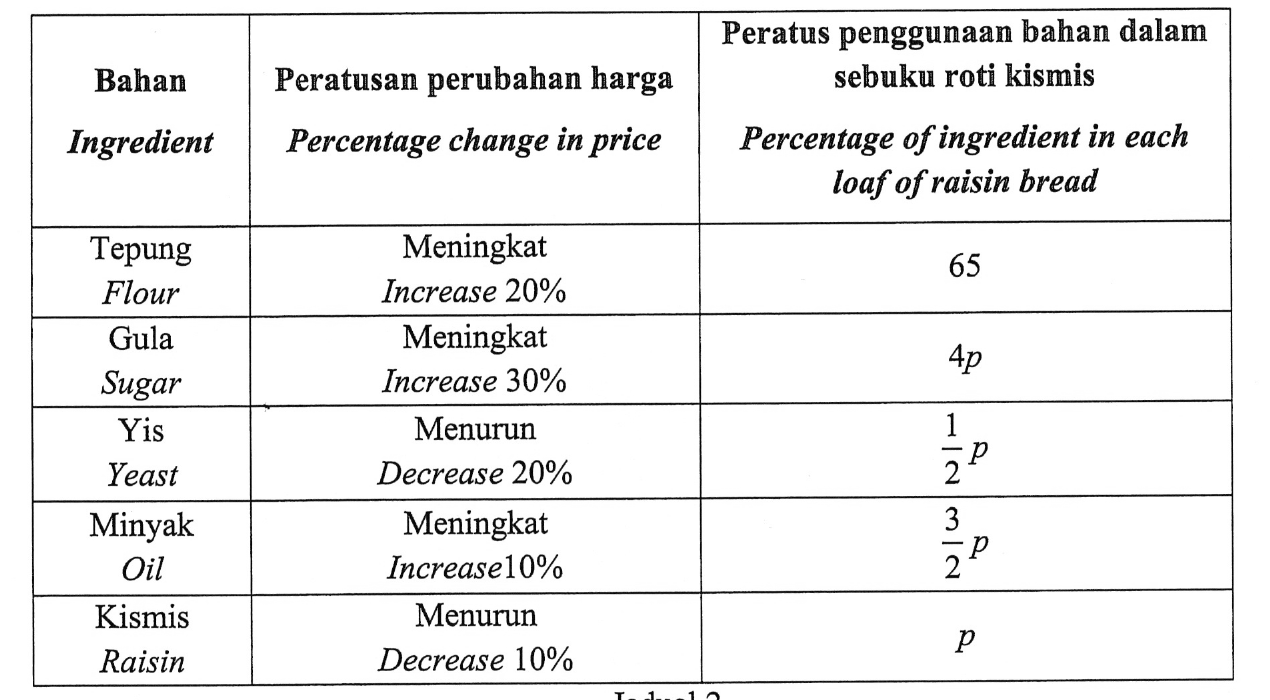
- (a)
Calculate the price of flour in the year 2024.
[2] - (b)
Calculate the composite index for the cost of production in 2024 based on 2022.
[4] - (c)
Determine whether the allocation of RM2200 for 200 loaves is enough.
[4]
Solution by scale drawing is not accepted. Diagram 6 shows a solid prism with a horizontal rectangular surface ABCD. The trapezium ABFE is the uniform cross section of the prism. The rectangles ADHE and BCGF are a vertical plane while the base surface EFGH is an inclined plane. Dimensions marked on the diagram: 11.04 cm (AE), 12.35 cm (AB), 8.21 cm (BC), 5.72 cm (BF). (a) Given that ∠HEC = 63.66°, find ∠HCE. (b) Find ∠BFE. Hence, calculate the area, in cm², of triangle BFE using Heron's formula. (c) Determine the shortest distance, in cm, from point F to EB.
Medium10 marks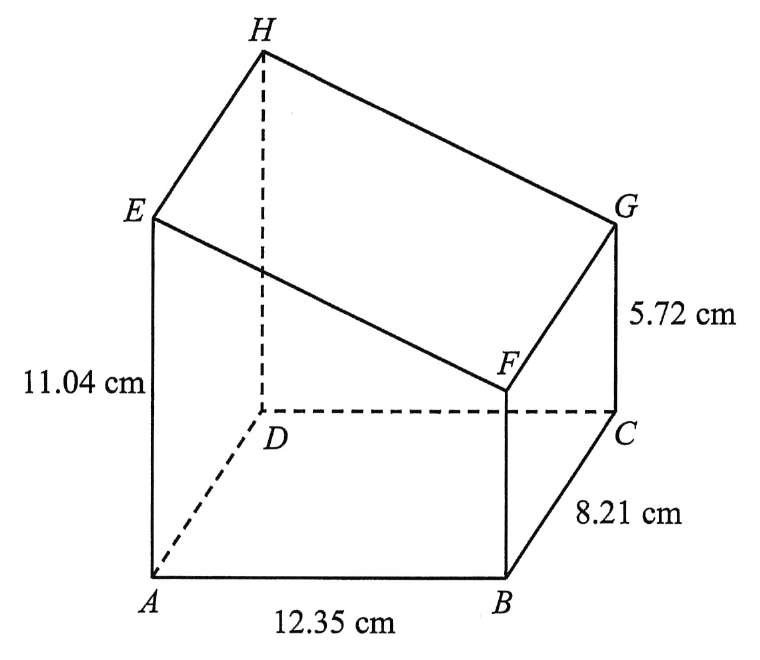
- (a)
Given that ∠HEC = 63.66°, find ∠HCE.
[3] - (b)
Find ∠BFE. Hence, calculate the area, in cm², of triangle BFE using Heron's formula.
[5] - (c)
Determine the shortest distance, in cm, from point F to EB.
[2]