Write your answer on paper. Then open the answer to check it.
Section A
Solve the simultaneous equations 2x + 3y = 5 and 2x² + y² = 8. Give your answers correct to three significant figures.
Medium5 marksSolve the simultaneous equations 2x + 3y = 5 and 2x² + y² = 8. Give your answers correct to three significant figures.
[5]
Diagram 1 shows the straight line graph obtained when y = 2x/(x³ − 8) is converted to linear form (Y against X; the line cuts the Y-axis at −4). Express X and Y in terms of x and/or y.
Easy2 marks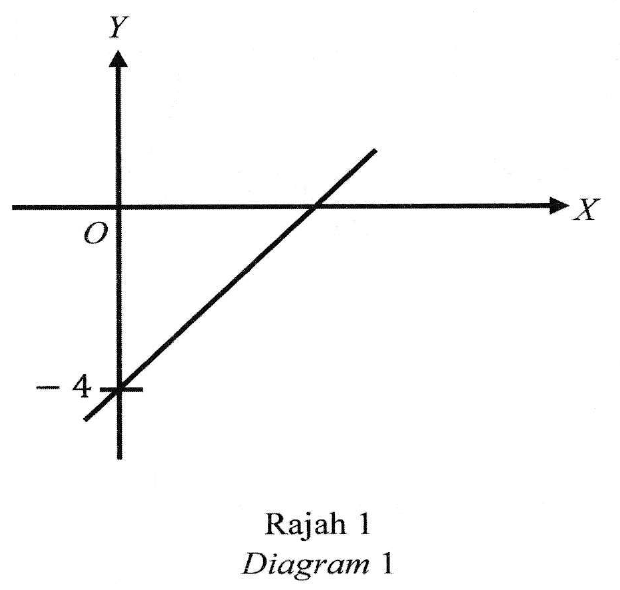
Express X and Y in terms of x and/or y.
[2]
Diagram 2 shows the function f: x → 7x − 9 (2 is mapped to m). (a) Find the value m. (b) Given function f: x → x + 4 and gf: x → (x − 4)/(x + 1), x ≠ −1, find the function g.
Easy3 marks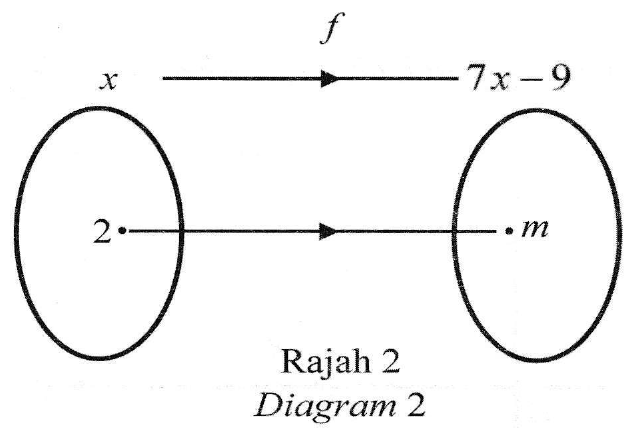
- (a)
Find the value m.
[1] - (b)
Given function f: x → x + 4 and gf: x → (x − 4)/(x + 1), x ≠ −1, find the function g.
[2]
(a) Given u = (7, 9) and v = (n − 1, 3) (column vectors). Find the possible value of n if (i) u and v are parallel, (ii) |u| = |v|. (b) Given p = (m − 1, 1) and q = (9, 8), where m is a constant. Find the value of m if p is perpendicular to q.
Easy7 marks- (a)(i)
u and v are parallel.
[2] - (a)(ii)
|u| = |v|.
[2] - (b)
Find the value of m if p is perpendicular to q.
[3]
Diagram 3 shows a sector ABC with centre A, where AB = BC = AC. Find the perimeter, in terms of p and π, of the shaded region (the segment bounded by chord BC and arc BC; AB = p).
Easy3 marks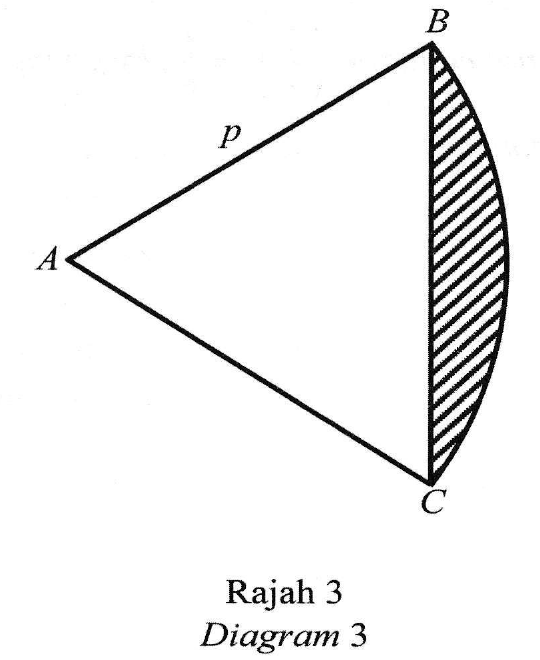
Find the perimeter, in terms of p and π, of the shaded region.
[3]
Solve the exponential equation (1/3)^p = 1/6, by giving the answer in the form of a + log₃ b, a and b are constants.
Medium3 marksSolve (1/3)^p = 1/6 in the form a + log₃ b.
[3]
Damia Furniture Company sold 30 000 dining table sets in 2019. Each year, sales increase by 2.5%. (a) Find the total number of dining table sets sold from 2019 to 2025. (b) If 24% of the sets sold from 2021 to 2025 are round and 15% are square, calculate the sum of round and square dining table sets.
Medium7 marks- (a)
Find the total number of dining table sets sold from 2019 to 2025.
[3] - (b)
If 24% of the sets sold from 2021 to 2025 are round and 15% are square, calculate the sum of round and square sets.
[4]
(a) Sketch the graph of y = cos 2x + 1 for 0 ≤ x ≤ 2π. (b) Hence, using the same axes, sketch a suitable straight line graph to find the number of solutions to the equation cos 2x = 1 − x/(4π) for 0 ≤ x ≤ 2π. State the number of solutions.
Easy5 marks- (a)
Sketch the graph of y = cos 2x + 1 for 0 ≤ x ≤ 2π.
[3]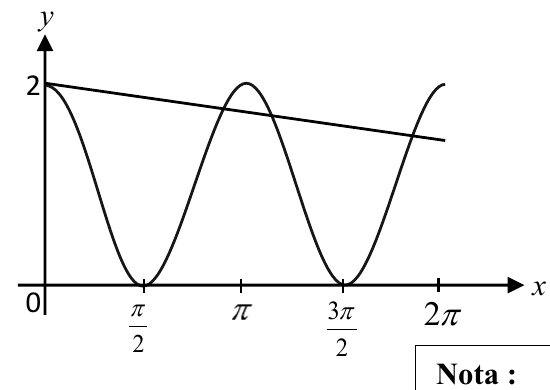
- (b)
Sketch a suitable straight line and state the number of solutions of cos 2x = 1 − x/(4π).
[2]
(a)(i) Given two functions u(x) and v(x). Using differentiation from first principles, prove the product rule d/dx[u(x)v(x)] = u(x)v′(x) + v(x)u′(x). (ii) Hence, differentiate (2x − 3)⁴(3x + 2) with respect to x. (b) The annual production cost K(n) for producing n units of houses is K(n) = 2n² − 100n + 1375000. Determine the number n of houses to be produced to minimise the annual production cost by using the calculus method. Hence, calculate the annual production cost.
Hard9 marks- (a)(i)
Prove the product rule using first principles.
[3] - (a)(ii)
Differentiate (2x − 3)⁴(3x + 2) with respect to x.
[2] - (b)
Determine n that minimises K(n) = 2n² − 100n + 1375000, and calculate the minimum annual production cost.
[4]
(a) Diagram 4 shows the curve x = f(y) intersecting the y-axis at y = a and y = b. Given that the area bounded by the curve and the y-axis is 10 unit², find the value of ∫ₐᵇ 2f(y) dy. (b) Given that ∫₁³ g(x) dx = −3, find the value of k if ∫₁³ [2g(x) + x − k] dx = 3k.
Medium6 marks- (a)
Given the area bounded by the curve and the y-axis is 10 unit², find ∫ₐᵇ 2f(y) dy.
[2]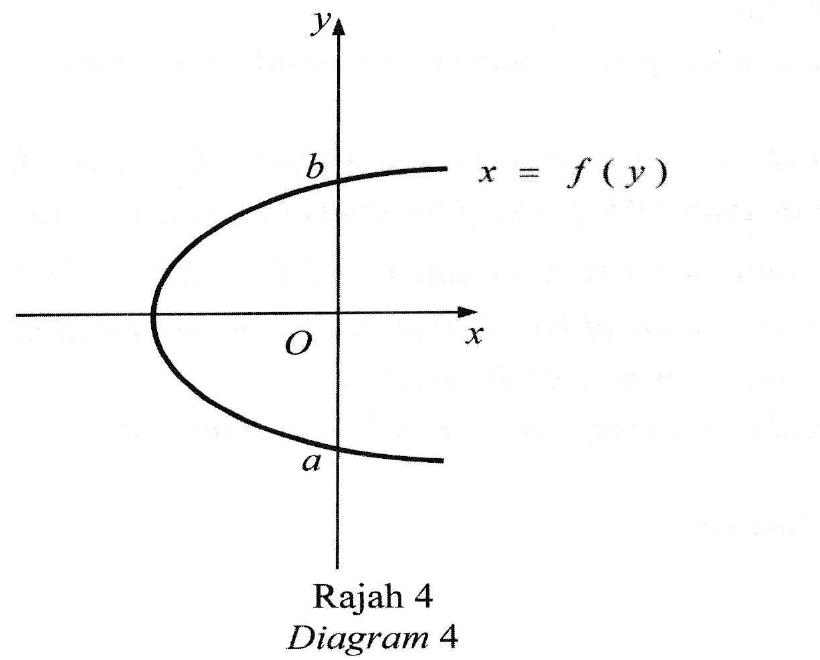
- (b)
Find k if ∫₁³ [2g(x) + x − k] dx = 3k, given ∫₁³ g(x) dx = −3.
[4]
(a)(i) Show that (n − 1)!/(n − 3)! = n² − 3n + 2. (ii) If ˣC_a = ˣC_b, express x in terms of a and b. (b) A committee of a parent teacher association is made up of 6 people chosen from 7 parents, 4 teachers and a principal. How many ways can the committee be formed if it (i) must include a principal, (ii) has exactly 3 parents, (iii) has not more than 3 teachers?
Medium8 marks- (a)(i)
Show that (n − 1)!/(n − 3)! = n² − 3n + 2.
[2] - (a)(ii)
If ˣC_a = ˣC_b, express x in terms of a and b.
[1] - (b)(i)
Must include a principal.
[1] - (b)(ii)
Exactly 3 parents.
[2] - (b)(iii)
Not more than 3 teachers.
[2]
Diagram 5 shows the graph of the heights of children, in cm, at a childcare centre. The heights are normally distributed with mean μ and standard deviation σ. The graph marks 88 and 136 on the x-axis; the area under the curve between x = 88 and x = 136 is 49.6% and the area to the right of x = 136 is 32.6%. Find the value of μ and of σ.
Medium6 marks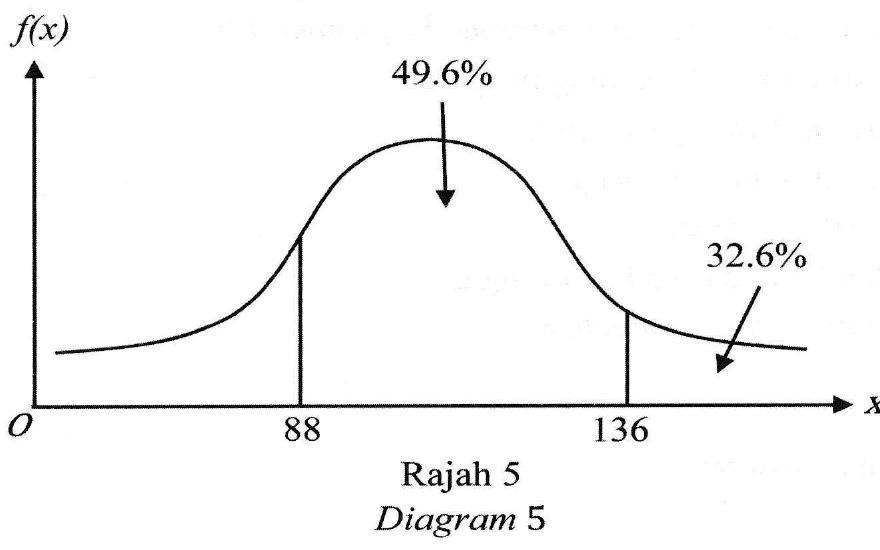
Find the value of μ and of σ.
[6]
Section B
Diagram 6 shows points A(a, b), B(c, d) and P. (a) Given that point P divides line segment AB in the ratio m : n, show that x = (an + cm)/(m + n). (b) Hence, find the coordinates of P if the values of a, b, c and d are −3, 7, 3 and −2 such that AP : PB is 2 : 1. (c) Find the equation of the straight line perpendicular to AB and passing through point P.
Medium8 marks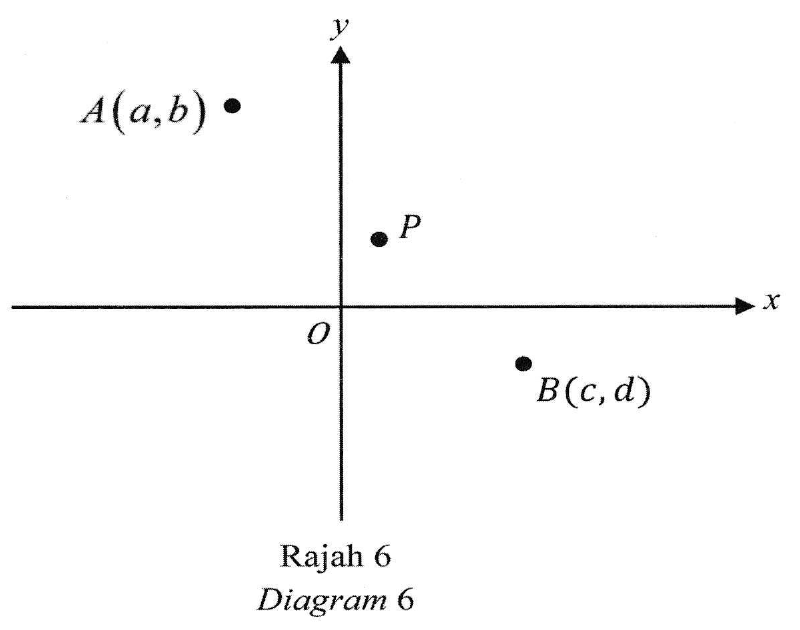
- (a)
Show that x = (an + cm)/(m + n).
[2] - (b)
Find the coordinates of P if a, b, c, d are −3, 7, 3, −2 and AP : PB = 2 : 1.
[2] - (c)
Find the equation of the straight line perpendicular to AB and passing through P.
[4]
(a) Diagram 7 shows the graph of the function f(x) = √(2x − 4) for 2 ≤ x ≤ 4. The graph of f⁻¹(x) is the image of f(x) under the reflection in the line f(x) = x. Find (i) the function f⁻¹(x), (ii) the domain and range of the function f⁻¹(x), (iii) f⁻¹f(3). (b) Given function h: x → x/3 + c, where c is a constant. If h(x) maps 4 onto itself, find the value of c.
Medium8 marks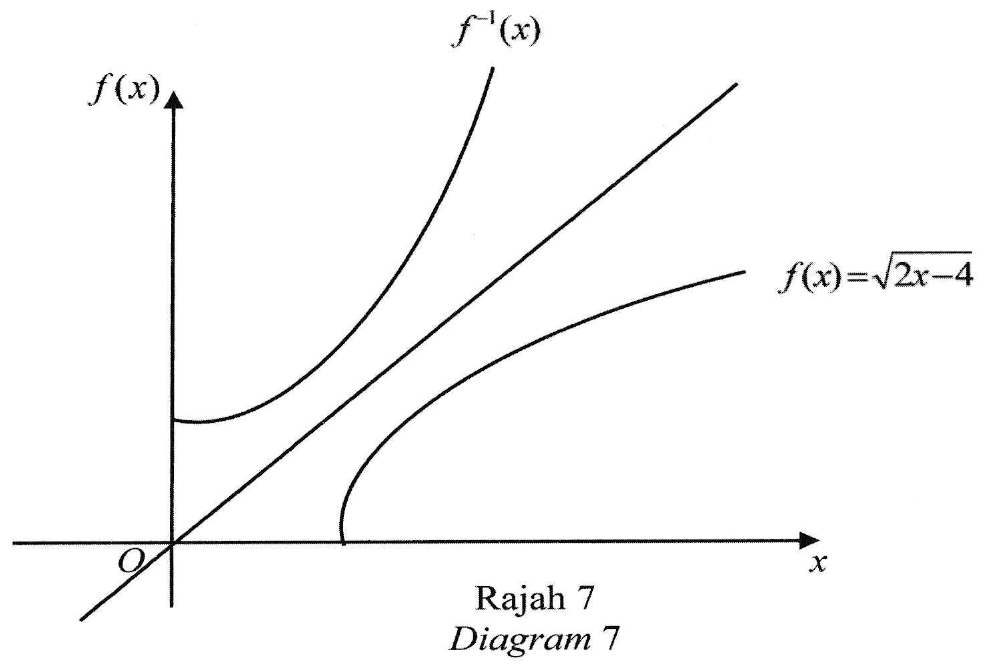
- (a)(i)
Find the function f⁻¹(x).
[2] - (a)(ii)
Find the domain and range of f⁻¹(x).
[2] - (a)(iii)
Find f⁻¹f(3).
[1] - (b)
If h(x) maps 4 onto itself, find the value of c.
[3]
(a) Given the quadratic equation px² − 7qx + 16p = 0, where p and q are constants and equal roots, find p : q. Hence, find the value of p + q. (b) Find the range of values of x for the quadratic inequality 2x² ≤ 1 + x by using the number line method. (c) Given a quadratic function g(x) = a(x − b)² + c, where a, b and c are constants, has a maximum value of 10. The equation of the axis of symmetry of the graph g(x) is x = 4. Find (i) the range of values of a, (ii) the values of b, (iii) the values of c.
Medium8 marks- (a)
Equal roots of px² − 7qx + 16p = 0: find p : q, then p + q.
[3] - (b)
Find the range of x for 2x² ≤ 1 + x by the number line method.
[2] - (c)(i)
Find the range of values of a.
[1] - (c)(ii)
Find the value of b.
[1] - (c)(iii)
Find the value of c.
[1]