Write your answer on paper. Then open the answer to check it.
Section A
You are required to perform a food test to determine the presence of reducing and non-reducing sugars in food samples P and Q. Diagram 1(a) and Diagram 1(b) show the setup of the experiment (syringe adding Benedict's solution to a food sample in a test tube held by a holder; test tubes P and Q in a boiling water bath heated by a Bunsen burner). Steps: 1 Label each test tube P and Q. 2 Add 2 ml of food sample P into tube P. 3 Add 2 ml of food sample Q into tube Q. 4 Add 2 ml of Benedict's solution into both tubes and shake well. 5 Put tubes P and Q in a boiling water bath for 5 minutes. 6 Record your observation. Based on the experiment conducted, answer the following questions.
Medium15 marks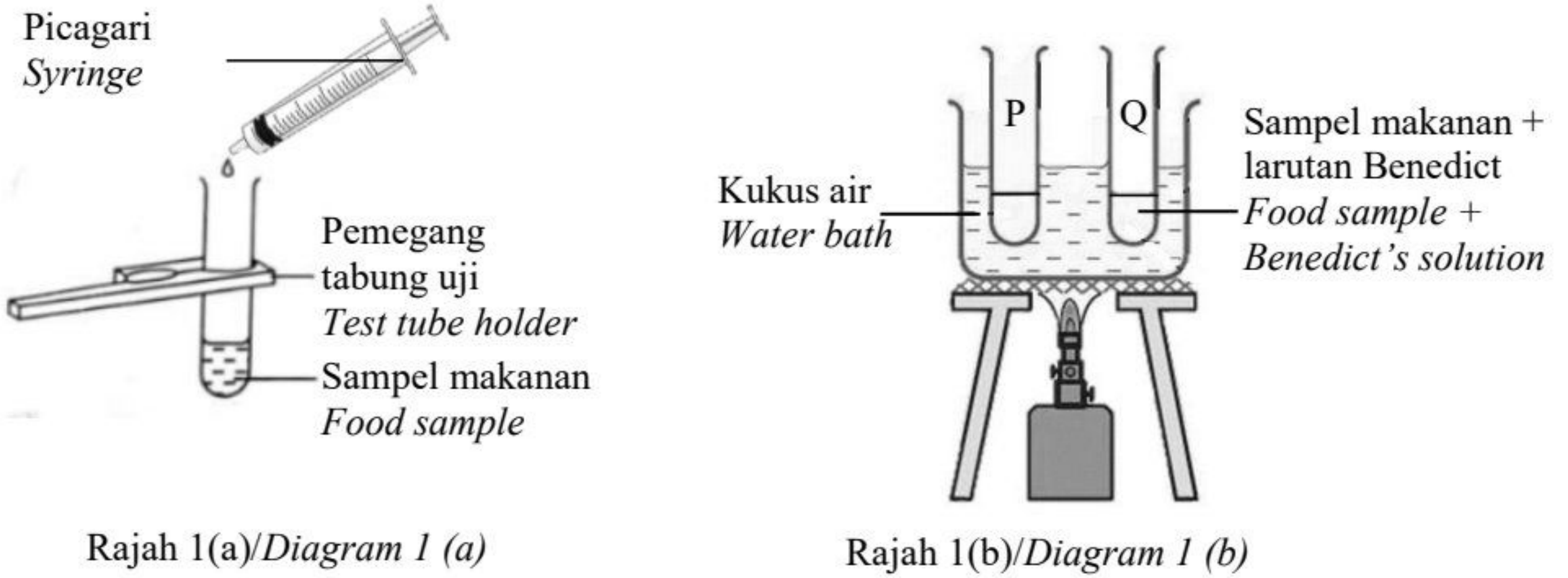
- (a)(i)
Construct a table to record the results of this experiment. Your table should have the following titles: Food sample; Observation on initial food sample colour; Observation on final food sample colour.
[3] - (a)(ii)
Explain the inference for the observation for food sample P.
[2] - (b)
Complete Table 1 based on the experiment that has been conducted. Table 1 has two columns: Manipulated variable; Method to handle variable.
[2] - (c)
State the hypothesis for the experiment.
[1] - (d)
Based on the result of the experiment, explain the operational definition of reducing sugar.
[2] - (e)
Classify the following food samples into reducing sugar and non-reducing sugar in Table 2. Food samples: Grains, Milk, Sugar cane, Sugar beet, Honey, Grapes. Table 2 columns: Reducing sugar; Non-reducing sugar.
[2]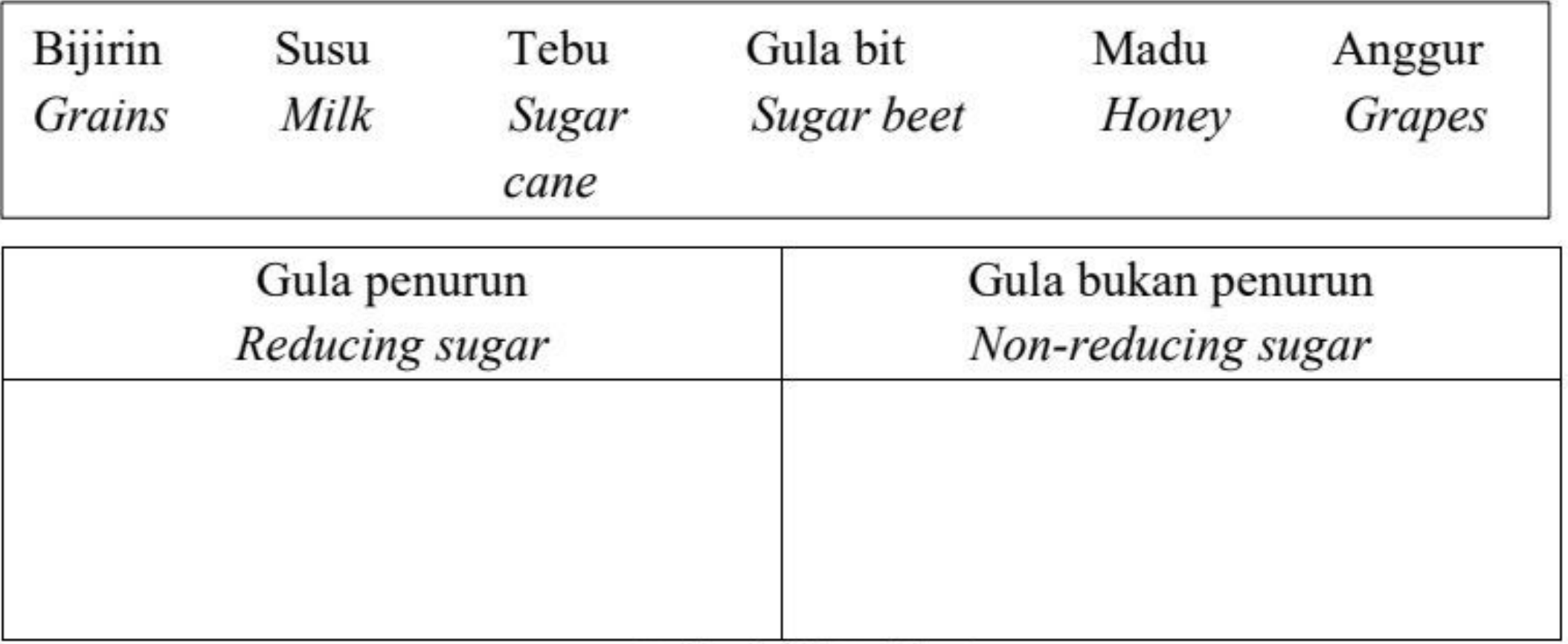
- (f)
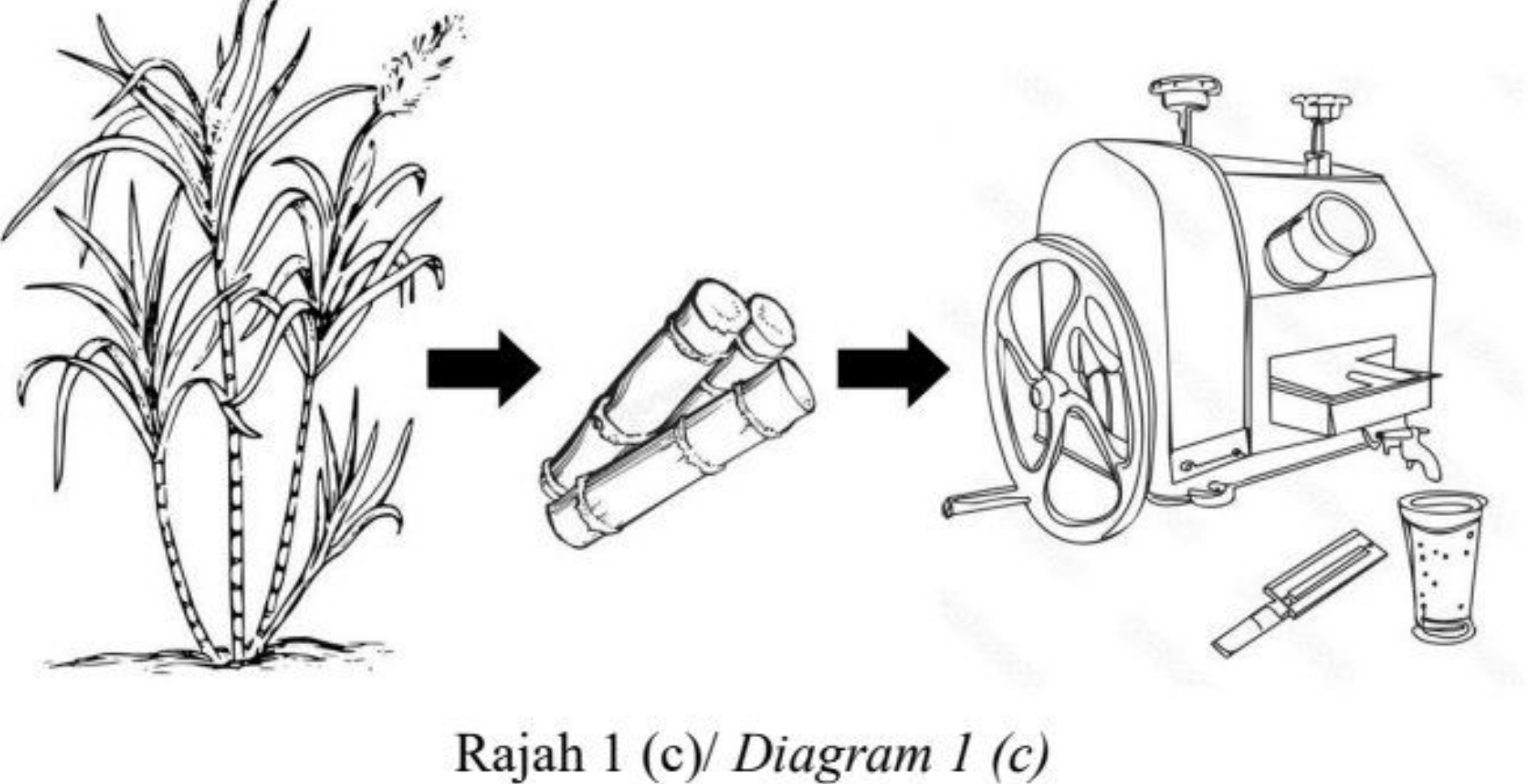
You are given the juice from plant in Diagram 1(c) (sugar cane plant, cut stems, juice pressed by a machine into a glass). Explain the method that should be done in order for the Benedict's test to show a positive result.
[3]