Write your answer on paper. Then open the answer to check it.
Section A
Diagram 1 shows a Periodic Table of Elements. The letters used are not the actual atomic symbols for the elements. (Elements P, S, U in the left part; Q, R, T in the right part; T is argon.) Based on Diagram 1, answer parts (a) to (d).
Medium5 marks
- (a)
What is the meaning of period?
[1] - (b)
What is the basic principle used in arranging the elements in the Periodic Table of Elements?
[1] - (c)
Element T is argon, name the group of T.
[1] - (d)
Which elements have the same chemical properties? Give a reason for your answer.
[2]
Diagram 2 shows the graph of temperature against time for cooling of acetamide, C₂H₅NO in an experiment. (Graph: temperature falls from P at 100 °C, stays constant at 80 °C from Q to R, then falls to S.)
Medium5 marks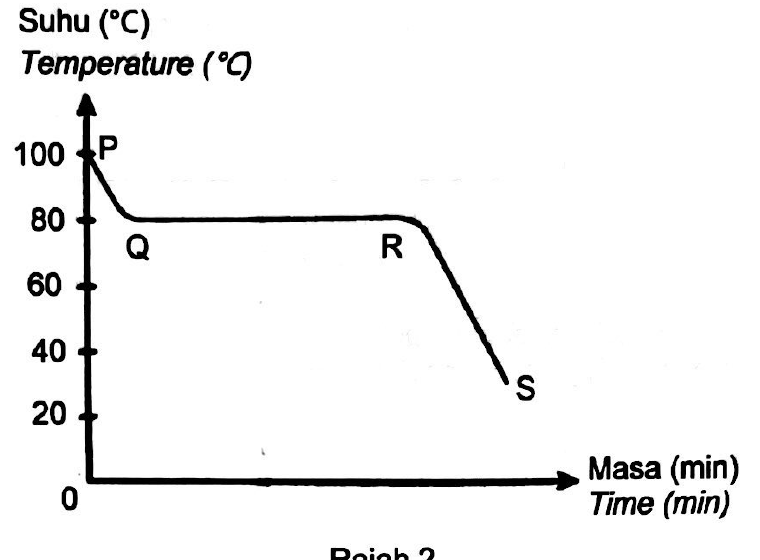
- (a)
What is the meaning of freezing point?
[1] - (b)
State the freezing point of acetamide in this experiment.
[1] - (c)
State the type of particle for acetamide.
[1] - (d)
Explain why there is no change in temperature from point Q to point R.
[2]
Diagram 3 shows information about mole (represented by symbol N_A). Diagram 3.1 shows the structural formula of a gas at room temperature which is colourless, highly irritating with a pungent and suffocating odour (ammonia, NH₃).
Medium6 marks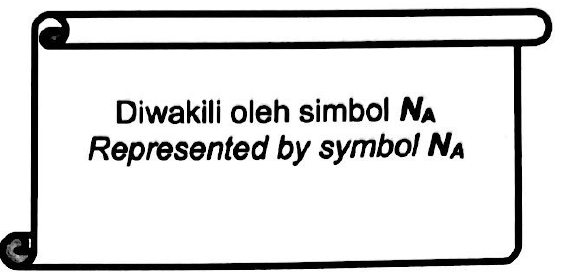
- (a)
What is represented by the symbol above (N_A)?
[1] - (b)
State the relationship between the number of moles and the number of particles.
[1] - (c)(i)
What is the volume for 0.01 mol of the gas at room temperature in cm³? [Molar volume = 24 dm³ mol⁻¹ at room temperature]
[1]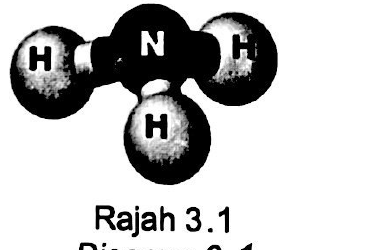
- (c)(ii)
How many molecules are there in the gas above? [Avogadro's constant = 6.02 × 10²³ mol⁻¹]
[1] - (d)
Pentane, C₅H₁₂ burns completely in oxygen to produce carbon dioxide and water. Write a balanced chemical equation for this reaction.
[2]
Diagram 4 shows the monomers of terylene: ethane-1,2-diol (HO-CH₂-CH₂-OH) and benzene-1,4-dicarboxylic acid (HOOC-C₆H₄-COOH).
Medium7 marks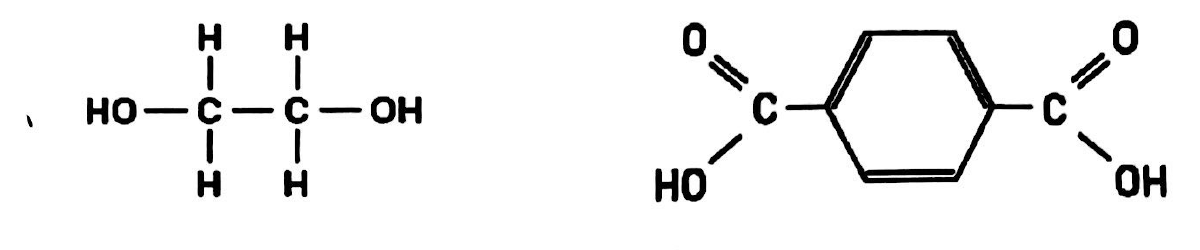
- (a)
What type of polymerisation for terylene?
[1] - (b)(i)
Draw the structural formula of the polymer that is formed by these two monomers.
[2] - (b)(ii)
Explain why polymer formed in (b)(i) also named as polyester.
[1] - (c)(i)
Terylene is widely used in the textile industry. However, water pollution has occurred due to wastewater disposal. Explain the impact on the environment if wastewater is not well managed.
[1] - (c)(ii)
The use of dyes in batik industry has caused the river pollution. How to solve the problem by using the green technology concept?
[2]
Diagram 5 shows the apparatus set-up used to determine the heat of reaction between sodium hydrogen carbonate, NaHCO₃ and hydrochloric acid, HCl. 20.0 cm³ of 2.0 mol dm⁻³ hydrochloric acid is poured into a plastic cup. The initial temperature of the acid is recorded (29 °C). One spatula of sodium hydrogen carbonate powder is added. The mixture is stirred and the final temperature is recorded (18 °C). Chemical equation for reaction I: NaHCO₃(s) + HCl(aq) → NaCl(aq) + H₂O(l) + CO₂(g)
Medium8 marks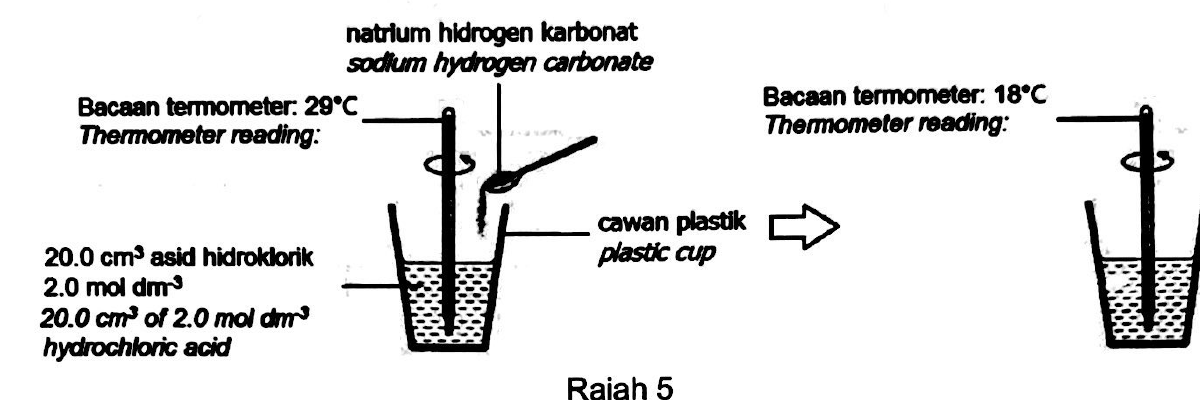
- (a)
State one reason why plastic cup is used in this experiment.
[1] - (b)
State the type of reaction occurred based on the change in temperature.
[1] - (c)(i)
Calculate the heat change, Q for this reaction. [Specific heat capacity of solution, c = 4.2 J g⁻¹ °C⁻¹; density of solution = 1 g cm⁻³]
[1] - (c)(ii)
Calculate the heat of reaction, ΔH for this reaction.
[3] - (d)
The experiment is then repeated using sodium carbonate, Na₂CO₃ powder to replace sodium hydrogen carbonate, NaHCO₃ powder. Chemical equation for reaction II: Na₂CO₃(s) + 2HCl(aq) → 2NaCl(aq) + H₂O(l) + CO₂(g). The heat of reaction, ΔH obtained is −36.0 kJ mol⁻¹. Compare reaction I and reaction II based on the change in the total energy content of reactants and the total energy content of products.
[2]
Diagram 6.1 shows a medal and its compositions: 90% copper, 5% element Q.
Medium9 marks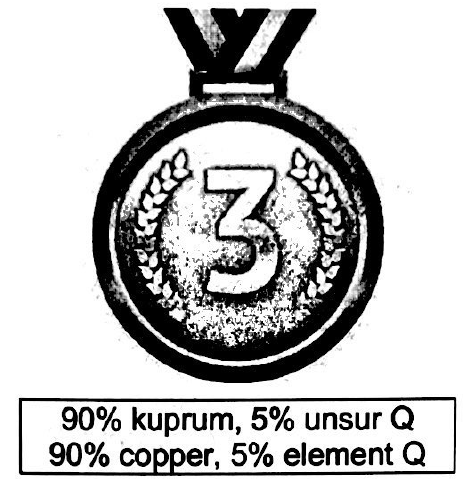
- (a)(i)
What is the meaning of alloy?
[1] - (a)(ii)
State the element Q.
[1] - (b)(i)
Diagram 6.2 shows the apparatus set-up to investigate the rusting of iron (iron nails coiled with metals P, Q and R in test tubes A, B and C with jelly solution, potassium hexacyanoferrate(III) solution and phenolphthalein; Table 6: A low intensity of blue colour, B pink, C high intensity of blue colour). Write oxidation and reduction half equation for test tube C if metal R is copper.
[4]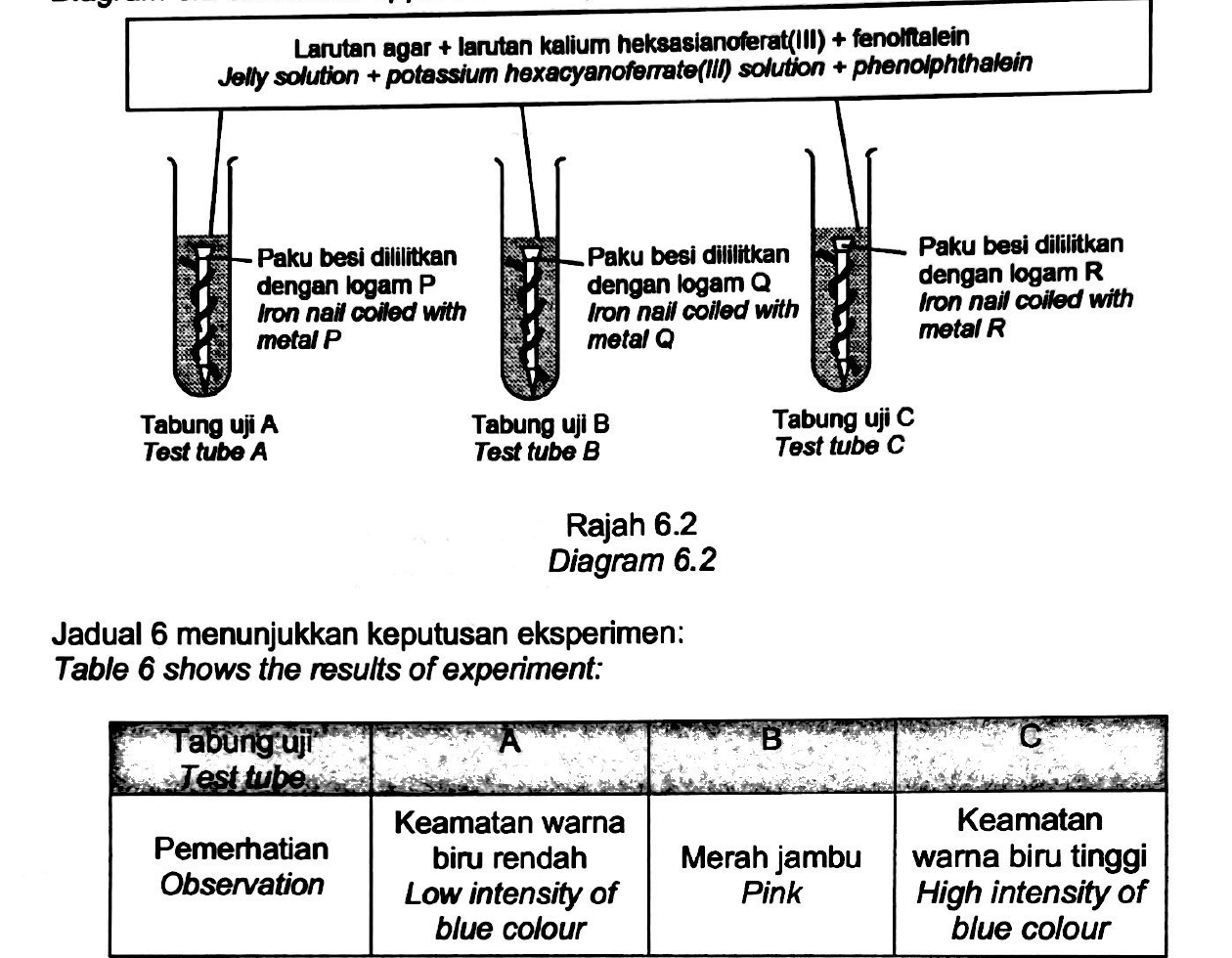
- (b)(ii)
Based on Diagram 6.2, which test tube shows rusting. Explain your answer.
[3]
Diagram 7.1 shows two reagent bottles: A contains 0.100 mol dm⁻³ HCl and B contains 0.001 mol dm⁻³ HCl. Diagram 7.2 shows a titration (sulphuric acid in the burette; potassium hydroxide solution with phenolphthalein in the conical flask).
Medium10 marks- (a)
State the meaning of strong acid?
[1] - (b)(i)
Based on Diagram 7.1, which reagent bottle gives a lower pH value?
[1]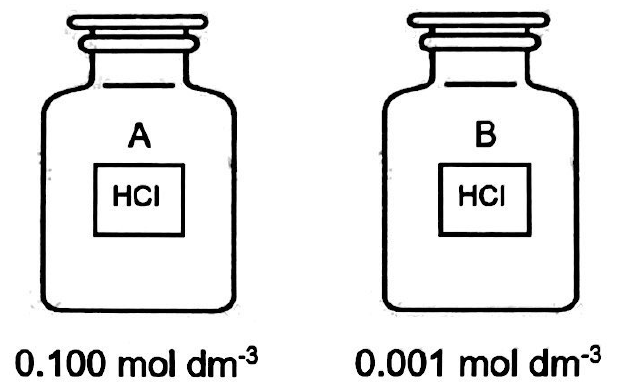
- (b)(ii)
State the pH value of HCl acid in bottle B.
[1] - (c)(i)
Diagram 7.2 shows titration method carried out by a student. Write a balanced chemical equation for the above reaction.
[2]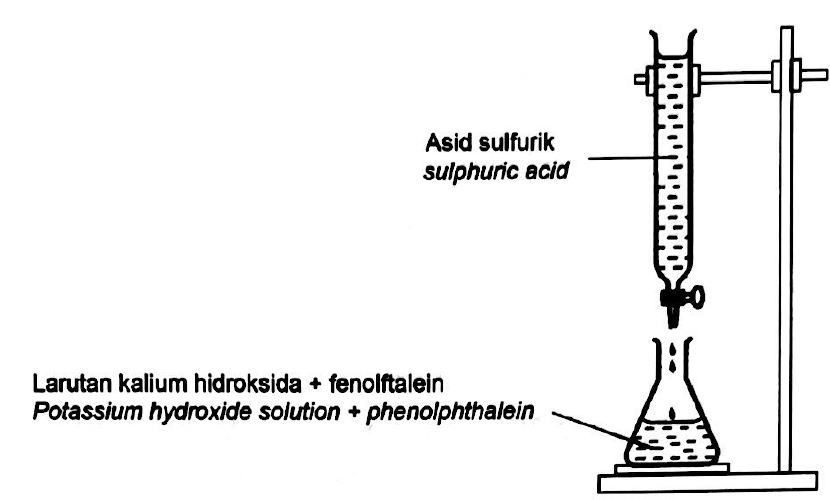
- (c)(ii)
The experiment is repeated by using ethanoic acid. Which acid will use more volume? Explain your answer.
[3] - (c)(iii)
During the experiment, what should you do so that the volume of acid used while titration is doubled than in Diagram 7.2? Justify your actions.
[2]
Diagram 8.1 shows the structural formula for a carbon compound X (CH₃COOH). Diagram 8.2 shows a flow chart of a series of changes that occur between some members of the homologous series: butene with Ni at 180 °C (Process I) gives compound A; butene with H₃PO₄ at 300 °C, 60 atm (Process II) gives compound B.
Medium10 marks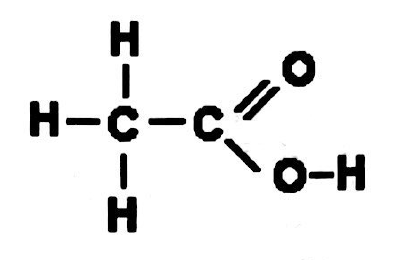
- (a)(i)
State the meaning of carbon compound.
[1] - (a)(ii)
State the functional group of compound X.
[1] - (b)(i)
Compound X reacts with compound Y to produce methyl ethanoate. What is the chemical formula of compound Y?
[1] - (b)(ii)
Write a balanced chemical equation for the answer in b(i).
[2] - (c)(i)
State the general formula of compound A and B.
[2]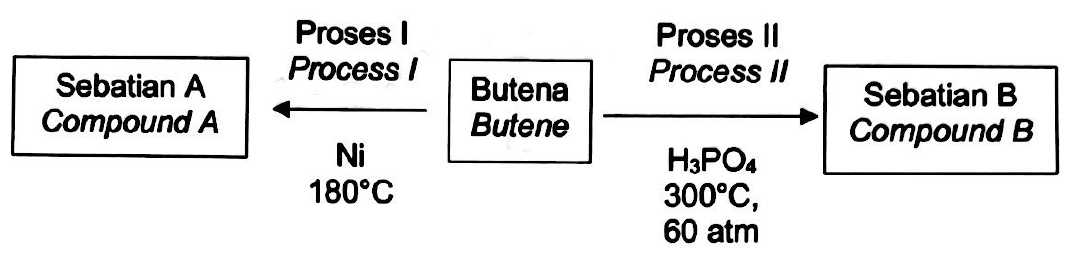
- (c)(ii)
Describe a chemical test to differentiate between compound A and butene?
[3]
Section B
Diagram 9.1 shows the atomic structure of elements P (6 protons, 6 neutrons), Q (8 protons, 8 neutrons) and R (11 protons, 12 neutrons). Diagram 9.2 shows the molecular structure for covalent compounds A (giant lattice) and B (simple molecule).
Medium20 marks- (a)
State the meaning of nucleon number and proton number.
[2]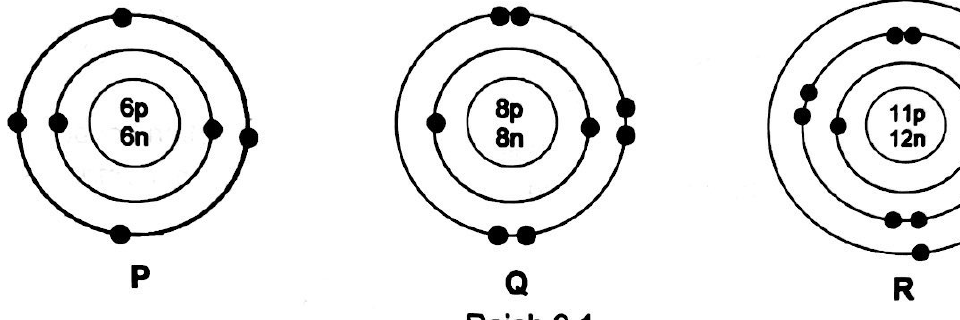
- (b)
Write the electron arrangement of P atom and Q.
[2] - (c)(i)
Write the balanced chemical equation between element Q and R.
[2] - (c)(ii)
Calculate the mass of compound formed if 2.3 g R react with Q in excess.
[4] - (d)
State what is type of covalent compound A and B. Suggest an example for both compounds. Compare both compounds based on structure, chemical bond and melting point and boiling point.
[10]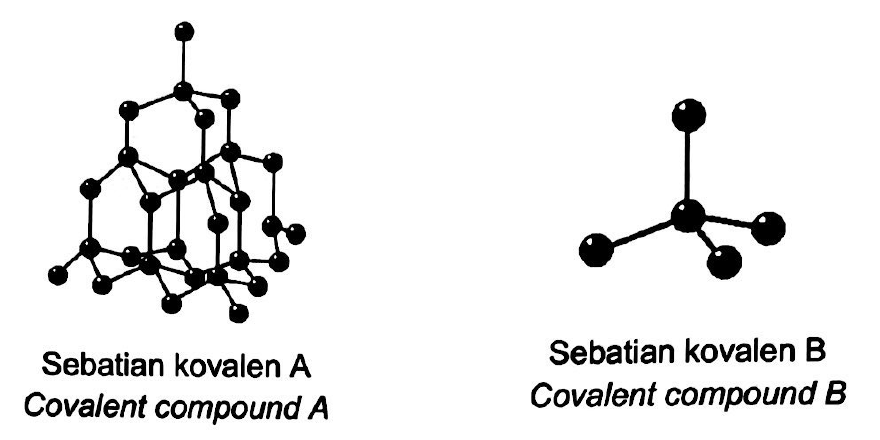
Diagram 10.1 shows coral reefs found in Sibu Island, formed from salt Z. Diagram 10.2 shows the apparatus set-up for the reaction of hydrochloric acid with solid salt Z (gas passed into lime water). Table 10 shows the result of an experiment to study the factor that affects rate of reaction: Experiment I excess zinc powder + 20 cm³ of 0.1 mol dm⁻³ sulphuric acid, 30.0 °C, 20.0 s to collect 30 cm³ gas; Experiment II excess zinc powder + 20 cm³ of 0.1 mol dm⁻³ sulphuric acid + copper(II) sulphate solution, 30.0 °C, 12.0 s; Experiment III excess zinc powder + 20 cm³ of 0.1 mol dm⁻³ sulphuric acid, 40.0 °C, 10.0 s.
Hard20 marks- (a)(i)
State the meaning of salt and name one insoluble salt.
[2]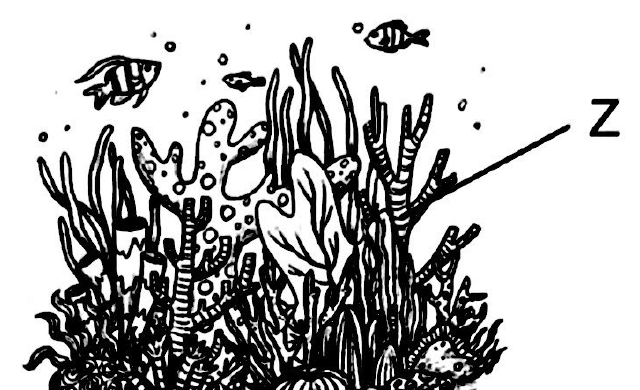
- (a)(ii)
Solid Z salt contain calcium element, what is salt Z and the gas released during the reaction in Diagram 10.2?
[2]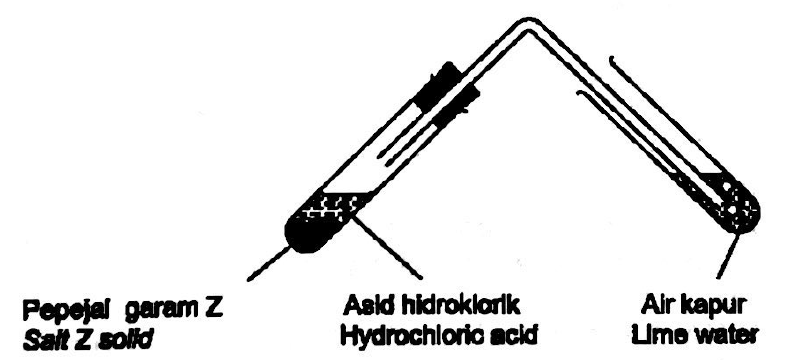
- (b)(i)
Write the chemical equation for the reaction between zinc and sulphuric acid. Calculate the average rate of the reaction for Experiment I and Experiment II in cm³ s⁻¹.
[4]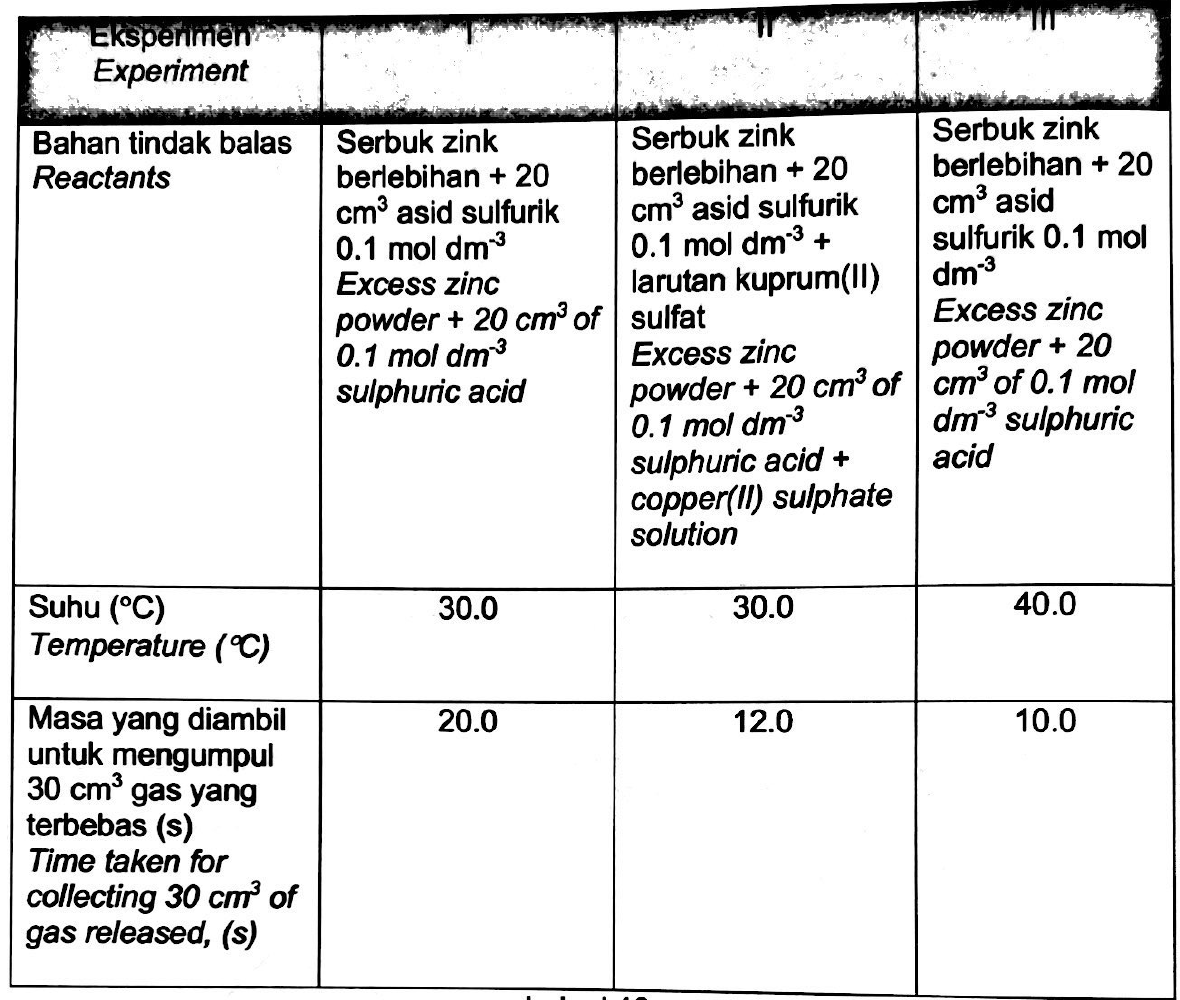
- (b)(ii)
Sketch the graph volume against time for both experiments in the same axes.
[2] - (b)(iii)
Based on Table 10, compare the rate of reaction between (Experiment I and II) and (Experiment I and III). In each case, state the factor affecting the rate of reaction and explain the difference in the rate of reaction with reference to the collision theory.
[10]
Section C
Diagram 11.1 shows the apparatus set-up to study a redox reaction (zinc in zinc sulphate solution inside a porous pot, copper in copper(II) sulphate solution, connected with a voltmeter). Standard electrode potential series: Zn²⁺(aq) + 2e ⇌ Zn(s), E° = −0.76 V; Cu²⁺(aq) + 2e ⇌ Cu(s), E° = +0.34 V. Diagram 11.2 shows the apparatus setup for cell A (zinc, zinc sulphate, porous pot, with copper electrode) and cell B (copper electrodes in copper(II) sulphate solution).
Hard20 marks- (a)
What is the meaning of redox reaction?
[1]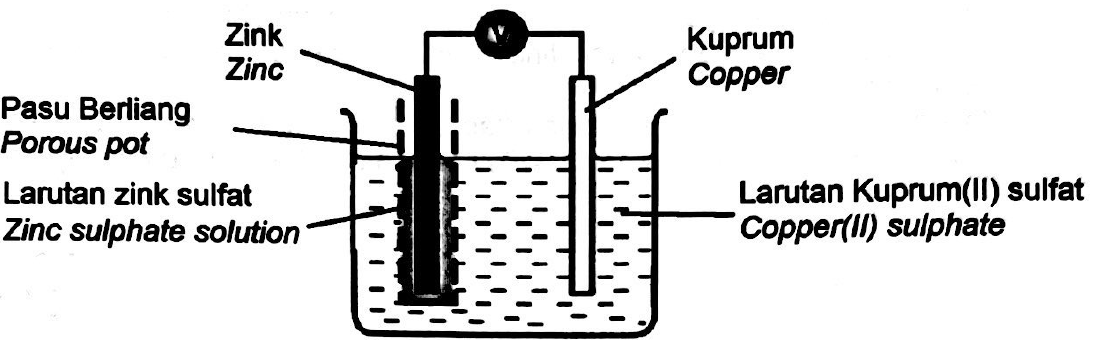

- (b)(i)
Based on Diagram 11.1 and the Standard Electrode Potential Series, identify the negative terminal and positive terminal of the cell.
[2] - (b)(ii)
Write the overall ionic equation.
[2] - (b)(iii)
Write cell notation of the chemical cell in Diagram 11.1.
[2] - (b)(iv)
Calculate the E° cell.
[1] - (c)(i)
Compare cell A and cell B in terms of product formed, observation and half equation at anode.
[6]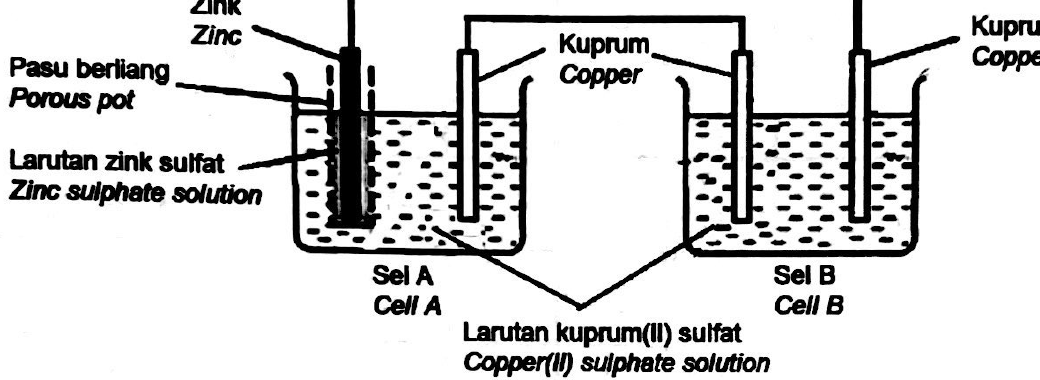
- (c)(ii)
Faridah's house is located at seaside. She has a problem when her steel doorknob always needs to be replaced due to rusting that occurred faster at that area. As Faridah's friend, suggest a way to solve the problem by using electrolysis concept.
[6]