Write your answer on paper. Then open the answer to check it.
Section A
Diagram 1 shows a graph of temperature against time for the melting of naphthalene solid (A rising from 60 °C to B at 80 °C at t1; B to C constant 80 °C from t1 to t3; C to D rising above 80 °C).
Medium5 marks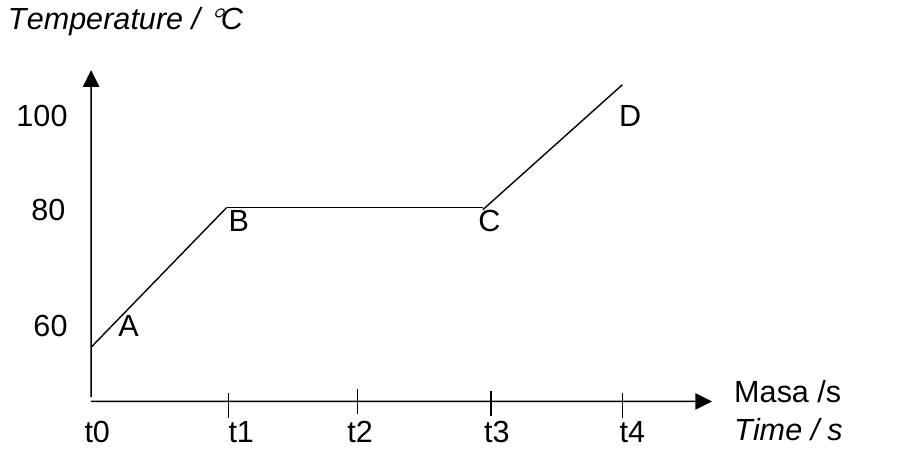
- (a)
State the type of particles in naphthalene.
[1] - (b)
Explain why the temperature remains unchanged from t1 to t3.
[2] - (c)
State the time when all the naphthalene solids have turned to liquid.
[1] - (d)
State the observation when naphthalene heated directly.
[1]
Diagram 2 shows the arrangement of atoms in alloy X (iron atoms and carbon atoms) and the structural formula of monomer Y (H2C=CH2).
Medium5 marks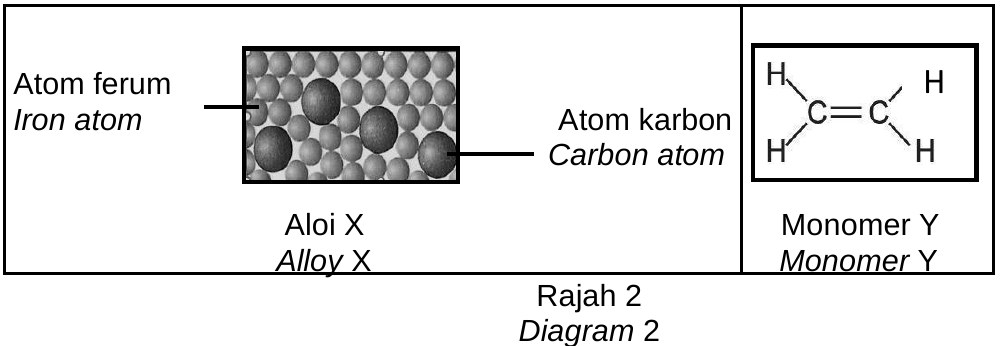
- (a)
State the meaning of alloy.
[1] - (b)(i)
State the name of alloy X.
[1] - (b)(ii)
State the hardness of alloy X compared to pure copper metal.
[1] - (c)(i)
State the name of monomer Y.
[1] - (c)(ii)
Draw the structural formula of polymer formed from monomer Y.
[1]
Diagram 3 shows the standard representation of atom Z: ⁷₃Z (nucleon number 7, number 3 at the bottom). 0.05 mol Z reacts with oxygen to form oxide of Z.
Medium6 marks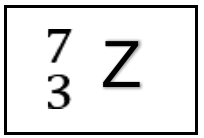
- (a)
What is represented by the number 3?
[1] - (b)
Write the formula of ion Z.
[1] - (c)(i)
Write the chemical equation for the reaction between Z and oxygen.
[2] - (c)(ii)
Calculate the mass of oxide of Z formed. [Relative atomic mass: Z = 7; O = 16]
[2]
Diagram 4.1 shows some of the elements in the Periodic Table of Elements represented by the letters U, V, W, X and Y (U in Group 1 Period 1; Y in Group 1 Period 3; V in Group 14, W in Group 16 of Period 2; X in Group 17 of Period 3). Element V and element W react to produce compound Z. Diagram 4.2 shows a fire extinguisher that uses compound Z as the main ingredient (CO2 extinguisher).
Medium7 marks
- (a)
State the elements that can combine to form ionic compounds.
[1] - (b)(i)
Write the formula of compound Z.
[1] - (b)(ii)
State the type of bond in compound Z.
[1] - (c)(i)
Explain why compound Z is suitable for extinguishing fires involving electrical appliances, gas and steam.
[2]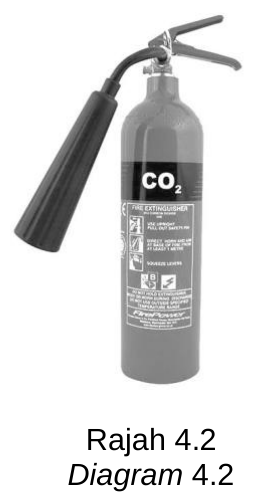
- (c)(ii)
Can water replace compound Z as the main ingredient in a fire extinguisher in Figure 4.2? Give your reasons.
[2]
Diagram 5 shows the set-up of apparatus to purify impure silver that contains copper as impurities by electrolysis (impure silver metal and pure silver metal in 0.1 mol dm⁻³ M nitrate solution, with an ammeter and a space for a battery).
Medium8 marks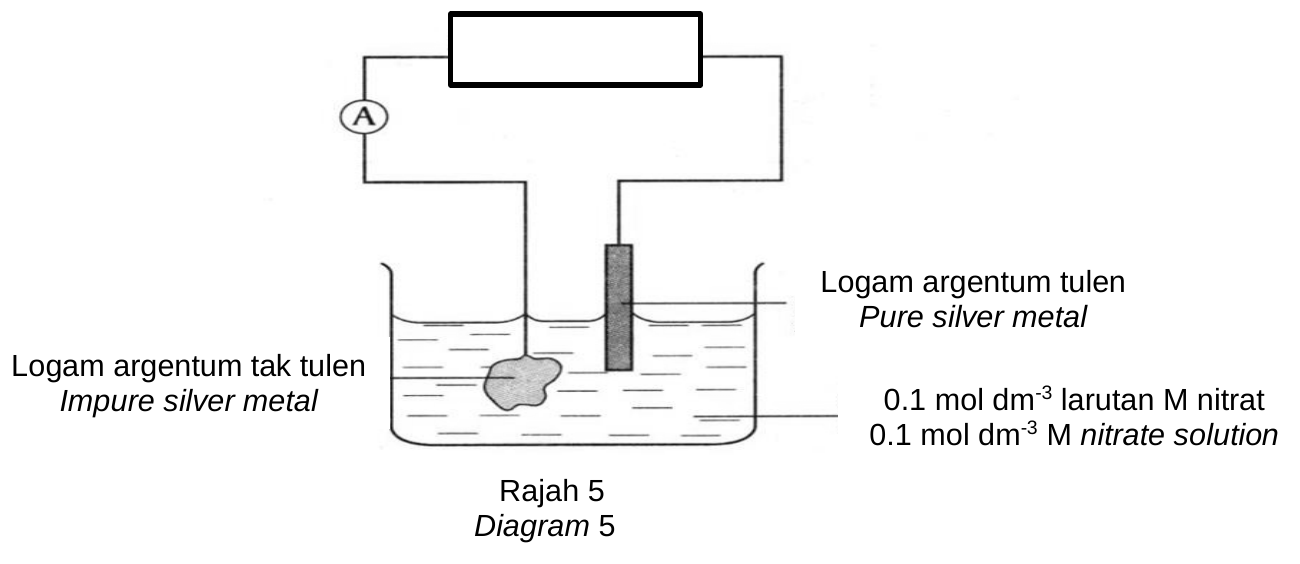
- (a)
Name a suitable electrolyte used in this experiment.
[1] - (b)
Draw the symbol of battery at the space provided in Diagram 5 to connect the pure silver metal and impure silver metal.
[1]
- (c)
If the initial mass of the pure silver metal electrode is 25.3 g and after 30 minutes the final mass is 36.1 g, calculate the number of moles of silver extracted from the impure silver metal. [Relative Atomic Mass, Ag = 108]
[2] - (d)
Write the half equation for the reaction that occurs at the anode and cathode.
[2] - (e)
A student carried out electrolysis for two different acids. Table 5: diprotic acid R - colourless gas at anode and colourless gas at cathode; monoprotic acid M - greenish yellow gas at anode and colourless gas at cathode. Suggest the names of the acids used.
[2]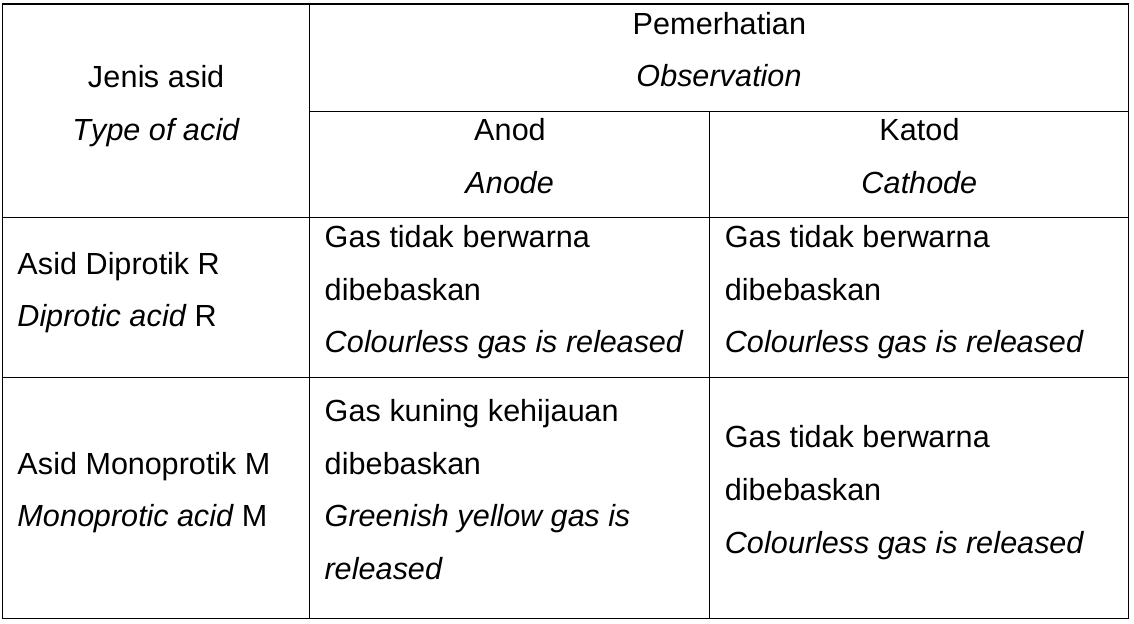
A student determines the heat of displacement for the reaction between copper and silver nitrate solution. Excess copper powder is added to 100 cm³ of 0.2 mol dm⁻³ silver nitrate solution. The heat of displacement is −105 kJ mol⁻¹.
Medium9 marks- (a)
What is meant by heat of displacement?
[1] - (b)
State one observation in this experiment.
[1] - (c)
Write an ionic equation for the reaction occurred.
[1] - (d)(i)
Calculate the number of moles of silver ions reacted.
[1] - (d)(ii)
Calculate the heat released. [Specific heat capacity of the solution = 4.2 J g⁻¹ °C⁻¹; density of the solution = 1 g cm⁻³]
[1] - (d)(iii)
Calculate the change in temperature.
[1] - (e)
The experiment is repeated using 100 cm³ of 0.4 mol dm⁻³ silver nitrate solution and excess copper powder. Predict the temperature change. Explain why this change is different from that in (d)(iii).
[3]
Diagram 7 shows two sets of experiment to study the factor affecting the rate of reaction between hydrochloric acid, HCl and zinc carbonate, ZnCO3. Set I: excess ZnCO3 chips with 100 cm³ of 0.25 mol dm⁻³ HCl gives 60 cm³ gas after 3 minutes. Set II: excess ZnCO3 chips with 100 cm³ of 0.50 mol dm⁻³ HCl gives 120 cm³ gas after 3 minutes.
Medium10 marks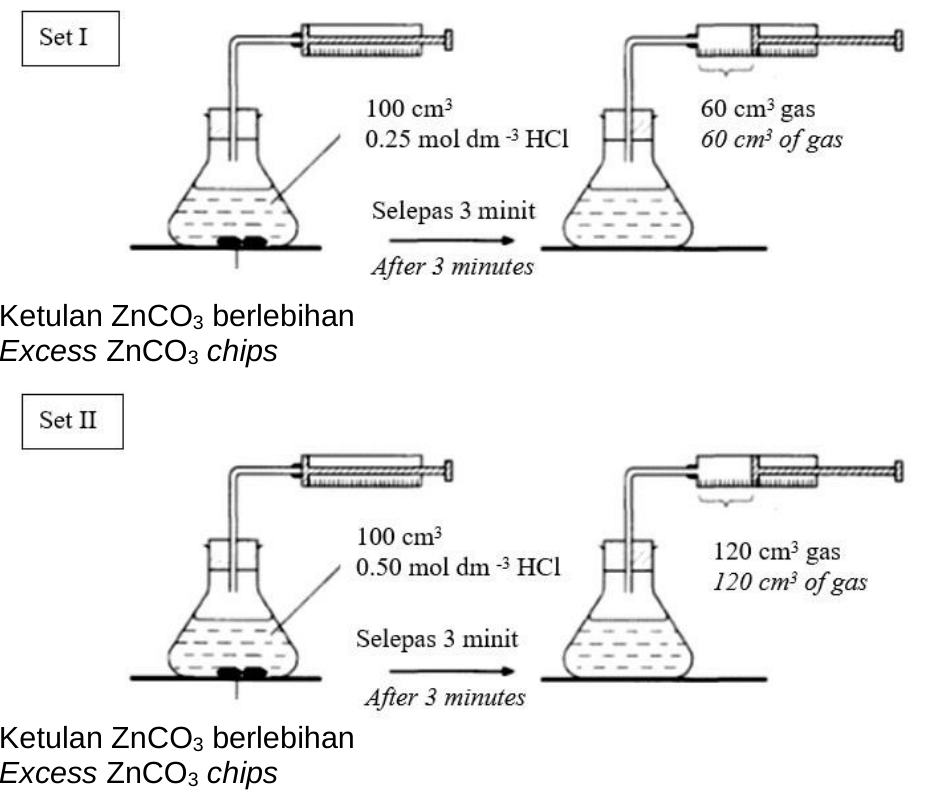
- (a)
State one factor that affects the rate of reaction from diagram 7.
[1] - (b)
What is the reading needed to be recorded in both experiments to determine the rate of reaction in 3 minutes?
[1] - (c)
Write a chemical equation for the reaction in these experiments.
[2] - (d)
Calculate the average rate of reaction in set I.
[1] - (e)
Compare the rate of reaction in set I and set II. Explain your answer with reference to the collision theory.
[3] - (f)
A student wishes to increase the rate of reaction for Set I by changing the hydrochloric acid to sulphuric acid of the same concentration. In your opinion, is this a correct decision? Explain your answer.
[2]
In the Chemistry PBD project, Anas and his friends carried out the preparation of soap. Palm oil is hydrolysed to palmitic acid, CH3(CH2)14COOH and glycerol. Then, palmitic acid reacts with sodium hydroxide solution, NaOH to form soap. Finally, sodium chloride is added to precipitate the soap.
Medium10 marks- (a)
State the name for the process of preparing soap.
[1] - (b)
Suggest another chemical that can be used to replace sodium hydroxide solution.
[1] - (c)
Write the chemical equation to show the formation of soap.
[2] - (d)
Calculate the mass of soap produced if 0.05 mol soap is produced. [Molar mass of soap = 278 g mol⁻¹]
[1] - (e)
Table 8 shows information on cleaning agent W (hard water: stain remains) and cleaning agent X (hard water: stain disappears). Which cleaning agent is soap? Give a reason for your answer.
[2]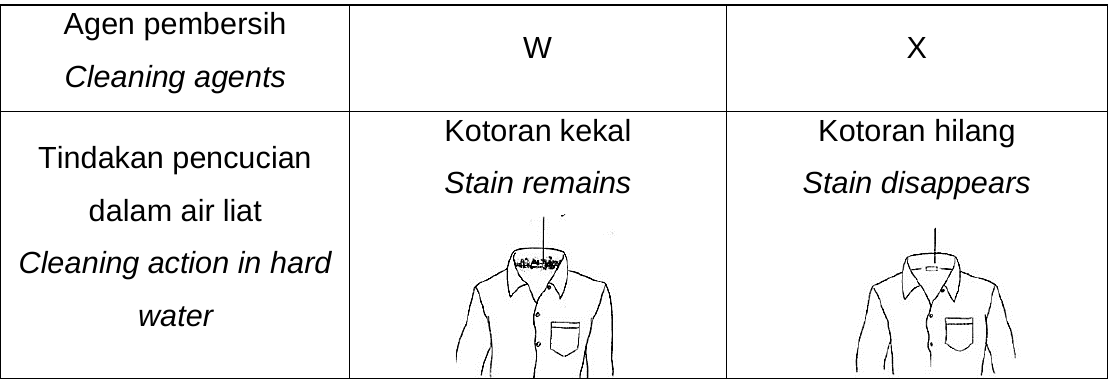
- (f)
You are given two beakers, P and Q, containing soap solution or detergent solution. With the use of calcium nitrate solution 0.5 mol dm⁻³, boiling tubes and rubber stopper, describe briefly how you can distinguish between soap and detergent.
[3]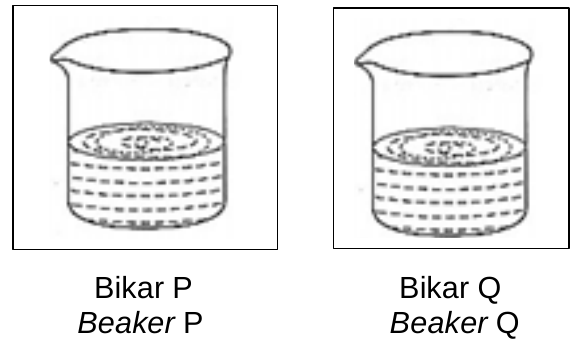
Section B
Diagram 9.1 shows HA gas flowed into two beakers containing propanone and water to study the properties of acid. Calcium carbonate chips are then added to each solution (beaker P: HA in propanone; beaker Q: HA in water).
Medium20 marks- (a)
Based on Diagram 9.1, compare the observations in beaker P and beaker Q. Explain your answer.
[5]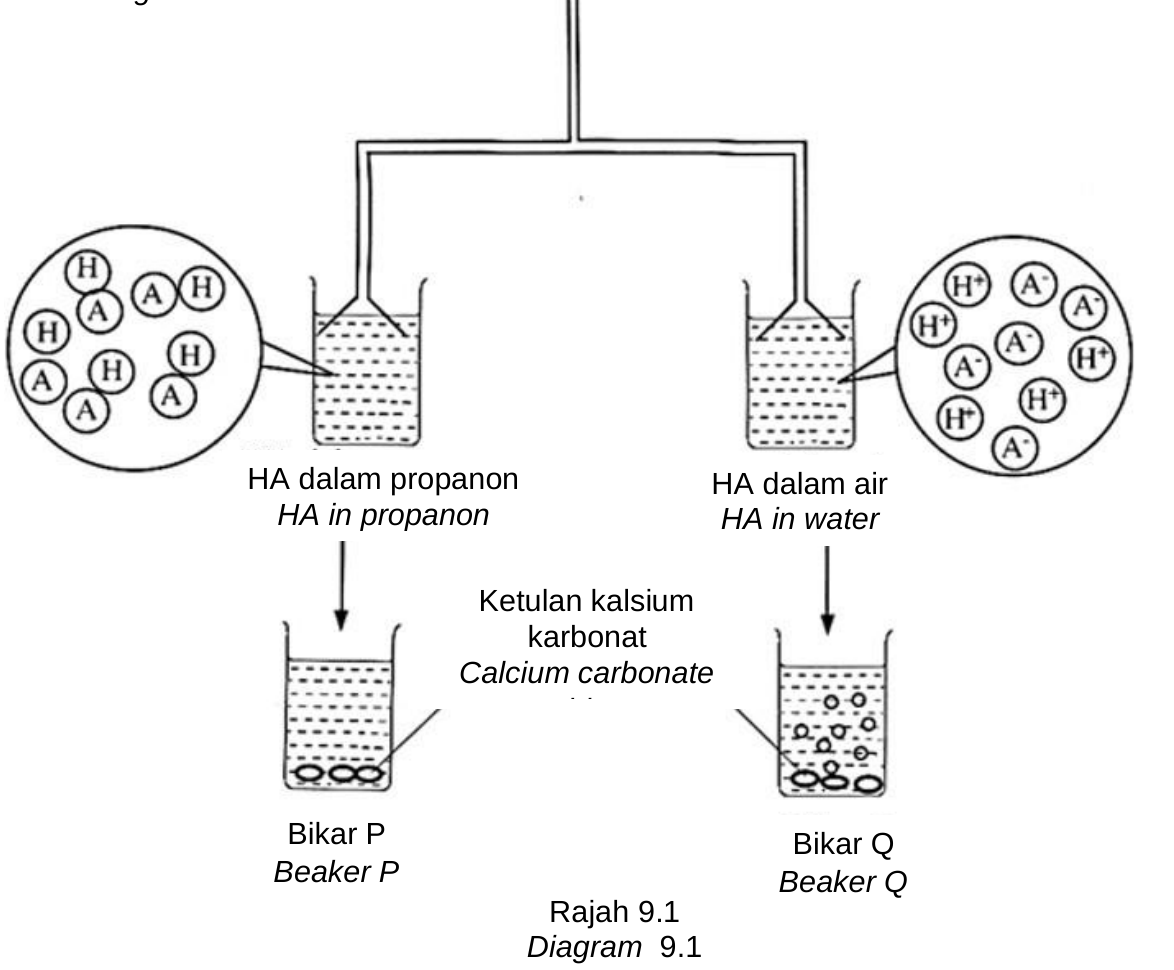
- (b)(i)
Diagram 9.2 shows the pH value of acids HA and HB (both monoprotic, 0.1 mol dm⁻³; beaker S pH 4.0, beaker R pH X). Suggest the names of HA acid and HB acid. Predict the value of X in Beaker R. Explain the difference between the two acids in Beaker R and Beaker S.
[5]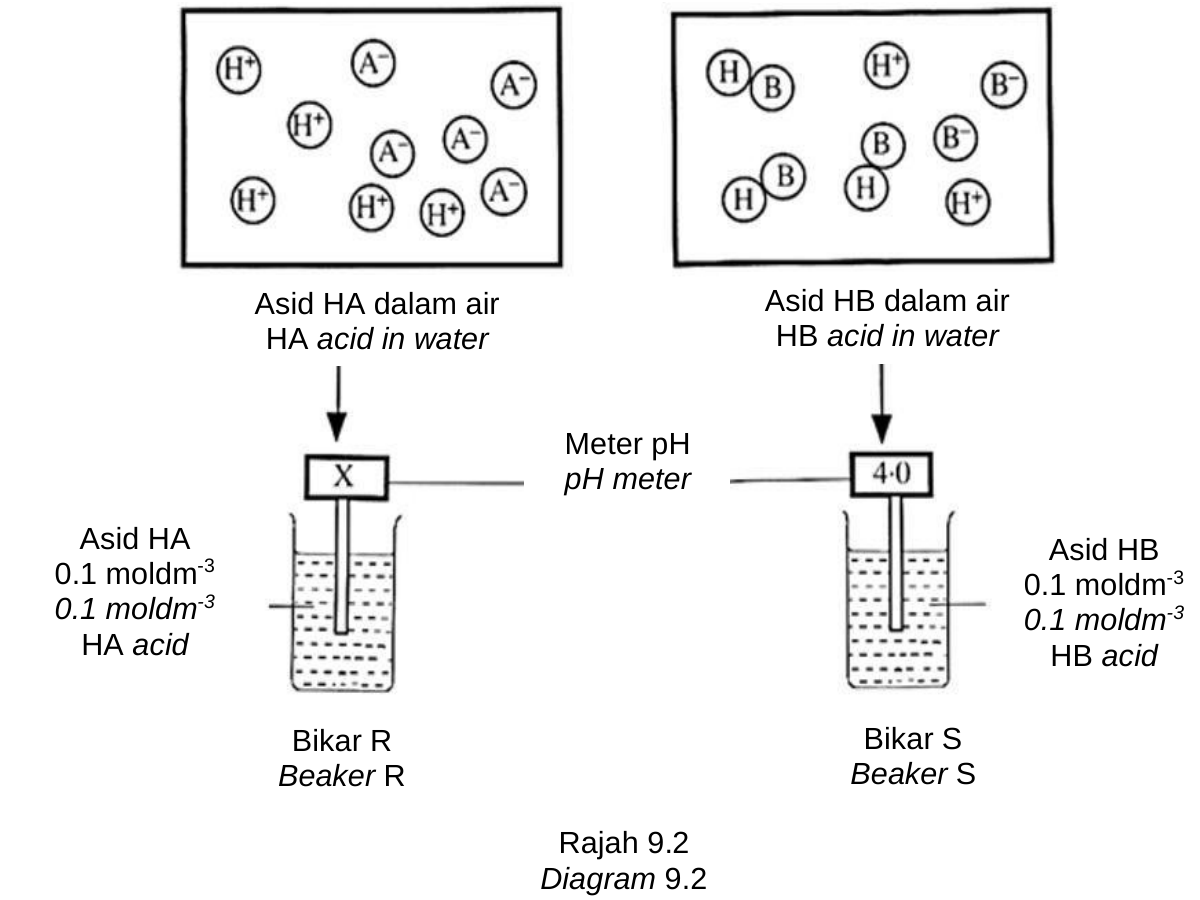
- (b)(ii)
50 cm³ of acid HB in beaker S is added with 20 cm³ of water. State the name of the process involved and explain the change in the pH value.
[3] - (c)
Diagram 9.3 shows the apparatus set-up to prepare insoluble salt T (25 cm³ of 0.5 mol dm⁻³ copper(II) chloride solution mixed with 25 cm³ of 0.5 mol dm⁻³ sodium carbonate solution). State the name of the reaction, write the chemical equation, calculate the mass of salt T formed and suggest one substance that can replace copper(II) chloride solution to produce salt T. [Molar mass of salt T: 124 g mol⁻¹]
[7]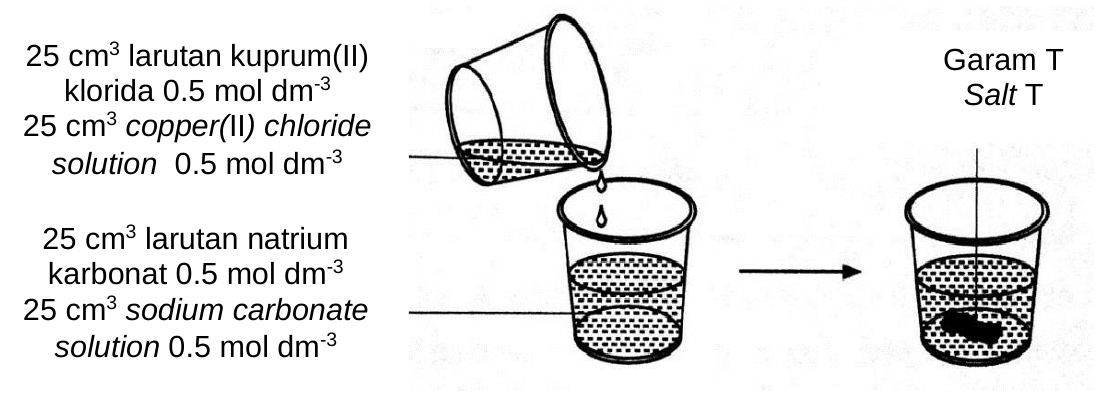
The reaction NaCl(aq) + AgNO3(aq) → NaNO3(aq) + AgCl(s) is given in part (a). Iron is extracted from iron ore, Fe2O3 using coke, C: 3C + 2Fe2O3 → 4Fe + 3CO2. Two sets of experiment study the effect of other metals on rusting of iron.
Medium20 marks- (a)
State the meaning of redox reaction. Determine whether the reaction NaCl(aq) + AgNO3(aq) → NaNO3(aq) + AgCl(s) is a redox or not. Explain your answer in terms of change in oxidation number.
[4] - (b)(i)
If the factory can process 800 kg iron ore per day using excess carbon, calculate the mass of iron produced. [Relative atomic mass: O = 16; Fe = 56]
[4] - (b)(ii)
Determine the oxidation number of iron in compound Fe2O3 and state the IUPAC nomenclature of the compound.
[2] - (c)
Set I: iron nail coiled with metal P; Set II: iron nail coiled with metal Q; both in hot jelly solution containing potassium hexacyanoferrate(III) and phenolphthalein. Observation: Set I pink colour formed; Set II dark blue colour formed (Table 10). Based on the observations, suggest metal P and metal Q. Explain why there is a difference in the observations. Include the half-equations for oxidation reaction and state the metals that are oxidised.
[10]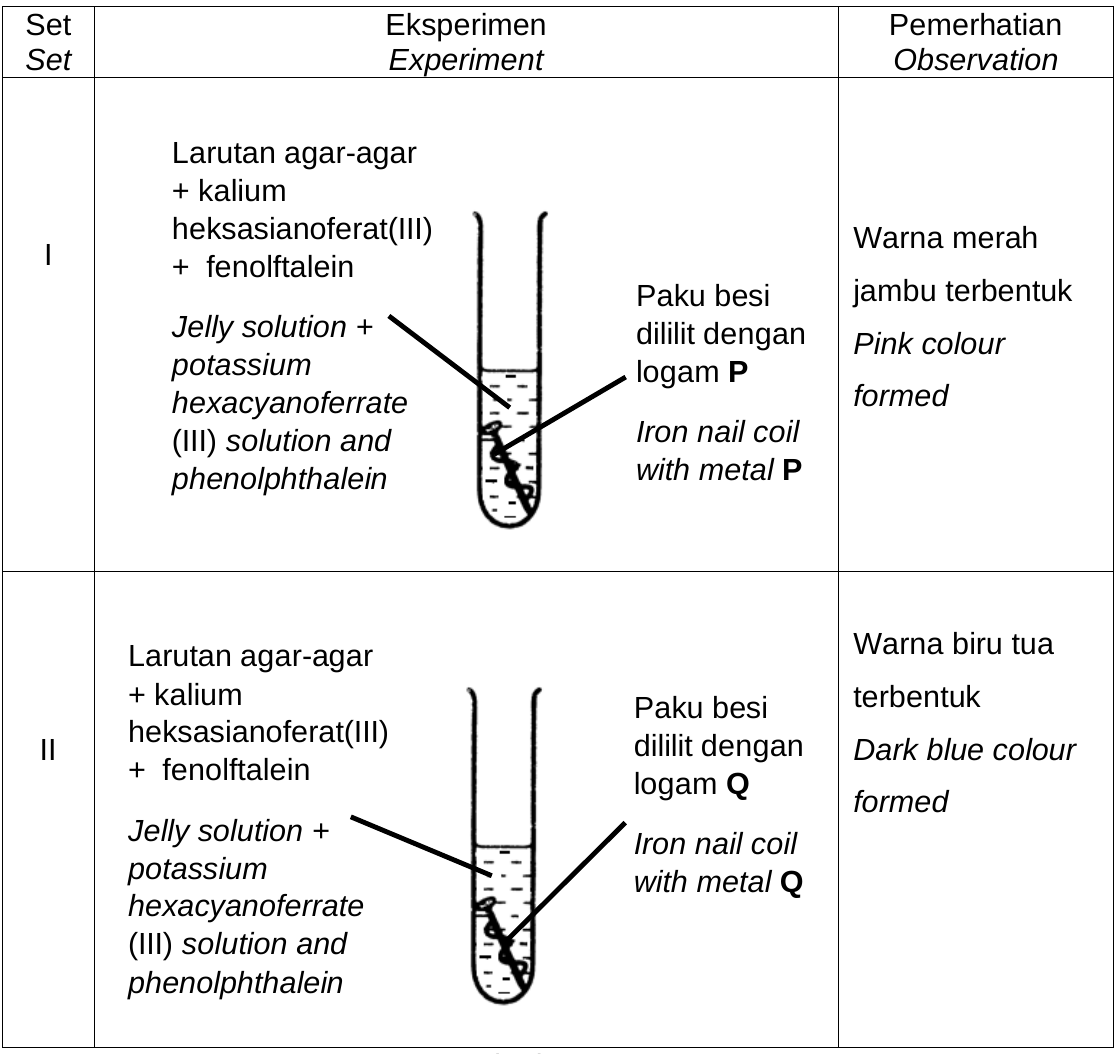
Section C
Diagram 11.1 shows the flow chart for the formation of pineapple flavouring (C3H7COOC2H5) using alcohol X and substance Z. C6H12O6 gives alcohol X; alcohol Y is oxidised to substance Z; X and Z undergo esterification to give pineapple flavouring.
Medium20 marks- (a)(i)
Write the general formula for alcohol and identify alcohols X, Y and substance Z.
[4]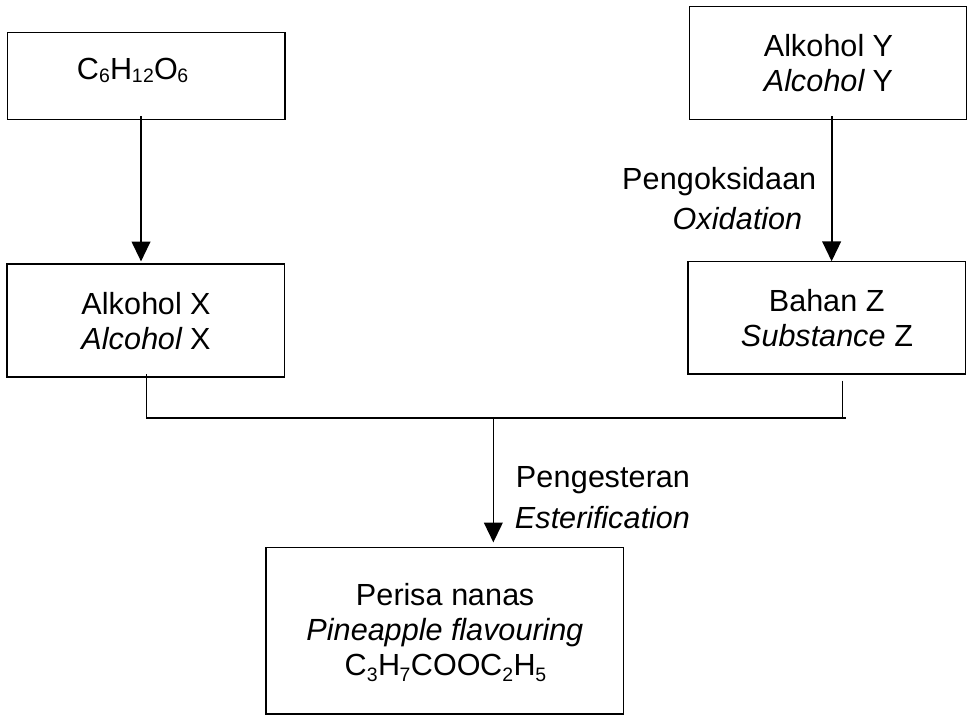
- (a)(ii)
Using alcohol X and substance Z, describe briefly how you can prepare the pineapple flavouring. Include the chemical equation for the esterification reaction.
[8] - (a)(iii)
State the functional group and draw the structural formula of pineapple flavouring. Calculate the mass of pineapple flavouring produced when 0.03 moles of alcohol X is used in the esterification reaction. [Molar mass of pineapple flavouring = 116 g mol⁻¹]
[4]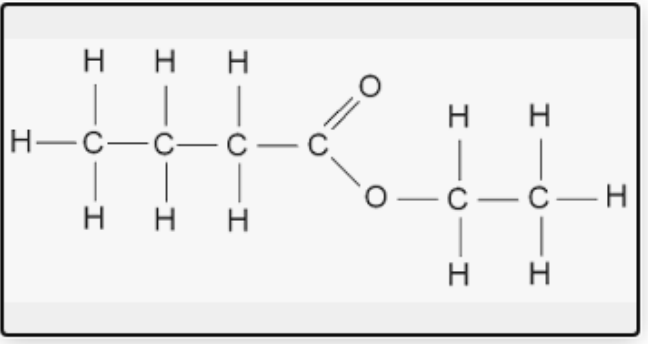
- (b)
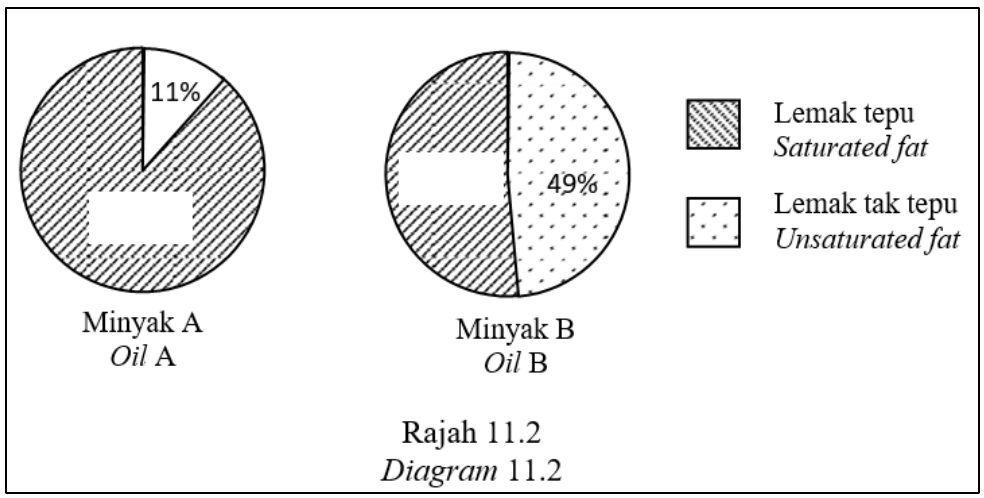
Diagram 11.2 shows the pie charts for the composition of saturated fat and unsaturated fat in oil A (11% unsaturated) and oil B (49% unsaturated, 51% saturated). Saturated fat contains single covalent bonds between carbon atoms; it can increase cholesterol in the blood but resists oxidation at high temperature. Unsaturated fat contains double covalent bonds between carbon atoms; it is easily oxidised at high temperature to form carcinogenic substances. Puan Aminah chooses oil B to stir fry mixed vegetables and to deep fry chicken. Does she make the correct choice? Give the reason with reference to the effect of fats on health.
[4]