Write your answer on paper. Then open the answer to check it.
Section A
Table 1 shows three elements with their proton number and nucleon number: Oxygen (proton number 8, nucleon number 16), Magnesium (12, 24), Lithium (3, 7).
Medium5 marks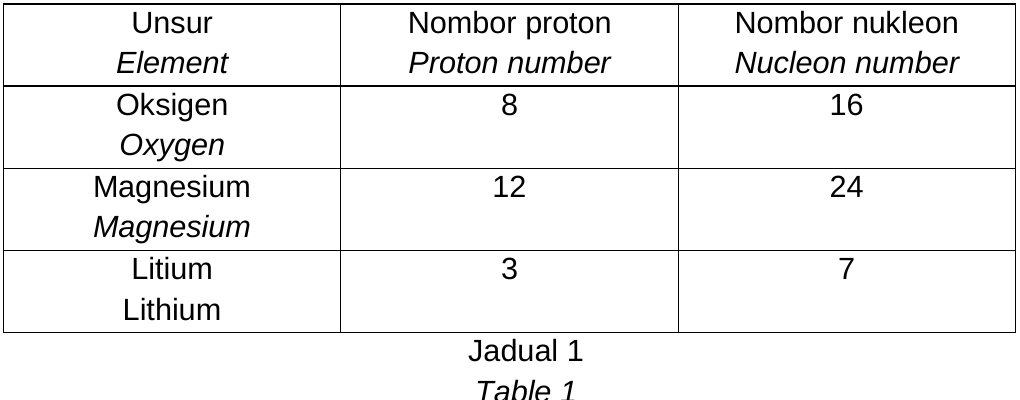
- (a)(i)
What is the meaning of nucleon number?
[1] - (a)(ii)
Based on Table 1, write the standard representation for each element (oxygen, magnesium, lithium).
[3] - (a)(iii)
State one subatomic particle present in the nucleus of lithium atom.
[1]
(a) In a school Science Week competition, compound X in a banana-flavoured culture drink is to be identified. Diagram 2.1 gives the simplest mole ratio of atoms: C 7, H 14, O 2. (b) Combustion of propane gas, C₃H₈ in excess oxygen produces water and carbon dioxide: C₃H₈ + X O₂ → Y CO₂ + Z H₂O.
Medium5 marks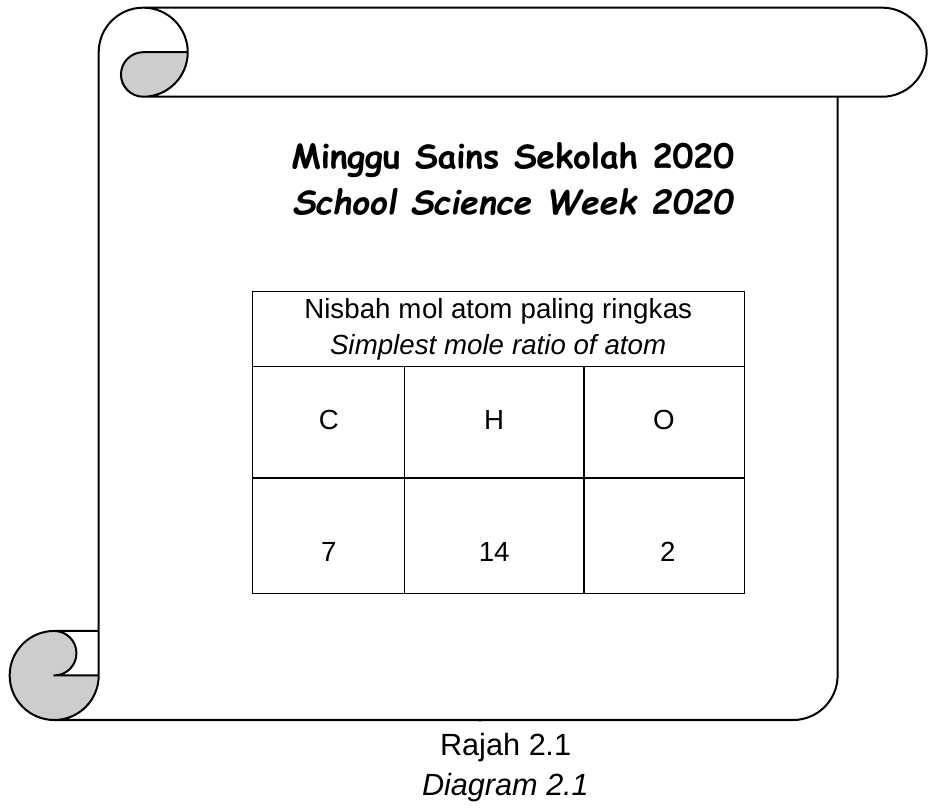
- (a)(i)
What is the meaning of empirical formula?
[1] - (a)(ii)
State the empirical formula of compound X.
[1] - (b)
Balance the chemical equation by determining the values of X, Y and Z.
[3]
Diagram 3.1 shows the graph of the volume of gas released against time for the reaction between calcium carbonate and hydrochloric acid. Points on the graph: (60 s, 22 cm³), (120 s, 38 cm³), (240 s, 45 cm³); the curve levels off after about 240 s.
Medium6 marks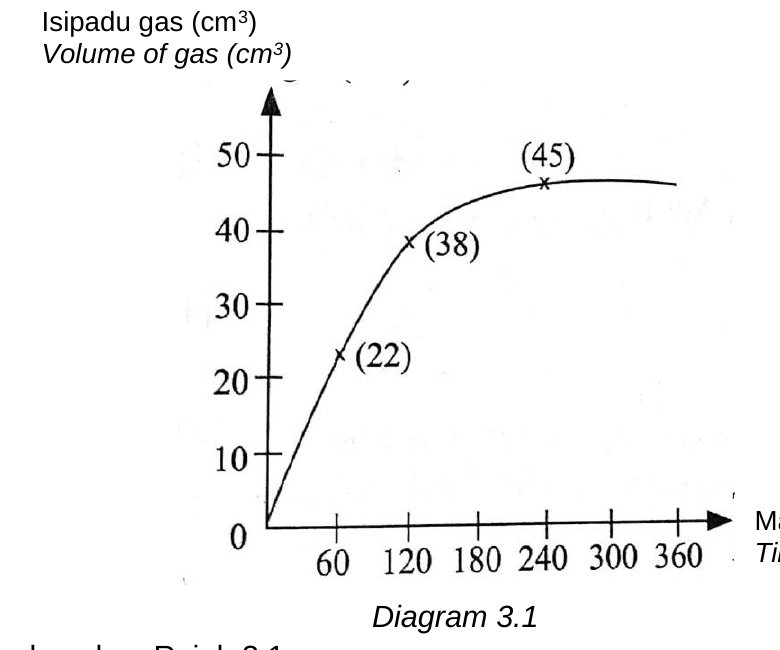
- (a)(i)
State the meaning of rate of reaction.
[1] - (a)(ii)
State one observable change in this experiment that can be used to determine the rate of reaction.
[1] - (a)(iii)
Calculate the overall average rate of reaction.
[2] - (b)
Classify the following reactions into fast reaction and slow reaction: electric cells reaction, fireworks, rock erosion, fermentation.
[2]
Diagram 4.1 shows elements in the periodic table: ²³₁₁Na, ³⁹₁₉K and ³⁵·⁵₁₇Cl.
Medium7 marks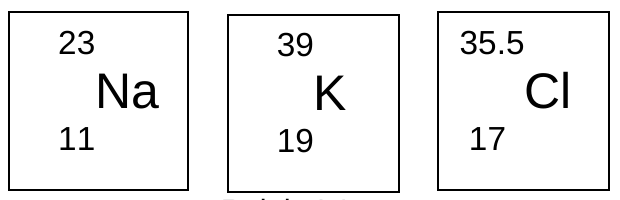
- (a)
In which group of the periodic table is chlorine located?
[1] - (b)
Write the electron arrangement for potassium atom.
[1] - (c)
Sodium and potassium react with water to produce metal hydroxide solution and hydrogen gas. Write the chemical equation for the reaction of potassium with water.
[1] - (d)(i)
A piece of burning sodium is placed quickly into a gas jar containing oxygen gas. State the observation of this reaction.
[1] - (d)(ii)
Name the type of the compound formed.
[1] - (d)(iii)
Draw the electron arrangement of the compound in (d)(ii).
[2]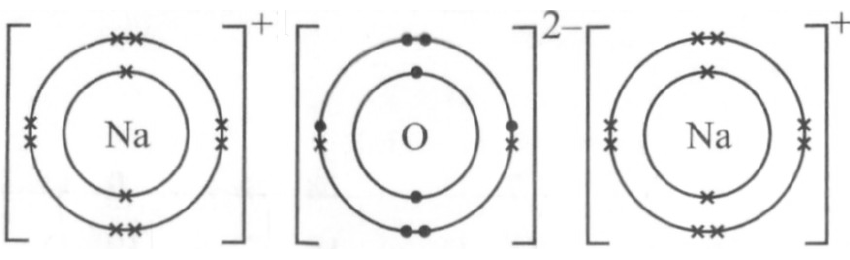
Diagram 5.1 shows a ginger plant with parts P, Q, R and S. Ginger can be used as a traditional medicine. Table 5.1 shows the function of three types of modern medicine: prevents pain (X), kills or prevents the reproduction of bacteria (Y), changes the emotions and behaviour of the patient (Z).
Medium8 marks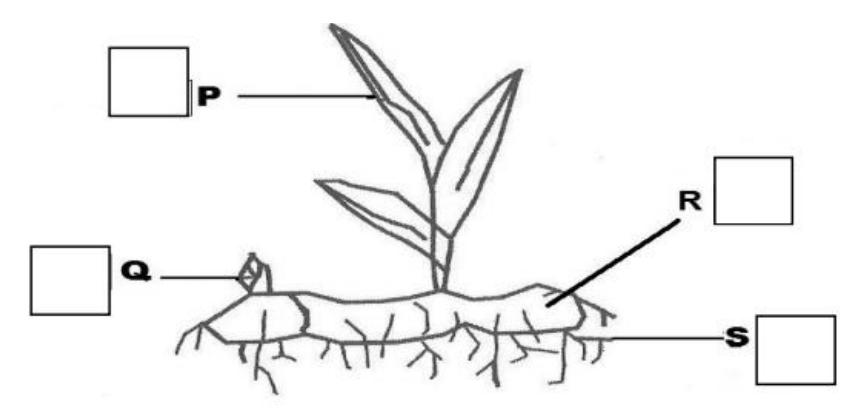
- (a)
Which of the parts P, Q, R, S is used as the main source of medicine? Mark (/) in the box in Diagram 5.1.
[1] - (b)
What illness can be cured by using ginger?
[1] - (c)
How is ginger used to treat the illness in (b)?
[1] - (d)(i)
Complete Table 5.1 to show which medicine has each function: X (prevents pain), Y (kills or prevents the reproduction of bacteria), Z (changes the emotions and behaviour).
[3] - (d)(ii)
A patient treated with medicine of type Y must finish all the medicine given by the doctor to make sure all bacteria are killed. What will happen if not all the bacteria are killed?
[2]
Diagram 6.1 shows the conversion of but-1-ene to hydrocarbon Y through process X at 180 °C with nickel as a catalyst. (c) 29 g of hydrocarbon Y is completely burnt in oxygen: C₄H₁₀ + 13/2 O₂ → 4CO₂ + 5H₂O. [Relative atomic mass: C = 12, O = 16, H = 1]
Medium9 marks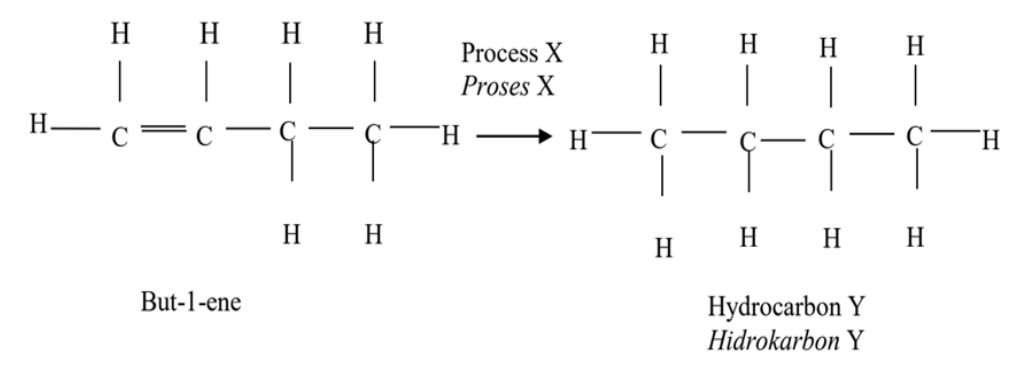
- (a)
Name process X.
[1] - (b)
Write the chemical equation to represent process X.
[1] - (c)(i)
Calculate the mass of carbon dioxide gas produced.
[4]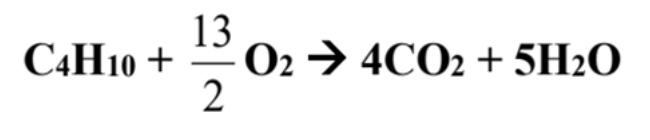
- (d)
Calculate the percentage of carbon per molecule in but-1-ene and hydrocarbon Y, and state which one produces more soot.
[3]
Diagram 7.1 shows the apparatus set-up (polystyrene cup, 50 cm³ of 0.2 mol dm⁻³ copper(II) sulphate, excess zinc powder) to determine the heat of displacement. Thermochemical equation: Zn + CuSO₄ → ZnSO₄ + Cu, ΔH = -210 kJ mol⁻¹. [Specific heat capacity of solution = 4.2 J g⁻¹ °C⁻¹; density of solution = 1 g cm⁻³]
Medium10 marks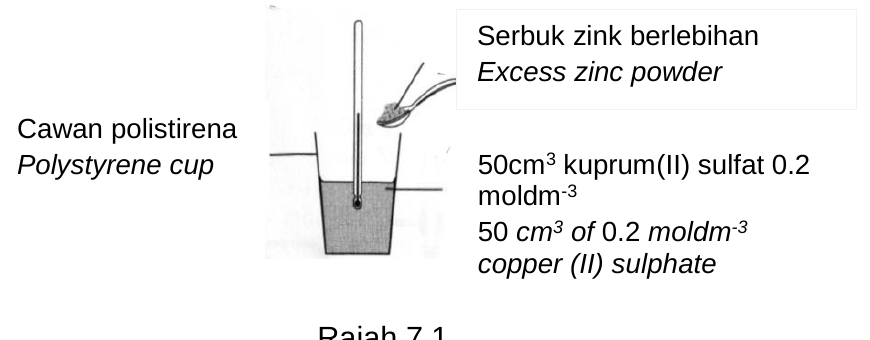
- (a)
State the meaning of heat of displacement.
[1] - (b)
Give one reason why a polystyrene cup is used in the experiment.
[1] - (c)(i)
Calculate the number of moles of copper(II) ion.
[1] - (c)(ii)
Calculate the heat released during the reaction.
[2] - (c)(iii)
Calculate the change of temperature in this experiment.
[1] - (d)(i)
The experiment is repeated using magnesium powder instead of zinc powder (same volume and concentration of copper(II) sulphate). Predict the heat of displacement.
[1] - (d)(ii)
Give a reason for your answer in (d)(i).
[1] - (e)
Draw the energy level diagram for the reaction.
[2]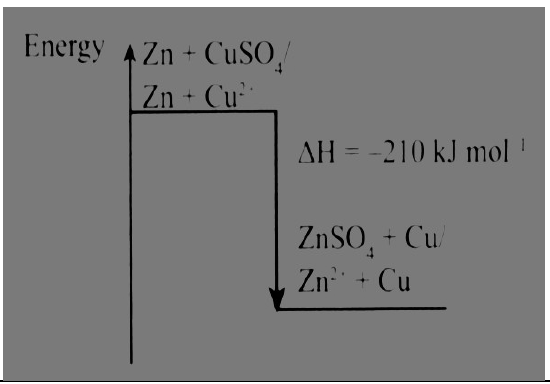
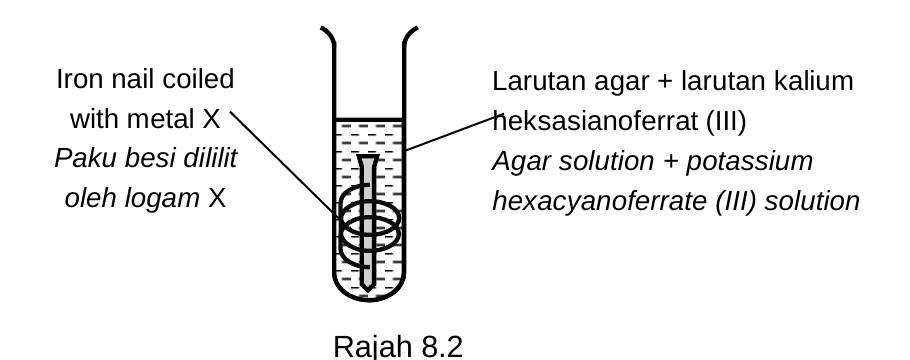
(a) Diagram 8.1 shows two sets of experiments to investigate redox reactions. Set 1: bromine water and dilute sulphuric acid in one arm and iron(II) sulphate solution in the other arm of a U-tube, carbon electrodes connected to a galvanometer (G). Set 2: magnesium ribbon in iron(II) sulphate solution. (b) Diagram 8.2: an iron nail coiled with metal X in agar solution + potassium hexacyanoferrate(III) solution. After three days blue spots form in the test tube.
Medium10 marks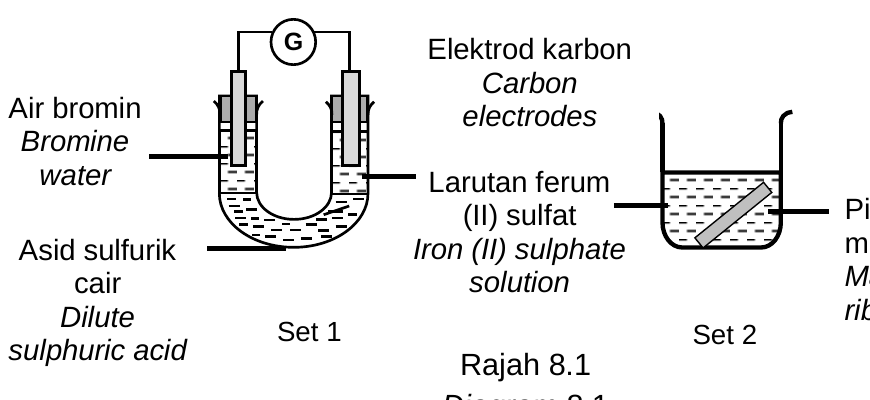
- (a)(i)
What is meant by redox reaction?
[1] - (a)(ii)
State the function of bromine water and iron(II) sulphate solution in Set 1.
[2] - (a)(iii)
After 15 minutes the iron(II) sulphate solution in Set I changes from green to brown, but in Set II it changes from green to colourless and a grey solid forms. Complete Table 8.1: change in oxidation number of iron and half-equation of iron, for Set I and Set II.
[4]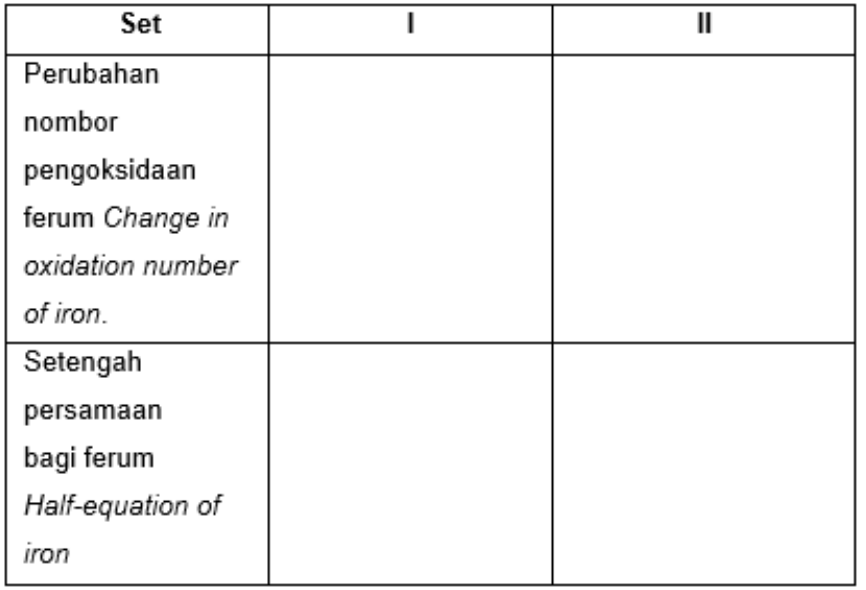
- (b)(i)
Suggest a suitable metal for X.
[1] - (b)(ii)
Explain the observation seen for metal X in Table 8.2.
[2]
Section B
Diagram 9.1 shows a simple chemical cell: a copper electrode in 1.0 mol dm⁻³ copper(II) nitrate solution and an iron electrode in 1.0 mol dm⁻³ iron(II) nitrate solution joined by a salt bridge and a voltmeter. Choose ONE question from Section B (Question 9 or 10).
Hard20 marks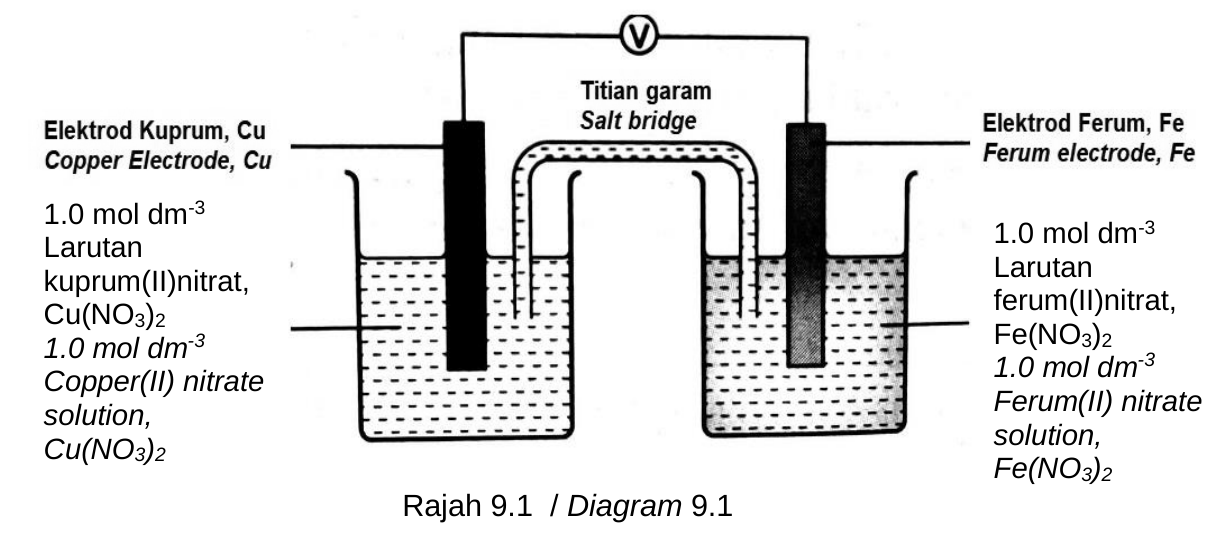
- (a)(i)
Based on Diagram 9.1 and the standard electrode potentials of the half-cells, state the positive terminal and negative terminal of this cell.
[2] - (a)(ii)
Write the cell notation for the voltaic cell.
[1] - (a)(iii)
Calculate the voltage of the cell.
[1]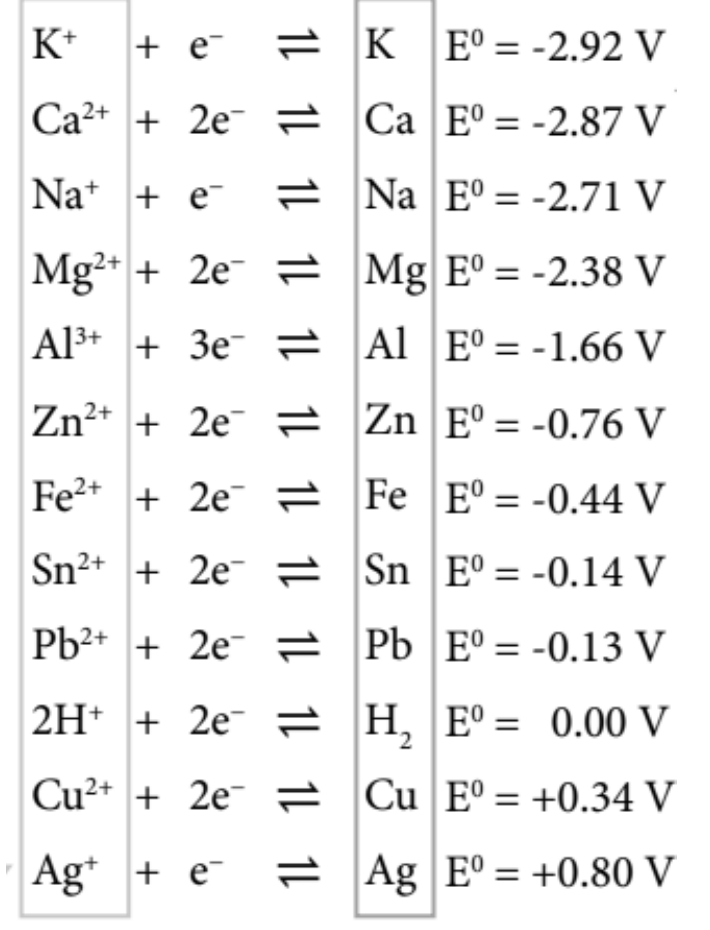
- (b)(i)
The experiment is repeated using silver and magnesium electrodes, each in an aqueous solution of its own metal ions (Table 9.1: Mg²⁺ + 2e⁻ ⇌ Mg, E° = -2.38 V; Ag⁺ + e⁻ ⇌ Ag, E° = +0.80 V; 2H⁺ + 2e⁻ ⇌ H₂, E° = 0.00 V). State an observation at the positive terminal and at the negative terminal.
[2]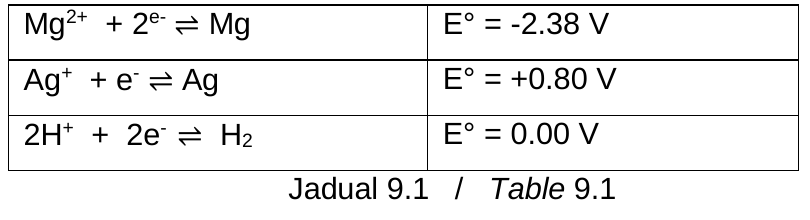
- (b)(ii)
Write the half equation of oxidation and the half equation of reduction for this experiment. Explain your answer.
[4] - (c)
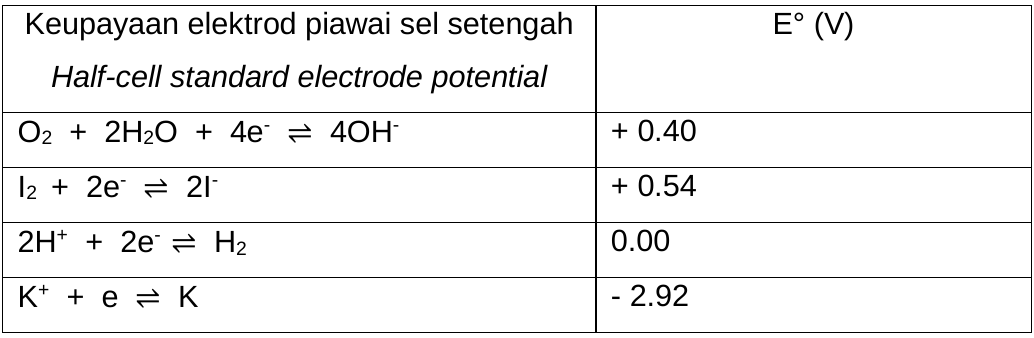
Diagram 9.2 shows the electrolysis of concentrated potassium iodide solution using carbon electrodes. Table 9.2: O₂ + 2H₂O + 4e⁻ ⇌ 4OH⁻, +0.40 V; I₂ + 2e⁻ ⇌ 2I⁻, +0.54 V; 2H⁺ + 2e⁻ ⇌ H₂, 0.00 V; K⁺ + e ⇌ K, -2.92 V. Based on Diagram 9.2 and Table 9.2, explain the reactions at the anode and cathode: ion selectively discharged, reason, half equation, observation, product.
[10]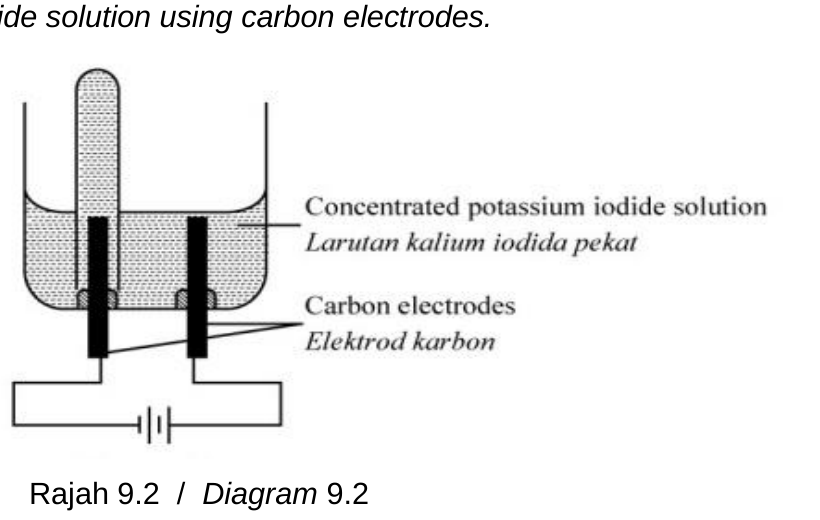
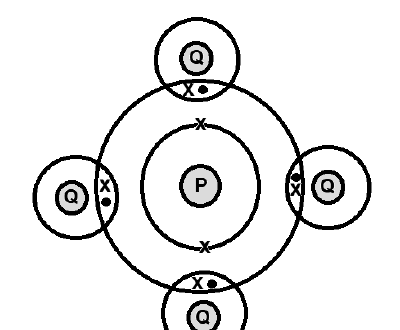
Choose ONE question from Section B (Question 9 or 10). Diagram 10.1 shows the electron arrangement of the ionic compound XY: X²⁺ (2.8) and Y²⁻ (2.8.8). Diagram 10.2 shows the symbols ¹²₆P, ¹₁Q and ¹⁶₈R (not the actual symbols). Diagram 10.3 and Table 10.1 show an experiment on electrical conductivity of lead(II) bromide, PbBr₂ and naphthalene, C₁₀H₈ in solid and molten states.
Hard20 marks- (a)
Based on Diagram 10.1, explain the position of element X in the Periodic Table.
[5]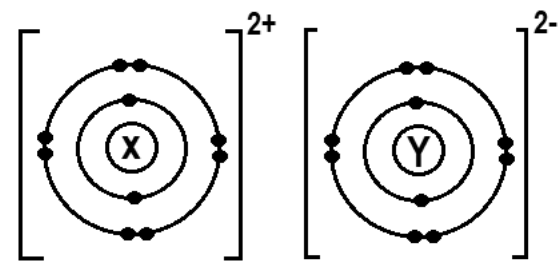
- (b)
Using the information in Diagram 10.2, explain the formation of the compound from elements P and Q. Draw the electron arrangement of the compound formed.
[5]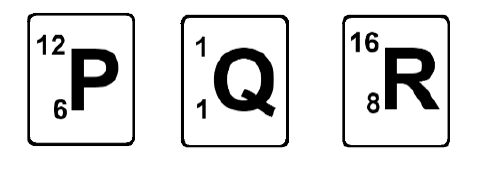
- (c)
Based on Diagram 10.3 and Table 10.1, state the difference in observation for the ionic and covalent compound in terms of electrical conductivity and melting point. Explain your answer.
[10]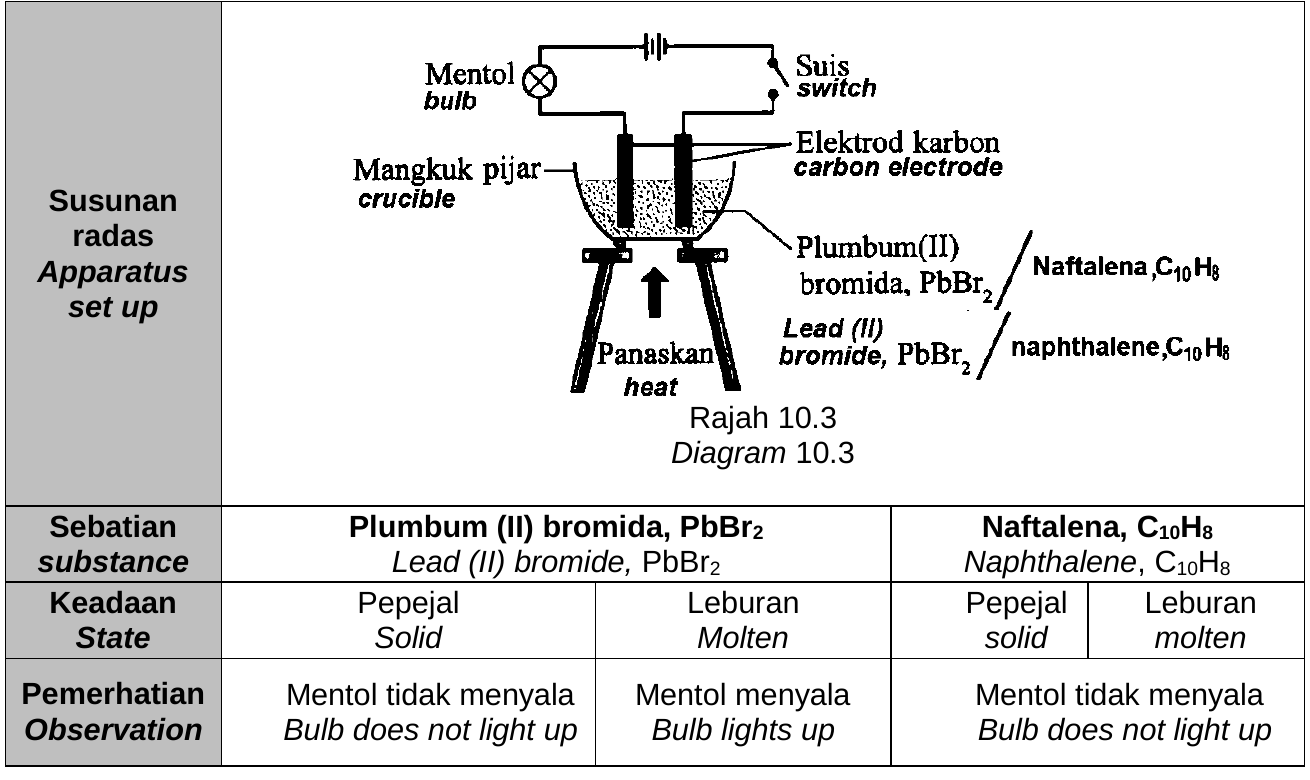
Section C
Diagram 11.1 shows the apparatus set-up (flask with zinc pieces and excess acid Y on a balance reading 87.025 g, syringe collecting gas) used to investigate the chemical properties of acid using excess acid Y. Acid Y is a monoprotic strong acid.
Hard20 marks- (a)(i)
Suggest acid Y and identify the gas released.
[2]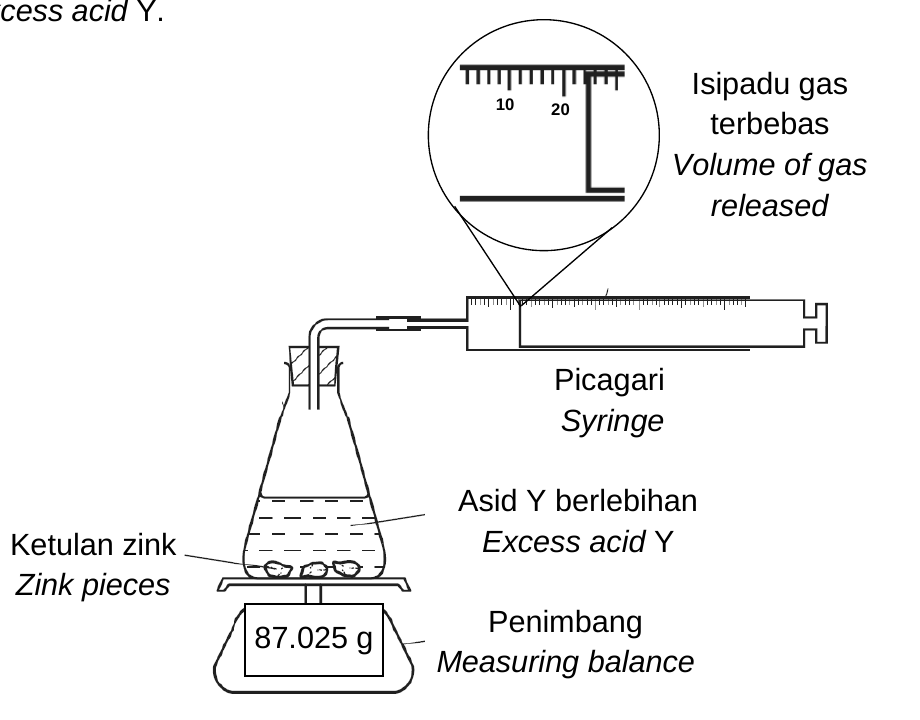
- (a)(ii)
Write the chemical equation for the reaction between acid Y and zinc. State the volume of gas released in Diagram 11.1 and calculate the mass of zinc used in the experiment.
[5] - (b)
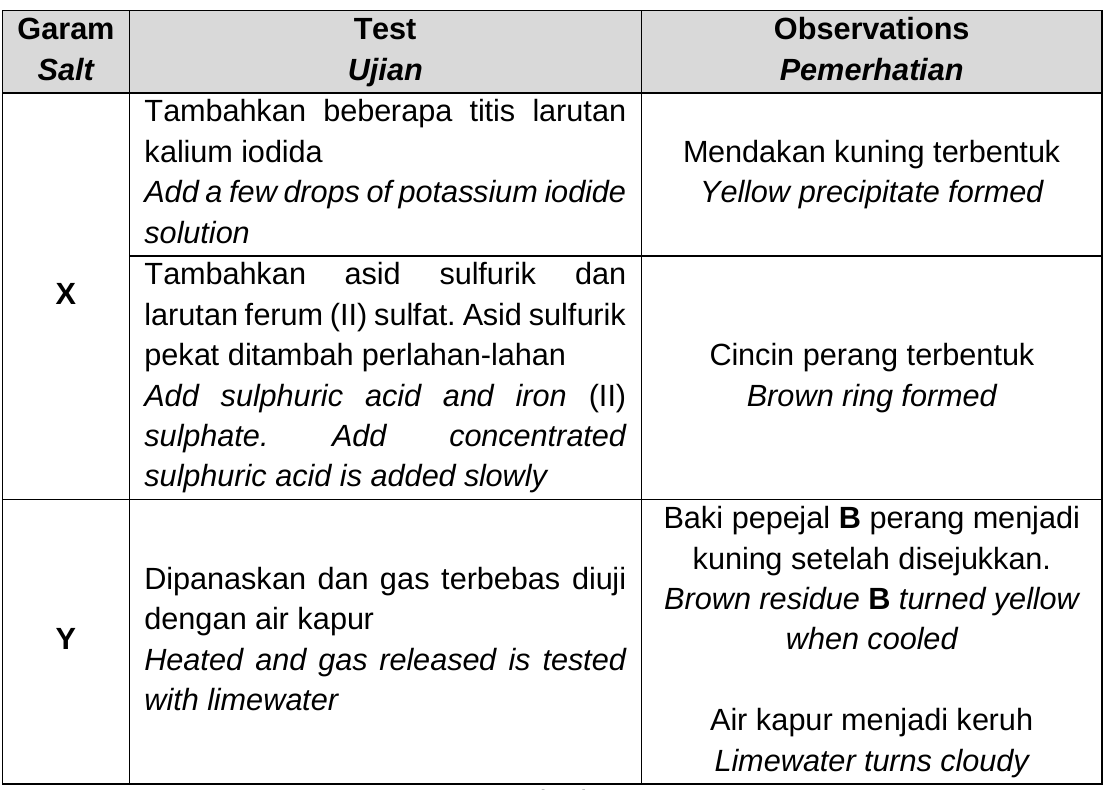
A mixture of salt X (soluble) and salt Y (insoluble) with the same cation is separated (Diagram 11.2). Table 11.1: Salt X + a few drops of potassium iodide solution: yellow precipitate; Salt X + sulphuric acid and iron(II) sulphate, then concentrated sulphuric acid added slowly: brown ring. Salt Y heated: brown residue B turns yellow when cooled; gas released turns limewater cloudy. What is the cation for both salts? Identify salt X, salt Y and residue B. State the gas released when salt Y is heated.
[5]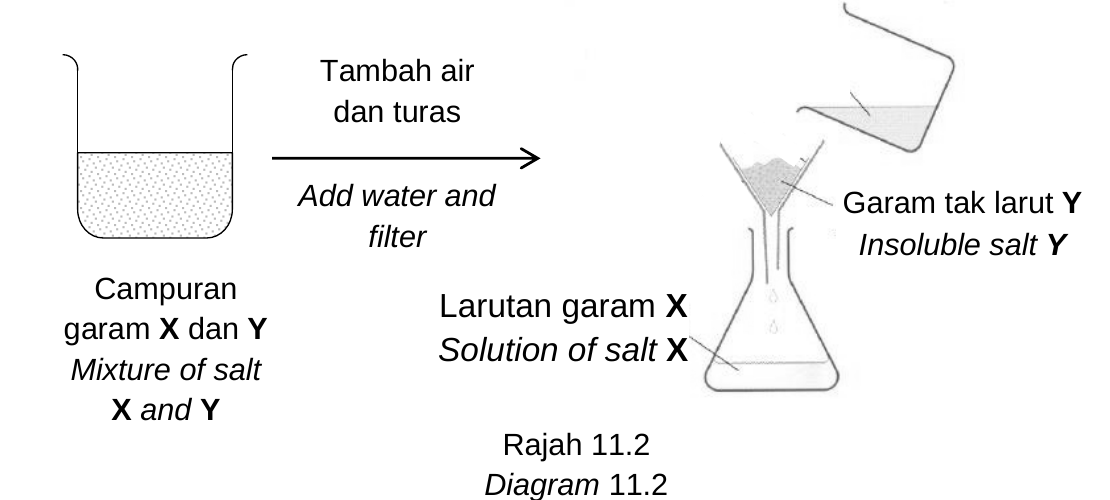
- (c)
Two citrus drinks, Lemonade and Orangeade, contain citric acid (Diagram 11.3). The concentration of citric acid can be determined using potassium hydroxide solution or another suitable chemical. Plan an investigation to show which drink contains the higher concentration of citric acid. Include the conclusion.
[8]