Write your answer on paper. Then open the answer to check it.
Section A
Table 1 shows the number of protons and neutrons for atom W, X, Y and Z. W: 5 protons, 6 neutrons; X: 6 protons, 6 neutrons; Y: 8 protons, 8 neutrons; Z: 8 protons, 9 neutrons.
Medium5 marks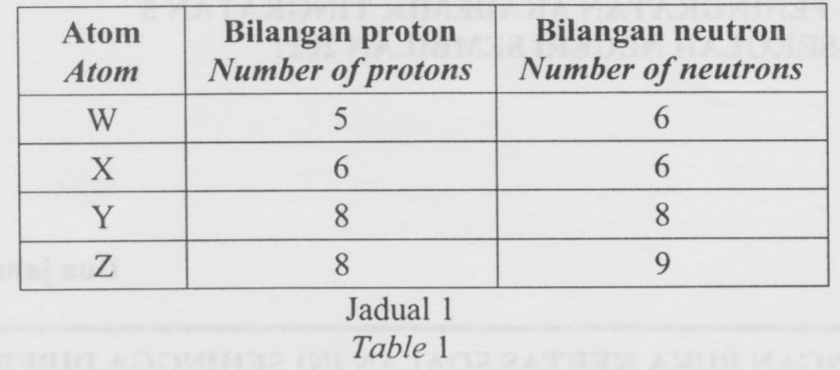
- (a)
What is the meaning of nucleon number?
[1] - (b)
What is the nucleon number of atom Z?
[1] - (c)
Write the symbol of atom W in the form of ᴬ_Z X.
[1] - (d)(i)
Based on Table 1, which atoms are isotopes?
[1] - (d)(ii)
Phosphorus-32 is an example of isotope. State the use of the isotope.
[1]
Plastic bottle is one of the products produced from polymer X. Diagram 2 shows the structural formula for polymer X: a repeating unit -(CH2-CH2)n- drawn with C-H bonds, i.e. each carbon bonded to two hydrogen atoms in a chain, repeated n times.
Medium5 marks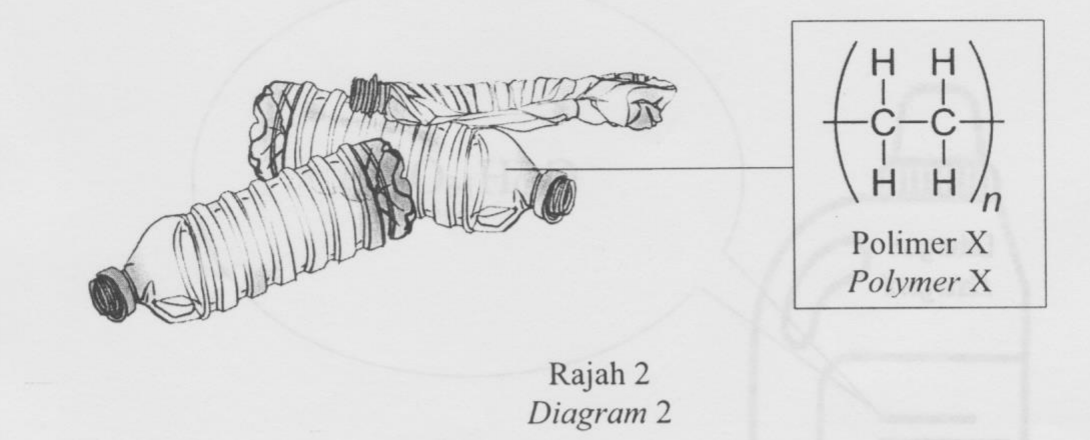
- (a)
What is the meaning of polymer?
[1] - (b)
State the name of the basic unit that forms polymer X.
[1] - (c)
Draw the structural formula of the basic unit of polymer X mentioned in 2(b).
[1] - (d)
State two other uses of polymer X in daily life.
[2]
Diagram 3 shows a chemical formula for one of the substances contained in a detergent: C10H16O4N2. (b) Washing soda is a chemical compound that can be used to remove stubborn stains from cloth and is an essential component in most homemade laundry detergent. Washing soda or sodium carbonate can be prepared by heating sodium bicarbonate, NaHCO3. When sodium bicarbonate is heated, sodium carbonate, carbon dioxide and water are formed.
Medium6 marks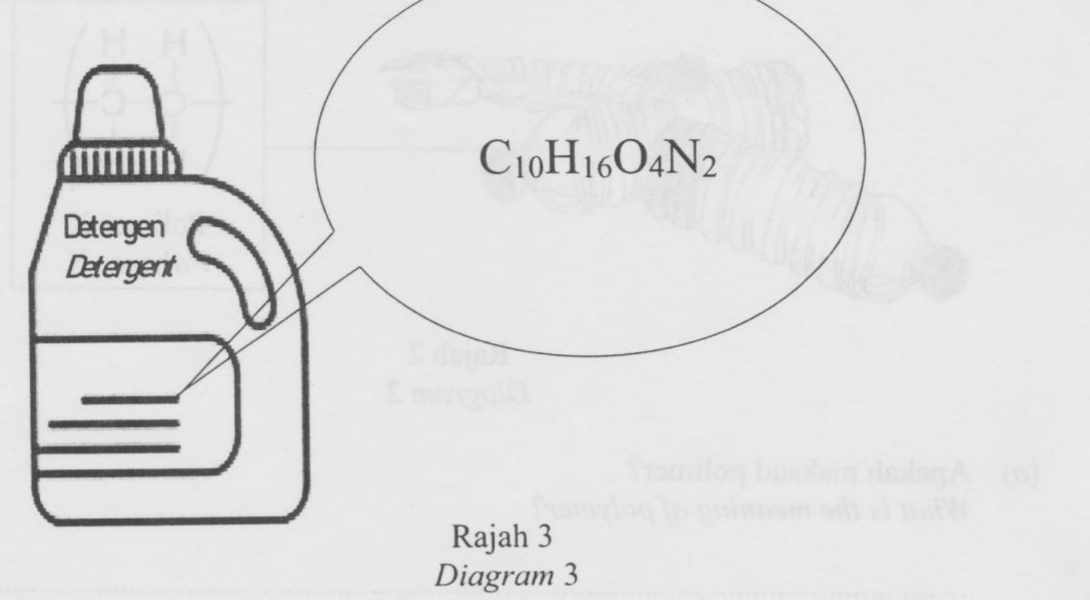
- (a)(i)
What is the meaning of chemical formula?
[1] - (a)(ii)
Based on Diagram 3, write the empirical formula for the structure.
[1] - (b)(i)
Write the chemical equation for the process of preparing washing soda.
[2] - (b)(ii)
If 0.2 mol of sodium bicarbonate is heated, what is the mass of washing soda produced? [Relative atomic mass: H=1, C=12, O=16, Na=23]
[2]
Table 4 shows the physical properties of substance of two elements of Group 17 in Periodic Table of Elements: chlorine, Cl2 (gas at room temperature, -101 °C) and bromine, Br2 (liquid, -7 °C). (b) Diagram 4 shows a coloured-glass window.
Medium7 marks- (a)(i)
Explain how does atom of Group 17 element form an ion that has a stable electron arrangement.
[1]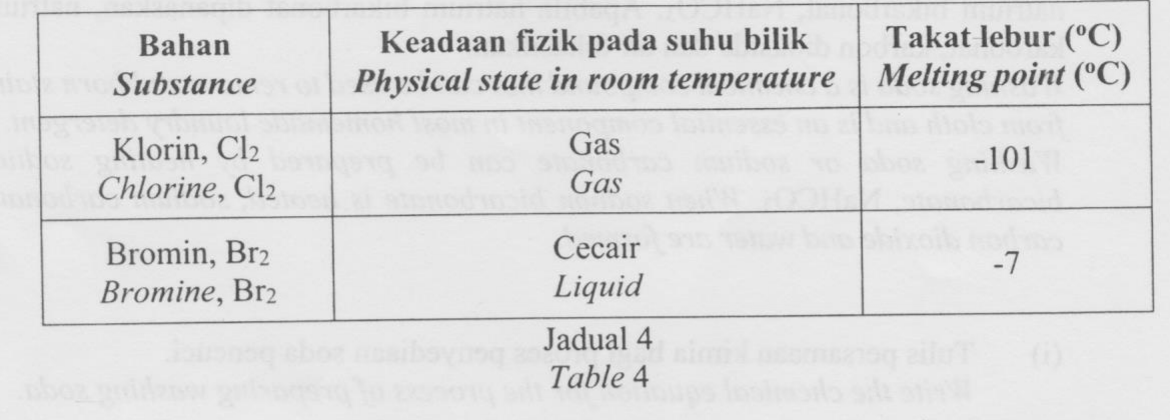
- (a)(ii)
Compare the boiling point of chlorine, Cl2 and bromine, Br2. Explain why.
[3] - (a)(iii)
The position of fluorine is above chlorine in Periodic Table of Element. What is the physical state of fluorine in room temperature?
[1] - (b)(i)
Manganese is used to make coloured-glass windows. State the name of the group for manganese in Periodic Table of Element.
[1]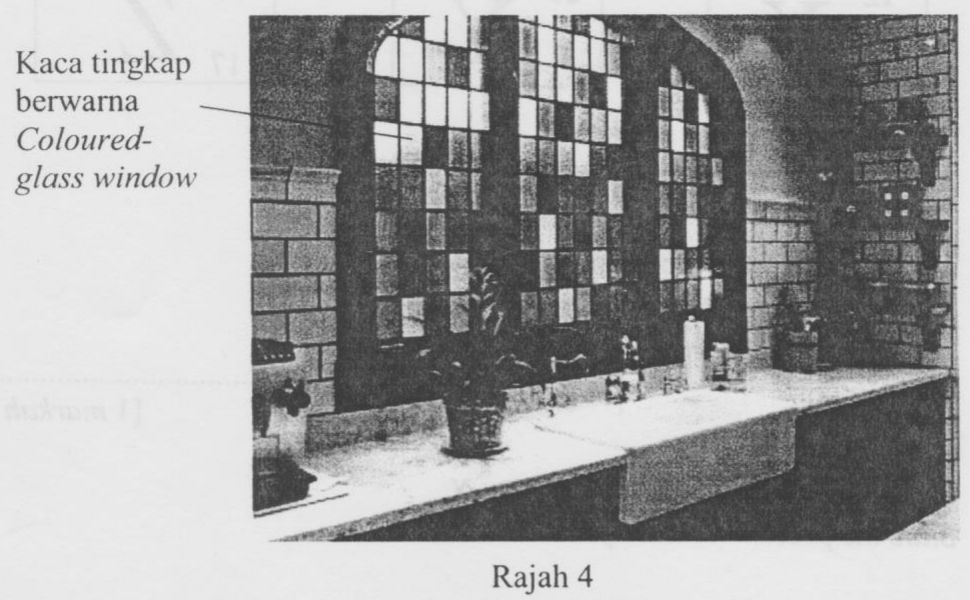
- (b)(ii)
Beside forming coloured compounds, state another special characteristic for the element of the group stated in 4(a)(i).
[1]
Diagram 5 shows the symbols of atom X (12/6 X), Y (23/11 Y) and Z (35/17 Z); nucleon number at top, proton number at bottom.
Medium8 marks- (a)
What is the meaning of proton number?
[1]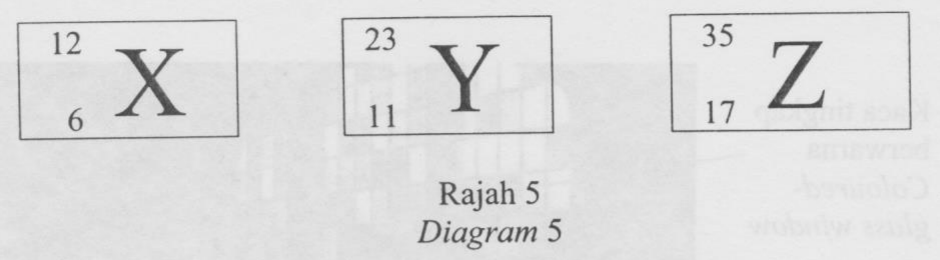
- (b)
State the proton number of atom X.
[1] - (c)
Determine the number of neutrons of atom Y.
[1] - (d)
Atom Y reacts with atom Z to form compound L. Draw the electron arrangement for compound L.
[2] - (e)(i)
Atom X can also react with atom Z to form another compound with formula XZ4. Compare the melting point of compound XZ4 with melting point of compound L.
[1] - (e)(ii)
Explain your answer in 5(e)(i).
[2]
Table 6 shows the information for two sets of experiment to investigate factor affecting the rate of reaction between calcium carbonate and hydrochloric acid. Set I: 4 g of calcium carbonate powder and 40 cm3 of 0.5 mol dm-3 hydrochloric acid. Set II: 4 g of calcium carbonate chips and 40 cm3 of 0.5 mol dm-3 hydrochloric acid.
Medium9 marks- (a)
What is the meaning of rate of reaction?
[1]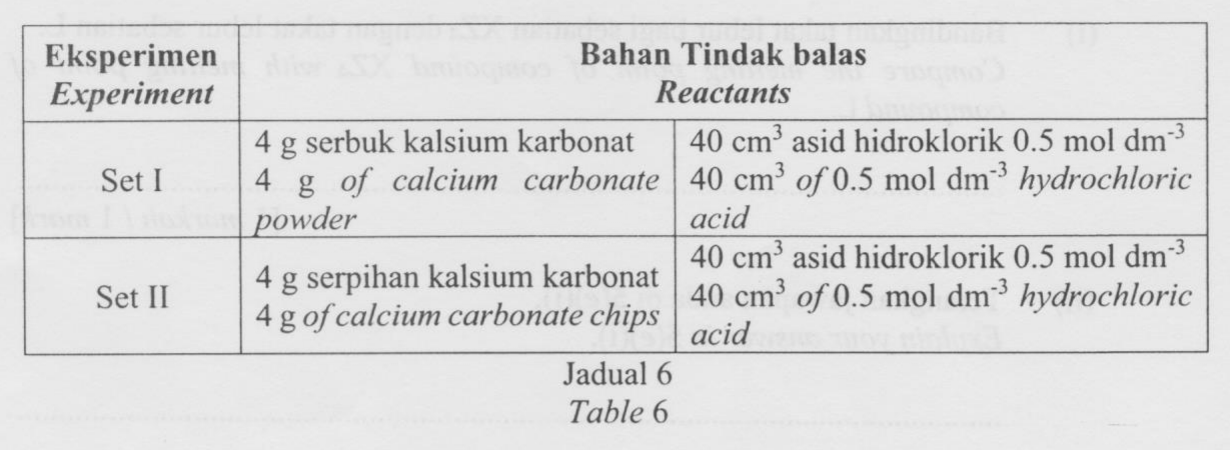
- (b)(i)
Name the gas produced.
[1] - (b)(ii)
Write a balanced chemical equation for the reaction occurs.
[2] - (b)(iii)
Calculate the maximum volume of gas released at room conditions. [Molar volume: 24 dm3 mol-1 at room conditions]
[3] - (b)(iv)
Compare the rate of reaction of experiments in Set I and Set II. Explain why.
[2]
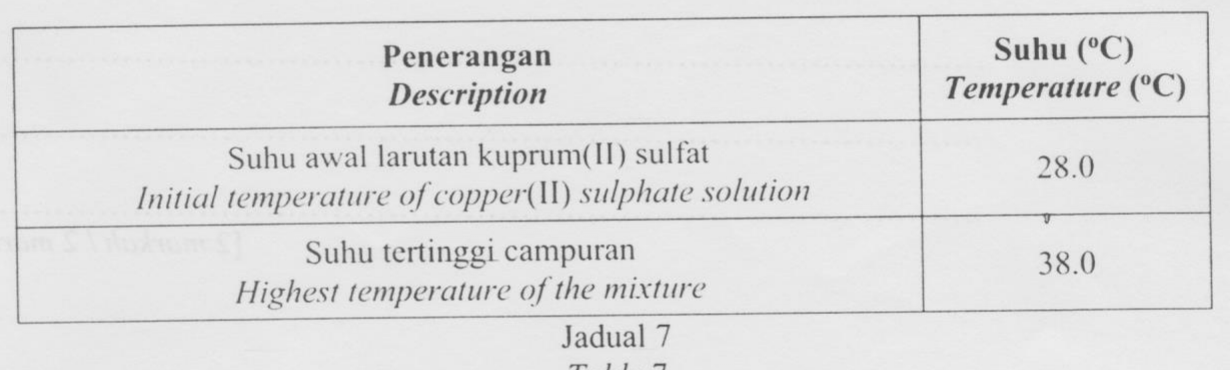
Diagram 7 shows the apparatus set-up for an experiment to determine the heat of displacement of copper: excess zinc powder is added to 100 cm3 of 0.2 mol dm-3 copper(II) sulphate solution in a polystyrene cup with a thermometer. Table 7 shows the temperature recorded: initial temperature of copper(II) sulphate solution 28.0 °C; highest temperature of the mixture 38.0 °C.
Medium10 marks- (a)
What is the meaning of heat of displacement in this experiment?
[1]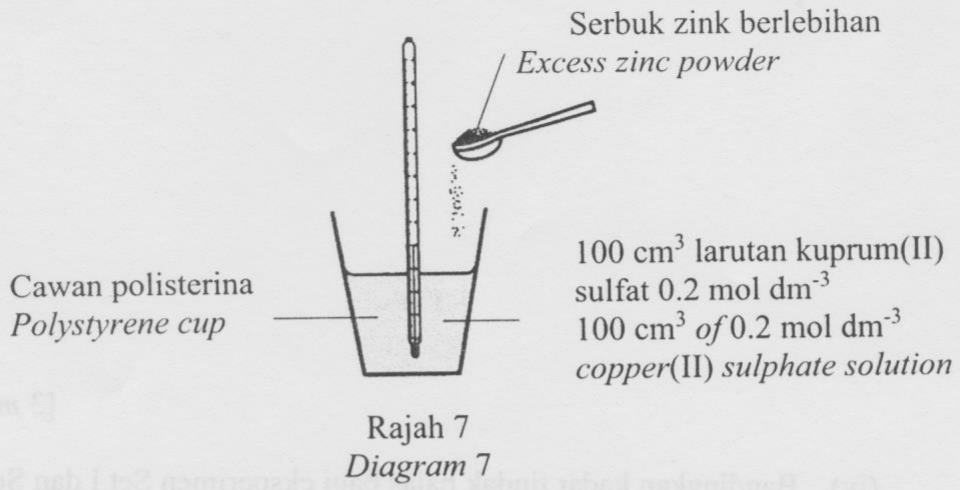
- (b)(i)
Based on the temperature change in Table 7, what is the type of the reaction?
[1] - (b)(ii)
Based on the temperature change in Table 7, compare the total energy of the reactants and total energy of the products.
[1] - (c)
State one observation in the experiment besides the temperature change.
[1] - (d)
Calculate the heat of displacement of copper by zinc. [Specific heat capacity of the solution = 4.2 J g-1 °C-1; density of solution = 1 g cm-3; relative atomic mass: Zn = 65]
[3] - (e)
Compare the heat of displacement of copper if zinc metal is replaced by magnesium metal. Give a reason.
[2] - (f)
If the experiment is repeated by using 50 cm3 of 0.2 mol dm-3 copper(II) sulphate solution, predict the change of temperature of the mixture.
[1]
(a) Table 8.1 shows the observations of two sets of voltaic cells. Cell I: silver electrode in 1.0 mol dm-3 silver nitrate solution and copper electrode in 1.0 mol dm-3 copper(II) nitrate solution, separated by a porous pot; the intensity of blue colour of copper(II) nitrate solution increases. Cell II: copper electrode in 1.0 mol dm-3 copper(II) nitrate solution (porous pot) and zinc electrode in 1.0 mol dm-3 zinc nitrate solution; the intensity of blue colour of copper(II) nitrate solution decreases. Based on Table 8.1 and referring to the Standard Electrode Potential Series at page 27. (b) Table 8.2 shows a list of apparatus and materials: salt bridge, connecting wire, voltmeter, beaker, silver electrode, silver nitrate solution, iron electrode, iron(II) nitrate solution.
Medium10 marks- (a)(i)
State the chemical formula for copper(II) nitrate solution.
[1]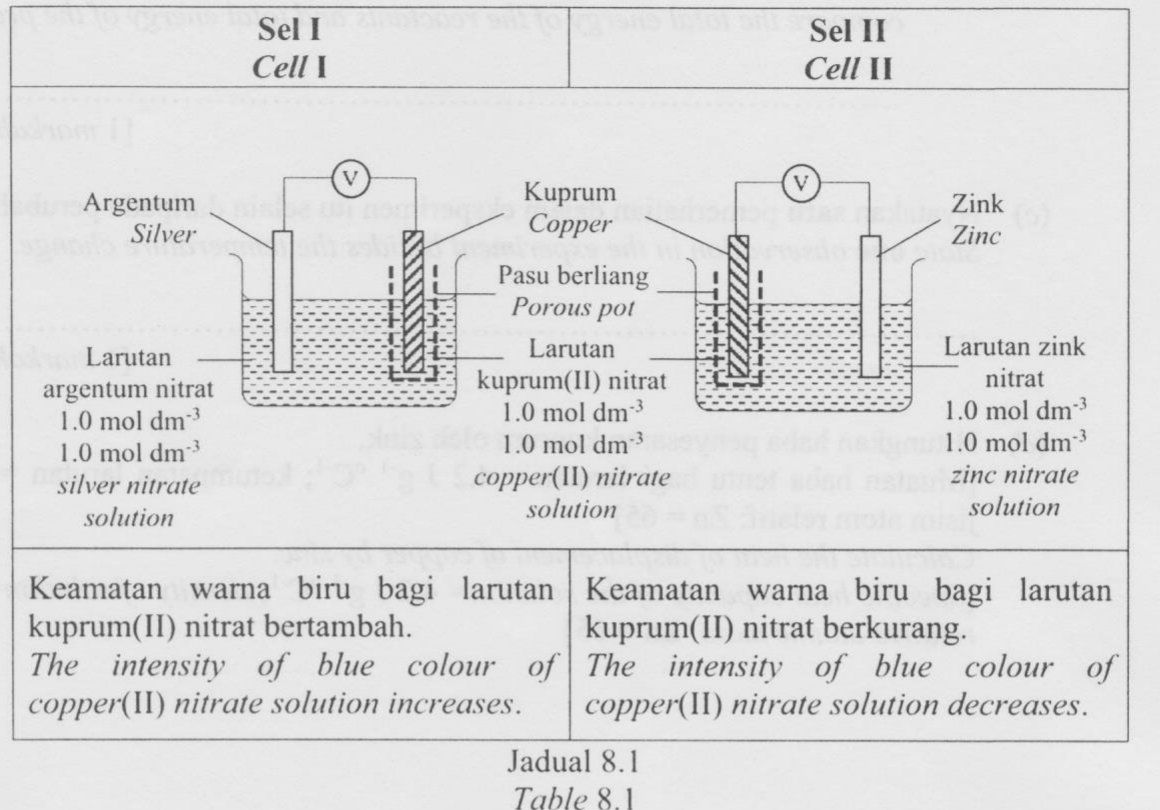
- (a)(ii)
Identify the negative terminal in Cell I.
[1] - (a)(iii)
Calculate the voltage of Cell I.
[1] - (a)(iv)
Write the cell notation for Cell II.
[2] - (a)(v)
Explain the difference in the observation of copper(II) nitrate solution in Cell I and Cell II.
[2] - (b)
Draw a labelled apparatus set-up for a different chemical cell by using the apparatus and materials given in Table 8.2. Mark in the diagram the positive and negative terminals of the cell.
[3]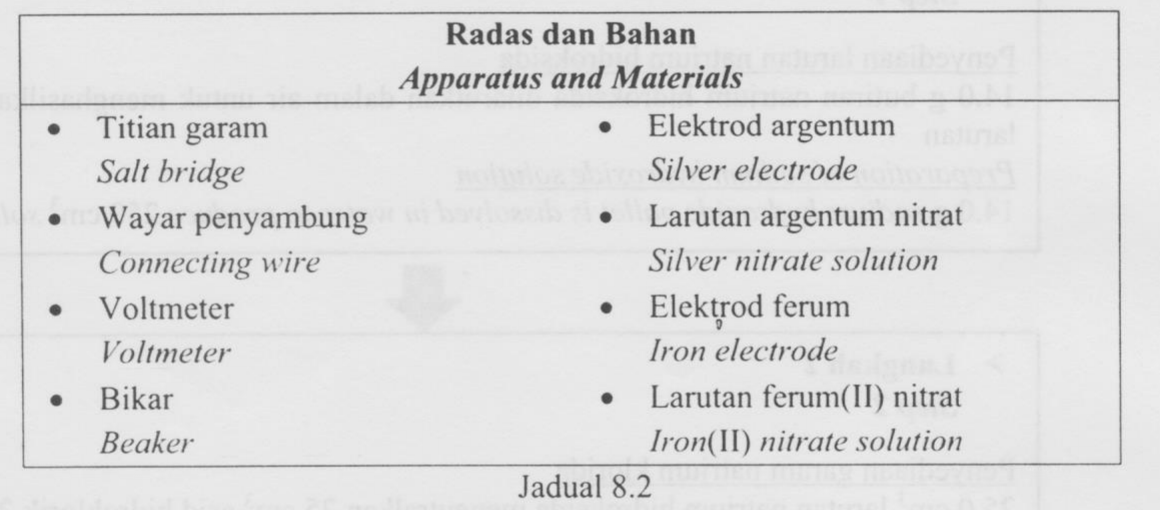
Section B
(a) Diagram 9.1 shows the steps in preparation of sodium chloride salt. Step 1: 14.0 g sodium hydroxide pellet is dissolved in water to produce 250 cm3 solution. Step 2: 25.0 cm3 of sodium hydroxide solution neutralises 25 cm3 of 2 mol dm-3 hydrochloric acid. (b) Diagram 9.2 shows series of reaction involving solid P. Analysis on colourless solution Q is done to identify its cation and anion. (c) A woman's arm was stung by a wasp. Diagram 9.3 shows a woman uses material X found at her house kitchen to relief her pain.
Hard20 marks- (a)
What is the meaning of standard solution? Based on Step 1, calculate the concentration of sodium hydroxide in mol dm-3. Based on Step 2, write chemical equation for the reaction occur. Then calculate the mass of sodium chloride obtained. [Relative atomic mass: H=1, O=16, Na=23, Cl=35.5]
[8]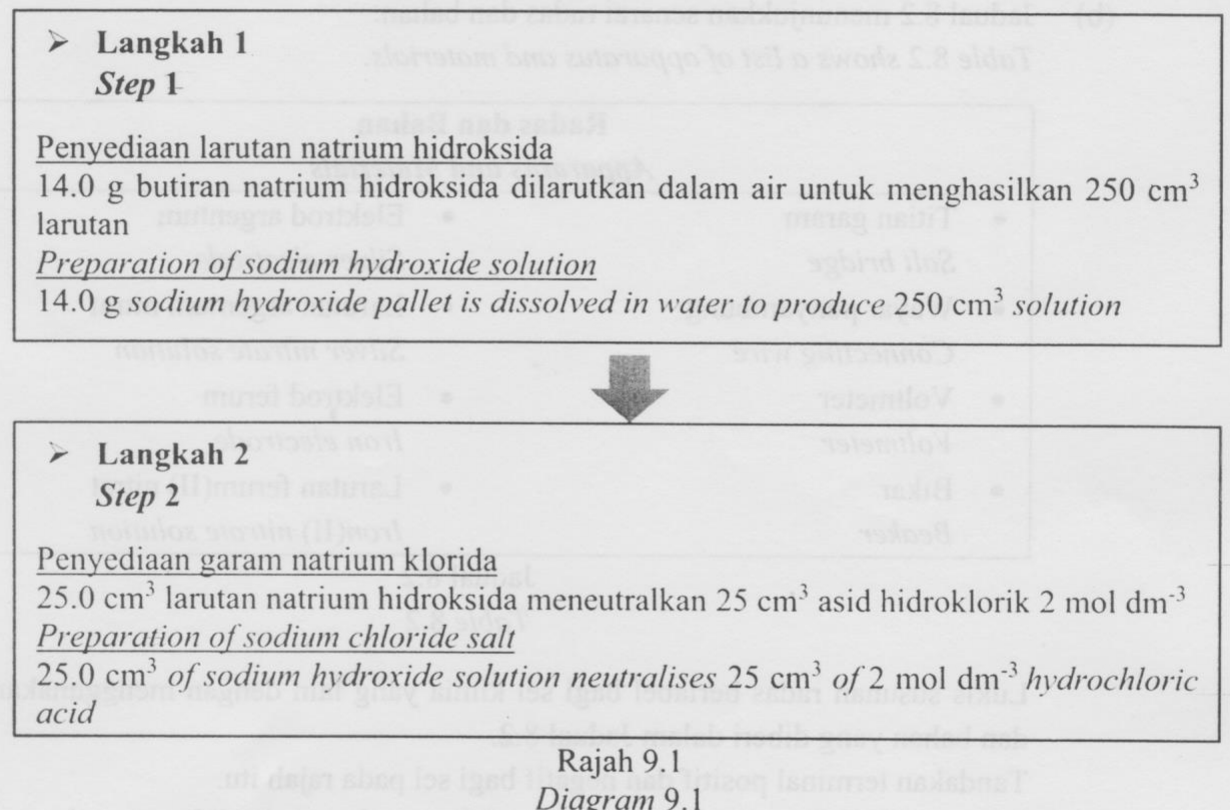
- (b)(i)
Based on Diagram 9.2, identify substance P, Q, R, S and T.
[5]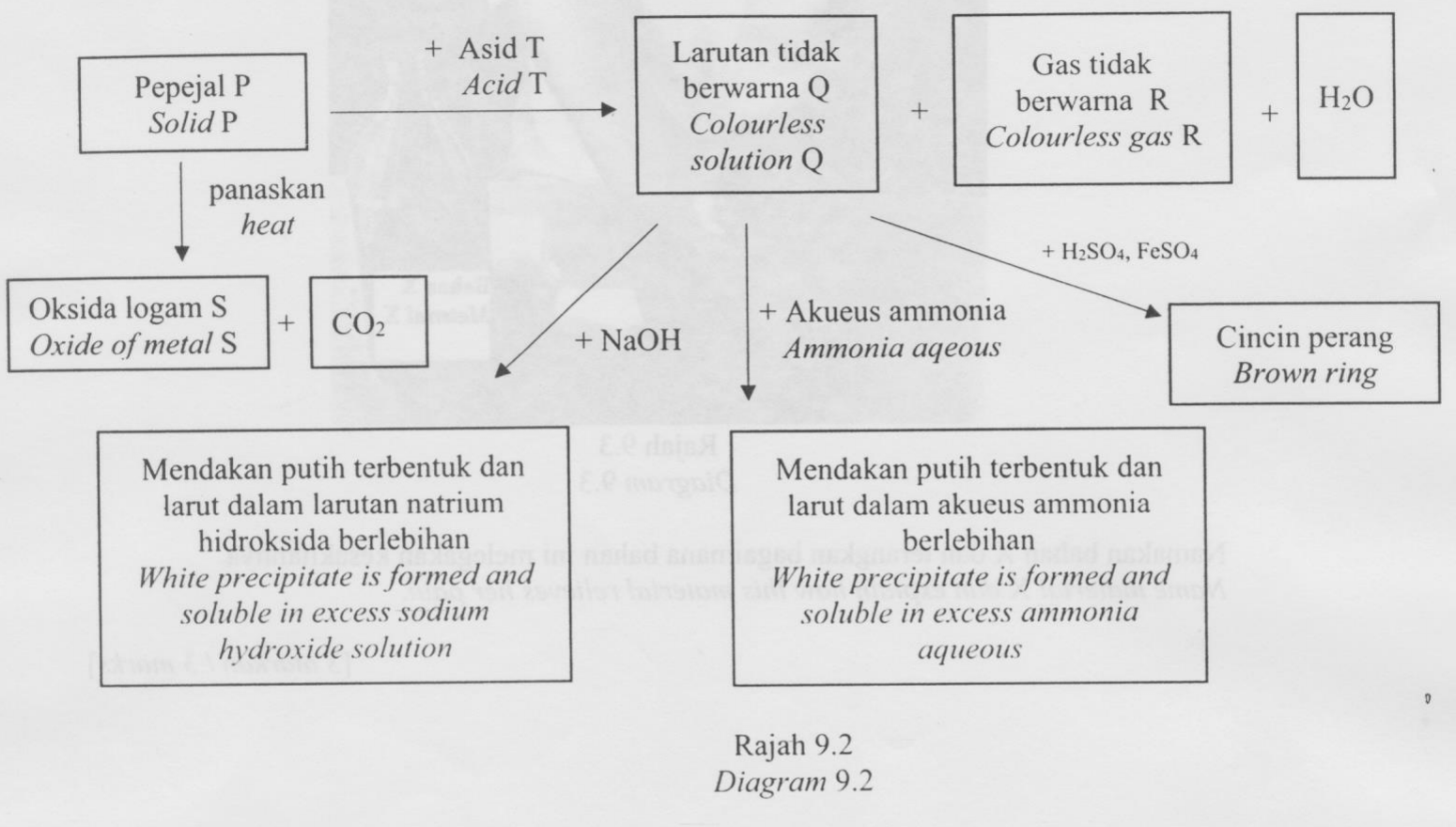
- (b)(ii)
Solid P reacts with acid T to produce colourless solution Q, colourless gas R and water. Write a balanced chemical equation for the reaction and describe chemical test for colourless gas R.
[4] - (c)
Name material X and explain how this material relieves her pain.
[3]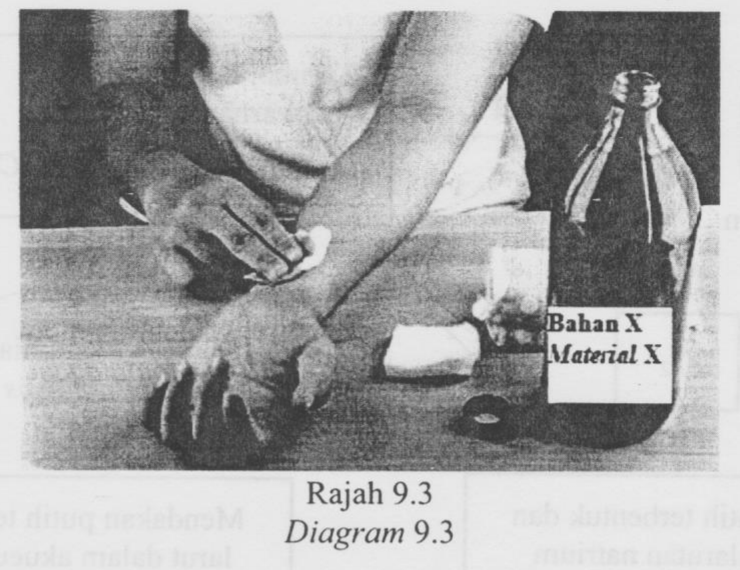
(a) The following information is about hydrocarbon Z: empirical formula is CH2; relative molecular mass is 56. (b) Diagram 10 shows the conversion of propene to another homologous series: propene undergoes hydration to give compound X; propene undergoes Reaction I to give propane; compound X reacts with compound W in Reaction II to give propyl ethanoate.
Hard20 marks- (a)(i)
Determine the molecular formula of Z. [Relative atomic mass: C = 12, H = 1]
[2] - (a)(ii)
Hydrocarbon Z burns completely in oxygen to produce carbon dioxide gas and water. Write a balanced chemical equation for the reaction occurs. Calculate the volume of carbon dioxide gas produced when 11.2 g of Z is burnt completely. [Relative atomic mass: C = 12, H = 1; Molar volume: 24 dm3 mol-1 at room conditions]
[5] - (a)(iii)
Draw and name two isomers of hydrocarbon Z according to IUPAC nomenclature.
[4] - (b)(i)
Name Reaction I and Reaction II.
[2]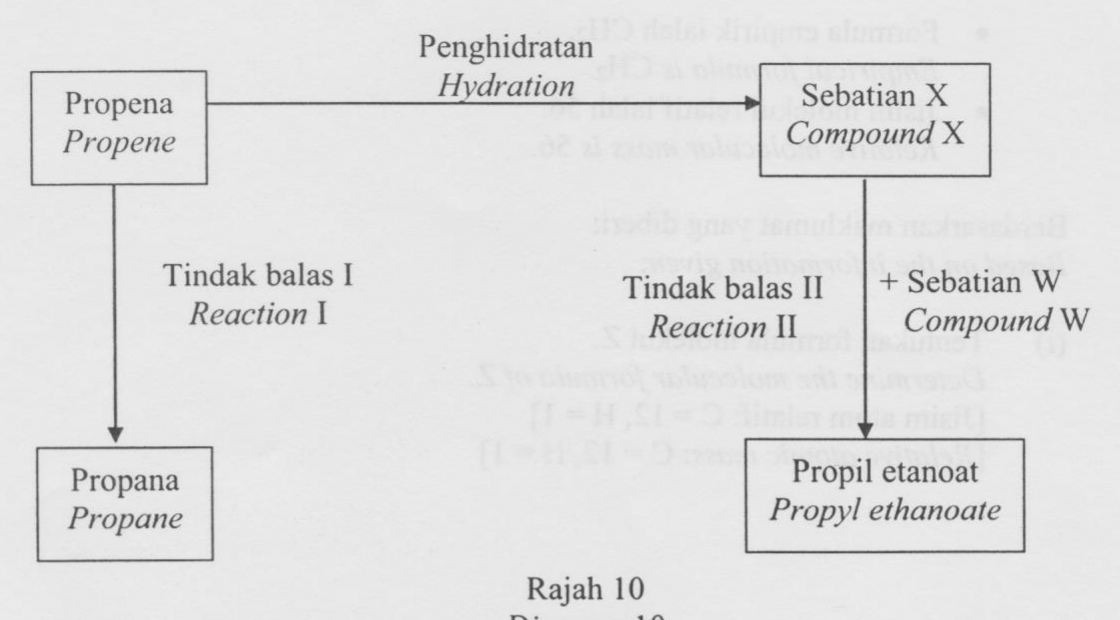
- (b)(ii)
State the formula for compound X and compound W. Write a balanced chemical equation for the formation of propyl ethanoate. Describe briefly a chemical test to differentiate compound X and compound W.
[7]
Section C
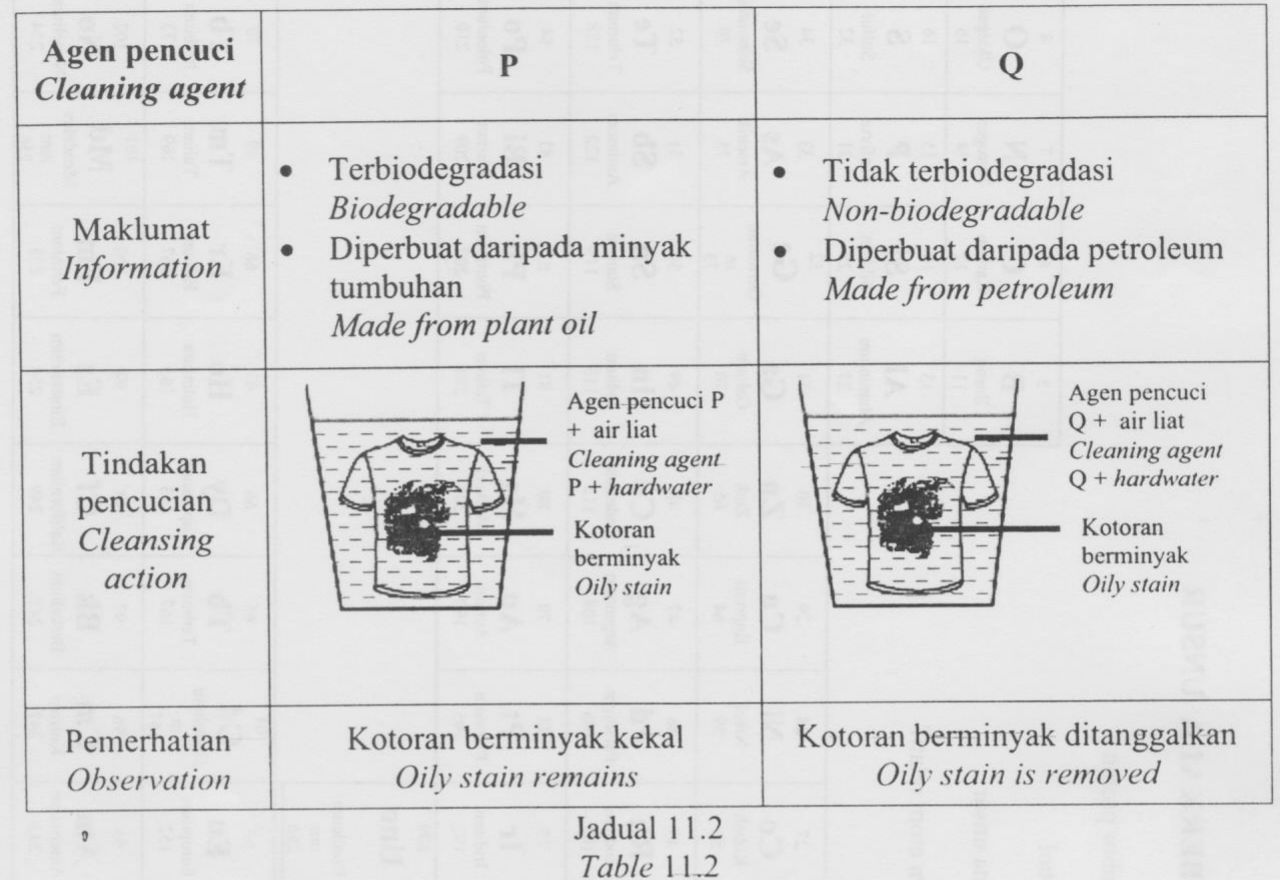
(a) Moisturizer is an example of cosmetics. Puan Siti wants to buy moisturizer at a supermarket even though she has produced her own moisturizer at home using aloe vera. Table 11.1 shows the information between moisturizer at supermarket (ingredients: coconut oil, mercury, potassium carbonate) and homemade moisturizer (ingredients: 100% aloe vera gel). (b) Diagram 11 shows the structure of fatty acid X (an unsaturated fatty acid with one C=C double bond, carboxylic acid group at one end). (c) Soap can be produced from the reaction between oil and alkali. (d) Table 11.2 shows the cleansing action on cloth by using two different cleaning agent: P (biodegradable, made from plant oil; oily stain remains in hard water) and Q (non-biodegradable, made from petroleum; oily stain is removed in hard water).
Medium20 marks- (a)(i)
What does it mean by cosmetics and what type of cosmetics used in moisturizer?
[2]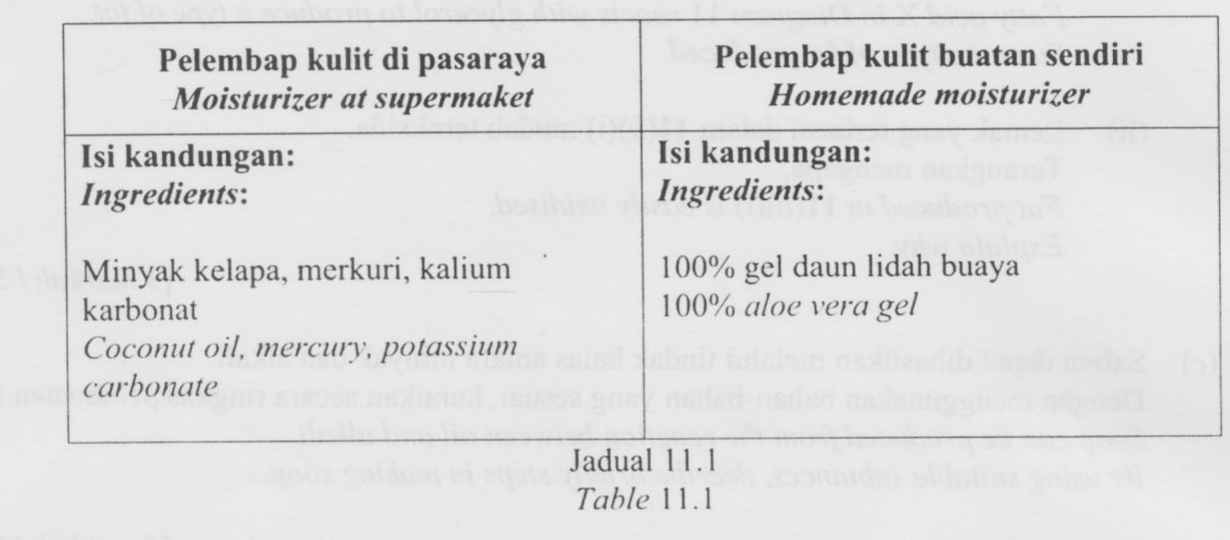
- (a)(ii)
Which moisturizer is safe to be used by Puan Siti? Explain your answer.
[5] - (b)(i)
Fatty acid X in Diagram 11 reacts with glycerol to produce a type of fat. State the type of fat produced.
[1]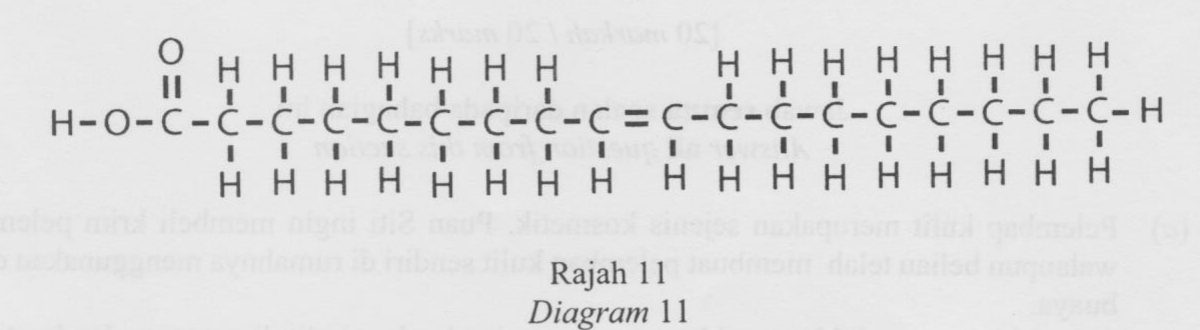
- (b)(ii)
Fat produced in 11(b)(i) is easily oxidised. Explain why.
[2] - (c)
Soap can be produced from the reaction between oil and alkali. By using suitable substances, describe briefly steps in making soap.
[5] - (d)
Based on Table 11.2, which cleaning agent is effective in hard water? Explain your answer.
[5]