Which of the following is correct? (Scientist – Discovered)
Easy
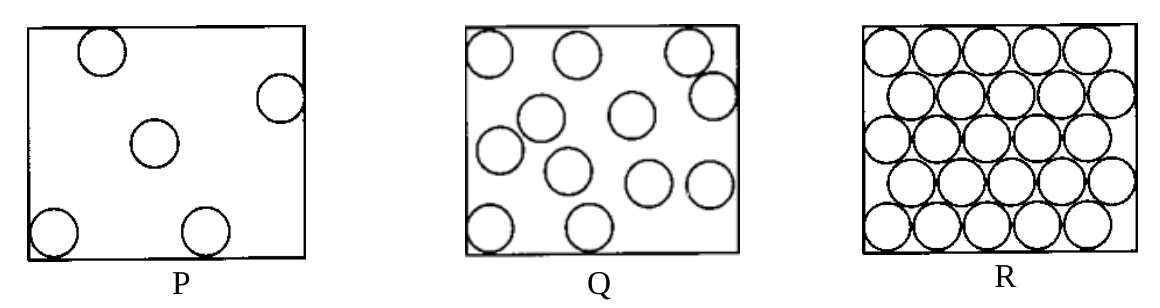
Diagram 1 shows the arrangement of particles in three states of matter at room temperature. What are substances P, Q and R at room temperature? (P: particles far apart; Q: particles randomly arranged, close; R: particles closely packed in order)
Medium
Which of the following are symbols for the elements of chromium, manganese and potassium?
Easy
Elements in the Periodic Table are arranged according to an increase in
Easy
Which compound is formed by transferring electrons?
Easy
Which compound is correctly matched with its type of bonds? (Substance – Type of bonds)
Medium
Which of the following is correct about weak acid solution?
Easy
Which acid contains the highest number of hydrogen ions?
Medium
Which of the following is a soluble salt?
Medium
A catalyst increases the rate of reaction because it increases
Medium
Which pair is correctly matched? (Cosmetic – Example)
Medium
Which of the following shows the arrangement of the atoms in an alloy?
Easy
Which of the following happens to a substance that undergoes a reduction reaction?
Medium
Petroleum consists of hydrocarbons. How are these hydrocarbons separated?
Easy
Which substance is a natural polymer?
Easy
Which of the following is correct for an endothermic reaction?
Easy
Y⁺ ion has 12 neutrons and 10 electrons. Which of the following is the proton number and nucleon number for atom Y? (Proton number – Nucleon number)
Medium
Diagram 2 shows the structural formulae of two monomers, A (a diamine) and B (a dicarboxylic acid). Monomers A and B undergo a condensation polymerisation reaction to produce a polymer. What is the by-product produced besides the polymer?
Medium
The following chemical equation represents the reaction of ethane with chlorine gas: CH₄(g) + Cl₂(g) → CH₃Cl(g) + HCl(g). What is the name of the reaction?
Medium
Which of the following is the similarity between ethene and alcohol?
Medium
What is the period for an element with proton number of 20?
Medium
Table 1 shows elements with their respective proton number: W = 7, X = 9, Y = 17, Z = 19. Which pair of elements has the same chemical properties?
Medium
A child spilled curry gravy on his shirt. The stain was very hard to remove after being washed with a type of detergent. Which additive should be added into a new detergent to make sure the stain can be removed?
Medium
Solution X formed green precipitate when added with sodium carbonate solution but blue solution formed when added with potassium sulphate solution. What is solution X?
Medium
Which particles combine to form a dative bond? I Chloride ion; II Hydrogen ion; III Water molecule; IV Ammonia molecule
Medium
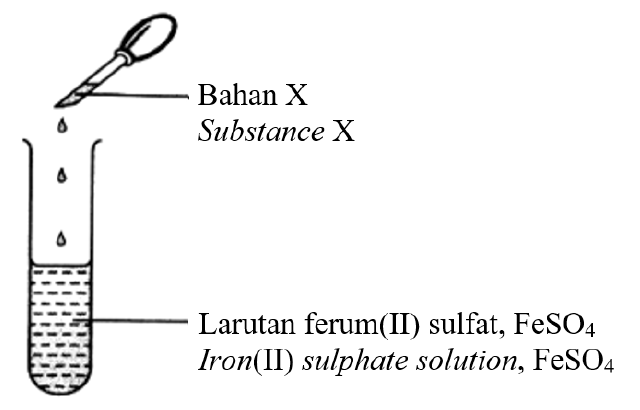
Diagram 3 shows an apparatus set-up of an experiment to study the conversion of iron(II) ion, Fe²⁺ to iron(III) ion, Fe³⁺. Substance X is added drop by drop into iron(II) sulphate solution, FeSO₄. Which substance can be used as substance X?
Medium
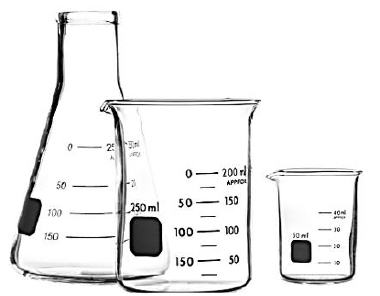
Diagram 4 shows items made from a type of glass (conical flask and beakers). What is the type of glass used in making the items?
Easy
In order to produce a glass that is more resistant to heat and chemicals, substance X is added to soda lime glass in the manufacturing process. What is X?
Easy
Diagram 5 shows the structure of a polymer. Which of the following is the monomer of the polymer?
Medium
Diagram 6 shows a type of plant that can be found around the housing area (an aloe vera plant in a pot). What is the function of the plant as a traditional medicine?
Easy
An experiment to determine the heat change for combustion of propanol, C₃H₇OH: volume of water in copper container 300 cm³; initial temperature 27.5 °C; highest temperature 68.5 °C. What is the heat released by the combustion of propanol? [Specific heat capacity of water = 4.2 J g⁻¹ °C⁻¹, water density = 1 g cm⁻³]
Medium
The equation CuO + H₂SO₄ → CuSO₄ + H₂O represents the reaction between 100 cm³ of 1.0 mol dm⁻³ sulphuric acid and 10 g copper(II) oxide. What is the mass of copper(II) oxide that remains unreacted? [Relative atomic mass: Cu = 64, O = 16]
Medium
9.75 g of element X reacts with 63.5 g of element Y to form a compound. What is the empirical formula of the compound formed? [Relative atomic mass: X = 39; Y = 127]
Medium
The standard electrode potential, E° for half-cell equations: Zn²⁺(aq) + 2e ⇌ Zn(s) E° = –0.76 V; Fe³⁺(aq) + e ⇌ Fe²⁺(aq) E° = +0.77 V. What can be deduced from the given information?
Medium
The equation CaCO₃ + 2HCl → CaCl₂ + CO₂ + H₂O represents the reaction between 50 cm³ of 1.0 mol dm⁻³ hydrochloric acid with calcium carbonate chips. What is the number of carbon dioxide molecules released? [Avogadro constant: 6.02 × 10²³ mol⁻¹]
Medium
During the MCO, Ahmad needed to drink a Barium meal (made of barium sulphate salt) before an abdominal X-ray. Which of the following solutions are suitable to verify the presence of anion in that salt? I Hydrochloric acid; II Sulphuric acid; III Barium chloride solution; IV Sodium sulphate solution
Medium
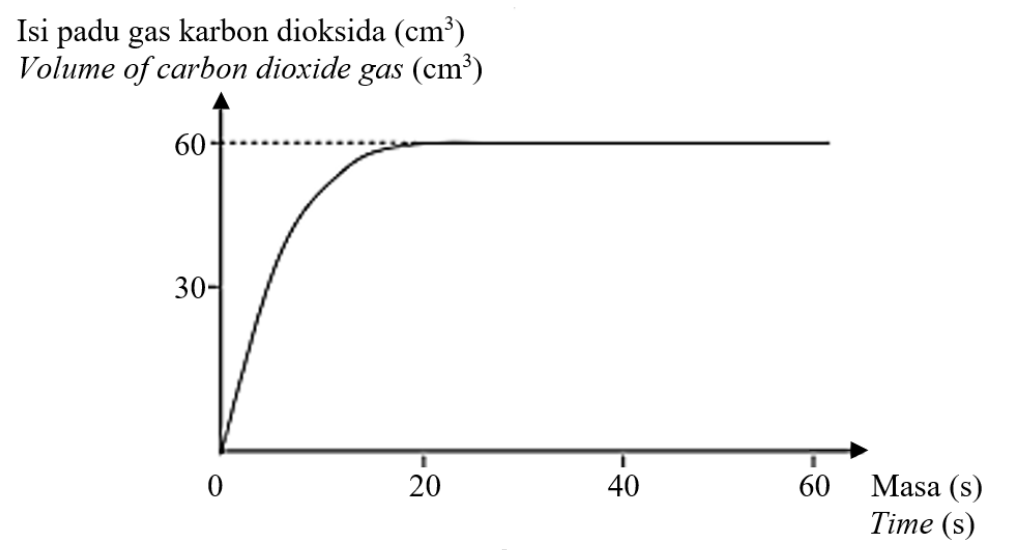
Diagram 7 shows a graph of the volume of gas released against time for the reaction between hydrochloric acid with excess marble chips. What is the average rate of the reaction?
Medium
20 cm³ of 0.5 mol dm⁻³ metal X hydroxide solution reacts completely with 20 cm³ of 1.0 mol dm⁻³ nitric acid. What is the formula of metal X nitrate salt produced?
Medium
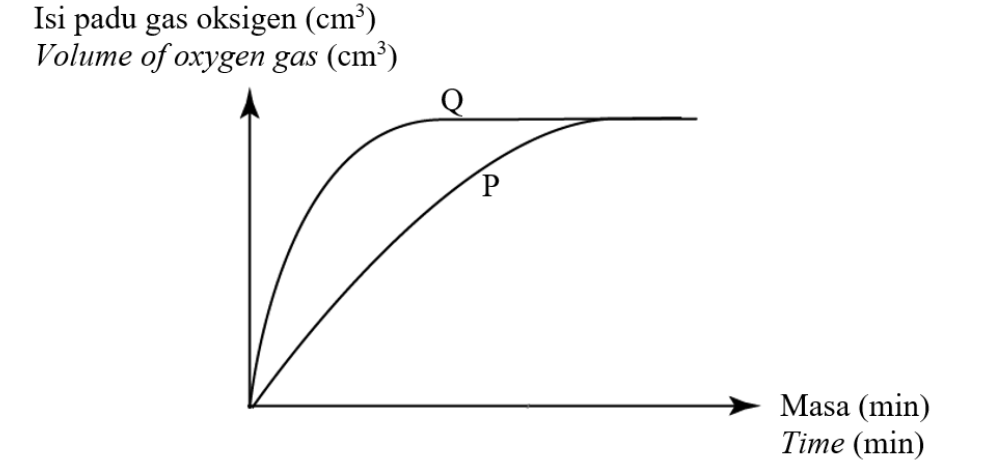
Diagram 8 shows curves P and Q for decomposition of hydrogen peroxide solution in the presence of a catalyst (Q is steeper, same final volume). Curve P: 50 cm³ of 1.0 mol dm⁻³ hydrogen peroxide at 21 °C. Which of the following would obtain curve Q? (Volume – Concentration – Temperature)
Medium
Salt X is heated: Salt X → Oxide J + Gas K + Gas L. Oxide J is black when hot and cold; brown gas K is released; colourless gas L ignites a glowing wooden splinter. Which of the following is true about the test?