Write your answer on paper. Then open the answer to check it.
Section A
Protium, deuterium and tritium are isotopes of the hydrogen element. Diagram 1 shows the atomic structure for these three atoms of hydrogen (protium: 1 proton, 1 electron; deuterium: 1 proton, 1 neutron, 1 electron; tritium: 1 proton, 2 neutrons, 1 electron).
Medium5 marks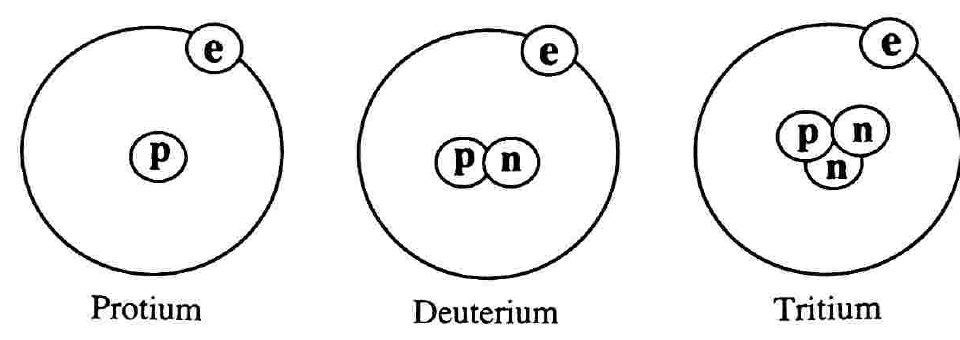
- (a)
What is the meaning of isotopes?
[1] - (b)
State the name of all subatomic particles inside the nucleus.
[1] - (c)
Name subatomic particle that is negatively charged.
[1] - (d)
Do the three hydrogen atoms in Diagram 1 have the same chemical properties? Explain your answer.
[2]
Diagram 2 shows the electron arrangement of gas A (one nitrogen atom sharing electron pairs with three hydrogen atoms).
Medium5 marks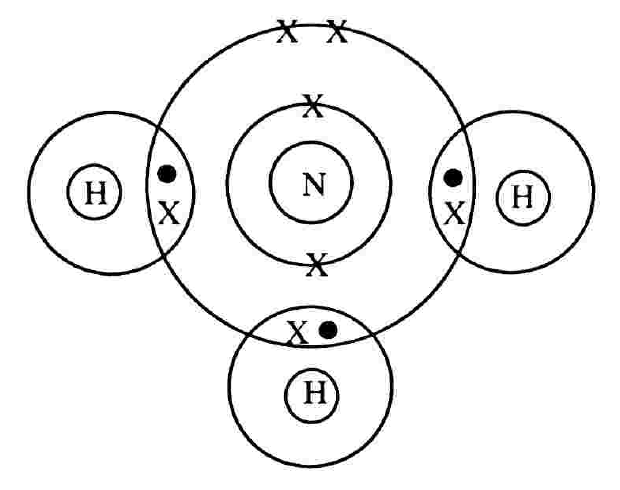
- (a)
State the type of particles in gas A.
[1] - (b)
What is the purpose of chemical bond formation?
[1] - (c)(i)
Based on Diagram 2, state the type of chemical bond in gas A.
[1] - (c)(ii)
Based on Diagram 2, explain how the chemical bond is formed.
[2]
Diagram 3 shows the symbol of the atom of element X: relative atomic mass 35.5, proton number 17. The letter used is not the actual symbol of the element.
Medium6 marks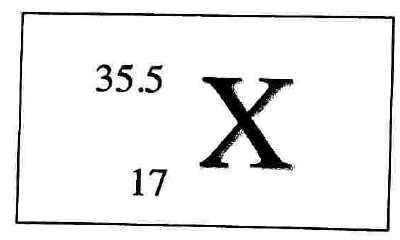
- (a)
What is represented by the number 17 in Diagram 3?
[1] - (b)
State the period of element X in the Periodic Table of Elements.
[1] - (c)(i)
X reacts with hot iron wool to form a brown solid. Write the chemical equation for the reaction occurs.
[2] - (c)(ii)
Calculate the mass of the brown solid formed when 0.3 mol X reacts with hot iron wool. [Relative atomic mass: Fe = 56, X = 35.5]
[2]
Diagram 4 shows the apparatus set-up of an experiment to determine the empirical formula for oxide of copper (hydrogen gas from zinc granules and hydrochloric acid passes over heated copper oxide powder in a glass tube; water in the other test tube; ethanol burner on a wooden block). Table 4 shows the results obtained by a student: mass of glass tube 9.25 g; mass of glass tube + oxide of copper 9.35 g; mass of glass tube + copper 9.33 g.
Medium7 marks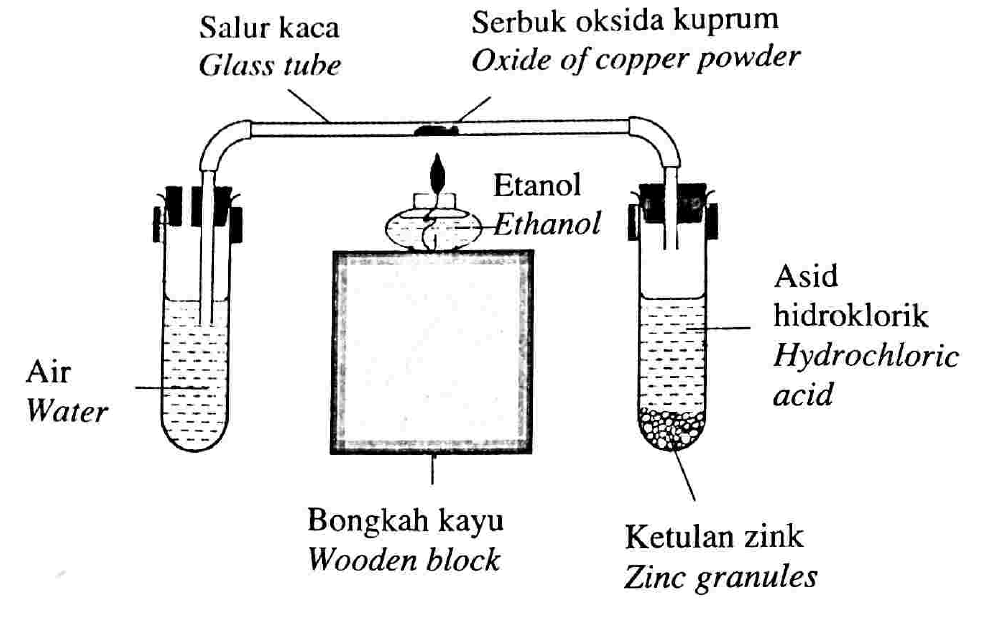
- (a)
What is the meaning of empirical formula?
[1] - (b)
What is the role of zinc granules and hydrochloric acid in this experiment?
[1] - (c)
Name another oxide of metal which the empirical formula can be determined by using the same method as shown in Diagram 4.
[1] - (d)(i)
Based on Table 4, calculate the mass of copper and oxygen.
[1]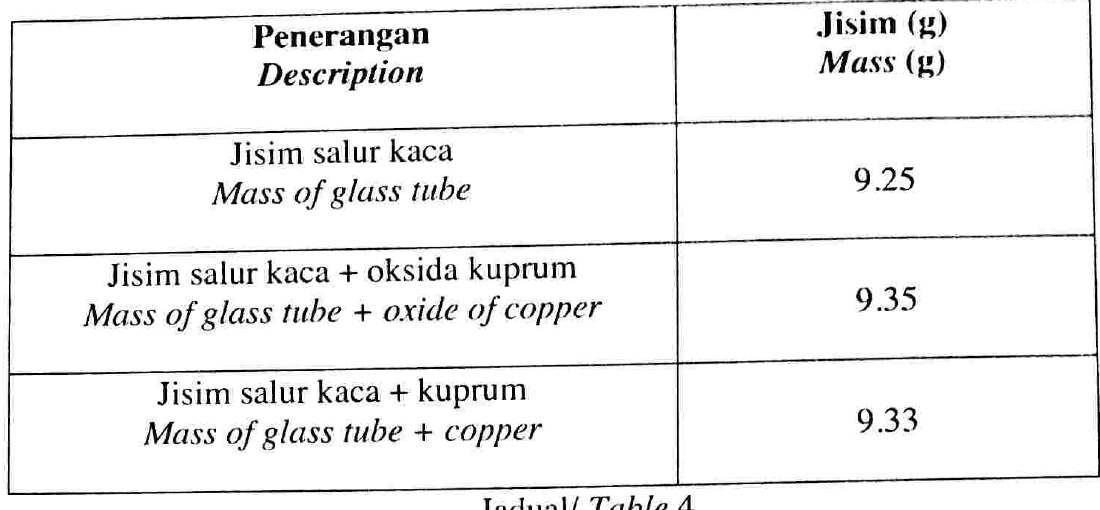
- (d)(ii)
Calculate the number of moles of copper atom and oxygen atom and then determine the empirical formula for the oxide of copper. [Relative atomic mass: Cu = 64, O = 16]
[3]
Table 5 shows sodium hydroxide solutions with different concentrations: solution R 0.100 mol dm⁻³, pH value blank; solution S 0.001 mol dm⁻³, pH 11.0.
Medium8 marks- (a)
What is pH?
[1]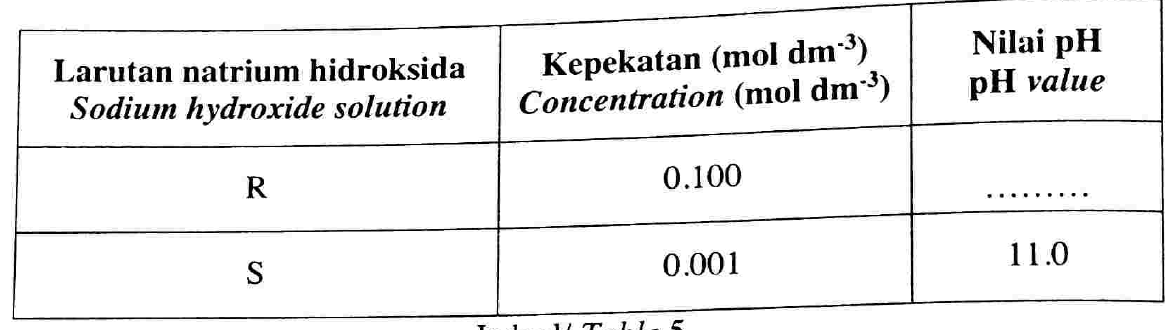
- (b)
Calculate the pH value for solution R.
[2] - (c)(i)
Compare the pH values of R and S solutions.
[1] - (c)(ii)
Explain your answer in 5(c)(i).
[2] - (d)
Diagram 5 shows the heating of solid T (white solid T, on heating, gives a solid that is yellow when hot and white when cold, plus a colourless gas that turns limewater cloudy). Write a chemical equation for the heating of solid T.
[2]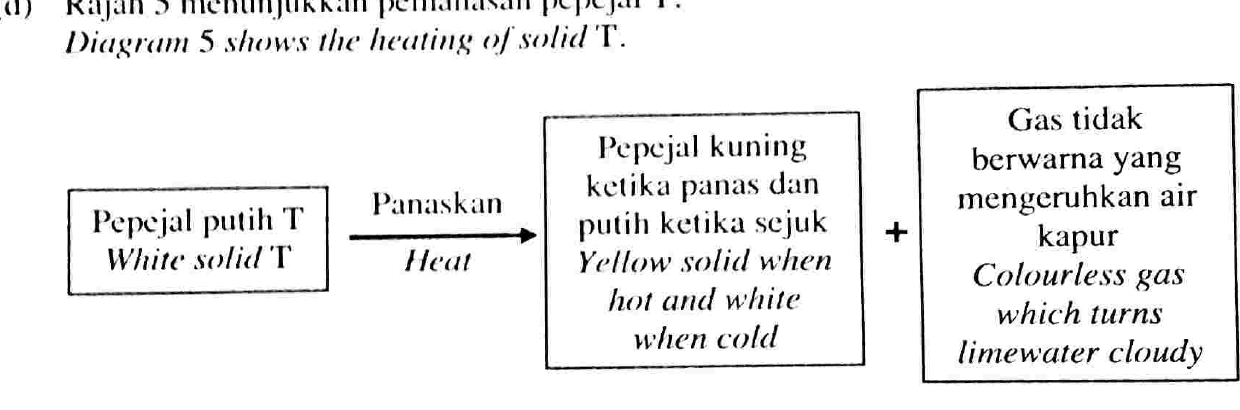
Diagram 6 shows a series of reactions involving compound P, C2H5OH: glucose undergoes reaction I with yeast to form compound P; compound P is oxidised with K2Cr2O7/H+ to form compound S; compound P undergoes dehydration to form gas R.
Medium9 marks- (a)(i)
State the name of reaction I.
[1]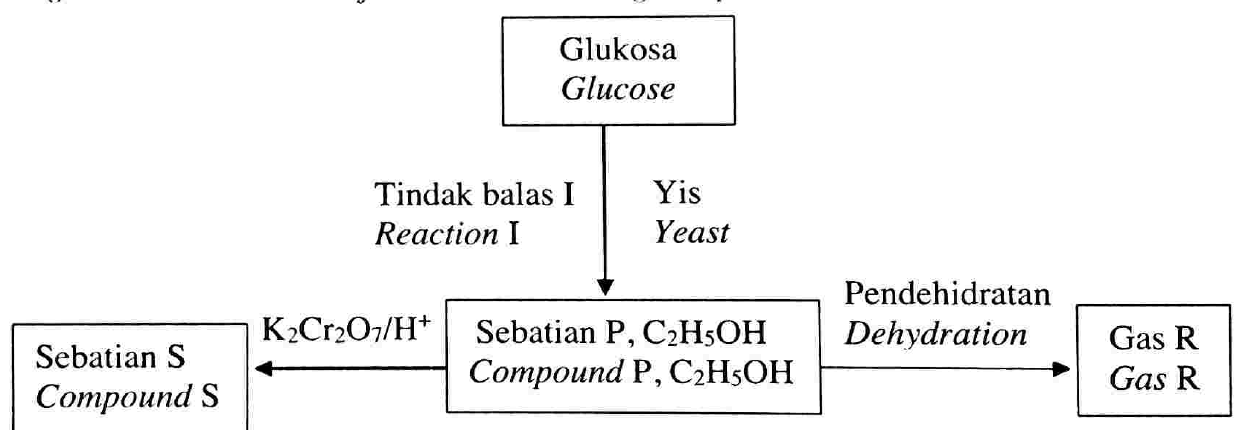
- (a)(ii)
State the name of compound P, C₂H₅OH.
[1] - (b)
Write a chemical equation for complete combustion of compound P.
[2] - (c)(i)
Based on Diagram 6, choose two substances that can react to produce a compound with sweet smell.
[1] - (c)(ii)
Draw the structural formula for the compound formed.
[1] - (d)
Table 6 shows the observations when gas R and ethane gas are delivered into two test tubes filled with bromine water separately: gas R, brown colour of bromine water turns colourless; ethane, brown colour of bromine water unchanged. Explain the differences in the observation in Table 6.
[3]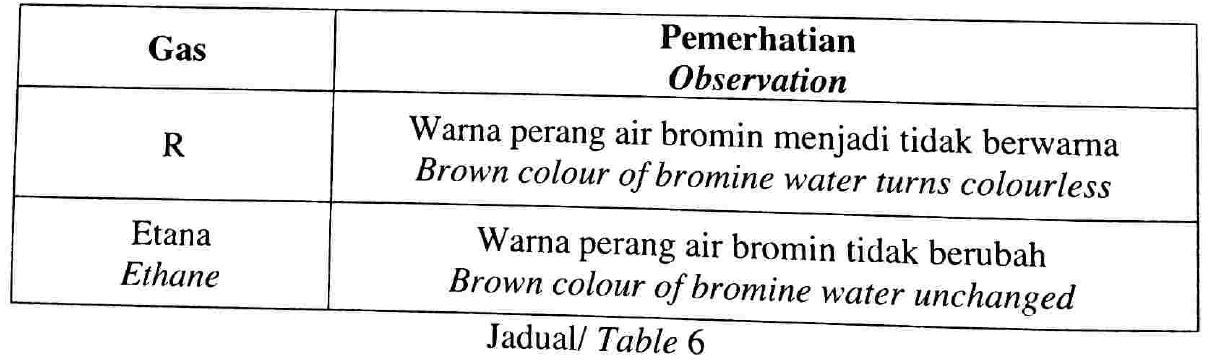
Diagram 7 shows an energy level diagram for a precipitation reaction: NaCl + AgNO3 at a higher level, AgCl + NaNO3 at a lower level, ΔH = −65.5 kJ mol⁻¹.
Hard10 marks- (a)
State the meaning of heat of precipitation.
[1]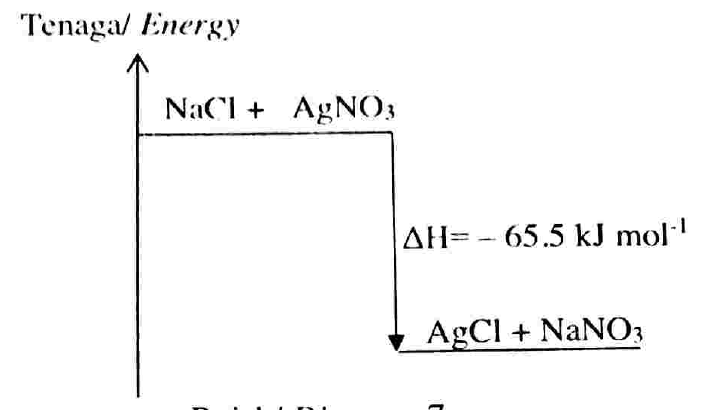
- (b)
State the colour of the precipitate formed.
[1] - (c)
Calculate the temperature change when 25 cm³ of 0.5 mol dm⁻³ silver nitrate solution reacts with 25 cm³ of 0.5 mol dm⁻³ sodium chloride solution. [Specific heat capacity of solution = 4.2 J g⁻¹ °C⁻¹, Density of solution = 1 g cm⁻³]
[3] - (d)
The reaction is repeated by using 25 cm³ of 0.5 mol dm⁻³ potassium chloride solution to replace sodium chloride solution. Predict the value of heat of precipitation for the reaction. Explain your answer.
[3] - (e)
Table 7 shows the fuel values of a few types of fuels: ethanol 30 kJ g⁻¹, petrol 34 kJ g⁻¹, natural gas 50 kJ g⁻¹, hydrogen gas 143 kJ g⁻¹. Based on Table 7, which fuel is the most suitable to replace petrol in vehicles? Give reason for your answer.
[2]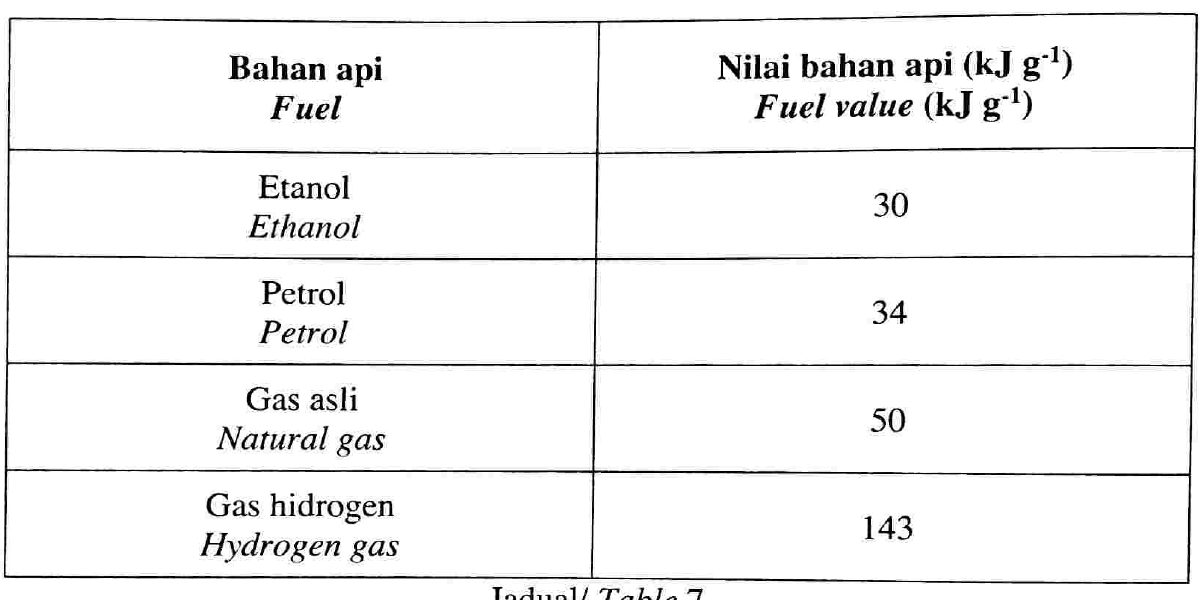
(a) Aurum (gold) is the main element in gold. Table 8 shows information related to two types of gold bar in the market: gold bar A (916) with silver atoms of different size mixed among the gold atoms, and gold bar B (999) with gold atoms only, in orderly arrangement. (b) Diagram 8.1 shows a campaign poster 'Practice Proper Waste Disposal' related to a Green Technology programme in the community. (c) Diagram 8.2 shows a newspaper clipping '14 million tonnes of garbage by 2022' relating to rubbish disposal in Malaysia.
Medium10 marks- (a)(i)
State the meaning of alloy.
[1]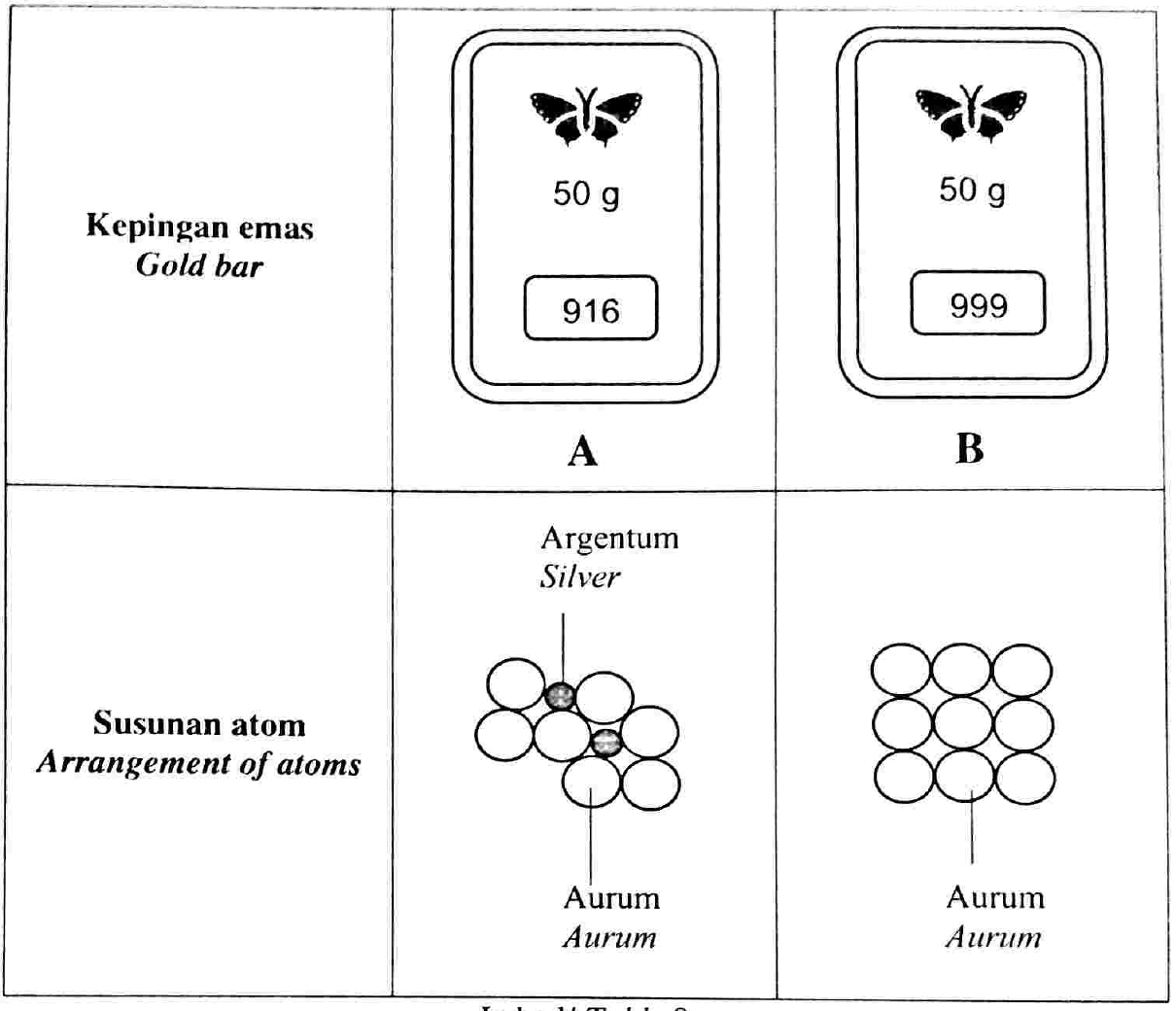
- (a)(ii)
Which gold bar is more suitable to make jewellery?
[1] - (a)(iii)
Based on your answer in 8(a)(ii), compare the two types of gold in terms of the arrangement of atoms to explain your choice.
[2] - (b)
In your opinion, do we need to support the campaign shown in Diagram 8.1? Explain your answer.
[3]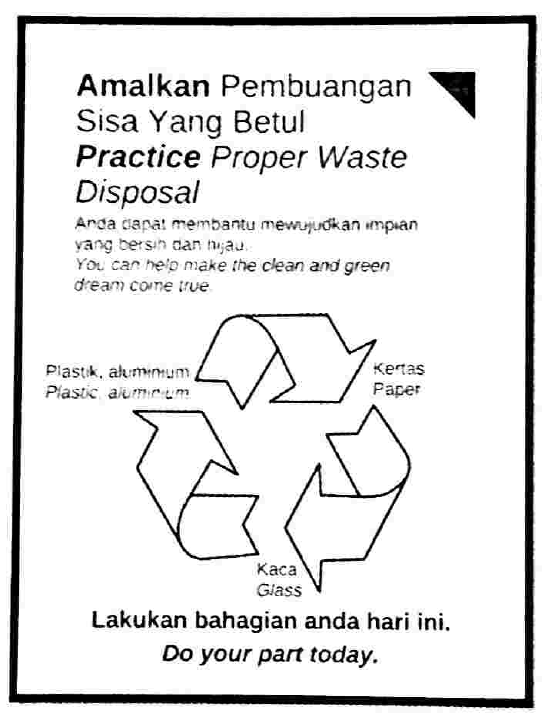
- (c)
Based on the newspaper clipping in Diagram 8.2, suggest two methods involving the application of Green Technology to solve the problem highlighted. Give one advantage for one of the methods suggested.
[3]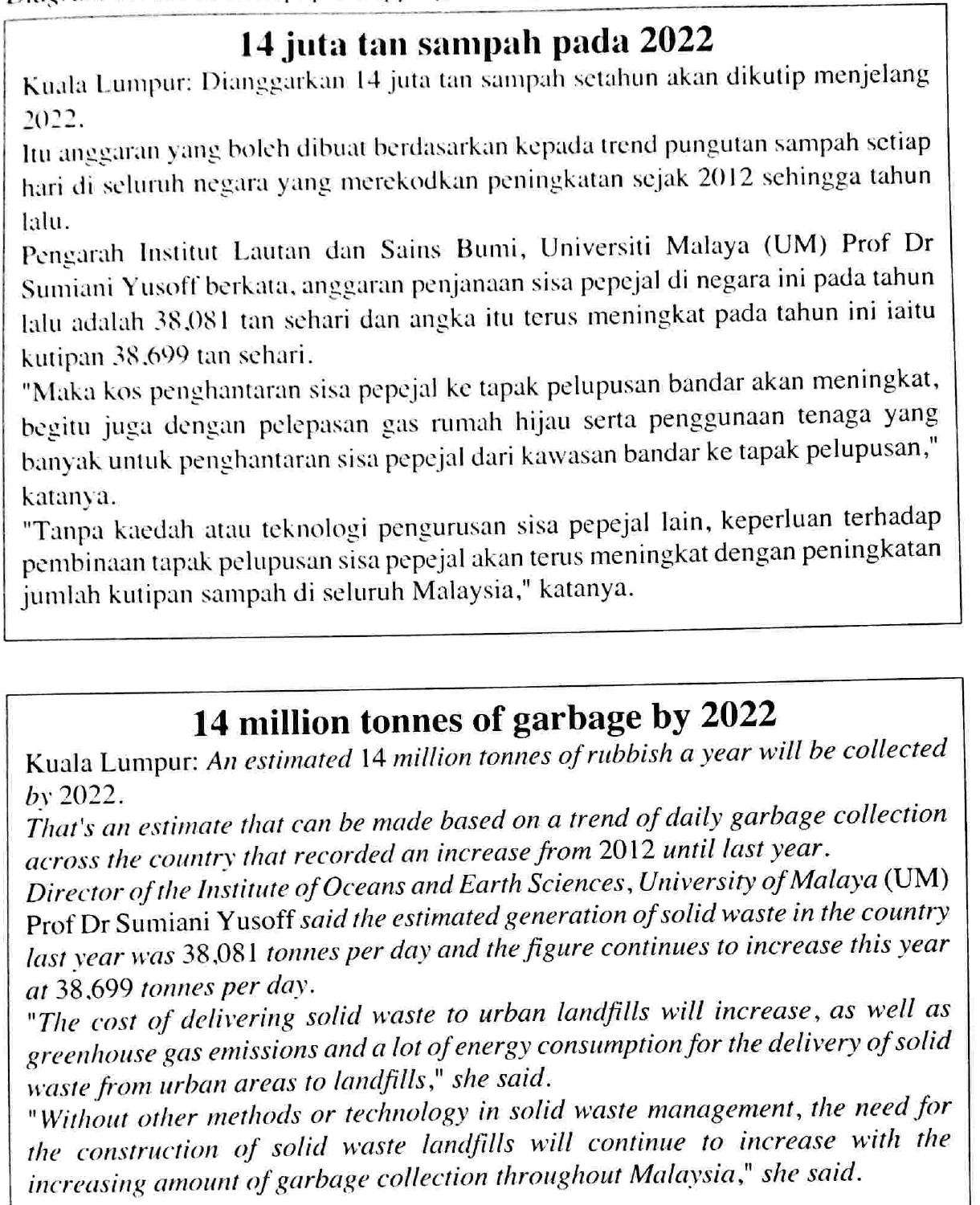
Section B
(a) Diagram 9 shows two water temperature options available on the washing machine in the laundry mart: hot water and cold water. (b) A student carried out three sets of experiment to investigate factors that affect the rate of reaction between magnesium and sulphuric acid. Table 9 shows the time taken to collect 30 cm³ of gas released: Set I, 20 cm³ of 1.0 mol dm⁻³ sulphuric acid, excess magnesium powder, 55 s; Set II, 20 cm³ of 1.0 mol dm⁻³ sulphuric acid, excess magnesium granules, 90 s; Set III, 20 cm³ of 2.0 mol dm⁻³ sulphuric acid, excess magnesium granules, 45 s.
Medium20 marks- (a)(i)
Based on Diagram 9, which water temperature option can clean clothes faster? Explain your answer.
[3]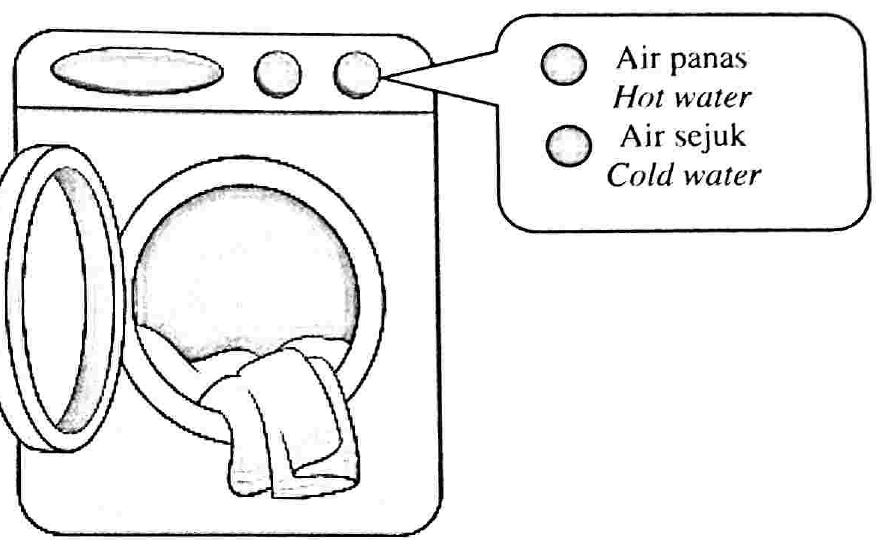
- (a)(ii)
State two factors that can affect the rate of reaction other than temperature.
[2] - (b)(i)
Based on Table 9, write the chemical equation for the reaction in Set III. Calculate the maximum volume of the gas released. [Molar volume at room conditions = 24 dm³ mol⁻¹]
[5]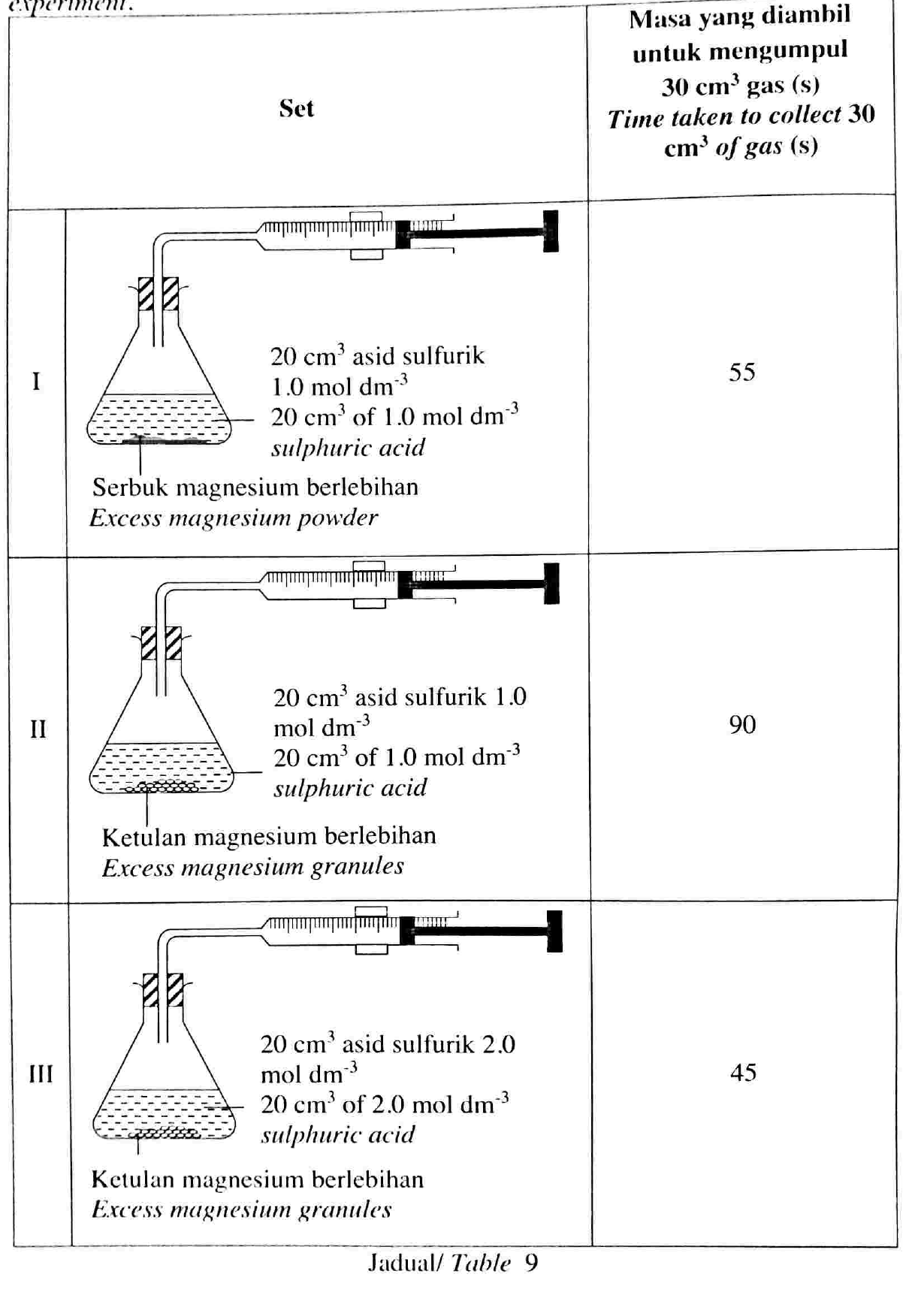
- (b)(ii)
Compare the rate of reaction between: Set I and Set II; Set II and Set III. Explain your answer based on the Collision Theory.
[10]
(a) A rubber tapper intends to collect latex in liquid form. However, he found the liquid latex turns into white solid after being left for a few hours. (b) An experiment investigated the elasticity of vulcanised and unvulcanised rubber (Table 10). (c) Diagram 10 shows the uses of two different polymers: polymer A (to produce threads that are important in textile industry) and polymer B (widely used to make plastic packaging, e.g. bottle and bag).
Medium20 marks- (a)
What should the rubber tapper do to overcome this problem? Explain your answer.
[3] - (b)(i)
Based on Table 10, state the type of rubber X and rubber Y. Compare and explain the differences in average increase in the length of rubber after weight is removed.
[6]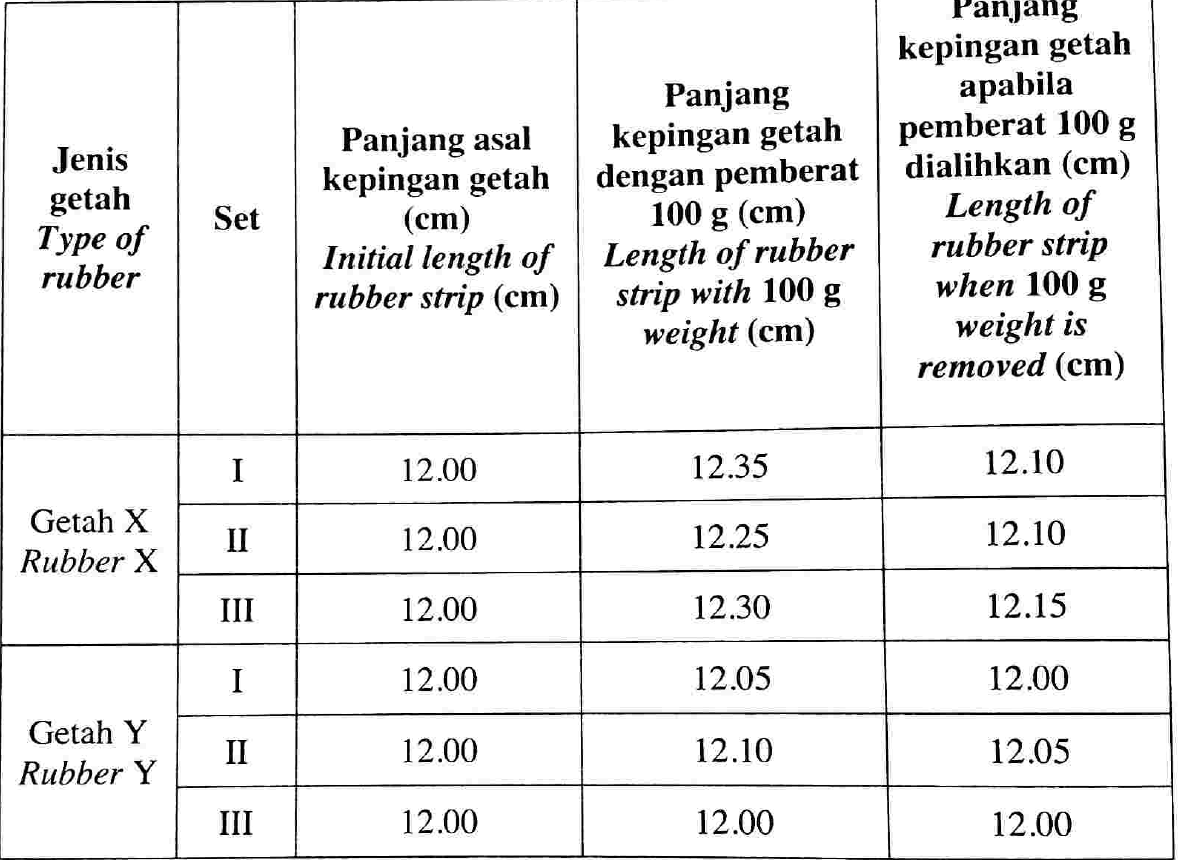
- (b)(ii)
Shoe soles can be made of rubber X and rubber Y. Which rubber is suitable to make shoe soles that can last longer? Give two reasons for your answer.
[3] - (c)(i)
State the meaning of polymer and give one example of natural polymer. Draw the structural formula and name polymer B according to IUPAC nomenclature.
[4]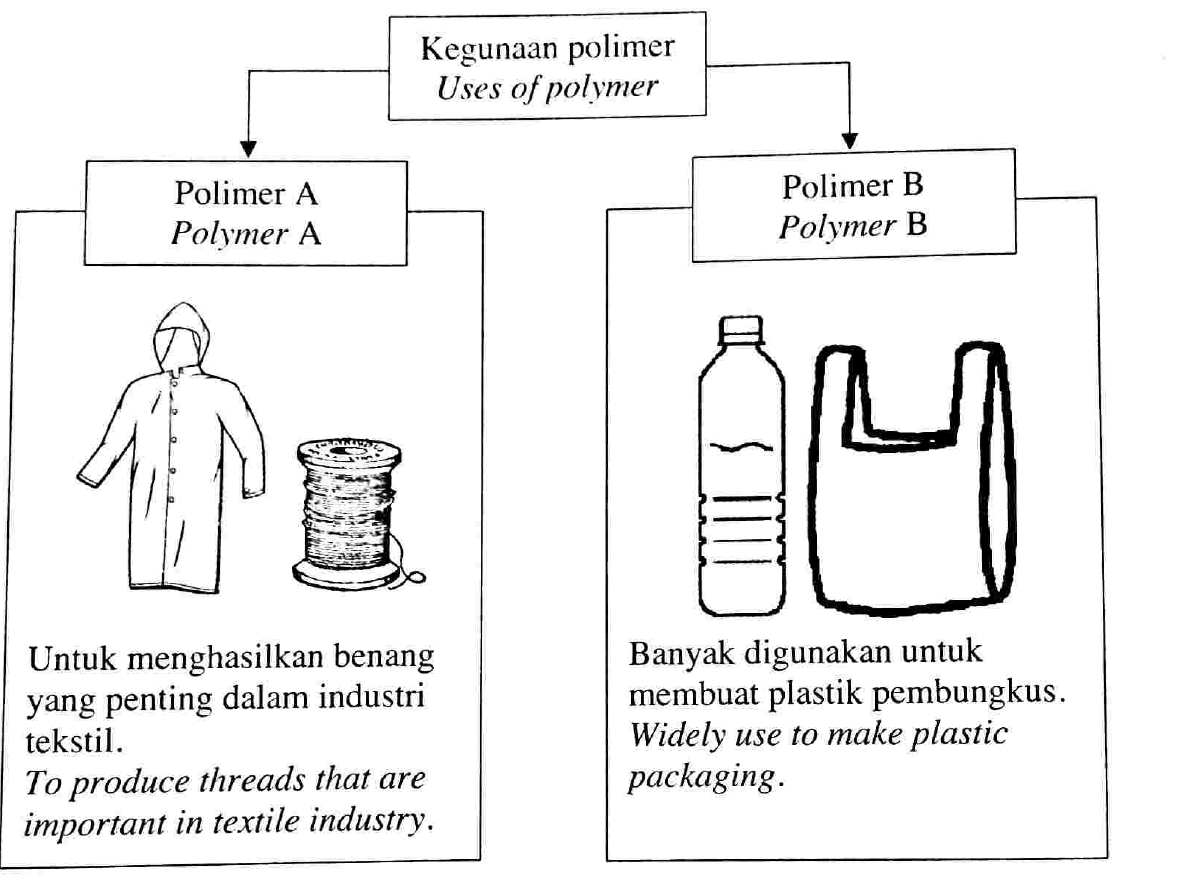
- (c)(ii)
Compare and contrast polymer A and polymer B in terms of types of polymerisation reaction and characteristics of the monomer involved.
[4]
Section C
Diagram 11.1 shows the apparatus set-up for a chemical cell: magnesium in magnesium nitrate solution and silver in silver nitrate solution, joined by a salt bridge and a voltmeter.
Medium20 marks- (a)
What is meant by redox reaction?
[1]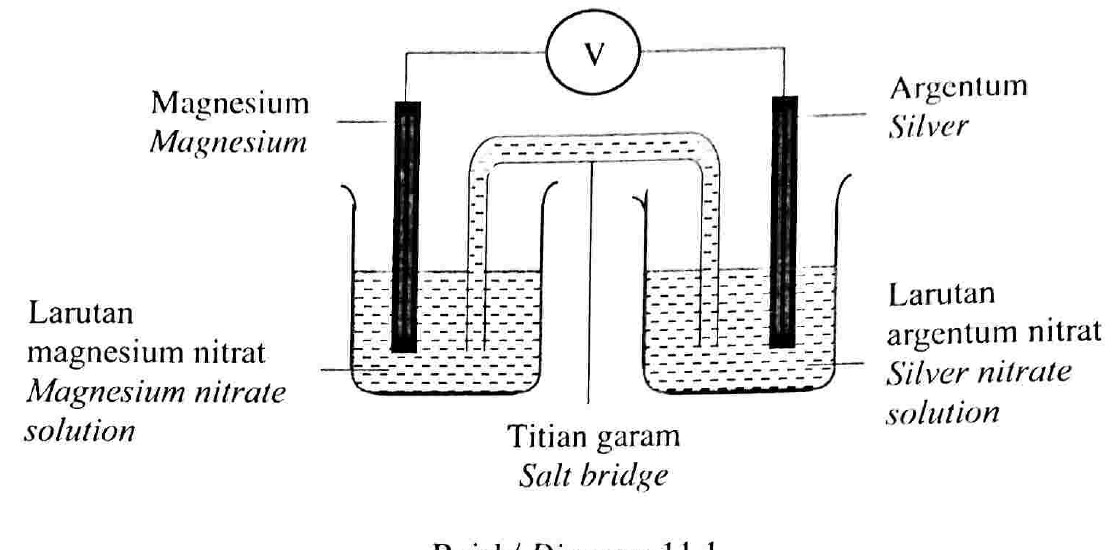
- (b)(i)
Based on Diagram 11.1, identify the negative terminal and positive terminal of the cell.
[2] - (b)(ii)
Write the overall ionic equation for the reaction. [E° values: Mg²⁺(aq) + 2e ⇌ Mg(s), E° = −2.38 V; Ag⁺(aq) + e ⇌ Ag(s), E° = +0.80 V]
[2]
- (b)(iii)
Write the cell notation of the cell.
[2] - (c)
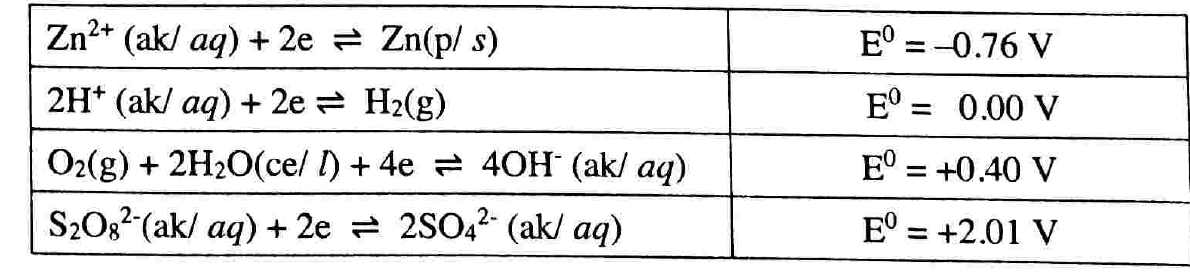
Diagram 11.2 shows the apparatus set-up to purify copper metal: cell P has copper and zinc electrodes in copper(II) sulphate solution; cell Q has impure copper and pure copper in copper(II) sulphate solution; the two cells are connected. Based on Diagram 11.2, compare the observations on the colour of electrolytes in cell P and cell Q after 30 minutes. Explain your answer. [E° values: Zn²⁺ + 2e ⇌ Zn, −0.76 V; 2H⁺ + 2e ⇌ H₂, 0.00 V; O₂ + 2H₂O + 4e ⇌ 4OH⁻, +0.40 V; S₂O₈²⁻ + 2e ⇌ 2SO₄²⁻, +2.01 V]
[5]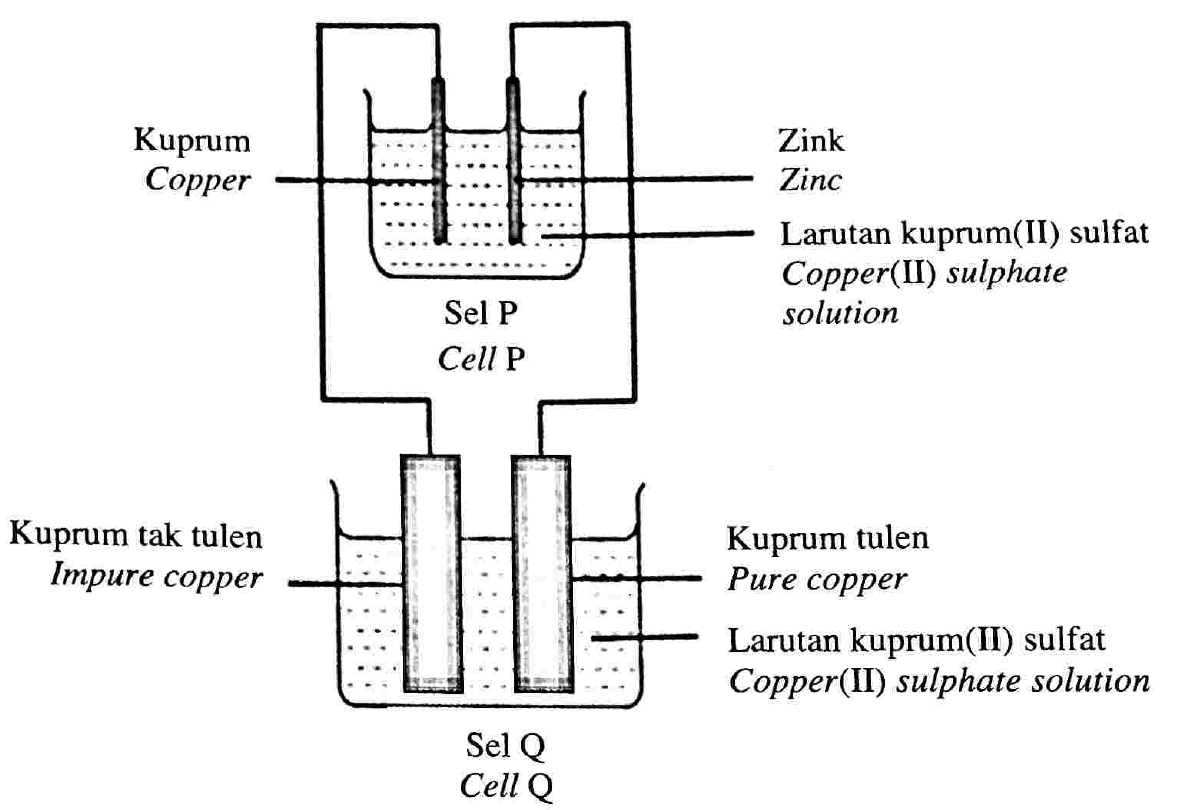
- (d)
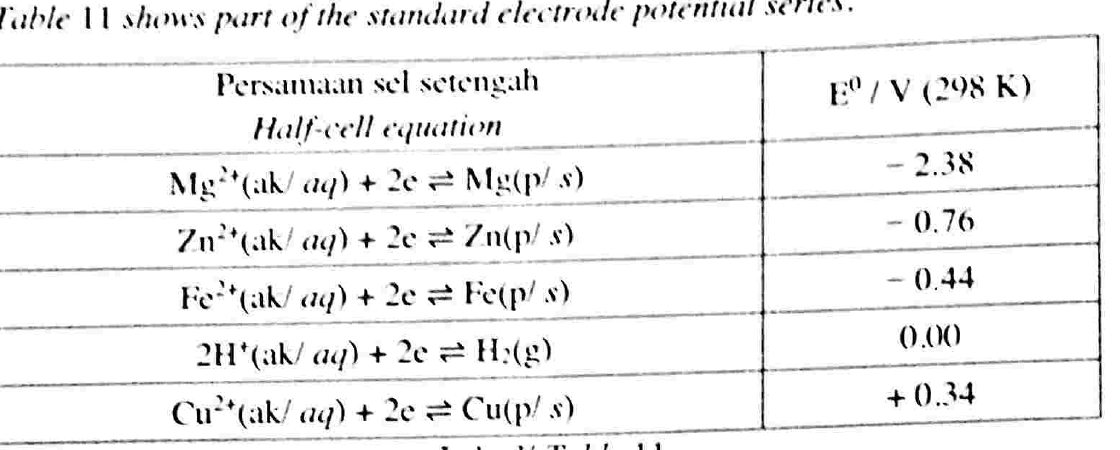
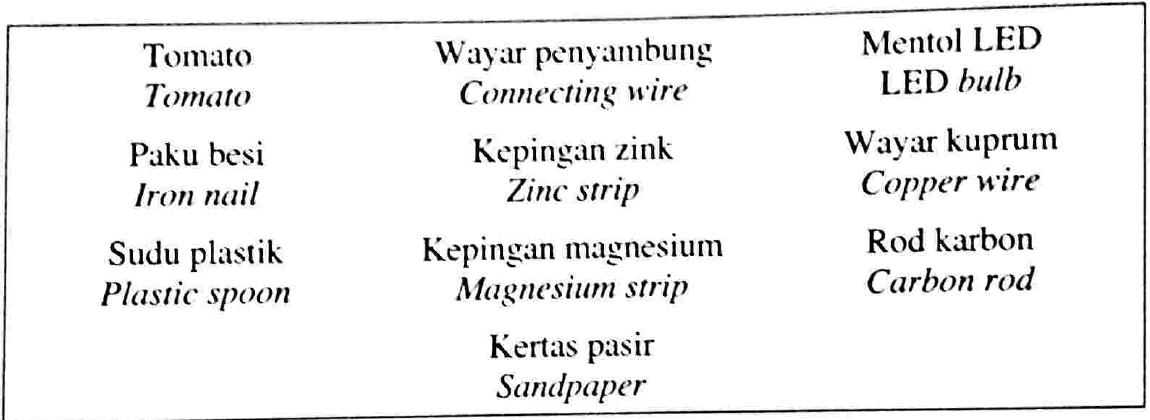
Table 11 shows part of the standard electrode potential series: Mg²⁺/Mg −2.38 V; Zn²⁺/Zn −0.76 V; Fe²⁺/Fe −0.44 V; 2H⁺/H₂ 0.00 V; Cu²⁺/Cu +0.34 V. Diagram 11.3 shows the list of materials and apparatus provided to construct a voltaic cell: tomato, connecting wire, LED bulb, iron nail, zinc strip, copper wire, plastic spoon, magnesium strip, carbon rod, sandpaper. By using your chemistry knowledge, draw the apparatus set-up of a voltaic cell that can light up an LED bulb. The apparatus set-up constructed should use suitable materials and apparatus given in Diagram 11.3. Describe briefly the steps of constructing the voltaic cell and explain the redox reaction that takes place. Then, determine the value of the voltage reading obtained.
[8]