Write your answer on paper. Then open the answer to check it.
Section A
Table 1 shows the number of protons and neutrons of atoms of elements W, X and Y (the letters are not the actual symbols). W: 6 protons, 6 neutrons; X: 6 protons, 8 neutrons; Y: 8 protons, 8 neutrons.
Medium5 marks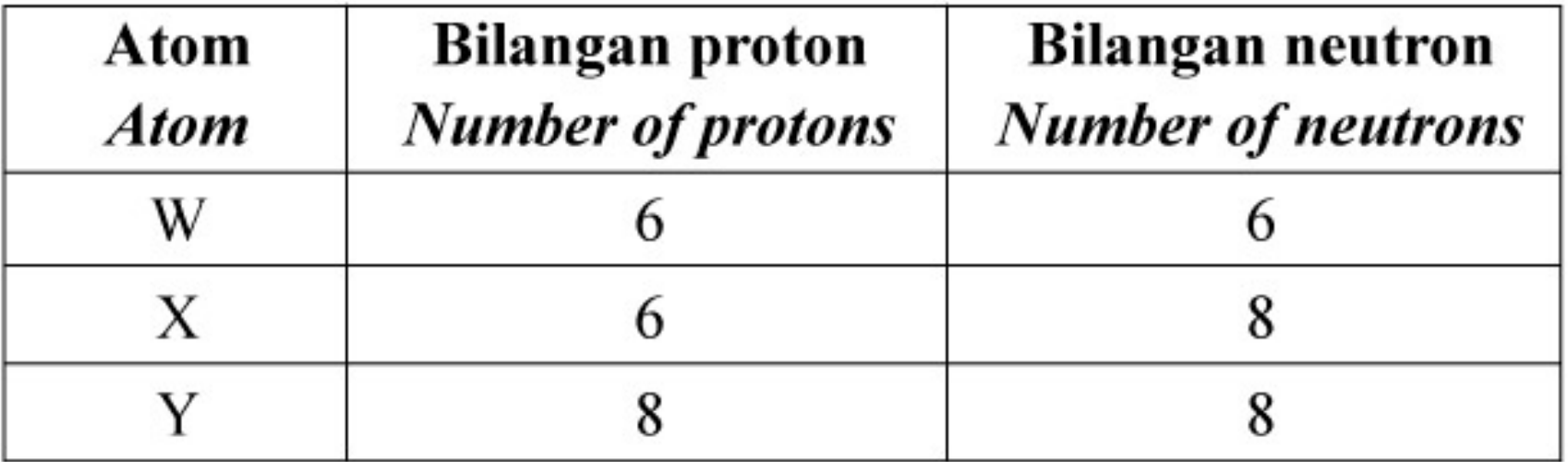
- (a)
State the term for 'the total number of protons and neutrons' in an atom.
[1] - (b)
Write the standard representation of element Y.
[1] - (c)
State a pair of isotopes in Table 1. Explain your answer.
[2] - (d)
Write the electron arrangement for the atom of element X.
[1]
Diagram 2 shows a medal made of bronze.
Medium5 marks- (a)
Name the element added to copper to form bronze.
[1] - (b)
Draw the arrangement of atoms in bronze.
[2] - (c)
Why is bronze more suitable for making medals compared to copper?
[1] - (d)
Name one other alloy of copper.
[1]
Diagram 3 shows the apparatus set-up to determine the empirical formula for oxide of copper (hydrogen gas passed over heated oxide of copper).
Medium6 marks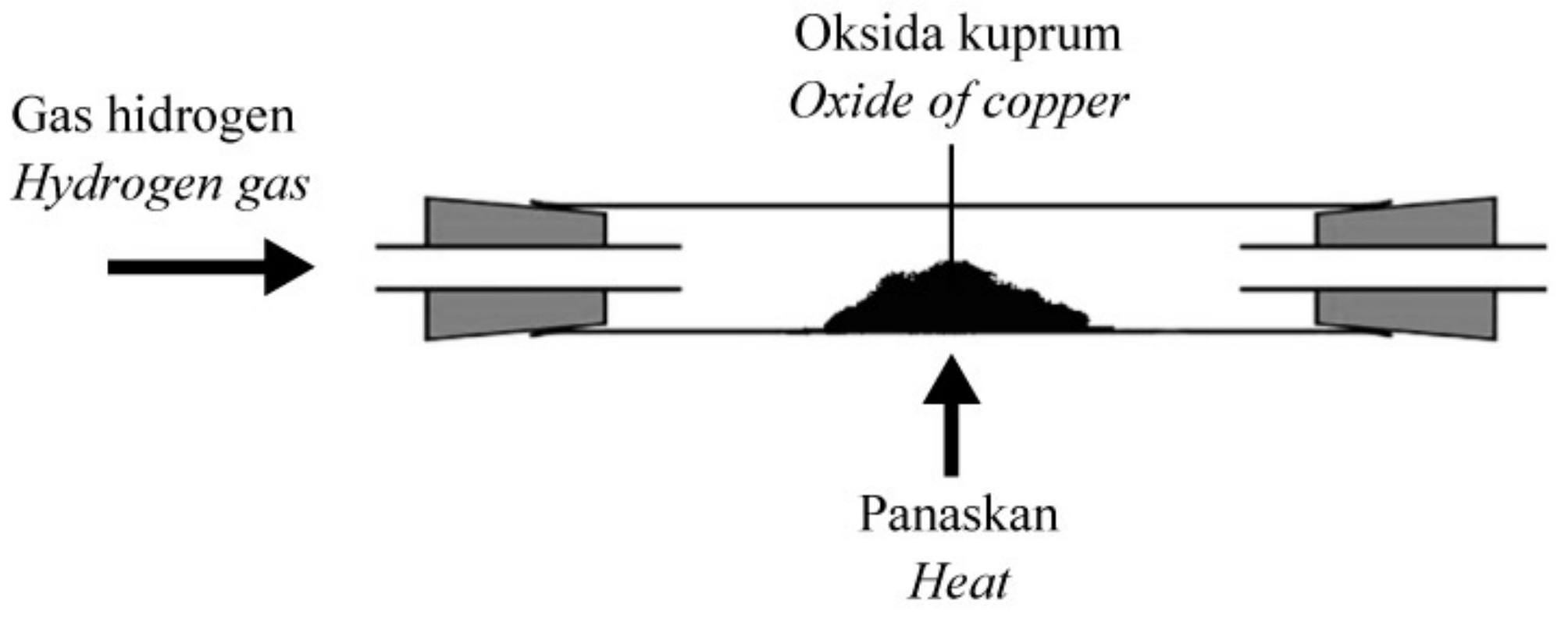
- (a)
What is the meaning of empirical formula?
[1] - (b)
Table 3 shows the results of experiment: mass of combustion tube 135.15 g; mass of combustion tube + oxide of copper 151.15 g; mass of combustion tube + copper 147.95 g. Determine the empirical formula for oxide of copper. [Relative atomic mass: O = 16, Cu = 64]
[4]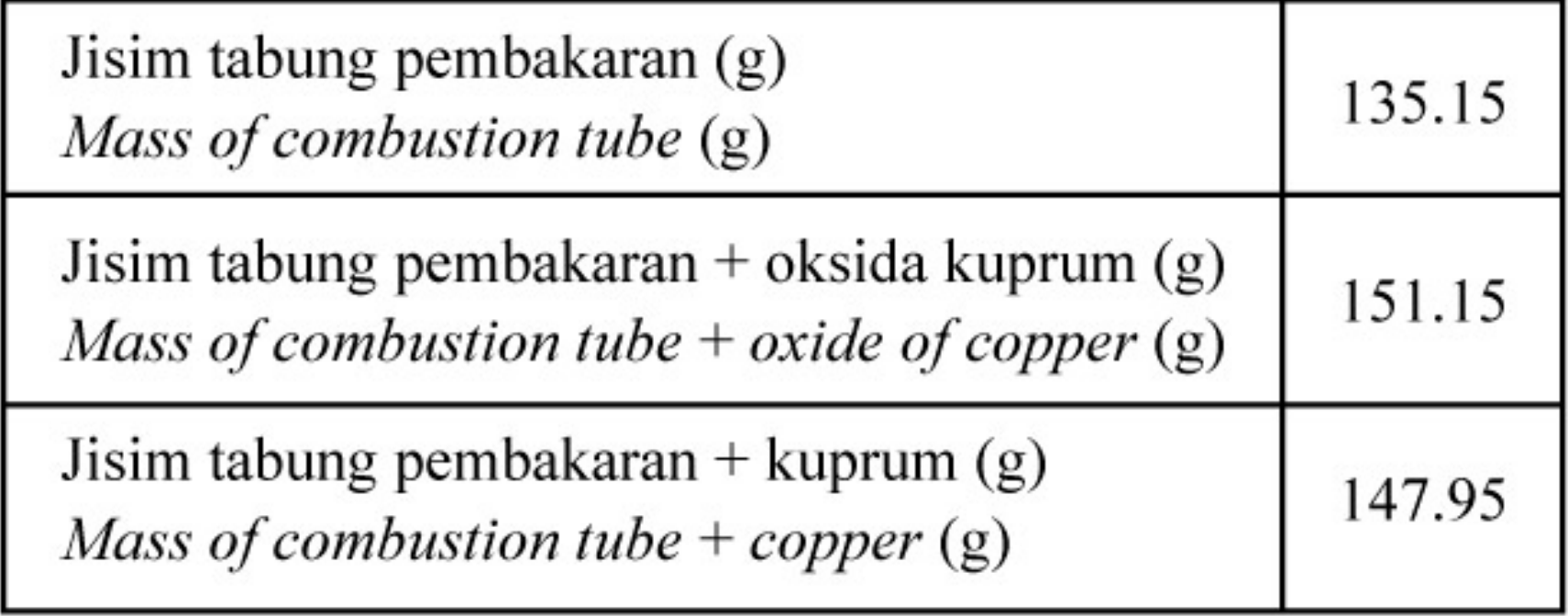
- (c)
The empirical formula of magnesium oxide cannot be determined by using the same method. Explain the statement.
[1]
Diagram 4 shows part of the Periodic Table of Elements. A, B, C, D, E and F are not the actual symbols of the atoms. Use the letters to answer the following questions.
Medium7 marks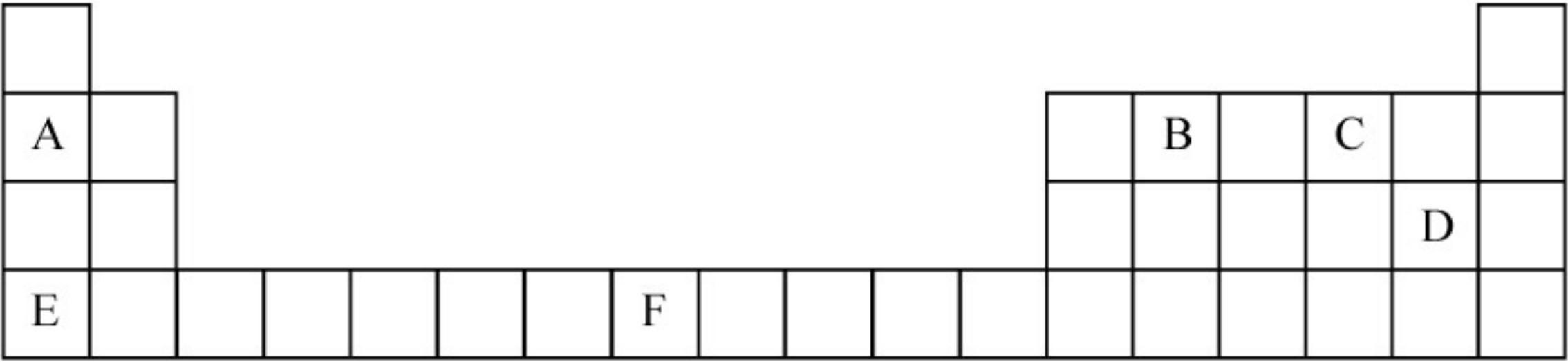
- (a)(i)
Elements A and E can react with gas D to form a white solid. Between elements A and E, which is more reactive when reacting with gas D?
[1] - (a)(ii)
Explain your answer in 4(a)(i).
[2] - (b)(i)
Elements B and C react to form a compound used to extinguish fire. Draw the electron arrangement for the compound formed.
[2] - (b)(ii)
Explain why the compound is suitable used for extinguishing fire involving electrical appliance.
[1] - (c)
Element F is used in the Haber Process to increase the rate of ammonia production. State one other special characteristic of element F.
[1]
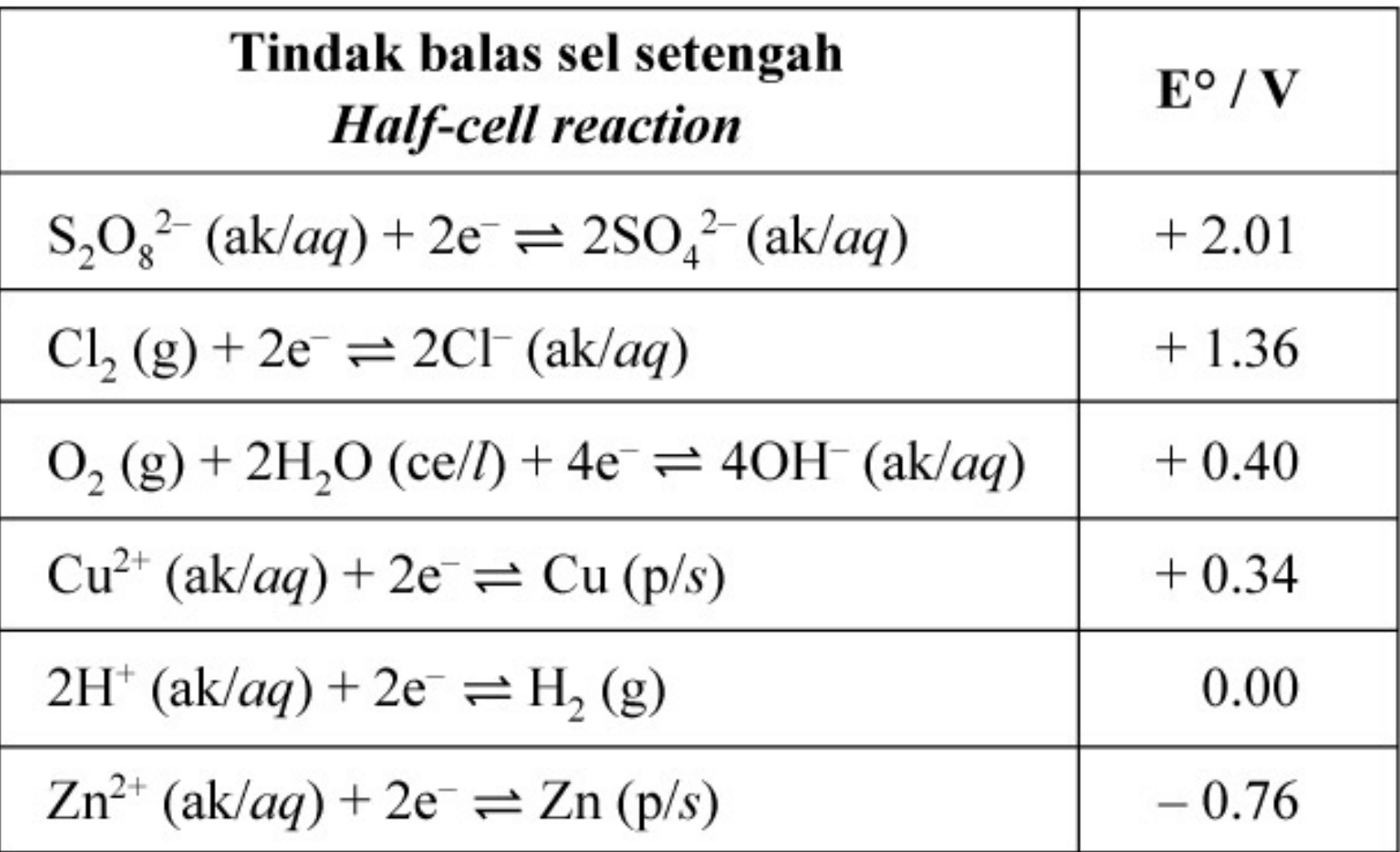
Diagram 5 shows apparatus set-up of Cell A (copper and zinc electrodes in copper(II) sulphate and zinc sulphate solutions separated by a porous pot) and Cell B (carbon electrodes in concentrated copper(II) chloride solution, gas P collected). Standard electrode potentials: S2O8²⁻ + 2e⁻ ⇌ 2SO4²⁻ +2.01 V; Cl2 + 2e⁻ ⇌ 2Cl⁻ +1.36 V; O2 + 2H2O + 4e⁻ ⇌ 4OH⁻ +0.40 V; Cu²⁺ + 2e⁻ ⇌ Cu +0.34 V; 2H⁺ + 2e⁻ ⇌ H2 0.00 V; Zn²⁺ + 2e⁻ ⇌ Zn -0.76 V.
Medium8 marks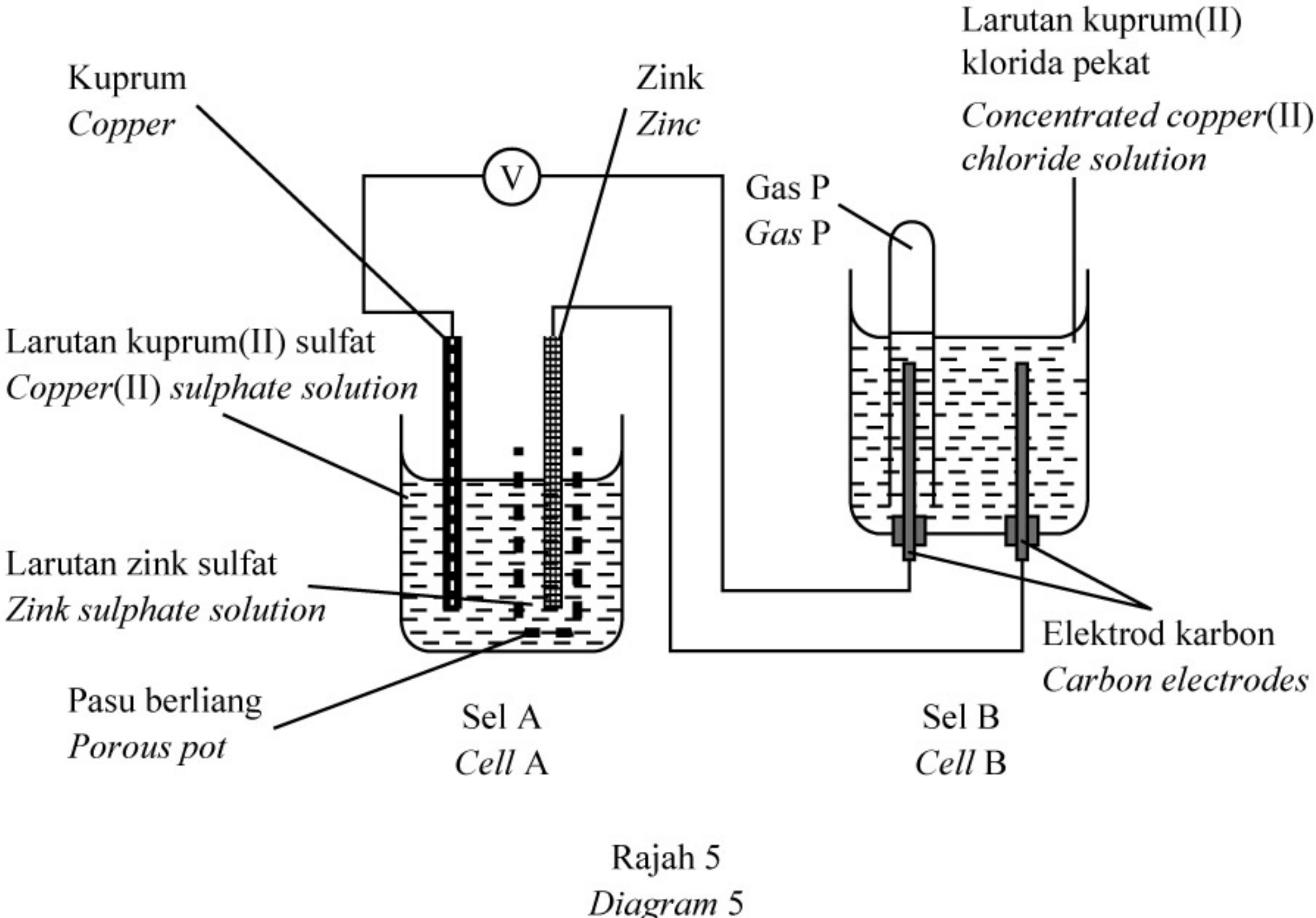
- (a)(i)
Referring to Cell A, state the metal that acts as positive terminal. Explain your answer.
[2] - (a)(ii)
Write the ionic equation for the reaction that occurs in the cell.
[1] - (a)(iii)
Calculate the voltage of cell, E°cell.
[1] - (b)(i)
Referring to Cell B, name the gas P.
[1] - (b)(ii)
Explain how gas P is produced based on the selection of ion to be discharged.
[2] - (b)(iii)
Write the half equation for the reaction at cathode.
[1]
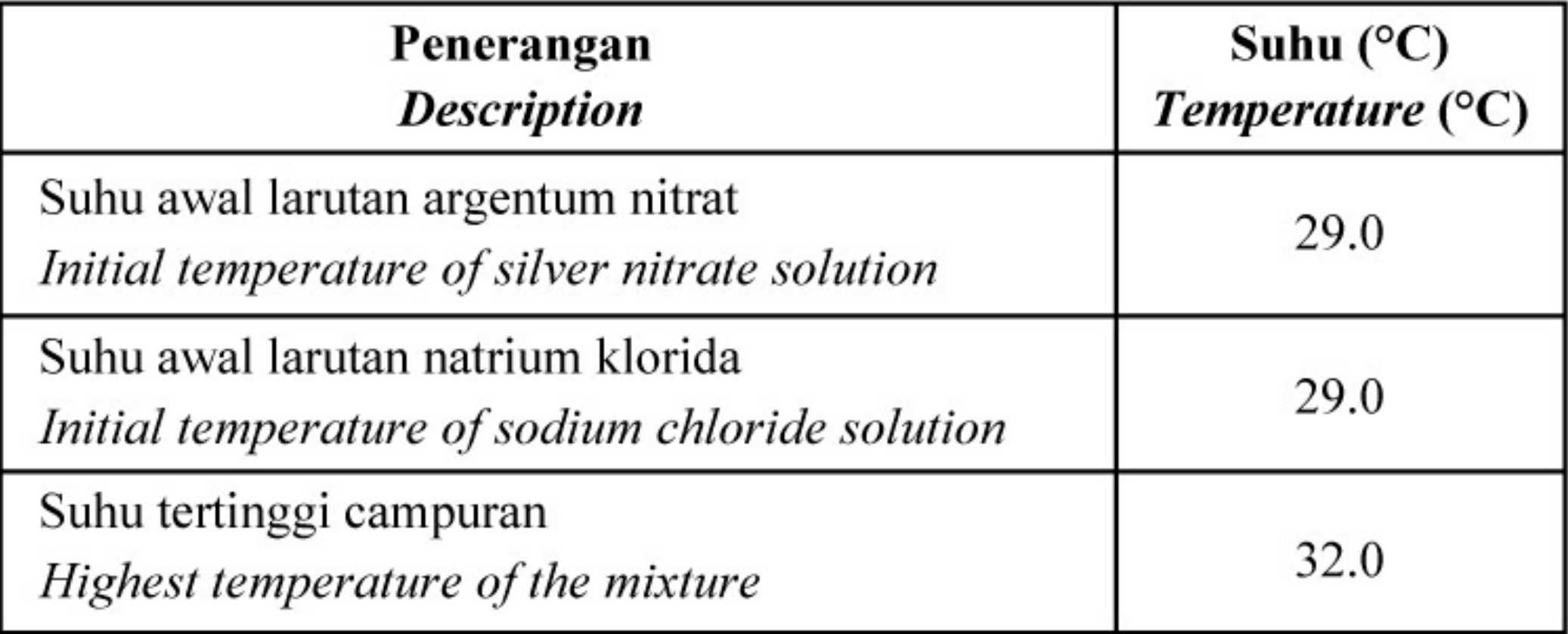
Diagram 6 shows the apparatus set-up to determine the heat of precipitation for silver chloride (50 cm³ of 0.5 mol dm⁻³ sodium chloride solution added to 50 cm³ of 0.5 mol dm⁻³ silver nitrate solution in a polystyrene cup). Table 6: initial temperature of silver nitrate solution 29.0 °C; initial temperature of sodium chloride solution 29.0 °C; highest temperature of the mixture 32.0 °C.
Medium9 marks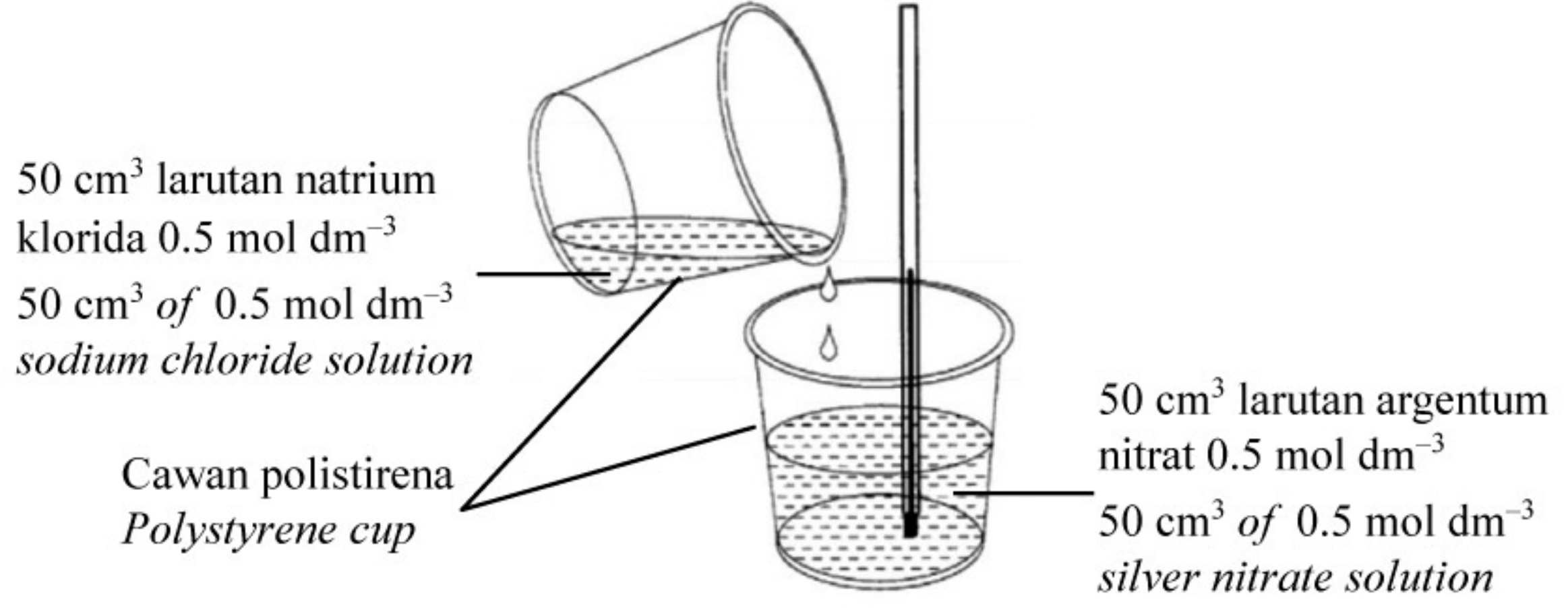
- (a)
What is meant by heat of precipitation in this experiment?
[1] - (b)
State one observation in the experiment.
[1] - (c)(i)
The chemical equation is AgNO3 + NaCl → AgCl + NaNO3. Calculate the heat change in the reaction. [Specific heat capacity of solution, c = 4.2 J g⁻¹ °C⁻¹; density of solution = 1 g cm⁻³]
[1] - (c)(ii)
Calculate the heat of precipitation for silver chloride.
[3] - (d)
Based on the change in temperature in Table 6, state the type of the reaction.
[1] - (e)
The experiment is repeated by using 50 cm³ of 0.5 mol dm⁻³ potassium chloride solution to replace the sodium chloride solution. What is the change in temperature for this reaction? Explain your answer.
[2]
Table 7 shows two sets of experiment to investigate the factors affecting the rate of reaction between calcium carbonate and hydrochloric acid. Set I: 5 g calcium carbonate powder + 50 cm³ of 1.0 mol dm⁻³ hydrochloric acid, 33 s to collect 40 cm³ of carbon dioxide. Set II: 5 g calcium carbonate chip + 50 cm³ of 1.0 mol dm⁻³ hydrochloric acid, 45 s.
Medium10 marks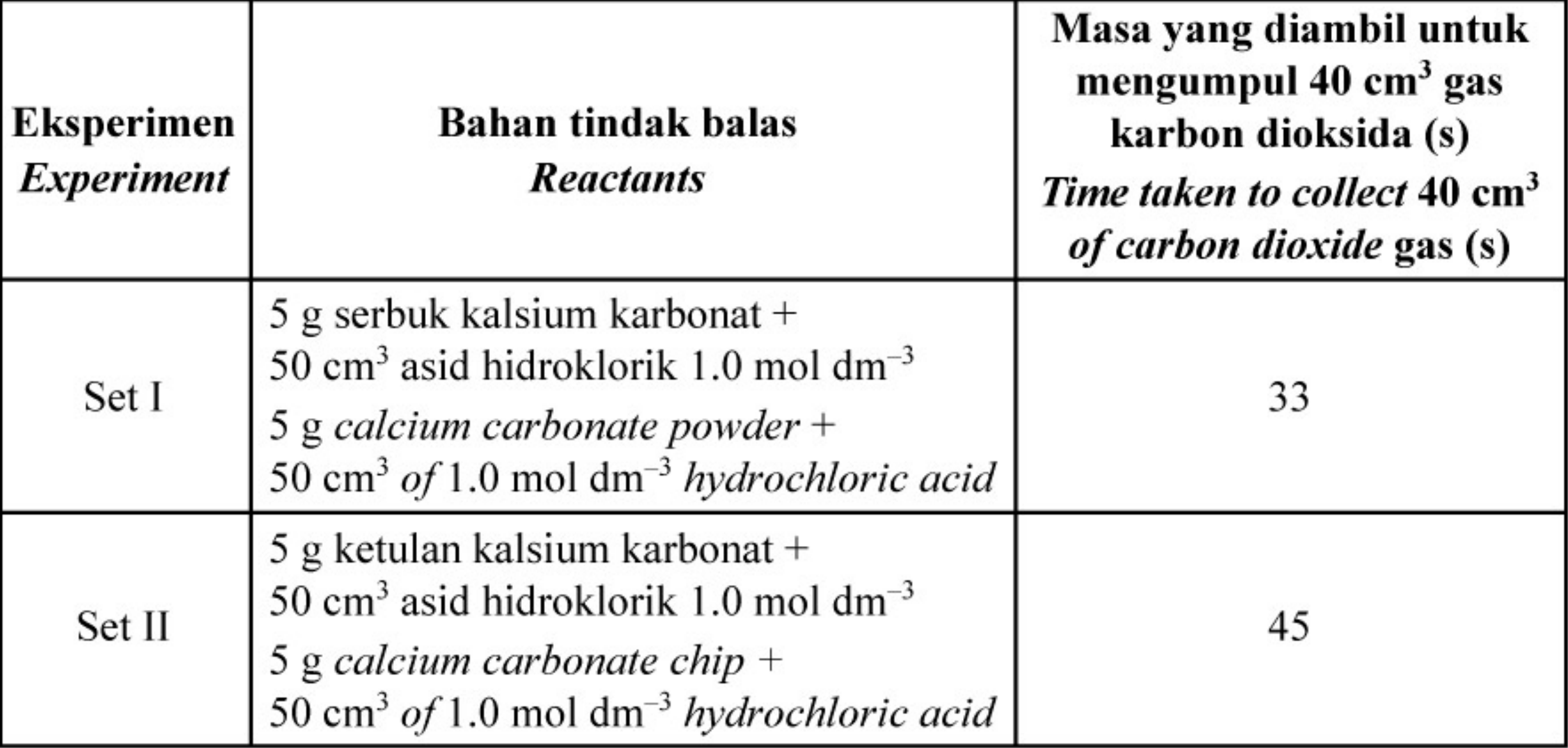
- (a)
Write an ionic equation for the reaction in this experiment.
[1] - (b)(i)
Compare the rate of reaction for Set I and Set II.
[1] - (b)(ii)
Explain your answer in 7(b)(i) with reference to the collision theory.
[4] - (c)
Sketch the graph of volume of carbon dioxide gas against time for Set I and Set II.
[2] - (d)
A student wishes to increase the rate of reaction for Set II by changing the hydrochloric acid with sulphuric acid of the same concentration. In your opinion, do you think the student made the correct decision? Explain your answer.
[2]
Diagram 8 shows the apparatus set-up used to prepare soap in a school laboratory (palm oil + concentrated sodium hydroxide solution heated, then distilled water and sodium chloride added).
Medium10 marks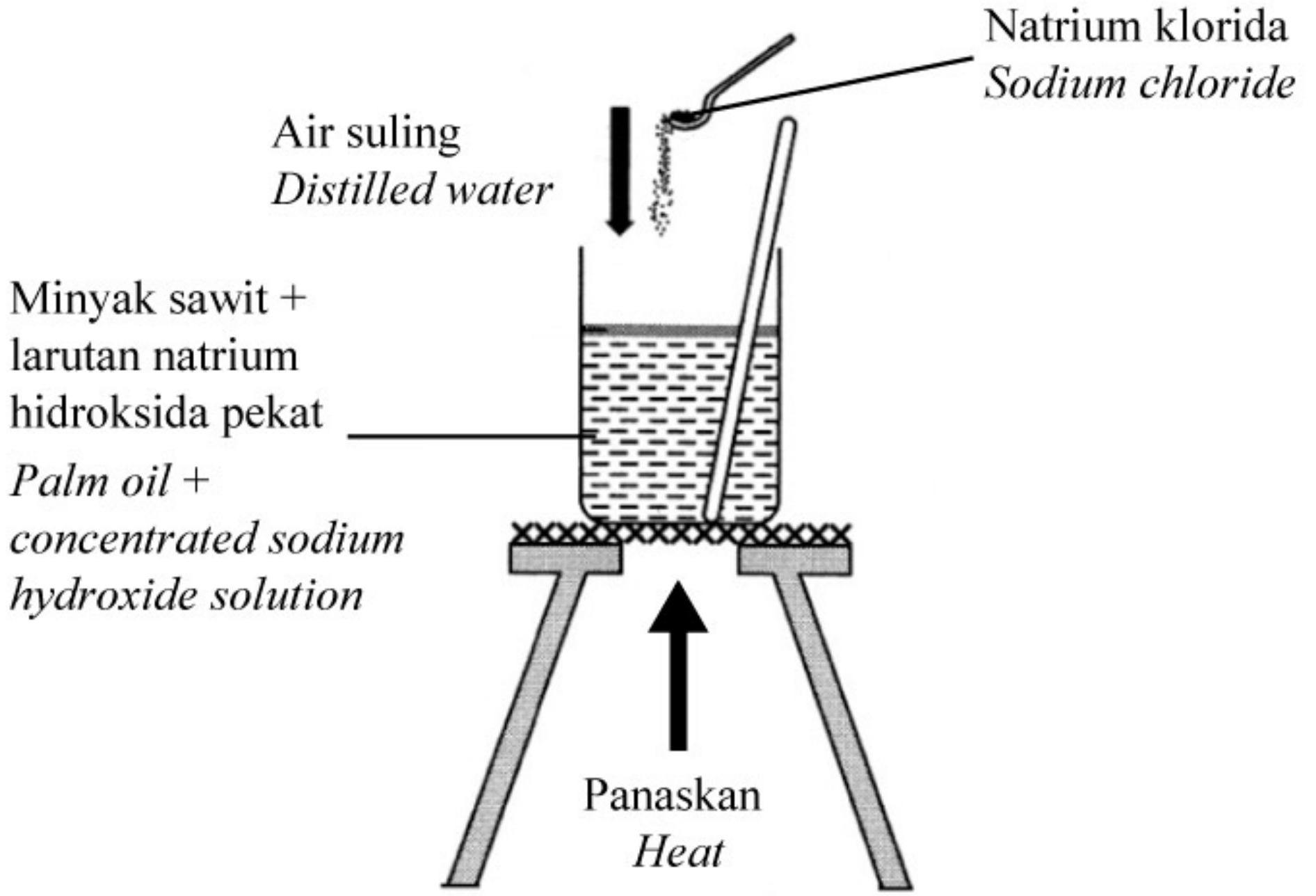
- (a)(i)
State the name of the reaction used in the preparation of soap.
[1] - (a)(ii)
The following equation shows the reaction in the preparation of soap: (palm oil triglyceride of palmitic acid) + 3NaOH → glycerol (CH2OH-CHOH-CH2OH) + ?. Draw the structural formula for sodium palmitate in the space provided.
[1]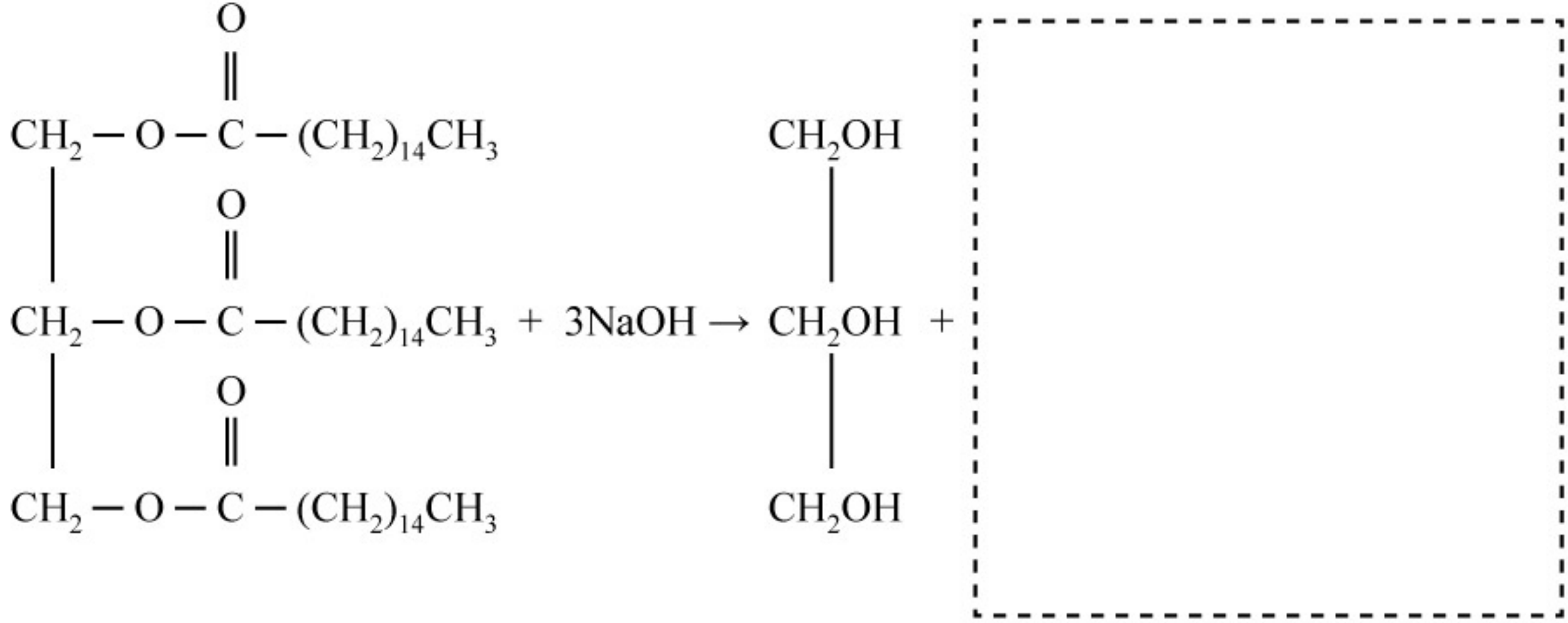
- (a)(iii)
Calculate the mass of soap produced if 0.05 mol soap is produced. [Relative atomic mass: H = 1, C = 12, O = 16, Na = 23]
[2] - (a)(iv)
A student wishes to prepare potassium palmitate soap. What alkali should be used?
[1] - (b)(i)
Table 8 shows two sets of experiment to compare the effectiveness of the cleansing action of cleaning agent A and B in hard water (A: grease stain removed; B: some grease stain still remains). Which cleaning agent is more effective in hard water? Explain your answer.
[2]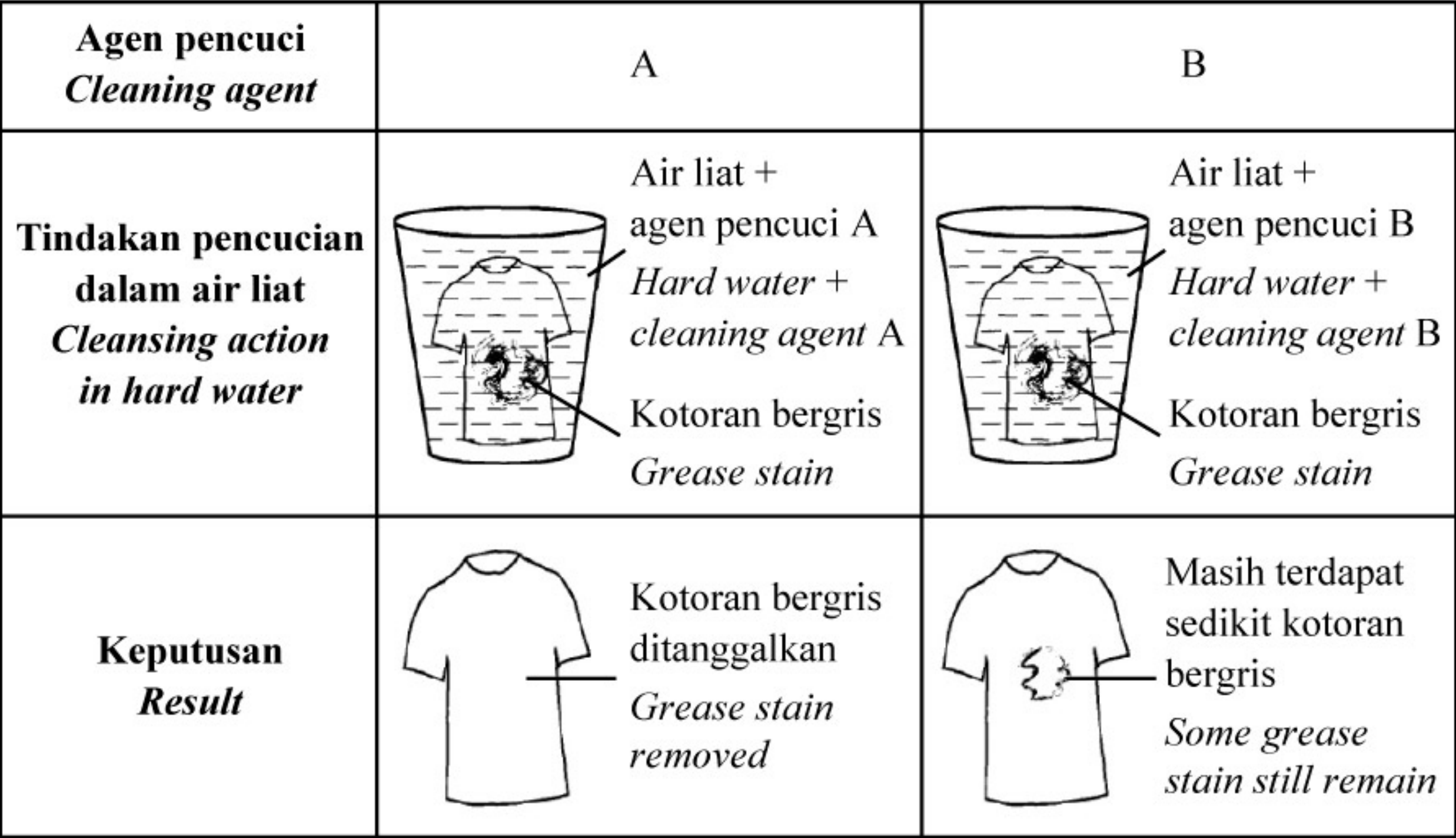
- (b)(ii)
By using the following materials, describe briefly how to differentiate between soap and detergent: 1 g soap, 1 g detergent, hard water, two boiling tubes.
[3]
Section B
Table 9 shows information about solution P and solution Q with the same concentration but different pH value. P: pH less than 7; reacts with copper(II) oxide to produce copper(II) chloride and water. Q: pH less than 7; reacts with potassium hydroxide solution to produce potassium ethanoate and water.
Medium20 marks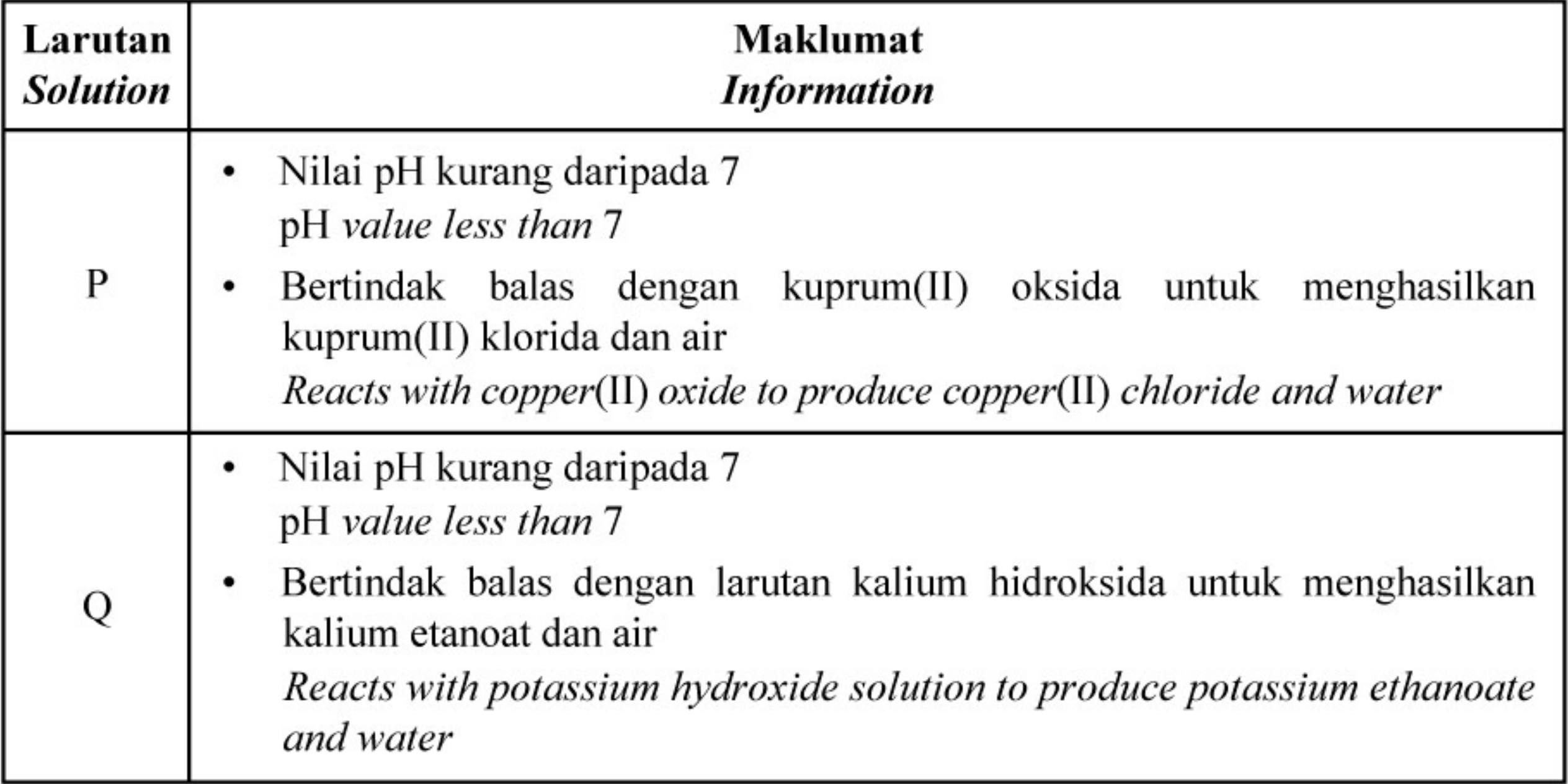
- (a)(i)
Based on Table 9, state the names of solution P and solution Q. Which solution shows a higher pH value? Explain your answer.
[5] - (a)(ii)
100 cm³ of 0.1 mol dm⁻³ of solution P reacts with excess copper(II) oxide to produce copper(II) chloride and water. Write the chemical equation for the reaction and calculate the mass of copper(II) chloride produced. [Molar mass of copper(II) chloride = 135 g mol⁻¹]
[5] - (b)(i)
Diagram 9 shows the reaction of white solid W: W + nitric acid → colourless solution Y + gas V + water; heating W → solid Z (yellow when hot and white when cold) + gas V. Identify substances V, W, Y and Z.
[4]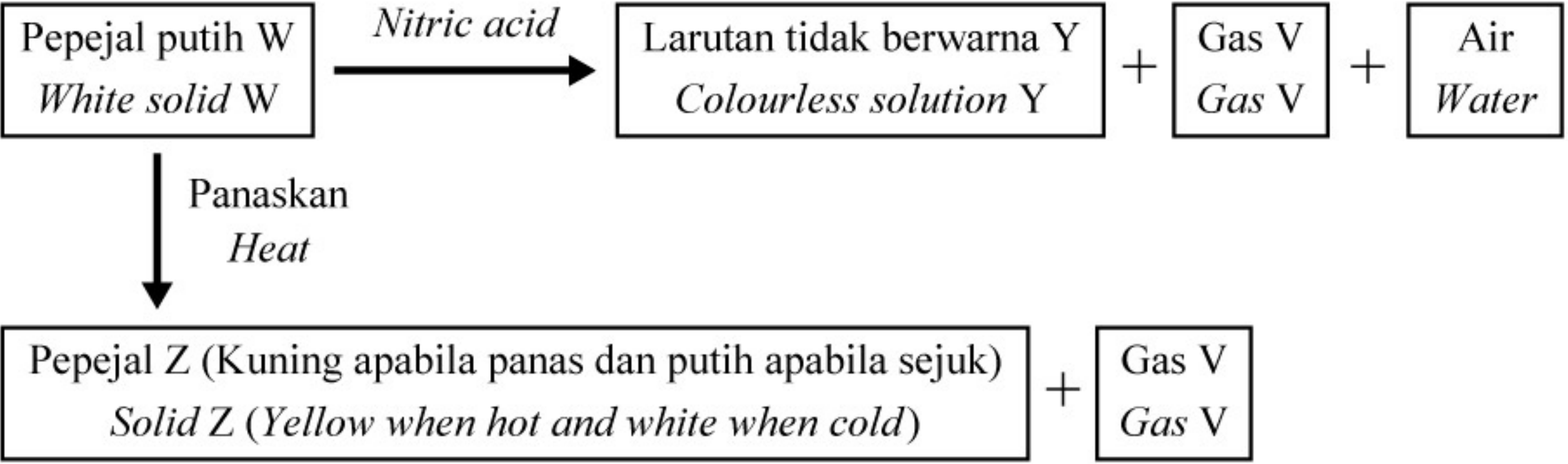
- (b)(ii)
Describe a chemical test to verify the cation and anion present in solution Y.
[6]
Question on polymers: natural and synthetic polymers, nylon formation, and natural rubber (latex).
Medium20 marks- (a)(i)
Polymer consists of natural polymer or synthetic polymer. State one example of natural polymer and one example of synthetic polymer.
[2] - (a)(ii)
Diagram 10.1 shows the structural formula of two monomers to produce nylon in the laboratory: 1,6-diaminohexane H2N-(CH2)6-NH2 and decanedioyl dichloride ClOC-(CH2)8-COCl. Write the chemical equation for the formation of nylon.
[2]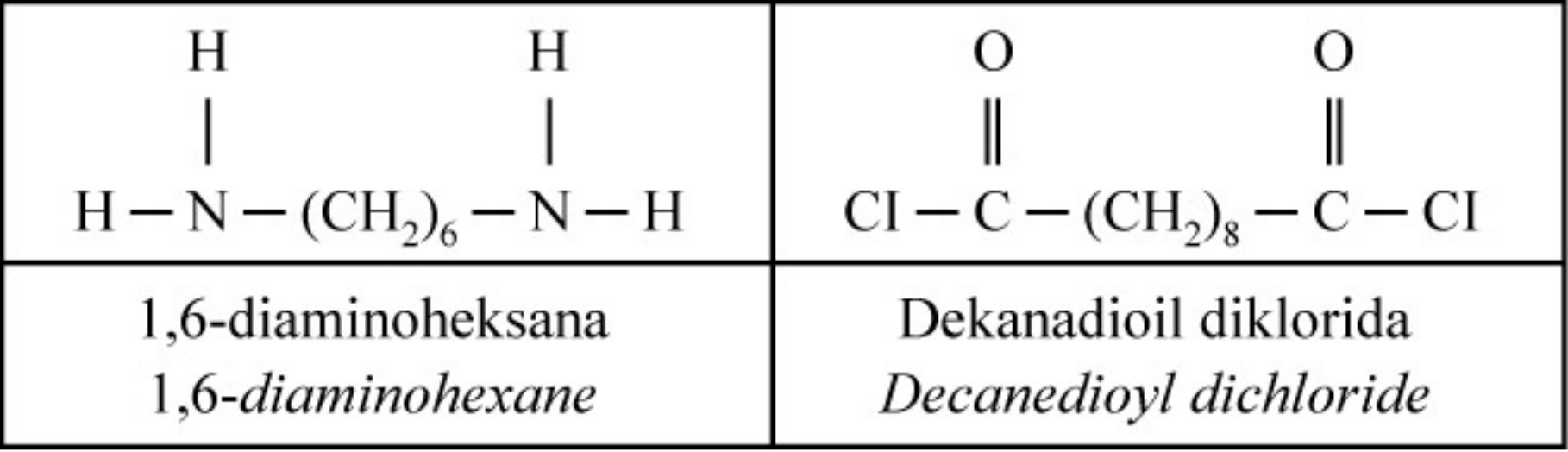
- (b)(i)
Diagram 10.2 shows latex produced from tapping the rubber tree. Natural rubber is found in the latex and it is a type of natural polymer known as polyisoprene. Draw the structural formula for the monomer of natural rubber and give its IUPAC name. State three characteristics of natural rubber.
[5] - (b)(ii)
Latex obtained from tapped rubber trees will be collected immediately to prevent latex from coagulate. Explain how the latex can coagulate. Describe one suitable method to prevent the latex from coagulate. Explain your answer.
[8] - (b)(iii)
Natural rubber is not suitable for making vehicle tires. Justify the above statement. Suggest a process that can be done so that natural rubber can be used to make vehicle tires.
[3]
Section C
Question on isomers of butene and conversions of organic compounds (Diagram 11.1 and 11.2).
Medium20 marks- (a)
Diagram 11.1 shows a structural formula of butene (but-1-ene, CH3CH2CH=CH2). Draw the structural formulae for another two isomers of butene and name each isomer according to the IUPAC nomenclature.
[4]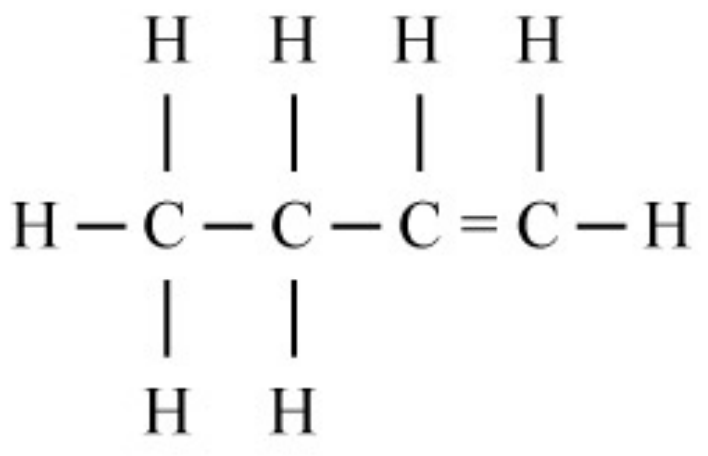
- (b)(i)
Diagram 11.2 shows the conversions of several organic compounds (compound X → ethanoic acid by Reaction I; compound X → ethene by Reaction II; ethanoic acid → ethyl ethanoate by Reaction III). State the name of Reaction I, Reaction II and Reaction III. State the name, homologous series and molecular formula of compound X. Draw an apparatus set-up for Reaction II.
[8]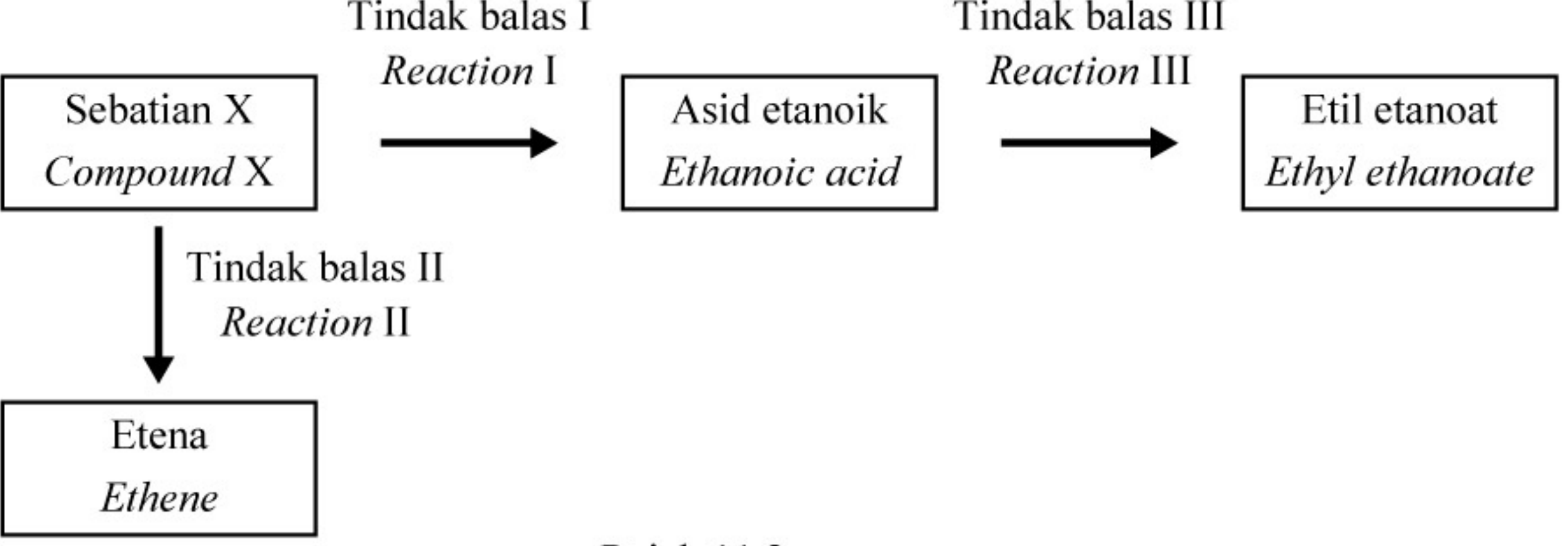
- (b)(ii)
Ethyl ethanoate has sweet fruity smell. Describe an experiment to prepare ethyl ethanoate in laboratory through Reaction III. Your description should contain: procedures; chemical equation.
[8]