Write your answer on paper. Then open the answer to check it.
Section A
Diagram 1 shows the symbol of atoms for element P, Q and S: ²³₁₁P, ³⁵₁₇Q, ²⁰₁₀S.
Medium5 marks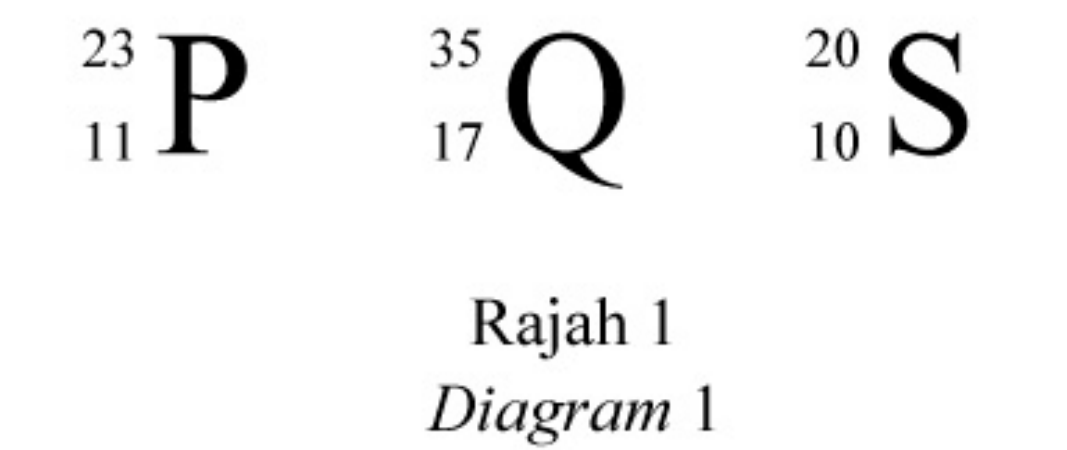
- (a)
What is meant by nucleon number?
[1] - (b)
State the proton number of atom S.
[1] - (c)
What is the number of neutrons for atom P?
[1] - (d)
Draw the atomic structure of element Q.
[2]
Table 2.1 shows two types of glass and their composition. Glass X: silica, sodium carbonate, boron oxide and aluminium oxide. Glass Y: silica, sodium carbonate and calcium carbonate.
Medium5 marks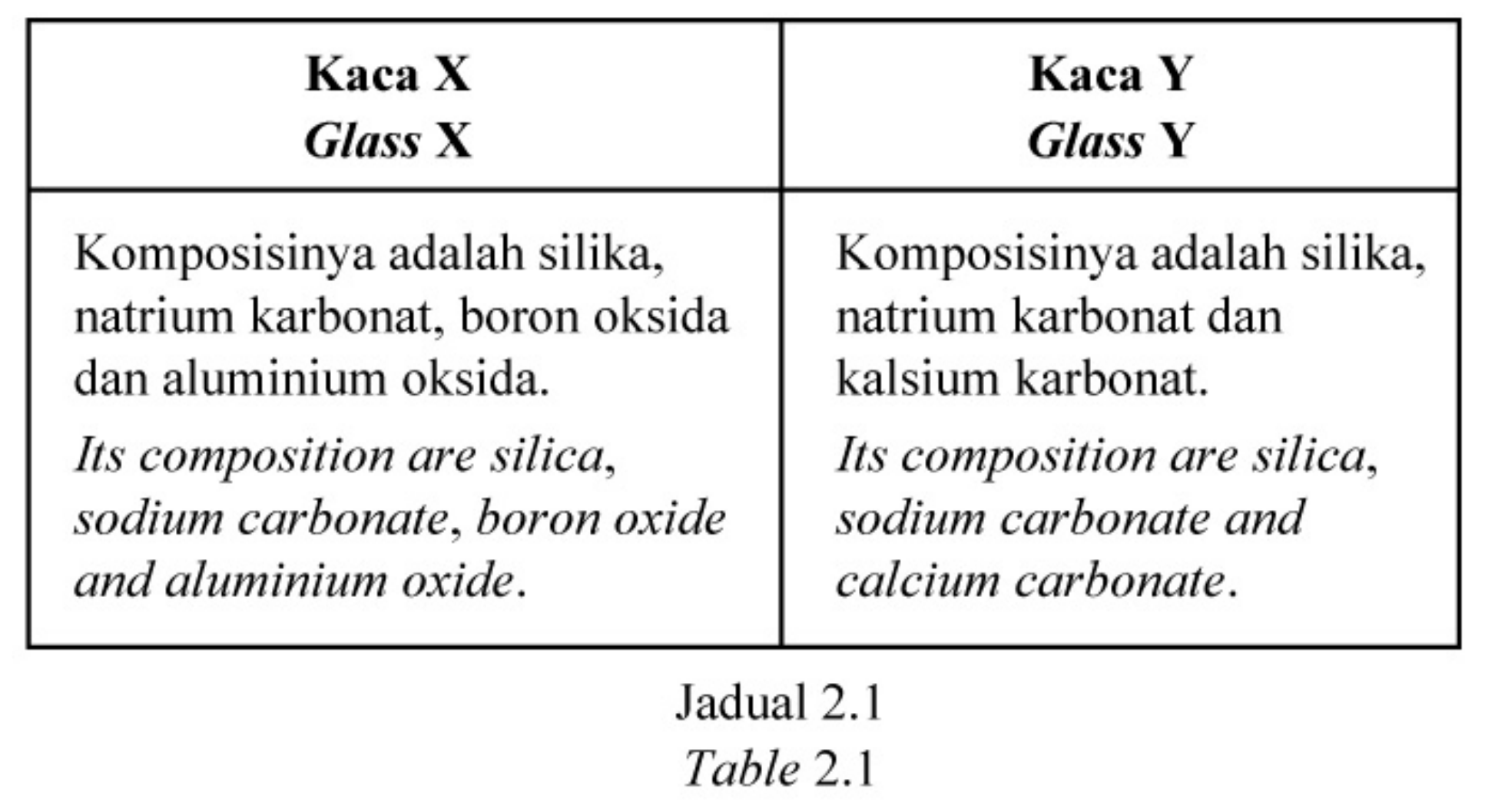
- (a)
Diagram 2 shows a pot. The cover of the pot is made from a type of glass. State the glass in Table 2.1 which can be used to make the cover of the pot. Explain your answer.
[2]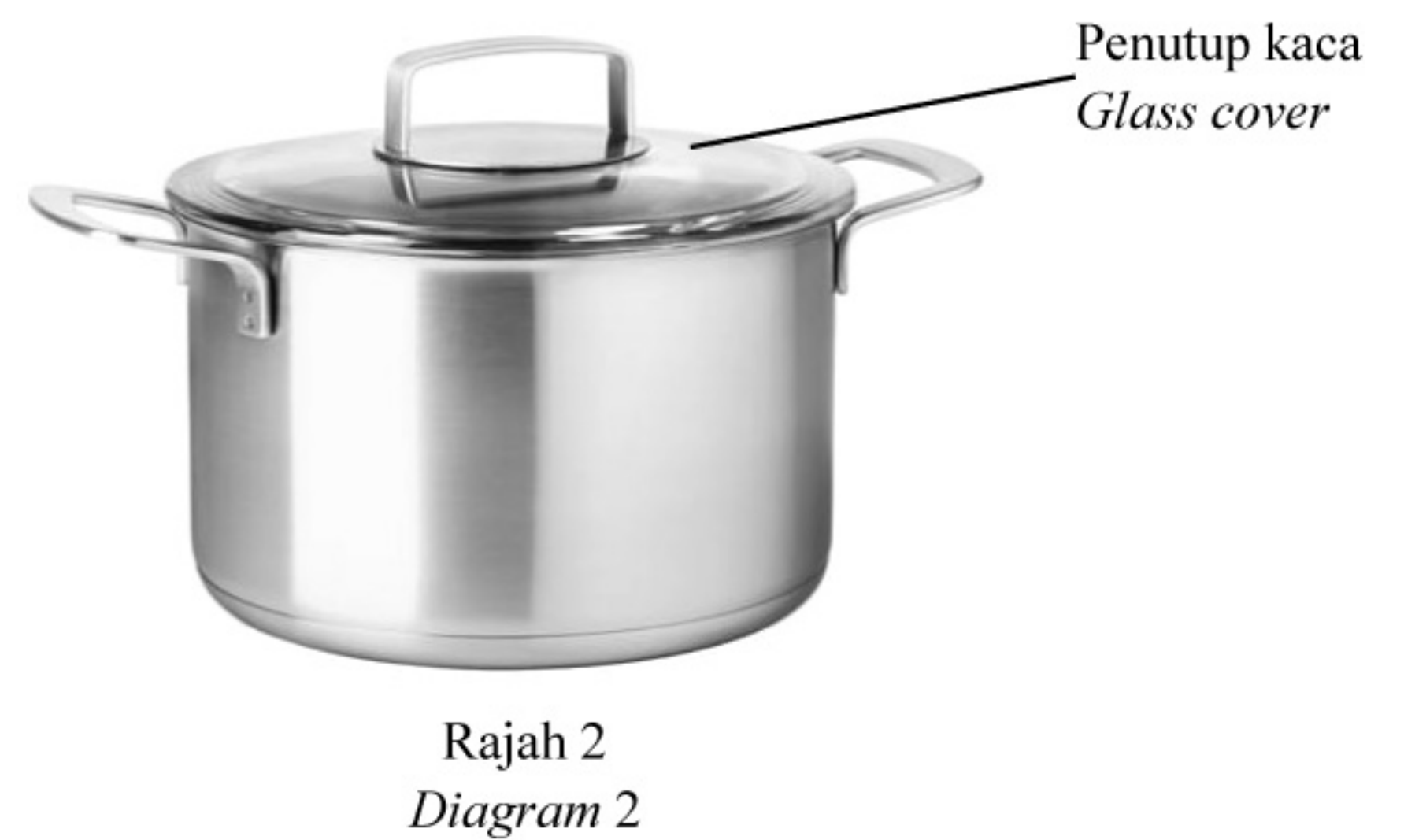
- (b)(i)
Table 2.2 shows manufactured substances M (Reinforced concrete: cement, sand, small pebbles and steel) and N (Silicone carbide: silicone and carbon). State the types of manufactured substances M and N.
[2]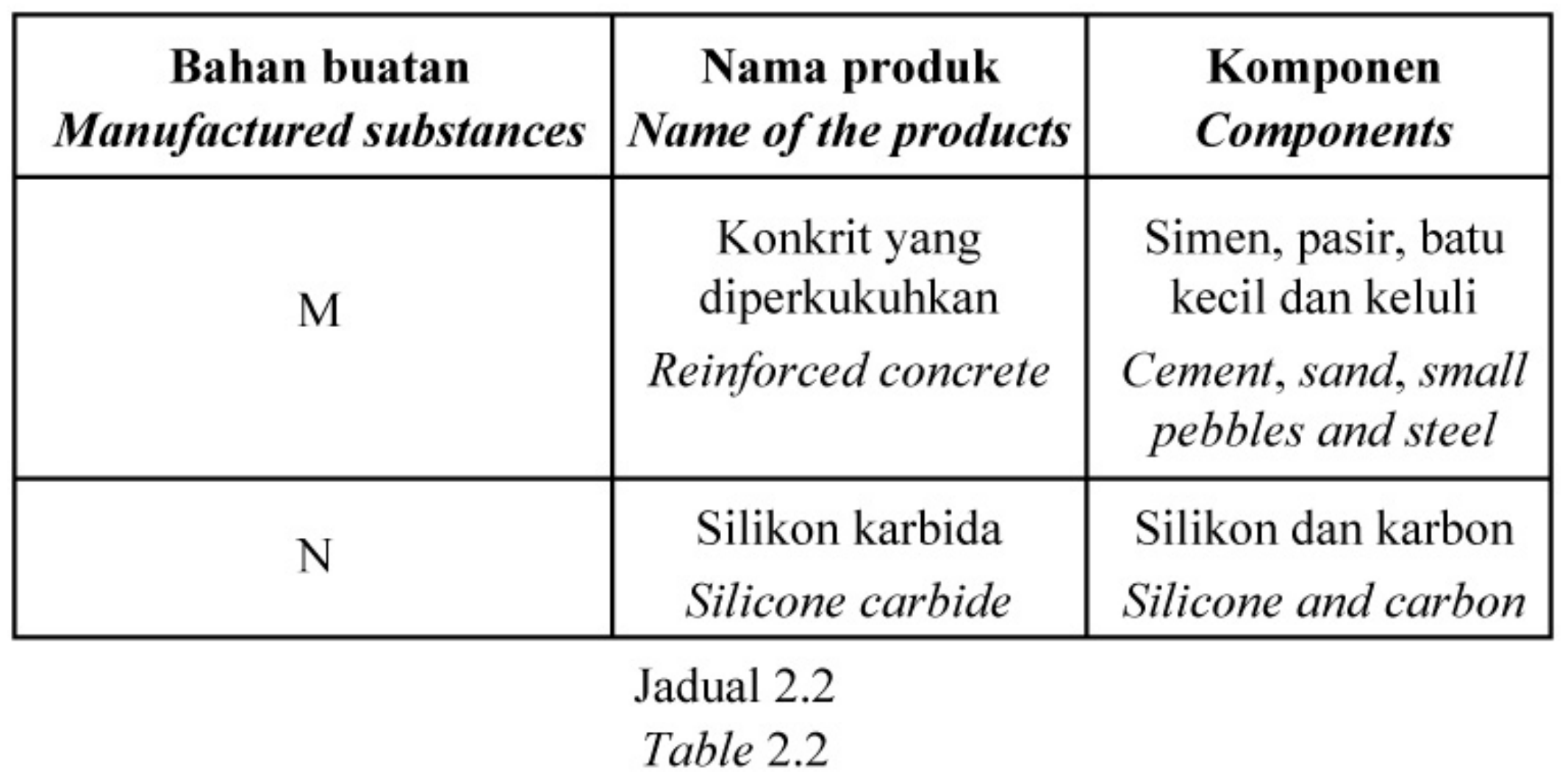
- (b)(ii)
What is the advantage of using reinforced concrete compared to concrete?
[1]
Diagram 3 shows the set-up of apparatus to determine the empirical formula of magnesium oxide.
Medium6 marks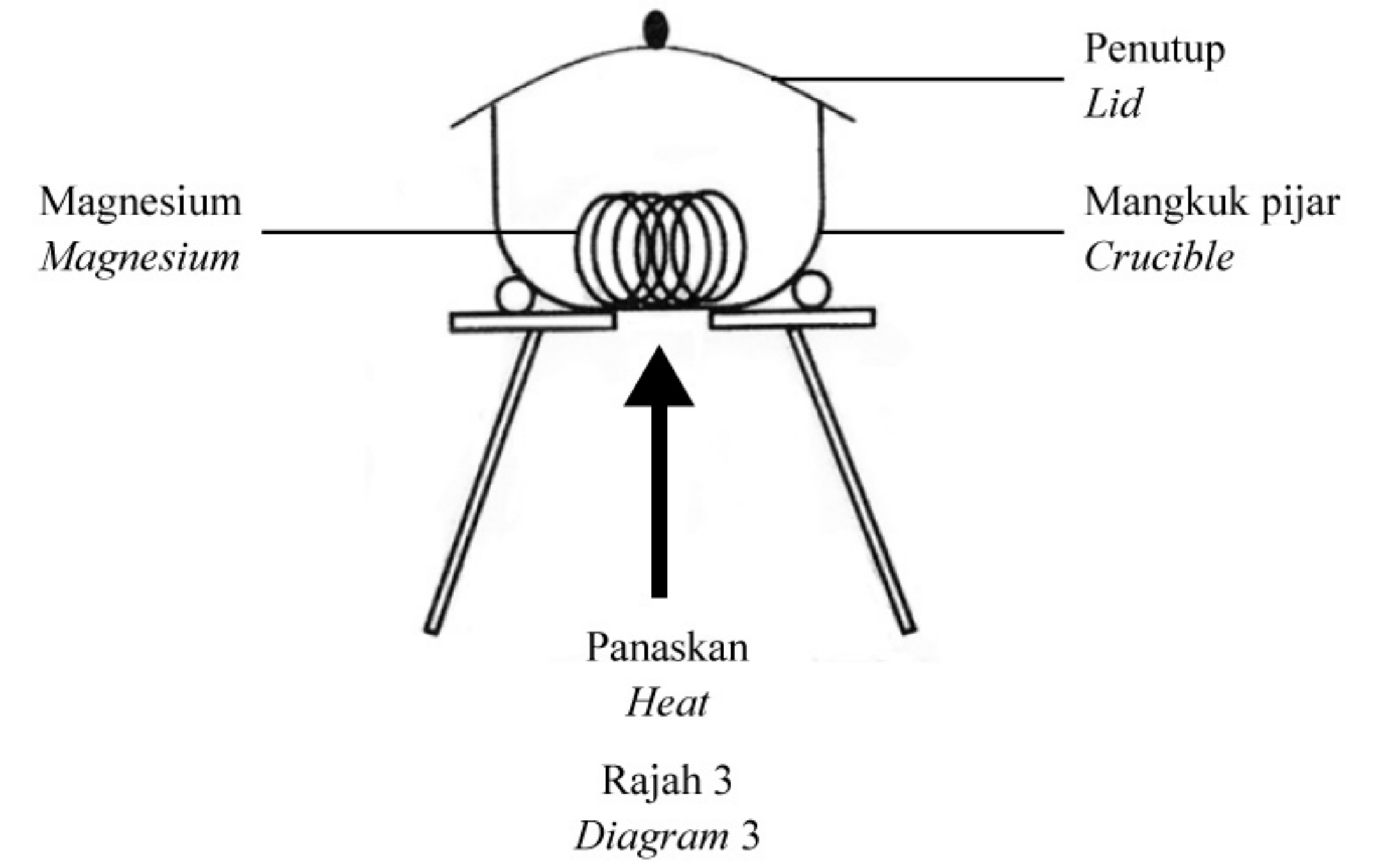
- (a)
What is the meaning of empirical formula?
[1] - (b)(i)
The result of the experiment: mass of crucible + lid = 150.05 g; mass of crucible + lid + magnesium = 156.29 g; mass of crucible + lid + magnesium oxide = 160.45 g. Calculate the mass of: magnesium; oxygen.
[2] - (b)(ii)
Determine the empirical formula of magnesium oxide. [Relative atomic mass: Mg = 24, O = 16]
[3]
Diagram 4 shows the set-up of apparatus of an experiment to compare the reactivity of lithium and sodium towards oxygen.
Medium7 marks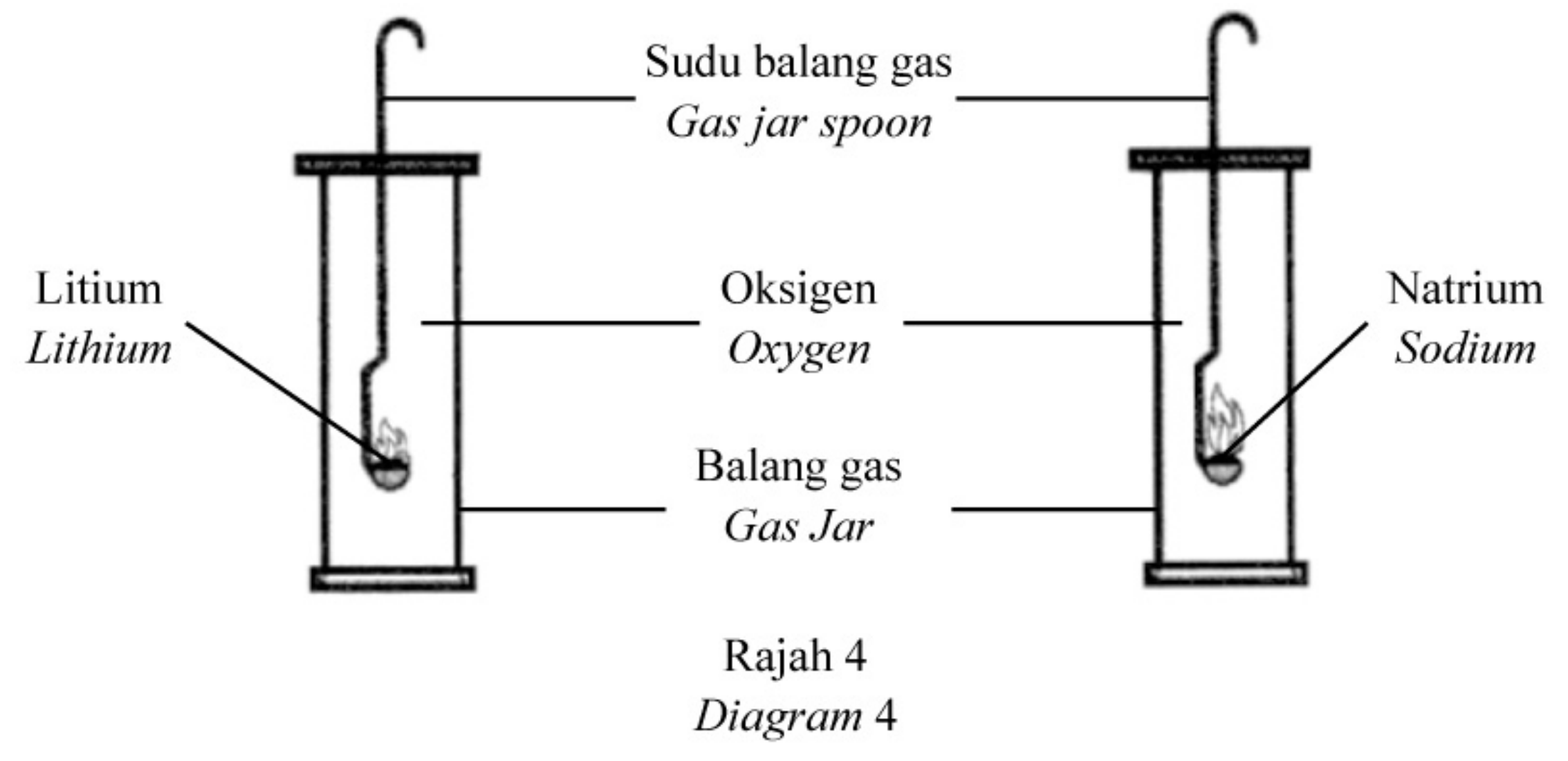
- (a)(i)
Compare the reactivity of lithium and sodium towards oxygen.
[1] - (a)(ii)
Explain your answer in 4(a)(i).
[3] - (b)(i)
State the type of bond that formed between sodium and oxygen.
[1] - (b)(ii)
Draw the electron arrangement of the compound formed between sodium and oxygen.
[2]
Diagram 5 shows the set-up of apparatus to investigate the reaction between iron(II) sulphate solution and acidified potassium manganate(VII) solution through the transfer of electrons at a distance (carbon electrodes X and Y, dilute sulphuric acid in the U-tube, galvanometer G).
Medium8 marks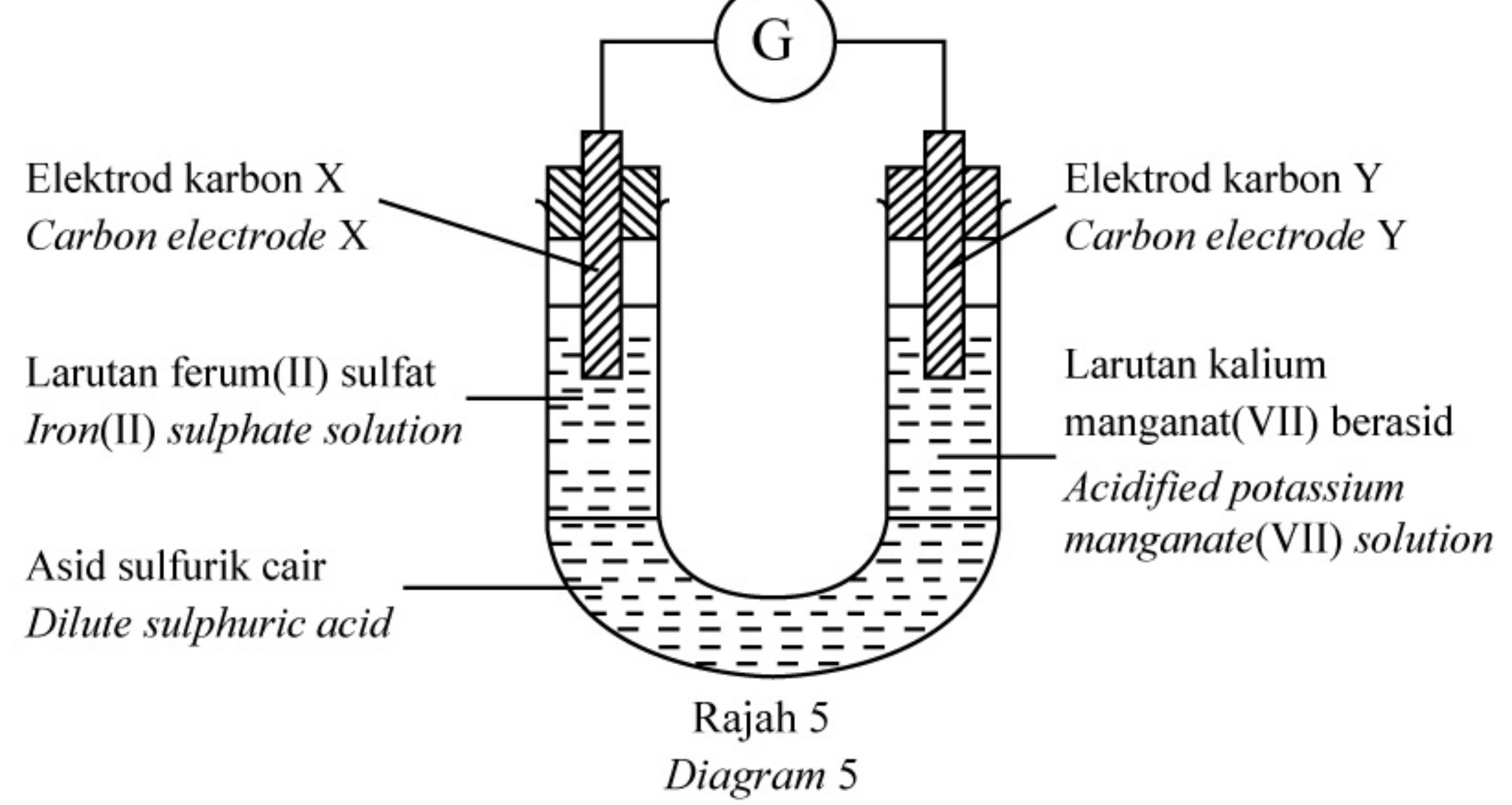
- (a)
What is the function of dilute sulphuric acid in Diagram 5?
[1] - (b)
State the change of colour of acidified potassium manganate(VII) solution after 30 minutes.
[1] - (c)
Calculate the oxidation number of manganese in manganate(VII) ion.
[1] - (d)
Write the half equation at carbon electrode Y.
[2] - (e)
Describe briefly a chemical test to verify the cation produced in the solution at carbon electrode X.
[2] - (f)
Suggest another substance that can replace iron(II) sulphate solution in Diagram 5.
[1]
Diagram 6 shows an experiment to determine the heat of displacement for a reaction. 50 cm³ of 1.0 mol dm⁻³ copper(II) nitrate solution is poured into a plastic cup and the initial temperature (28.0 °C) is recorded. Excess zinc powder is added to the same cup. The mixture is stirred slowly and the highest temperature (34.0 °C) is recorded.
Medium9 marks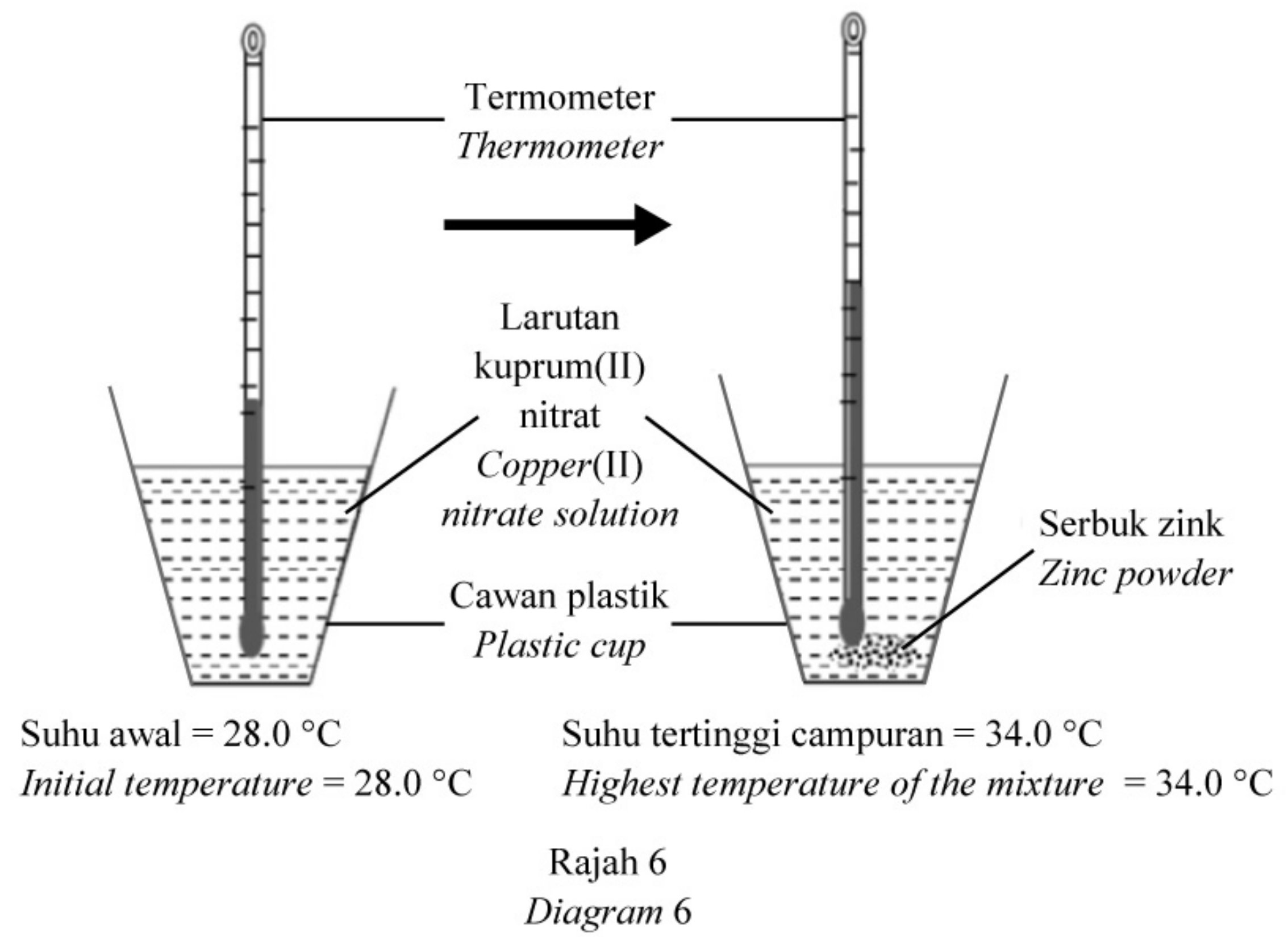
- (a)
What is the meaning of heat of displacement of the experiment?
[1] - (b)
Write the ionic equation for the reaction that took place in this experiment.
[1] - (c)(i)
Based on the experiment, calculate the heat change in the reaction. [Specific heat capacity of solution, c = 4.2 J g⁻¹ °C⁻¹; Density of solution = 1 g cm⁻³]
[1] - (c)(ii)
Calculate the number of moles of copper(II) nitrate that reacted.
[1] - (c)(iii)
Calculate the heat of displacement in this reaction.
[1] - (d)
Draw an energy level diagram for the reaction.
[2] - (e)
What is the value of heat of displacement if the experiment is repeated using magnesium powder? Explain your answer.
[2]
Table 7 shows two sets of experiment to investigate one factor that affects the rate of reaction between zinc and nitric acid. Set I: 50 cm³ of 1.0 mol dm⁻³ nitric acid + excess zinc powder, 30.00 cm³ of gas collected in 1 minute. Set II: 50 cm³ of 1.0 mol dm⁻³ nitric acid + excess zinc powder + catalyst X, 50.00 cm³ of gas collected in 1 minute.
Medium10 marks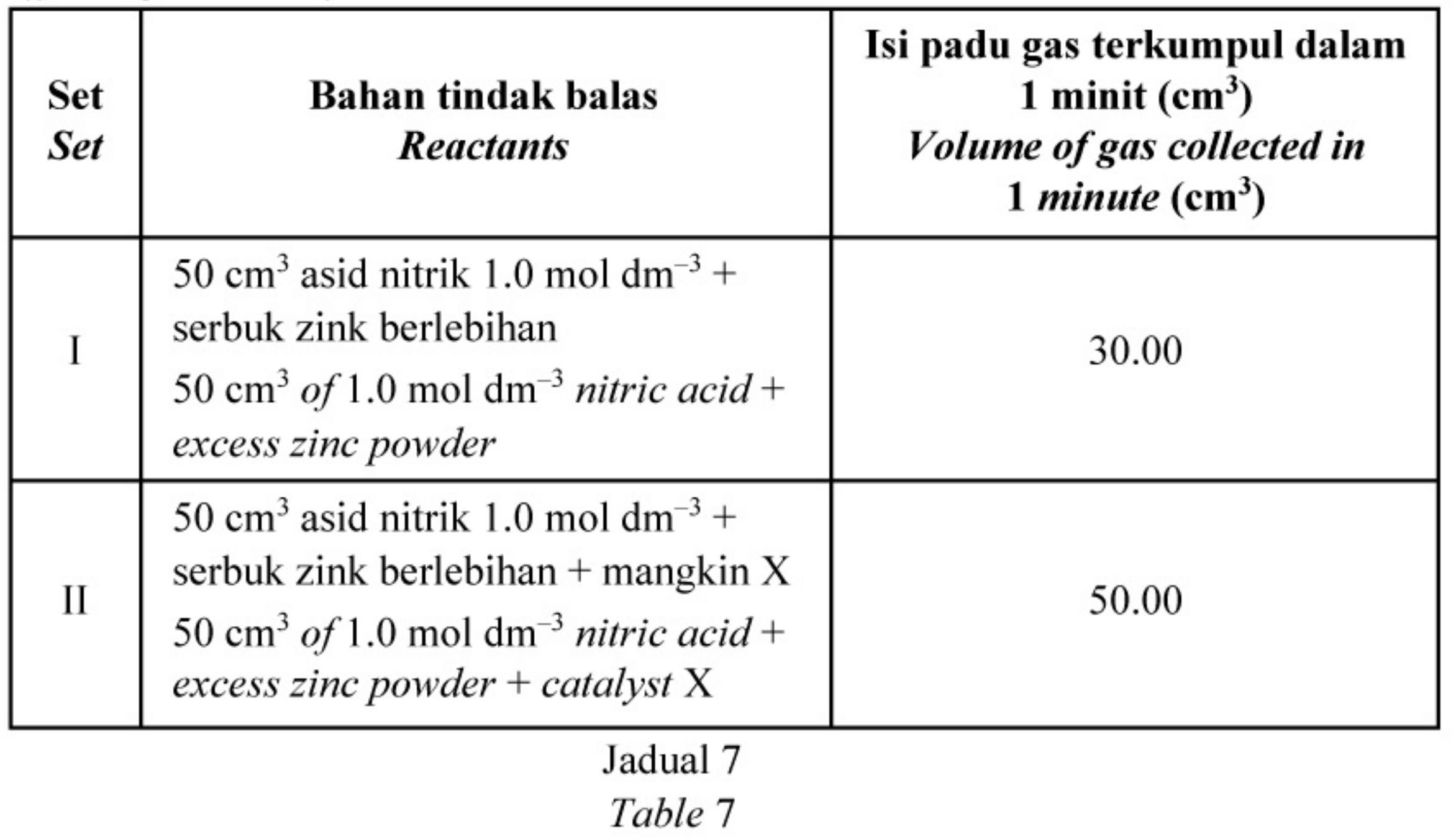
- (a)
Suggest the name of catalyst X in Set II.
[1] - (b)
State the name of the gas released in both experiment.
[1] - (c)
Calculate the average rate of reaction in unit of cm³ s⁻¹. Set I; Set II.
[2] - (d)(i)
Compare the rate of reaction between Set I and Set II.
[1] - (d)(ii)
Explain your answer in 7(d)(i) based on Collision Theory.
[3] - (e)
Draw the energy profile diagram for the reaction between zinc and nitric acid for both sets of the experiment. Then, show the activation energy for Set I and Set II.
[2]
Diagram 8 shows the structural formula of two types of cleaning agents. Cleaning agent A: CH₃(CH₂)₁₄COONa. Cleaning agent B: CH₃(CH₂)₁₀CH₂OSO₃Na.
Medium10 marks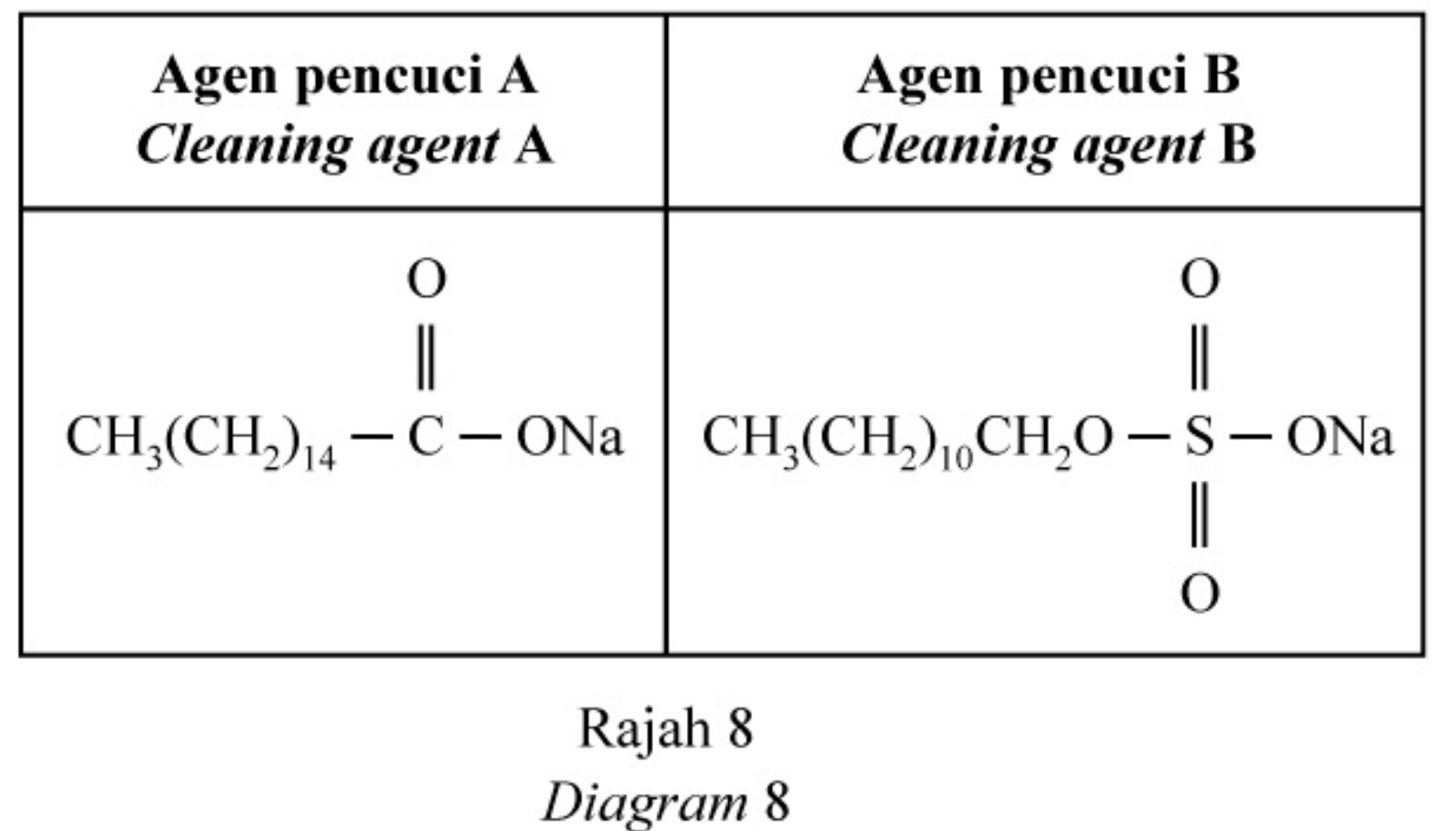
- (a)
State the name of the process to prepare cleaning agent A.
[1] - (b)
During preparation of cleaning agent A, sodium chloride powder is added into the mixture of oil and concentrated sodium hydroxide solution. What is the purpose?
[1] - (c)
State the ion contains in hard water.
[1] - (d)
State which cleaning agent is more effective in sea water. Explain your answer.
[2] - (e)
Which cleaning agent is more environmentally friendly? Explain your answer.
[2] - (f)
By using the following materials, describe briefly how to differentiate between cleaning agent A and cleaning agent B: 1 g of cleaning agent A, 1 g of cleaning agent B, hard water, two boiling tubes.
[3]
Section B
Diagram 9.1 shows the titration curve based on the reaction between sodium hydroxide solution, NaOH and 1.0 mol dm⁻³ hydrochloric acid, HCl using phenolphthalein as the indicator (pH against volume of NaOH; end point at 20 cm³, pH 7).
Medium20 marks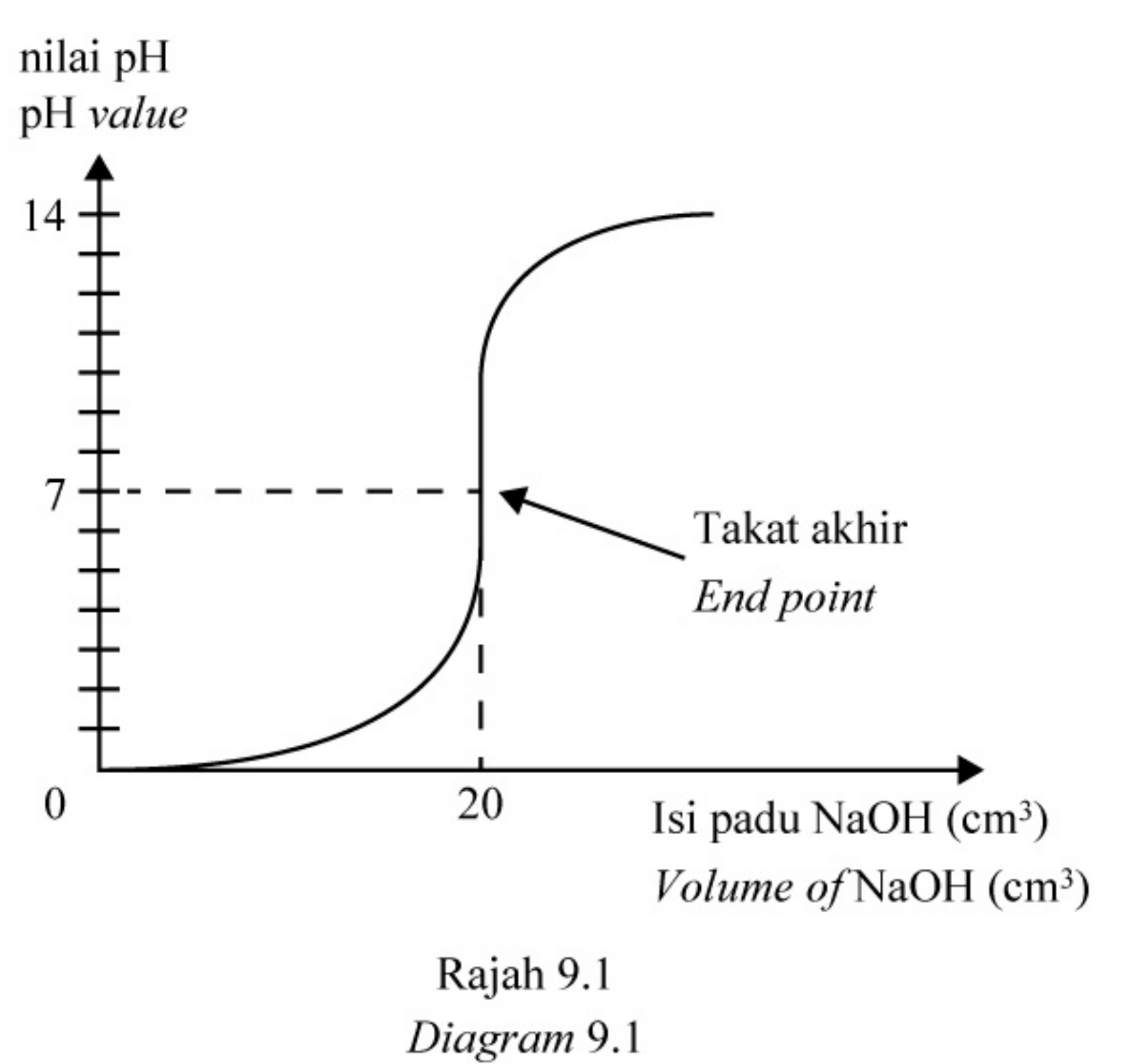
- (a)
Name the type of reaction that occurs in the conical flask. State the colour change of the solution in the conical flask when the end point of titration is reached. State the pH value at the end point of titration.
[3] - (b)(i)
Diagram 9.2 shows the titration of 50 cm³ of 0.5 mol dm⁻³ sulphuric acid, H₂SO₄ reacts completely with 25 cm³ of sodium hydroxide solution, NaOH. Write the chemical equation for the reaction. Calculate the molarity of the sodium hydroxide solution, NaOH needed to neutralise the sulphuric acid.
[5]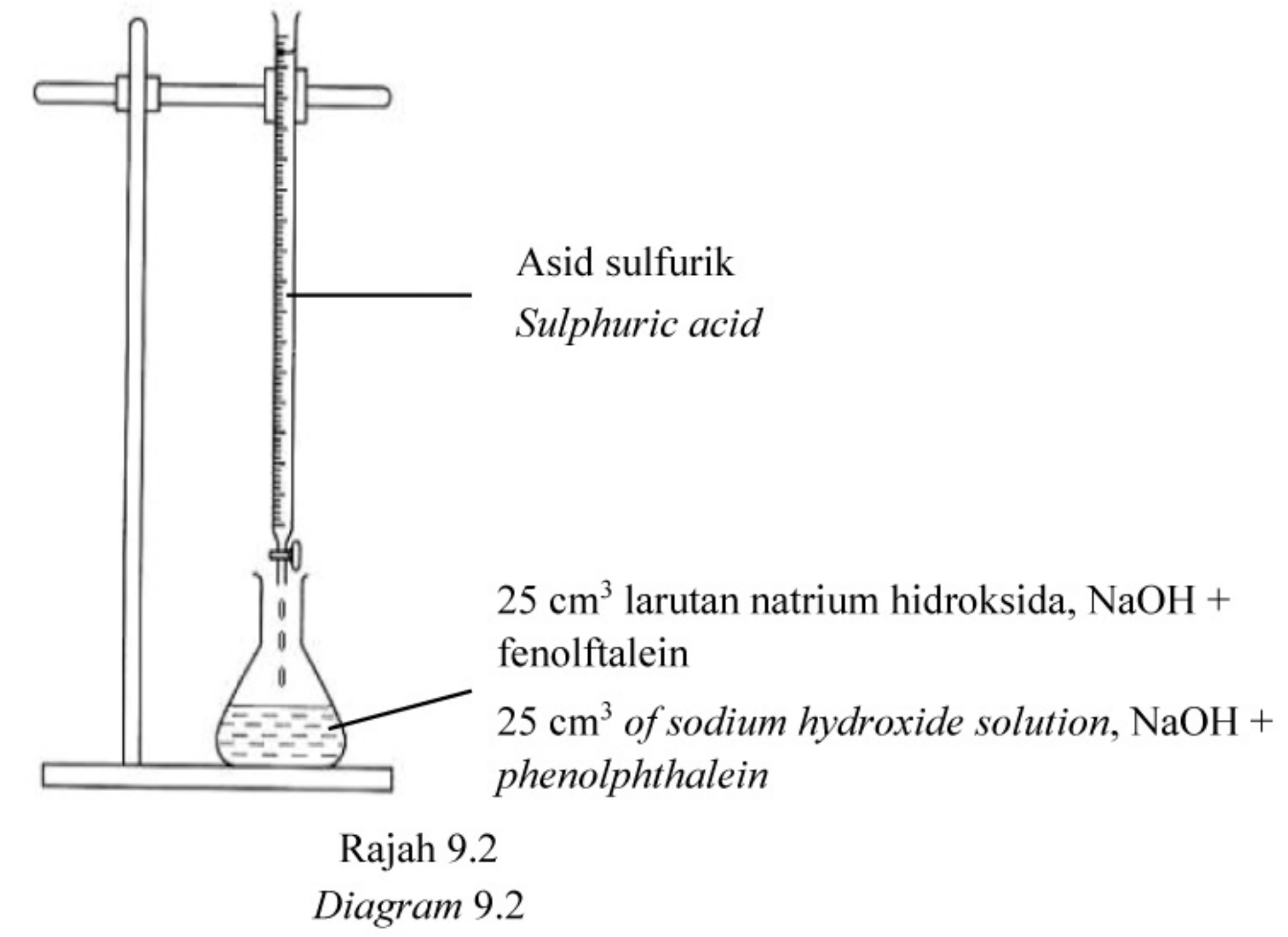
- (b)(ii)
If the sulphuric acid in question 9(b)(i) is replaced with hydrochloric acid with the same volume and concentration, predict the molarity of sodium hydroxide solution needed. Explain your answer.
[2] - (c)(i)
Diagram 9.3 shows the reaction involving a solid P. Solid P (white) is a carbonate salt; when heated strongly it decomposes into solid Q (brown when hot and yellow when cold) and gas R. Identify P, Q and R.
[3]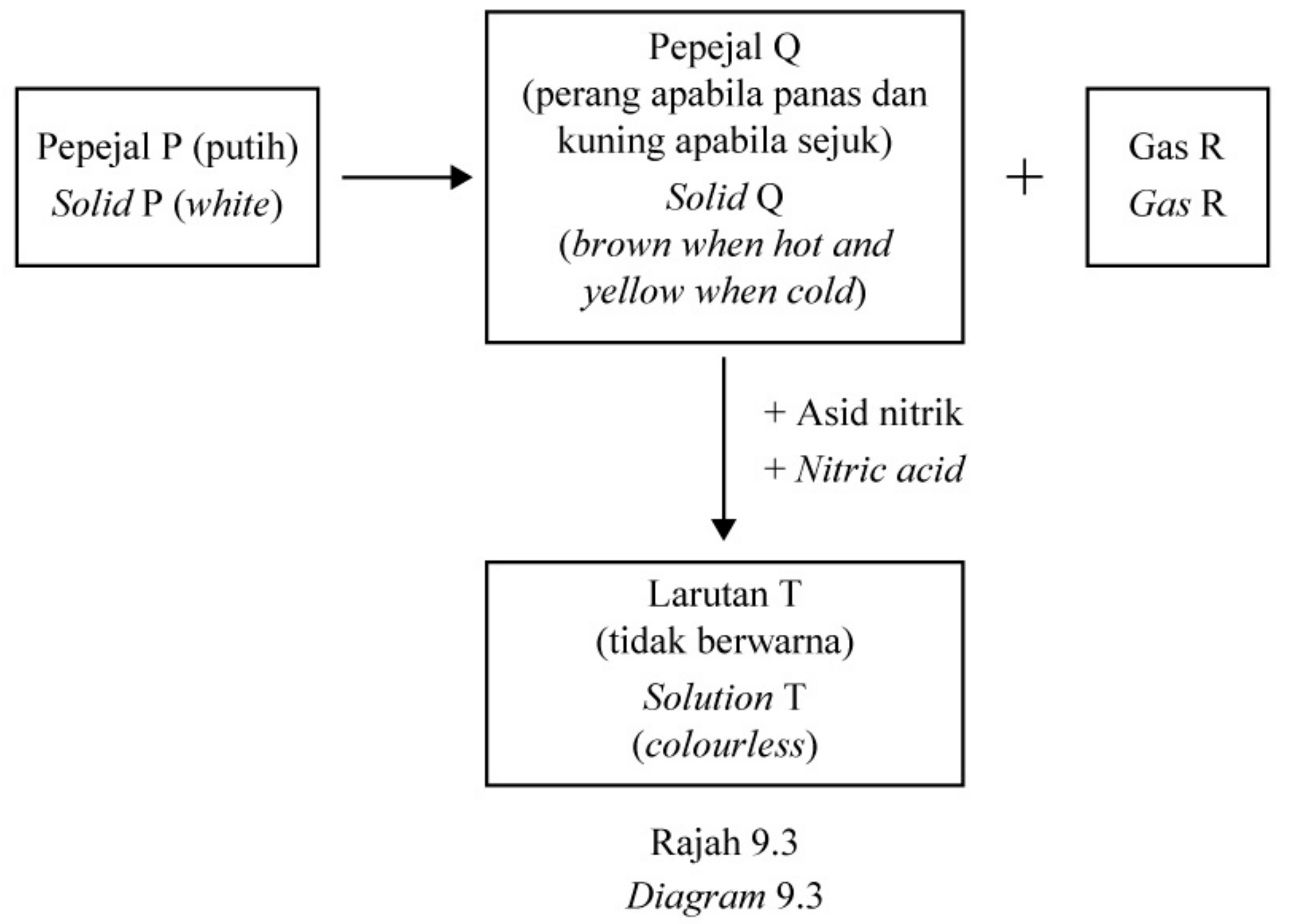
- (c)(ii)
Solid Q reacts with nitric acid to produce colourless solution T. State the name of solution T. Describe chemical test to verify the presence of cation and anion in the solution T.
[7]
Diagram 10.1 shows nylon threads used in the textile industry and the structure of the nylon polymer. Diagram 10.2 shows a flow chart to prepare rubber in two different physical states and the car tyre production process.
Medium20 marks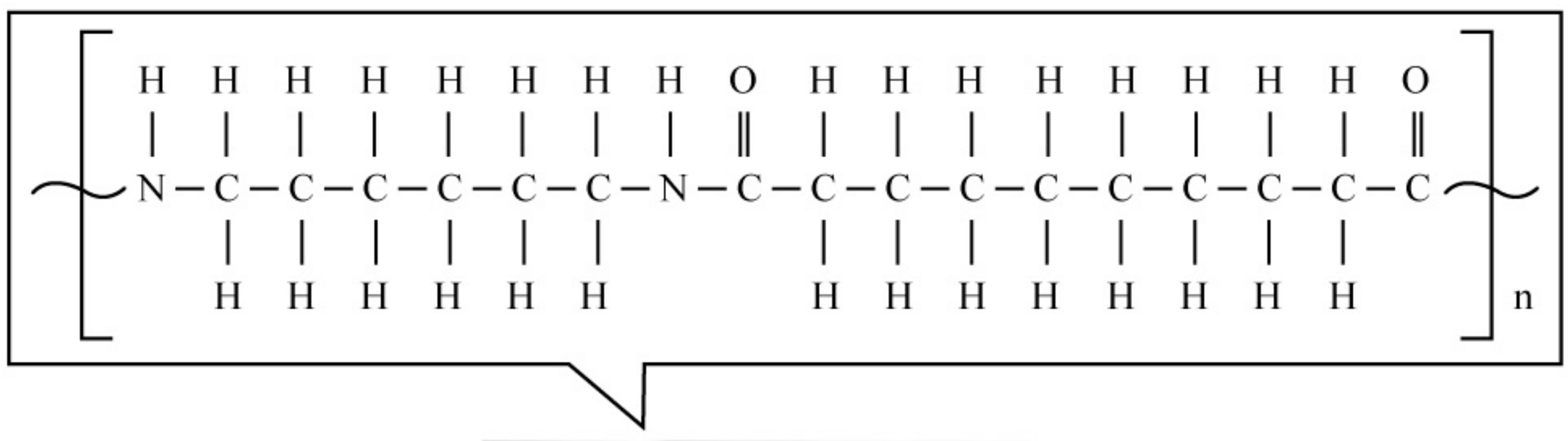
- (a)
Nylon is made from polymerisation of the mixture of two monomers. State the type of polymerisation involved. Draw the structural formula of the two monomers. State one property of nylon.
[4]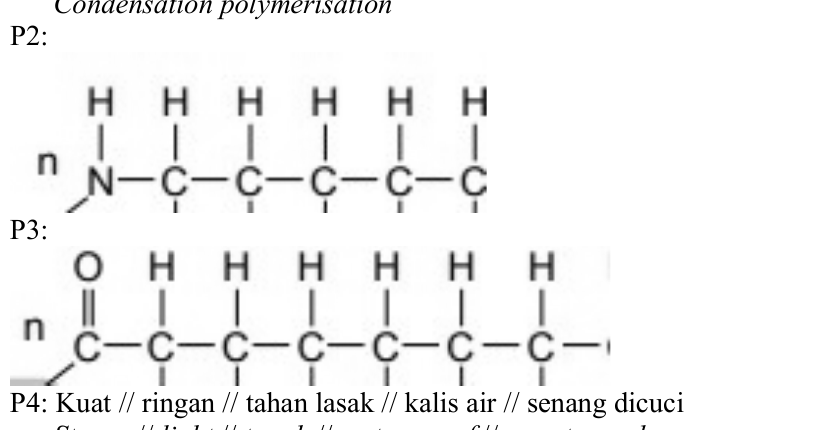
- (b)
Polythene is one of the examples of polymer. Polythene is widely used as plastic bags. State two characteristics of polythene that make it suitable to be used as plastic bags. Then, suggest two ways to reduce the pollution of this polymer.
[4] - (c)(i)
Based on Diagram 10.2, suggest process Z. How can process Z increase the elasticity of natural rubber?
[3]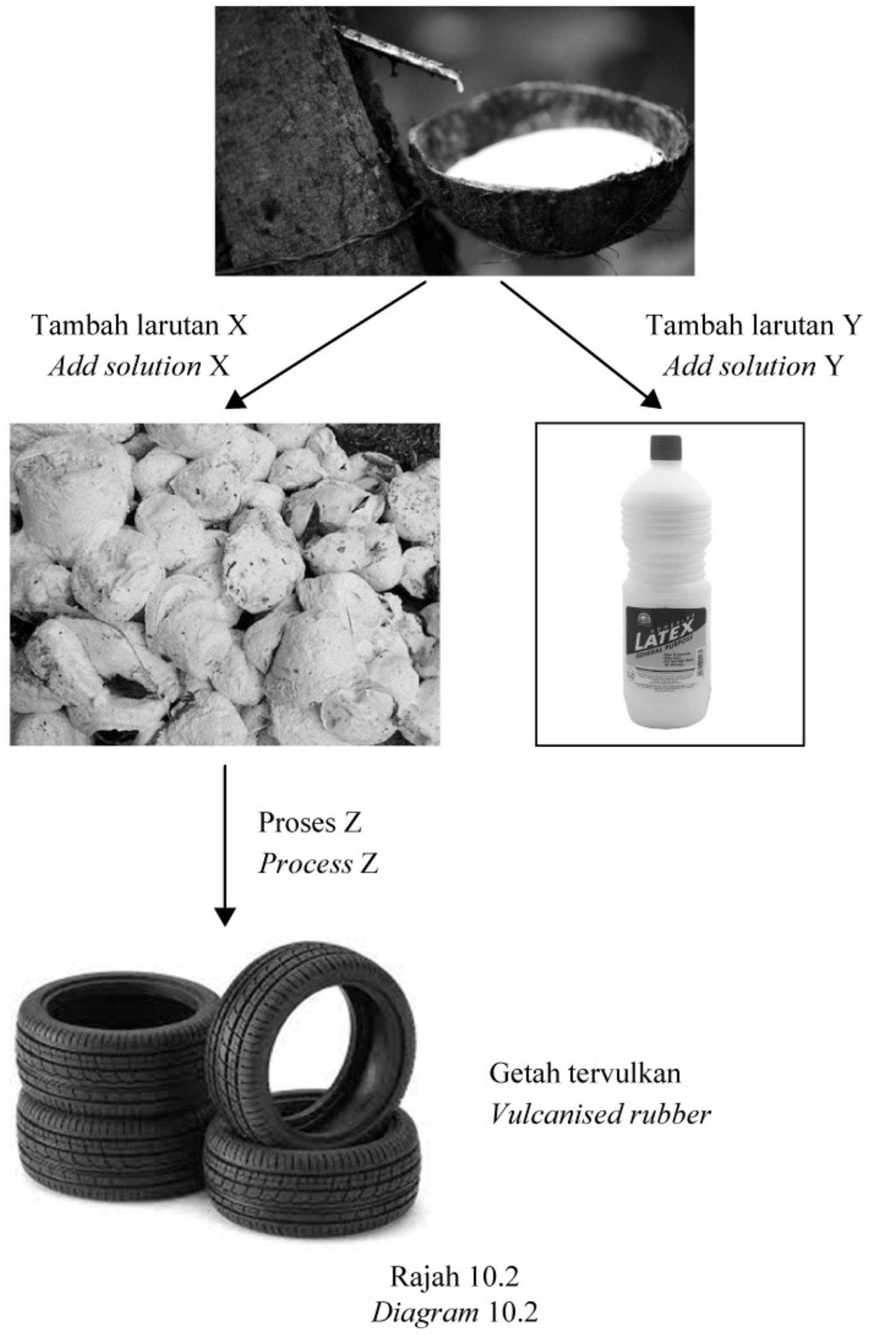
- (c)(ii)
Identify solution X and solution Y. Explain why the physical state of latex is different when solution X and solution Y are added into fresh latex.
[9]
Section C
Diagram 11 shows Kamal's recent discovery. Kamal says: 'Hi, friends! Do you know that some chemicals smell fragrant? This one I have here is propyl ethanoate produced from alcohol P and carboxylic acid Q.'
Medium20 marks- (a)(i)
Suggest the name of alcohol P and carboxylic acid Q that can be used to produce propyl ethanoate. State the functional group of propyl ethanoate and draw the structural formula of propyl ethanoate.
[4] - (a)(ii)
Propyl ethanoate can be prepared through process X. Identify process X. Describe an experiment on how to prepare propyl ethanoate in the laboratory. In your description, include the balanced chemical equation for this process.
[9] - (a)(iii)
Calculate the mass of alcohol P that is used when 5.1 g of propyl ethanoate is produced in process X. [Relative atomic mass: H = 1, C = 12, O = 16]
[3] - (b)
Mr. Metiren plans to buy a new car but he was confused between petrol and diesel engines. After he learned that diesel, C₁₅H₂₈ is a hydrocarbon that has a greater number of carbon atoms per molecule than petrol, C₈H₁₈, Mr. Metiren chose to buy a car with a diesel engine. In your opinion, did he make the right decision? Justify your answer.
[4]