Write your answer on paper. Then open the answer to check it.
Section A
Diagram 1 shows the structural formula of two different types of rubber, rubber X (long chains of isoprene units with no links between chains) and rubber Y (chains joined by sulphur (S-S) cross-links).
Medium5 marks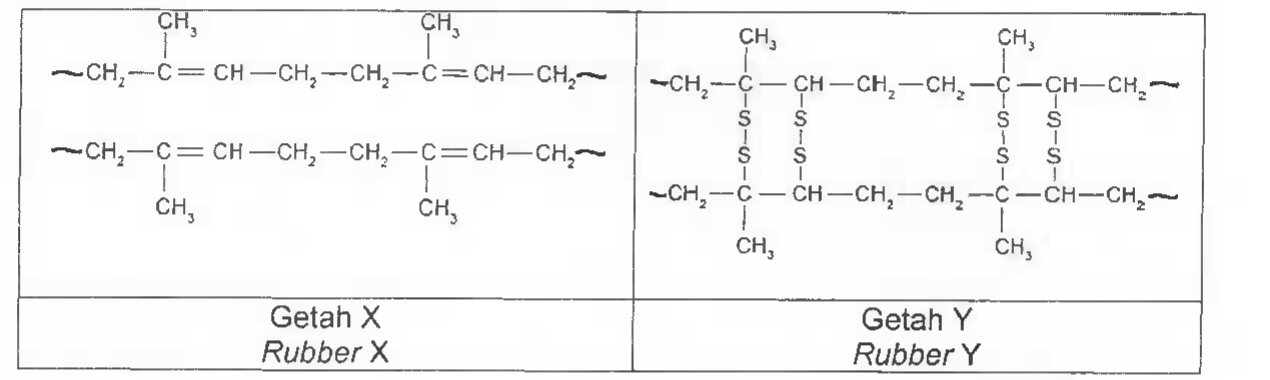
- (a)
State the types of rubber X and rubber Y.
[2] - (b)
State one example of product made of rubber Y.
[1] - (c)
When rubber X is heating with sulphur, rubber Y is produced. Name the process.
[1] - (d)
State one different characteristic between rubber X and rubber Y.
[1]
Diagram 2 shows part of the Periodic Table of Elements. A, B, C, D, E, F are not the actual symbols of the elements.
Medium5 marks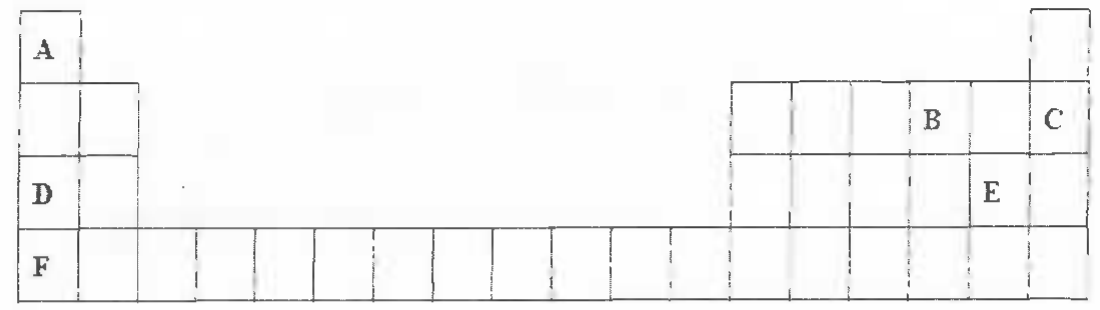
- (a)
What is the basic principle used in arranging the elements in the Periodic Table of Elements?
[1] - (b)
State two elements that are placed in the same group.
[1] - (c)
Write the electron arrangement for atom B.
[1] - (d)
Atomic size of E is smaller than atomic size of D. Explain.
[2]
Table 3 shows the empirical formulae and molecular formulae of two compounds. Compound M: molecular formula C4H8 (empirical formula blank). Compound J: empirical formula Zn(NO3)2, molecular formula Zn(NO3)2.
Medium6 marks
- (a)
State the meaning of empirical formula.
[1] - (b)
Write empirical formula of compound M.
[1] - (c)(i)
When compound J is heated strongly, it will decompose to form zinc oxide, oxygen gas and nitrogen dioxide gas. Write a balanced chemical equation for the decomposition of compound J.
[2] - (c)(ii)
If 1 mole of compound J is heated, calculate the volume of gas nitrogen dioxide produced at room condition. [Molar volume of gas at room condition is 24 dm³ mol⁻¹]
[2]
Siti and Ayu wash a shirt using sea water. Siti using cleaning agent A while Ayu using cleaning agent B. Table 4.1 shows the molecular formula of cleaning agent A (CH3(CH2)14COONa) and cleaning agent B (CH3(CH2)nCH2-O-SO2-ONa, a sulphonate/sulphate detergent).
Medium7 marks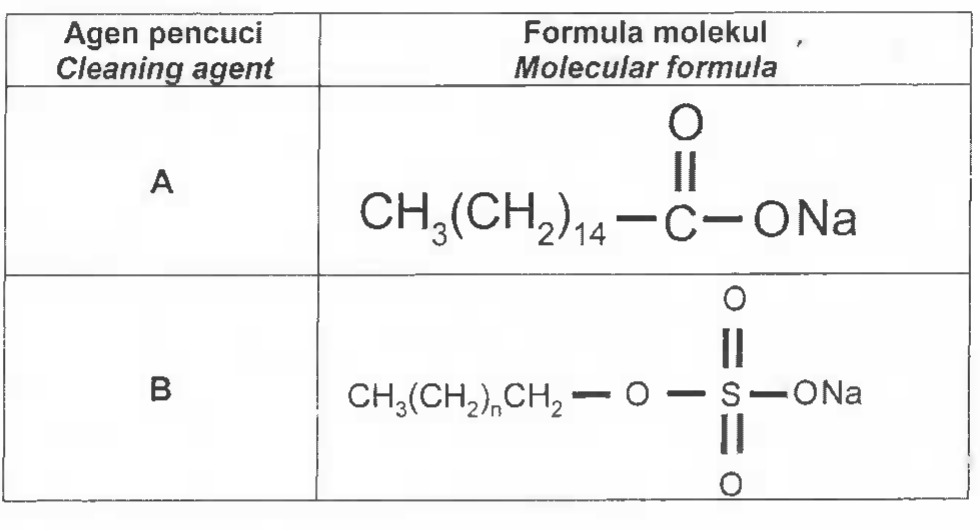
- (a)(i)
Which of the cleansing agent is soap?
[1] - (a)(ii)
State the name of the process of making soap.
[1] - (a)(iii)
The reaction between palmitic acid, CH3(CH2)14COOH in cooking oil and sodium hydroxide is a process of making soap. Write the chemical equation involved.
[2] - (b)
Diagram 4.2 shows situation I (sea water + cleaning agent A) and situation II (sea water + cleaning agent B) on cleansing action on dirty clothes with an oily stain in sea water. In situation I the stain remains on the shirt; in situation II the shirt is clean. Based on Diagram 4.2, which situation the cleaning agent action is less effective? Explain your answer.
[3]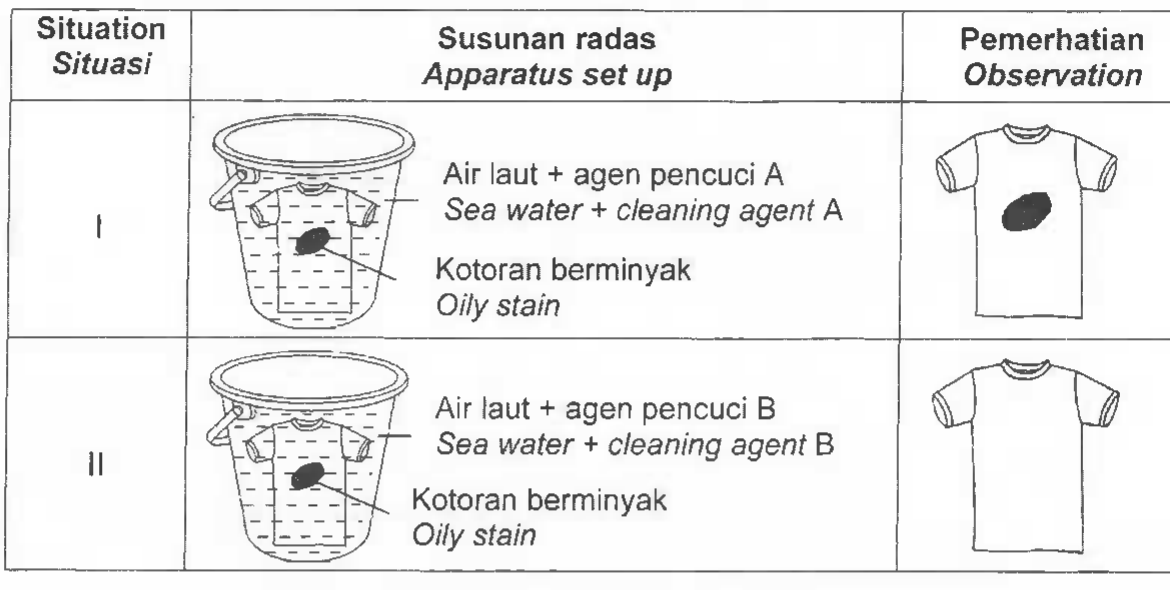
Diagram 5.1 shows the electron arrangement of sodium chloride compound (Na⁺ and Cl⁻ ions). Diagram 5.2 shows the electron arrangement of compound X formed when oxygen reacts with carbon (carbon dioxide, CO2).
Medium8 marks- (a)(i)
State the type of bond for sodium chloride compound.
[1]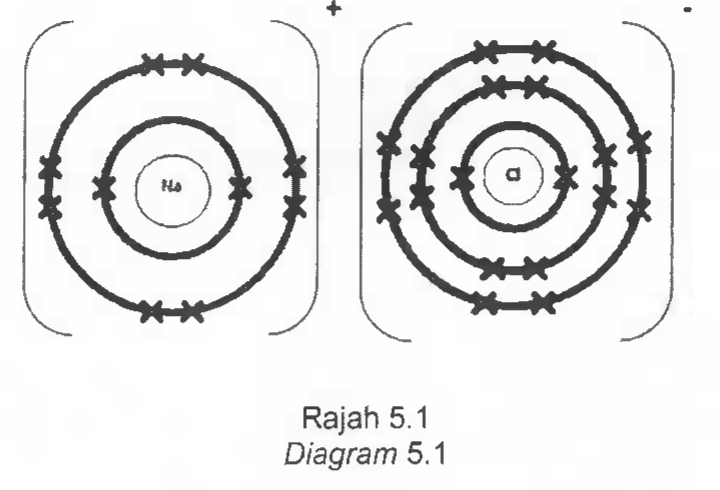
- (a)(ii)
How are sodium ion and chloride ion formed from their respective atoms?
[2] - (b)(i)
State the one properties of compound X.
[1]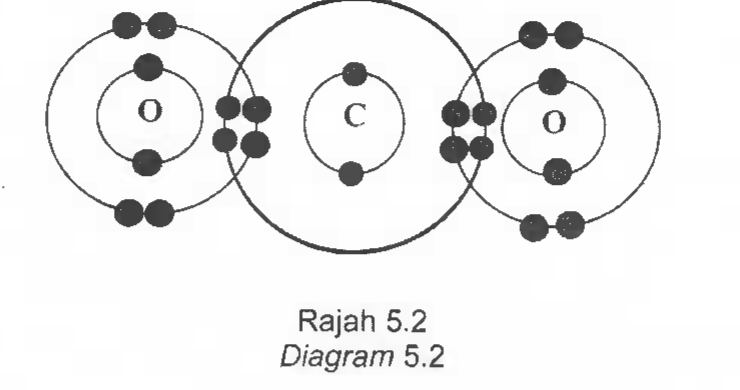
- (b)(ii)
Chemical equation below shows the reaction between compound X and ammonia to form urea and water. Complete and balance the equation: ........ NH3 + CO2 → (NH2)2CO + ..............
[2] - (b)(iii)
If 24 dm³ of gas X reacts with ammonia, calculate the mass of urea formed. [Molar mass of urea = 60 g mol⁻¹, Molar volume of gas at room conditions is 24 dm³ mol⁻¹]
[2]
Diagram 6 shows a series of reactions that involved salt W. Salt W is heated to give CuO + brown gas + gas Q (reaction on heating). CuO + solution R gives salt W (reaction II). Salt W + solution S gives CuCO3 + solution Z (reaction III).
Medium9 marks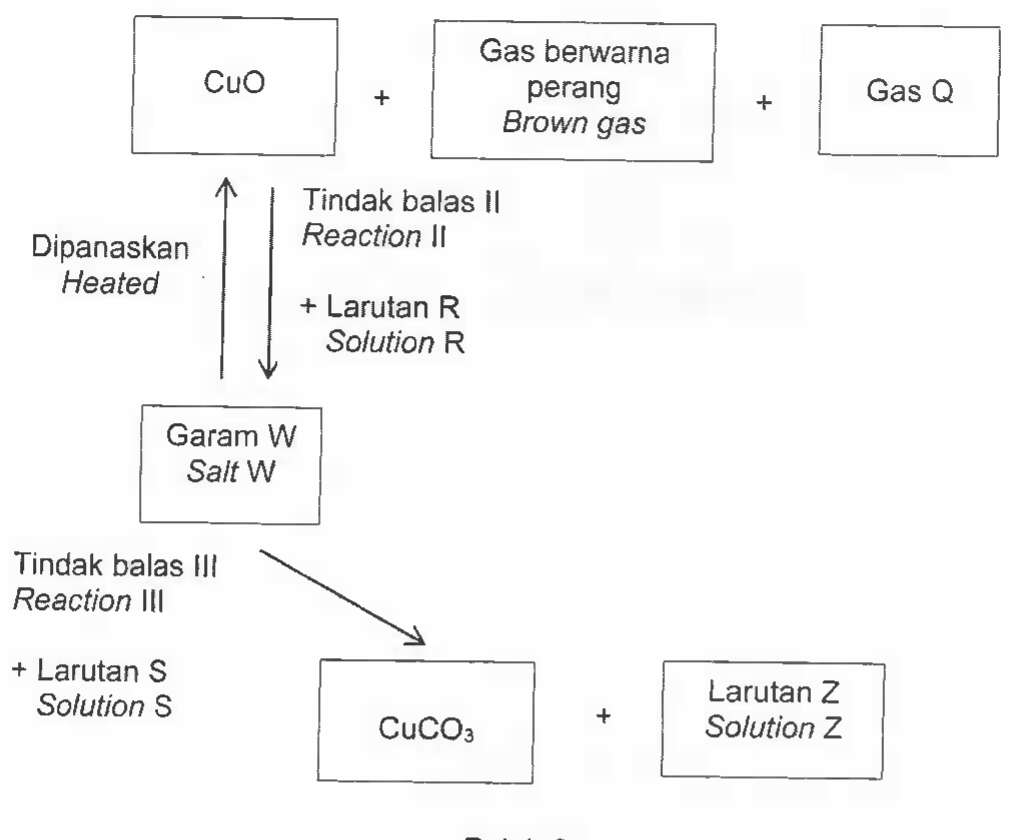
- (a)(i)
State the colour of CuO.
[1] - (a)(ii)
The solid of CuO can be changed into salt W through the reaction II. Suggest a chemical that is suitable for changing the solid of CuO to salt W.
[1] - (b)
Write a chemical equation to represent the decomposition of salt W by heat.
[2] - (c)
State the observation when excess ammonia solution is added into solution of salt W.
[2] - (d)
Based on reaction III, solution S was added into salt W produce two types of salt, that are CuCO3 and Z solution. Describe a chemical test to identify the anion present in Z solution.
[3]
Diagram 7 shows a bottle of liquid disinfection that contain compound X (structural formula CH3CH2OH). Besides compound X, compound Y with a fruity smell is also found in the liquid disinfection.
Medium10 marks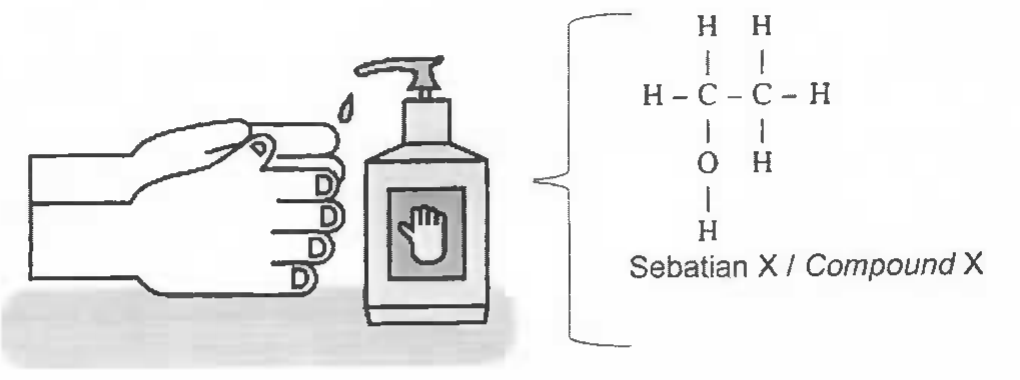
- (a)(i)
State the homologous series of compound X.
[1] - (a)(ii)
State the name of compound X.
[1] - (a)(iii)
Compound X is known as a clean fuel. The combustion of compound X produces blue flame without soot. Write a chemical equation for the combustion of compound X.
[2] - (b)(i)
Compound Y which is propyl butanoate can be prepared through reaction Z between alcohol P and compound Q. Name the reaction Z.
[1] - (b)(ii)
State the name of compound Q.
[1] - (b)(iii)
Write a chemical equation for the reaction Z.
[2] - (c)
During Covid-19 pandemic, usage of liquid sanitizer that contains up to 70% of X compound is necessary measure to prevent spreading of germs. Based on medical expert, washing hand routine using soap and water is more effective than using liquid sanitizer. Suggest why liquid sanitizer is preferred than traditional soap and water routine?
[2]
Diagram 8 shows the apparatus set-up by a student to carry out an experiment to determine the heat of neutralisation between nitric acid and sodium hydroxide solution (25 cm³ of 1.0 mol dm⁻³ sodium hydroxide poured into 25 cm³ of 1.0 mol dm⁻³ nitric acid in a polystyrene cup). Table 8: initial temperature of nitric acid 28.0 °C; initial temperature of sodium hydroxide solution 28.0 °C; highest temperature of the reaction mixture 34.0 °C.
Medium10 marks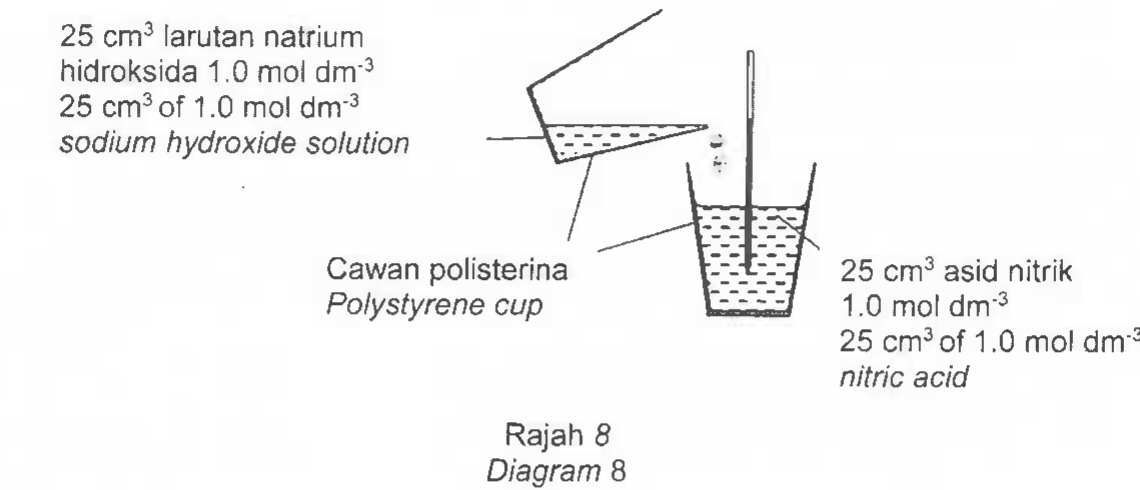
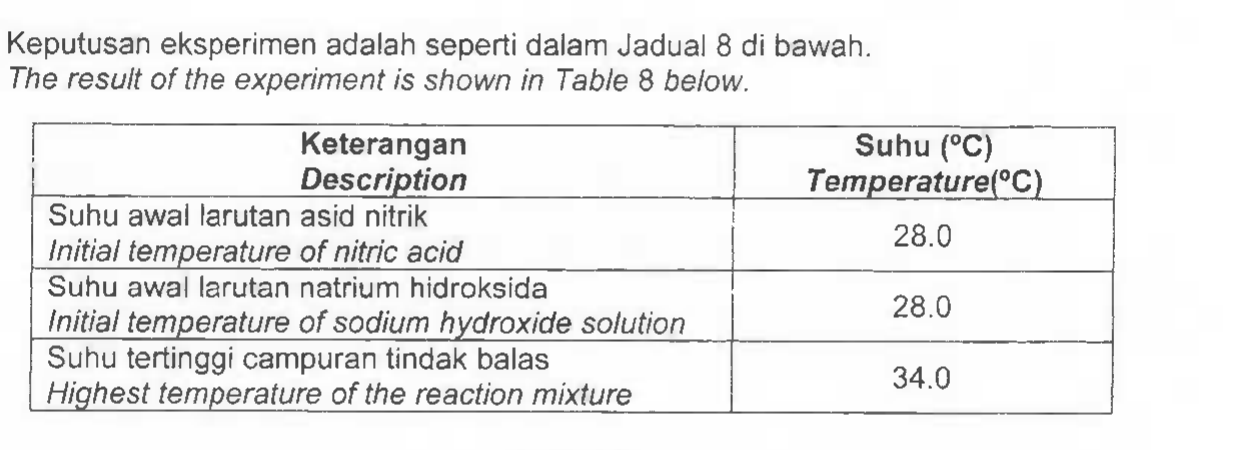
- (a)
What is the meaning of heat of neutralization for this experiment?
[1] - (b)
Suggest one apparatus that can be used to replace polystyrene cup in this experiment.
[1] - (c)(i)
Based on the experiment, calculate the heat change in the reaction. [Specific heat capacity = 4.2 J g⁻¹ °C⁻¹]
[1] - (c)(ii)
Calculate the heat of neutralization of the experiment.
[3] - (d)(i)
The experiment is repeated by using 25 cm³ of 1.0 mol dm⁻³ of sulphuric acid to replace the nitric acid. Predict the value of heat of neutralization for the experiment.
[1] - (d)(ii)
Explain your answer in 8(d)(i).
[1] - (e)
A mountain climber went to warm his hands and feet. He used a special pack that contains anhydrous calcium chloride that dissolves in water and releases heat of 85 kJ mol⁻¹: CaCl2(s) → Ca²⁺(aq) + 2Cl⁻(aq). Draw the energy level diagram that shows the heat change occurred.
[2]
Section B
Diagram 9 shows two situations of grilling 500 g of meat (Situation A: small pieces of meat on a grill over fire; Situation B: one large piece of meat). Table 9 shows information about the reactants and temperature used in three experiments to study the factors affecting the rate of a reaction between calcium carbonate and hydrochloric acid, which produces gas X that makes lime water chalky. Experiment I: excess calcium carbonate chips and 30 cm³ of 0.5 mol dm⁻³ hydrochloric acid, 35 °C, time to collect 50 cm³ of gas 50 s. Experiment II: excess calcium carbonate chips and 30 cm³ of 0.5 mol dm⁻³ hydrochloric acid, 45 °C, 30 s. Experiment III: excess calcium carbonate chips and 30 cm³ of 1.0 mol dm⁻³ hydrochloric acid, 45 °C, 20 s.
Medium20 marks- (a)
Based on Diagram 9, in which situation meat will cook faster and state the factor that affect the rate of cooking meat.
[2]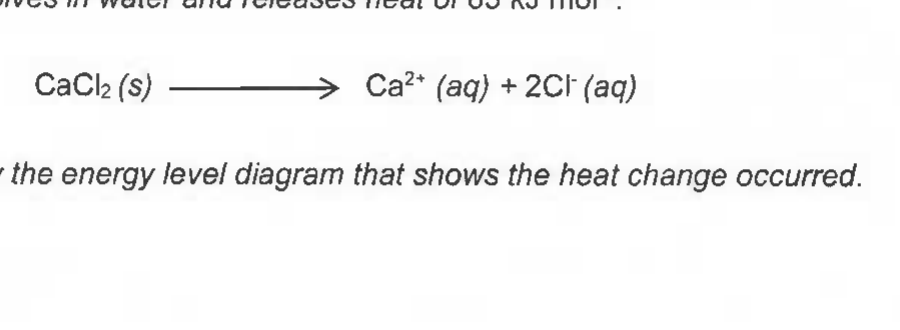
- (b)(i)
What is meant by rate of reaction and state the name of gas X produced.
[2]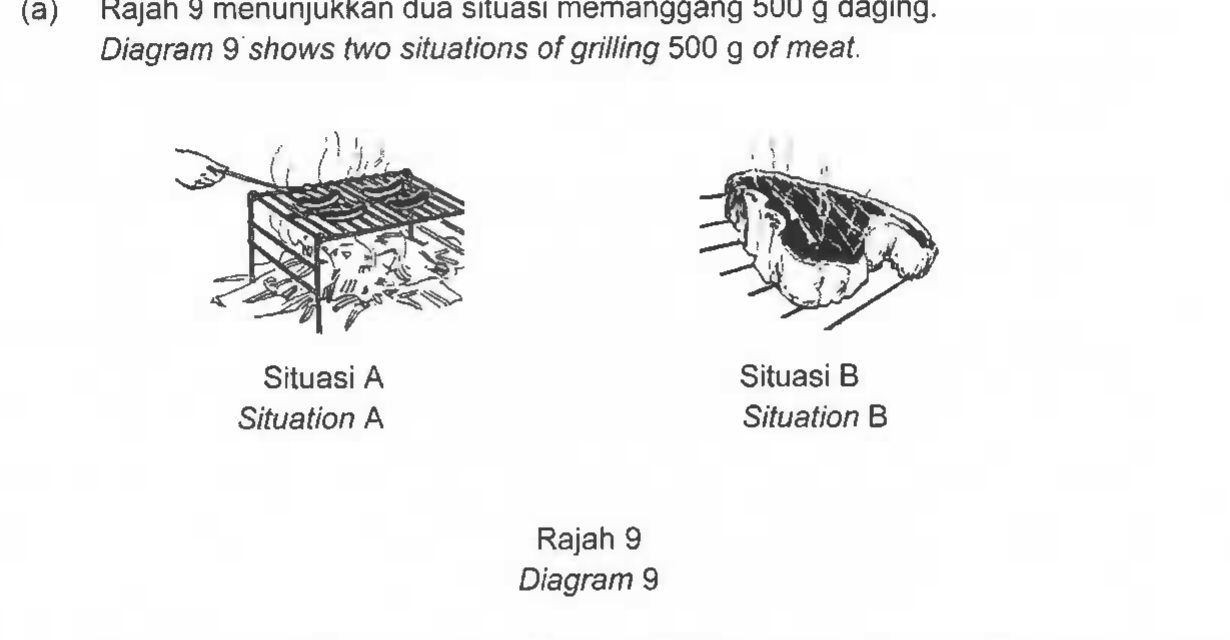
- (b)(ii)
Write the chemical equation for the reaction between calcium carbonate and hydrochloric acid. Calculate the maximum volume of carbon dioxide gas produced in experiment I. [Molar volume of gas at room condition is 24 dm³ mol⁻¹]
[5] - (b)(iii)
Calculate the average rate of reaction for Experiment II.
[1] - (b)(iv)
Compare the rate of reaction between Experiment I and Experiment II, and between Experiment II and Experiment III. Explain your comparisons with reference to the Collision Theory.
[10]
Three parts: (a) solutions P and Q of same concentration but different pH; (b) titration of sulphuric acid with potassium hydroxide; (c) hydrogen chloride dissolved in solvent X and solvent Y.
Medium18 marks- (a)
Table 10.1 shows information about solution P and solution Q with same concentration but different pH value. P: pH value less than 7; reacts with copper(II) oxide to produce copper(II) nitrate and water. Q: pH value less than 7; reacts with sodium hydroxide solution to produce sodium ethanoate and water. Based on the Table 10.1, state the name of solution P and solution Q. Which solution shows higher pH value and explain your answer.
[4]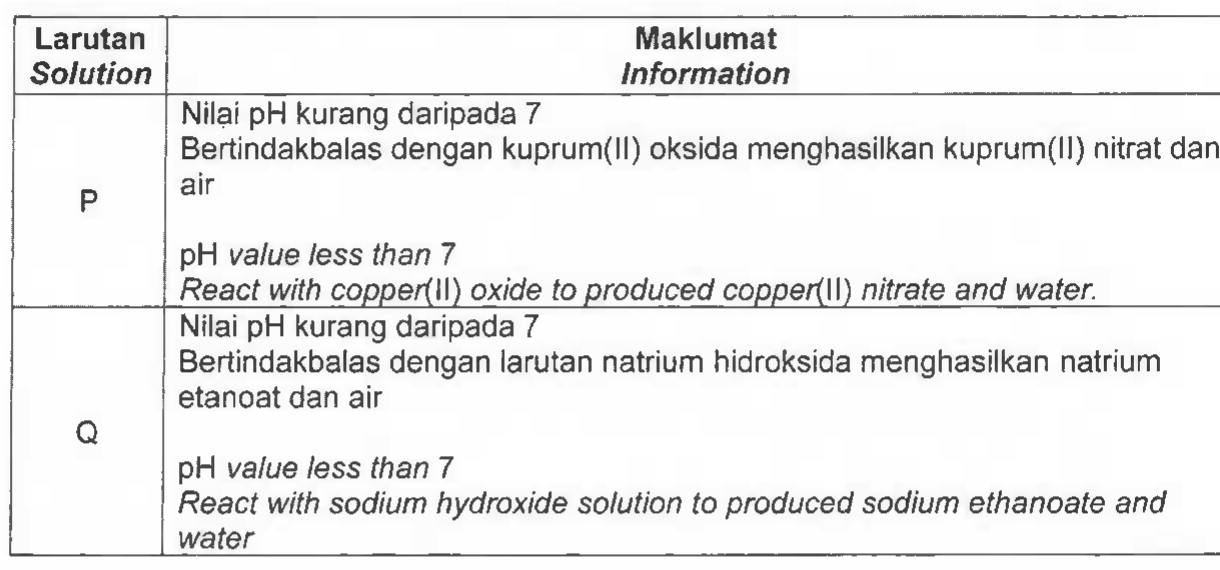
- (b)
Diagram 10.2 shows set-up of apparatus used in titration of acid and alkali: sulphuric acid in the burette, 20.0 cm³ potassium hydroxide 0.5 mol dm⁻³ + phenolphthalein in the conical flask. State the type of reaction that occurred in conical flask. Write the chemical equation, hence calculate molarity of sulphuric acid if end point of titration is 10.0 cm³.
[6]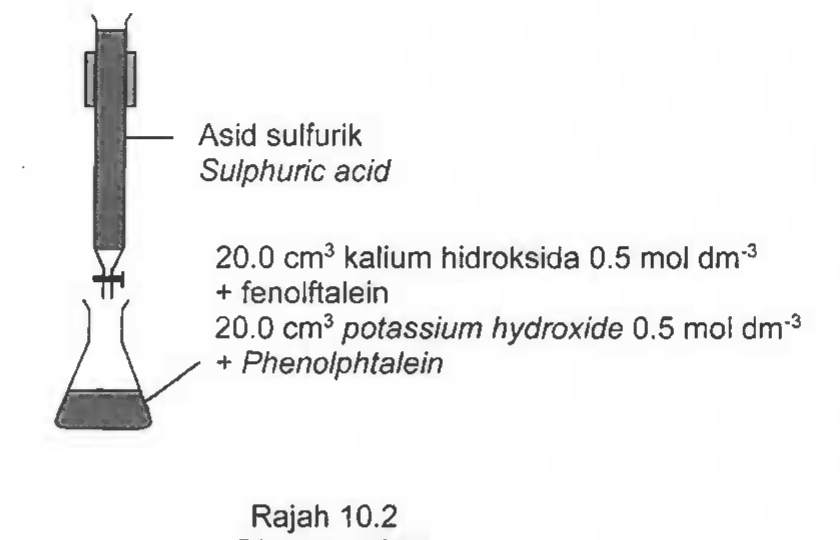
- (c)
Table 10.3 shows set-up of apparatus for two sets of experiment to investigate electric conductivity and one of acid properties when hydrogen chloride dissolved in solvent X and solvent Y. Set I: carbon electrodes in HCl in solvent X (bulb lights up) and HCl in solvent Y (bulb does not light up). Set II: HCl in solvent X or Y added to calcium carbonate, gas passed into lime water. Suggest solvent X and solvent Y. Explain the differences of observation in both sets of experiments.
[8]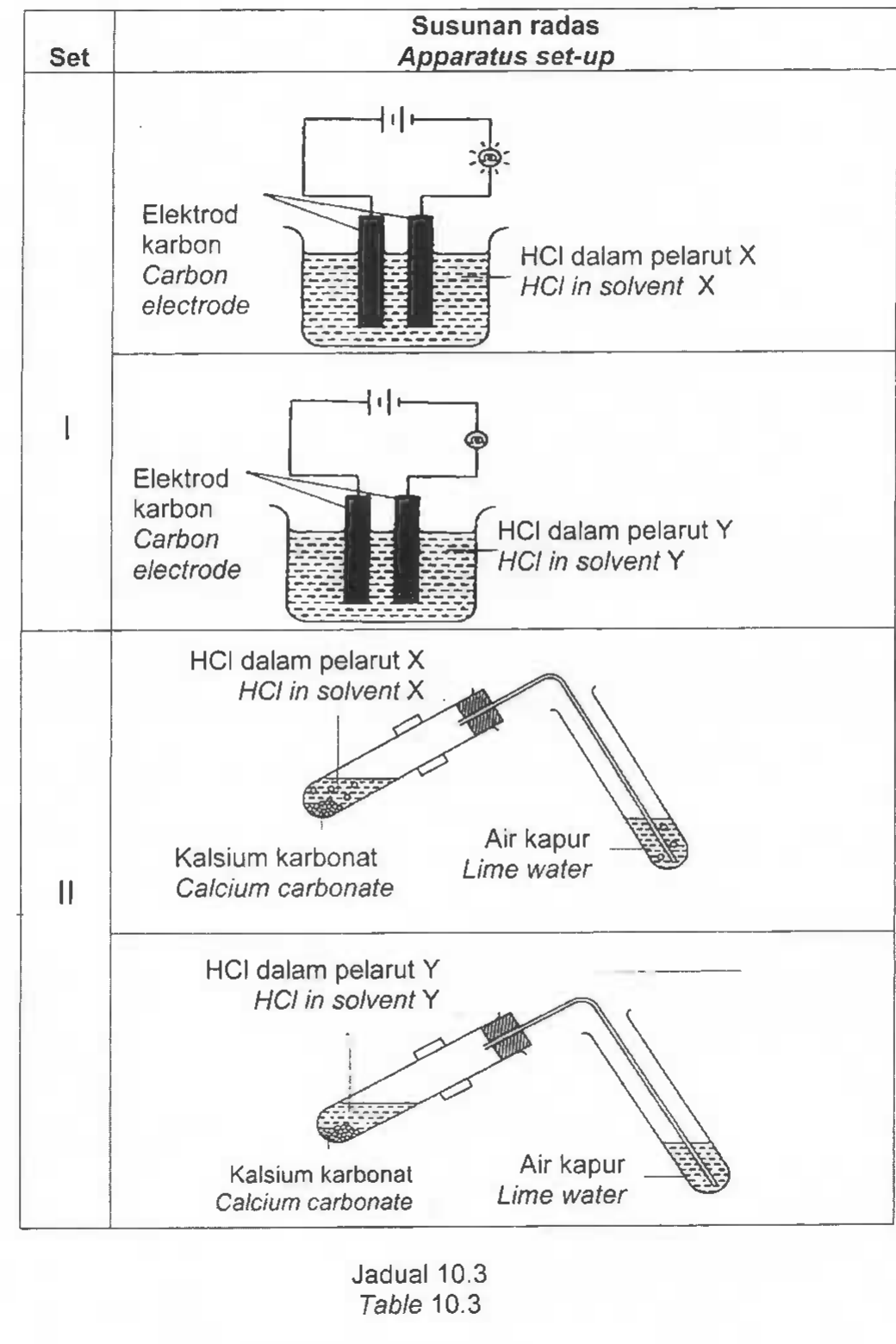
Section C
Redox reaction at a distance, strengths of oxidising/reducing agents using standard electrode potentials, and factors affecting electrolysis.
Hard20 marks- (a)(i)
What is meant by redox reaction?
[1] - (a)(ii)
Table 11.1 shows the lists of apparatus and material needed by the students: U-tube, connecting wire, galvanometer, carbon electrodes, bromine water, potassium iodide solution, sulphuric acid. Draw one labelled diagram to show the apparatus set-up to conduct the experiment. The diagram must include the apparatus and materials given in Table 11.1. In your diagram, draw the arrows to show the direction of electron flow. Then, write half equation for oxidation and half equation for reduction.
[5]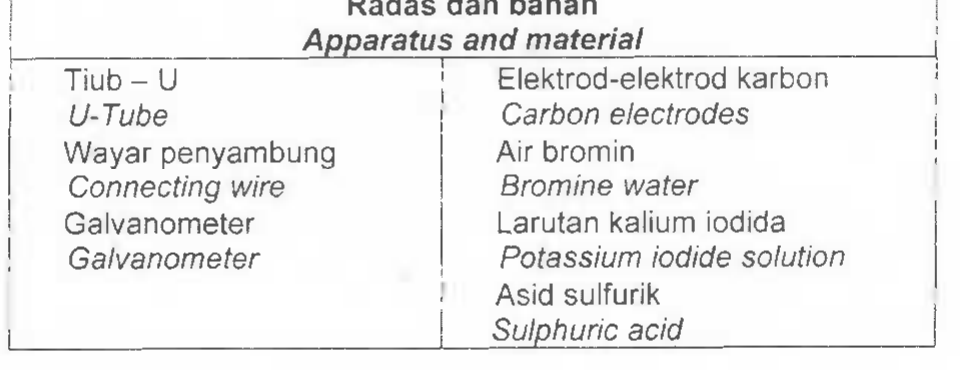
- (b)
Table 11.2 shows the observation for the reaction between metal X with two different salt solutions: copper(II) sulphate (brown deposit is formed); zinc sulphate (no change). Given the standard electrode potential values: X²⁺ + 2e ⇌ X, E° = −0.13 V; Cu²⁺ + 2e ⇌ Cu, E° = +0.34 V; Zn²⁺ + 2e ⇌ Zn, E° = −0.76 V. Based on E° value given, arrange the atoms or ions in an ascending order of the strength of oxidising agents and reducing agents. Next, explain why there are differences in observation obtained in the Table 11.2.
[7]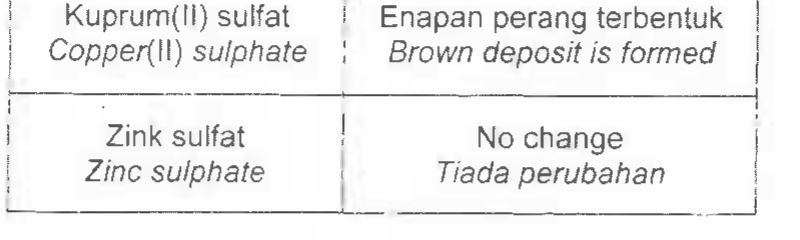
- (c)(i)
A student carried out an experiment to study one of the factors affecting electrolysis. Table 11.3 shows the observation for two sets of experiment (carbon electrodes). Set I: cathode colourless gas bubbles; anode greenish yellow gas bubbles. Set II: cathode colourless gas bubbles; anode colourless gas bubbles. By using a suitable electrolyte, describe an experiment that can be carried out to obtain the observation as in the Table 11.3.
[4]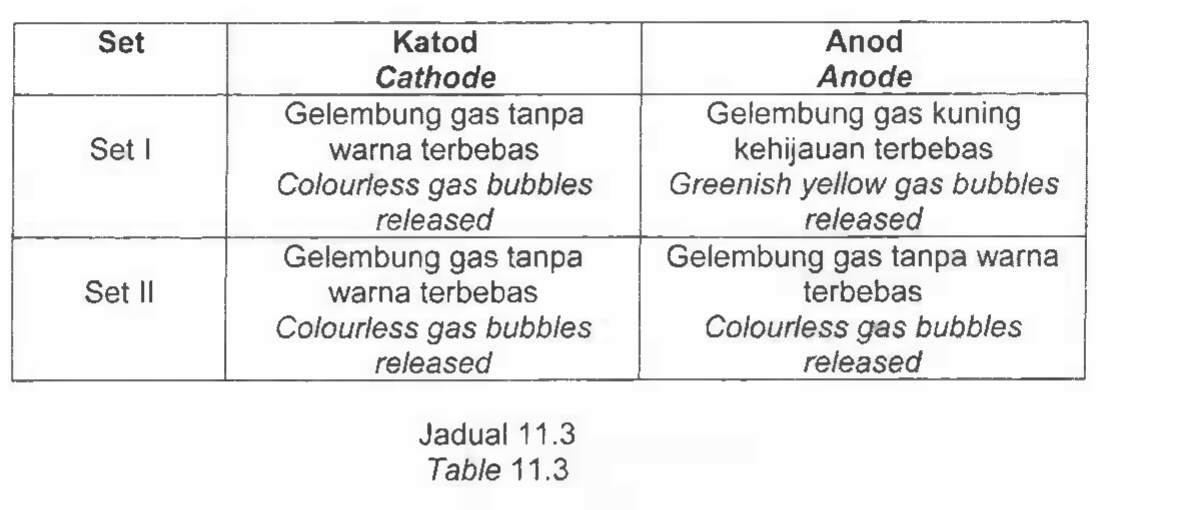
- (c)(ii)
Explain why there are differences in the observation at anode. E° is given: O2 + 2H2O + 4e ⇌ 4OH⁻, E° = +0.40 V; Cl2 + 2e ⇌ 2Cl⁻, E° = +1.36 V.
[3]