Write your answer on paper. Then open the answer to check it.
Section A
Table 1 shows four substances and its chemical formula: Helium He; Chlorine Cl₂; Naphthalene C₁₀H₈; Zinc chloride ZnCl₂.
Medium5 marks
- (a)
List all subatomic particle in an atom.
[1] - (b)
Zinc chloride is a chemical substance. State the particles present in the substance.
[1] - (c)
What is the physical state of chlorine in room condition?
[1] - (d)
Classify the substances into element and compound.
[2]
Diagram 2 shows the structural formula of polypropene, a polymer used in some type of plastic products (repeating unit: -[CH(H)-C(CH₃)H]n-).
Medium5 marks
- (a)
Draw and name the monomer of polypropene.
[2] - (b)
Name the type of polymerisation reaction that produces polypropene?
[1] - (c)
One of the uses of polypropylene is in the textiles industry. State two achievements of nanotechnology in textile industry?
[2]
Diagram 3.1 shows the trophy won by Ali's school in 2021 in the Young Scientist Competition. The trophy is made from bronze. Diagram 3.2 shows a set up apparatus of heating sodium carbonate salt in a test tube; after 5 minutes the test tube changed shape.
Medium6 marks
- (a)(i)
State the main element in bronze.
[1] - (a)(ii)
Draw the arrangement of atoms in bronze.
[2] - (c)
Izan heats the sodium carbonate salts in the test tube. After 5 minutes it was found that the test tube changed its shape. As a chemistry student, suggest a more suitable apparatus to be used to replace the test tube and explain why. Give one reason.
[3]
Table 4 shows examples of monomers that form natural polymers and the molecular formula of the monomer: Glucose C₆H₁₂O₆ (starch and cellulose); Isoprene C₅H₈ (natural rubber); Amino acid C₂H₄NH₂COOH (protein).
Medium7 marks
- (a)
State the meaning of empirical formula. (The Malay text asks for 'formula molekul'.)
[1] - (b)
State the empirical formula for glucose.
[1] - (c)
Glucose is needed by the human body to produce energy through aerobic processes. The overall chemical equation for aerobic respiration is C₆H₁₂O₆ + 6O₂ → 12H₂O + 6CO₂. State the qualitative information that can be obtained based on the chemical equation.
[1] - (d)
Farid wants to diversify his family's rubber-based factory products from surgical gloves to car tyres. As a chemistry student, explain how you can help Farid produce stronger and more elastic rubber. Explain why the produced rubber has properties that are so different compared to the original properties of the rubber.
[4]
Table 5 shows the information of elements in the Periodic Table of Elements; the letters are not the actual symbols. Element: P Q R S T U V; proton number 11 12 13 14 15 16 17; property of oxide: Basic, Basic, (blank for R), Acidic, Acidic, Acidic, Acidic.
Medium8 marks
- (a)
State the property of R oxide.
[1] - (b)
State the period for these elements.
[1] - (c)(i)
State the change in the atomic size of the elements from left to right in Periodic Table of Elements.
[1] - (c)(ii)
Give reasons for your answer in (c)(i).
[2] - (d)(i)
P reacts with V to form a compound. Name the type of bond formed.
[1] - (d)(ii)
Write the chemical equation for the formation of the formed compound.
[2]
Diagram 6 shows the structural formulae of compounds P (pentane), Q (2-methylbutane), R (pent-2-ene) and T (2-methylbut-2-ene). Compounds P and Q are isomers of a saturated hydrocarbon while compounds R and T are isomers of an unsaturated hydrocarbon.
Medium9 marks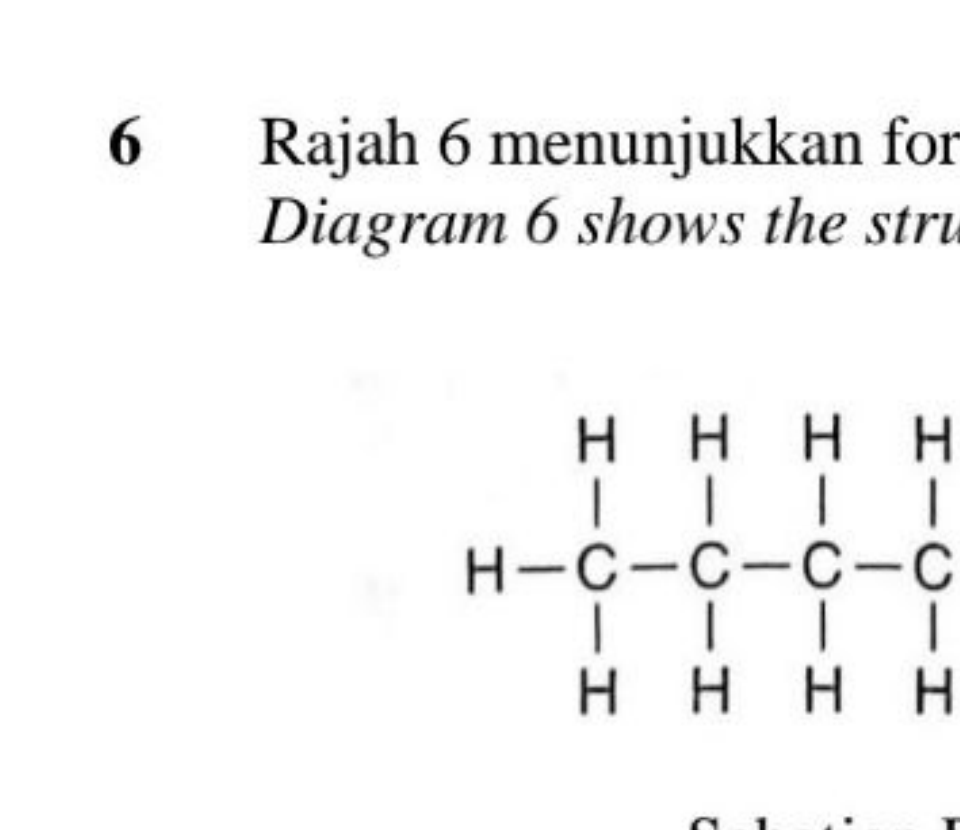
- (a)
What is meant by isomer?
[1] - (b)
Name compound T according to the IUPAC nomenclature.
[1] - (c)
Draw the structural formula for another isomer of carbon compounds P and Q.
[1] - (d)
Compound R can be converted to compound P. Write the chemical equation for the addition reaction that occurs.
[2] - (e)
The chemical equation below shows a complete combustion reaction of 300 cm³ of compound P: __C₅H₁₂ + __O₂ → __H₂O + __CO₂. Balance the chemical equation and calculate the mass of carbon dioxide gas formed. [Relative atomic mass: C=12, O=16, Molar volume = 24 dm³ mol⁻¹ at room temperature]
[4]
Diagram 7.1 shows the electron arrangement of carbon atom, oxygen atom and magnesium atom. Diagram 7.2 shows the diamond structure and methane structure; diamond and methane are covalent compounds.
Medium10 marks
- (a)(i)
Oxygen atom reacts with magnesium atom to form a compound. What is the type of compound formed?
[1] - (a)(ii)
Draw a diagram of the electron arrangement of the compound formed.
[2] - (b)
State the physical properties of covalent compound?
[1] - (c)(i)
Compare the melting point and boiling point of diamonds and methane.
[1]
- (c)(ii)
Predict the electrical conductivity of diamonds. Justify your answer.
[2] - (d)
Copper, Cu is a metal that is commonly used in the manufacturing of electric wires. Explain briefly how this metal can conduct electricity.
[3]
Table 8 shows the information obtained in determining the heat of precipitation of lead(II) sulphate. The experiment was conducted by mixing 25 cm³ of 0.5 mol dm⁻³ lead(II) nitrate solution with 25 cm³ of 0.5 mol dm⁻³ potassium sulphate solution. Initial temperature of lead(II) nitrate solution 28.0 °C; initial temperature of potassium sulphate solution 29.0 °C; highest temperature of the mixture 33.0 °C.
Medium10 marks
- (a)
What is meant by the heat of precipitation for the experiment.
[1] - (b)
Write the ionic equation for this reaction.
[1] - (c)(i)
Calculate the number of moles of lead(II) ions present in the solution.
[1] - (c)(ii)
Calculate the number of moles of sulphate ions present in the solution.
[1] - (d)
Calculate the heat change that occurs in this reaction. [Specific heat capacity = 4.2 J g⁻¹ °C⁻¹, density of the solution = 1 g cm⁻³]
[1] - (e)
Calculate the heat of precipitation of this reaction.
[1] - (f)
Draw an energy level diagram for this precipitation reaction.
[2] - (g)
During a soccer match, a player found his knee swollen after colliding with an opposing player. Physiotherapists have placed ice packs on the player's knee to ease the pain. As a chemistry student, suggest other methods to help the player to relieve the pain. Explain how?
[2]
Section B
Diagram 9.1 shows the equation reaction between magnesium and acid P: Mg + Acid P → Salt Q + H₂. Acid P is a monoprotic acid. Diagram 9.2 shows a flow chart of magnesium salt: magnesium sulphate, MgSO₄, magnesium chloride, MgCl₂ and magnesium nitrate, Mg(NO₃)₂ can be converted to magnesium carbonate, MgCO₃ (plus salt T) through reaction I with solution R. MgCO₃ decomposes through reaction II to form MgO and gas P.
Medium20 marks- (a)
Based on Diagram 9.1, state the meaning of monoprotic acid and state one physical property for this acid. Suggest acid P and identify salt Q.
[4]
- (b)(i)
Choose one of the 3 magnesium salts that will react with solution R through reaction I to produce magnesium carbonate, MgCO₃ and salt T, and suggest the appropriate solution R as well as write the chemical equation involved.
[3]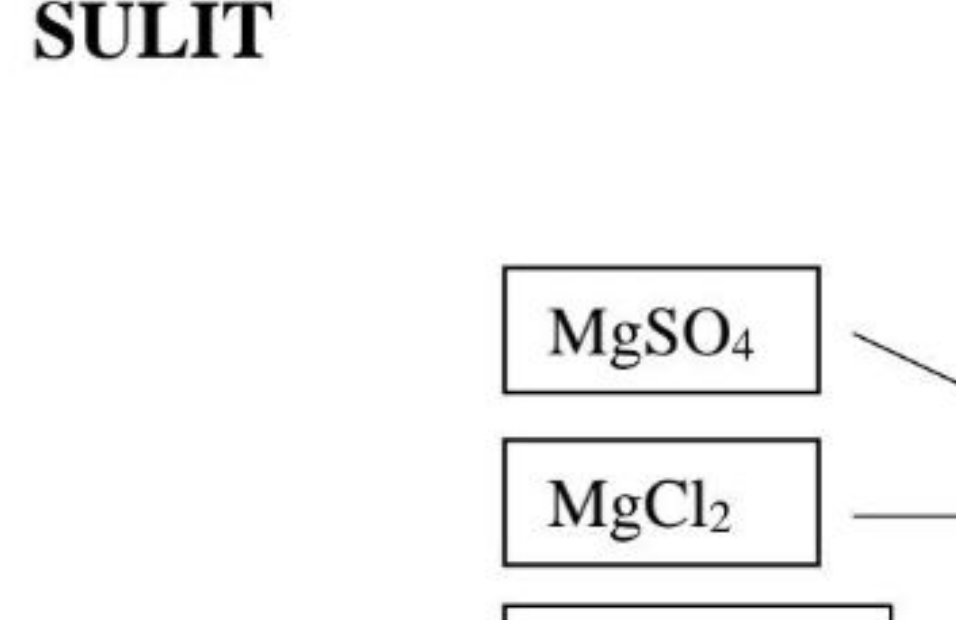
- (b)(ii)
Name reaction II and explain how to test for the presence of gas P.
[3] - (c)
An experiment is carried out to study the acidic properties and electrical conductivity of solutions A and B. Solution A: glacial ethanoic acid + solvent K; solution B: glacial ethanoic acid + solvent L. Diagram 9.3 shows the observation for two sets of the experiment (Set I: marble chips added to each solution; Set II: carbon electrodes, battery and bulb). Based on Diagram 9.3, identify solvent K and solvent L. Explain why there are differences in the observations in Set I and Set II. Write the chemical equation for the reaction that occurs in Set I.
[10]
Table 10 shows two sets of reaction experiments between marble, CaCO₃ and hydrochloric acid. Time taken to collect 50 cm³ of carbon dioxide gas: Set I: 5.0 g marble chips + 50 cm³ of 0.5 mol dm⁻³ HCl at room temperature, 50 s; Set II: 5.0 g marble powder + 50 cm³ of 0.5 mol dm⁻³ HCl at room temperature, 20 s.
Medium20 marks
- (a)(i)
State the meaning of rate of reaction in this experiment and the factor that affects the rate of reaction.
[2] - (a)(ii)
Write the chemical equation for Set I. Calculate the average rate of reaction for Set I and Set II. Based on your answer, compare the rate of reaction between two sets and explain the comparison using collision theory.
[8] - (b)
Diagram 10 shows the graph of volume of carbon dioxide gas against time for two sets of experiment, I and II. Suggest another two methods to conduct the experiment, in order to obtain the graph as in Set II.
[2]
- (c)
Using Set I in Table 10, describe the procedure for conducting the experiment.
[8]
Section C
Diagram 11.1 shows the apparatus arrangement of a chemical cell (voltaic cell) in a redox reaction: magnesium in magnesium nitrate solution and silver in silver nitrate solution joined by a salt bridge and a voltmeter. E° values: Mg²⁺(aq) + 2e⁻ ⇌ Mg(s), E° = −2.38 V; Ag²⁺(aq) + e⁻ ⇌ Ag(s), E° = +0.80 V (as printed).
Medium20 marks- (a)
What is meant by a redox reaction and state the negative terminal and positive terminal of this cell. Next, write the ionic equation and cell notation for the cell.
[7]

- (b)
Diagram 11.2 shows the apparatus setup of the purification process of copper metal: cell P (copper and zinc electrodes in copper(II) sulphate solution) is connected to cell Q (impure copper and pure copper electrodes in copper(II) sulphate solution). Using the E° values (Zn²⁺/Zn −0.76 V; 2H⁺/H₂ 0.00 V; Cu²⁺/Cu +0.34 V; O₂/OH⁻ +0.40 V; S₂O₈²⁻/SO₄²⁻ +2.01 V), compare the observations on the colour of electrolytes in cell P and cell Q after 30 minutes. Explain your answer.
[5]

- (c)
Diagram 11.3 shows the list of materials and apparatus provided to construct a voltaic cell (tomato, connecting wire, LED bulb, iron nail, zinc strip, copper strip, plastic spoon, magnesium strip, carbon rod, sand paper). Table 11 shows standard electrode potentials: Mg²⁺/Mg −2.38 V; Zn²⁺/Zn −0.76 V; Fe²⁺/Fe −0.44 V; 2H⁺/H₂ 0.00 V; Cu²⁺/Cu +0.34 V. By using your chemistry knowledge, draw an apparatus setup of a voltaic cell that can light up an LED bulb, using suitable materials and apparatus from Diagram 11.3. Describe briefly the steps of constructing the voltaic cell and explain the redox reaction that takes place. Then determine the value of the voltage reading obtained.
[8]