Write your answer on paper. Then open the answer to check it.
Section A
Table 1 shows four substances and their chemical formulae: iodine I₂, helium He, acetamide C₂H₅NO, sodium chloride NaCl. Diagram 1 shows the graph of temperature against time when solid acetamide is heated.
Medium5 marks- (a)(i)
State one substance which exist as atom.
[1]
- (a)(ii)
What is the physical state of iodine at room temperature?
[1] - (b)(i)
Based on Diagram 1, what is represented by T₂?
[1]
- (b)(ii)
Why is there no change in temperature from Q to R?
[1] - (b)(iii)
What is the state of matter from Q to R?
[1]
Diagram 2 shows the reaction between X oxide (XO) and hydrogen gas to give atom X and a water molecule.
Medium5 marks- (a)
What is meant by chemical formula?
[1]
- (b)
State the chemical formula of hydrogen gas.
[1] - (c)
Deduce two informations based on Diagram 2.
[2] - (d)
Relative formula mass of X oxide is 80. Calculate the relative atomic mass of X.
[1]
Diagram 3 is a part of the Periodic Table of Elements (showing Li, Na, Mg, Si, P, Cl, Ar).
Medium6 marks- (a)
Give the name for the vertical row of element that is non-reactive.
[1]
- (b)(i)
Choose two elements in the above Periodic Table of Elements that can react to form ionic substance.
[1] - (b)(ii)
Write the chemical equation for the compound formed.
[2] - (b)(iii)
Based on the chemical equation written in (b)(ii), calculate mass of 0.5 mol compound formed.
[2]
Diagram 4.1 shows a refrigerator coated with titanium nano antibacterial technology in its cleaning system. Diagram 4.2 shows items made of polymers: safety vest (polymer P), water pipes (polymer Q), food packaging (polymer R), fishing line (polymer S).
Medium7 marks- (a)(i)
What is the meaning of nanotechnology?
[1]
- (a)(ii)
State one advantage of the use of nanotechnology over food stored in the refrigerator in Diagram 4.1.
[1] - (b)(i)
Classify materials P, Q, R and S according to the polymerization reaction (Addition polymerization / Condensation polymerization).
[2]
- (b)(ii)
Name the polymer for R.
[1] - (b)(iii)
Draw the monomer structure formula for polymer Q.
[2]
Diagram 5.1 shows substance A (a ceramic pot). Diagram 5.2 shows two types of glass used in the laboratory (Glass X and Glass Y), both test tubes.
Medium8 marks- (a)
What is the main element in substance A and main characteristics of substance A?
[2]
- (b)
State the types of ceramic and give an example for each type.
[4] - (c)
Teacher Kamisah wants to heat a solution. Choose which glass she should use and explain your answer.
[2]
The thermochemical equation for the displacement reaction between iron and copper(II) sulphate solution is Fe + CuSO₄ → FeSO₄ + Cu, ΔH = −150 kJ mol⁻¹. Table 6 shows the heat of combustion of methanol CH₃OH 725 kJ mol⁻¹, ethanol C₂H₅OH 1 376 kJ mol⁻¹ and propanol C₃H₇OH 2 015 kJ mol⁻¹.
Medium9 marks- (a)(i)
State the meaning of heat of displacement.
[1] - (a)(ii)
Based on the given thermochemical equation, state one observation when excess iron powder is added to copper(II) sulphate solution.
[1] - (a)(iii)
In this experiment, excess iron is added to 100 cm³ of 0.5 mol dm⁻³ copper(II) sulphate solution. Given that the specific heat capacity of the solution is 4.2 J g⁻¹ °C⁻¹ and the density of the solution is 1.0 g cm⁻³. Calculate the temperature change in this experiment.
[3] - (b)
Based on information in Table 6, explain why there is a difference in the values of the heat of combustion.
[4]
Salt and sugar are substances added in preparation of food since long time ago. Diagram 7 shows substance A (salt) and substance B (sugar).
Medium10 marks- (a)
What is the meaning of cation?
[1]
- (b)
Based on diagram A above, determine the cation that is present.
[1] - (c)
Draw formation of ionic bond for substance A and write one of half equation that is involved.
[3] - (d)
Compare 3 physical properties of Substance A and Substance B.
[3] - (e)
State a substance that can replace Substance B. Justify your answer.
[2]
Diagram 8.1 shows the observation for the activity to prepare salt X and salt Y by using two different reactions. Reaction I: 50 cm³ sodium chloride solution 0.2 mol dm⁻³ + 50 cm³ silver nitrate solution 0.2 mol dm⁻³ (salt X is a solid at the bottom). Reaction II: 50 cm³ nitric acid 0.5 mol dm⁻³ + excess magnesium powder (salt Y is a solution). Diagram 8.2 shows two fertilisers: urea (NH₂)₂CO and ammonium nitrate NH₄NO₃. Amir wants his crops to grow faster, bigger and healthier.
Medium10 marks- (a)(i)
State the meaning of salt.
[1]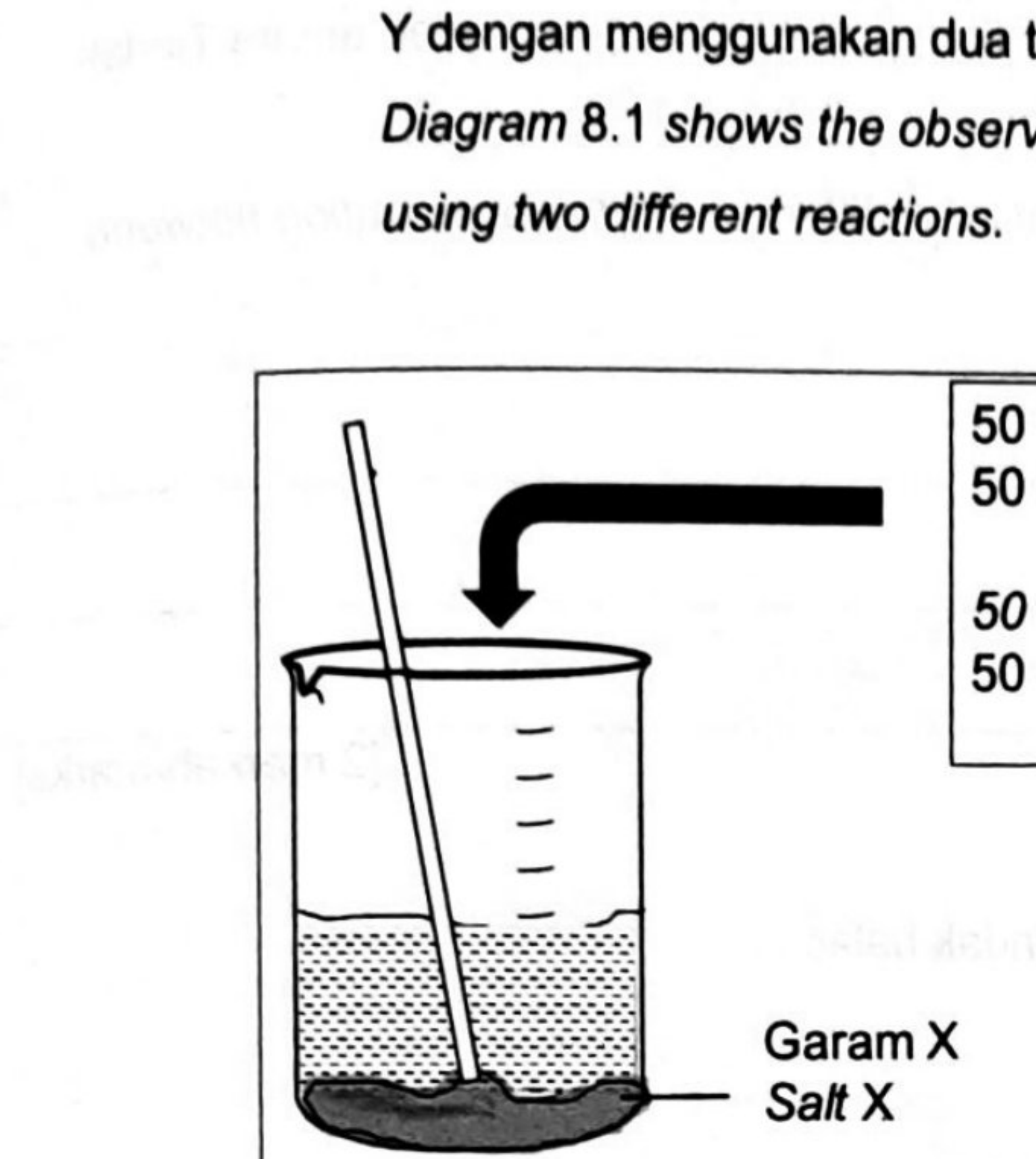
- (a)(ii)
Based on Diagram 8.1, explain the difference in the observation between Reaction I and Reaction II.
[2] - (a)(iii)
Name Salt X in Reaction I.
[1] - (a)(iv)
Calculate the mass of magnesium powder that reacted with the nitric acid to form Salt Y in Reaction II. [Relative atomic mass: Mg = 24]
[3] - (b)
Diagram 8.2 shows two bags of different fertilizer that are commonly used by the farmers. Help Amir to choose the most suitable fertilizer and justify your choice.
[3]
Section B
Diagram 9.1 shows the conversions of a carbon compound involving a series of reactions: hydrocarbon M gives hydrocarbon R with H₂ on heating; hydrocarbon M gives alcohol A; alcohol A gives carboxylic acid S; alcohol A reacts (Reaction P) with carboxylic acid S to give compound Z. Answer one question from Section B.
Medium20 marks- (a)
Define the meaning of hydrocarbon and write the general formula of Hydrocarbon R.
[2]
- (b)
Hydrocarbon M has 85.7% of carbon and 14.3% of hydrogen by mass. The relative molecular mass of Hydrocarbon M is 56. Determine the molecular formula of hydrocarbon M.
[3] - (c)
Hydrocarbon R and Hydrocarbon M occur in different isomers. Draw two isomers of the hydrocarbons.
[2] - (d)
Hydrocarbon R and M burn in the air produce water, carbon dioxide and soot. Explain the difference in the quantity of soot produced for each of the hydrocarbons. [Relative atomic mass: C = 12, H = 1]
[3] - (e)
The reaction between carboxylic acid S and alcohol A will produce compound Z. Name the reaction P and the reagent involved in the production of carboxylic acid S and compound Z. Draw the structural formula of compound Z and name it.
[6] - (f)
Diagram 9.2 shows the result of two chemical tests to differentiate between hydrocarbon R and M (bromine water: R no change; M brown colour decolourised). Explain the difference in the observations.
[4]
Diagram 10.1 shows a chemical cell (tin in tin(II) chloride solution, copper in copper(II) chloride solution, dilute sulphuric acid in the salt bridge) and Table 10.1 shows E° values: Sn²⁺ + 2e ⇌ Sn, E° = −0.14 V; Cu²⁺ + 2e ⇌ Cu, E° = +0.34 V. Diagram 10.2 shows two sets of apparatus to investigate the transfer of electrons at a distance: Set I (FeSO₄ / substance X, H₂SO₄, carbon electrodes P and Q; green FeSO₄ turns brown) and Set II (FeCl₃ / substance Y, H₂SO₄, carbon electrodes R and S; brown FeCl₃ turns green).
Hard20 marks- (a)(i)
What is the function of dilute acid sulphuric and colour of copper(II) chloride solution?
[2]
- (a)(ii)
Identify negative terminal and positive terminal in the cell.
[2] - (a)(iii)
Write half equation for oxidation and reduction of the reaction, overall ionic equation, cell notation and calculate the voltage value that produced in the cell.
[6] - (b)
By naming substance X and substance Y, compare the redox reaction of set I and set II in terms of: substance oxidized; half equation of reduction reaction; direction of electron flow; oxidizing agent and reducing agent.
[10]
Section C
Diagram 11 shows two situations to study rate of reaction in daily life: Situation I, cool box; Situation II, vitamin C dissolved in water. Table 11 shows three sets of experiment on calcium carbonate and nitric acid: I: 25 cm³ of 0.1 mol dm⁻³ nitric acid and excess calcium carbonate chips at 30 °C; II: same reactants at 40 °C; III: 25 cm³ of 0.1 mol dm⁻³ nitric acid and excess calcium carbonate powder at 40 °C.
Hard20 marks- (a)
What is meant by rate of reaction?
[1]
- (b)(i)
Based on Diagram 11, state two factors involved in situation I and II.
[2] - (b)(ii)
Explain how the factor affecting rate of reaction helps you in situation I and situation II in Diagram 11.
[4] - (c)
Table 11 shows three sets of experiment to study the factors affecting the rate of reaction between calcium carbonate, CaCO₃ and nitric acid, HNO₃. Explain the difference in the rate of reaction between Experiment I and II OR Experiment II and III by using collision theory.
[5]
- (d)(i)
The passage below describes platelets and their relation to the rate of blood clotting: Blood clotting depends on the concentration of platelets in the blood. Harun had a minor accident and he found out that the blood flow from his wounds was difficult to stop. Describe this situation.
[4] - (d)(ii)
The diagram shows two bottles of fragrance containing different percentage of ester: 1 Eau de Toilette 5–15%; 2 Eau de Parfum 15–20% (lasts longer). Firdaus works as Chief Executive Officer in Melur Holding. Sometimes he works in the office and sometimes he has to visit the construction site. According to the situation on Firdaus work place, justify the uses of both perfumes.
[4]