Write your answer on paper. Then open the answer to check it.
Section A
Diagram 1 shows the atomic structure of a pair of isotopes of sodium: Sodium-23 (11p, 12n) and Sodium-24 (11p, 13n), each with electron arrangement 2.8.1.
Medium5 marks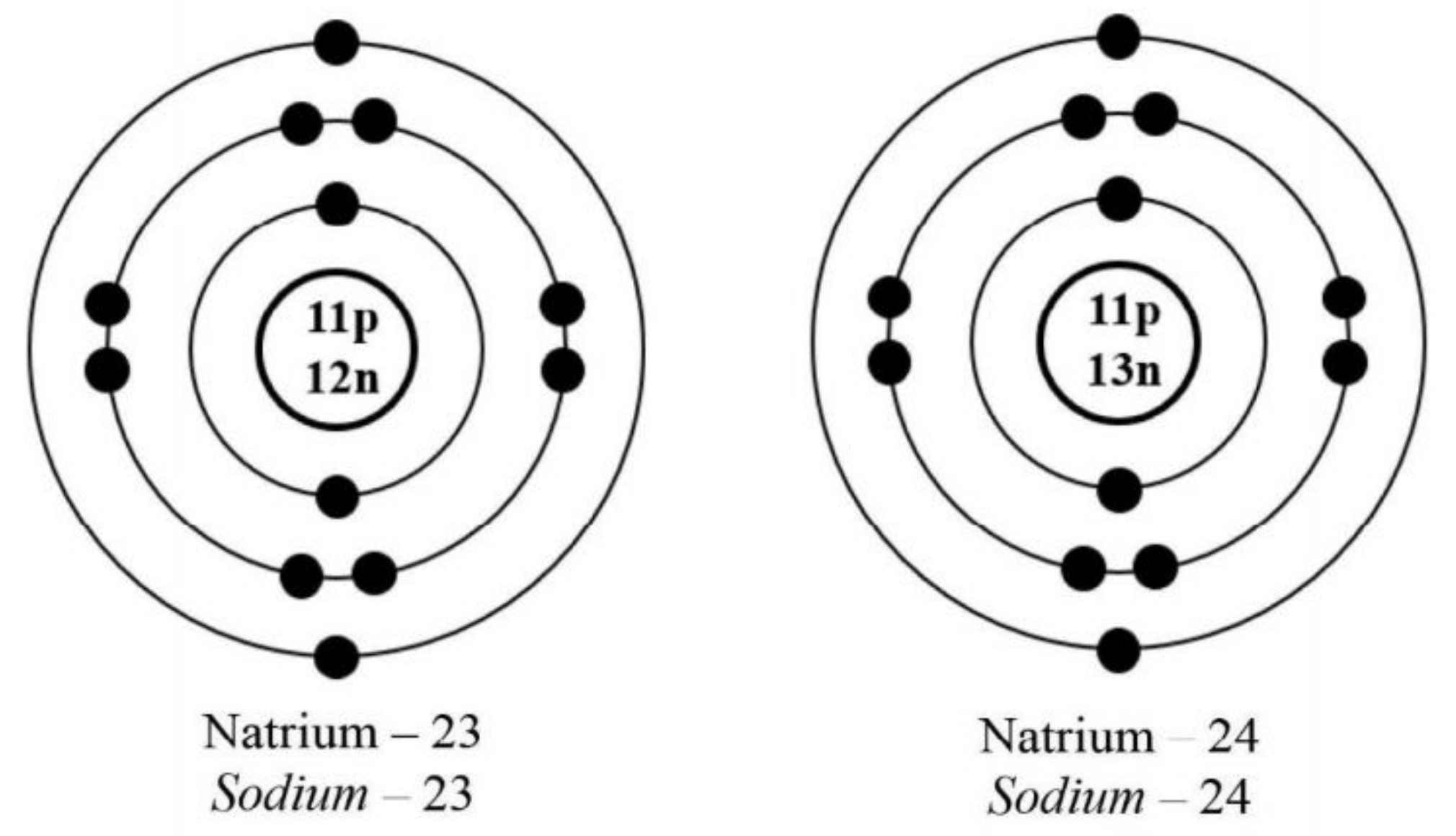
- (a)
What is meant by isotope?
[1] - (b)
Write the standard representative for Sodium-23 atom.
[1] - (c)
State the use of Sodium-24.
[1] - (d)
Compare the chemical properties of the two sodium atoms in Diagram 1. Explain your answer.
[2]
Table 1 shows information about some of the elements found in Period 3 of the Periodic Table of Elements. Proton number: Sodium 11, Magnesium 12, Aluminium 13, Silicon 14, Chlorine 17.
Medium5 marks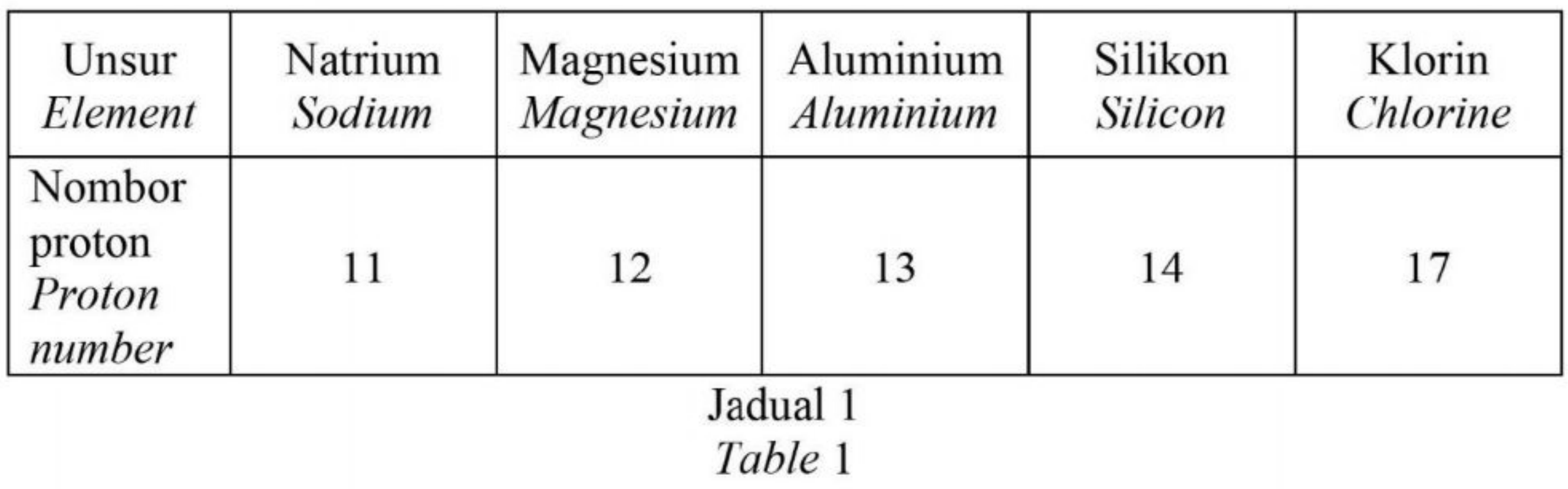
- (a)
What is meant by period in Periodic Table of Element?
[1] - (b)
State the element that exists as diatomic molecule.
[1] - (c)
Write the electron arrangement for Aluminium atom.
[1] - (d)
Explain why size of sodium atoms are larger than chlorine atoms.
[2]
Diagram 2 shows a reaction to produce an insoluble salt: sodium carbonate solution is added to copper(II) sulphate solution with stirring, giving solution X and substance Y.
Medium6 marks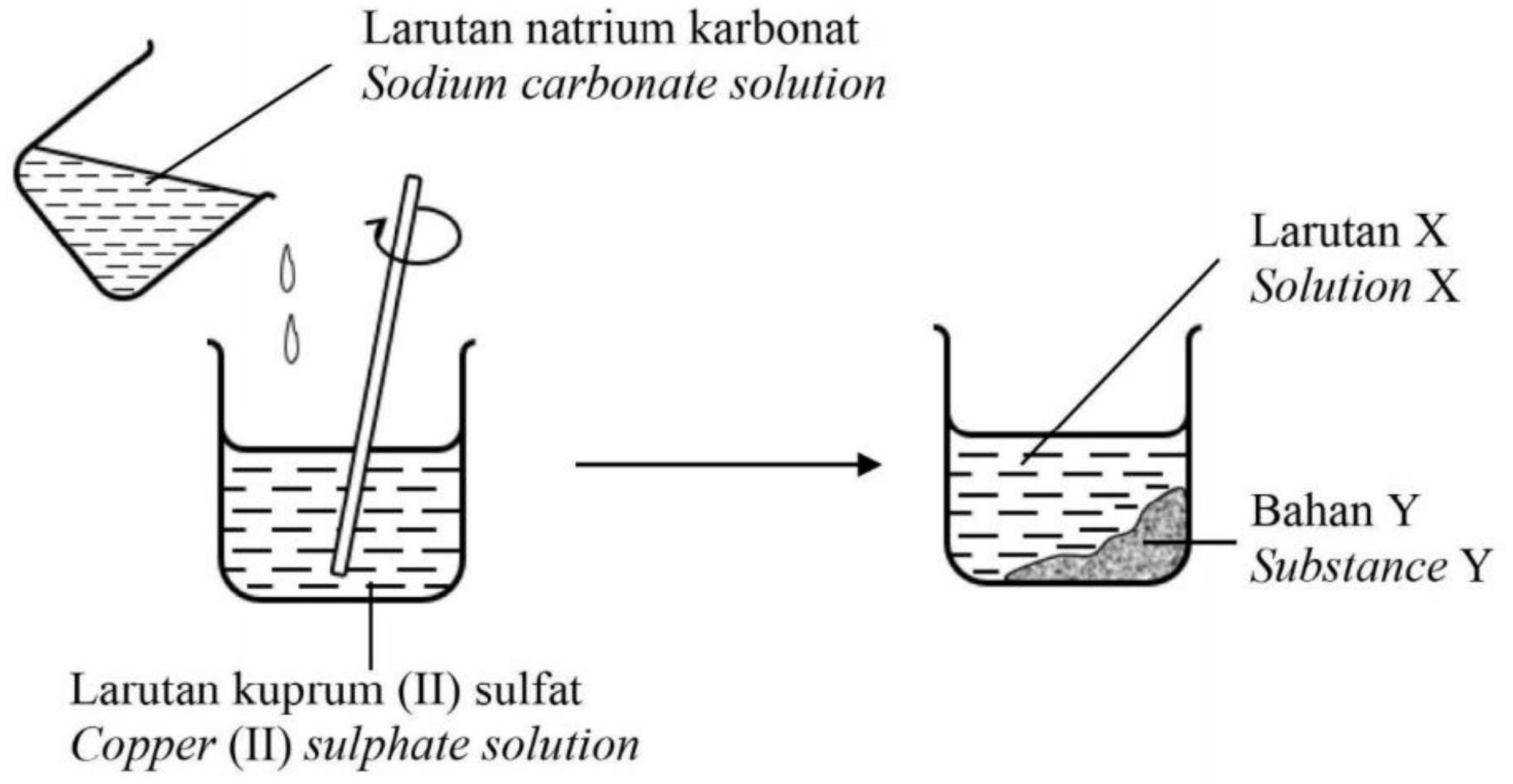
- (a)
State the meaning of salt.
[1] - (b)(i)
Identify Solution X and Substance Y.
[2] - (b)(ii)
What is the colour of substance Y?
[1] - (c)
The reaction in Diagram 2 is represented by: Na₂CO₃ + CuSO₄ → X + Y. If sodium carbonate solution is added in excess to 0.2 mol of copper(II) sulphate solution, calculate the mass of substance Y produced. [Molar mass of substance Y = 124 g mol⁻¹]
[2]
(a) Diagram 3 shows part of the structural formula for polymer X (a chain of -CH₂-CH(CH₃)- units). (b) Table 2 shows the properties of two types of rubber Y and Z. Y: high strength, more resistant to oxidation, returns to its original shape after stretching. Z: low strength, easier to oxidise, longer than its original length after stretching.
Medium7 marks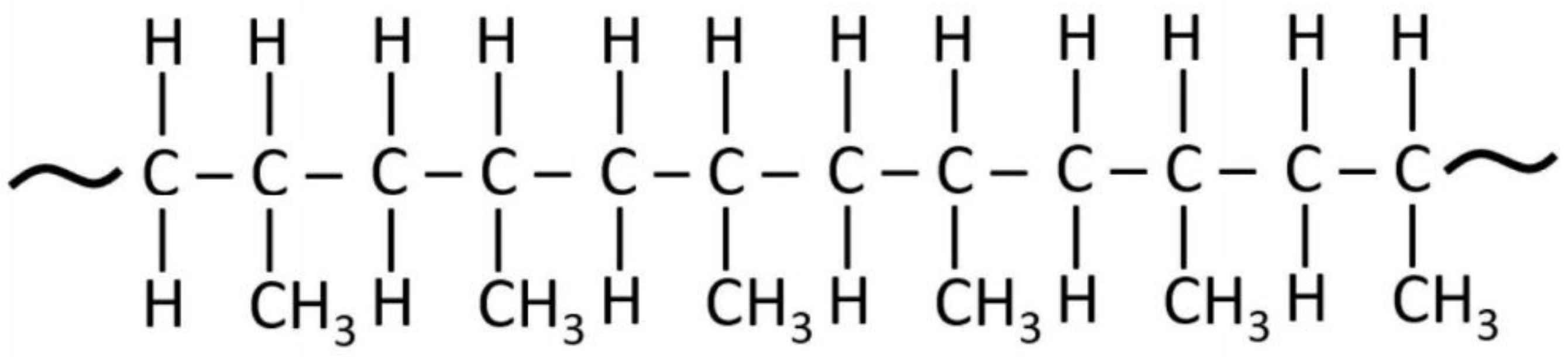
- (a)(i)
Identify the polymer X.
[1] - (a)(ii)
Write the chemical equation to produce polymer X.
[2] - (b)(i)
Identify rubber Y and Z.
[2]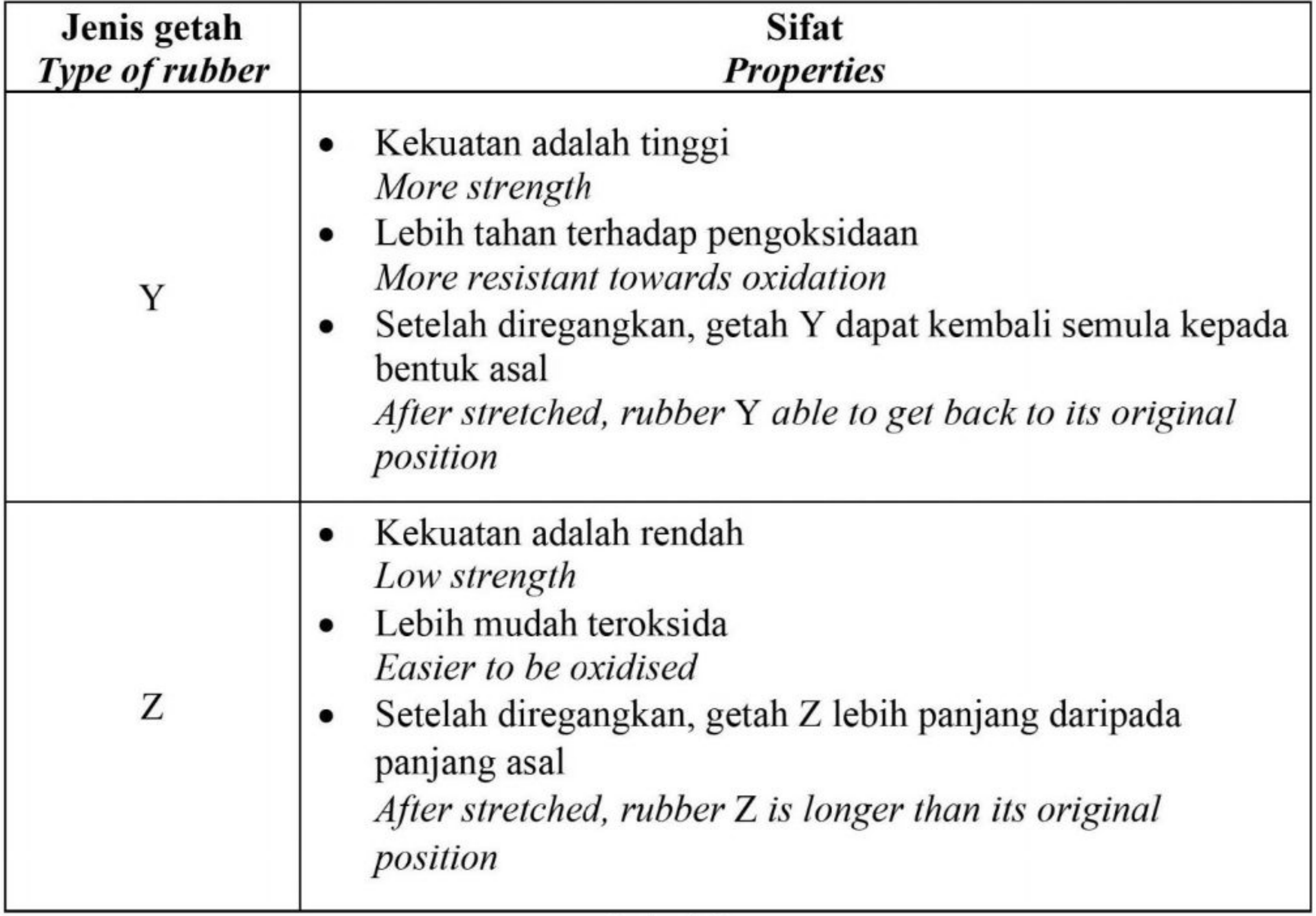
- (b)(ii)
Compare the elasticity of rubber Y and Z. Explain your answer.
[2]
Diagram 4 shows the two main ingredients used in soap making: cooking oil and sodium hydroxide solution.
Medium8 marks- (a)(i)
Name the soap making process.
[1]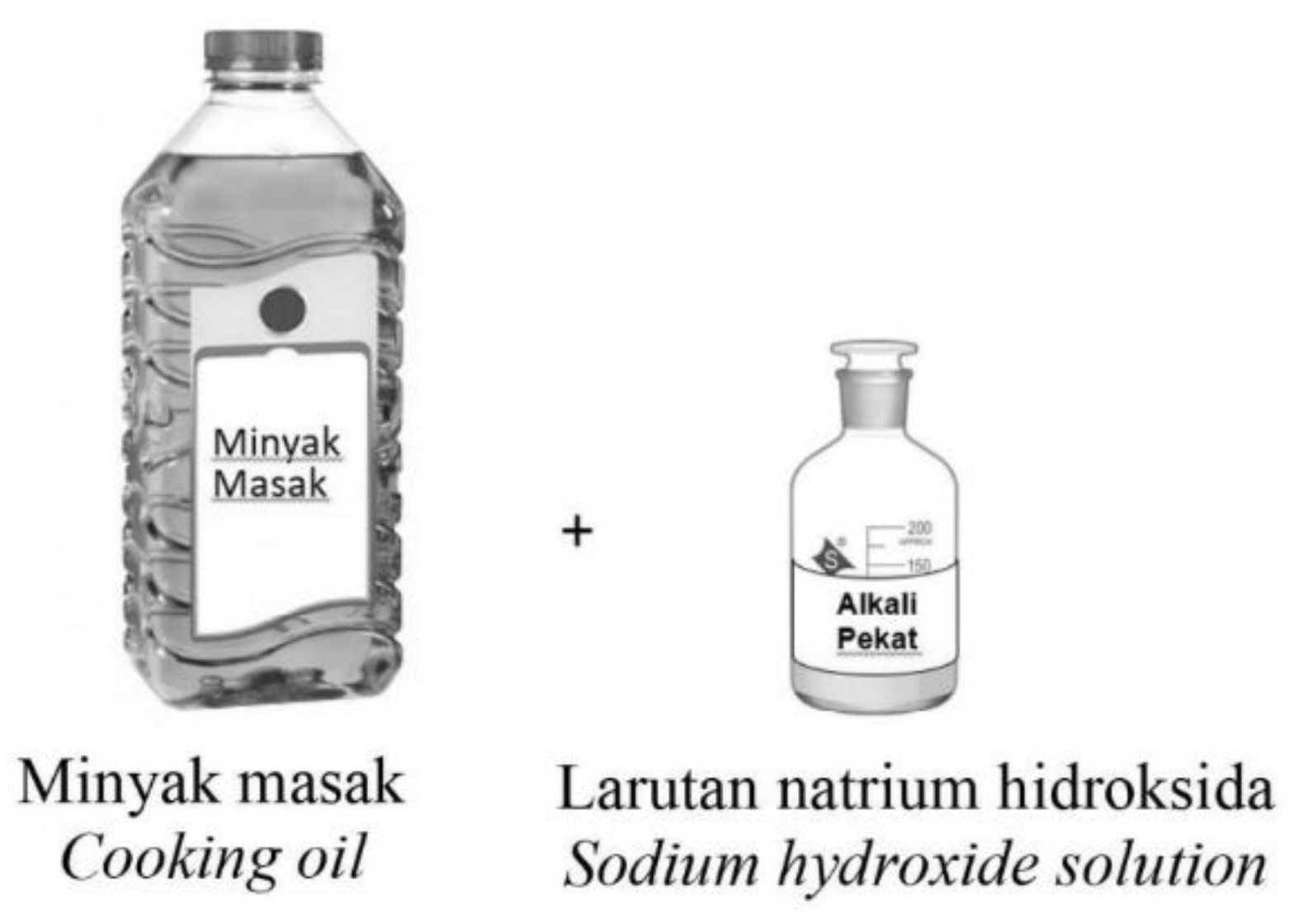
- (a)(ii)
Suggest other substance that can be used to replace concentrated sodium hydroxide solution.
[1] - (b)(i)
Palmitic acid from palm oil is mixed with concentrated sodium hydroxide solution to produce soap X, CH₃(CH₂)₁₄COONa. CH₃(CH₂)₁₄COOH + NaOH → CH₃(CH₂)₁₄COONa + H₂O. If 0.2 moles of palmitic acid were used in this reaction, calculate the mass of soap produced. [Molar mass of CH₃(CH₂)₁₄COONa = 278 g mol⁻¹]
[2] - (b)(ii)
Name the soap X.
[1] - (c)
While participating in the camping on the beach, Rafiq found his shirt dirty because he spilled curry sauce during lunch. Rafiq tried to wash his clothes with soap on the beach. Can the stains on Rafiq's shirt be cleaned? Explain your answer.
[3]
A student conducts two sets of experiments to study redox reactions (Table 3). Set I: bromine water added to iron(II) sulphate solution; the green solution turns brown. Set II: magnesium strip in iron(II) sulphate solution; grey solid deposited on the magnesium strip.
Medium9 marks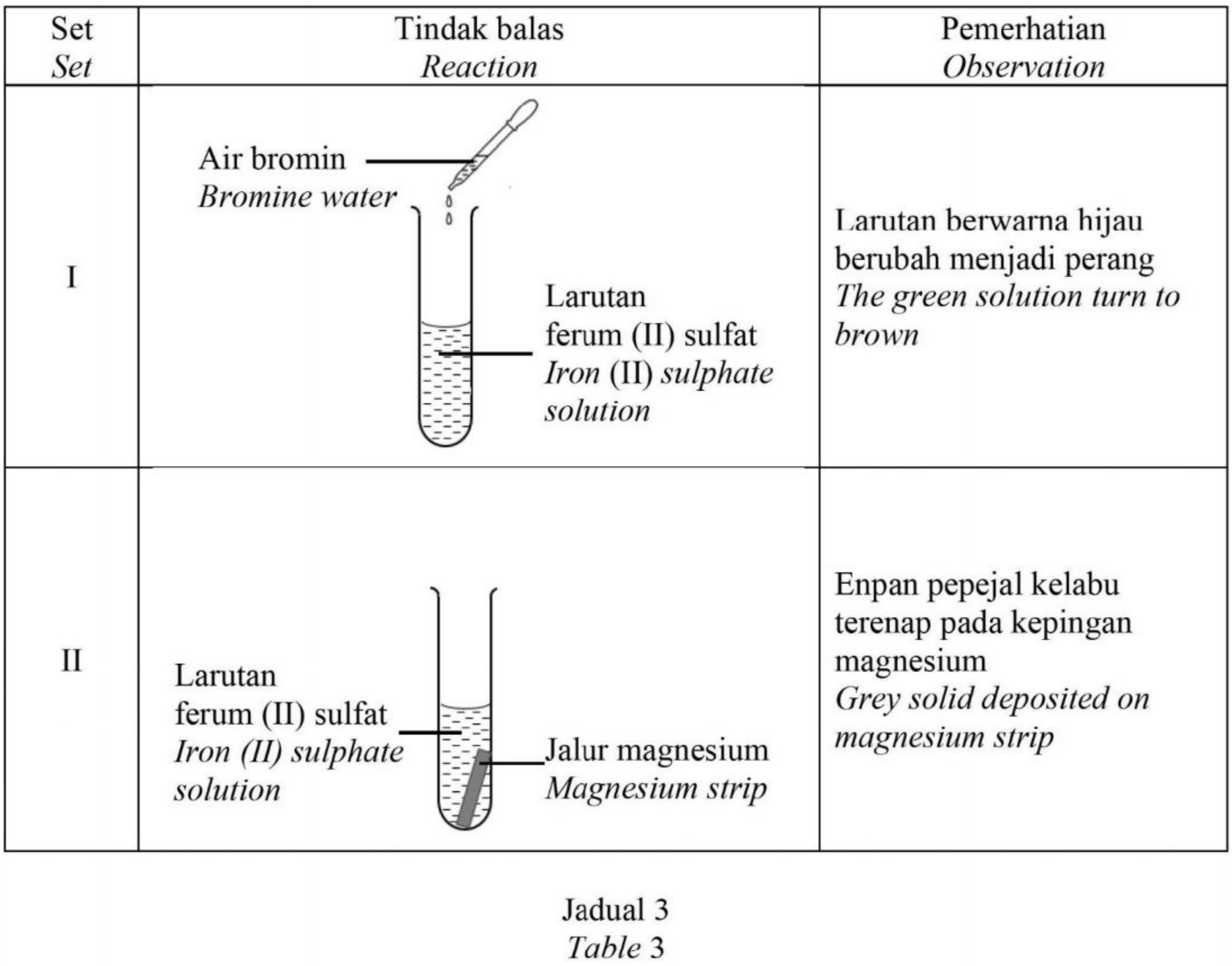
- (a)
State the meaning of redox reaction.
[1] - (b)(i)
Based on Set I, explain the changes that occurred.
[2] - (b)(ii)
Based on the observations, describe a chemical test to confirm the presence of ions that cause the brown colour to form.
[2] - (c)(i)
Write the half equation for the reduction reaction in Set I and Set II.
[2] - (c)(ii)
State the function of iron(II) sulphate solution in Set I and Set II.
[2]
(a) Table 4.1 shows the experimental information of the neutralisation reaction between acid X and alkali Y that produces sodium chloride salt and water: 25 cm³ of 1.0 mol dm⁻³ acid X + 25 cm³ of 1.0 mol dm⁻³ alkali Y; initial temperature 29.0 °C; maximum temperature 35.0 °C. (b) Table 4.2 shows heat of reaction for two chemical reactions: I NH₄Cl → NH₄⁺ + Cl⁻, +15.1 kJ mol⁻¹; II NH₄NO₃ → NH₄⁺ + NO₃⁻, +25.7 kJ mol⁻¹.
Medium10 marks- (a)(i)
State the meaning of heat of neutralisation.
[1]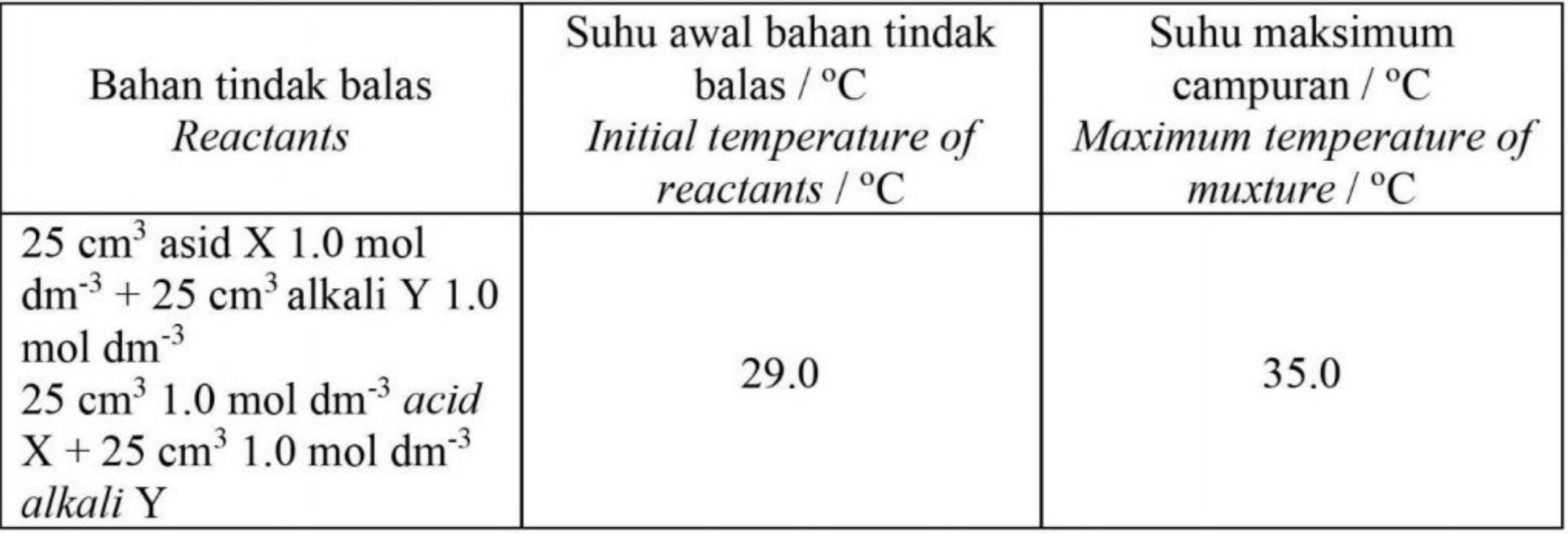
- (a)(ii)
Name Acid X and Alkali Y.
[2] - (a)(iii)
Calculate the heat of neutralisation for the reaction in Table 4.1. [Specific heat capacity of solution, C = 4.2 J g⁻¹ °C⁻¹; density of solution = 1 g cm⁻³]
[3] - (a)(iv)
Draw an energy level diagram for the reaction.
[2] - (b)
Which reaction is suitable as an ingredient in a cold pack to relieve muscle pain? Explain your answer.
[2]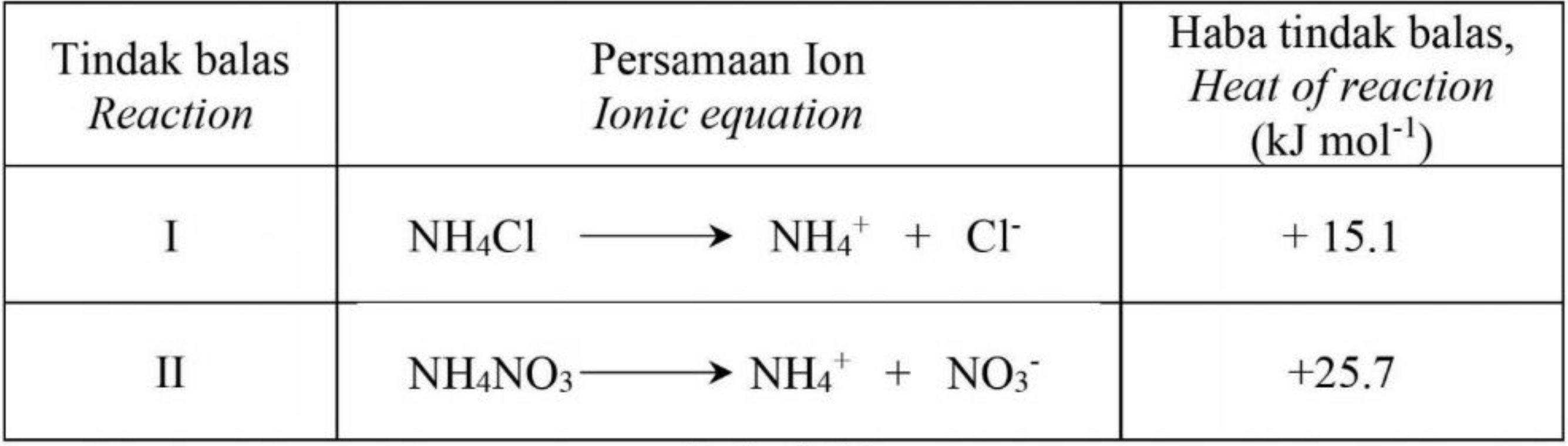
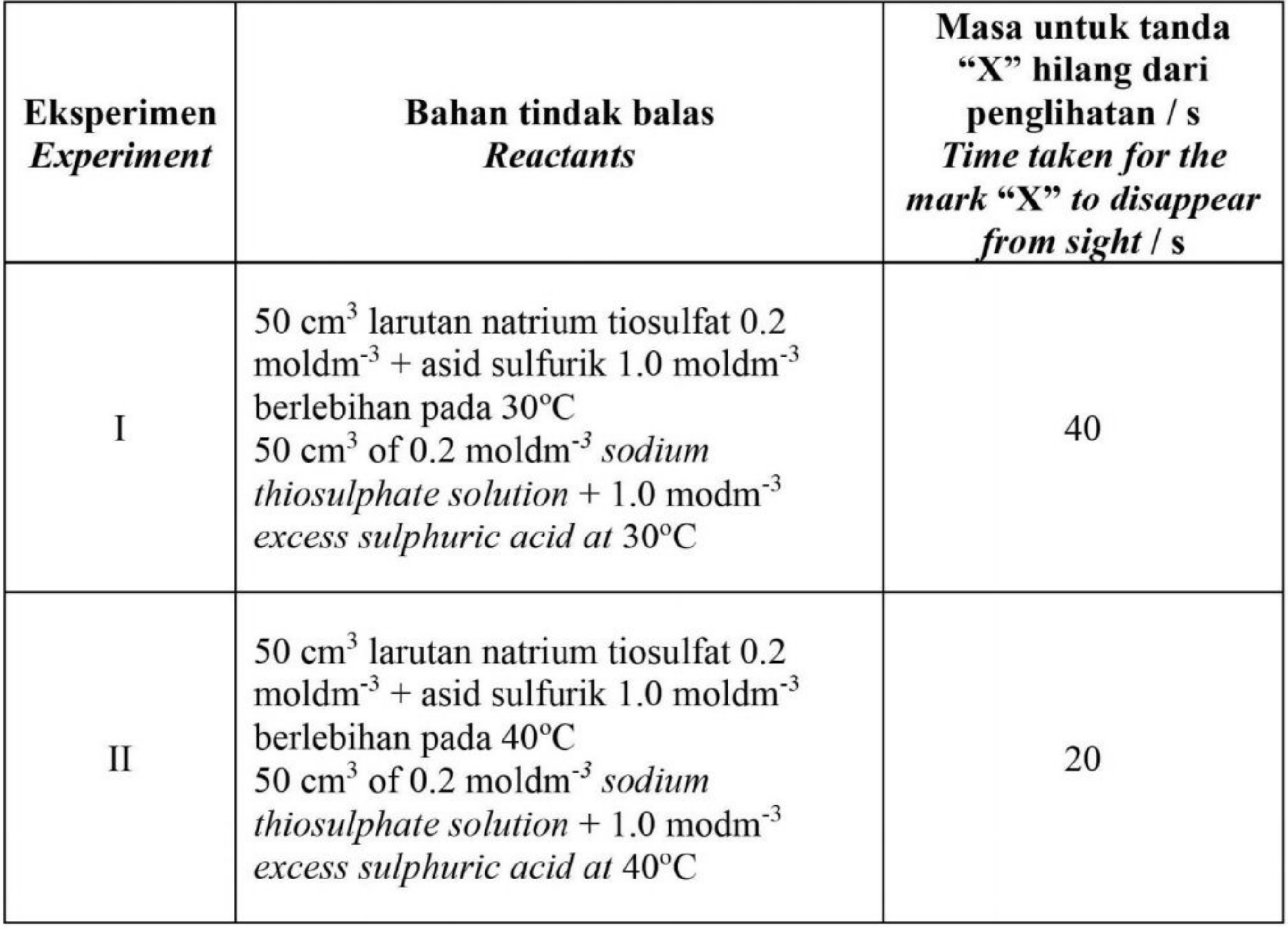
(a) Diagram 5 shows the apparatus set up for Experiment I and II at different temperatures to determine the rate of reaction between sodium thiosulphate and sulphuric acid (the mark X under the flask disappears from sight). Table 5: Experiment I: 50 cm³ of 0.2 mol dm⁻³ sodium thiosulphate solution + 1.0 mol dm⁻³ excess sulphuric acid at 30 °C, time for mark X to disappear 40 s; Experiment II: same but at 40 °C, 20 s. (b) Diagram 6 shows a conversation between a doctor and a gastric patient about how to take medicine.
Medium10 marks- (a)(i)
What is the colour of sulphur precipitate?
[1]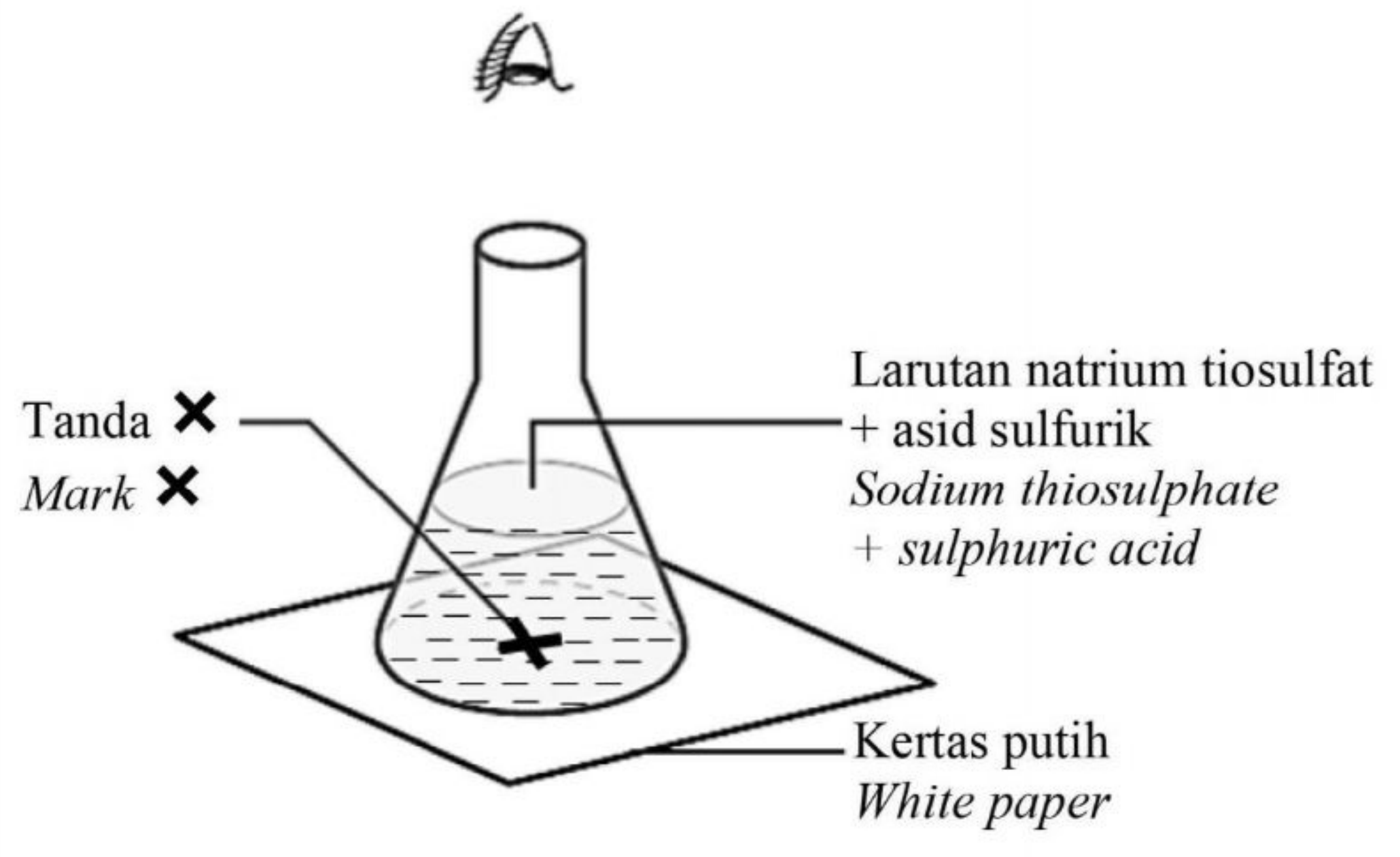
- (a)(ii)
Calculate the average rate of reaction for Experiment I and Experiment II.
[2] - (a)(iii)
Compare the rate of reaction of Experiment I and Experiment II.
[1] - (a)(iv)
Explain your answer in (a)(iii) using collision theory.
[3] - (b)
Based on the conversation in Diagram 6, what is the effective way to take medication to relieve the patient's pain? Explain your answer. (The doctor says: 'This medicine can be swallowed directly or chewed before.')
[3]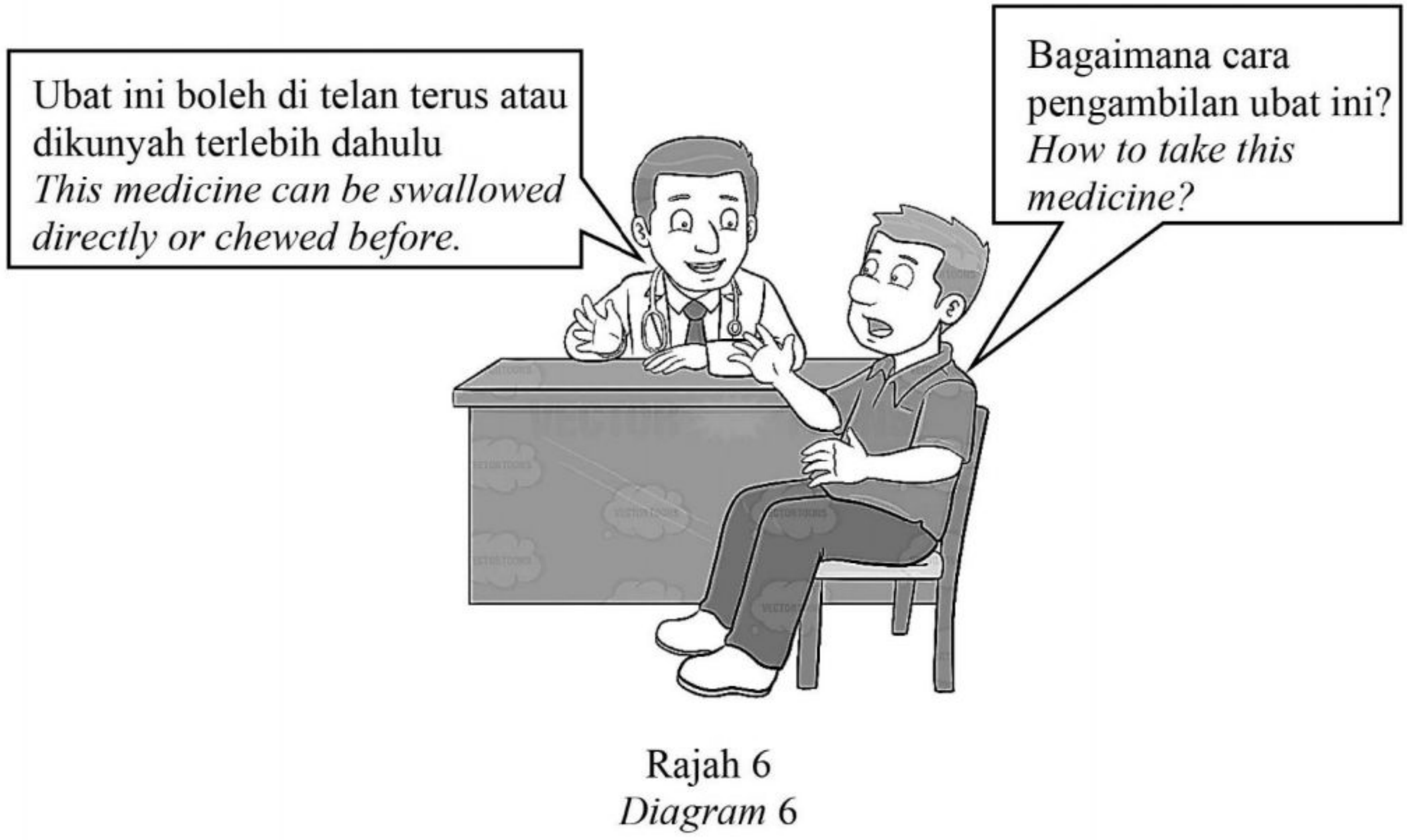
Section B
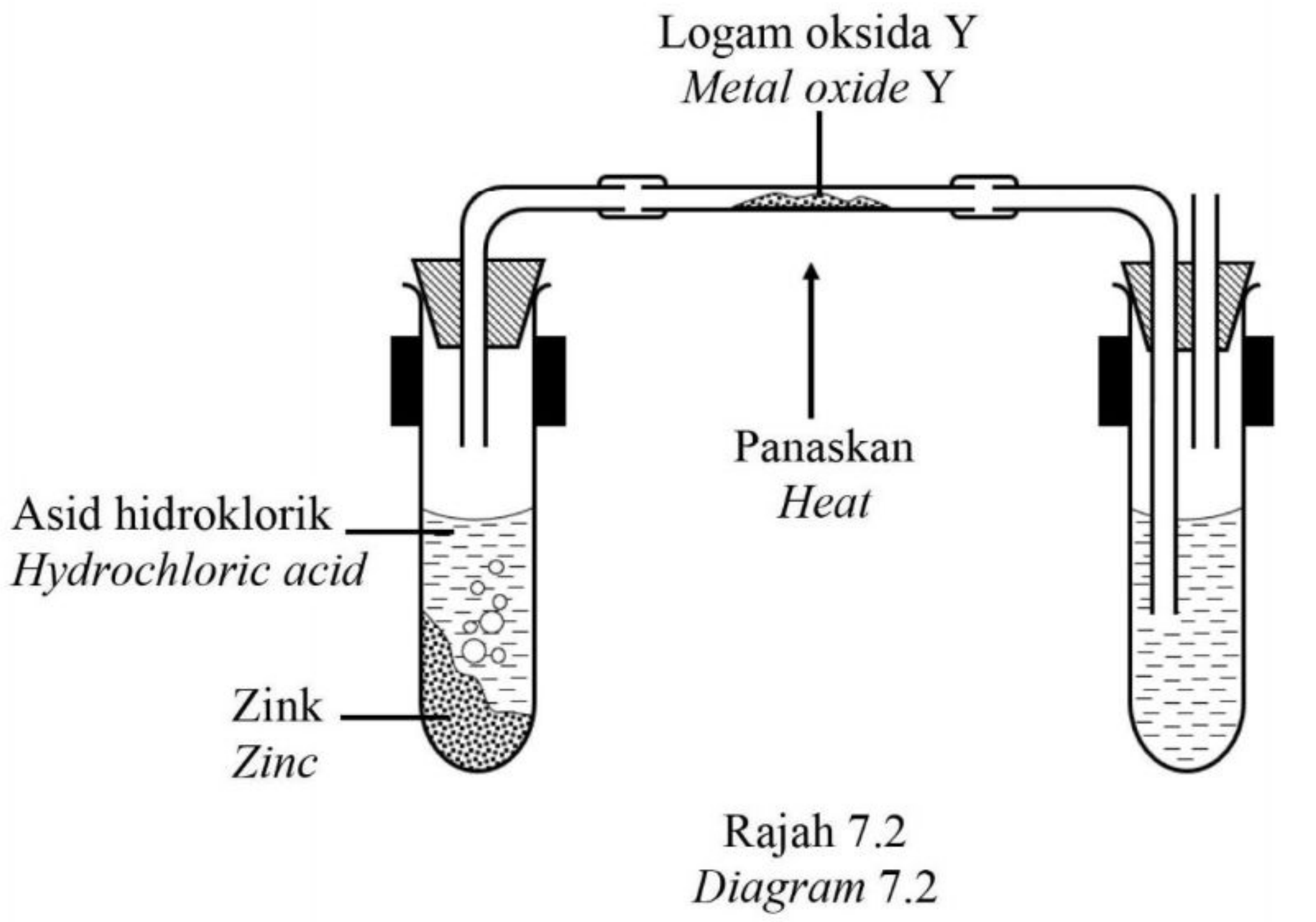
(a) Diagrams 7.1 and 7.2 show two methods used to determine the empirical formula for metal oxide X (metal X heated in a crucible) and metal oxide Y (hydrogen from zinc and hydrochloric acid passed over heated metal oxide Y). (b) Information on hydrocarbon P: carbon 85.70%, hydrogen 14.30%, relative molecular mass = 56.
Hard20 marks- (a)(i)
What is meant by empirical formula?
[1]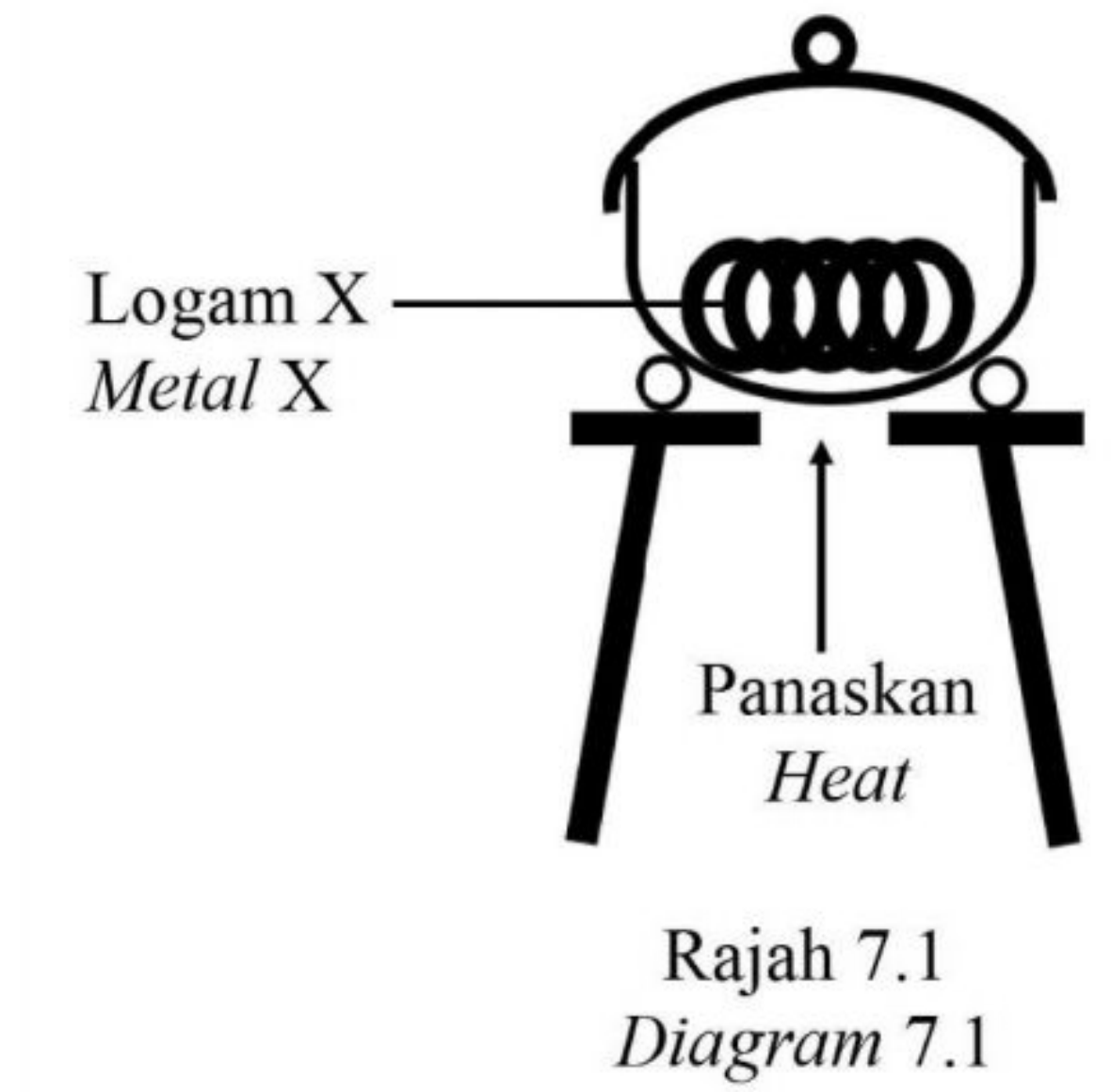
- (a)(ii)
Suggest metal X and metal Y. Explain why the metal was chosen.
[4] - (a)(iii)
Based on Diagram 7.2, write the chemical equation for the reaction that occurs between hydrochloric acid and zinc. Calculate the mass of zinc required in the reaction to produce 100 cm³ of gas to be used in the reaction to determine the empirical formula of metal oxide Y. [Relative atomic mass Zn = 65; Molar volume of gas = 24 dm³ mol⁻¹ at room condition]
[5] - (b)(i)
Based on the information above, determine the empirical formula of hydrocarbon P and the molecular formula of hydrocarbon P. [Relative atomic mass H = 1, C = 12]
[5]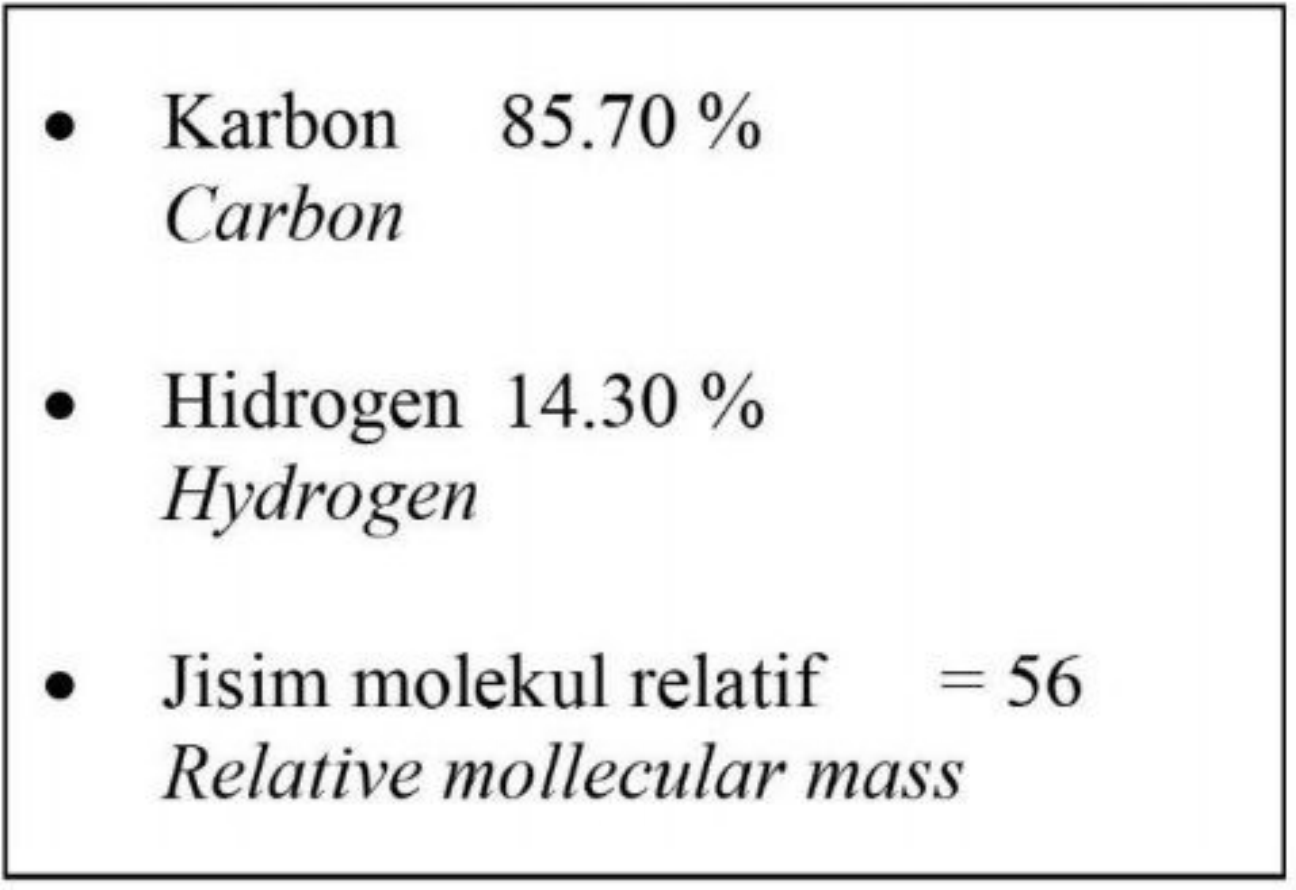
- (b)(ii)
Hydrocarbon P can burn completely in air. Write the chemical equation for the complete combustion of hydrocarbon P and explain the information that can be obtained from the chemical equation qualitatively and quantitatively.
[5]
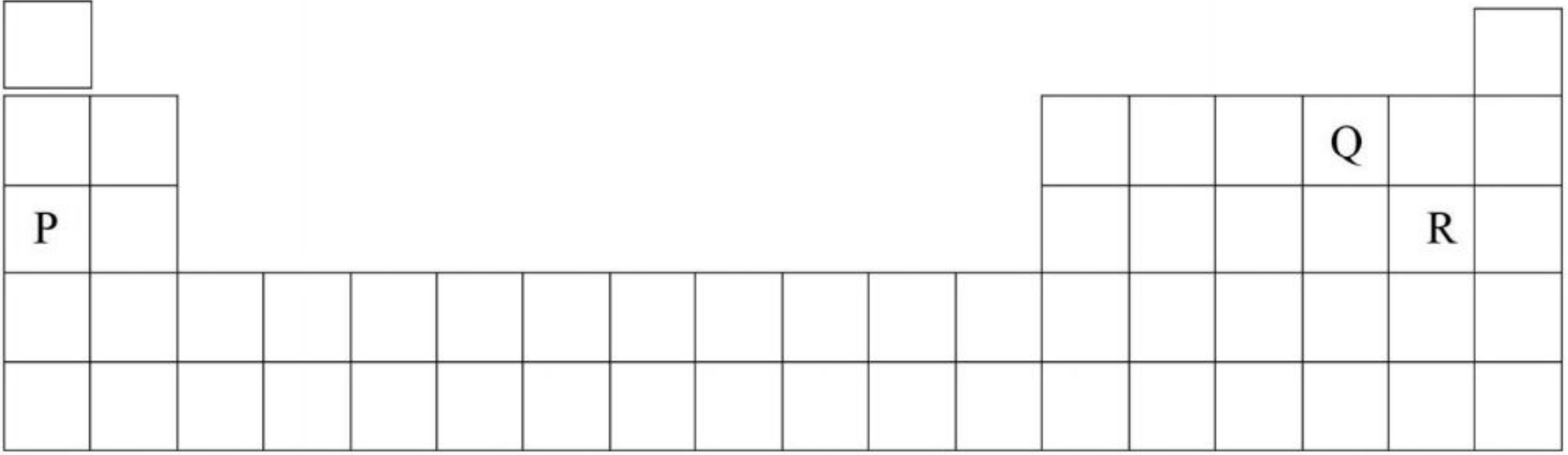
(a) Diagram 8.1 shows the arrangement of apparatus to study the electrical conductivity of compound X (ammeter reads about 0.5) and compound Y (ammeter reads almost 0). Diagram 8.2 shows the position of elements P, Q and R in the Periodic Table of Elements (P in Group 1 Period 3, Q in Group 14 Period 2, R in Group 17 Period 3). (b) Table 6 shows information for compounds M and N.
Medium20 marks- (a)(i)
State the types of compounds X and Y and the types of particles found in both compounds.
[4]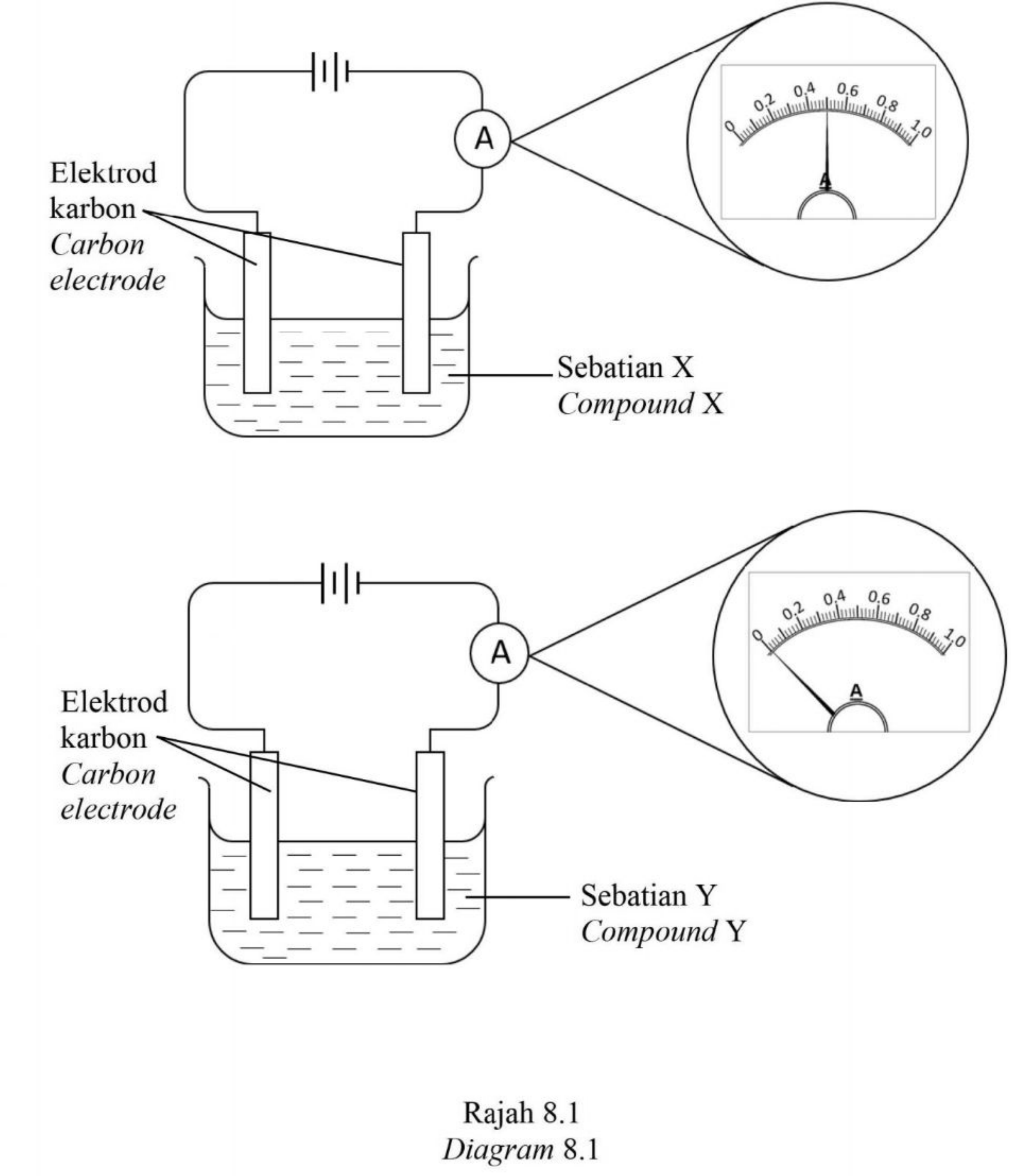
- (a)(ii)
Choose the elements that react to form compound X and compound Y and write the chemical formula for compound X and compound Y. Describe how bonds are formed in compound X.
[9] - (a)(iii)
The following chemical equation shows how potassium reacts with Q to form a compound: 4K + Q₂ → 2K₂Q. Calculate the mass of product formed at the end of the reaction if 7.8 g of potassium reacts with excess Q. [Relative atomic mass: Q = 16, K = 39]
[3] - (b)
Compare the boiling points of compounds M and N. Explain your answer.
[4]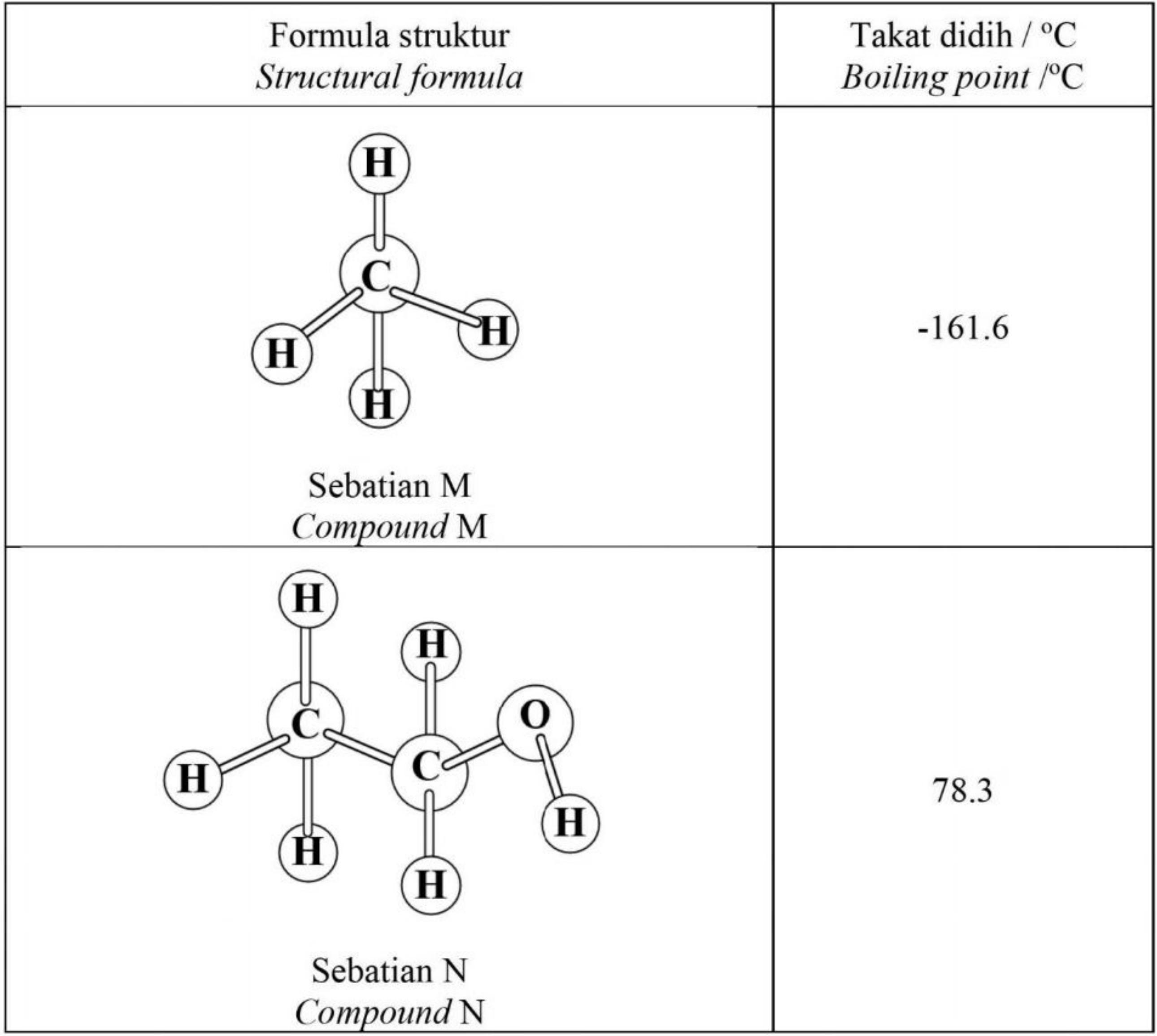
Section C
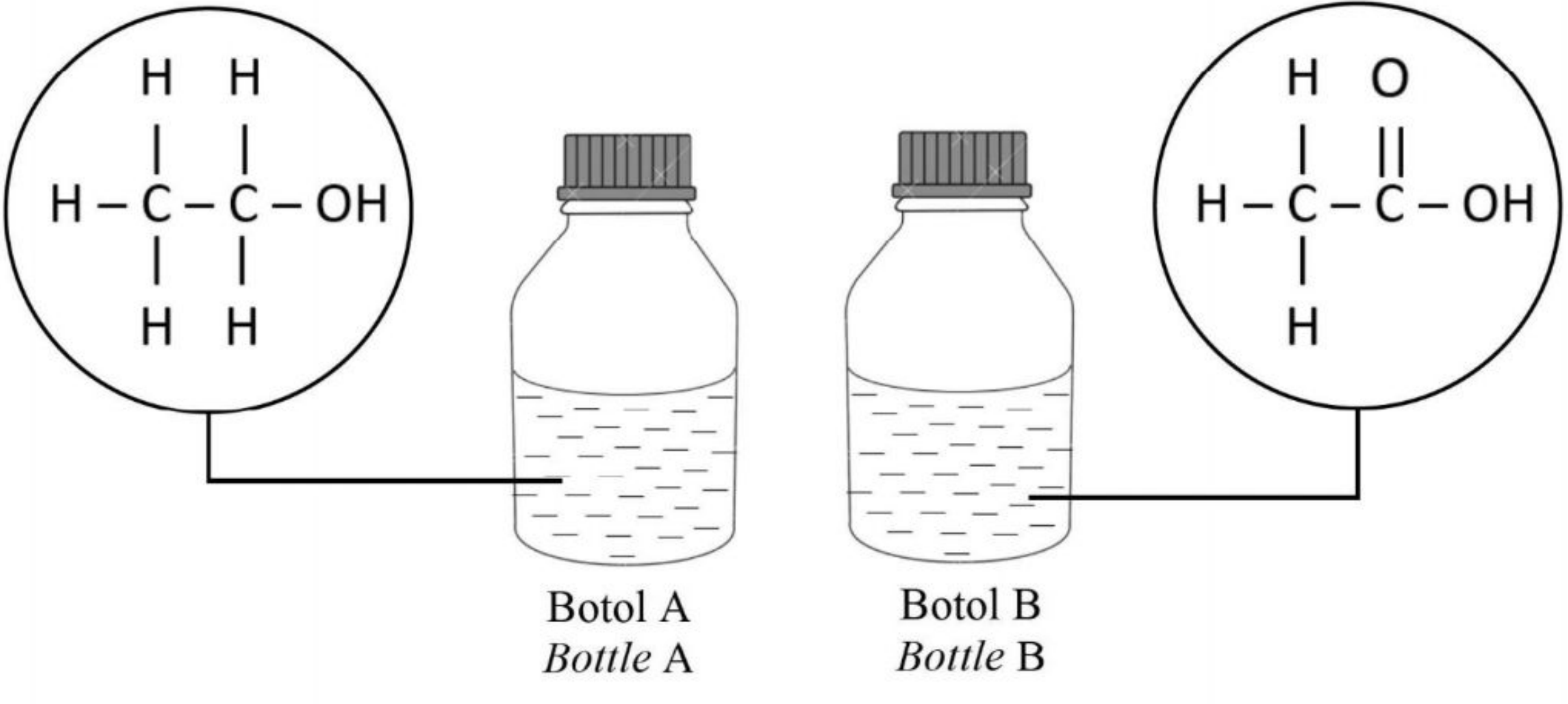
(a) Table 7: compound S is a saturated hydrocarbon, the fourth member of its homologous series; compound T is an unsaturated hydrocarbon with a double bond between carbon atoms, the third member of its homologous series. (b) Diagram 9.1 shows the conversion of some organic compounds: propene (C₃H₆ drawn as H-C=C-H with CH₃ shown) undergoes hydration to compound X; Process I converts X to compound Y; X and Y undergo esterification to compound Z. (c) Diagram 9.2 shows 2 bottles containing a colourless liquid: Bottle A (C₂H₅OH structure shown) and Bottle B (CH₃COOH structure shown).
Hard20 marks- (a)(i)
What is meant by saturated hydrocarbon?
[1]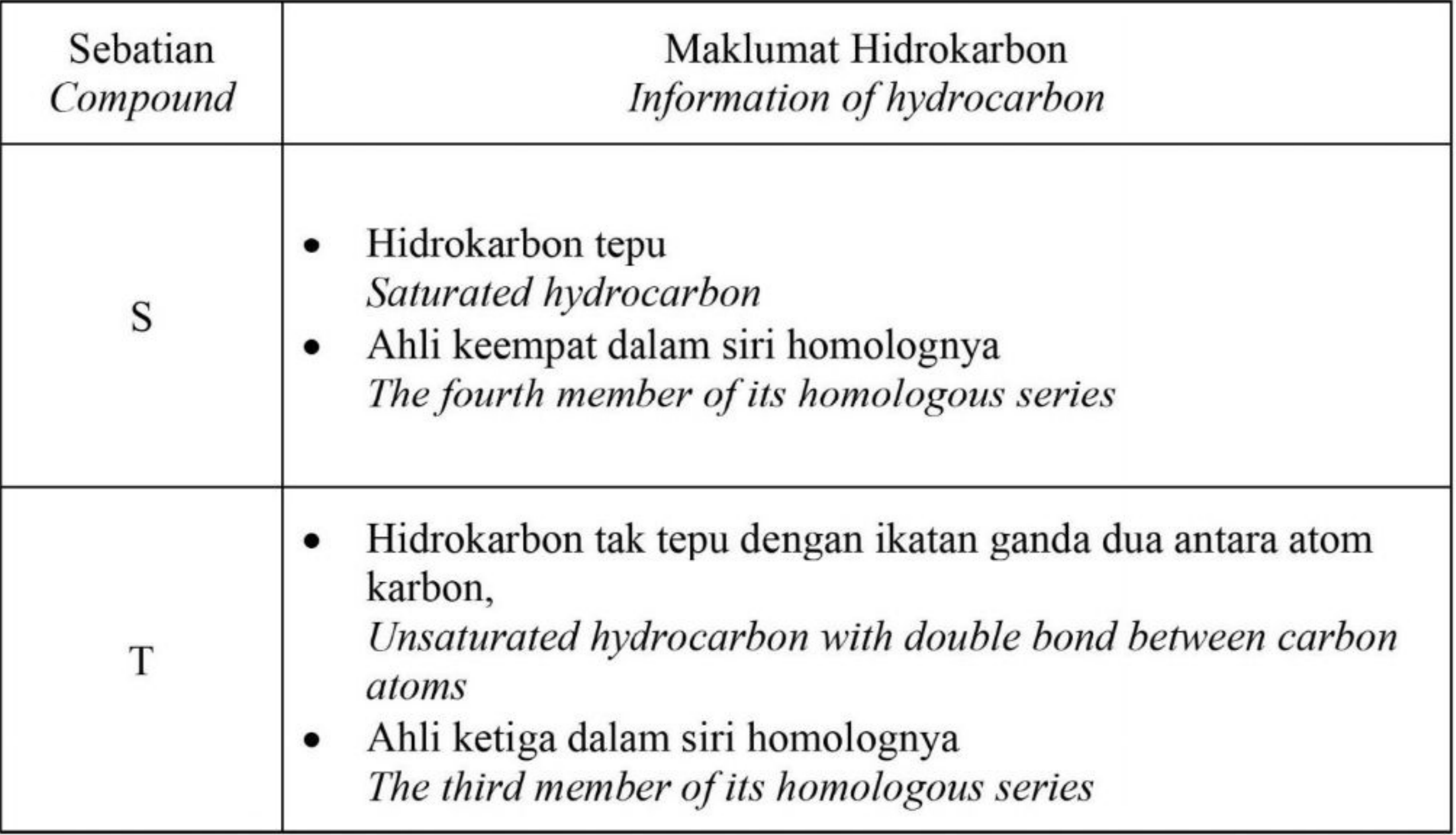
- (a)(ii)
Suggest a name for compounds S and T.
[2] - (a)(iii)
Compounds S and T can be used as fuel at home. Which fuel is less polluting to the environment? Show the calculation of percentage of carbon atom and explain your reason.
[4] - (b)
State Process I, the homologous series of compound X and the functional group of compound Y. Name and write the molecular formula of compound Z.
[5]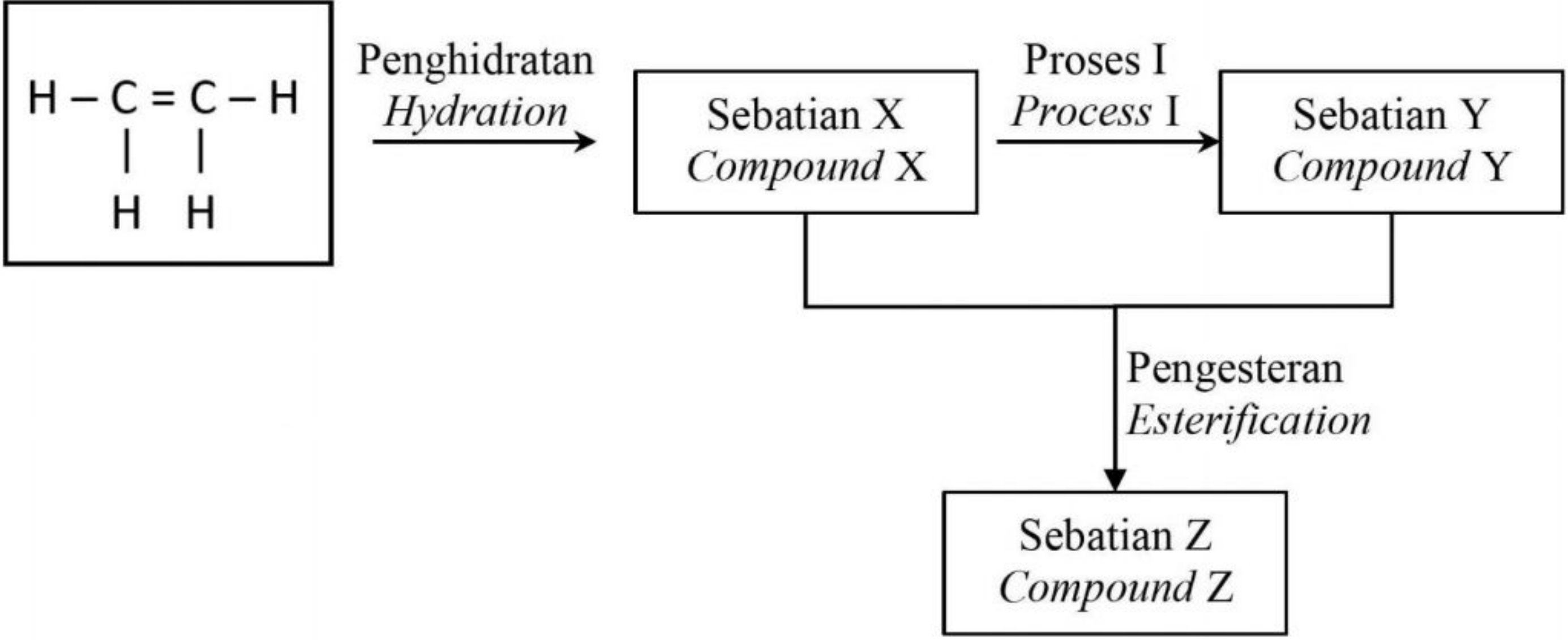
- (c)
Using sodium bicarbonate powder, describe a chemical test to tell the difference between the two liquids. State the observations and classify the substances into their respective homologous series.
[8]