Write your answer on paper. Then open the answer to check it.
Section A
Diagram 1 shows the ingredients of a cake: Wheat Flour, Saturated Fat, Citric Acid, Corn Syrup, Caramel, Lecithin, Egg, Margarine.
Medium5 marks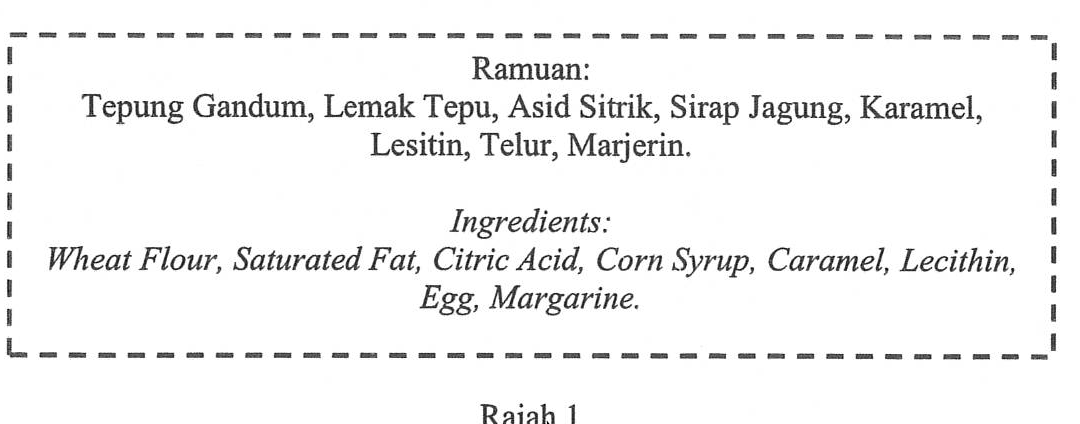
- (a)
One of the ingredients in the cake is fats. State the physical state of fats at room temperature.
[1] - (b)
Unsaturated fats can be converted to saturated fats through a reaction. Name the reaction.
[1] - (c)
Citric acid is commonly used in oily food such as cakes and biscuits. State the type of food additives and the function of the citric acid.
[2] - (d)
State another example of food additives in the cake.
[1]
Aspirin is used to reduce fever and relieve mild and moderate pain. Structural formula of aspirin is shown in Diagram 2.
Medium5 marks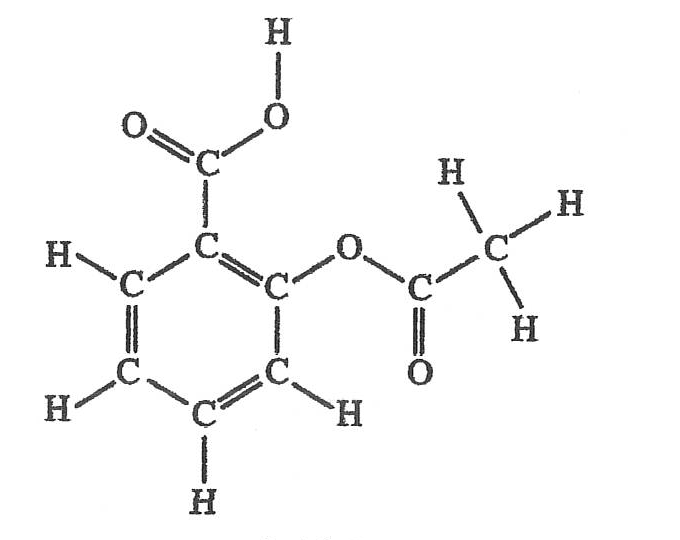
- (a)(i)
State the meaning of molecular formula.
[1] - (a)(ii)
Write the molecular formula of aspirin.
[1] - (a)(iii)
State the type of particle of aspirin.
[1] - (b)
The following chemical equation represents the burning of aluminium with oxygen: 4Al + 3O2 -> 2Al2O3. Give two information that can be interpreted from the chemical equation above.
[2]
Diagram 3 shows the standard representation of silicon atoms, Si: 28Si (proton number 14), 29Si, 30Si.
Medium6 marks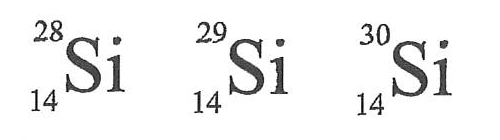
- (a)
What is the meaning of isotopes?
[1] - (b)
Draw the atomic structure of Si-28.
[2] - (c)
The percentage of natural abundance of 28Si, 29Si and 30Si is 92%, 5% and 3% respectively. Calculate the relative atomic mass of silicon, Si.
[2] - (d)
Isotopes are widely used in various field. State one example of isotopes used in medicine field.
[1]
Diagram 4 shows part of Periodic Table of Elements. P, Q, R, S, T and U do not represent the actual symbols of the elements. (P and Q in Group 1, Period 2 and Period 4; R in Group 2 Period 2; S in Group 16 Period 2; T in Group 17 Period 3; U in Group 18 Period 3.)
Medium7 marks
- (a)
Write the electron arrangement of ion T.
[1] - (b)
State the position of element S in the Periodic Table of Elements.
[1] - (c)
Arrange the atomic size of the elements in descending order.
[1] - (d)(i)
Which element exists as monoatomic gas?
[1] - (d)(ii)
Explain your answer in (d)(i).
[1] - (e)
Elements P and Q located in the same group but have different reactivity when react with oxygen. Explain why there is a difference in reactivity between these elements.
[2]
Diagram 5.1 shows structural formula of a polymer: repeating unit -[CH2-CH(CH3)]n- (H, H on one carbon; H, CH3 on the other).
Medium8 marks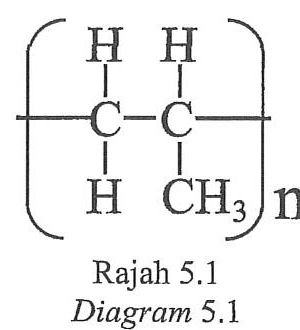
- (a)
What is meant by polymer?
[1] - (b)(i)
Based on Diagram 5.1, draw the structural formula of the monomer.
[1] - (b)(ii)
Name the type of polymerisation reaction in the production of the polymer.
[1] - (b)(iii)
State one of the uses of the polymer.
[1] - (c)(i)
Diagram 5.2 shows sport shoes used by a badminton player. Natural rubber and synthetic rubber can be used as the materials for the sport shoe sole. Choose the type of rubber that can be used as the material and justify your choice.
[3]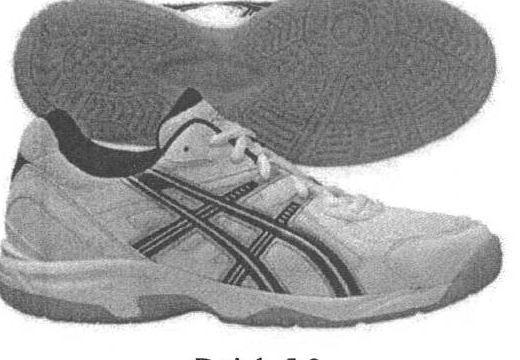
- (c)(ii)
Uncontrolled disposal of synthetic rubber leads to an environmental pollution. Suggest one way to overcome this issue.
[1]
Diagram 6 shows an electron arrangement of compound formed from the reaction between substance X and Y (X2+ ion with 2.8 and Y2- ion with 2.8.8 electrons).
Medium9 marks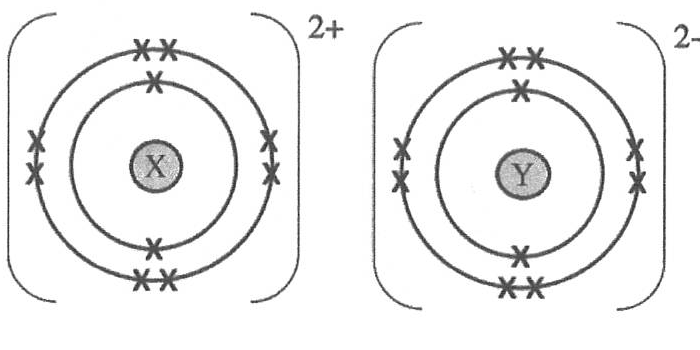
- (a)(i)
Write the electron arrangement of atom X.
[1] - (a)(ii)
State the type of forces of attraction between particles in the compound.
[1] - (a)(iii)
Write the chemical equation for the formation of the compound.
[2] - (a)(iv)
Calculate the mass of compound produced when 0.1 mol of X react with excess Y. [Relative atomic mass: Y=16; X=24]
[2] - (b)
Puan Juriah puts a white solid in a cupboard to keep the cockroach away. The physical properties of the white solid are: cannot conduct electricity in any states; low melting point and boiling point. Based on the information, identify the type of compound of the white solid and explain each property.
[3]
Diagram 7.1 shows the energy level diagram for the precipitation of barium sulphate, BaSO4: X + K2SO4 at a higher energy level than BaSO4 + Y, with ΔH = -1473.2 kJ mol⁻¹.
Medium10 marks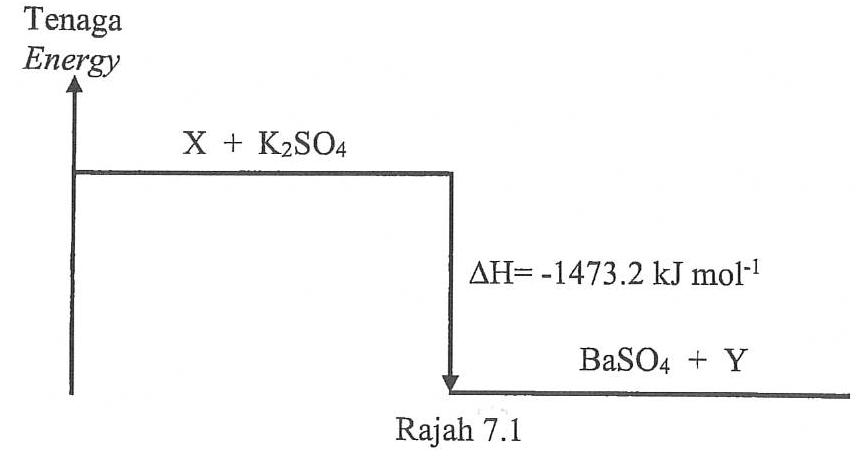
- (a)(i)
What is the meaning of heat of precipitation?
[1] - (a)(ii)
State one information that can be obtained from the energy level diagram shown in Diagram 7.1.
[1] - (a)(iii)
Name solution X.
[1] - (a)(iv)
Based on your answer in 7(a)(iii), write the ionic equation for this reaction.
[1] - (b)(i)
The thermochemical equation Pb(NO3)2 + Na2SO4 -> PbSO4 + 2NaNO3, ΔH = -50.4 kJ mol⁻¹ represents the reaction between lead(II) nitrate solution and sodium sulphate solution. Calculate the increase in temperature when 25 cm³ of 1 mol dm⁻³ lead(II) nitrate solution is added to 25 cm³ of 1 mol dm⁻³ sodium sulphate solution. [Specific heat capacity of solution = 4.2 J g⁻¹ °C⁻¹, density of solution = 1 g cm⁻³]
[3] - (b)(ii)
Experiment is repeated by using the same volume of solution as in 7(b)(i) and the temperature change, θ obtained is reduced by half. Suggest how you can obtain the new temperature change, θ.
[1] - (c)
Table 7 shows fuel value of methane and octane (methane: 27.0 kJ g⁻¹, boiling point -161.6 °C, gas, RM2.05 per litre; octane: 89.0 kJ g⁻¹, boiling point 125.6 °C, liquid, RM4.84 per litre). Which fuel would you choose for cooking and justify your choice.
[2]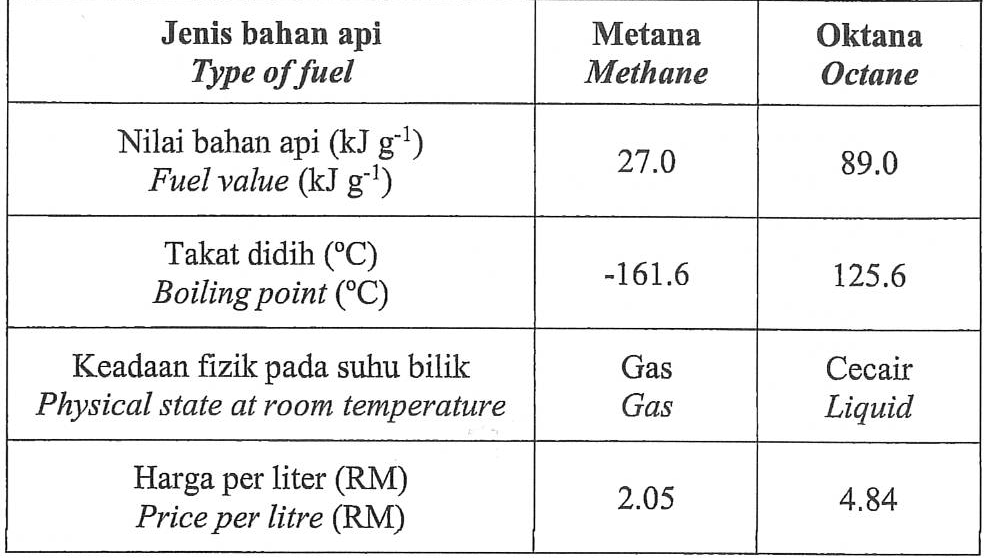
Diagram 8 shows the electrolysis of 1.0 mol dm⁻³ sodium chloride solution (Cell I, electrodes P and Q) and 1.0 mol dm⁻³ sodium nitrate solution (Cell II, electrodes R and S) using carbon electrodes. Standard electrode potentials: Na⁺ + e⁻ ⇌ Na, E° = -2.71 V; 2H⁺ + 2e⁻ ⇌ H2, E° = 0.00 V; O2 + 2H2O + 4e⁻ ⇌ 4OH⁻, E° = +0.40 V; Cl2 + 2e⁻ ⇌ 2Cl⁻, E° = +1.36 V.
Medium10 marks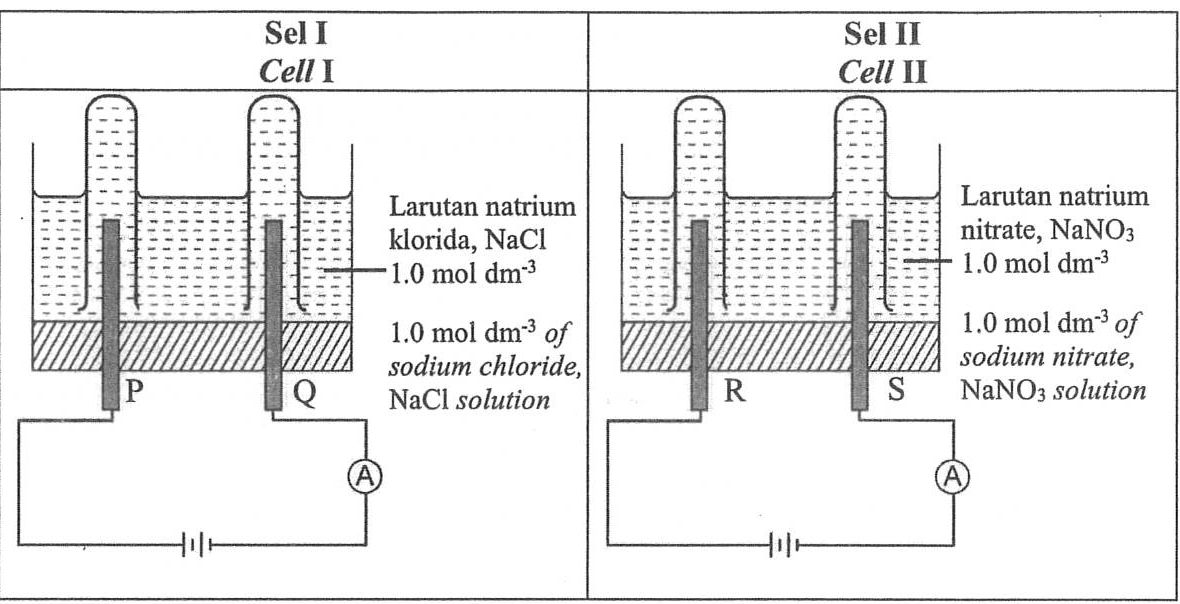
- (a)(i)
Based on Cell I, state all anions present in sodium chloride, NaCl solution.
[1] - (a)(ii)
Name the product formed at electrode P.
[1] - (a)(iii)
Explain your answer based on the selection of ions to be discharged in 8(a)(ii).
[1] - (a)(iv)
Describe a chemical test to verify the product formed at P electrode.
[2] - (b)
Write half equation at R electrode in Cell II.
[1] - (c)(i)
Table 8 shows an experiment to investigate the displacement of metals (test tube I: iron wire in lead(II) nitrate solution, grey solid formed; test tube II: copper wire in lead(II) nitrate solution, no changes). Based on Table 8, compare and explain the difference in the observations.
[3]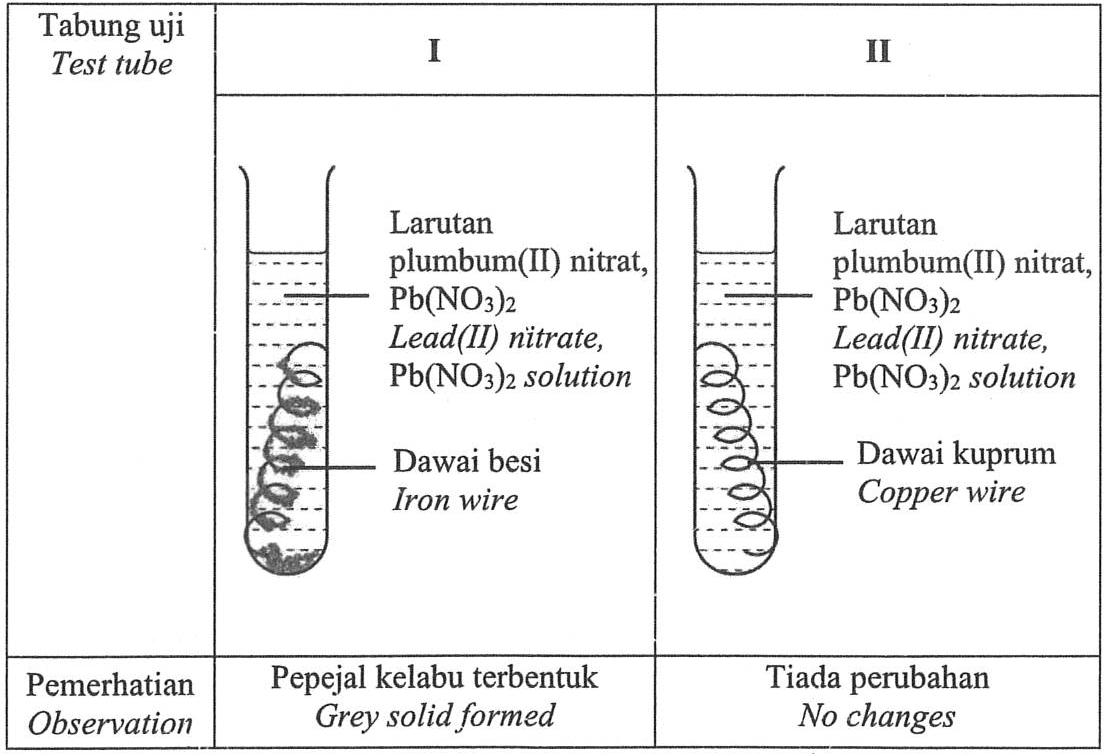
- (c)(ii)
Based on your answer in 8(c)(i), suggest an action to be taken to ensure reaction occurs in test tube II.
[1]
Section B
Diagram 9.1 shows a conversation between a patient with a stomach ache and her doctor. Dr. Gee says the antacid tablet can be swallowed directly or chewed. The antacid tablets contain calcium carbonate. Table 9 shows the volume of gas collected against time for the reaction between antacid tablets with hydrochloric acid. Set I and Set II use the different size of antacid tablets.
Medium20 marks- (a)(i)
Based on Diagram 9.1, which method will relieve the stomach pain faster? Explain your answer.
[3]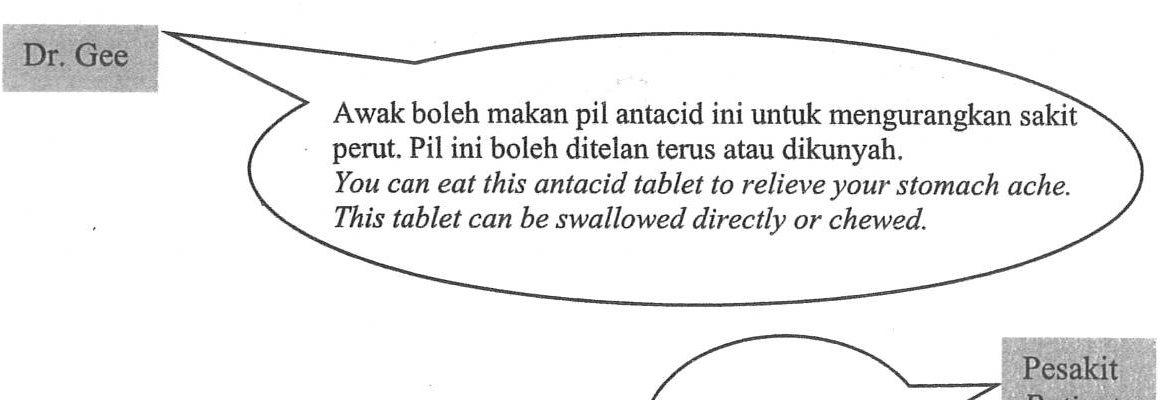
- (a)(ii)
Table 9: Volume of gas evolved (cm³) at time 0, 1, 2, 3, 4, 5 min. Set I: 0.00, 31.00, 48.00, 48.00, 48.00, 48.00. Set II: 0.00, 38.00, 54.00, 67.00, 72.00, 72.00. Calculate the average rate of reaction for Set I and Set II.
[2]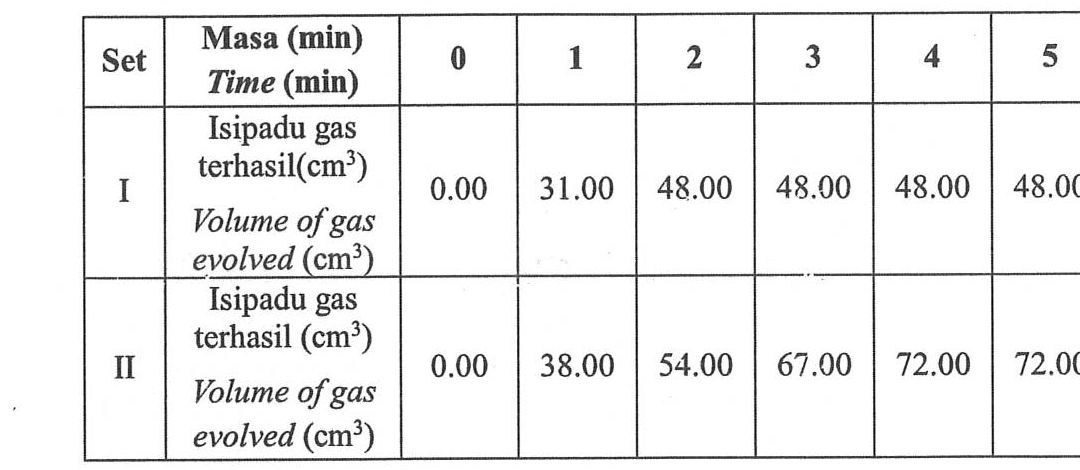
- (a)(iii)
Write a balanced chemical equation to represent the reaction between antacid tablet and hydrochloric acid and calculate the mass of calcium carbonate in the antacids tablet in Set II. [Relative atomic mass: H=1, C=12, O=16, Cl=35.5, Ca=40] [1 mol of gas occupies 24 dm³ at room conditions]
[5] - (b)
Diagram 9.2 shows the graph of volume of gas released against time for three sets of experiments to investigate the factors affecting rate of reaction between zinc and nitric acid. Excess zinc powder is added to 25 cm³ of 0.2 mol dm⁻³ nitric acid at 30 °C in Set I. Suggest changes that can be done to Set I other than the concentration of nitric acid and temperature to obtain the curve as shown in Set II and Set III. Explain both of your suggestions based on the collision theory.
[10]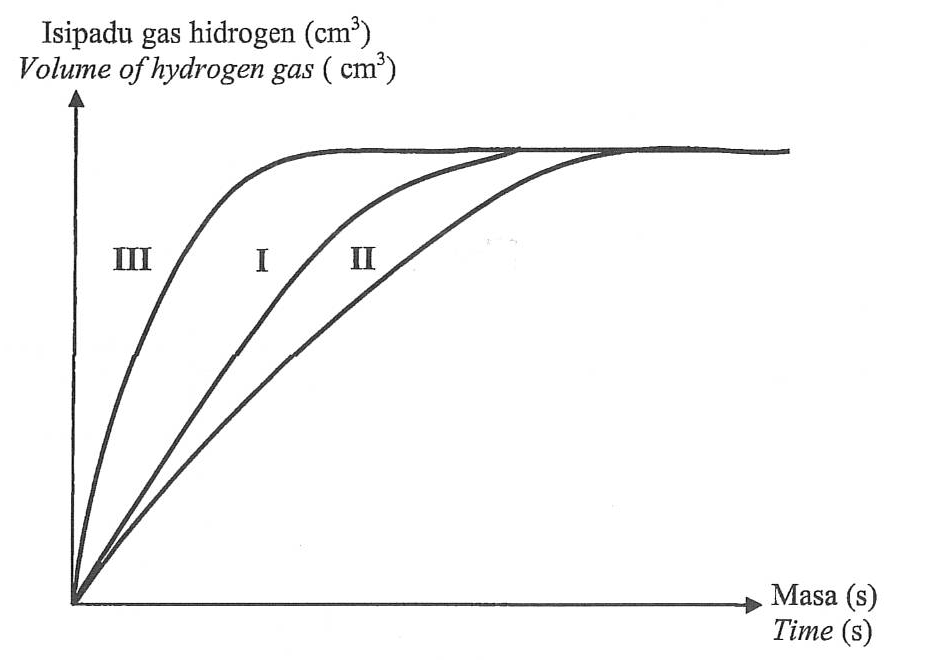
Diagram 10.1 shows a process used to separate petroleum into various products in industry (petroleum gas, petrol, naphtha, kerosene oil, diesel, lubricating oil, bitumen) using a distillation tower.
Medium20 marks- (a)(i)
State the method and physical properties involved in the separation process of petroleum as shown in Diagram 10.1.
[2]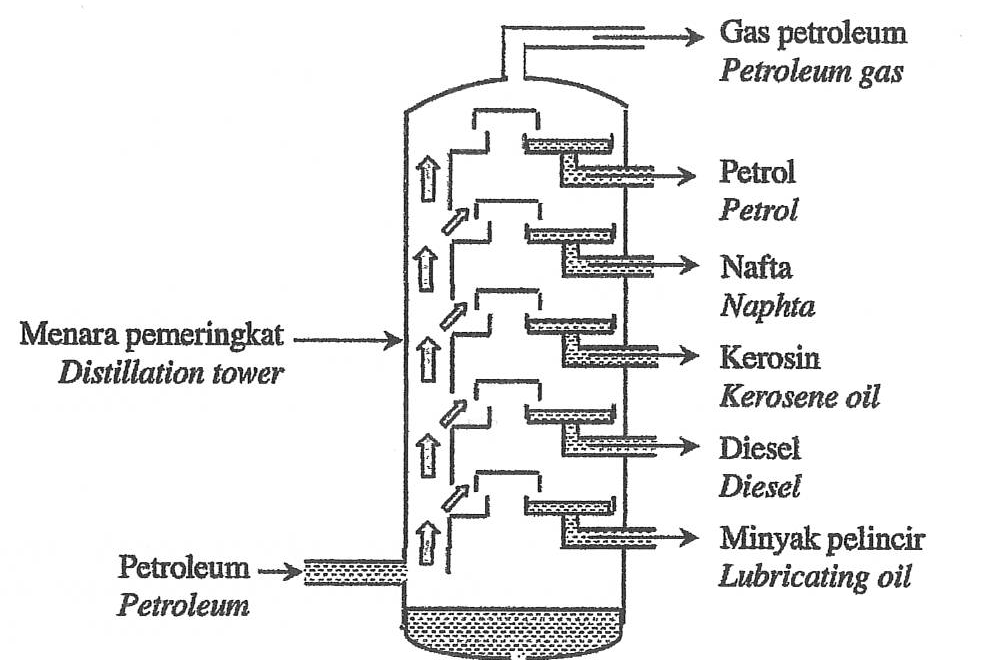
- (a)(ii)
2,2,4-trimethylpentane and butane are products of petroleum distillate. Draw the structural formulae for both distillates.
[2] - (b)
Naphtha is the mixture of hydrocarbon that consists of 5 to 10 carbon atoms. One of the distilled product is hexane, C6H14. Write the chemical equation for the combustion of hexane. Calculate the volume of carbon dioxide, CO2 gas released at room condition when 258 g of hexane used in the complete combustion above. [Relative atomic mass: H=1, C=12; 1 mol of gas occupies 24 dm³ mol⁻¹ at room conditions]
[5] - (c)(i)
Diagram 10.2 shows the conversion of organic compound from one homologous series to another. Alcohol P has less than four carbon atoms in its molecules. Compound Q can be converted to R through hydrogenation reaction. (P with porcelain chips gives Q; Reaction III converts P to compound S, which with CaCO3 gives a colourless gas; Q and R each undergo combustion to give carbon dioxide + water.) Suggest the name of alcohol P, write the molecular formula of compound Q, state the homologous series of compound R and name Reaction III.
[4]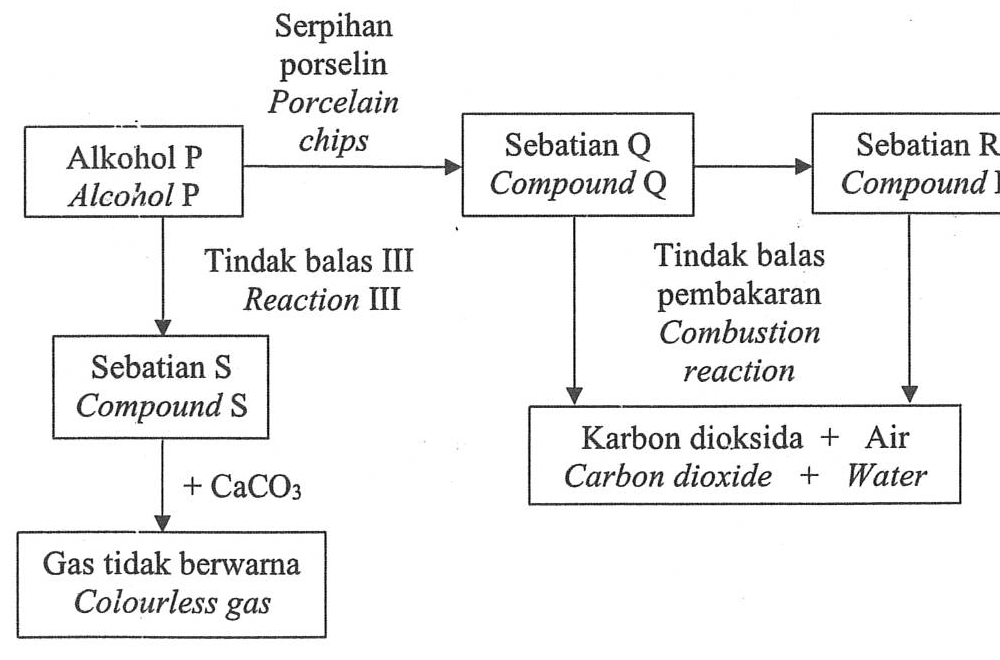
- (c)(ii)
Compare the sootiness of flames for the combustion of compound Q and compound R. [Relative atomic mass: H=1, C=12]
[4] - (d)
Diagram 10.3 shows the freshly plucked local fruits. Ethene, C2H4 gas is naturally released from the ripe fruits. Some fruits are injected with artificial ethene, C2H4 during the ripening process. Justify the use of artificial ethene during the fruit ripening process.
[3]
Section C
Diagram 11.1 shows the structural formula of ethanoic acid (CH3COOH).
Medium20 marks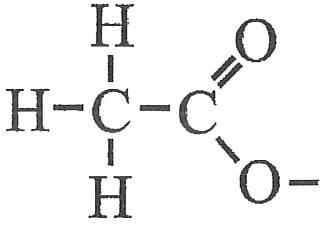
- (a)(i)
State the basicity of ethanoic acid and explain.
[2] - (a)(ii)
Based on Diagram 11.2 (Experiment I: glacial ethanoic acid + calcium carbonate, balloon does not inflate; Experiment II: ethanoic acid solution + calcium carbonate, balloon inflated), explain the differences in the observation between experiment I and II.
[3]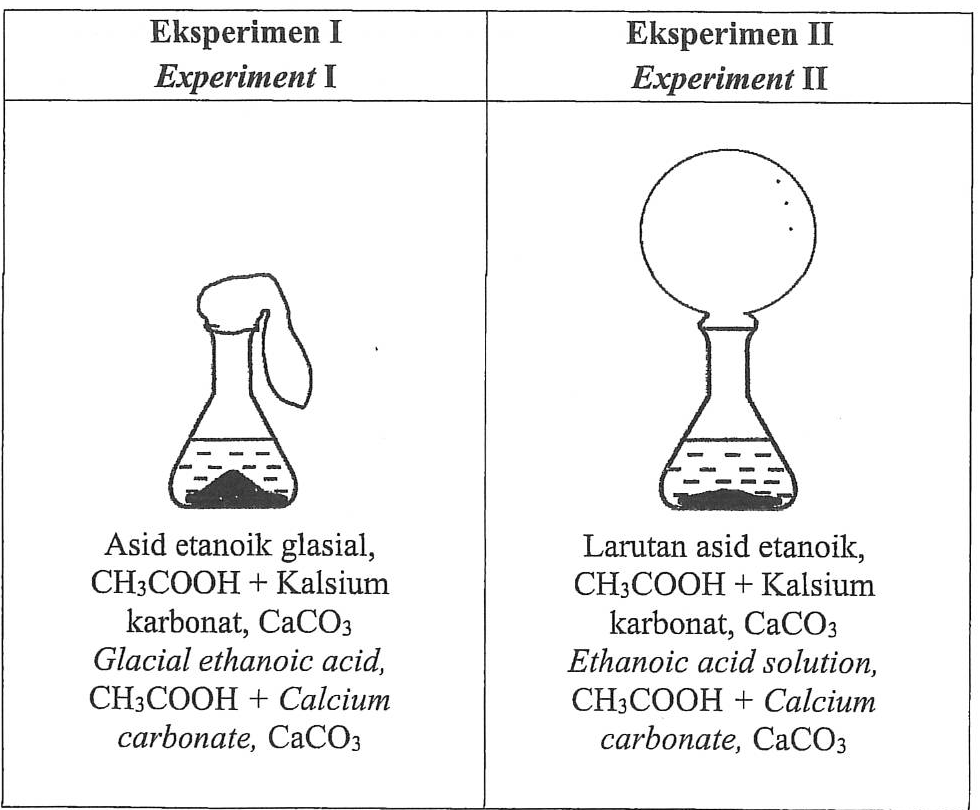
- (b)(i)
Diagram 11.3 shows a flow chart of reaction that occurs on salt X (salt X on heating gives black solid Y + brown gas Z + O2 gas; black solid Y converts back to salt X). Based on Diagram 11.3, salt X can be prepared by the reaction between black solid Y and substance P. Identify salt X, black solid Y, brown gas Z and name substance P.
[4]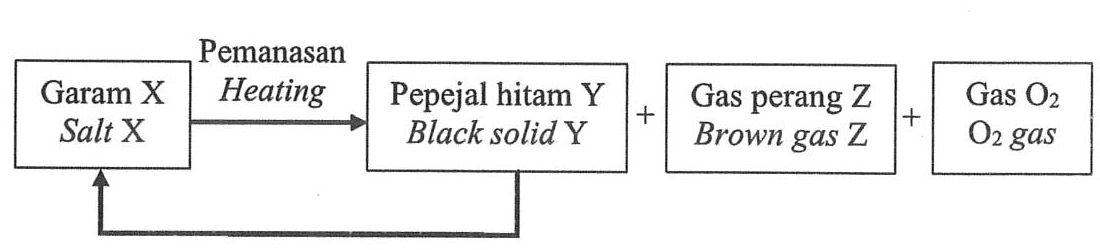
- (b)(ii)
9.4 g of X salt is heated and produced substance Y, Z gas and oxygen gas. Write the chemical equation for the reaction and calculate the volume of Z gas produced at room condition. [Molar mass of X = 188 g mol⁻¹; 1 mol of gas occupies 24 dm³ at room conditions]
[5] - (c)
Diagram 11.4 shows an article about the usage of sulphuric acid in the process of metal mining: sulphuric acid is used to leach copper(II) oxide minerals; copper will be extracted from copper(II) sulphate; excess sulphuric acid needs to be treated before it is discharged as the waste from the factory. By using your knowledge on chemical properties of acid, suggest a chemical substance used to treat the waste and name the reaction involved. Include an ionic equation to represent the reaction occurred and describe a chemical test to verify the absence of acid in the waste.
[6]