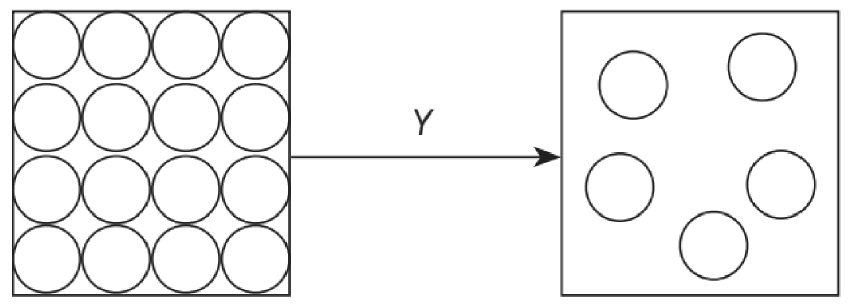
Diagram 1 shows the arrangement of particles of a substance that undergo change in the physical state through process Y (a regular close-packed arrangement of particles changes to widely separated particles). Which of the following substances undergo process Y? I. Bromine II. Iodine III. Chlorine IV. Naphthalene
Easy
Diagram 2 shows the standard representation of sodium-23: 23/11 Na (nucleon number 23, proton number 11). Which of the following statements is correct for Na+ ion? Options give number of protons / neutrons / electrons.
Medium
Table 1 shows the melting and boiling points of substances P, Q, R and S. P: melting -75 °C, boiling -15 °C. Q: melting -20 °C, boiling 97 °C. R: melting 35 °C, boiling 147 °C. S: melting 5 °C, boiling 120 °C. Which substances is a liquid at room temperature?
Medium
Which of the following pairs are matched correctly? (Columns: Atom / Ion / Molecule)
Medium
Which of the following pairs of physical properties of magnesium chloride is true? (Solubility in water / Electrical conductivity in aqueous solution)
Medium
The equation 2Al2O3 → 4Al + 3O2 represents the reaction to extract aluminium from aluminium oxide. What is the mass of aluminium that can be extracted from 102 g aluminium oxide? [Relative atomic mass: Al = 27, O = 16]
Medium
Which of the following are the special characteristics of transition elements? I. Form coloured compounds II. Can be used as a catalyst III. Have a low melting point IV. Have only one oxidation number
Medium
The statement refers to the contributions of a scientist in the development of the Periodic Table: studied the frequency of X-ray released by various elements and eventually found a relationship between the X-ray spectrum and proton numbers; arranged the elements in the Periodic Table of Elements according to their increasing proton numbers. Who was the scientist?
Easy
Which characteristics is correct about elements in Group 1 in the Periodic Table as going down the group?
Easy
Which of the following substances is a monoprotic acid?
Easy
1.08 g of element X combines with y g of oxygen to form a metal oxide with the empirical formula X2O3. What is the value of y? [Relative atomic mass: X = 27, O = 16]
Medium
The relative molecular mass of M2(SO4)3 is 342. What is the relative atomic mass of element M? [Relative atomic mass: O = 16, S = 32]
Medium
Table 2 shows the condition of reactants used in experiment I and experiment II. Experiment I: excess zinc granules + 50 cm3 of 2.0 mol dm-3 hydrochloric acid. Experiment II: excess zinc powder + 50 cm3 of 2.0 mol dm-3 hydrochloric acid. Which graph shows the correct curve for experiment I and experiment II? (Volume of hydrogen against time)
Medium
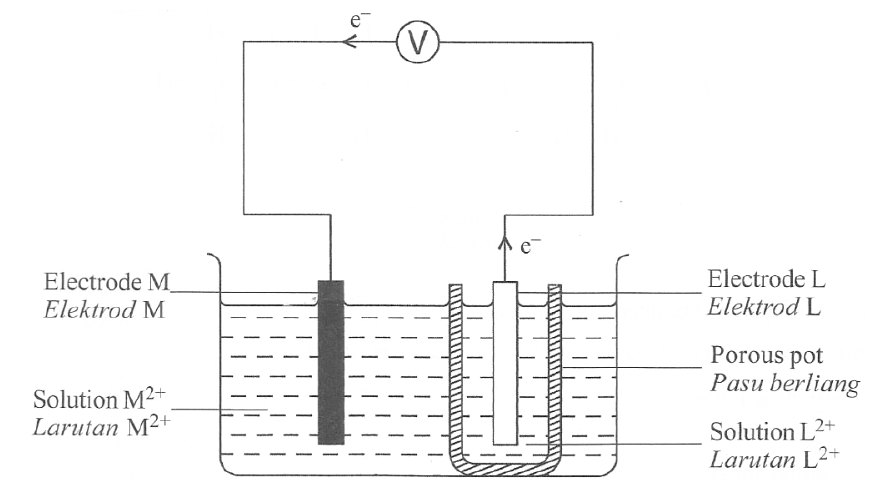
Diagram 3 shows a chemical cell (electrode M in solution M2+, electrode L in solution L2+, separated by a porous pot, voltmeter in circuit). The electrons move from electrode L to electrode M through the circuit. Which statement is correct about the reaction in the chemical cell?
Medium
Which of the following is incorrect about catalyst?
Medium
Which of the following is the name of the theory which is used to explain how different factors affect the rate of a reaction?
Easy
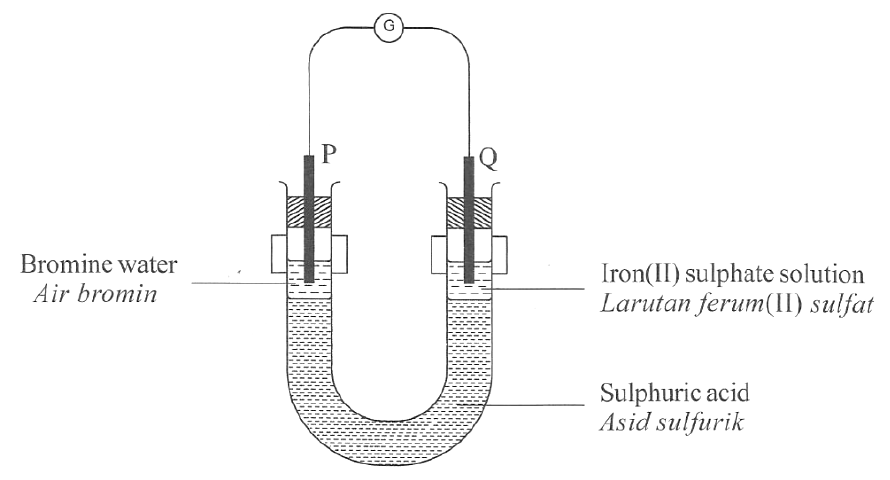
Diagram 4 shows the apparatus set-up to study the transfer of electron at a distance: a U-tube with sulphuric acid, bromine water with electrode P on one side and iron(II) sulphate solution with electrode Q on the other, joined by a galvanometer. Which of the following occurs in Diagram 4?
Medium
The equation C4H9OH → C4H8 + H2O (heat) shows the conversion of butanol to butene. What is process X?
Medium
Which of the following is a base?
Medium
Which of the following is a salt that does not dissolve in water?
Easy
Which of the following is the characteristic of hydrogen chloride gas that enables its acidic properties to be shown?
Medium
What is the pH value of sodium hydroxide 0.1 mol dm-3?
Medium
Heating of zinc nitrate produces brown gas. What is the gas?
Easy
Faizal wants to prepare 250 cm3 of 0.3 mol dm-3 sodium hydroxide solution. What is the mass of sodium hydroxide does Faizal need to produce the solution? [Relative atomic mass: Na = 23, O = 16, H = 1]
Medium
Excess zinc powder is reacted with 100 cm3 of 0.1 mol dm-3 hydrochloric acid. What is the volume of gas produced at room condition? (1 mol of gas occupies 24 dm3 at room condition)
Medium
A series of tests are conducted to verify the cation and anion present in a salt solution. Adding excess sodium hydroxide solution: white precipitate formed, insoluble in excess. Adding excess ammonia solution: white precipitate formed and soluble in excess ammonia solution. Which of the following is the cation present in the salt solution?
Medium
Advanced ceramics are made from inorganic compounds such as oxides, carbides and nitrides. Which of the following is made from advance ceramics?
Easy
Diagram 5 shows a spectacle made from a type of glass. The spectacle can protect our eyes from dangerous ultraviolet (UV) rays. Which of the following substance is the chemical used in the glass?
Easy
What is the general formula of alkenes?
Easy
Diagram 6 shows a flower that has a pleasant fragrance. What is the name of the substance that gives the pleasant fragrance?
Easy
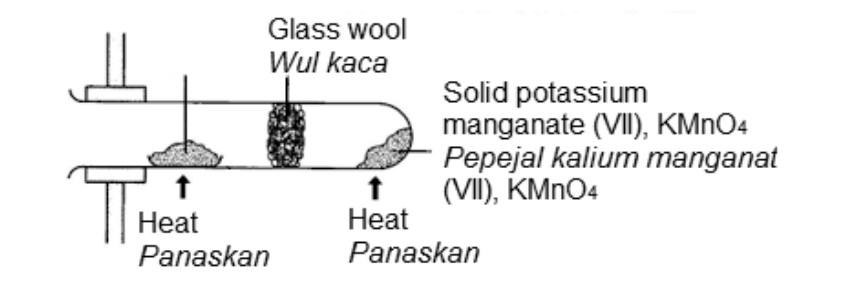
Diagram 7 shows the apparatus set-up to study the reactivity of a metal with oxygen (metal heated, oxygen from heating solid potassium manganate(VII), glass wool between). The colour of the product formed is yellow when hot and white when cold. What is the metal?
Medium
The ionic equation Cr2O7^2- + 14H+ + 6Fe2+ → 6Fe3+ + 2Cr3+ + 7H2O represents the reaction between acidified potassium dichromate(VI) solution and iron(II) sulphate solution. What is the change of oxidation number of chromium in the reaction?
Medium
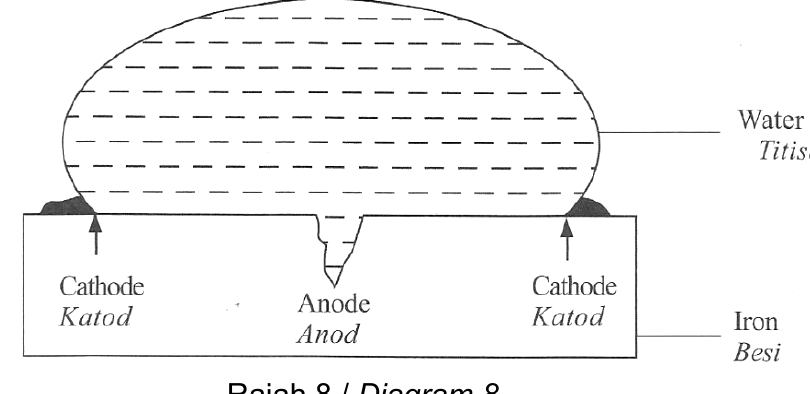
Diagram 8 shows a water droplet on a piece of iron (anode in the centre, cathode at the edges). Which equation occur at the cathode?
Medium
Which cation forms scum with soap?
Easy
Which substance is used to change iron (III) ion to iron (II) ion?
Medium
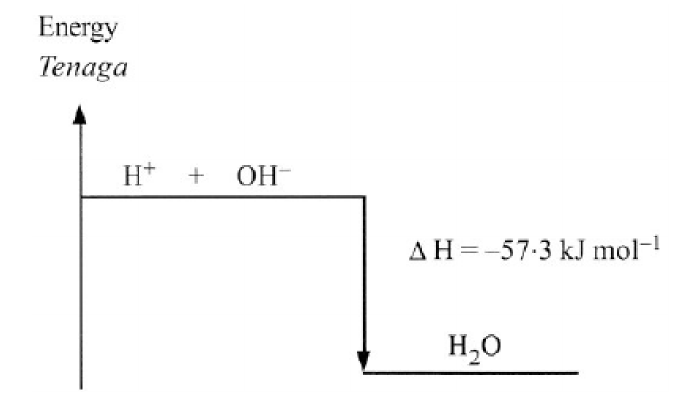
Diagram 9 shows an energy level of a reaction: H+ + OH- at a higher energy level, H2O at a lower level, ΔH = -57.3 kJ mol-1. What is the type of the reaction?
Easy
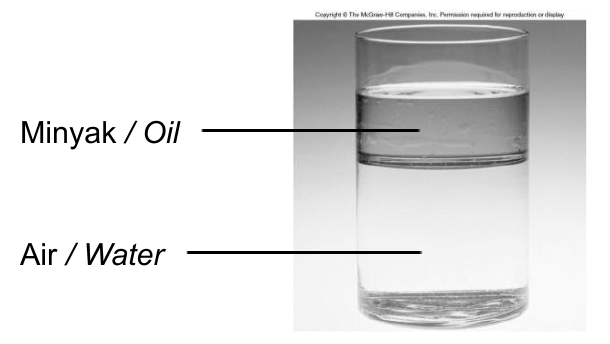
Diagram 10 shows a glass containing two layers of substances (oil above, water below). Which food additive is the most suitable to be added to ensure both substances are mixed?
Easy
The thermochemical equation HNO3 + KOH → KNO3 + H2O; ΔH = -57 kJ mol-1 represents the reaction between nitric acid and potassium hydroxide solution. What is the heat released when 50 cm3 of 2.0 mol dm-3 nitric acid is added to 25 cm3 of 2.0 mol dm-3 potassium hydroxide solution?
Medium
A diprotic acid, H2X has a concentration of 1.0 mol dm-3. What is the volume of H2X needed to neutralise 25.0 cm3 of 1.0 mol dm-3 sodium hydroxide solution, NaOH?