Write your answer on paper. Then open the answer to check it.
Section A
Diagram 1 shows the standard representation of atom Z: nucleon number 7, proton number 3.
Medium5 marks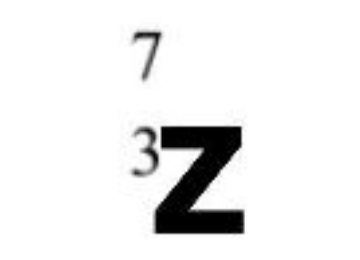
- (a)
What is represented by the number 3?
[1] - (b)
Write the formula of ion Z.
[1] - (c)
Draw the arrangement of particles of substance Z at room temperature.
[1] - (d)
Draw the atomic structure of atom Z.
[2]
Diagram 2.1 shows two pairs of spectacles made from two different types of lenses: lens Y is made from fused silica glass and lens Z from photochromic glass which turns dark when exposed to sunlight. Diagram 2.2 shows a Maglev train that can reach speeds of up to 581 km/h.
Medium5 marks- (a)(i)
State two photochromic materials used in spectacle lenses Z.
[2]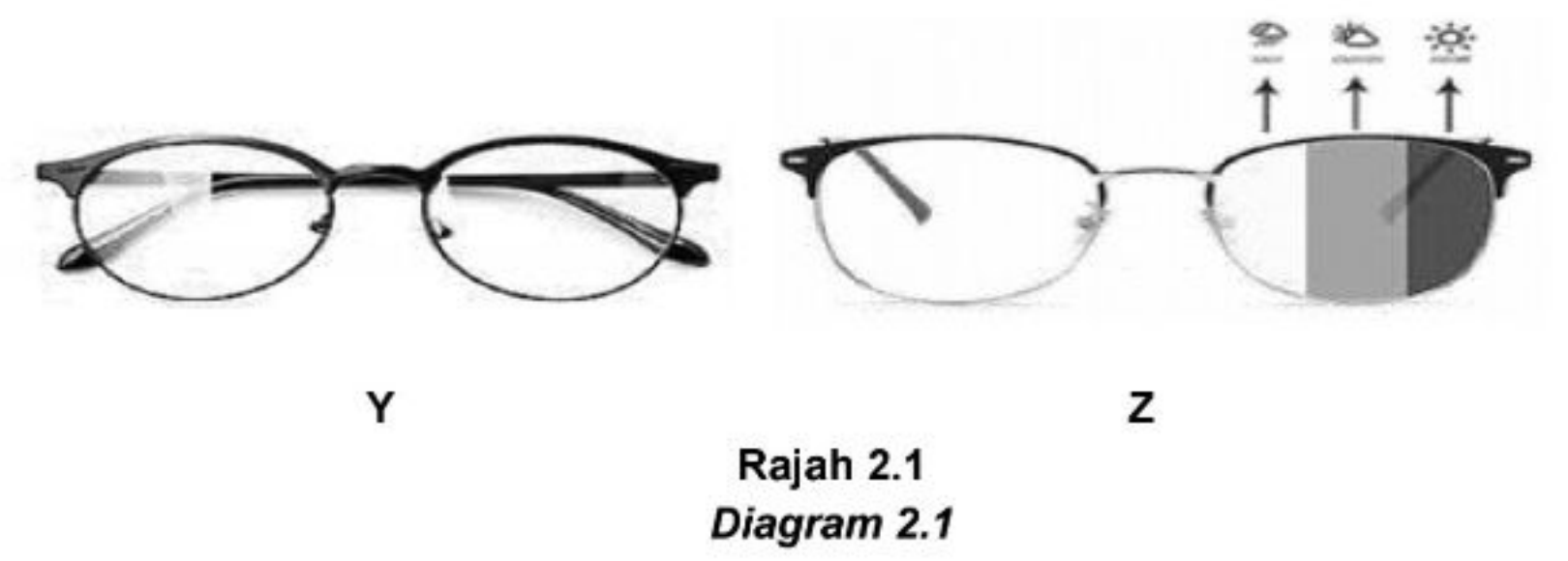
- (a)(ii)
State the advantage of the photochromic glass.
[1] - (b)(i)
State the appropriate alloy used in this transport.
[1]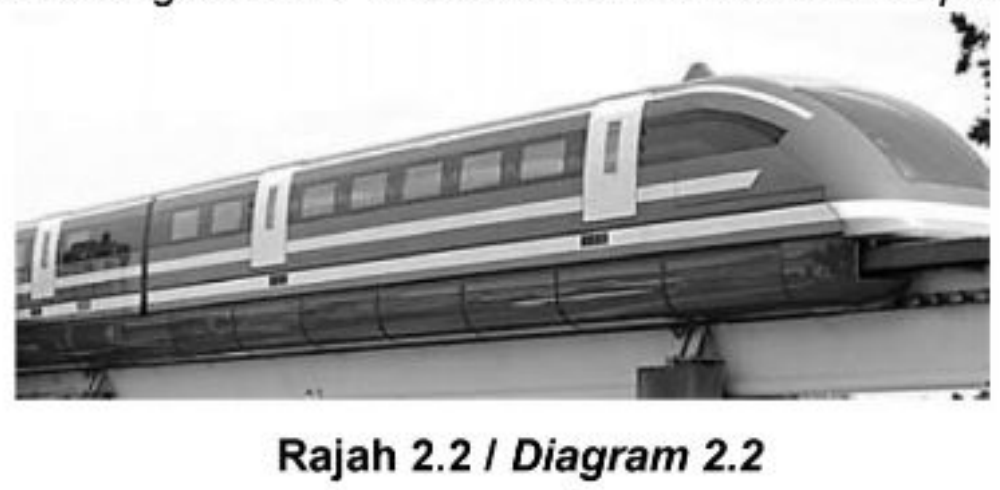
- (b)(ii)
Why is the alloy in (b)(i) suitable to use?
[1]
Diagram 3 shows part of the Periodic Table of Elements. The letters A, B, K, L, M and N do not represent the actual symbols of the elements. A and B are in Group 2 (Periods 3 and 4), K is in Group 1 Period 4, L is in Period 2, and M and N are in Period 3 (Groups 17 and 18).
Medium6 marks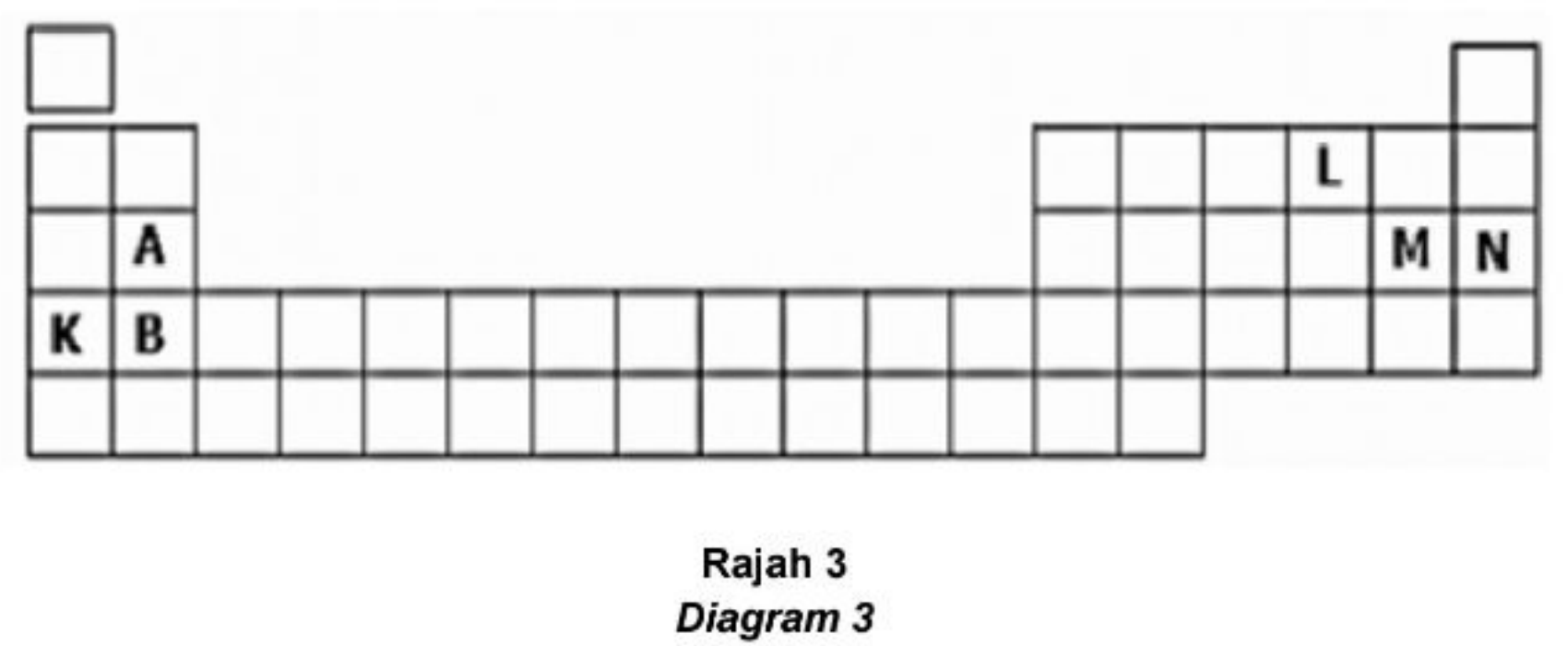
- (a)
Choose an element that is a halogen.
[1] - (b)
Which element is monoatomic?
[1] - (c)
Arrange A, B, K, L, M and N according to the increase in size of the atoms.
[1] - (d)(i)
Write a balanced chemical equation when element K and M react.
[2] - (d)(ii)
State one property of the compound formed in (d)(i).
[1]
Diagram 4 shows the electron arrangement of ammonia gas, NH3 (nitrogen atom sharing electrons with three hydrogen atoms).
Medium7 marks- (a)
State the type of particles of ammonia gas.
[1]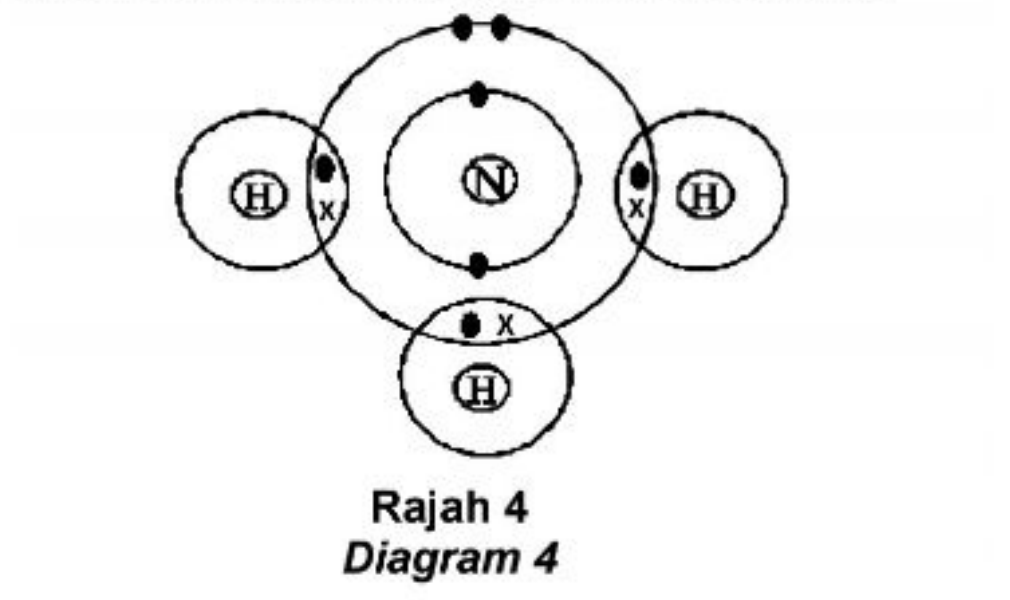
- (b)
State the type of chemical bond in ammonia gas.
[1] - (c)
What is the purpose of chemical bond formation?
[1] - (d)(i)
Ammonia gas can react with hydrogen chloride gas through formation of dative bond. What is dative bond?
[1] - (d)(ii)
Explain the formation of ammonium ion through the formation of dative bond between hydrogen ion, H+ and nitrogen atom, N in ammonia.
[3]
Table 1 shows the description and observation for two experiments. Experiment I: electrolysis of 1 mol dm-3 sodium sulphate solution using carbon electrodes; gas bubbles are released at the anode and cathode. Experiment II: combustion of 1.2 g magnesium powder in excess oxygen; glaring white flame is seen and white powder is formed.
Medium8 marks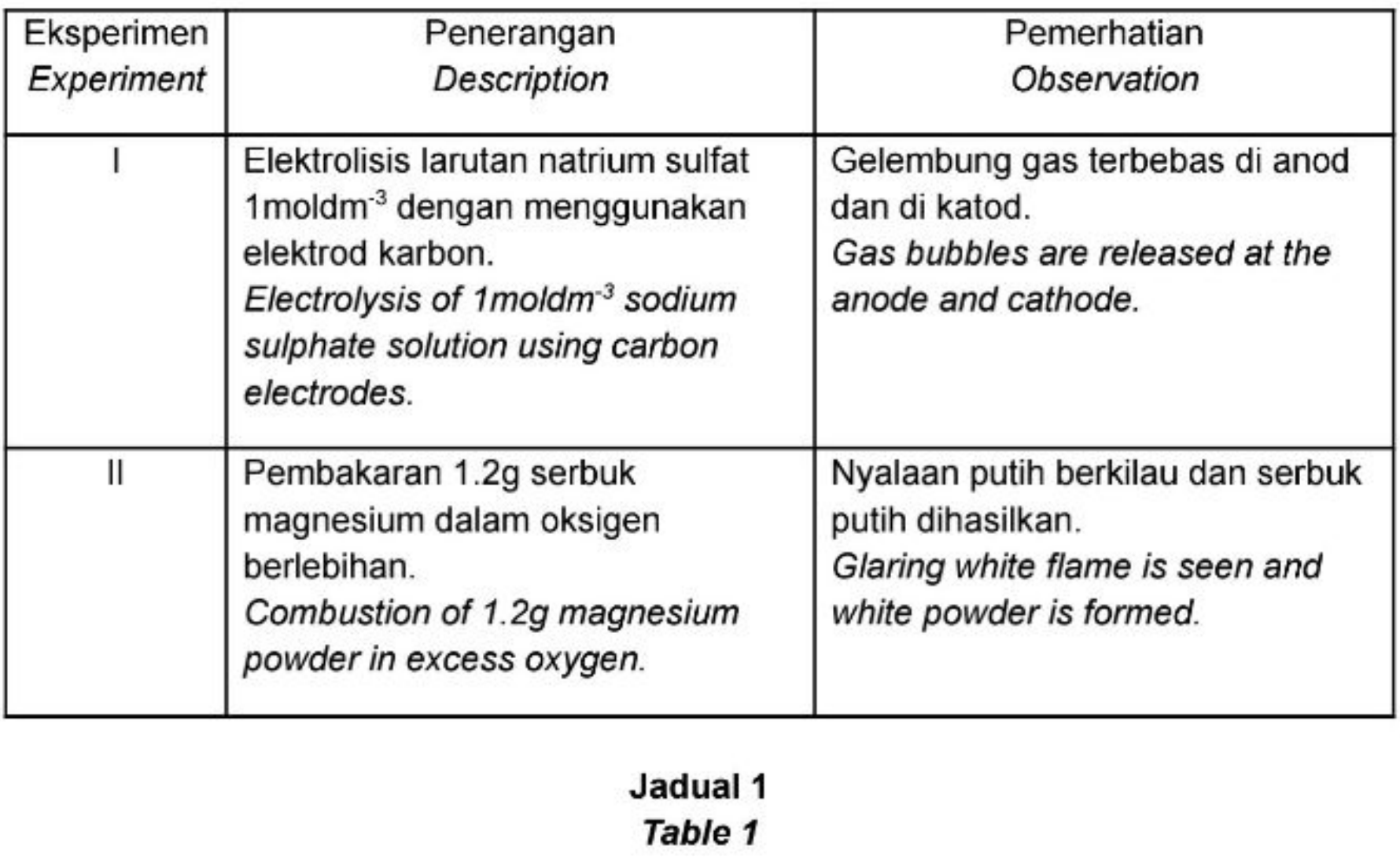
- (a)(i)
Based on Experiment I, list all ions present in sodium sulphate solution.
[1] - (a)(ii)
Name the gas liberated at the cathode. State how you would verify the gas.
[2] - (a)(iii)
Explain how the gas is formed at the cathode.
[3] - (b)(i)
Based on Experiment II, name the white powder formed.
[1] - (b)(ii)
State the change in oxidation number for magnesium.
[1]
Table 2 shows Experiments I and II in the preparation of a salt. Experiment I: sulphuric acid is added from a burette into 20.0 cm3 of 0.5 mol dm-3 potassium hydroxide with phenolphthalein in a conical flask. Experiment II: 25 cm3 of 0.5 mol dm-3 copper(II) chloride solution is mixed with 25 cm3 of 0.5 mol dm-3 sodium carbonate solution to form salt T.
Medium9 marks- (a)(i)
Based on Experiment I, write the chemical equation for the reaction that takes place.
[2]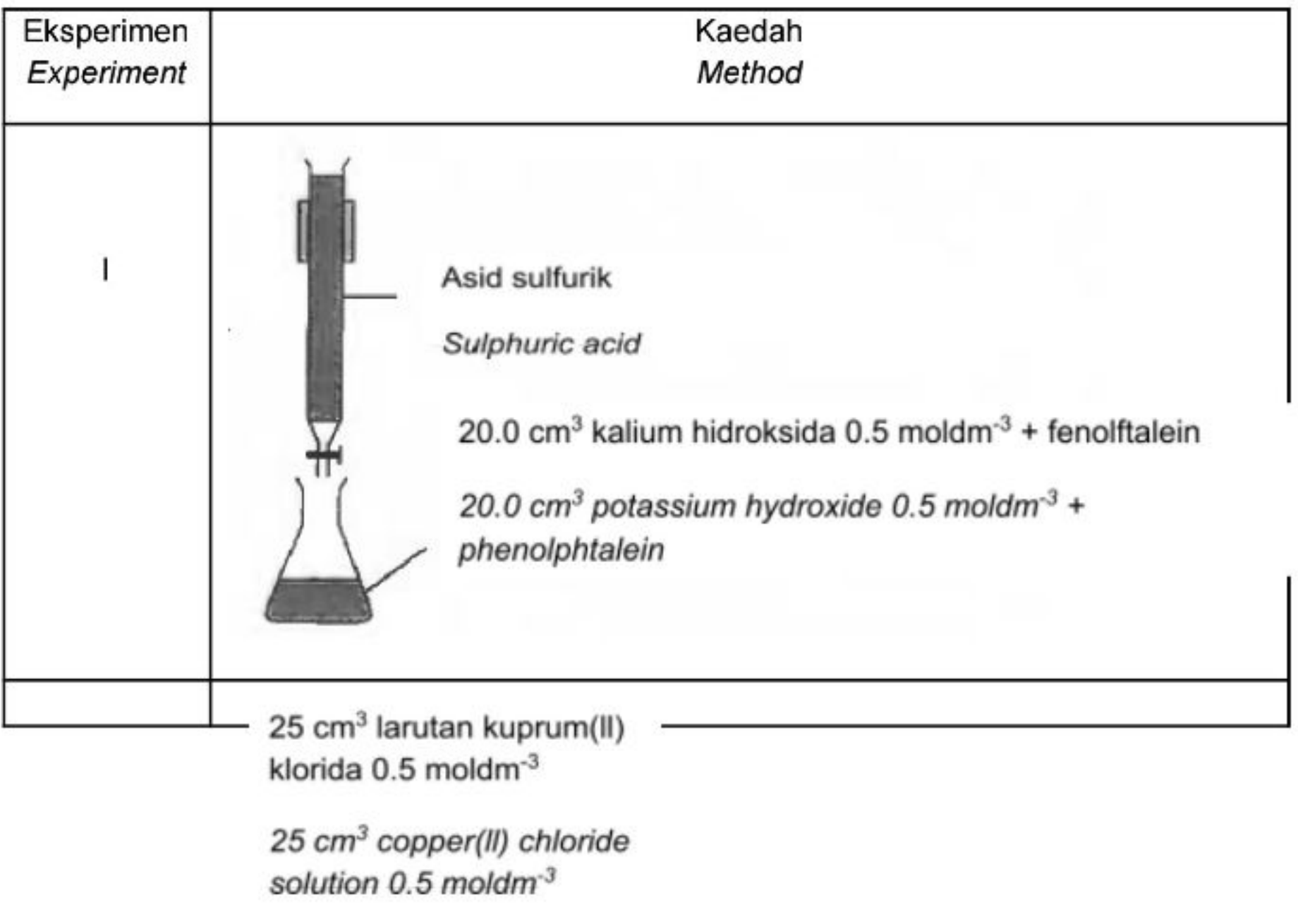
- (a)(ii)
State the name of the products formed in the conical flask.
[1] - (a)(iii)
State one another example of salt that can be prepared through this method.
[1] - (b)(i)
State the name of the reaction for the preparation of salt T.
[1]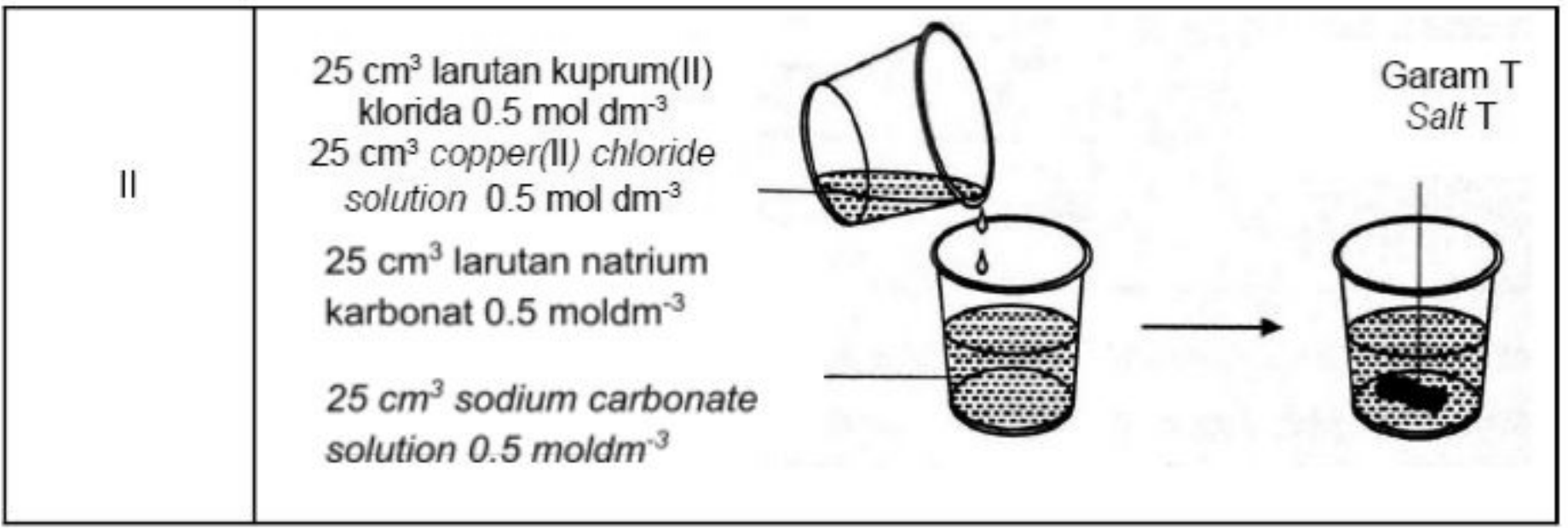
- (b)(ii)
Name salt T.
[1] - (b)(iii)
Calculate the mass of the salt T formed.
[3]
Diagram 5.1 shows the ingredients on the label of a bottle of chilli sauce (chilli, sugar, salt, cornflour, artificial colouring and sodium benzoate) and an ice-cream (milk, propyl ethanoate, sugar, artificial colouring, food additive R). Diagram 5.2 shows the structure of a polymer: a chain with repeating units of C(H)(CH3)-C(H)(H).
Medium10 marks- (a)(i)
State the type of food additive of sodium benzoate and what is its function.
[2]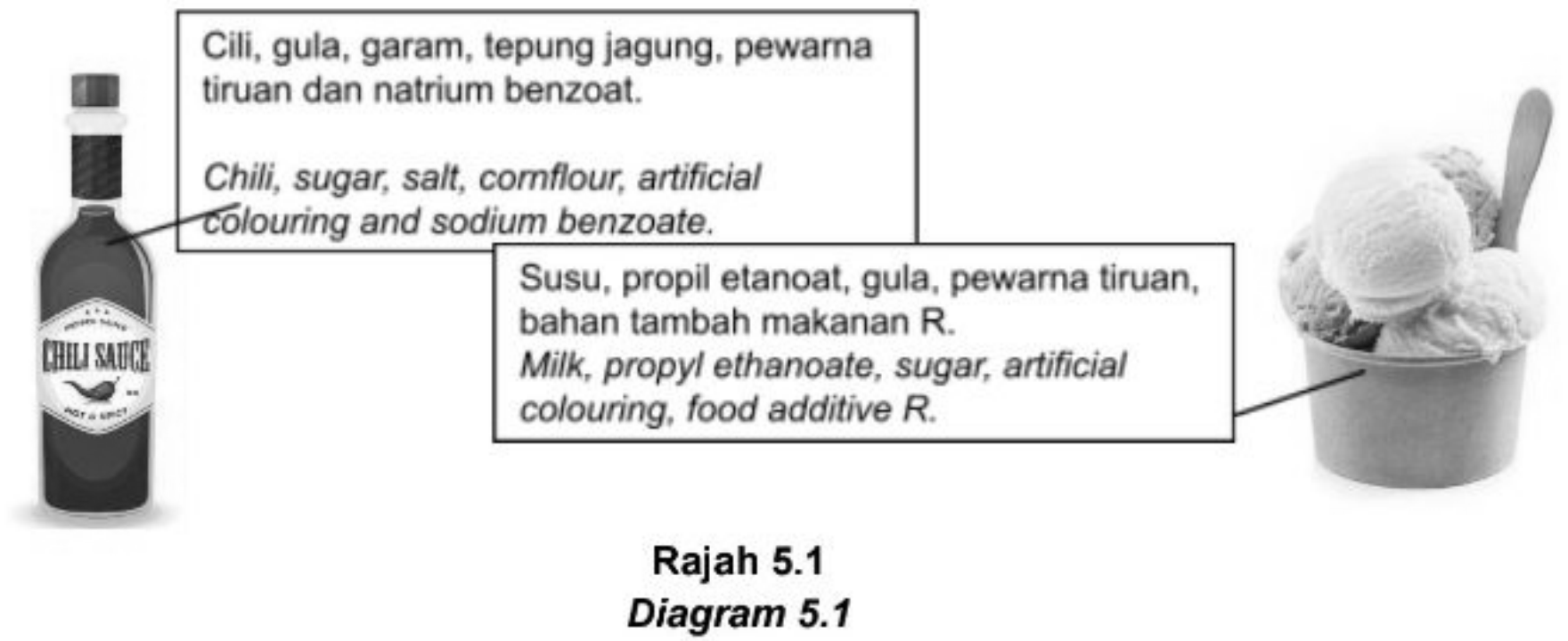
- (a)(ii)
What is the effect of taking excessive sodium benzoate for a long period of time?
[1] - (a)(iii)
Food additive R gives uniform and smooth texture in ice-cream. State the type of food additive of R.
[1] - (a)(iv)
Puan Azwa wants to prepare a dessert without using synthetic dyes. Suggest an ingredient she should add instead of synthetic dye. What is the benefit of using this ingredient?
[2] - (b)(i)
Draw and name the monomer involved.
[2]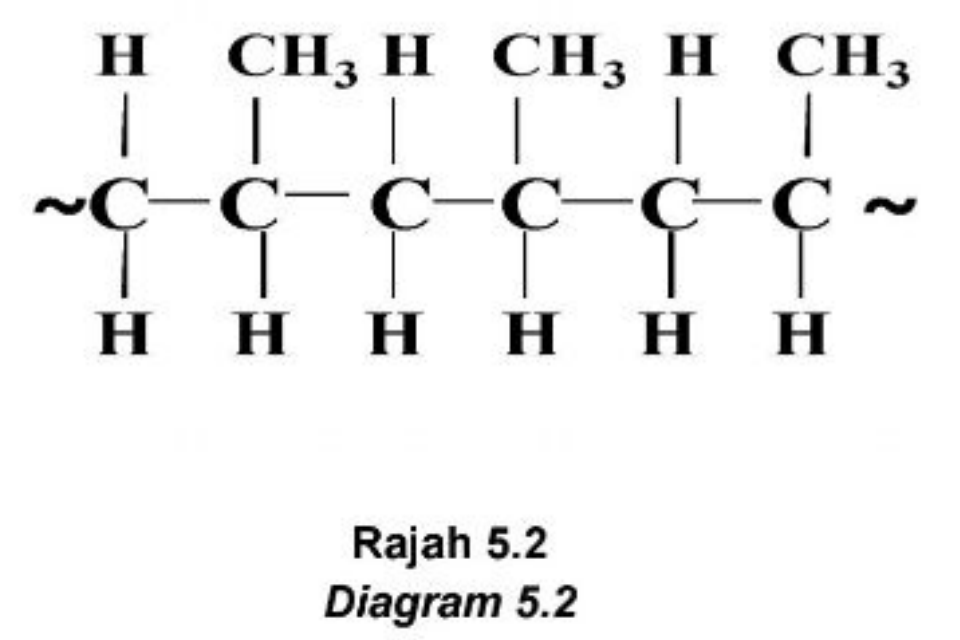
- (b)(ii)
Synthetic polymers are stronger and more durable compared to natural polymers. Justify the use of synthetic polymers in our daily lives.
[2]
Diagram 6 shows the conversions of several organic compounds. Compound A is but-1-ene, CH2=CH-CH2-CH3. Reaction I (+ H2O) converts A to compound B (an alcohol, butanol). Reaction II converts B to compound C, an ester (CH3COO-C4H9).
Medium10 marks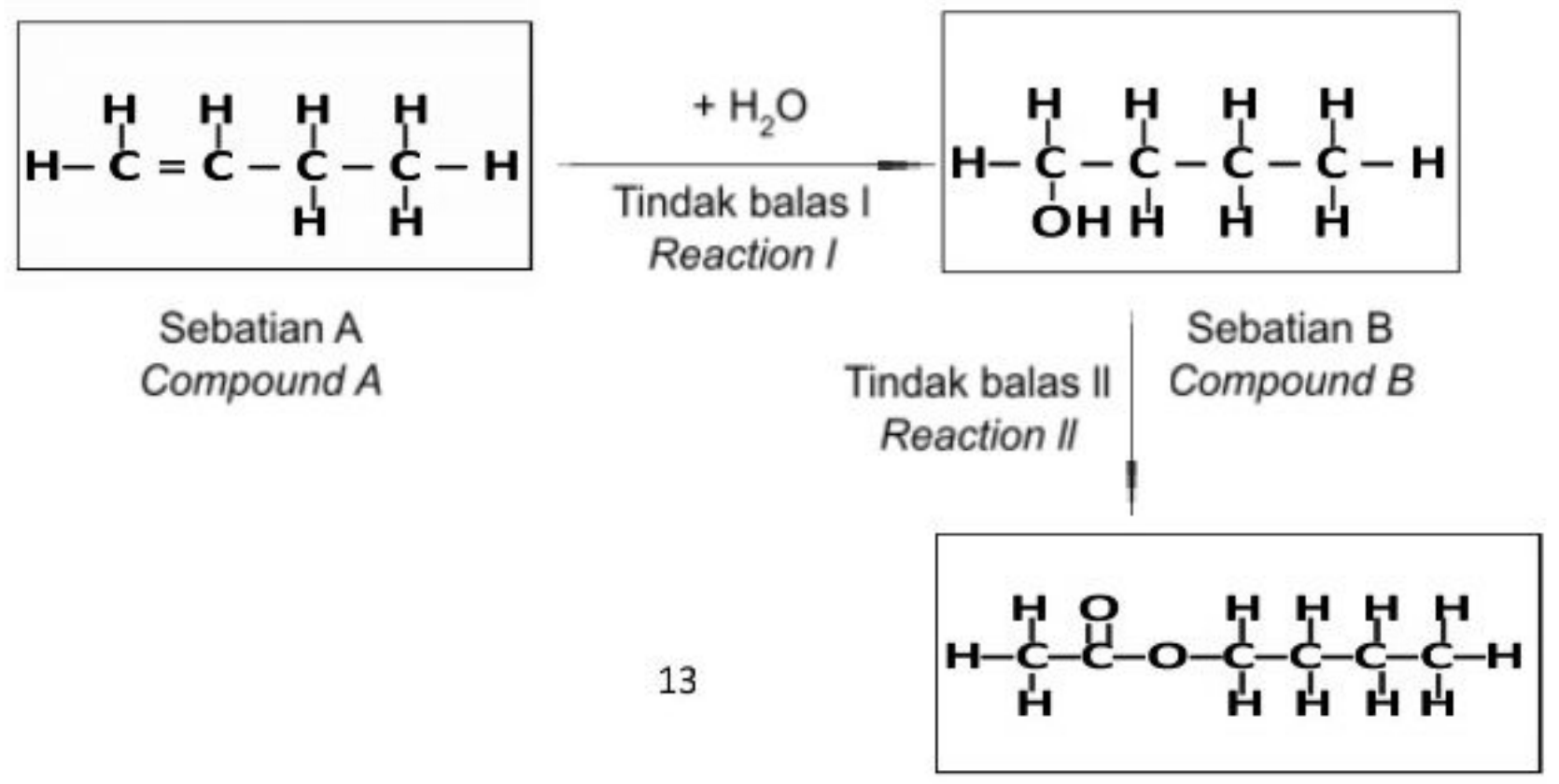
- (a)
Compound A has three isomers. Draw one of the isomers other than the structure above. Name the isomer.
[2] - (b)(i)
Name reaction I.
[1] - (b)(ii)
What conditions are needed in reaction I?
[1] - (c)
Describe a chemical test to differentiate between compound A and compound B.
[3] - (d)
Explain briefly how you can prepare compound C in the laboratory through reaction II.
[3]
Section B
Diagram 7.1 shows two sets of experiment to study the property of an alkali using red litmus paper: Set I uses sodium hydroxide pellets, Set II uses sodium hydroxide solution. Table 3: Set I no change in colour of red litmus paper; Set II red litmus paper turned blue. Diagram 7.2 shows pH of two alkalis: beaker A, 0.1 mol dm-3 sodium hydroxide solution, pH 13.0; beaker B, 0.1 mol dm-3 ammonia solution, pH 11.0.
Medium20 marks- (a)
Based on Table 3, explain the differences in the observations for both sets of experiment.
[4]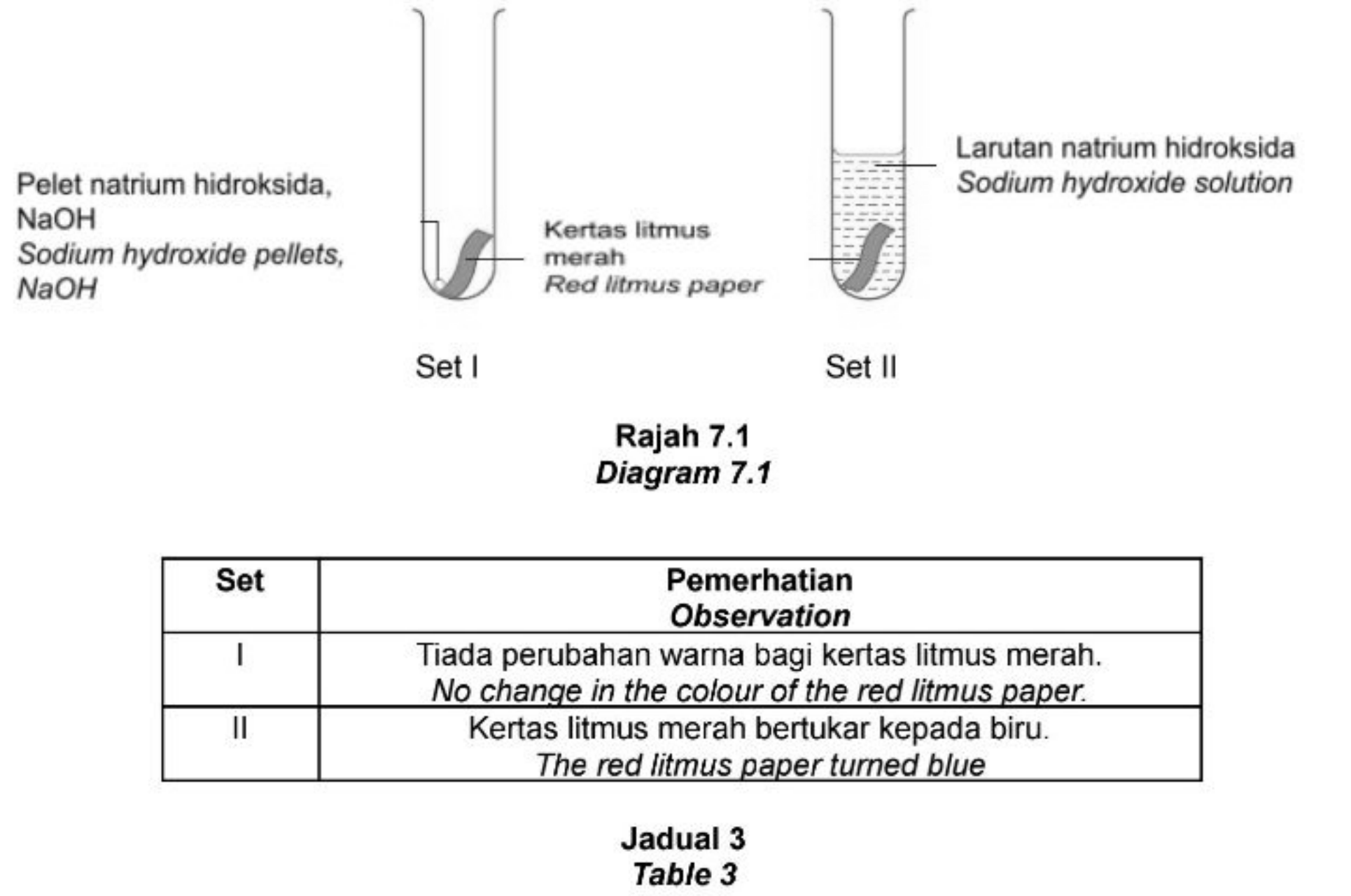
- (b)
Explain why the pH values of the two alkalis are different.
[4]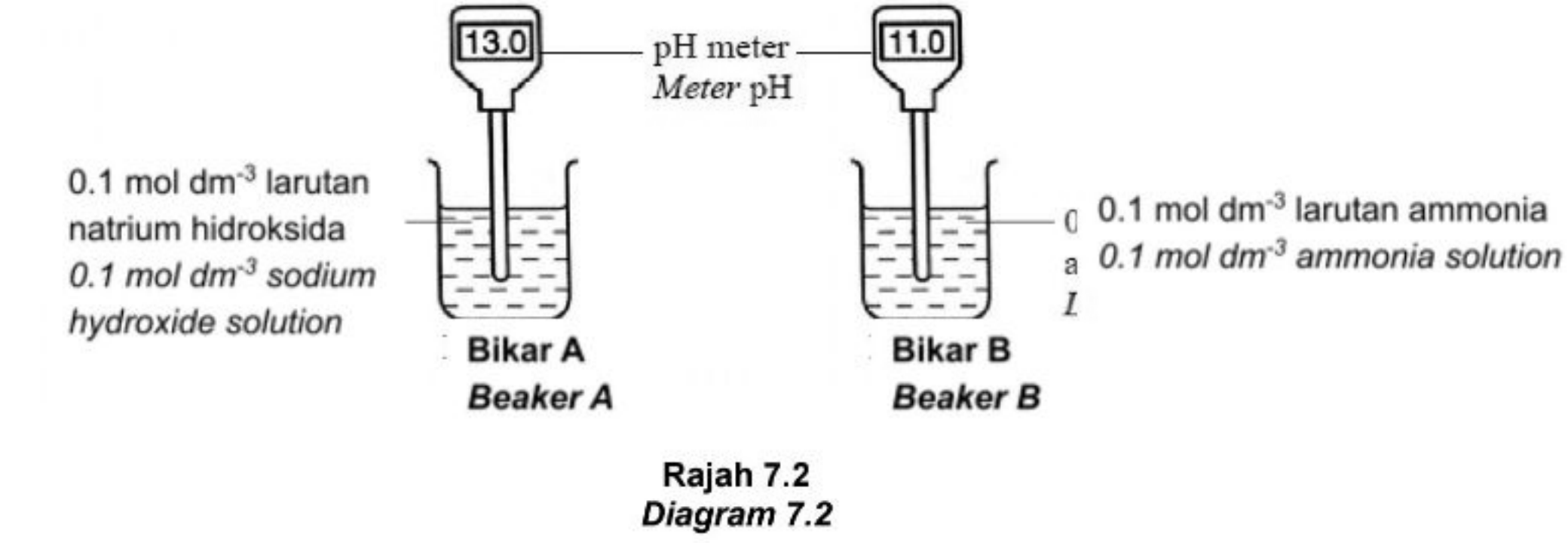
- (c)(i)
You are required to prepare a standard solution of sodium hydroxide of concentration 0.02 mol dm-3 using a 250 cm3 volumetric flask and the sodium hydroxide solution from beaker A (0.1 mol dm-3). Name the method used and determine the volume of sodium hydroxide solution needed.
[3] - (c)(ii)
Predict the pH value of the sodium hydroxide solution in the volumetric flask. Explain your answer.
[3] - (c)(iii)
25 cm3 of sulphuric acid is needed to react completely with 25 cm3 of the sodium hydroxide solution prepared in 9(c). State the type of reaction and write a balanced chemical equation. Calculate the concentration of the sulphuric acid used.
[6]
Table 4 shows the result of an experiment to study the factors affecting the rate of reaction. Experiment I: excess zinc granules + 20 cm3 of 0.1 mol dm-3 sulphuric acid, 30.0 °C, time to collect 30 cm3 gas 40.0 s. Experiment II: excess zinc granules + 20 cm3 of 0.1 mol dm-3 sulphuric acid, 40.0 °C, 25.0 s. Experiment III: excess zinc powder + 20 cm3 of 0.1 mol dm-3 sulphuric acid, 40.0 °C, 15.0 s. Diagram 8 shows the molecular model for the reaction between hydrogen gas and oxygen gas to produce water molecules.
Hard20 marks- (a)(i)
What is the rate of reaction?
[1]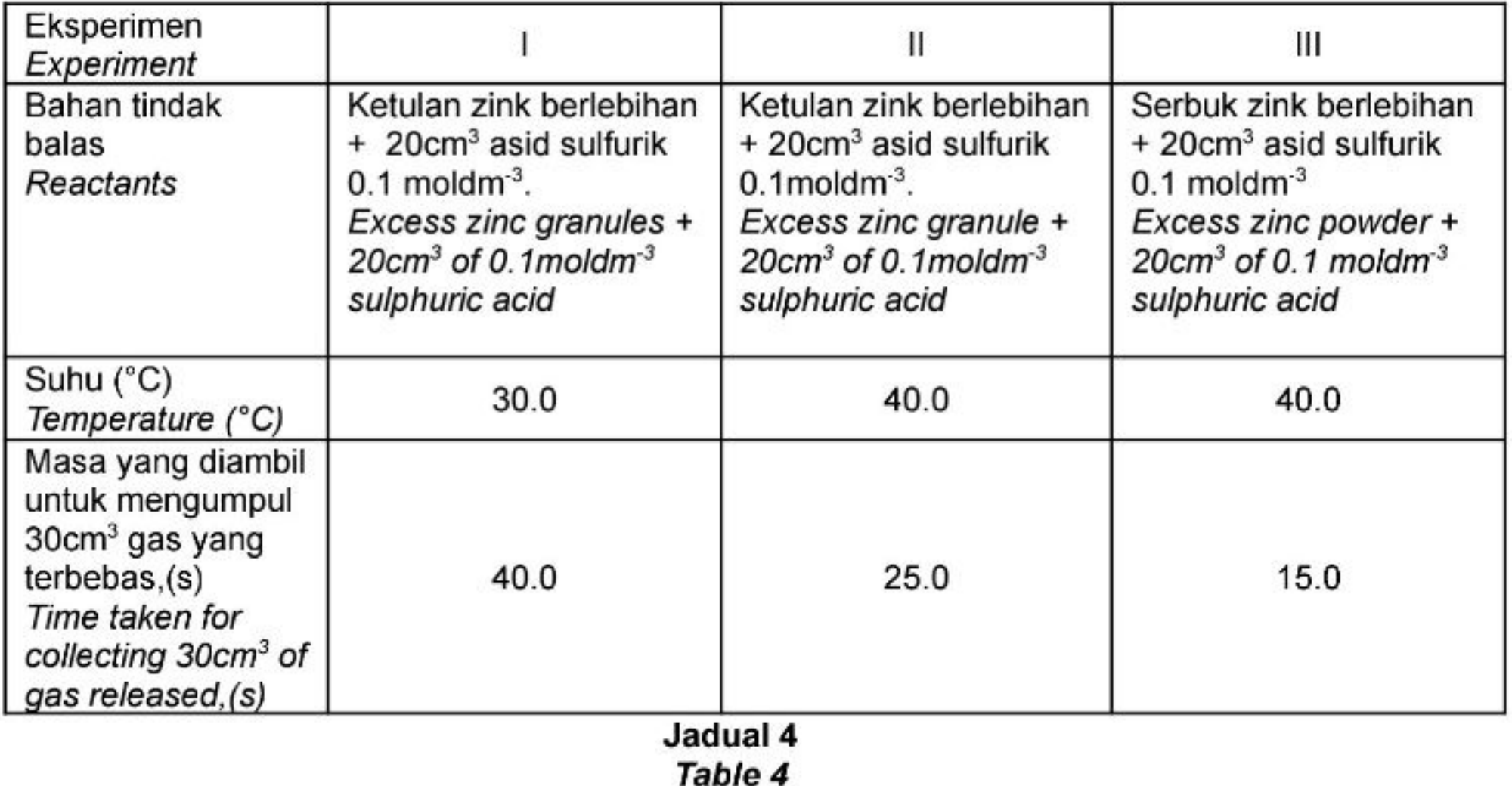
- (a)(ii)
Write the chemical equation for the reaction between zinc and sulphuric acid. Calculate the average rate of the reaction for Experiment I and Experiment II in cm3 s-1.
[4] - (a)(iii)
Sketch the graph of volume against time for experiment I and II on the same axes.
[2] - (a)(iv)
Compare the rate of reaction between Experiment I and II, and between Experiment II and III. In each case, explain the difference in the rate of reaction with reference to the collision theory.
[8] - (b)(i)
What is an effective collision? State two conditions for the effective collision to take place.
[3]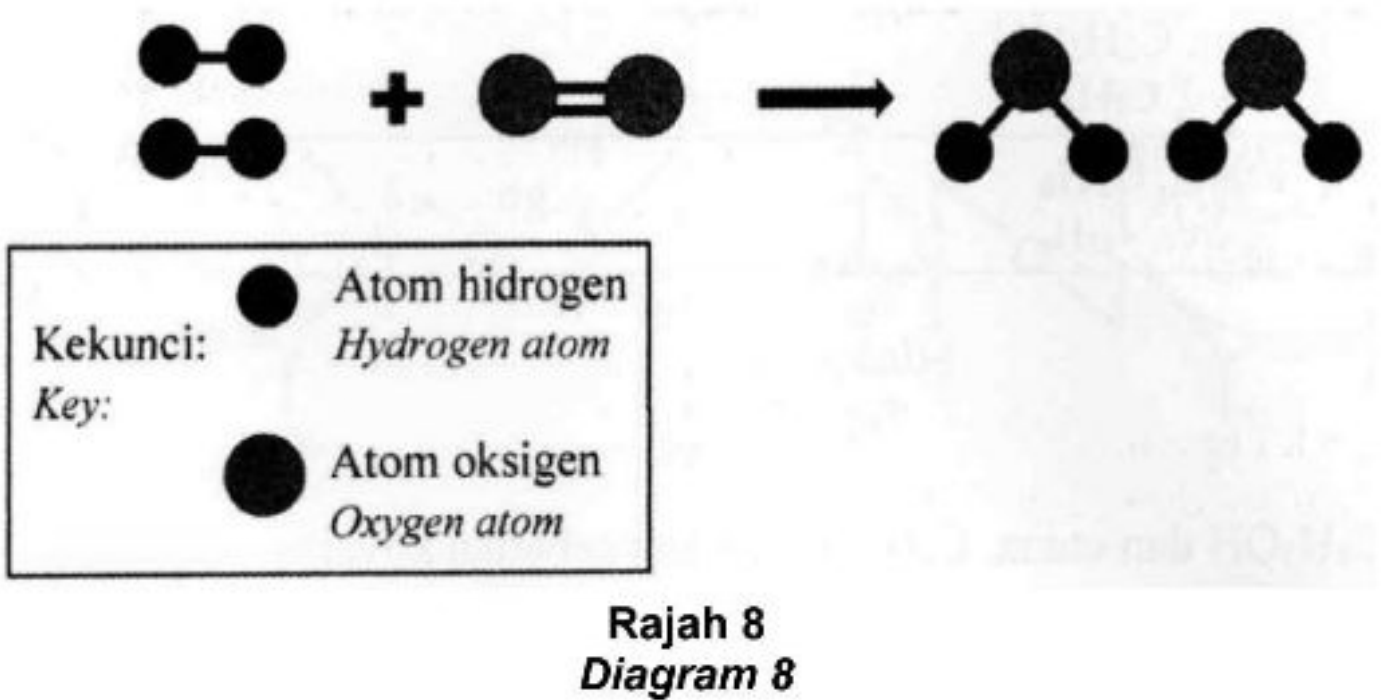
- (b)(ii)
Write a balanced chemical equation and suggest one way to increase the rate of reaction above.
[2]
Section C
An article refers to the first tram in the world using hydrogen fuel, developed by SIFANG in China. The tram is operated entirely by hydrogen fuel cells. When 1 mole of hydrogen is burnt, the heat released is 282 kJ. The highest speed is 70 km per hour; it operates in urban areas only; each tram is designed to carry 380 passengers.
Hard20 marks- (a)(i)
Is the reaction endothermic or exothermic? Explain your answer.
[2]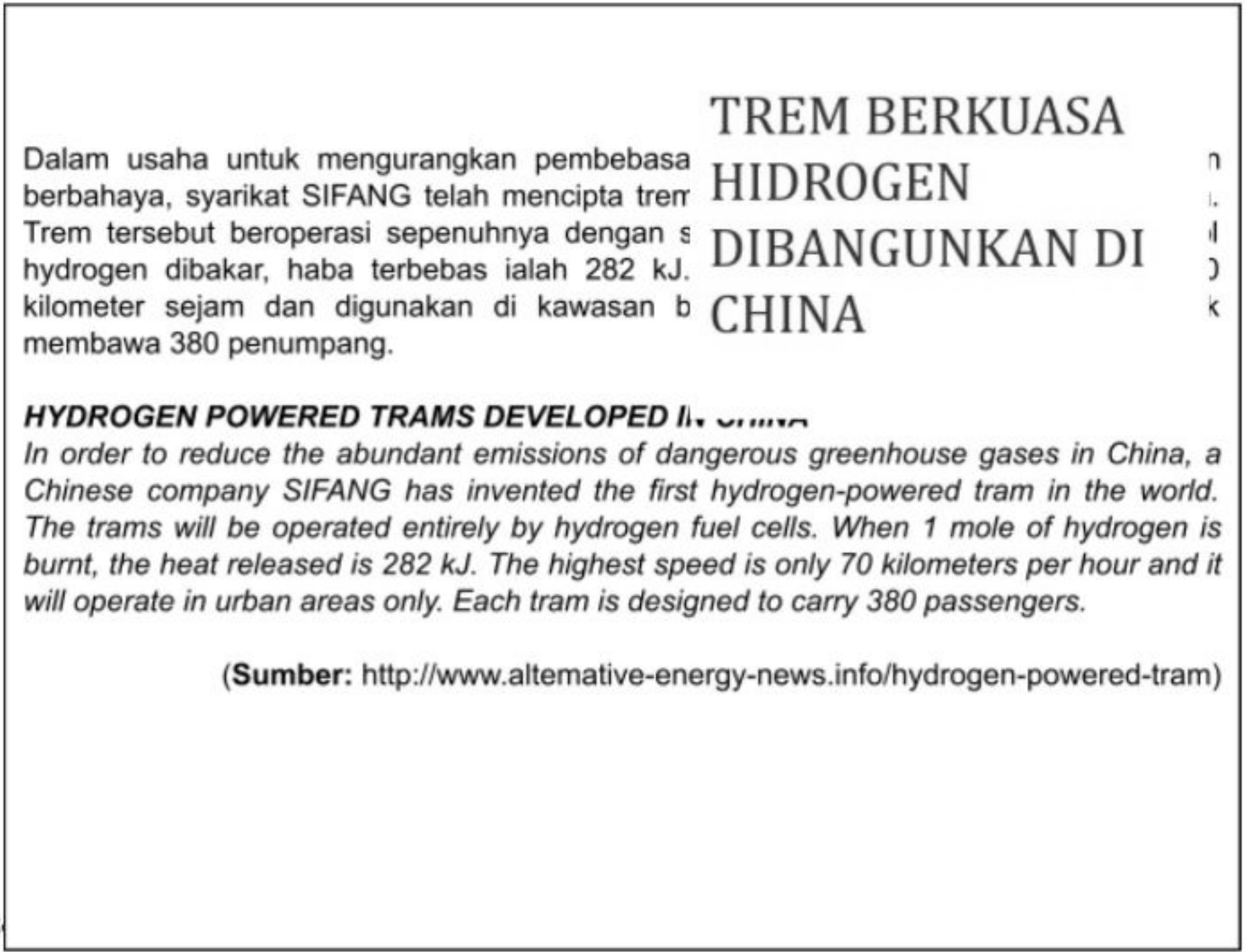
- (a)(ii)
Write the thermochemical equation for the combustion of hydrogen and construct an energy level diagram for the combustion of hydrogen.
[5] - (b)
In an experiment, 100 g of hydrogen liquid is burnt in excess oxygen. Calculate the total energy released when 100 g of hydrogen is burnt. [Relative atomic mass: H = 1]
[3] - (c)
Justify the use of hydrogen as a fossil fuel.
[3] - (d)
In an experiment, 50 cm3 of a strong monoprotic acid is mixed with 50 cm3 of sodium hydroxide, NaOH solution in a polystyrene cup. The concentrations of the acid and alkali are the same. The temperature of the mixture increases by 6.5 °C. Write a balanced chemical equation for the reaction. Calculate the heat released in the experiment. Compare the total heat released if the experiment is repeated with ethanoic acid. Explain. [Specific heat capacity of solution c = 4.2 J g-1 °C-1; density of solution = 1 g cm-3]
[7]