Write your answer on paper. Then open the answer to check it.
Section A
Table 1 shows the number of protons and neutrons for the atom of elements Q and X. The letters used are not the actual symbols of the elements. Element Q: protons 11, neutrons 12. Element X: protons 17, neutrons 18.
Medium5 marks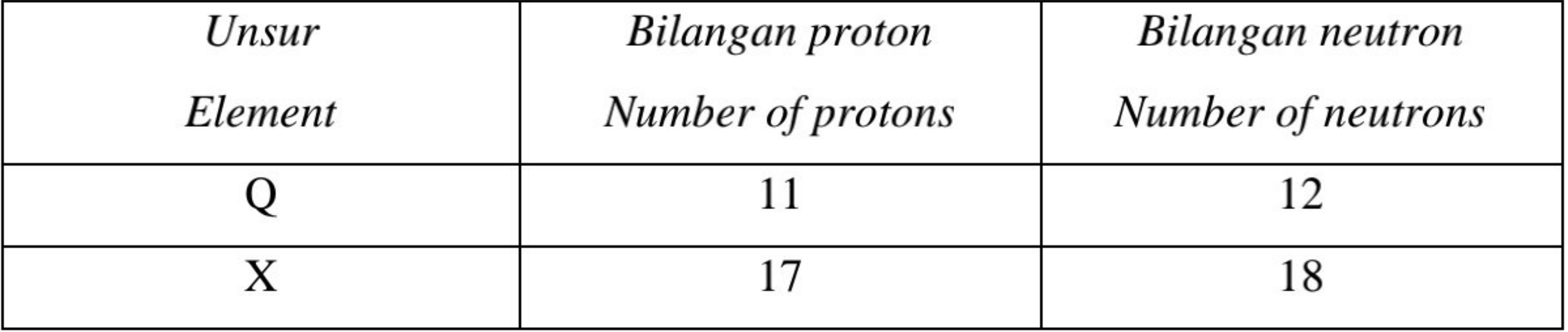
- (a)(i)
What is the nucleon number for atom Q?
[1] - (a)(ii)
Write the electron arrangement of atom Q.
[1] - (a)(iii)
Draw the electron arrangement of ion Q.
[1] - (b)(i)
Atom Z is an isotope of atom X. State the number of protons in an atom Z.
[1] - (b)(ii)
Why atom X and Z have same chemical properties?
[1]
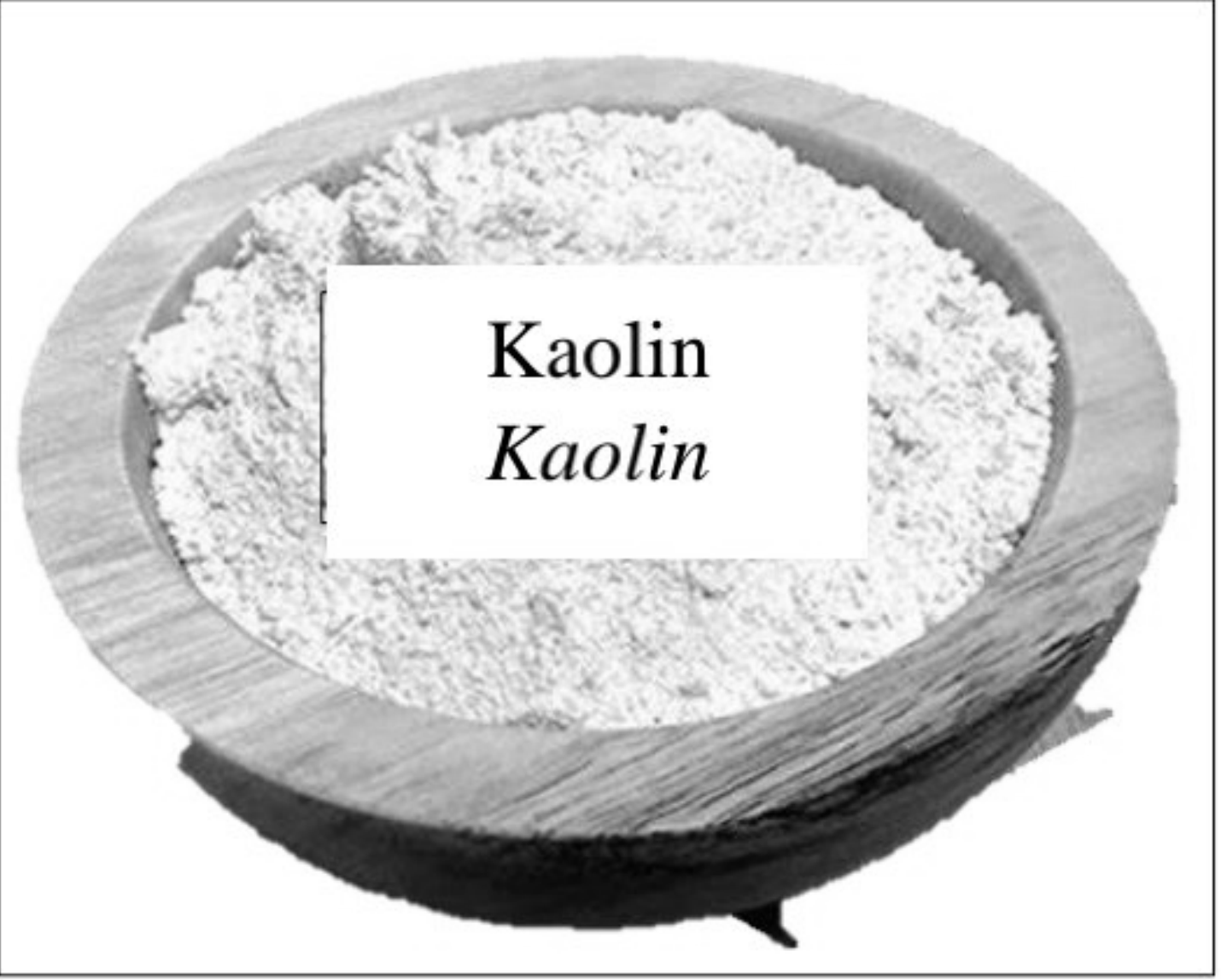
Diagram 2.1 shows an equipment (a key) made of a kind of alloy. Diagram 2.2 shows a white clay (kaolin) used to make white pottery.
Medium5 marks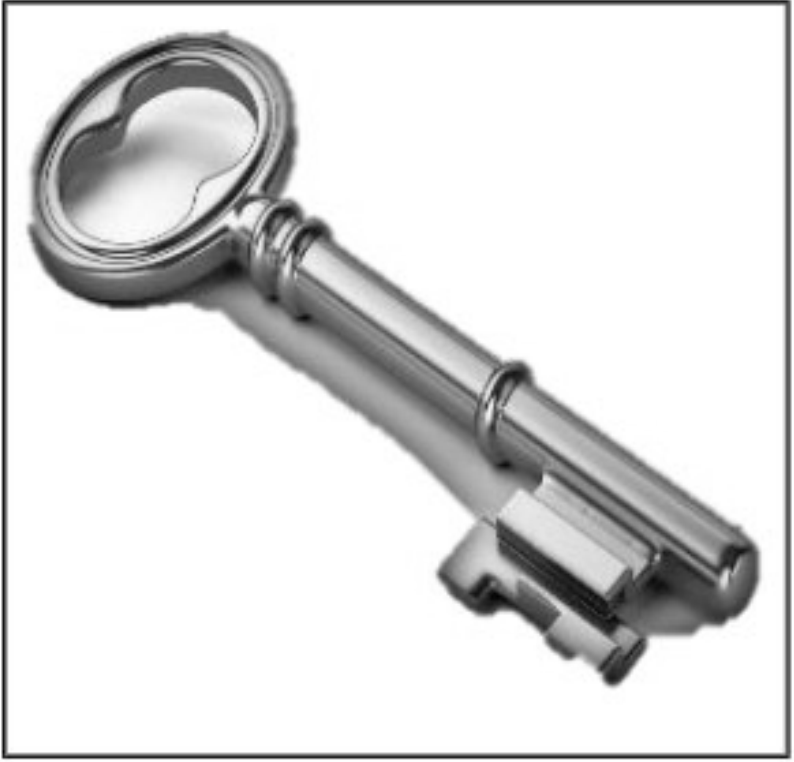
- (a)(i)
State the meaning of alloy.
[1] - (a)(ii)
Name the alloy for the equipment in Diagram 2.1.
[1] - (a)(iii)
State the two elements that produce the alloy for your answer in a(ii).
[1] - (b)
How do you want to produce a green-coloured pottery?
[2]
Table 3 shows the information of elements in the Periodic Table of Elements. Element: Na, Mg, Al, Si, P, S, Cl. Electron arrangement: 2.8.1, 2.8.2, 2.8.3, 2.8.4, 2.8.5, 2.8.6, 2.8.7. Atomic radius (nm): 186, 160, 143, 118, 110, 104, 100.
Medium6 marks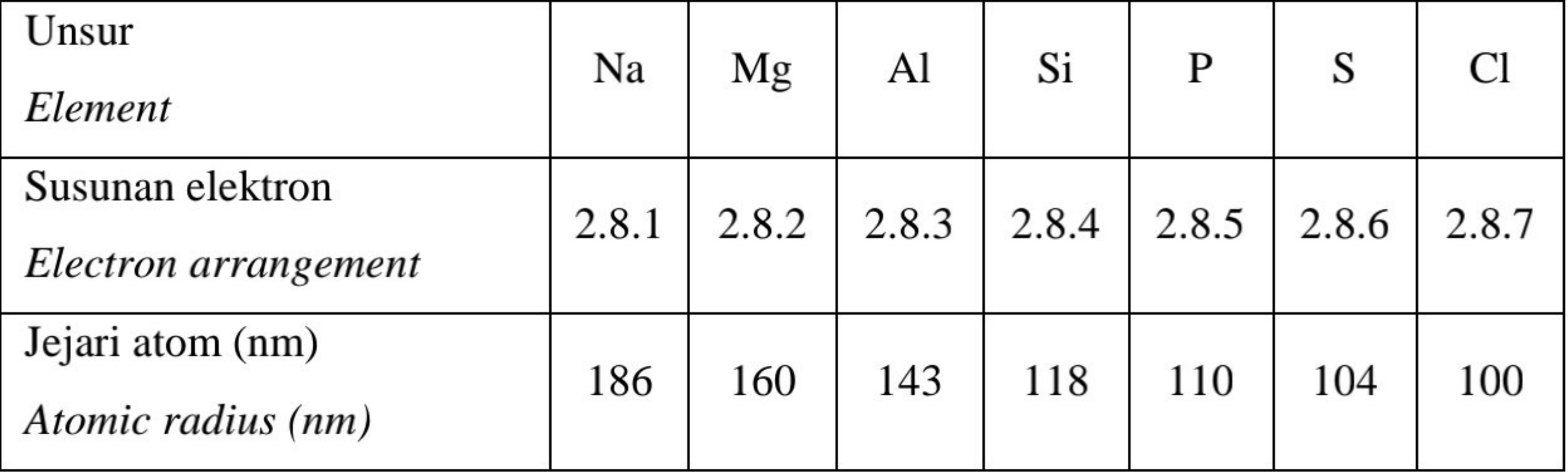
- (a)
Which period are the elements placed?
[1] - (b)
State the element that exists as diatomic molecule.
[1] - (c)
Sodium burns in oxygen to form sodium oxide. Write the chemical equation for the reaction.
[2] - (d)
Referring to the change in atomic radius, explain why the electronegativity increases across the period from left to right.
[2]
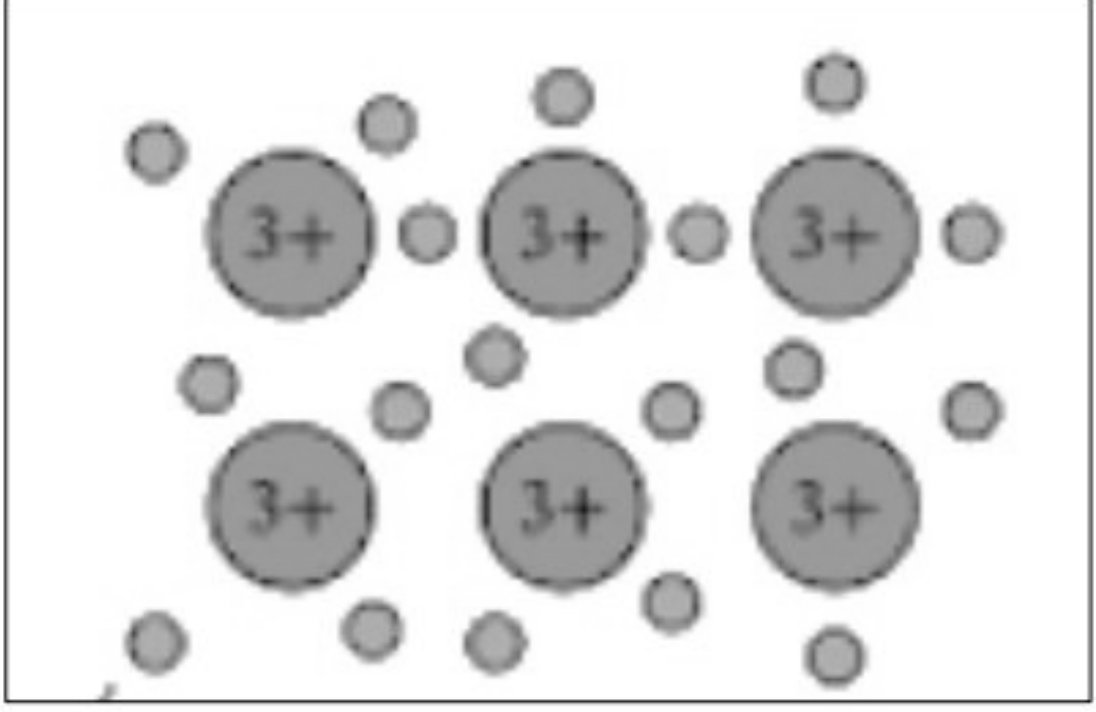
Diagram 4.1 shows three diagrams of electron arrangement for compounds E, F and G (E: nitrogen atom bonded to three hydrogen atoms; F: chlorine atom bonded to one hydrogen atom; G: oxygen atom bonded to two hydrogen atoms). Diagram 4.2 shows formation of metallic bond of aluminium (Al3+ ions surrounded by free electrons).
Medium7 marks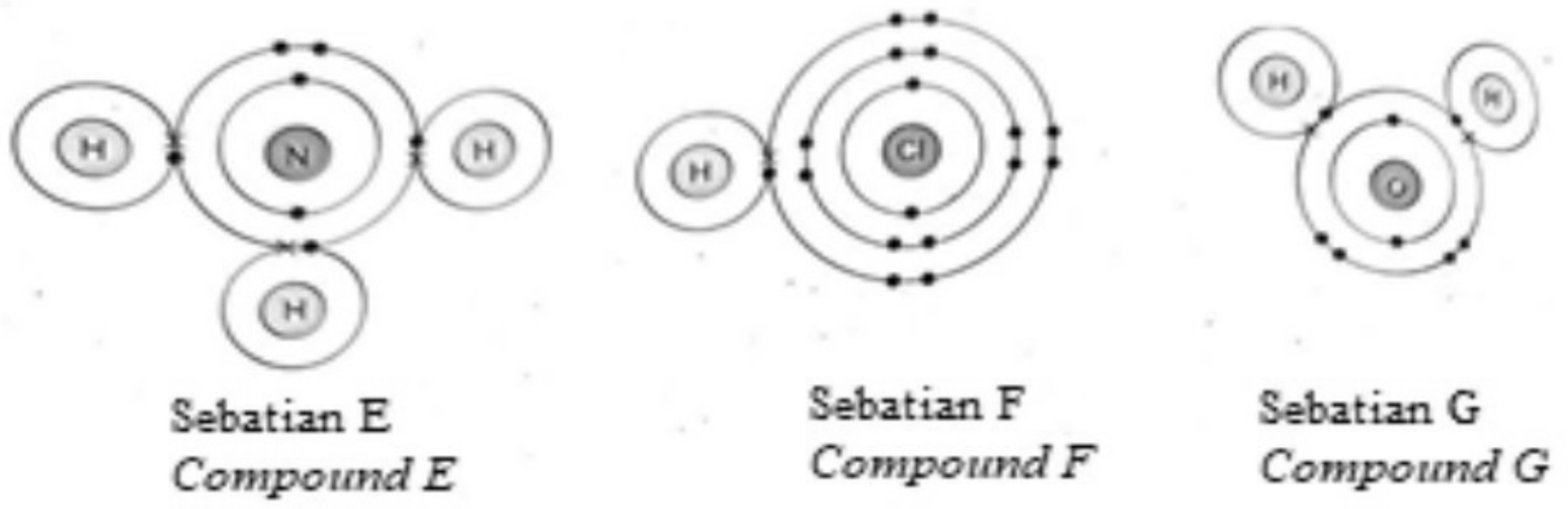
- (a)
State the type of compound for compound E.
[1] - (b)(i)
Compound F and compound G can react with compound E respectively. State the name of the new bond formed between: compound E and compound F.
[1] - (b)(ii)
State the name of the new bond formed between compound E and compound G.
[1] - (c)
Diagram 4.2 shows formation of metallic bond of aluminium. Explain how the formation of metal bonds of aluminium occurs.
[4]
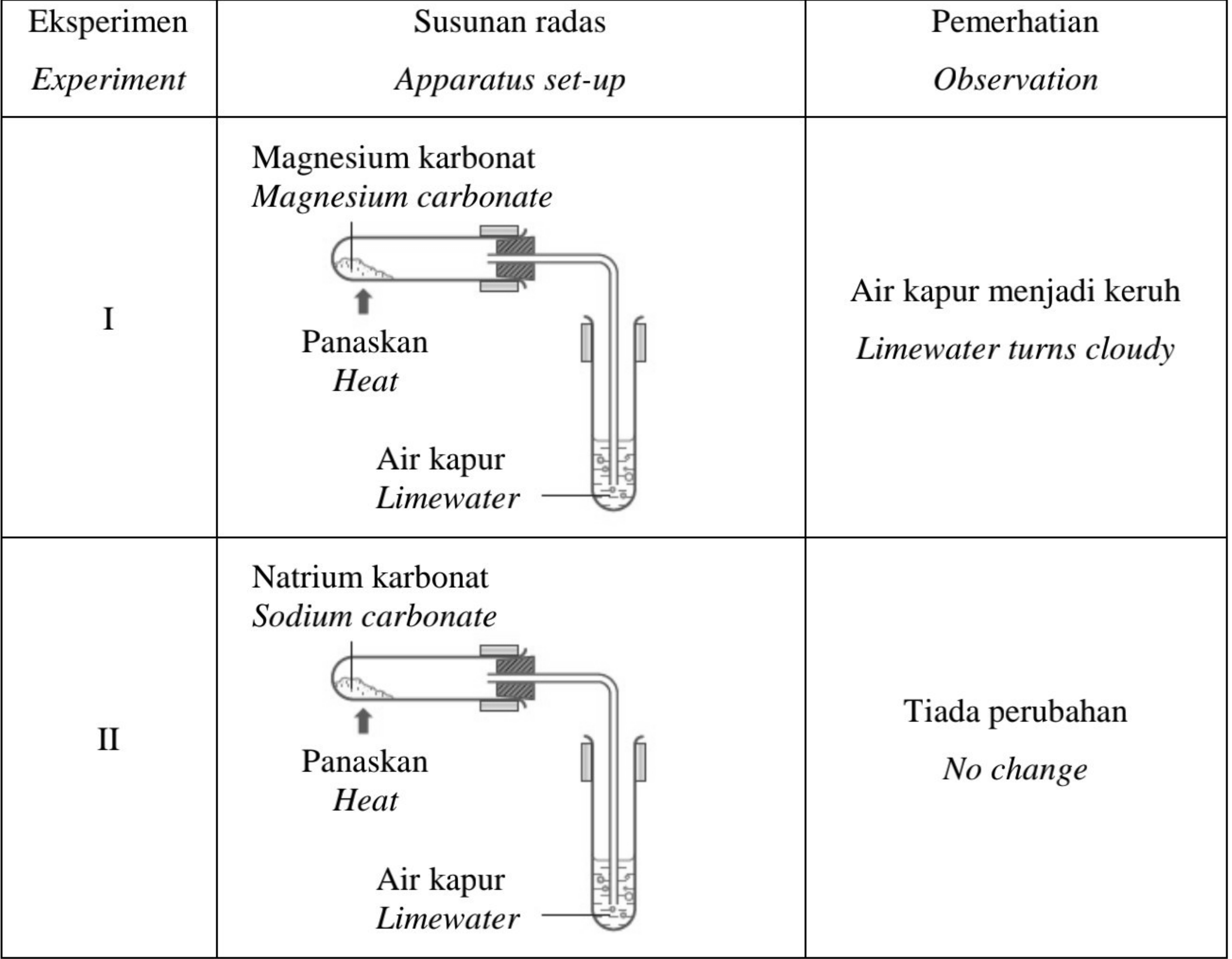
(a) Diagram 5.1 shows an apparatus set-up to prepare an insoluble salt between copper(II) chloride solution and sodium carbonate solution: 25 cm3 of 0.5 mol dm-3 sodium carbonate solution is poured into 25 cm3 of 0.5 mol dm-3 copper(II) chloride solution. (b) Diagram 5.2 shows the apparatus used in experiment to study the action of heat on carbonate salts. Experiment I: magnesium carbonate heated, limewater turns cloudy. Experiment II: sodium carbonate heated, no change.
Medium8 marks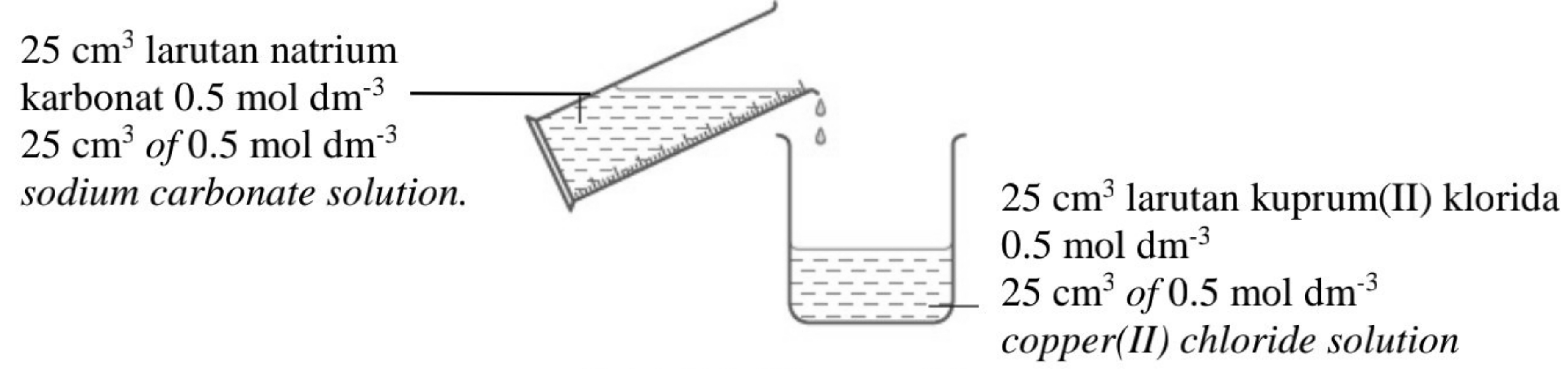
- (a)(i)
State the meaning of salt.
[1] - (a)(ii)
Write the chemical equation for the reaction.
[1] - (a)(iii)
Calculate the mass of precipitate formed. [Relative atomic mass: Cu = 64; C = 12; O = 16]
[3] - (a)(iv)
The experiment is repeated by replacing sodium carbonate solution with solution P. It was found that the insoluble salt formed are the same. Identify solution P.
[1] - (b)
Explain the difference in the observation between experiment I and experiment II.
[2]
Diagram 6.1 shows a shell. Shells are made from the type of salt. (a) Salma crushes the shell into small pieces, puts the pieces into a test tube and adds 50 cm3 of 1.0 mol dm-3 hydrochloric acid. Gas T is released. (b) Munirah uses hydrated oxalic acid crystals, (COOH)2.2H2O to prepare 250 cm3 of an acidic standard solution as shown in Diagram 6.2 (solid is dissolved in distilled water; solution is transferred into volumetric flask and water is added until the calibration mark). (c) Munirah wants to prepare 500 cm3 of a standard solution of hydrated oxalic acid, (COOH)2.2H2O 0.5 mol dm-3 from a stock solution of hydrated oxalic acid 1.5 mol dm-3.
Medium9 marks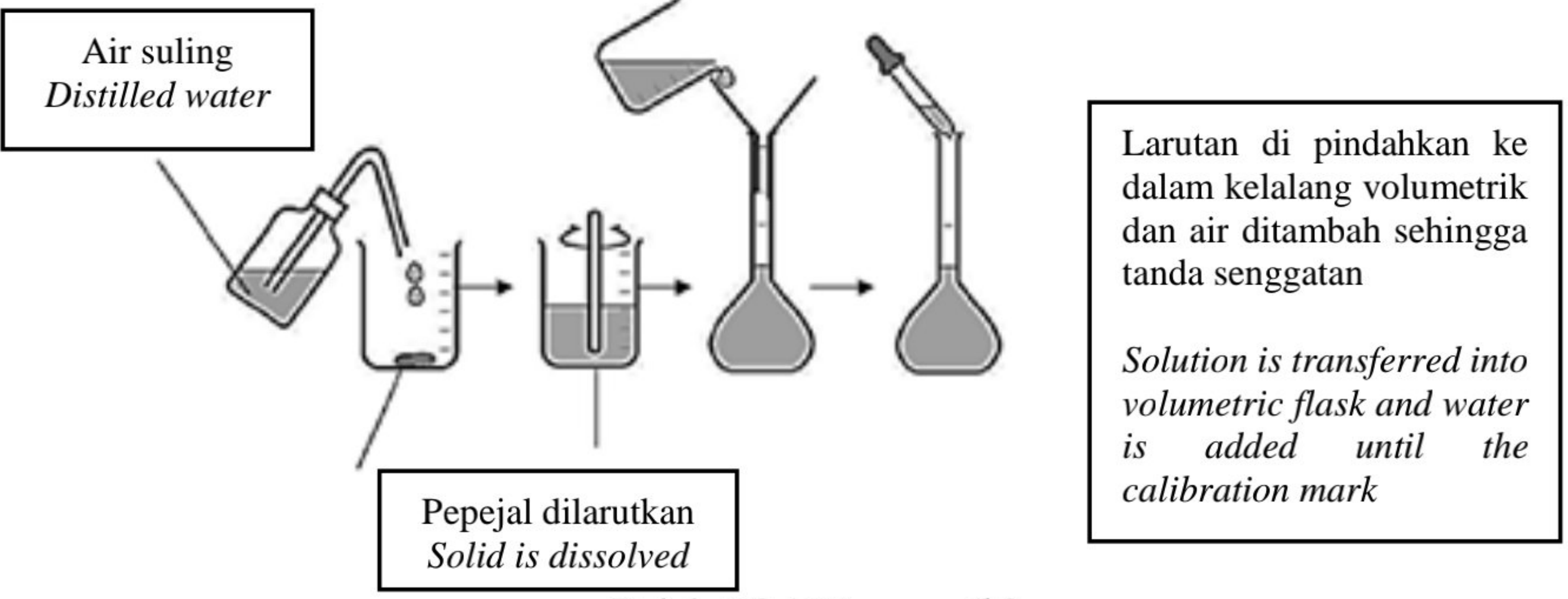
- (a)(i)
State the name of gas T.
[1] - (a)(ii)
Write the chemical equation involved in this reaction.
[2] - (b)(i)
What is meant by a standard solution?
[1] - (b)(ii)
Calculate the mass of hydrated oxalic acid, (COOH)2.2H2O crystals that needed to be dissolved in 500 cm3 of distilled water to produce an acidic standard solution with a concentration of 1.5 mol dm-3. [Relative atomic mass: C = 12, H = 1, O = 16]
[2] - (c)(i)
Name the method to prepare the standard solution.
[1] - (c)(ii)
Calculate the volume of stock solution needed to prepare the standard solution.
[2]
(a) Diagram 7 shows how Process Z converts natural rubber into vulcanised rubber (natural rubber polymer chains with C=C bonds react with sulphur to form S-S cross-links between chains). (b) Uncontrolled usage of synthetic rubber leads to environmental pollution problems.
Medium10 marks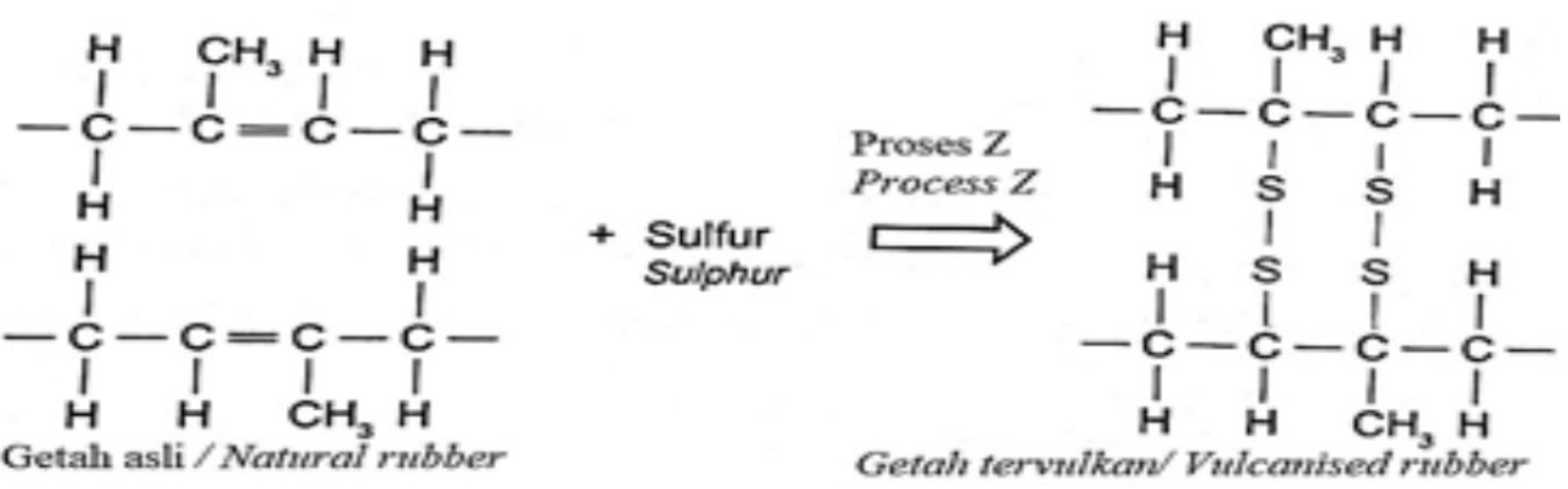
- (a)(i)
Based on Diagram 7, what is the name of process Z?
[1] - (a)(ii)
Explain how vulcanised rubber is produced.
[1] - (a)(iii)
Which rubber is more elastic? Explain your answer.
[3] - (b)(i)
Suggest 2 ways to overcome the problems resulting from the widespread usage of synthetic rubber.
[2] - (b)(ii)
What are 3 advantages of gloves made from synthetic rubber as compared to natural rubber?
[3]
Azrul and his friends carried out experiments to investigate the factor affecting the rate of reaction between powdered metal zinc and hydrochloric acid. Table 8 shows the information about the reactants and the time taken to collect 30 cm3 of gas P. Experiment I: powdered zinc + 50 cm3 of 1.0 mol dm-3 hydrochloric acid; time taken 10 s. Experiment II: powdered zinc + 100 cm3 of 0.5 mol dm-3 hydrochloric acid; time taken 20 s.
Medium10 marks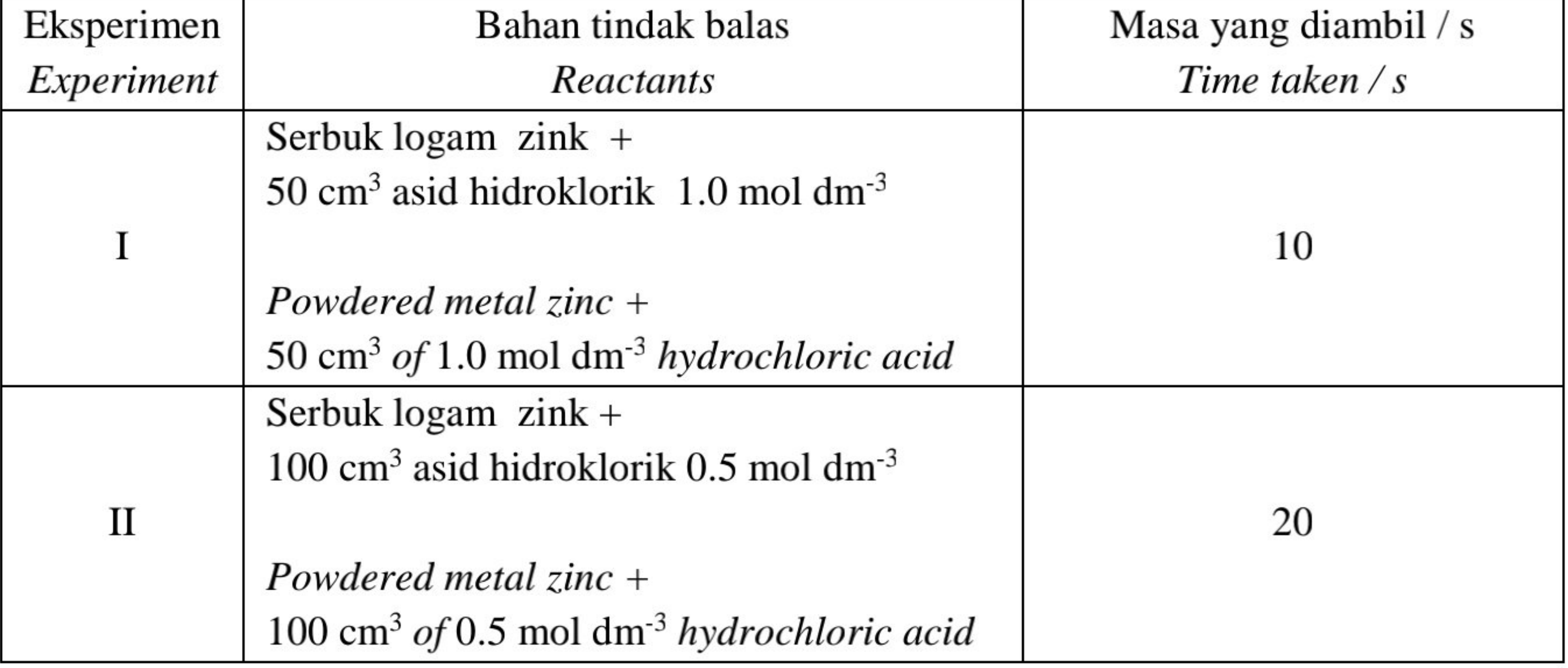
- (a)
What is the meaning of rate of reaction?
[1] - (b)(i)
Based on the table, state the gas produced.
[1] - (b)(ii)
Write the ionic equation for the reaction.
[1] - (c)(i)
Calculate the average rate of reaction for experiment I and experiment II.
[2] - (c)(ii)
Based on the answer in c(i), compare the rate of reaction between experiment I and experiment II. State the factor that affects the rate of reaction.
[2] - (c)(iii)
By using the collision theory, explain the difference in the rate of reaction for c(ii).
[3]
Section B
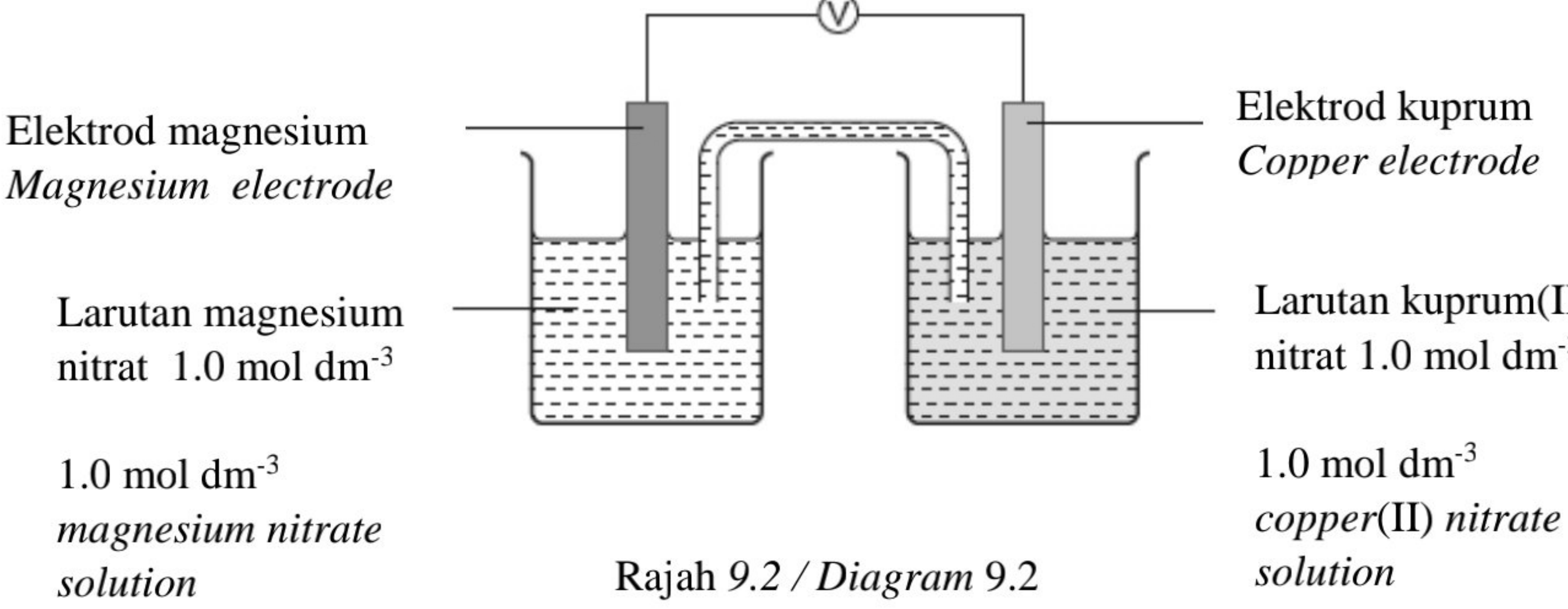
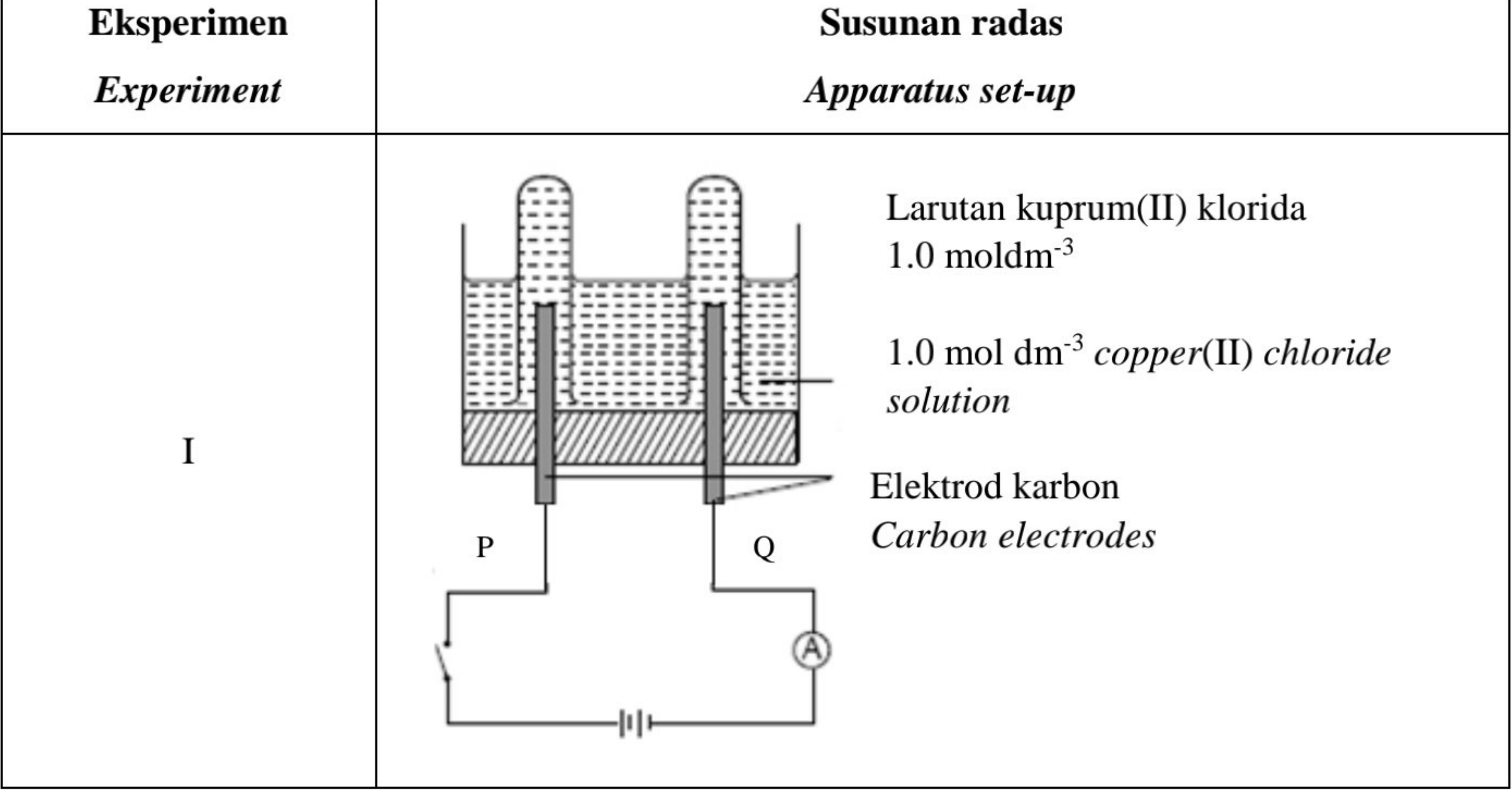
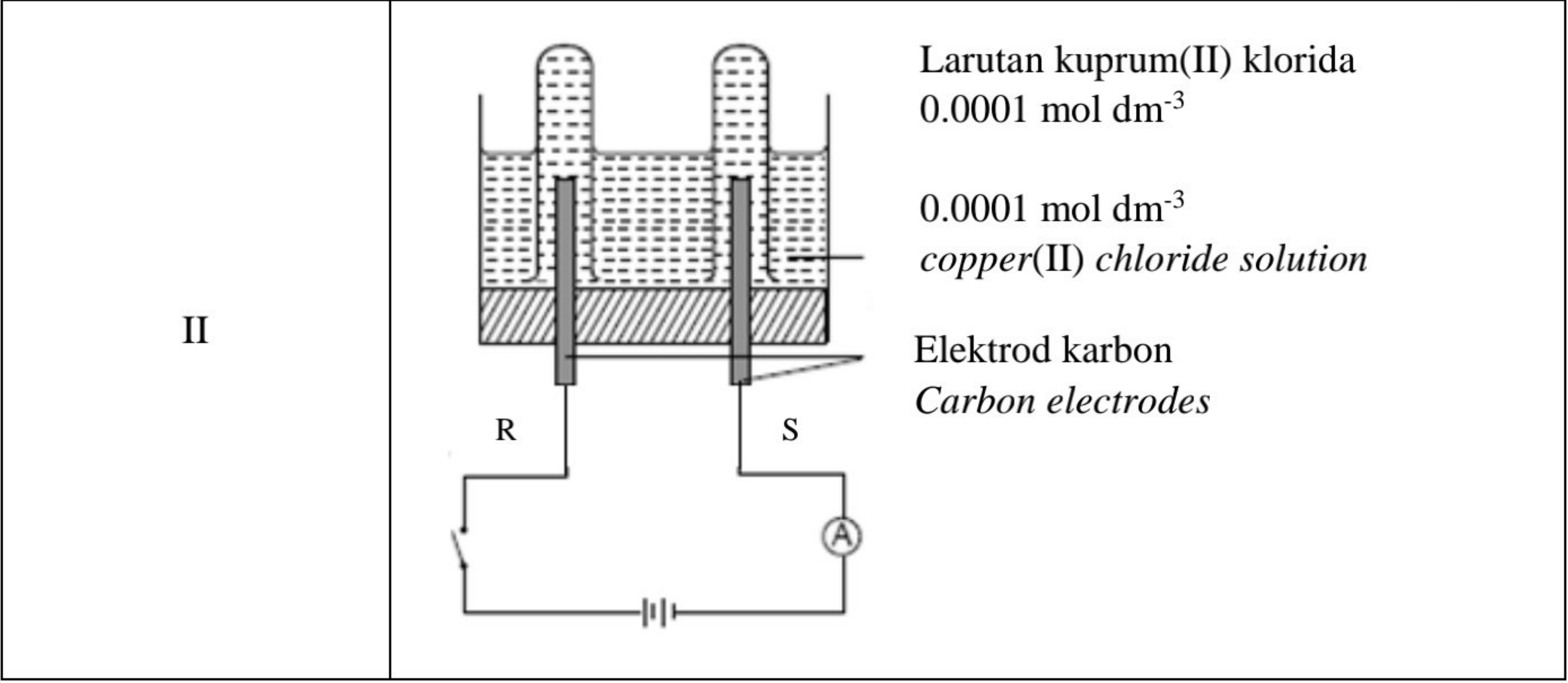
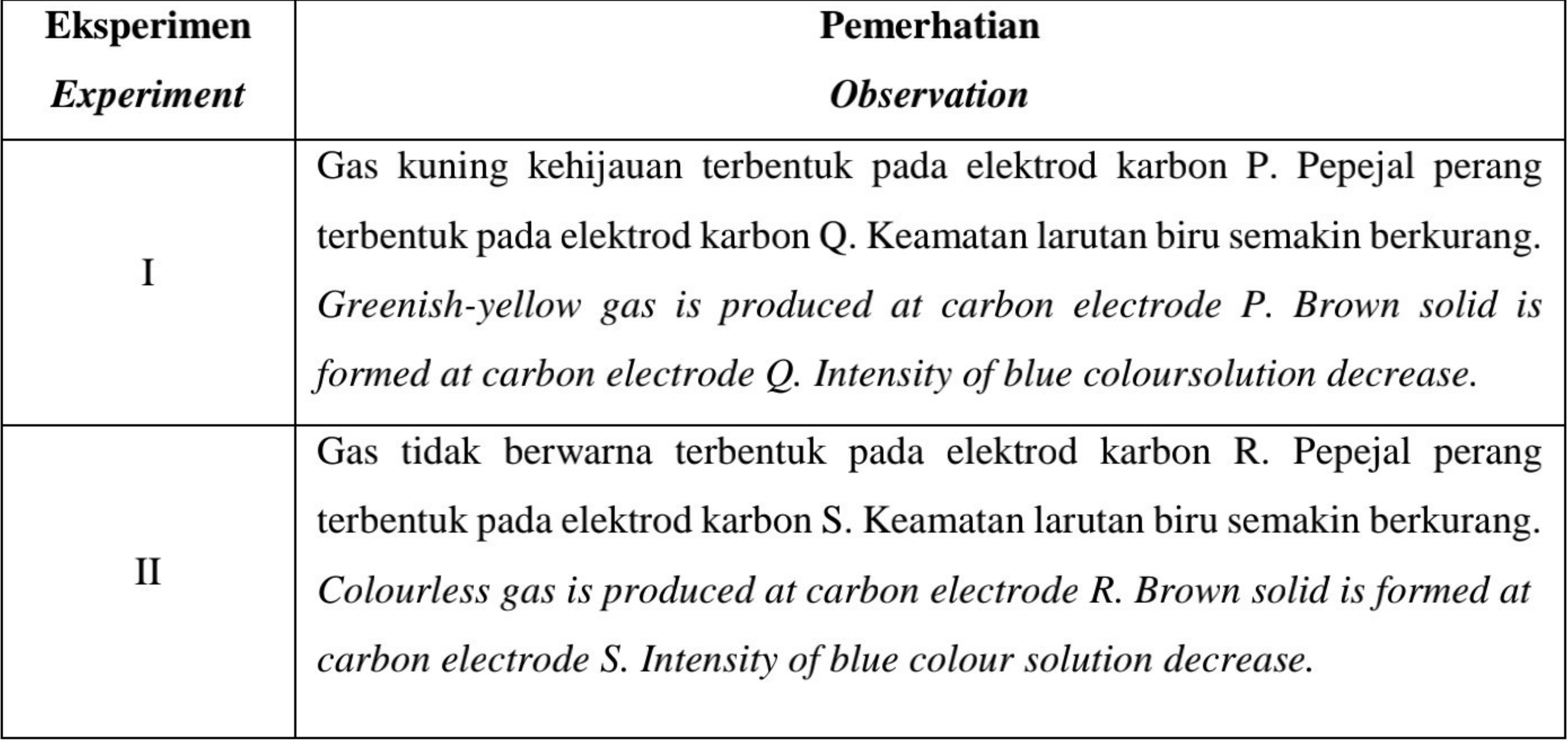
Substances X and Y are two colourless substances in a liquid state. Diagram 9.1 shows the set-up of apparatus to determine whether substances X and Y are electrolytes (carbon electrodes, battery, bulb: the bulb lights up with substance X and does not light with substance Y). Diagram 9.2 shows the apparatus set-up for chemical cell A (magnesium electrode in 1.0 mol dm-3 magnesium nitrate solution, copper electrode in 1.0 mol dm-3 copper(II) nitrate solution, salt bridge, voltmeter). Diagram 9.3 shows the apparatus used to study the electrolysis of copper(II) chloride solution with carbon electrodes: Experiment I uses 1.0 mol dm-3 copper(II) chloride solution (electrodes P and Q); Experiment II uses 0.0001 mol dm-3 copper(II) chloride solution (electrodes R and S). Table 9 observations after 20 minutes: I: greenish-yellow gas at P, brown solid at Q, intensity of blue colour decreases. II: colourless gas at R, brown solid at S, intensity of blue colour decreases. Diagram 9.4: Ahmad wants to coat his iron ring with a layer of silver.
Hard20 marks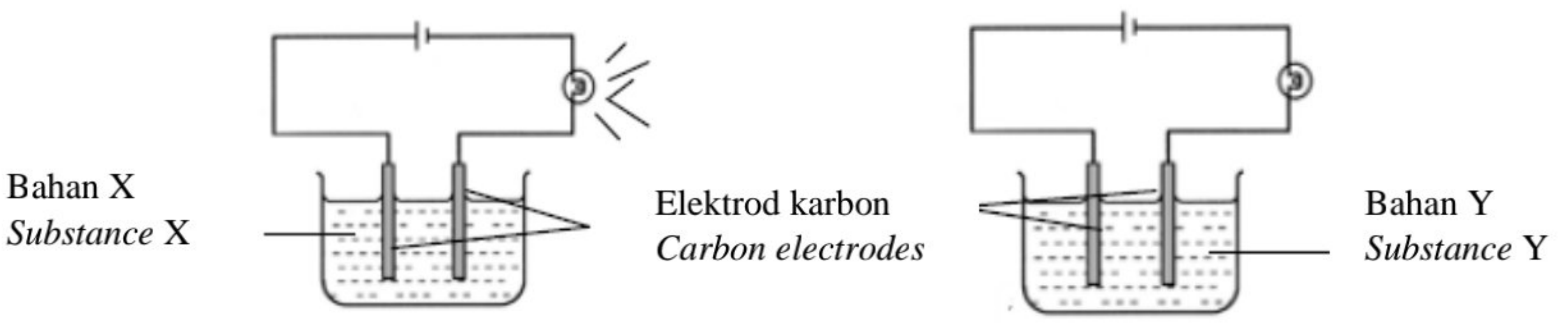
- (a)(i)
State the meaning of electrolyte.
[1] - (a)(ii)
Which substance X or Y is an electrolyte? Explain.
[2] - (b)(i)
Based on Diagram 9.2, write the cell notation of the chemical cell.
[1] - (b)(ii)
State the observation and write the half equation at the magnesium electrode.
[2] - (b)(iii)
If the magnesium electrode and magnesium nitrate solution in Chemical Cell A are replaced by an iron electrode and iron(II) chloride solution to form Chemical Cell B, explain the difference of the cell voltages of chemical cells A and B. Given: Mg2+ + 2e- ⇌ Mg, E° = -2.38 V; Fe2+ + 2e- ⇌ Fe, E° = -0.44 V; Cu2+ + 2e- ⇌ Cu, E° = +0.34 V.
[4] - (c)
State the name of the products at electrodes P, Q, R and S. Explain the observations and write half equations at the anode and cathode of experiment I. Given: 2H+ + 2e- ⇌ H2, E° = 0.00 V; Cu2+ + 2e- ⇌ Cu, E° = +0.34 V; O2 + 2H2O + 4e- ⇌ 4OH-, E° = +0.40 V; Cl2 + 2e- ⇌ 2Cl-, E° = +1.36 V.
[8] - (d)
Diagram 9.4 shows the conversation between Ahmad and Mei Ling. Ahmad: 'Mei Ling, I would like to coat my iron ring with a layer of silver. Can you show me how I can do it?' Mei Ling: 'Yes, Ahmad. I will show you the apparatus set-up.' Draw a labelled diagram of the apparatus set-up for Ahmad's activity.
[2]
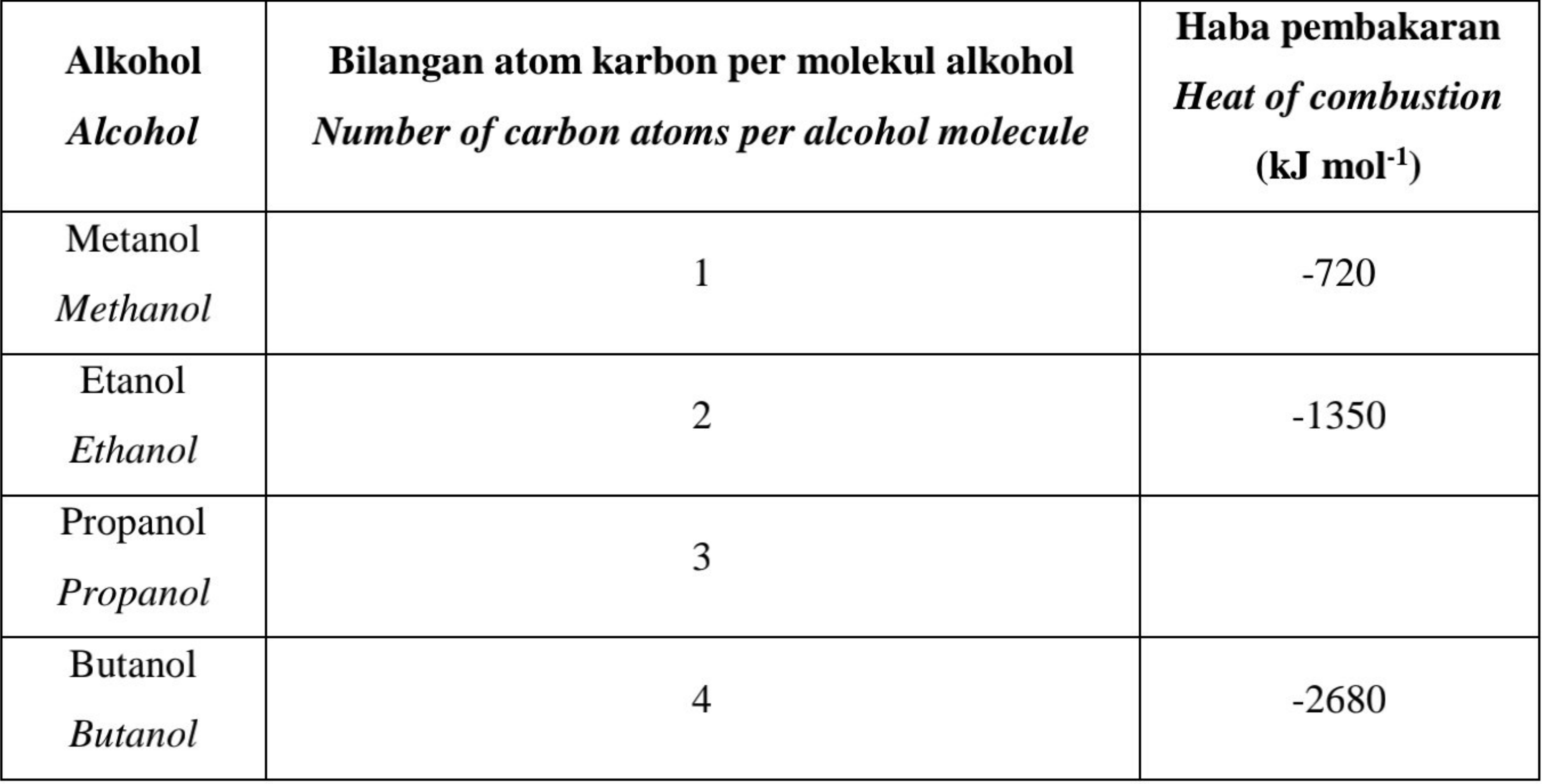
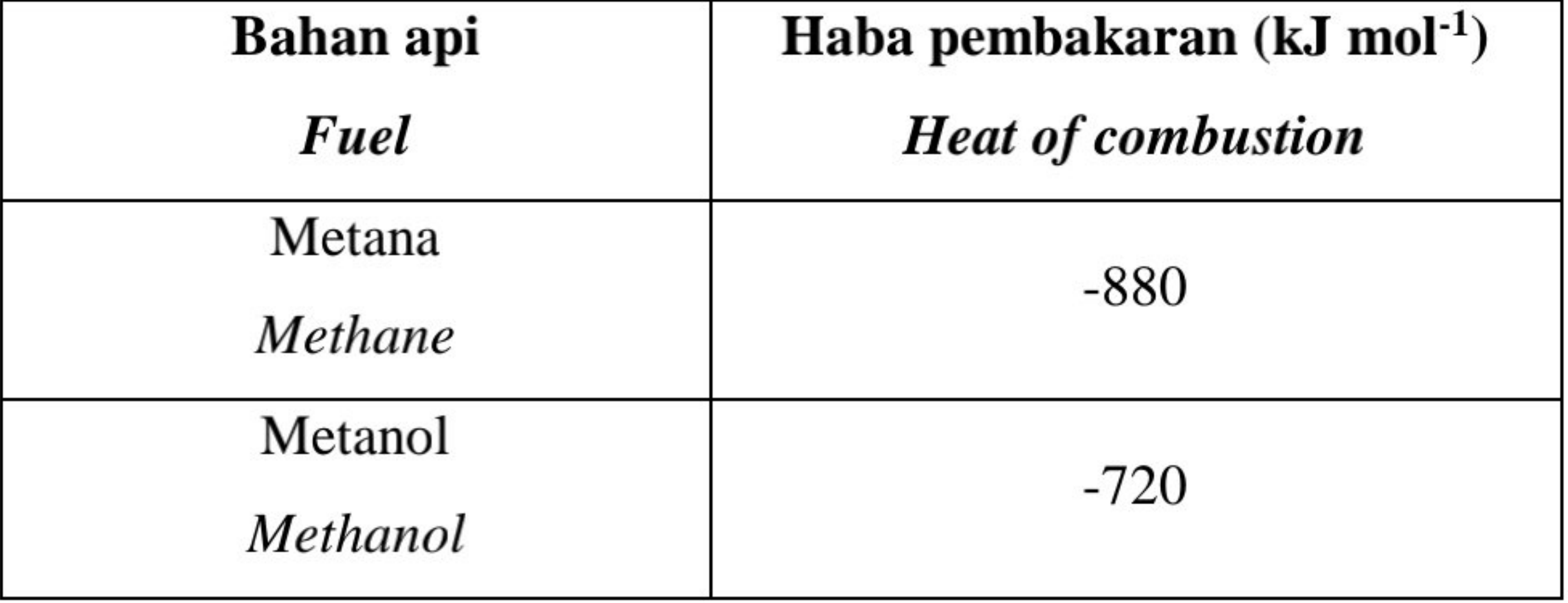
(a) Diagram 10 shows the apparatus set up to compare the heat of displacement of copper from 100 cm3 of 0.5 mol dm-3 copper(II) sulphate solution by magnesium powder, Mg (Set I) and zinc powder, Zn (Set II). Table 10.1: Set I initial temperature θi = 27.0 °C, highest θf = 32.0 °C; Set II initial θi = 27.0 °C, highest θf = 31.0 °C. (b) Table 10.2 shows the number of carbon atoms per alcohol molecule and the heat of combustion (kJ mol-1): methanol 1, -720; ethanol 2, -1350; propanol 3, (blank); butanol 4, -2680. (c) Table 10.3 shows the comparison of the heat of combustion of two fuels: methane -880 kJ mol-1; methanol -720 kJ mol-1.
Hard20 marks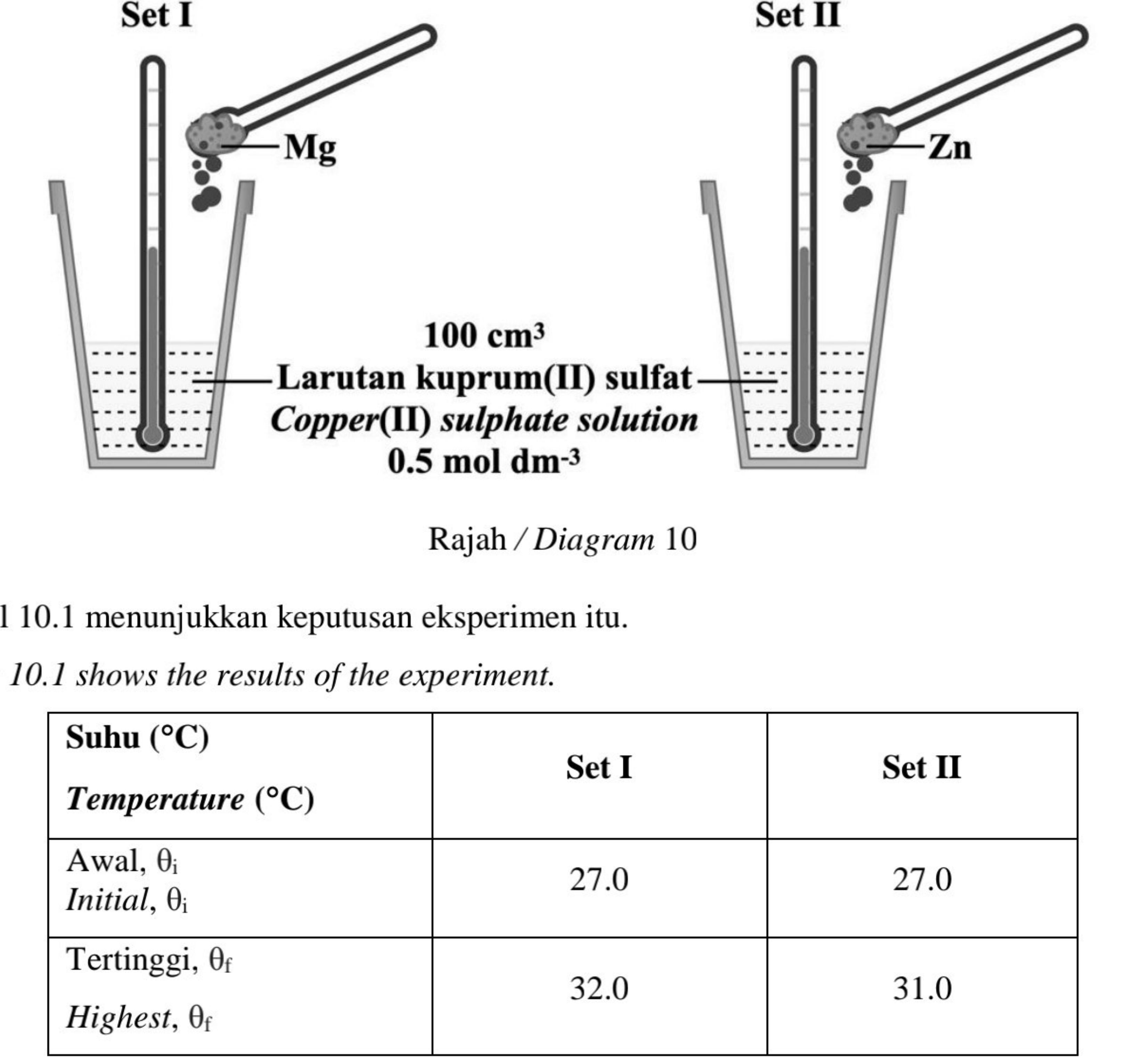
- (a)(i)
By choosing either Set I or Set II, answer the following: the meaning of heat of displacement; one precautionary step while conducting the experiment; state another observation, other than change in temperature; write the inference for the observation.
[4] - (a)(ii)
Calculate the heat of displacement of both sets of experiment and explain why there is a difference in the value of the heat of displacement. [Given that the specific heat capacity of solution is c = 4.2 J g-1 °C-1, density of solution = 1 g cm-3]
[6] - (b)(i)
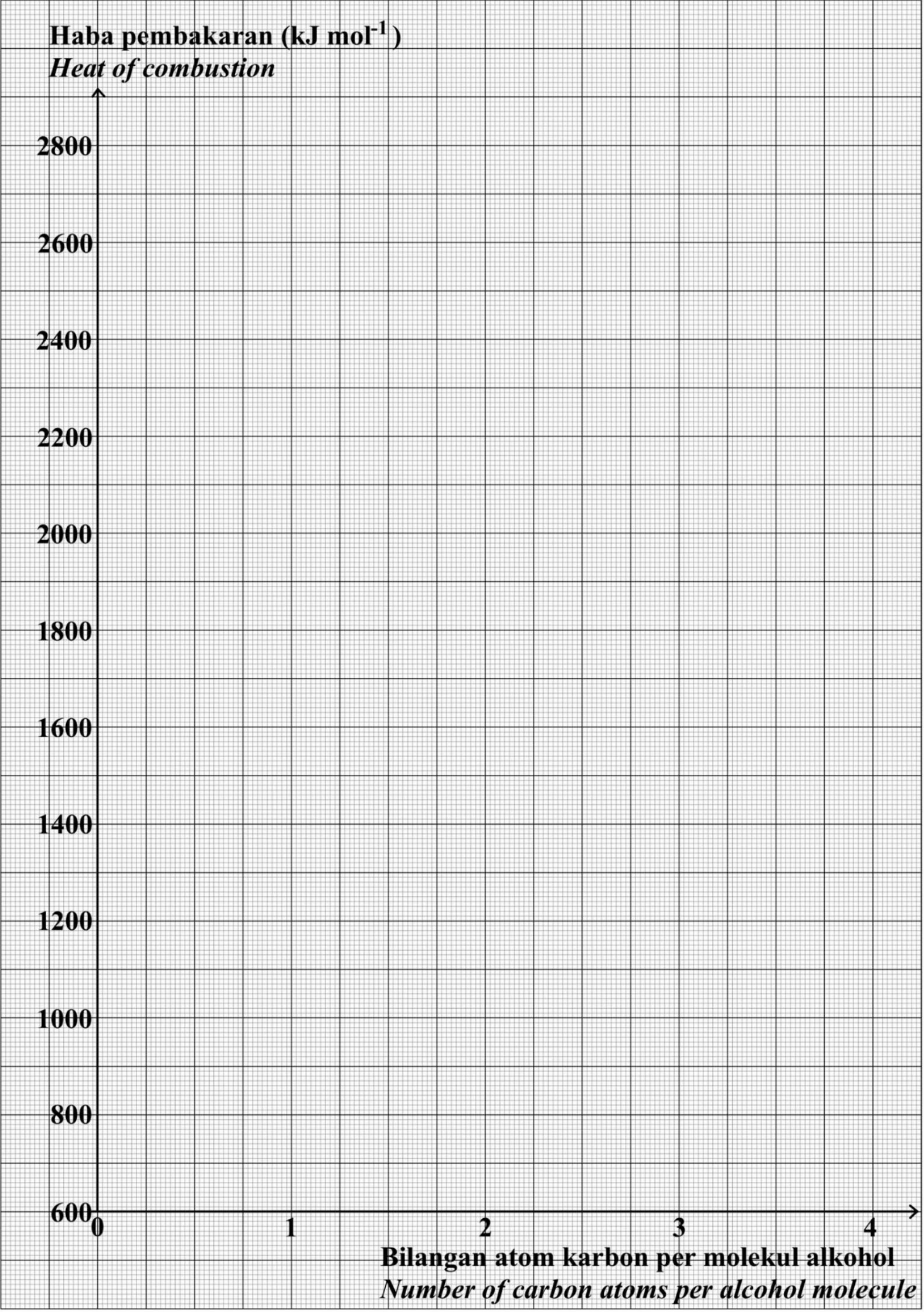
By using data in Table 10.2 draw a graph of heat of combustion against the number of carbon atoms per alcohol molecule on the graph paper on page 19. From the graph plotted, determine the value of the heat of combustion of propanol.
[3] - (b)(ii)
Explain why the heat of combustion of propanol and butanol are different. Include the chemical equations for the complete combustion of propanol and butanol to aid your explanation.
[5] - (c)
Yusuf created a machine to help speed up his work at the workshop. Based on Table 10.3, choose the most suitable fuel for the machine, based on either the fuel value or the effects of the fuel on the environment. Justify your choice. [Relative atomic mass: H = 1, C = 12, O = 16]
[2]
Section C
Diagram 11 shows the conversions of compound W. Compound W has a molecular formula of C4H10O. Compound W undergoes oxidation to form compound X; Reaction II (over porcelain chips) converts W to compound Y; Reaction I converts W to carbon dioxide and water.
Hard20 marks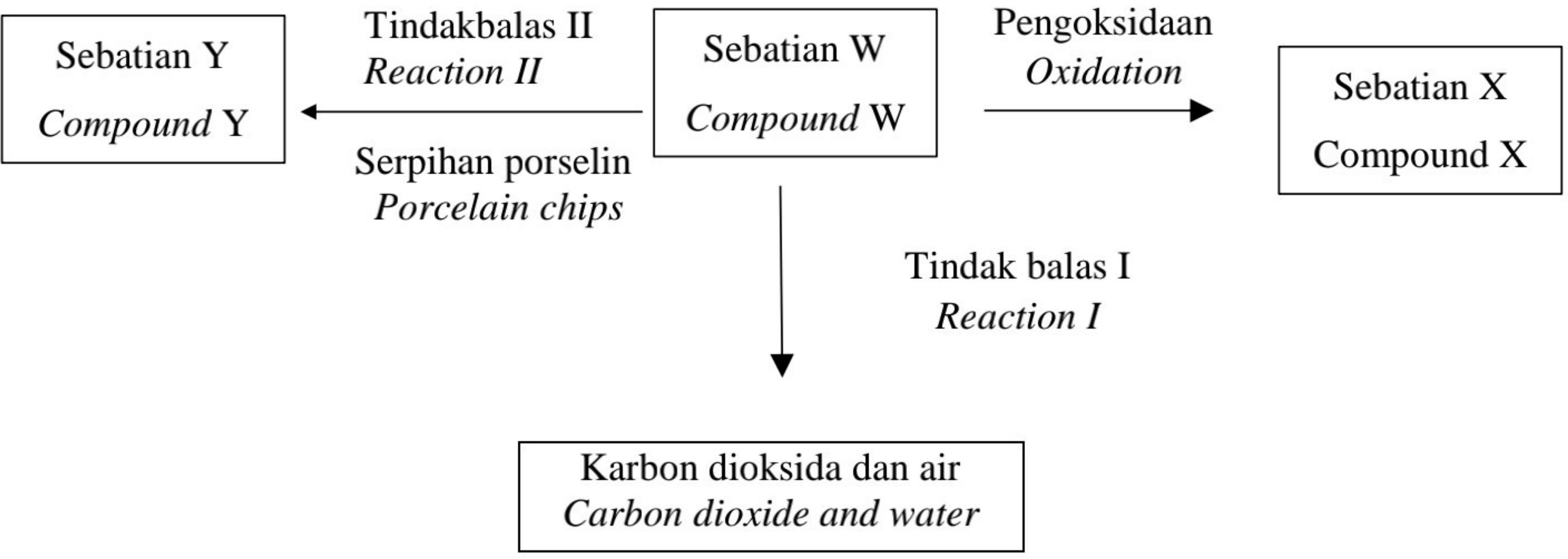
- (a)(i)
Based on Diagram 11: state the name of compound W; compound W can form isomers - draw the structural formula and name one of the isomers for compound W; state the name of Reaction II and write the chemical equation for the reaction.
[5] - (a)(ii)
Calculate the volume of carbon dioxide gas produced when 7.4 g compound W is burnt in excess oxygen. [Relative atomic mass: H = 1; C = 12; O = 16] [Molar volume of gas = 24 dm3 mol-1]
[2] - (b)
A student was given two colourless liquids which are an alkane and an alkene compound. Her teacher asked him to do a confirmation test. State and describe a chemical test that can be used to distinguish between the liquids.
[5] - (c)
Diana wants to bake a pineapple tart. She went to a bakery to buy pineapple essence. As a chemistry student how would you help her to prepare the pineapple essence (ethyl butanoate) in the laboratory by naming the two substances involved, write the chemical equation for the reaction and procedure of preparation.
[8]