Write your answer on paper. Then open the answer to check it.
Section A
Diagram 1 shows the electron arrangement of water.
Medium5 marks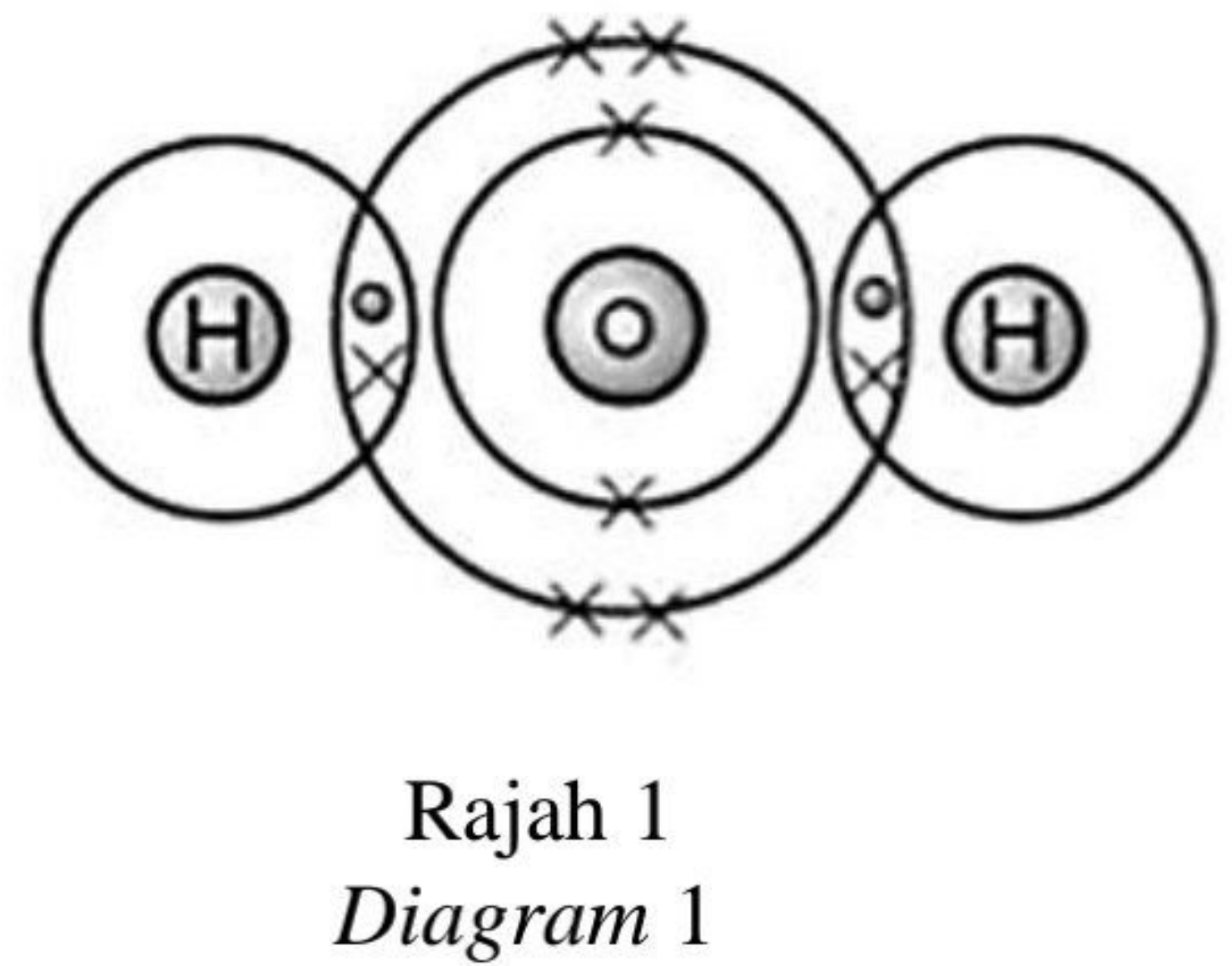
- (a)
What is the purpose of chemical bond formation?
[1] - (b)
State the type of particles in water.
[1] - (c)
State the type of chemical bond in water.
[1] - (d)
Based on Diagram 1, explain how the chemical bond is formed.
[2]
Diagram 2 shows the apparatus set-up for an experiment to investigate electron transfer at a distance in redox reaction. Carbon electrodes R and S are in a U-tube: iron(II) sulphate solution at R, acidified potassium manganate(VII) solution at S, dilute sulphuric acid at the bottom, connected to a galvanometer G.
Medium5 marks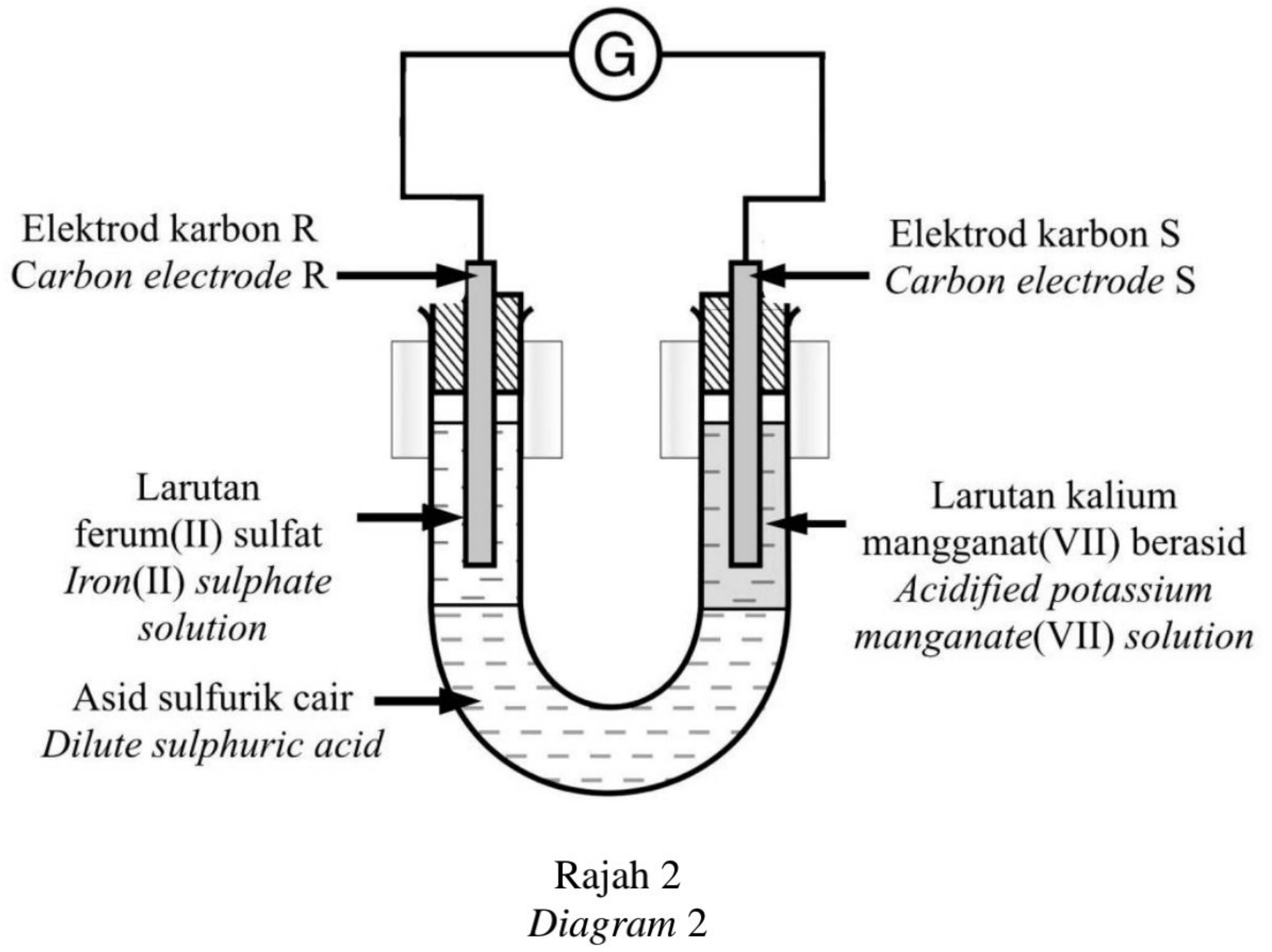
- (a)
State the colour of iron(II) sulphate solution.
[1] - (b)
When the circuit is completed, the galvanometer shows a deflection. State the type of reaction at R electrode.
[1] - (c)(i)
Referring to the reaction at S electrode, state the observation for acidified potassium manganate(VII) solution.
[1] - (c)(ii)
State the change in oxidation number of manganese in (c)(i).
[1] - (d)
Draw the arrow on Diagram 2 to show the direction of electron flow.
[1]
Propane and butane are hydrocarbon compounds which have molecular formula C₃H₈ and C₄H₁₀ respectively.
Medium6 marks- (a)(i)
What is the meaning of hydrocarbon?
[1] - (a)(ii)
Write the empirical formula for butane, C₄H₁₀.
[1] - (b)(i)
Combustion of propane gas in excess oxygen will produce carbon dioxide gas and water. Write the chemical equation for the reaction.
[2] - (b)(ii)
If 0.5 mol propane gas burns completely in excess oxygen, determine the volume of carbon dioxide gas released at room temperature condition. [1 mole of any gas occupies 24 dm³ mol⁻¹ at room conditions]
[2]
Diagram 3 shows an experiment to determine the heat of displacement. Excess magnesium powder is added into 50 cm³ of 0.5 mol dm⁻³ copper(II) nitrate solution in a polystyrene cup. The thermometer reads 29 °C before the experiment and 56 °C after. [Specific heat capacity, c = 4.2 J g⁻¹ °C⁻¹; Density of the solution = 1.0 g cm⁻³]
Medium7 marks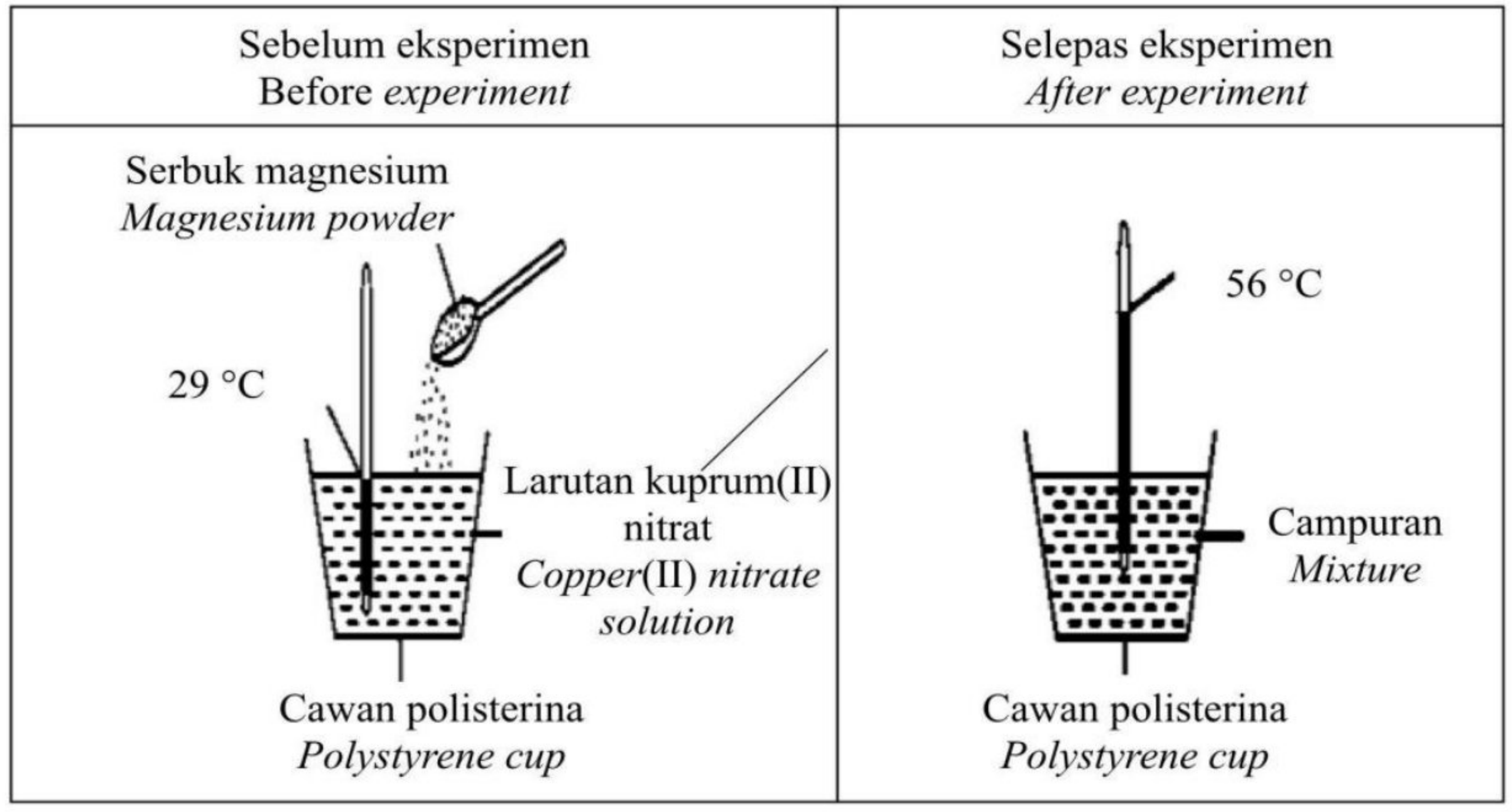
- (a)(i)
State the meaning of heat of displacement.
[1] - (a)(ii)
Based on the diagram, state the initial temperature of copper(II) nitrate solution and the highest temperature of the mixture.
[2] - (b)(i)
Write the ionic equation for the reaction that occurred.
[1] - (b)(ii)
Calculate the heat of displacement in this experiment.
[3]
Table 1.1 shows the composition and uses of three types of alloy. R: 90% copper, 10% tin; uses: trophies. Brass: 70% copper, 30% zinc; uses: keys. Duralumin: 93% aluminium, 3% copper, 3% magnesium, 1% manganese; uses: body of aeroplanes.
Medium8 marks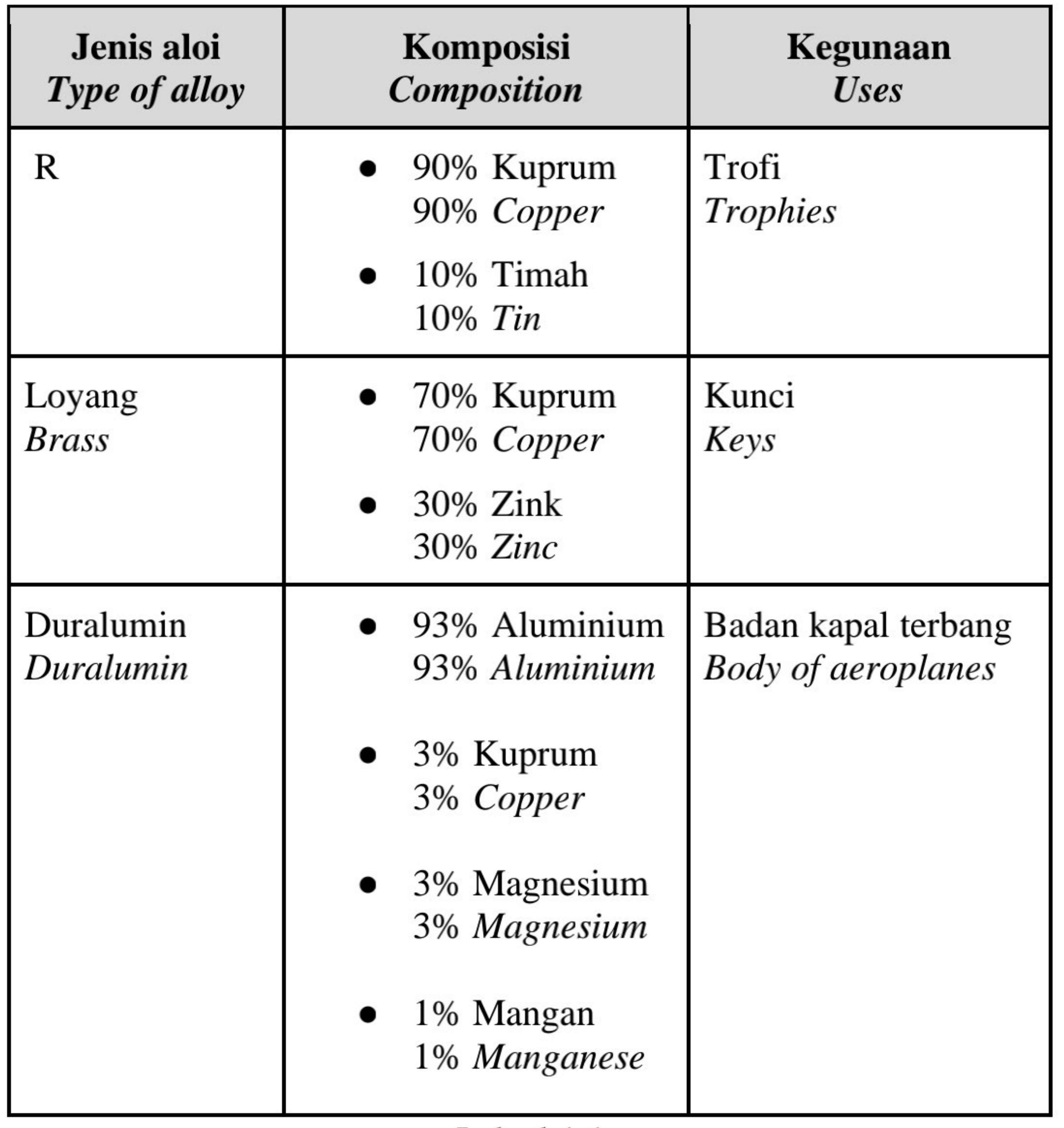
- (a)(i)
Name R.
[1] - (a)(ii)
State the other uses of the alloy in 5(a)(i).
[1] - (b)
Ahmad is a national cyclist. Suggest a type of alloy that is suitable to manufacture the Ahmad racing bicycle. Give your reason.
[2] - (c)
You are given a bronze key and a brass key. Every key has the same mass of 140 g. Calculate the mass of copper in each of the keys.
[2] - (d)
Diagram 4 shows apparatus used in an experiment to compare the hardness between bronze and its pure metal (a 1 kg weight dropped so a steel ball dents the block). Table 1.2 shows the diameter of the dent: copper 0.8 cm, bronze 0.6 cm. Explain the difference of diameter of the dent formed.
[2]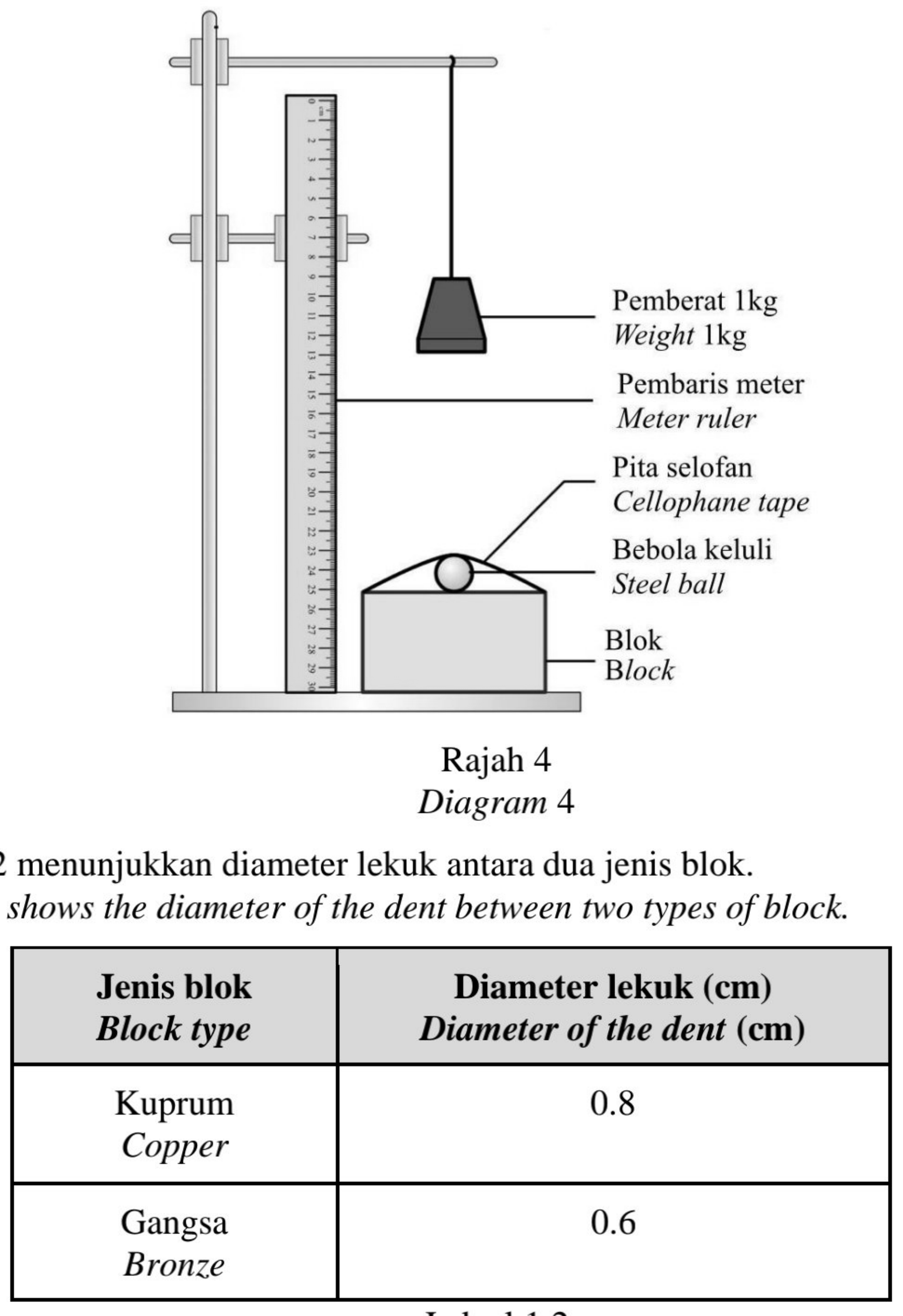
Table 2 shows the relative atomic mass and the proton number of four elements: oxygen (16, 8), sodium (23, 11), magnesium (24, 12), chlorine (35.5, 17).
Medium9 marks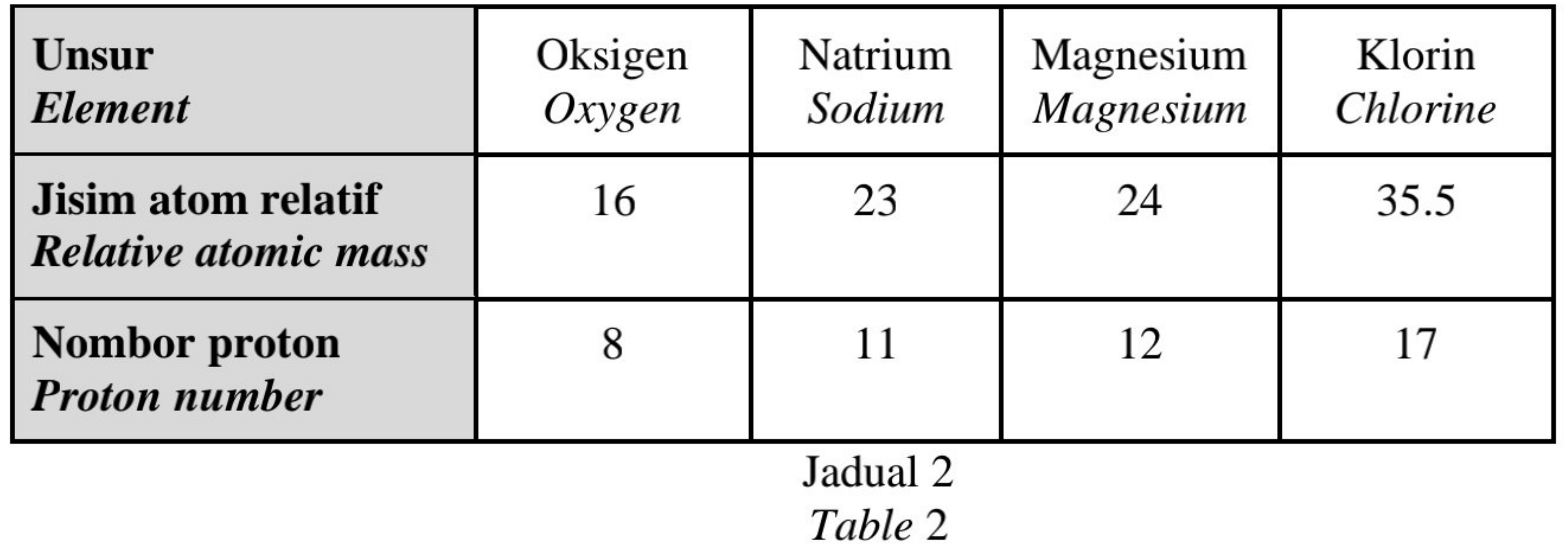
- (a)
What is the meaning of the proton number?
[1] - (b)
Magnesium reacts with oxygen gas to form magnesium oxide. Write a chemical equation for the formation of magnesium oxide.
[2] - (c)(i)
Sodium and chlorine react to form a compound. Draw the electron arrangement for the compound formed.
[2]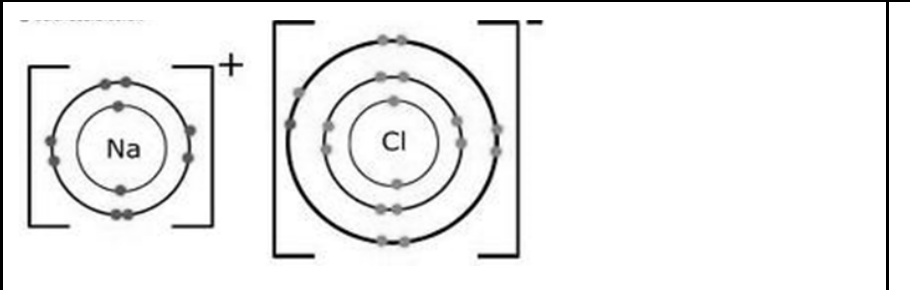
- (c)(ii)
State the type of compound formed.
[1] - (c)(iii)
Predict the physical properties of the compound formed.
[1] - (d)
If 1.2 g of sodium metal reacts with excess chlorine gas, calculate the mass of sodium chloride produced.
[2]
Diagram 5 shows the preparation of an insoluble salt: 25 cm³ of 0.5 mol dm⁻³ sodium sulphate solution is added to 25 cm³ of 1.0 mol dm⁻³ lead(II) nitrate solution to give precipitate X.
Medium10 marks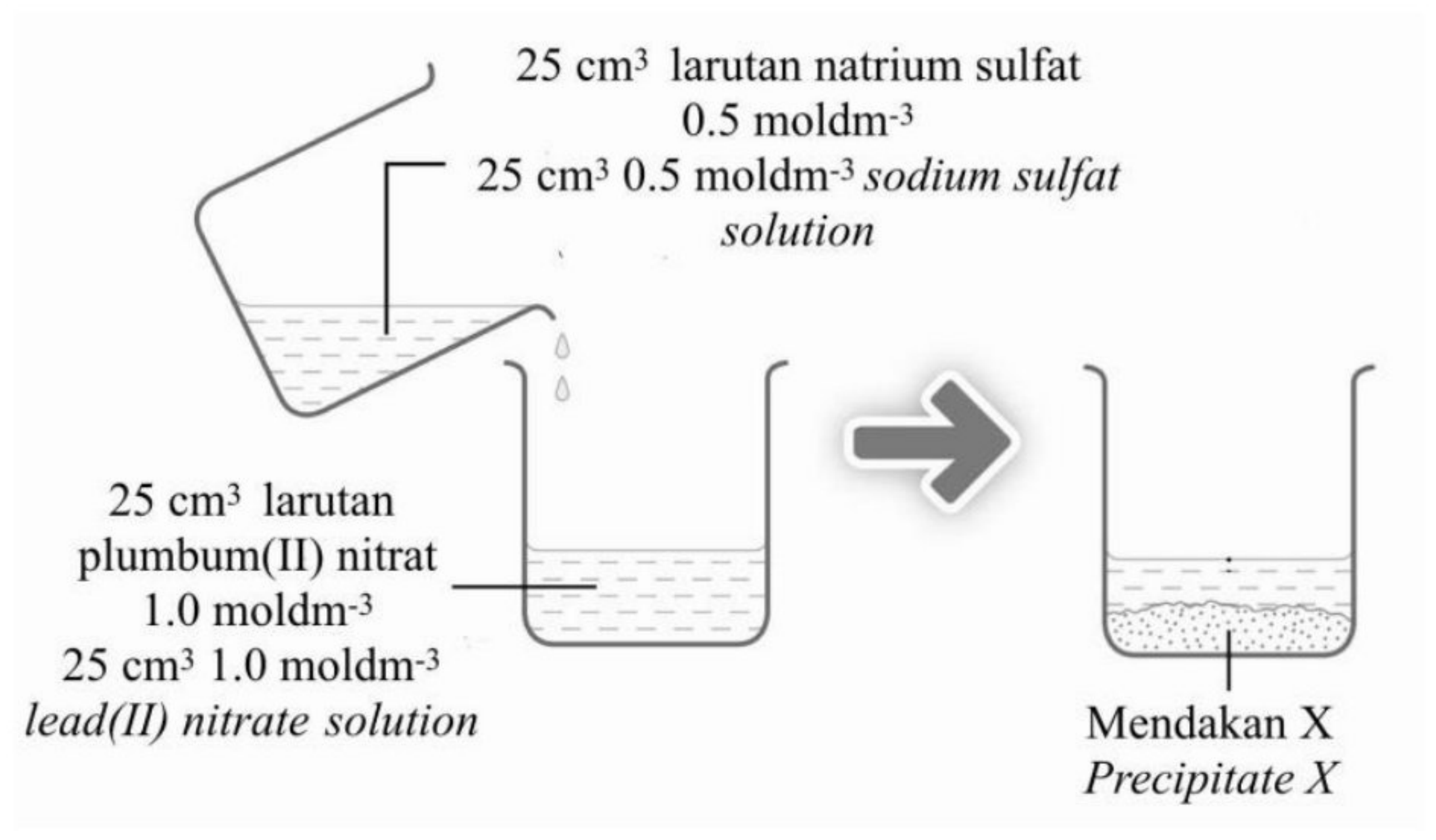
- (a)
State the name of the reaction above.
[1] - (b)
Name precipitate of insoluble salt.
[1] - (c)
Ionic equation for the precipitation formed: Pb²⁺ + SO₄²⁻ → PbSO₄. Calculate the mass of precipitate formed. [Relative atomic mass: N = 14, O = 16, Na = 23, S = 32, Pb = 207]
[3] - (d)(i)
Diagram 6 shows the flow chart of a series of reactions of copper(II) carbonate salt: copper(II) carbonate + sulphuric acid (reaction V) gives salt L + CO₂ + H₂O; salt L gives a blue precipitate insoluble in excess NaOH. Name salt L.
[1] - (d)(ii)
Write the chemical equation for reaction V.
[2] - (d)(iii)
A pupil wants to convert salt L back to copper(II) carbonate. Explain briefly how salt L can be changed back to copper(II) carbonate.
[2]
Diagram 7 shows part of the Periodic Table of Elements. A, B, C, D and E are not the actual symbols of the elements. Based on Diagram 7:
Medium10 marks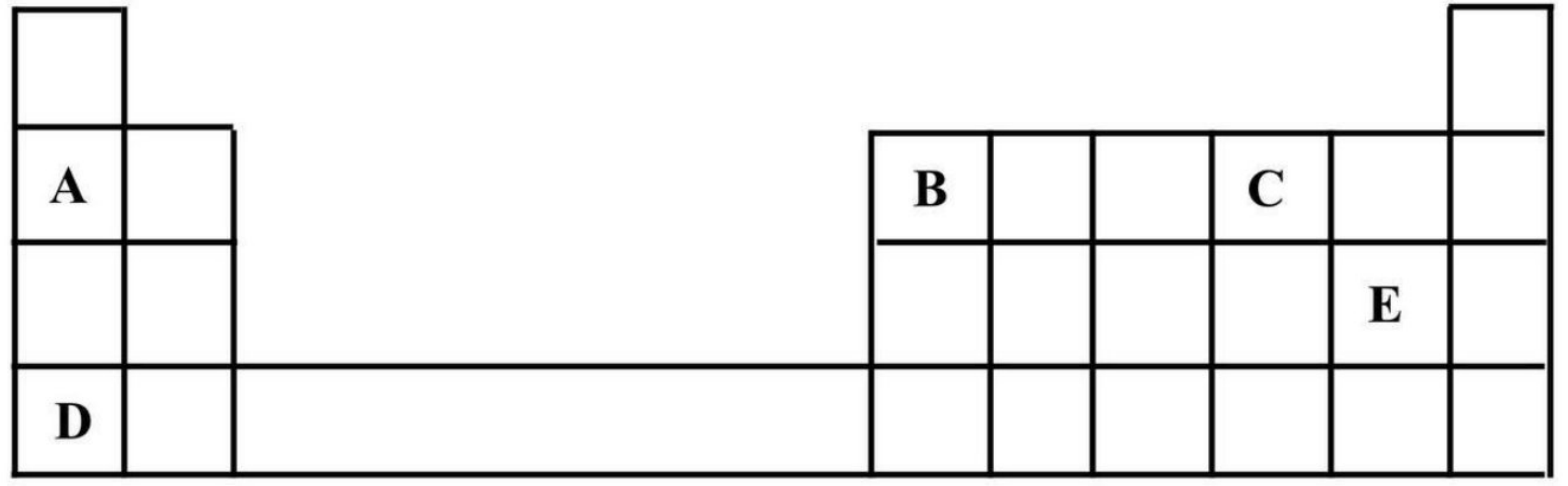
- (a)(i)
Which element is a halogen?
[1] - (a)(ii)
State two elements that are placed in the same group.
[1] - (b)(i)
0.1 mol of iron wool reacts with excess chlorine gas. Balanced chemical equation for the reaction: ... Fe + ... Cl₂ → ... FeCl₃
[1] - (b)(ii)
Calculate the mass of the product formed. [Relative atomic mass: Cl = 35.5, Fe = 56]
[2] - (c)
Table 3 shows the result when Group 1 elements react with oxygen: A burns slowly with red flame; D burns vigorously with purple flame. Explain reactivity differences in the observation between A and D elements.
[2] - (d)
B oxide is amphoteric in properties. Suggest two chemical substances to show metal B oxide is amphoteric oxide. Give your reason.
[3]
Section B
Diagram 8.1 shows two natural polymers: polymer X (milk) and polymer Y (rubber latex).
Medium20 marks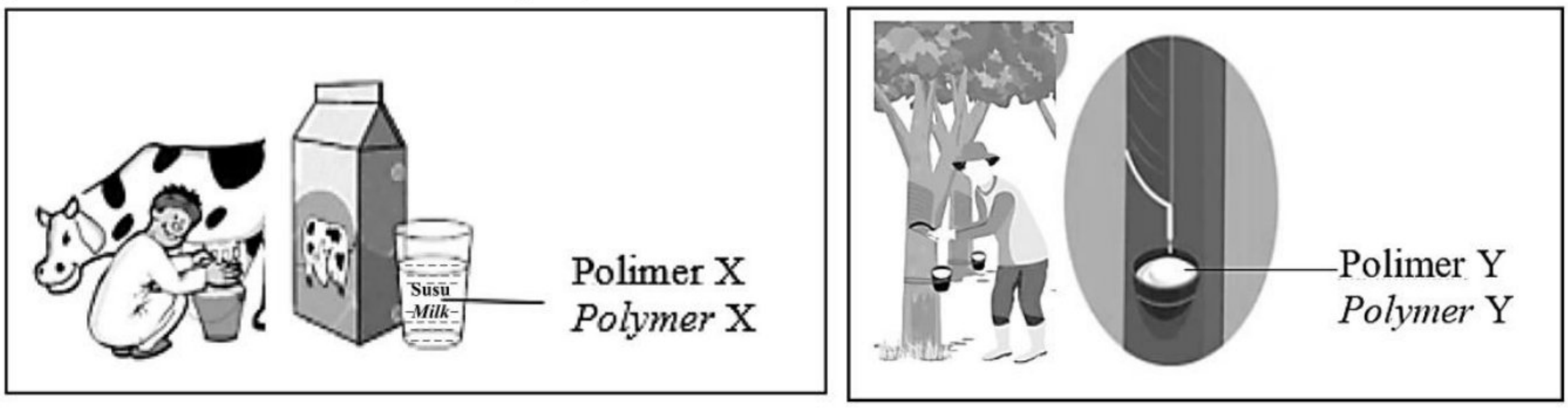
- (a)(i)
State the meaning of polymer.
[1] - (a)(ii)
State the monomer for polymer X and polymer Y.
[2] - (a)(iii)
Polymerisation process between monomers in polymer X produces polymer X and water. State the type of polymerisation involved.
[1] - (b)(i)
Diagram 8.2 shows information for two types of plates. Plate A: made from corn starch, wheat flour, soybean flour and water; biodegradable. Plate B: made from thermoset polymer; non-biodegradable. Choose the plate that can cause environmental pollution. Explain your answer.
[3]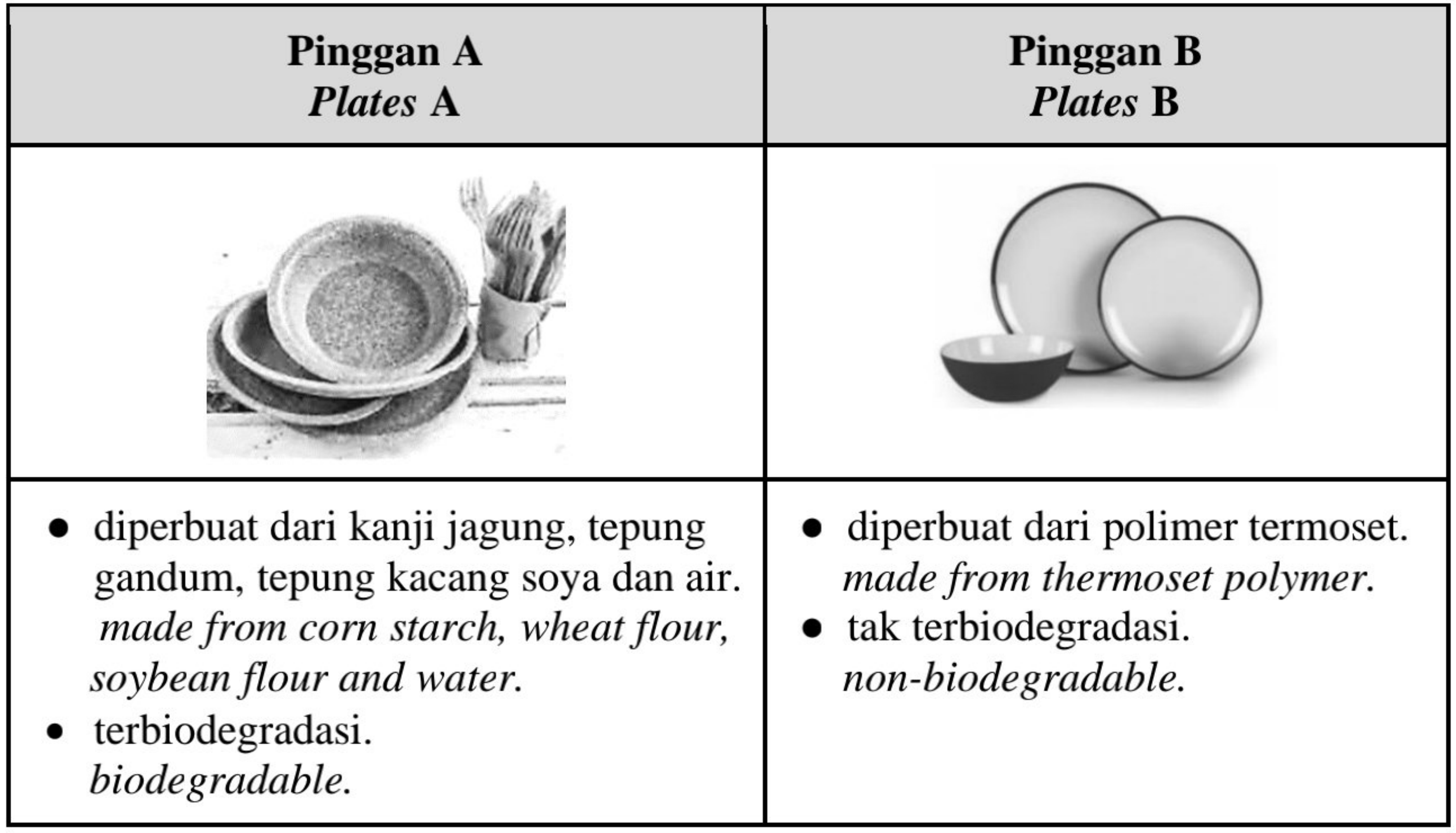
- (b)(ii)
Synthetic polymers are widely used in our daily lives. In your opinion, state three characteristics of plastics that encourage their wide usage.
[3] - (c)
Latex is collected in liquid form for processing or it can be left to coagulate and to be collected a day after it was tapped. Draw a labeled diagram of rubber particles and explain how latex clumps when acid is added to it.
[10]
A student carried out three sets of experiments by using 1.3 g of zinc to investigate the factors that affect the rate of reaction. The time taken to collect 100 cm³ of gas is recorded in Table 4. Set I: 50 cm³ of 0.5 mol dm⁻³ sulphuric acid with zinc powder, 80 s. Set II: 50 cm³ of 0.5 mol dm⁻³ sulphuric acid with zinc granule, 120 s. Set III: 50 cm³ of 1.0 mol dm⁻³ sulphuric acid with zinc powder, 40 s.
Hard20 marks- (a)(i)
Calculate rate of reaction for set I.
[1] - (a)(ii)
Zinc, Zn reacts with sulphuric acid, H₂SO₄ to produce zinc sulphate, and hydrogen gas. Write a balanced chemical equation for the reaction and calculate the maximum volume of hydrogen gas produced in set III. [Relative atomic mass: Zn = 65; 1 mole of any gas occupies 24 dm³ mol⁻¹ at room conditions]
[5] - (b)(i)
By referring to the collision theory, compare the rates of reaction of set I and set II.
[5]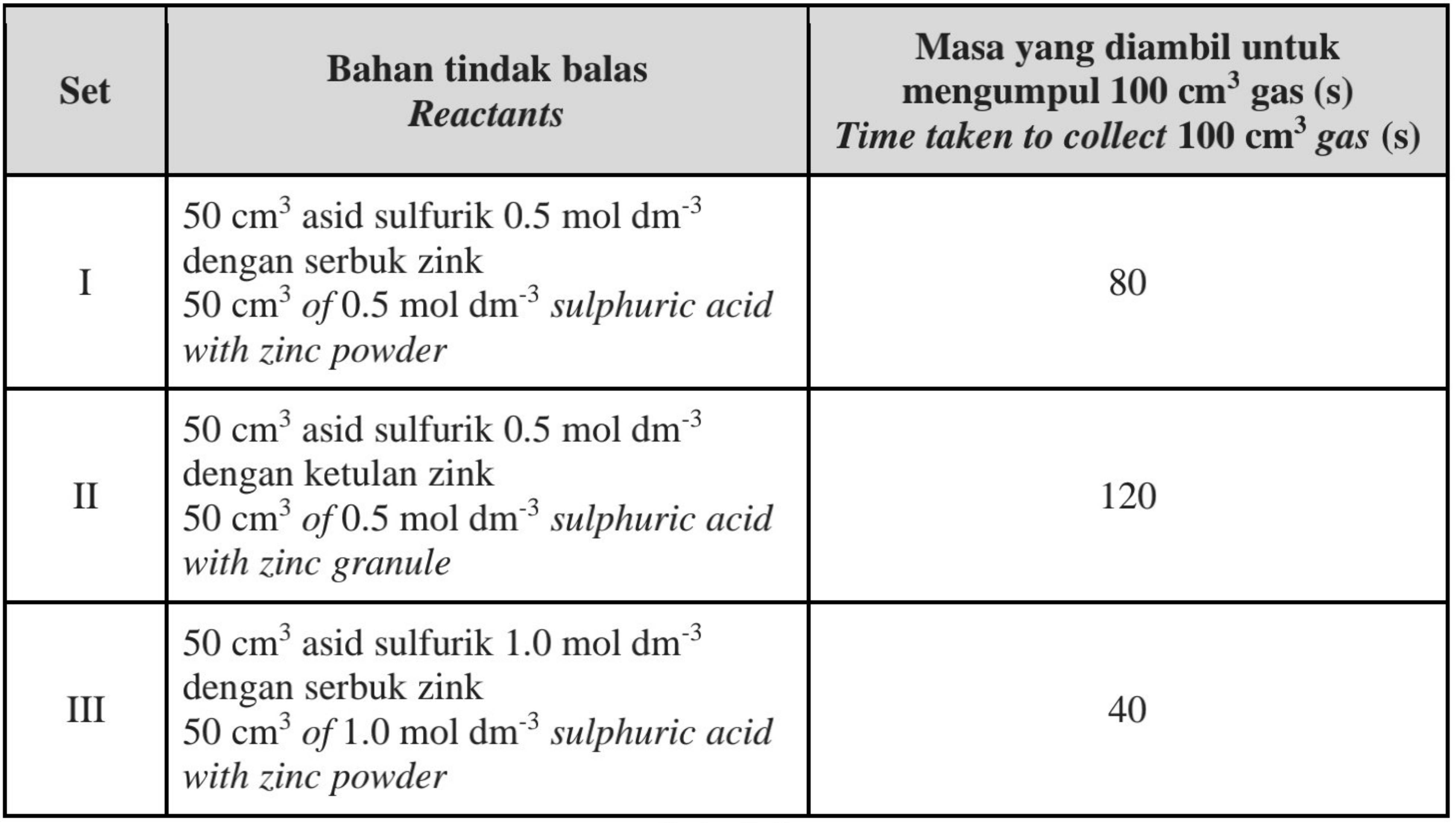
- (b)(ii)
By referring to the collision theory, compare the rates of reaction of set I and set III.
[5] - (c)(i)
Ali wants to grill satay on his 17th birthday celebration. Based on your knowledge in rate of reaction, state two factors to ensure satay cook faster.
[2]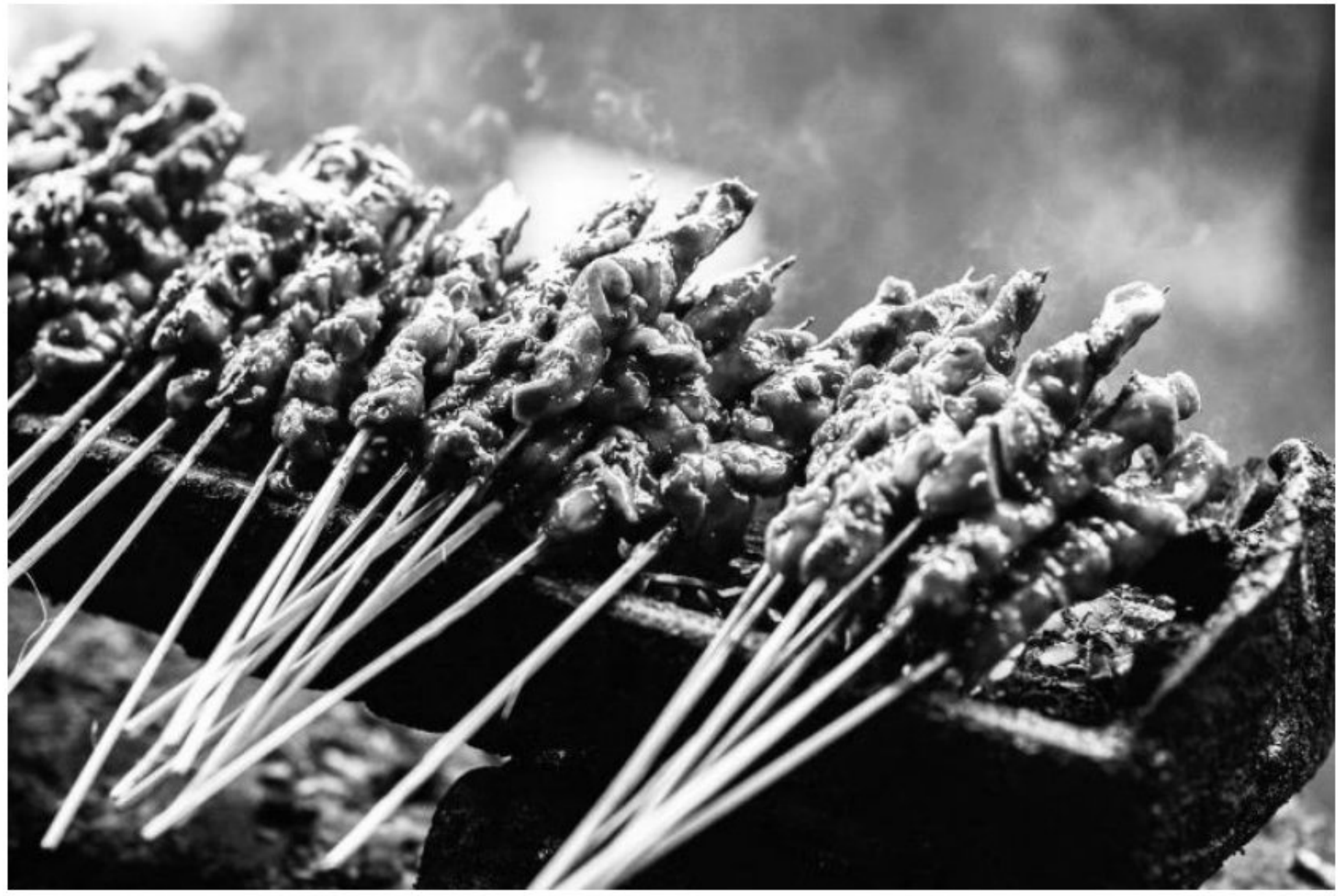
- (c)(ii)
Based on your answer in c(i), choose one factor and explain your answer.
[2]
Section C
Table 5 shows the pH value of H₂X, HY and HZ acids. Concentration of the acids are 0.01 mol dm⁻³. H₂X: pH 1.7; HY: pH 2.0; HZ: pH 5.0.
Medium20 marks- (a)(i)
H₂X acid is diprotic acid while HY acid and HZ acid are monoprotic acid. Suggest the name of H₂X, HY acid and HZ acid. Explain why the pH value of HY acid and HZ acid are different.
[6]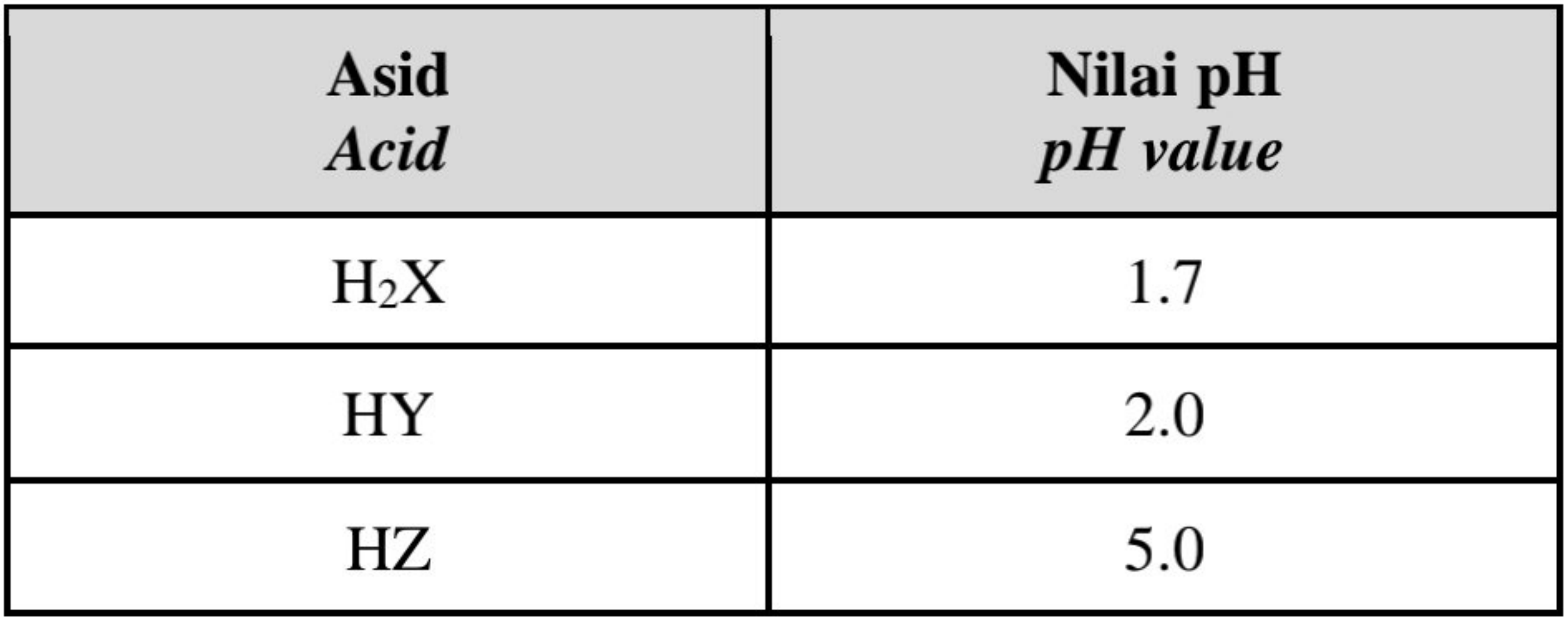
- (a)(ii)
In another experiment, 25 cm³ HY acid 1.0 mol dm⁻³ is needed to neutralise 25 cm³ of sodium hydroxide solution. Write the chemical equations and calculate the concentration of sodium hydroxide used in that experiment.
[4] - (b)
Diagram 9.1 shows a jellyfish. The sting of jellyfish is alkaline and causes pain. Suggest one substance that can be applied to the skin to relieve the pain without causing further injury. Give three reasons for your suggestion.
[4]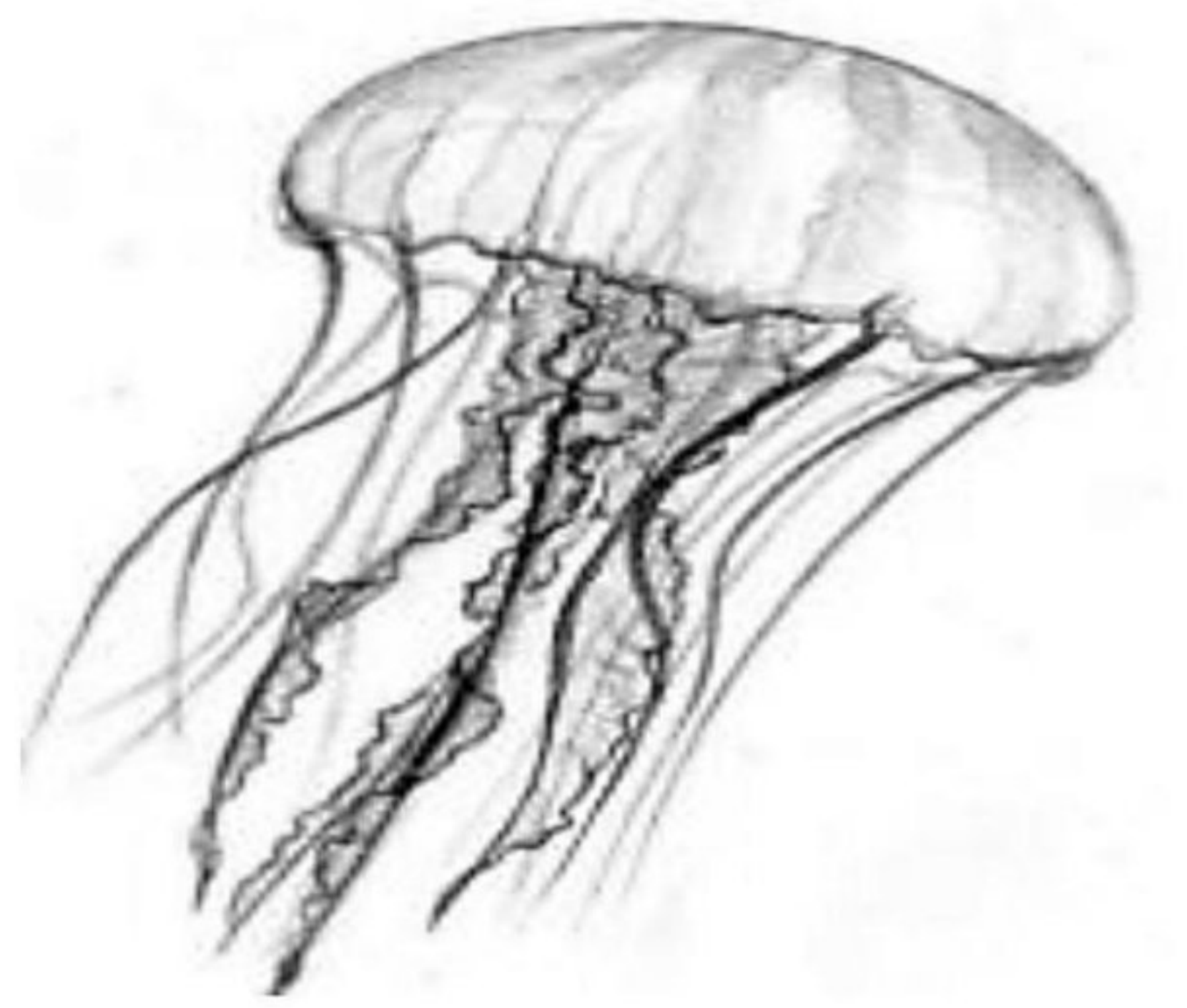
- (c)
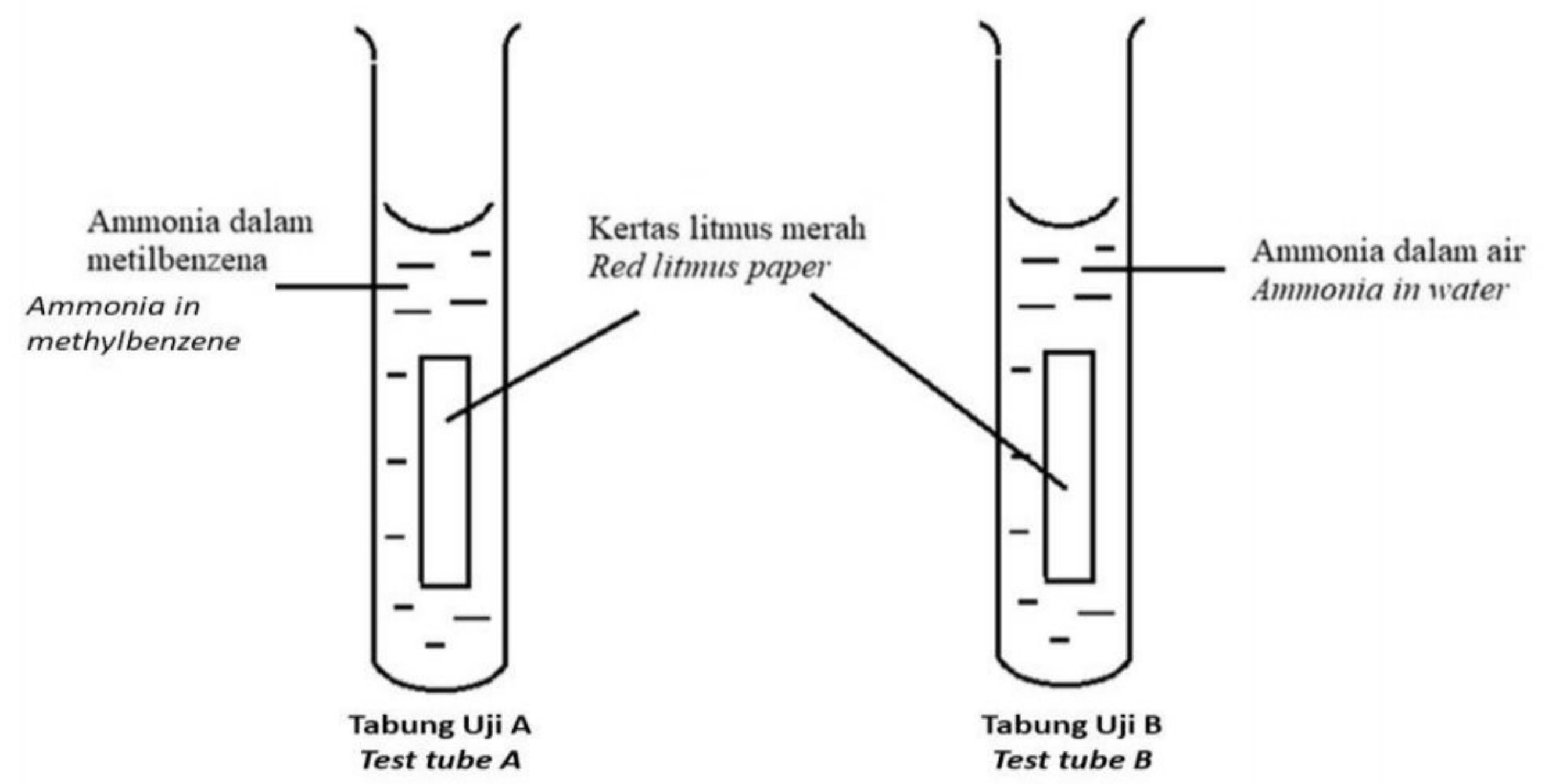
A student carries out a test to investigate the properties of ammonia when dissolved in methylbenzene (test tube A) and when dissolved in water (test tube B), each with red litmus paper, as shown in Diagram 9.2. Predict the observation to the colour of red litmus paper in both test tubes A and B. Explain your answer.
[6]