Write your answer on paper. Then open the answer to check it.
Section A
Table 1 shows three substances and their respective chemical formulae. Substance / Chemical formula: Bromine Br₂; Lead Pb; Lead(II) bromide PbBr₂. Use information from Table 1 to answer the following questions.
Medium5 marks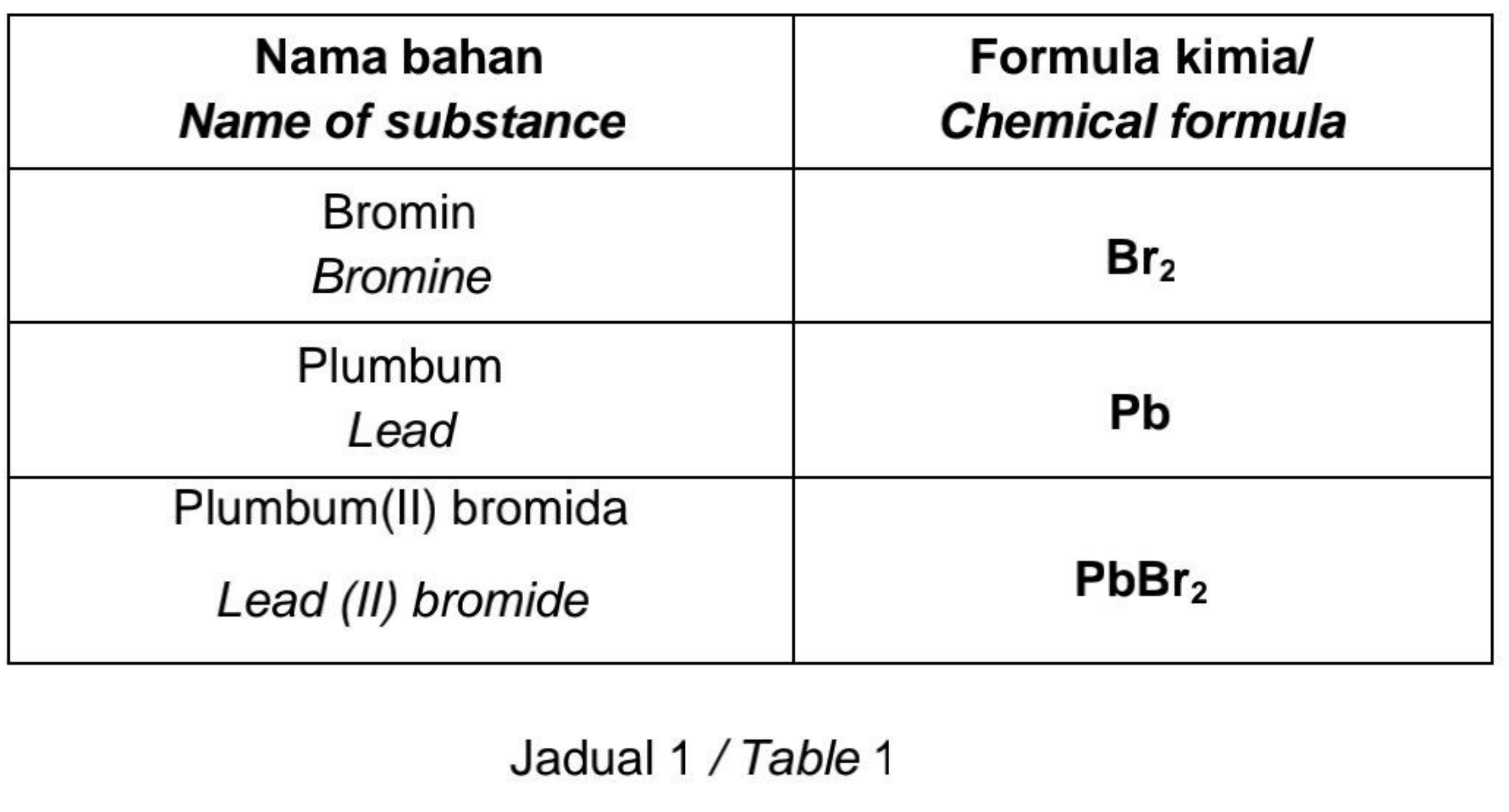
- (a)(i)
State one substance which exists as an atom.
[1] - (a)(ii)
Write the ionic formula for the substance in (a)(i).
[1] - (a)(iii)
Which substance has the lowest melting point?
[1] - (a)(iv)
What is the state of matter of bromine at room temperature?
[1] - (a)(v)
Lead(II) bromide can conduct electricity in molten state. Give a reason.
[1]
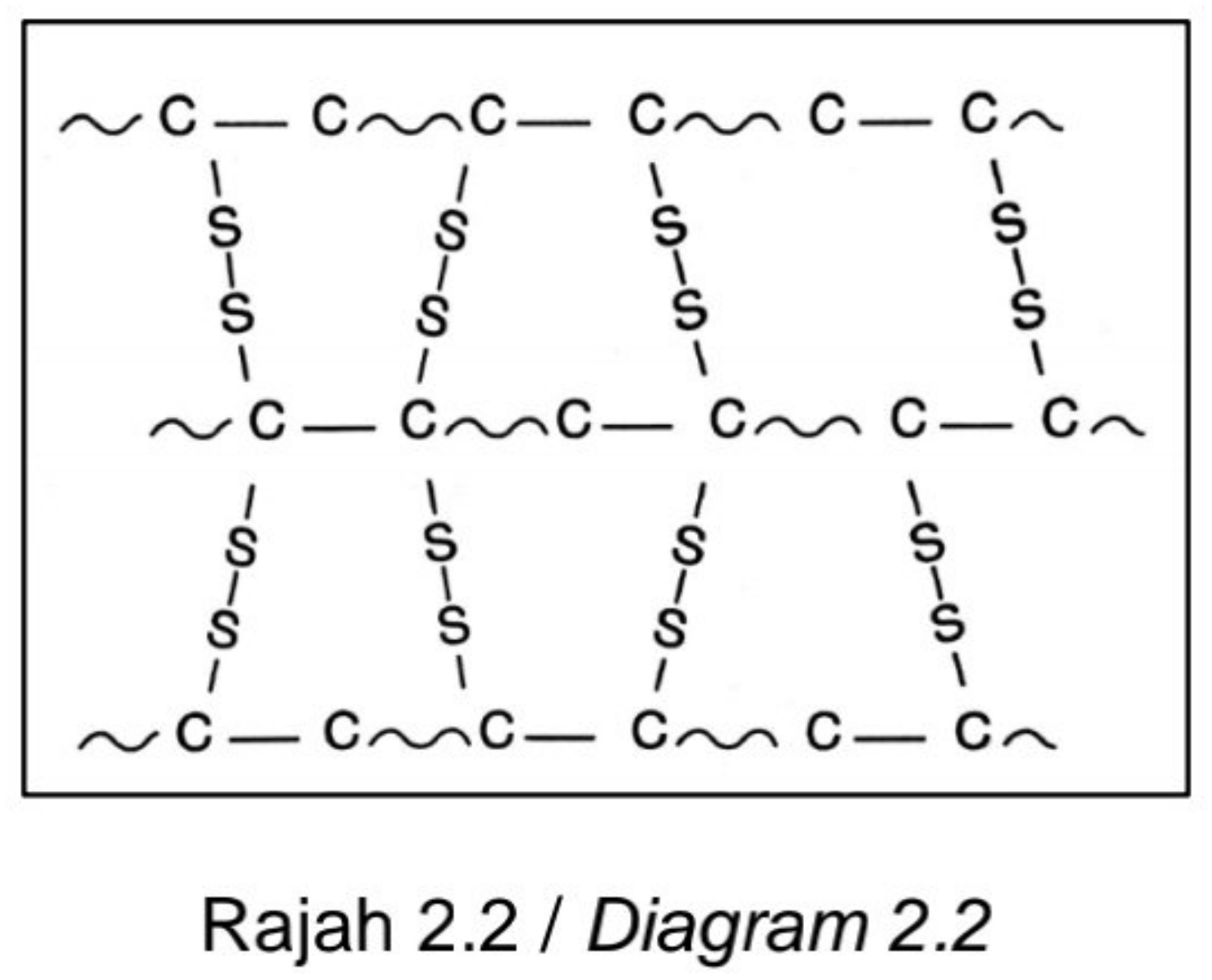
Diagram 2.1 shows the structural formula of the monomer of natural rubber (CH₂=C(CH₃)–CH=CH₂, drawn as H₃C and CH₂ groups on two carbon atoms). Diagram 2.2 shows the molecular structure of natural rubber after undergoing a process to enhance its properties (rubber chains joined by S–S cross-links).
Medium5 marks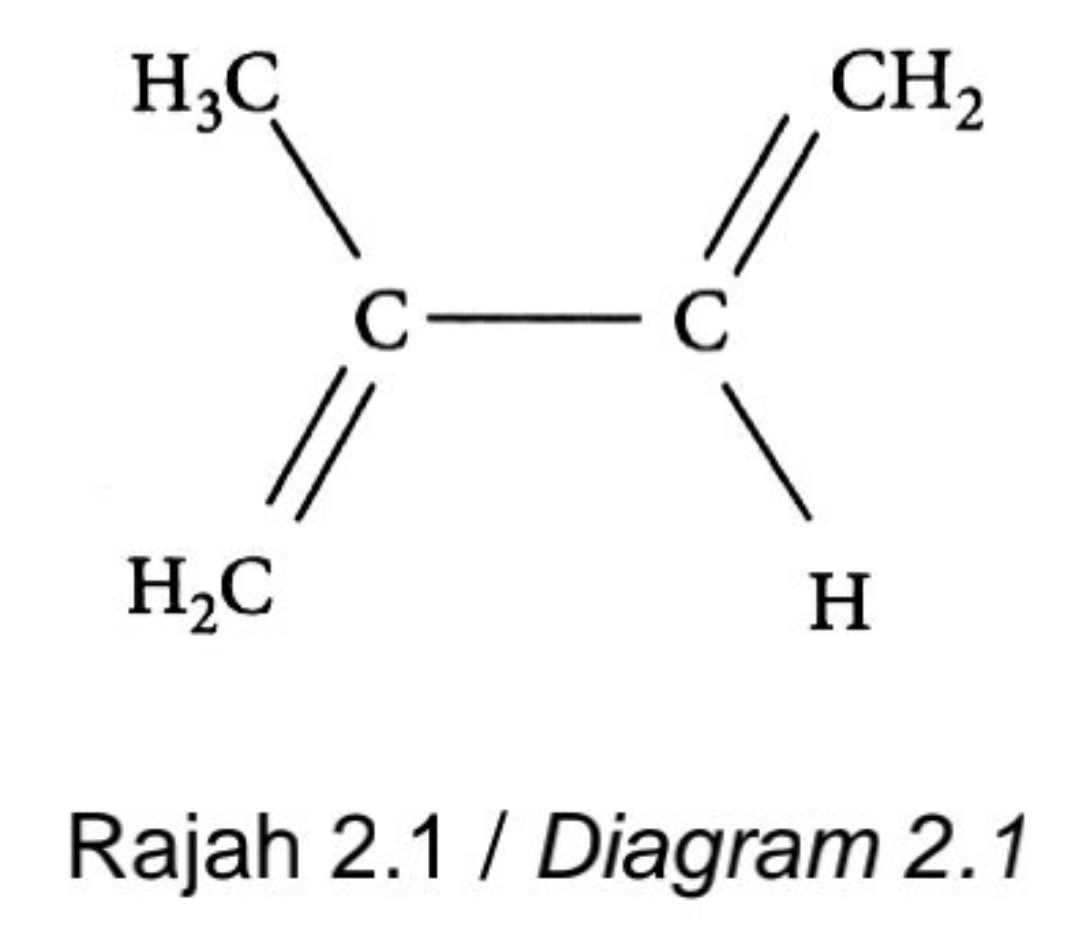
- (a)(i)
Based on the Diagram 2.1, name the structural formula of natural rubber based on the IUPAC nomenclature.
[1] - (a)(ii)
Draw the molecular structure of natural rubber.
[1] - (b)(i)
Name the process that occurred.
[1] - (b)(ii)
Explain how the process involved in (b)(i) improved the elasticity properties of natural rubber.
[2]
Diagram 3.1 shows the combination of cellulose and lignin to produce a composite (cellulose fibres embedded in lignin). Diagram 3.2 shows the Pyramids of Giza in Egypt, which are believed to have been built out of ceramics. Ceramics are solids consisting of non-organic and non-metallic materials, produced by forming and hardening using heat at high temperatures.
Medium6 marks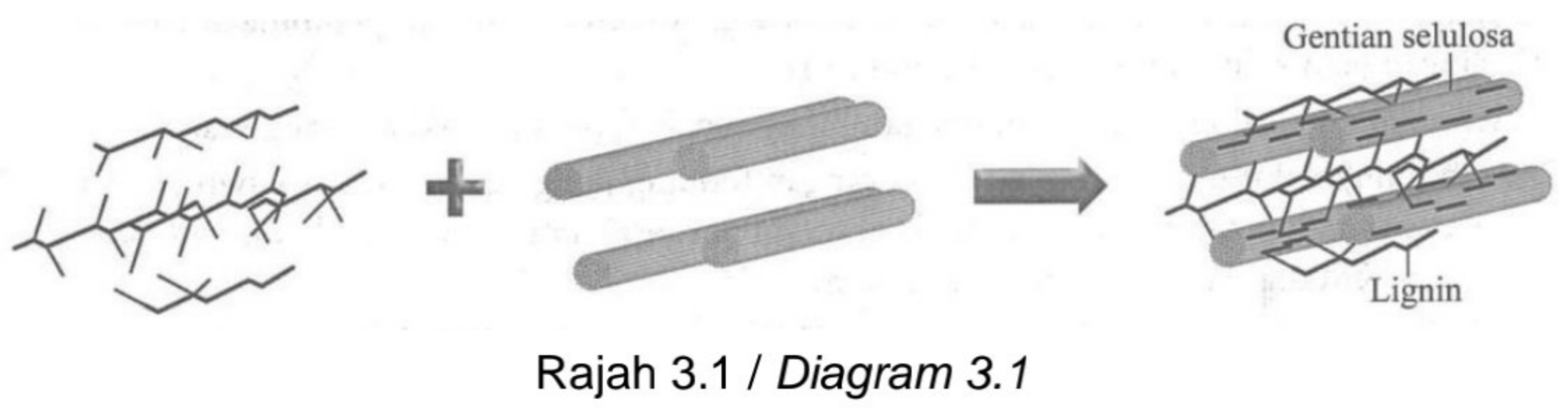
- (a)(i)
State the function of lignin.
[1] - (a)(ii)
Fibre optic is a composite material. State the substances in fibre optic and its advantage.
[2] - (b)(i)
State two types of ceramic.
[2] - (b)(ii)
Pottery, brick, bowl. Based on your answer at (3)(b)(i), which type of ceramic is suitable to manufacture the above items?
[1]
Table 4 shows the empirical formulae and molecular formulae of two compounds. Compound P: empirical formula (blank), molecular formula C₅H₁₀. Compound Q: empirical formula Zn(NO₃)₂, molecular formula Zn(NO₃)₂.
Medium7 marks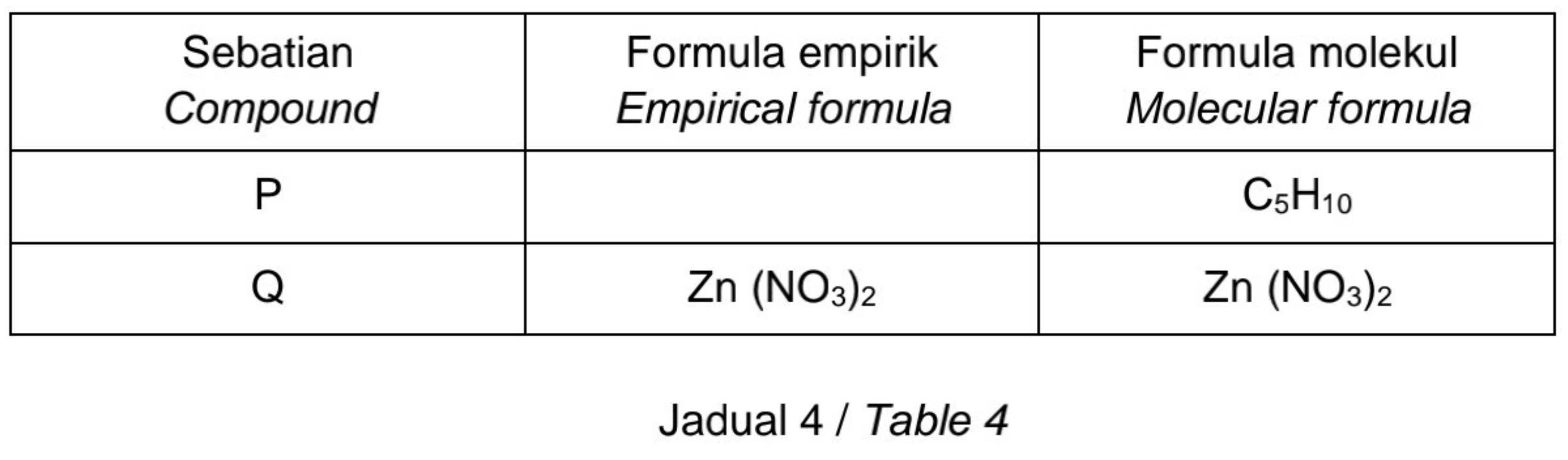
- (a)
State the meaning of empirical formula.
[1] - (b)
Write empirical formula of compound P.
[1] - (c)(i)
When compound Q is heated strongly, it will decompose to form zinc oxide, oxygen gas and nitrogen dioxide gas. Write a balanced chemical equation for the decomposition of compound Q.
[2] - (c)(ii)
If 0.5 mole of compound Q is heated, calculate the volume of nitrogen dioxide gas produced at room condition. [Molar volume of gas at room condition is 24 dm³ mol⁻¹]
[3]
Table 5 shows the electrical conductivity and melting point of substances R, S and T. R: conducts as solid (Yes), conducts as molten (Yes), melting point 660 °C. S: solid No, molten Yes, 192 °C. T: solid No, molten No, 80 °C.
Medium8 marks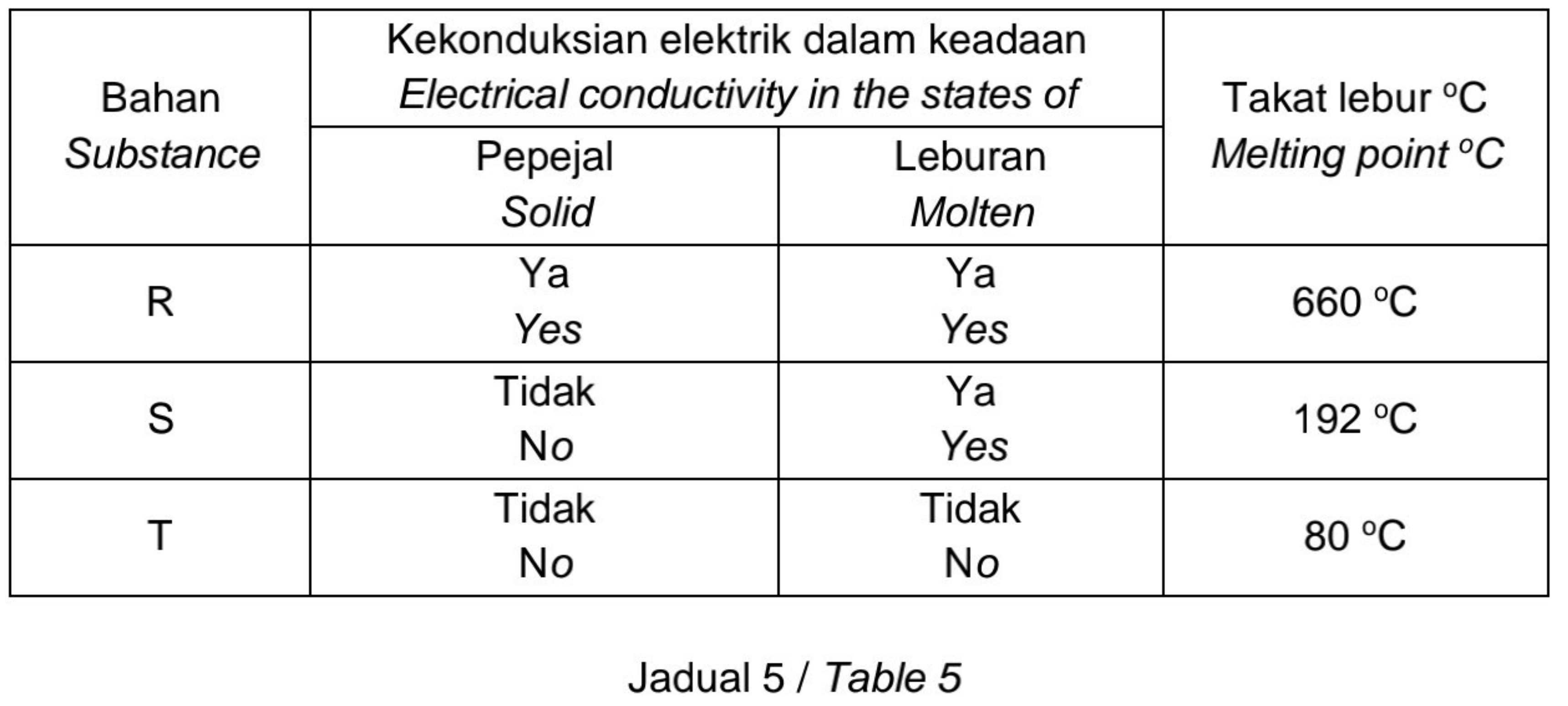
- (a)(i)
State the types of bonds for substance R, S and T.
[3] - (a)(ii)
State how the bonds is formed in substance S.
[1] - (a)(iii)
Does substance T soluble in water? Explain your answer.
[2] - (b)
Why does a wet finger help to turn the pages of a book? Explain your answer.
[2]
Diagram 6 shows an experiment conducted to determine the heat of displacement for the reaction between copper(II) nitrate solution and iron powder. 50 cm³ of 1.0 mol dm⁻³ copper(II) nitrate solution is poured into a plastic cup and the initial temperature is recorded. The excess iron powder is added to the same plastic cup. The mixture is stirred slowly, and the highest temperature is recorded. Initial temperature = 29.0 °C Highest temperature of mixture = 33.0 °C
Medium9 marks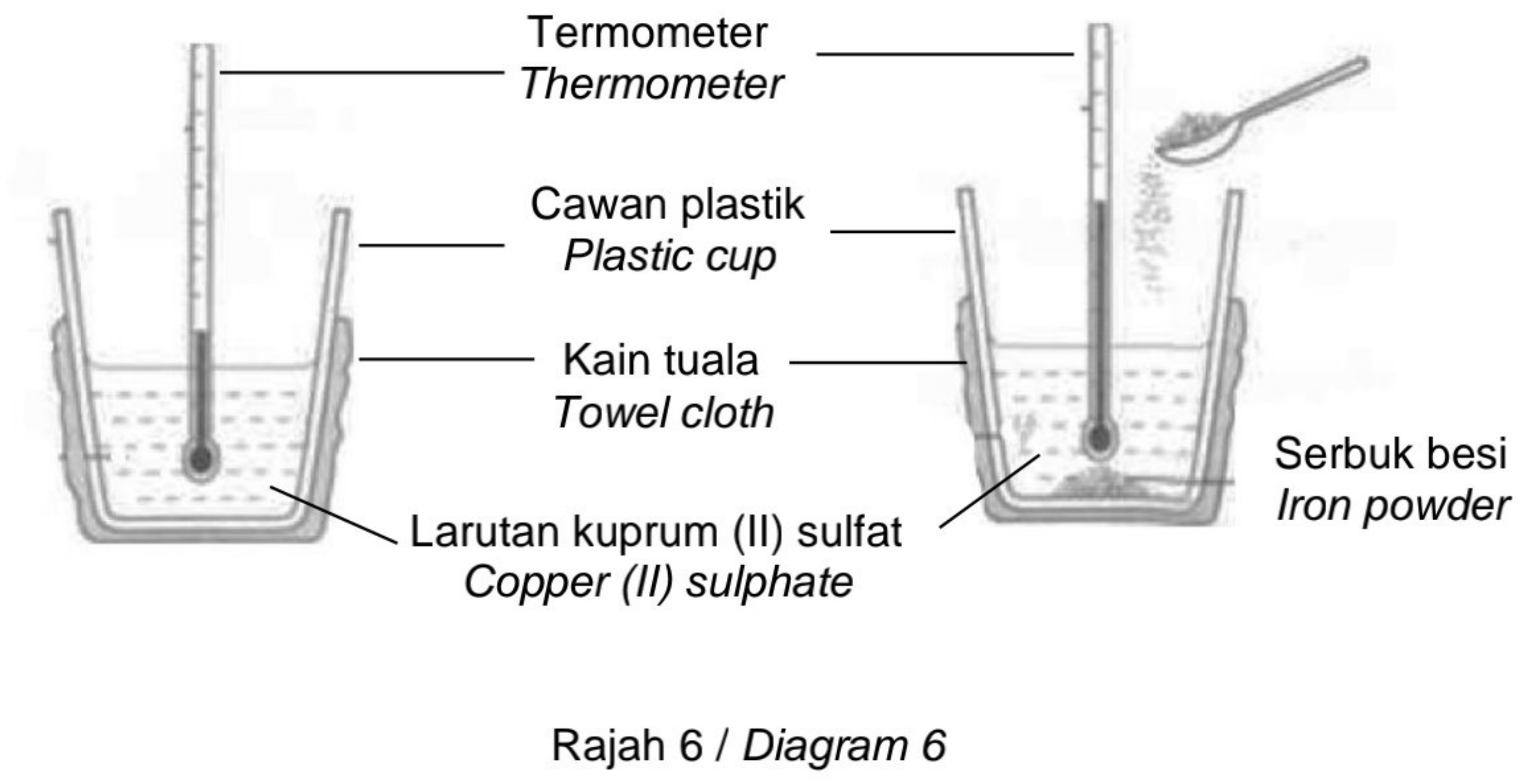
- (a)
What is the meaning of heat of displacement of the experiment?
[1] - (b)
Why does iron in the form of powder is used in this experiment?
[1] - (c)
Why is plastic cup used in this experiment?
[1] - (d)
State one observation in this experiment.
[1] - (e)
Complete the following ionic equation for the reaction in this experiment. Fe + Cu²⁺ →
[1] - (f)(i)
Based on the experiment, calculate the total heat released. [Specific heat capacity of solution: 4.2 J g⁻¹ °C⁻¹; density of water: 1 g cm⁻³]
[2] - (f)(ii)
Based on the experiment, calculate the number of moles of copper(II) nitrate that has reacted.
[1] - (f)(iii)
Based on the experiment, calculate the heat of displacement in this reaction.
[1]
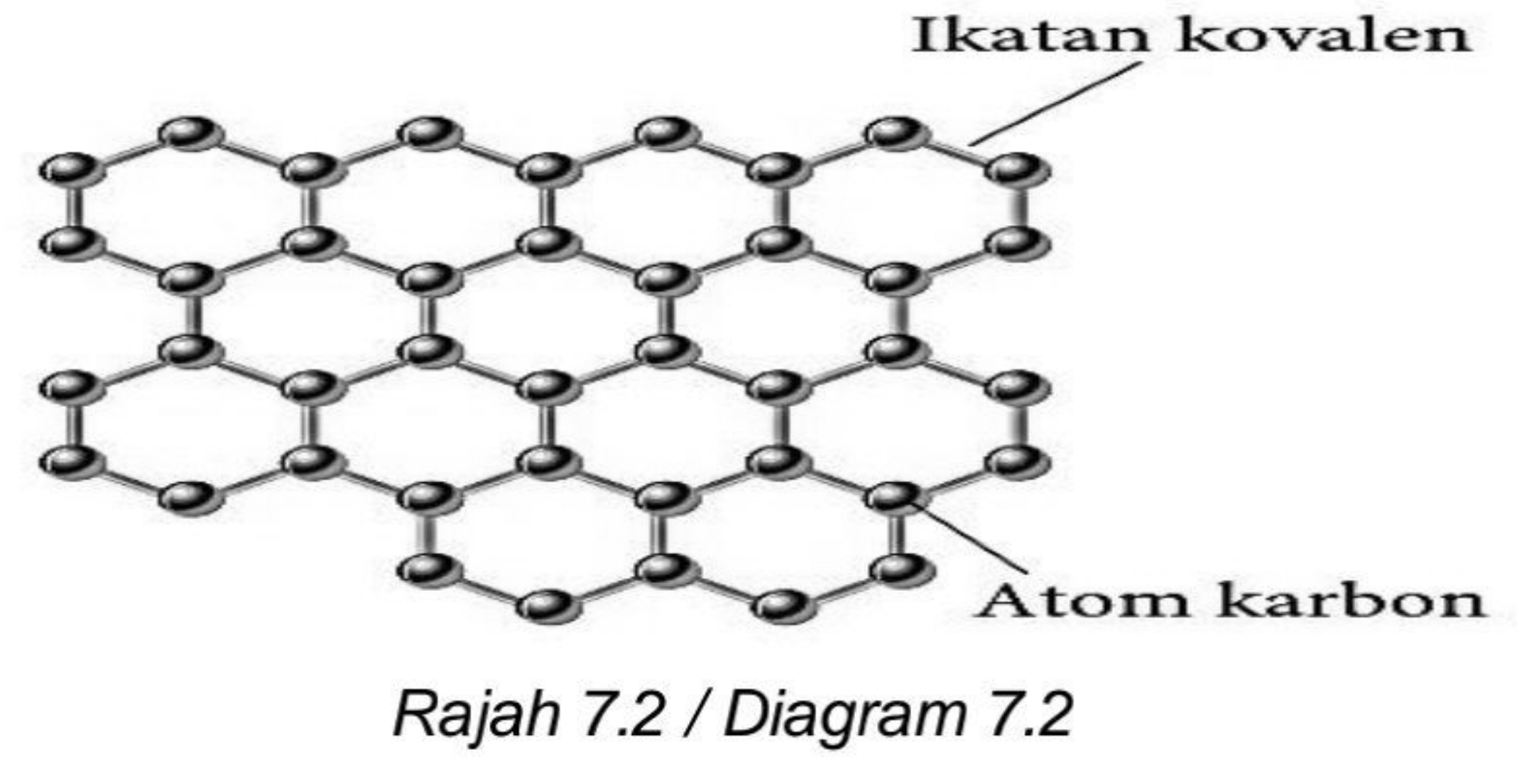
Table 7.1 shows information of three different food additives, P, Q and R. P: added to a low-calorie soft drink to sweeten it and for the consumption of diabetic patients. Q: added to fresh meat to preserve it and to make it look fresh. R: added to pickled chilli or mango pickles. Diagram 7.2 shows the structure of a graphene sheet (carbon atoms joined by covalent bonds in hexagons).
Medium10 marks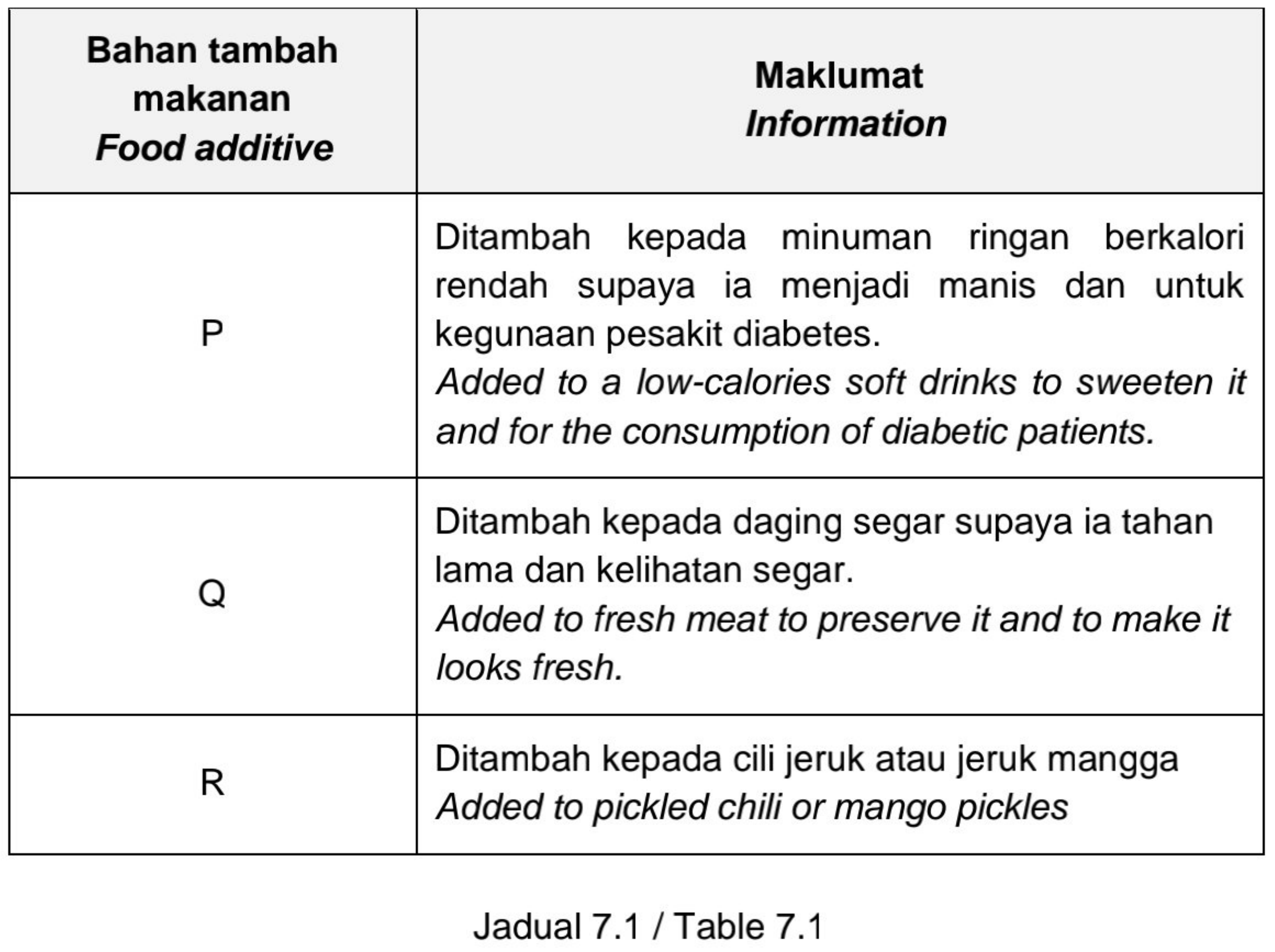
- (a)(i)
Suggest the name for food additives P, Q and R.
[3] - (a)(ii)
State the advantage and disadvantage about the uses of food additives in daily life.
[2] - (a)(iii)
Why is substance R added to chilli pickles or mango pickles?
[1] - (a)(iv)
Food additive R is a weak acid. Describe the chemical test to confirm it.
[2] - (b)(i)
Graphene is one of the carbon allotropes and is the most reactive carbon allotrope. Name one other allotrope of carbon.
[1] - (b)(ii)
State one physical property of graphene.
[1]
Diagram 8 shows the structural formulae of compounds J and K. Compound J: CH₃–CH=CH–CH₃ drawn in full (but-2-ene type chain of four carbons with a C=C in the middle). Compound K: four-carbon chain with an –OH group on carbon 2.
Medium10 marks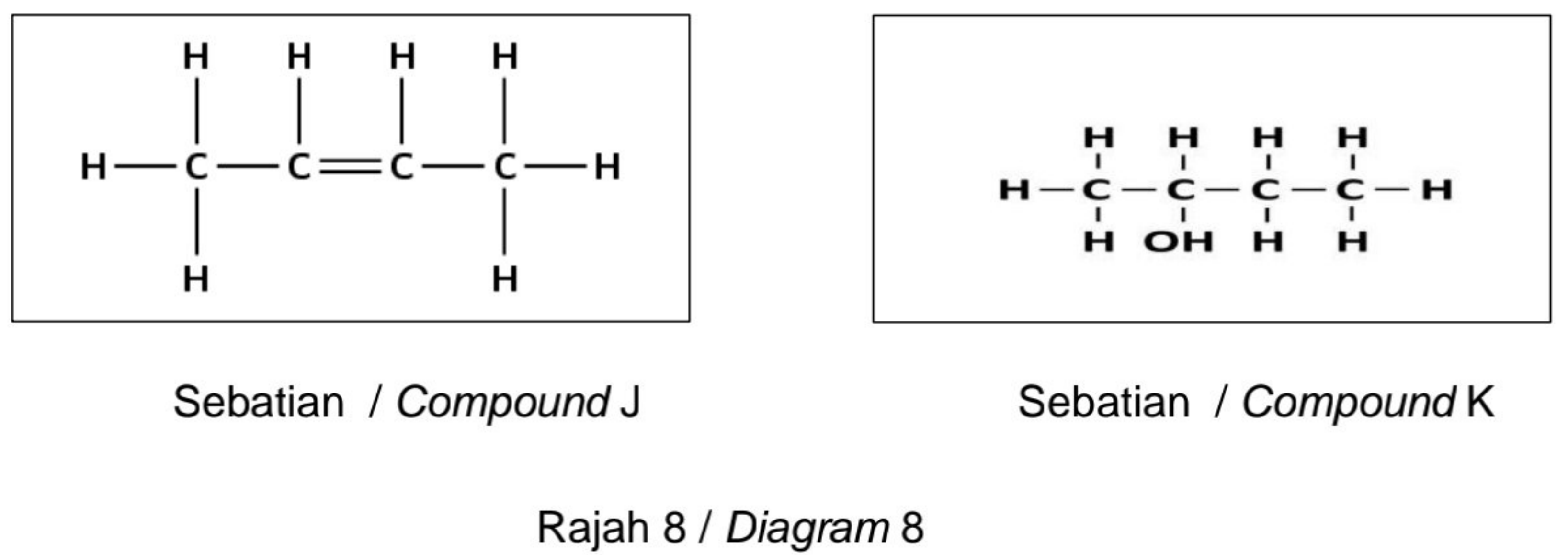
- (a)
State the homologous series for compounds J and K.
[2] - (b)(i)
Name compound K.
[1] - (b)(ii)
Name the reaction.
[1] - (b)(iii)
Draw another isomer of compound K and name it according to IUPAC nomenclature.
[2] - (c)(i)
Compound L is produced when an acidic potassium dichromate(VI) solution is added into a test tube containing compound K. State one observation for this reaction.
[1] - (c)(ii)
Write the molecular formula of compound L.
[1] - (d)
Compound J burns completely in excess oxygen. Write the chemical equation for the complete combustion of J.
[2]
Section B
Answer any one question (Section B). Diagram 9 shows 2 g of salt added into two different glasses, one with cold water and one with hot water.
Medium20 marks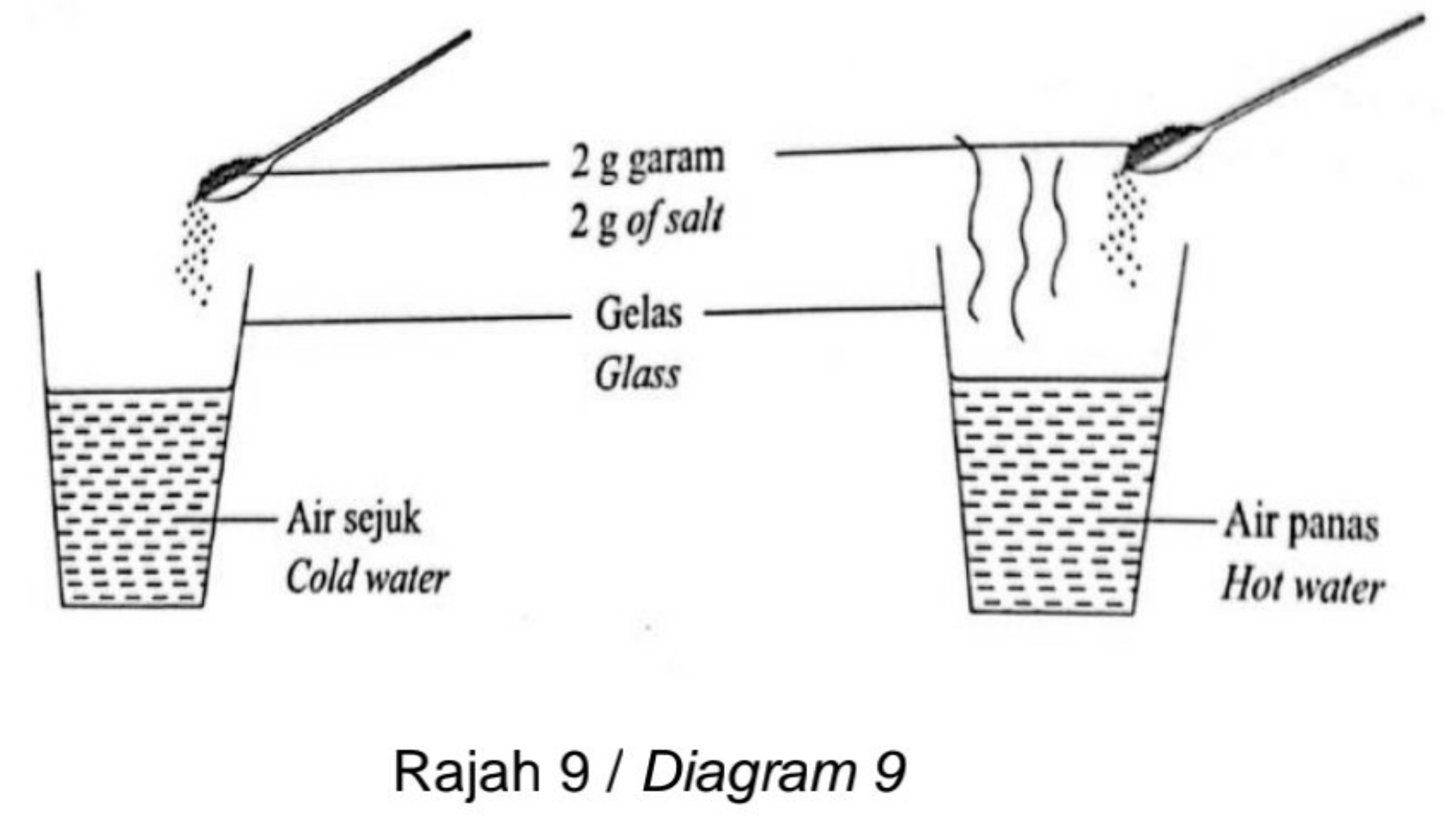
- (a)
Based on Diagram 9, salt in which glass will dissolve faster? Explain your answer.
[3] - (b)(i)
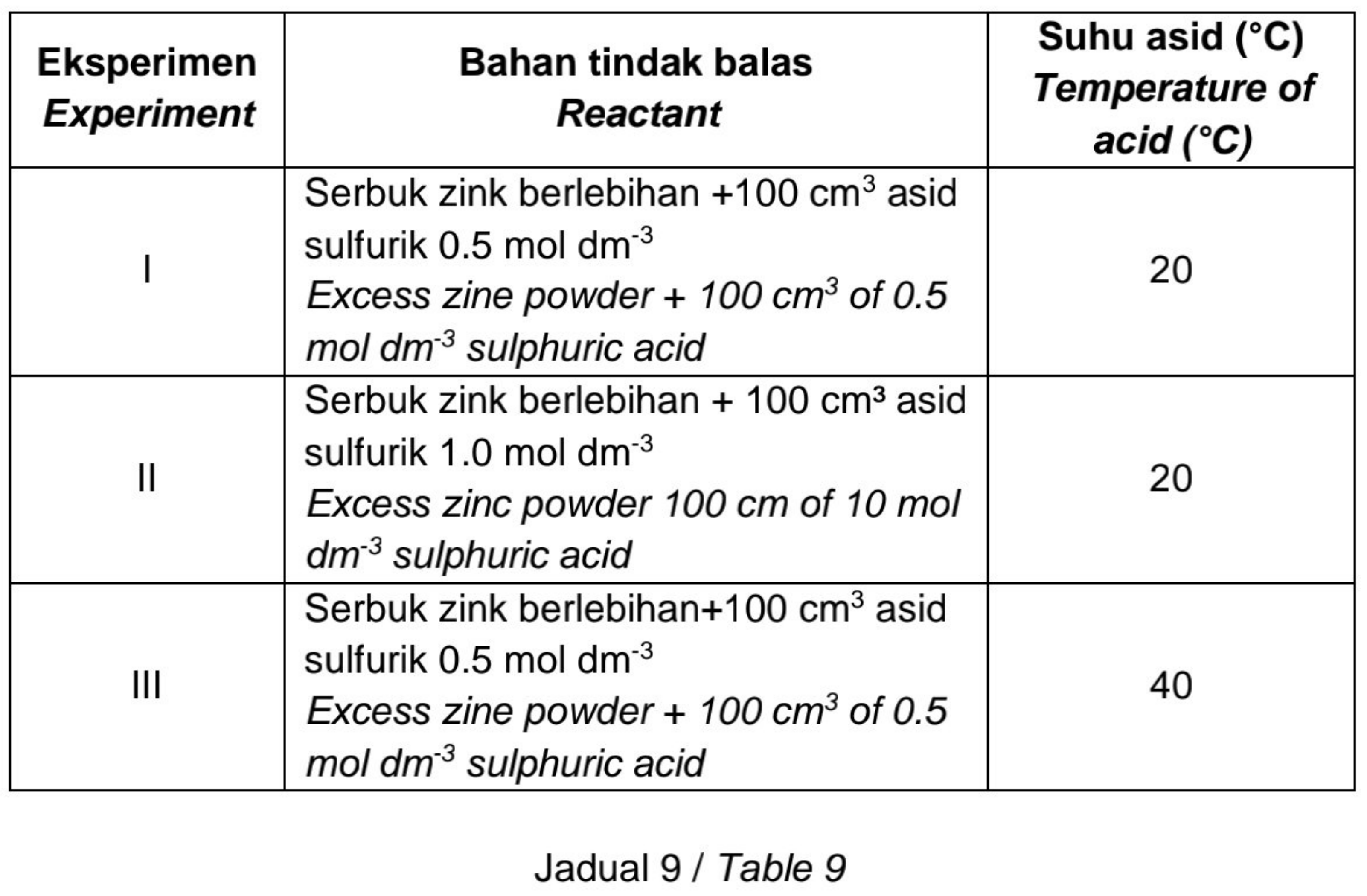
Three experiments were carried out to study the factors that affect the rate of reaction. Table 9: Experiment I: excess zinc powder + 100 cm³ of 0.5 mol dm⁻³ sulphuric acid, 20 °C. Experiment II: excess zinc powder + 100 cm³ of 1.0 mol dm⁻³ sulphuric acid, 20 °C. Experiment III: excess zinc powder + 100 cm³ of 0.5 mol dm⁻³ sulphuric acid, 40 °C. State all factors that affect the rate of reaction in Experiments I, II and III.
[2] - (b)(ii)
Write a balanced chemical equation for the reaction in Experiment I. Calculate the volume of gas released. [Molar volume of gas at room condition is 24.0 dm³ mol⁻¹]
[5] - (b)(iii)
Compare the reaction rate between Experiment I and II, and between Experiment I and III. Explain your answer by using Collision Theory.
[10]
Answer any one question (Section B). Diagram 10.1 shows the apparatus set-up for electrolysis of 0.0001 mol dm⁻³ Y chloride solution using carbon electrodes. The products at the cathode and anode are gases.
Hard20 marks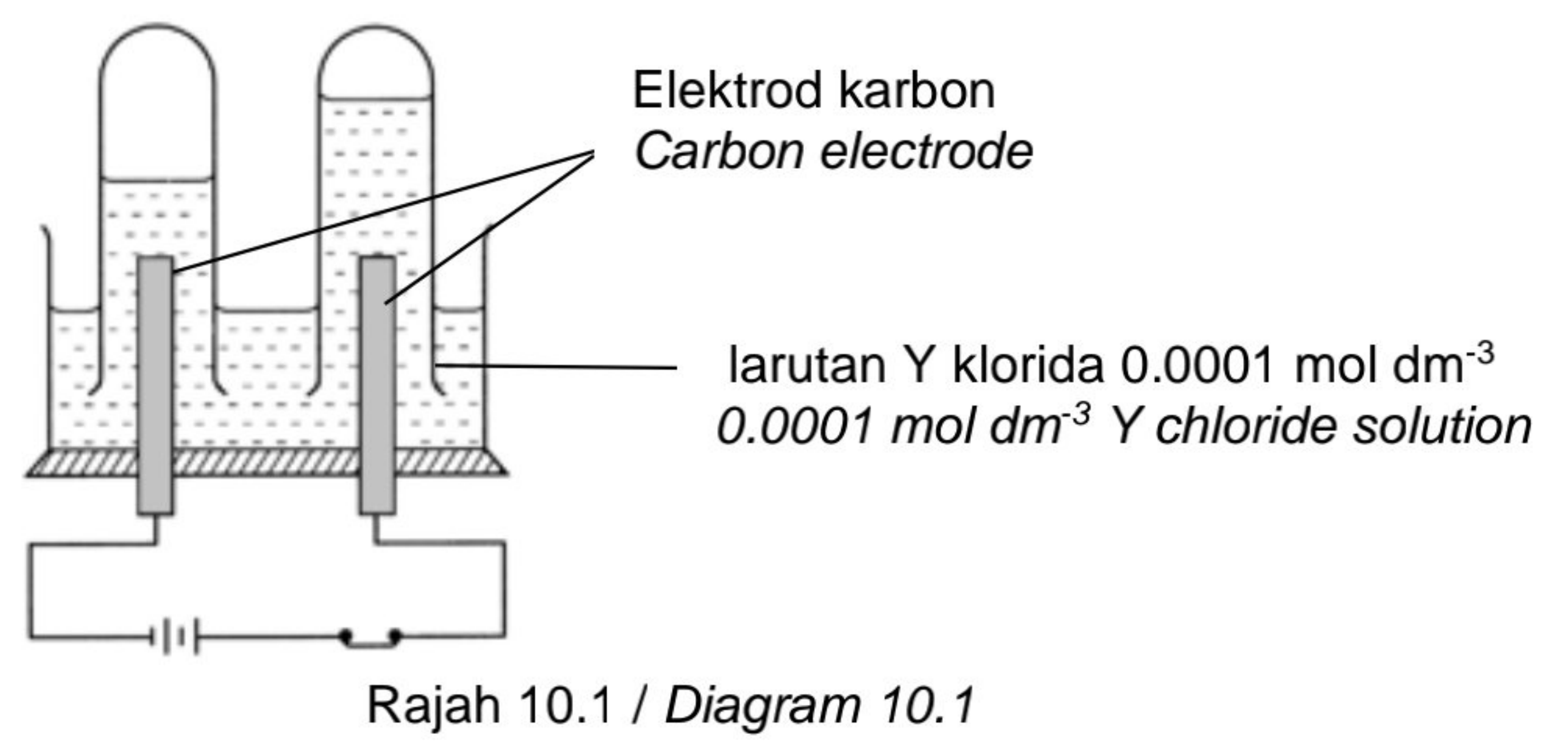
- (a)
Suggest Y chloride. Write the half equation for the reaction occurred at the anode. If the solution is replaced with 1.0 mol dm⁻³ of Y chloride solution, state the product at the anode. Give a reason for your answer. [Half-cell table: Cl₂ + 2e ⇌ 2Cl⁻ +1.36 V; O₂ + 2H₂O + 4e ⇌ 4OH⁻ +0.40 V; 2H⁺ + 2e ⇌ H₂ 0.00 V]
[4]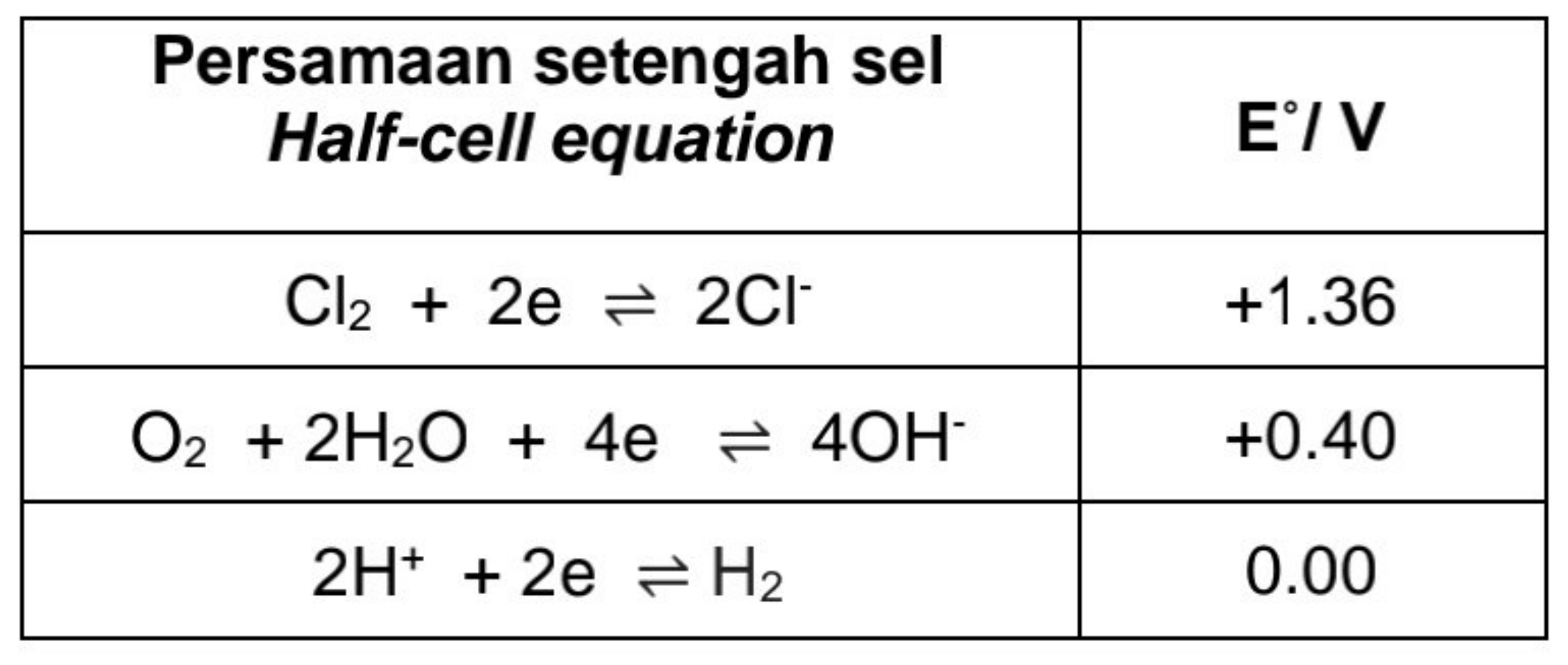
- (b)(i)
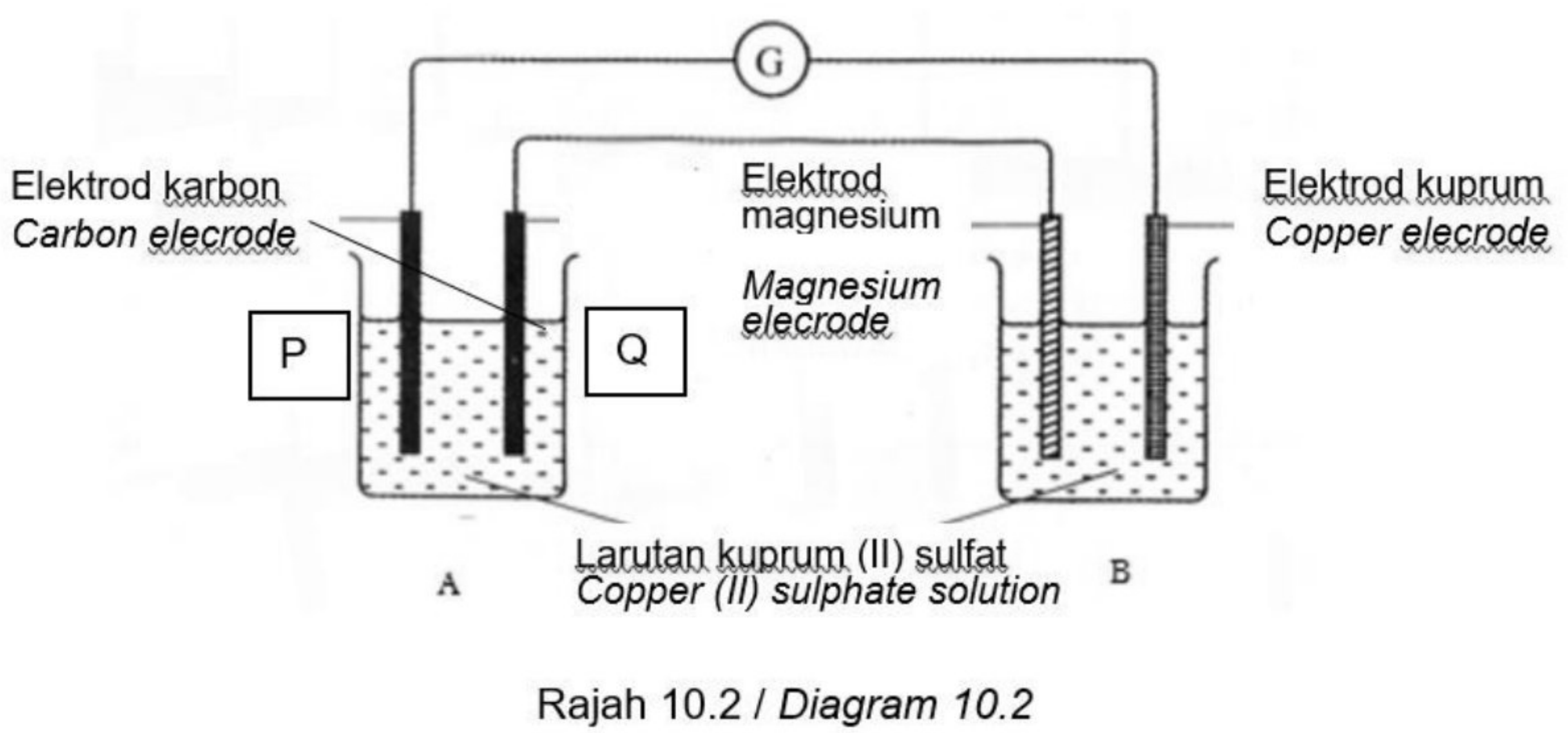
Diagram 10.2 shows two cells: cell A (copper(II) sulphate solution with carbon electrodes P and Q) connected to cell B (magnesium electrode and copper electrode) and a galvanometer. [E° values: Mg²⁺ + 2e ⇌ Mg −2.38 V; Cu²⁺ + 2e ⇌ Cu +0.34 V; S₂O₈²⁻ + 2e ⇌ 2SO₄²⁻ +2.01 V; O₂ + 2H₂O + 4e ⇌ 4OH⁻ +0.40 V; 2H⁺ + 2e ⇌ H₂ 0.00 V] Based on Diagram 10.2, state the electrode that acts as the cathode in cell A.
[1]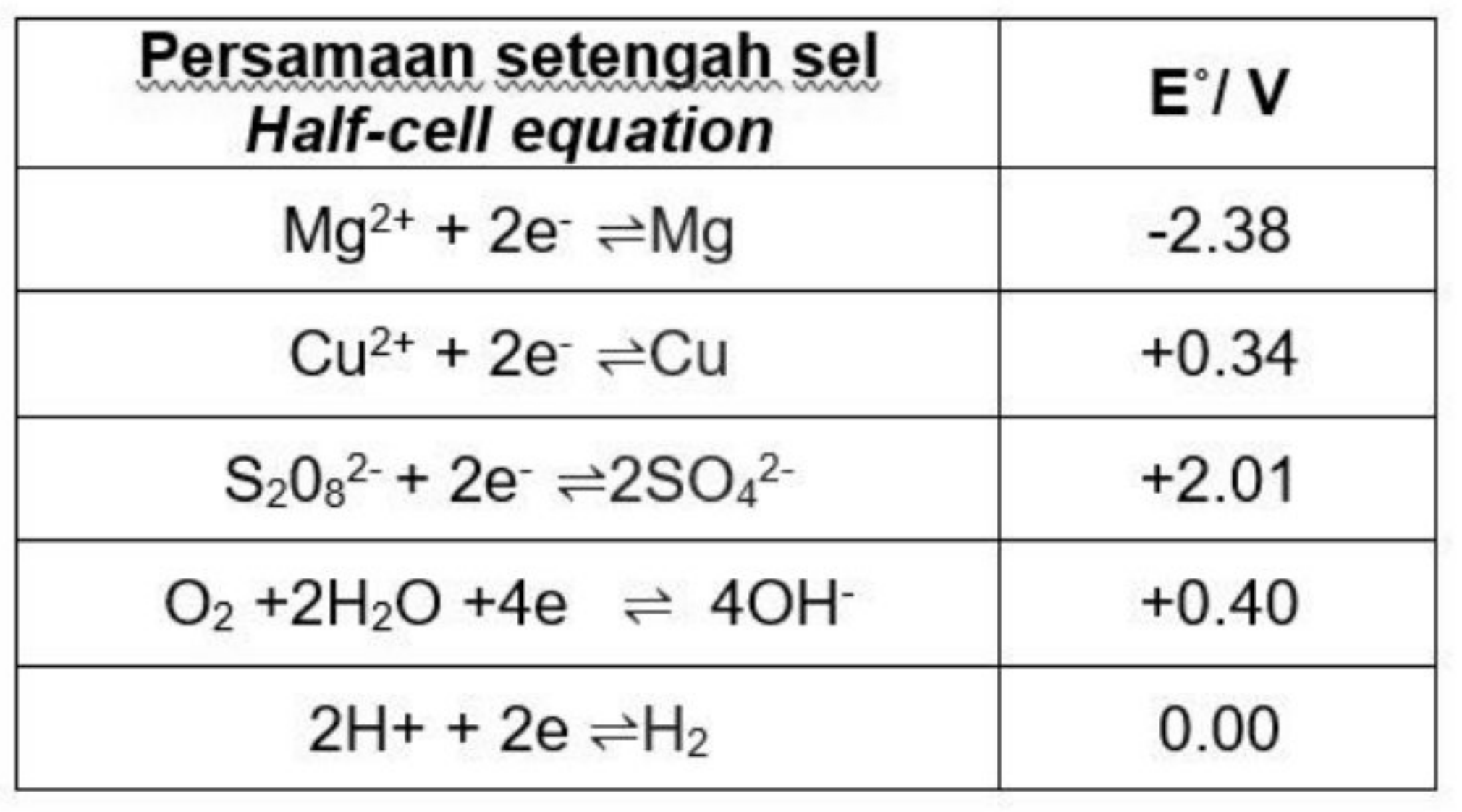
- (b)(ii)
Explain the reactions at the cathode. Your answer should include: list of the ions attracted; name of the selectively discharged ion; the reason why the ion is selectively discharged; type of the reaction occurred; observation.
[5] - (c)(i)
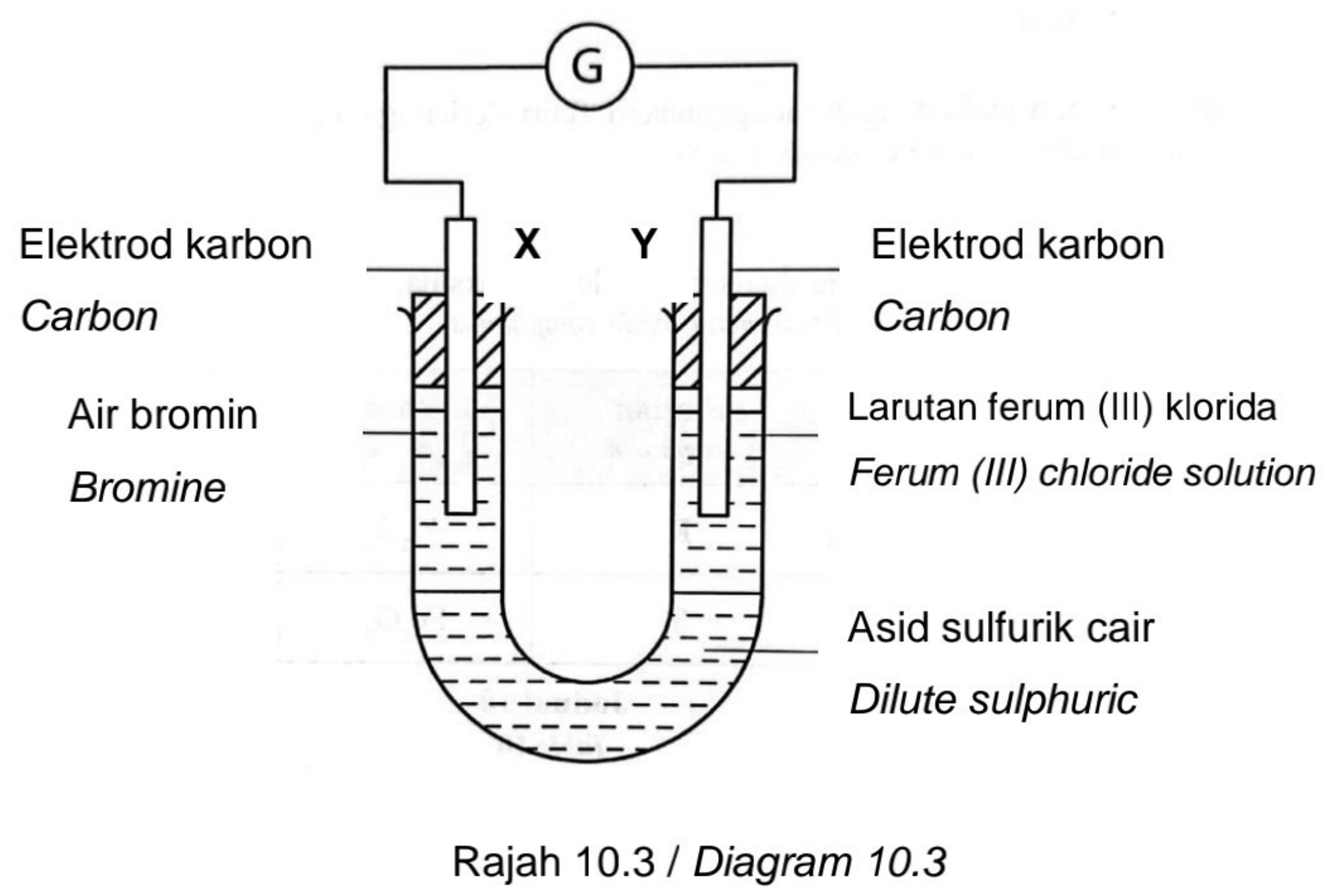
Diagram 10.3 shows the apparatus set-up carried out by Ally to study the transfer of electrons at a distance: carbon electrodes X and Y, bromine water on one side, iron(III) chloride solution on the other, dilute sulphuric acid in the U-tube, connected to a galvanometer. After a while, Ally noticed that the galvanometer needle was not deflected and there was no change in the solution used. Study Diagram 10.3 and identify the mistake made.
[1] - (c)(ii)
With the help of a labelled diagram, suggest the modifications that Ally should make and mark the direction of electron flow.
[2] - (c)(iii)
After the modification was carried out, the galvanometer needle was deflected. Based on the answer in (c)(ii): identify the oxidising agent and reducing agent; state the observations at X and Y; write the half equation that occurs at X and Y; write the ionic equation involved.
[7]
Section C
Diagram 11.1 shows the reaction scheme of salt Q. When salt Q is heated strongly, solid R is formed, which is brown when hot and yellow when cooled. A colourless gas W is also given off. The reaction of solid R and dilute nitric acid produces solution X. Solution X + sodium carbonate solution → precipitate Y + solution Z.
Hard20 marks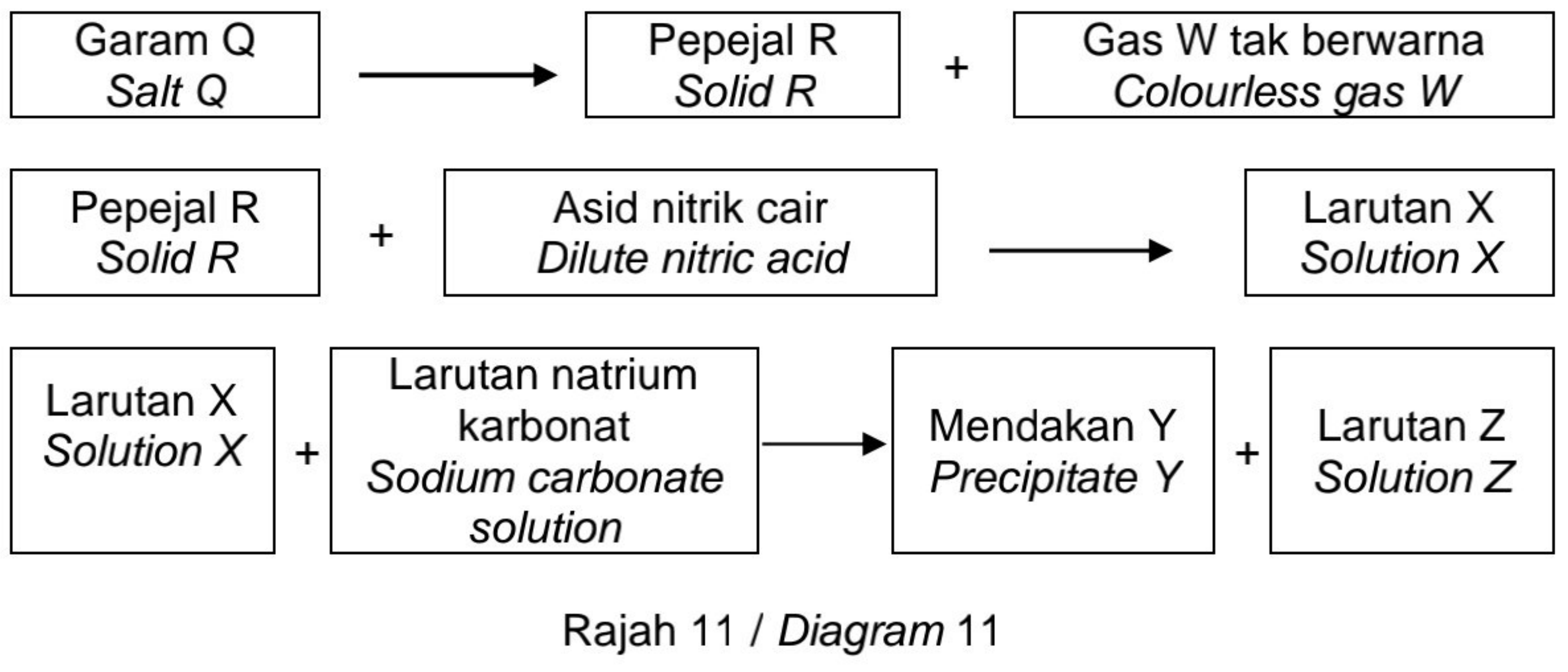
- (a)(i)
State the name of gas W that turns lime water cloudy. Identify salt Q, solid R and solution X.
[4] - (a)(ii)
Describe briefly a chemical test to verify the anion in solution Y.
[4] - (b)(i)
Suggest the name of the reaction that occurred between solution Y and sodium carbonate solution. Write the chemical equation for the reaction.
[3] - (b)(ii)
One of the salts produced from the reaction in (b)(i) is also found in processed meat such as sausages and salami, where it is added as a preservative that inhibits the growth of bacteria and retains the red colour. Name the salt found in the process meat. Can the salt be dissolved in water?
[2] - (c)
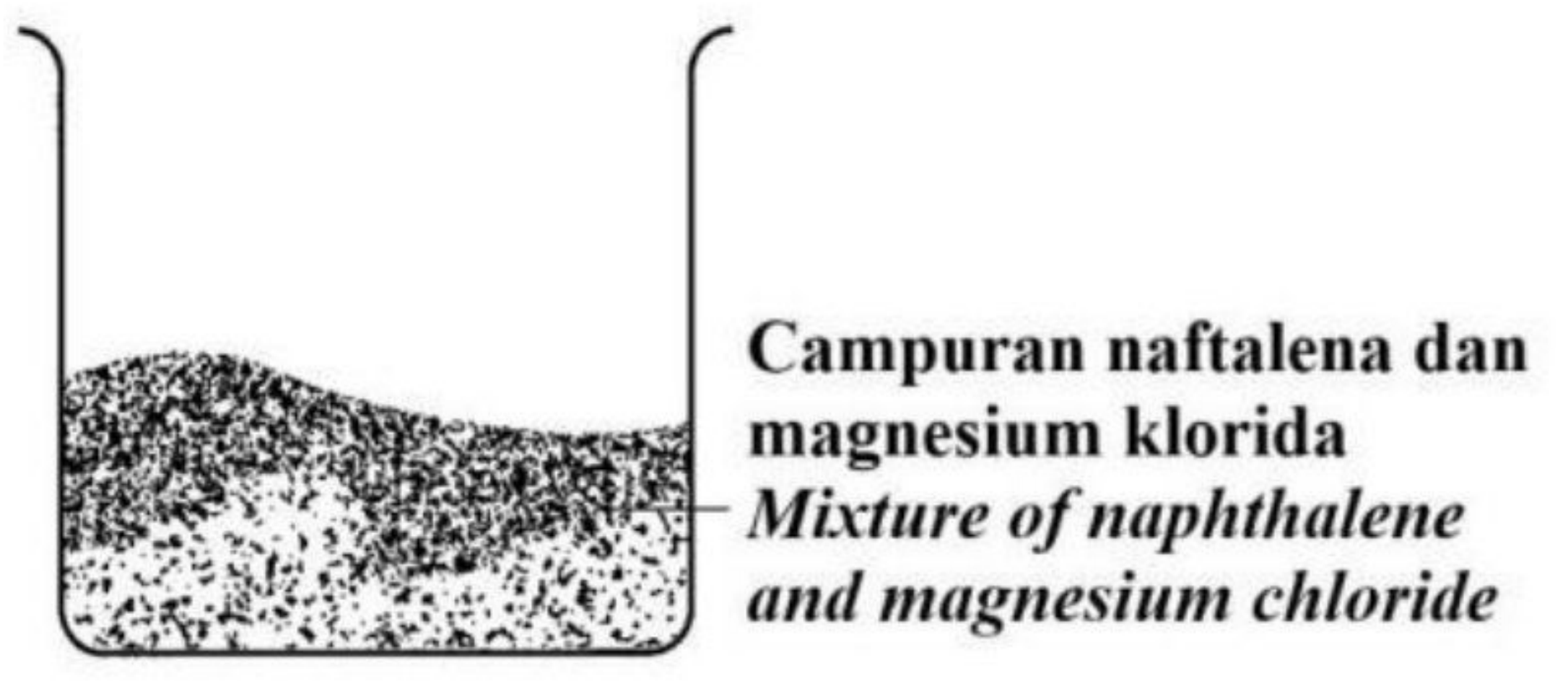
Diagram 11.2 shows a beaker containing a mixture of two white solids (naphthalene and magnesium chloride). Describe briefly how to separate the naphthalene from the magnesium chloride. Explain the differences in the observations after the mixture is separated.
[7]