Write your answer on paper. Then open the answer to check it.
Section A
The table below shows the element in Period 3 with their respective proton numbers: Na 11, Mg 12, Al 13, Si 14, P 15, S 16, Cl 17, Ar 18.
Medium5 marks
- (a)(i)
Write the electron arrangement of a silicon atom, Si.
[1] - (a)(ii)
In which group of the Periodic Table is silicon, Si located?
[1] - (b)
How does the atomic size change when going across Period 3 from left to right?
[1] - (c)
Argon is chemically unreactive. Explain why?
[2]
Table 2 below shows the examples and component for two types of manufactured substances in industry. Ceramic: example silicon carbide, components silicon and carbon. P: example reinforced concrete to build building, components cement, sand, small pebbles and steel.
Medium5 marks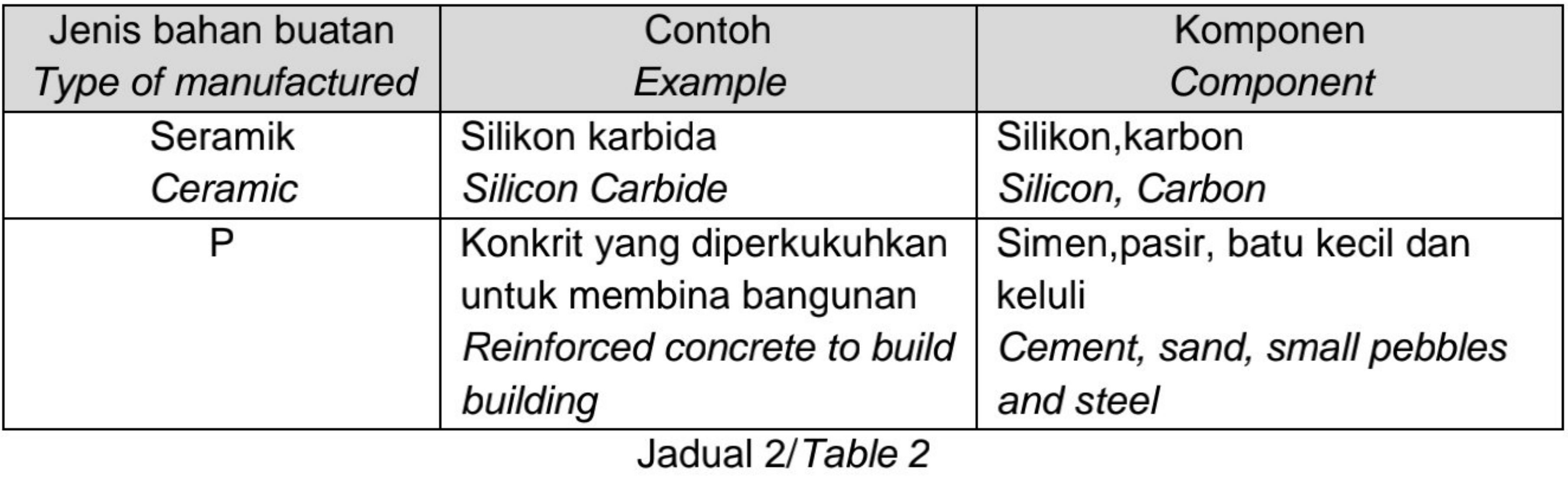
- (a)(i)
Name P.
[1] - (a)(ii)
State the use of reinforced concrete.
[1] - (b)
What is the advantage of using reinforced concrete compared to concrete?
[1] - (c)(i)
Name the category of ceramic for silicon carbide.
[1] - (c)(ii)
State the use of silicon carbide.
[1]
Drink bottles are usually made of a type of synthetic polymer Z. Diagram 3 shows the structural formula of polymer Z: repeating unit [-CH(H)-C(CH3)(H)-]n, i.e. -CH2-CH(CH3)-.
Medium6 marks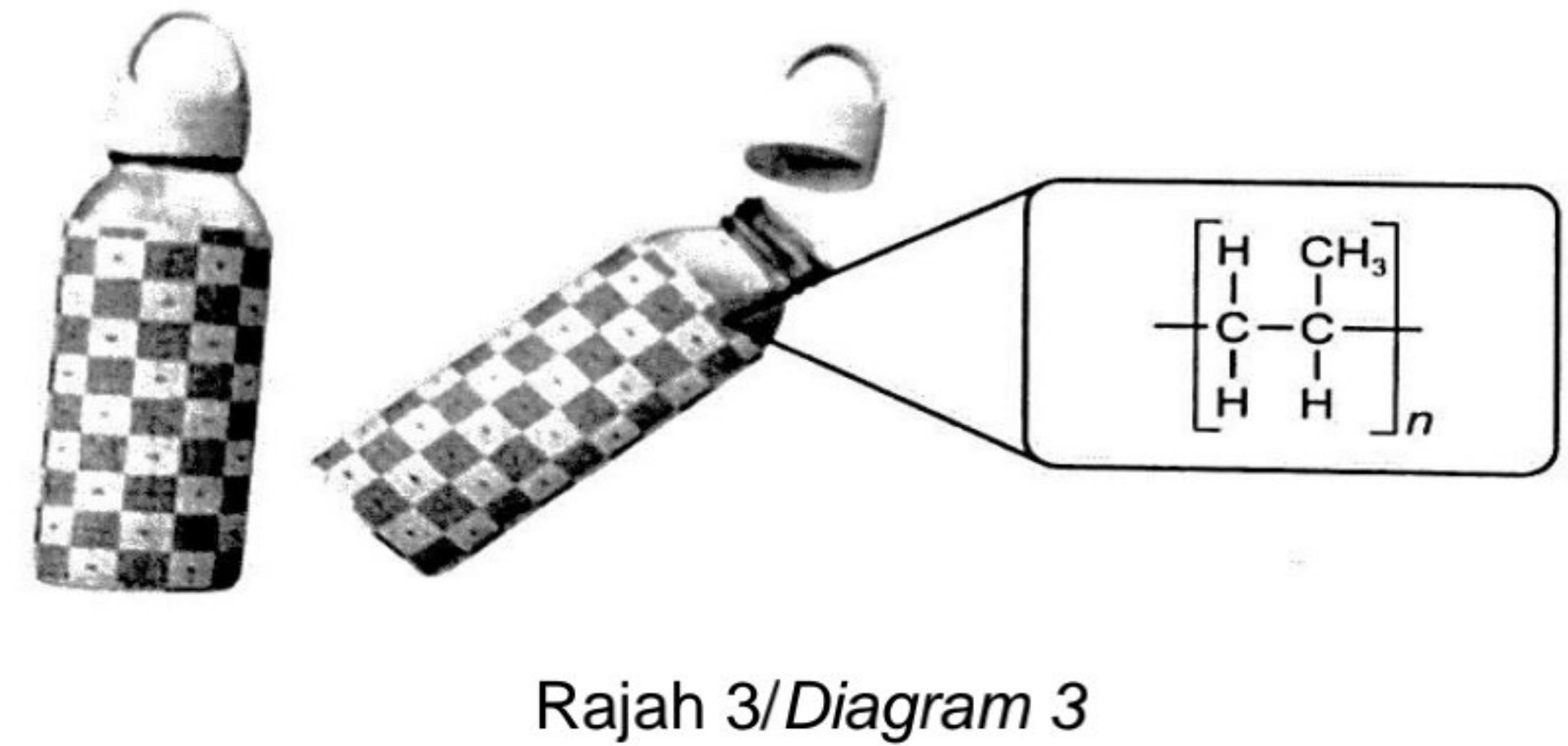
- (a)
What is the meaning of polymer?
[1] - (b)
Draw and name the structural formula of the basic unit that forms polymer Z.
[2] - (c)
Name the type of polymerisation that produces polymer Z.
[1] - (d)(i)
The waste from polymer Z can be easily recyclable. Name the type of polymer Z.
[1] - (d)(ii)
State one property of polymer Z that makes it easily recyclable.
[1]
Diagram 4.1 shows some examples of cosmetic ingredients involving nanotechnology.
Medium7 marks- (a)(i)
What is nanotechnology?
[1]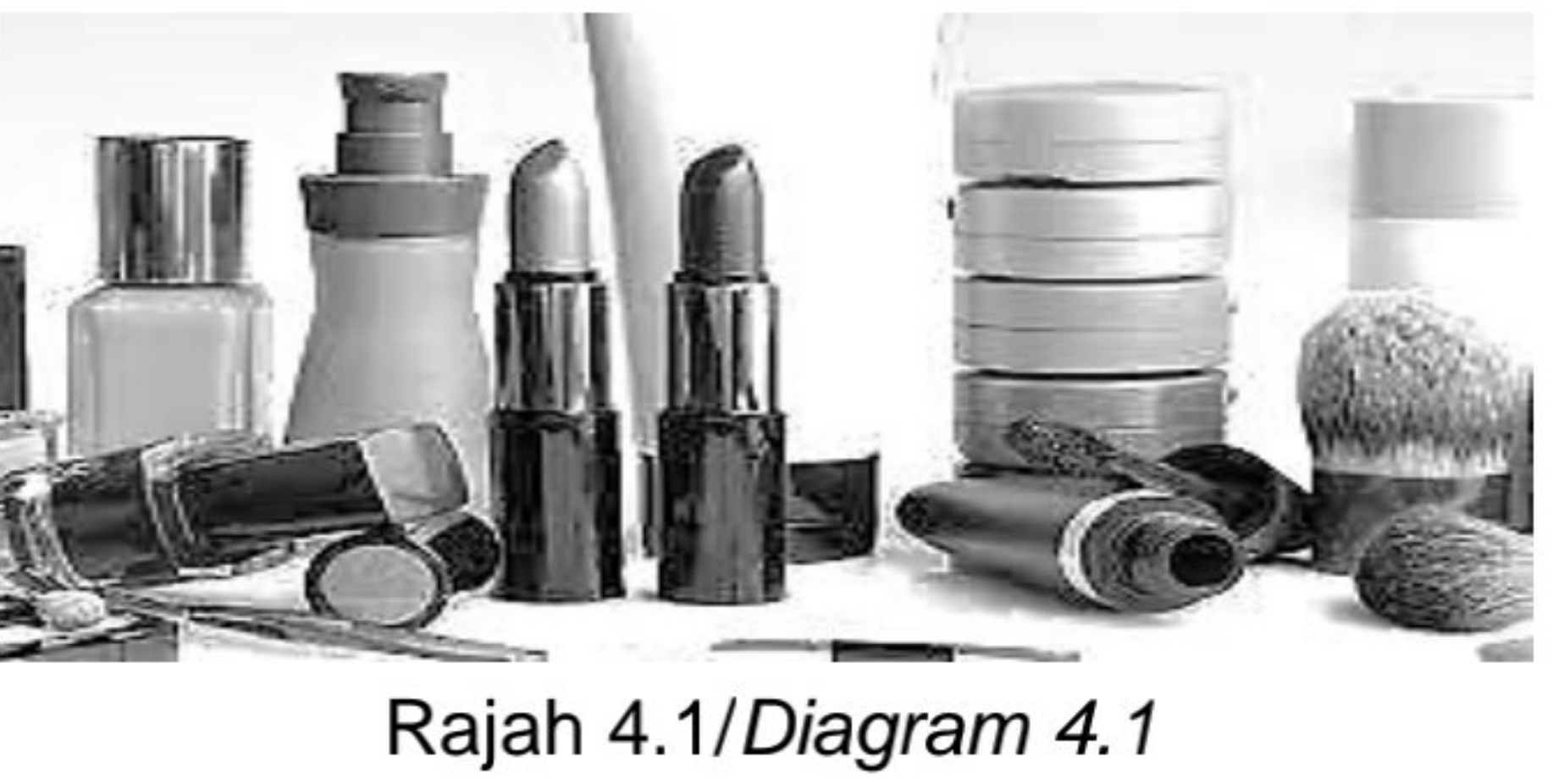
- (a)(ii)
State one advantage of the application of nanotechnology for cosmetics in Diagram 4.1.
[1] - (b)
The table below shows two different types of socks. Type A: regular socks that do not incorporate nanotechnology; becomes moist when exposed to liquid; emits foul smell after use. Type B: regular socks that incorporate nanotechnology; waterproof; does not emit foul odor after use. Based on the information in Table 4, which socks are more suitable for athletes to use? Explain your answer.
[2]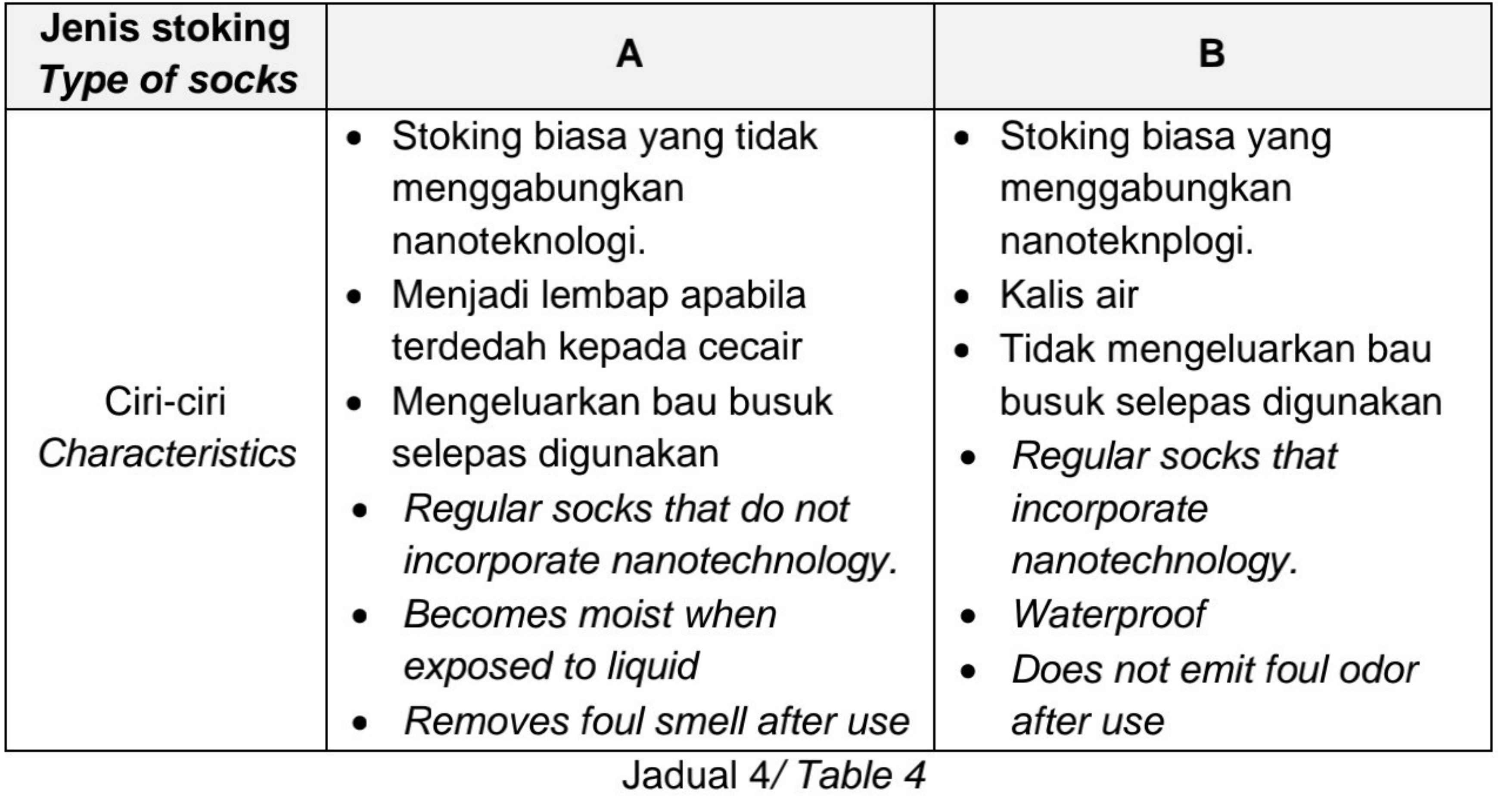
- (c)
Diagram 4.2 shows a campaign related to a healthy lifestyle carried out by the Malaysian Ministry of Health ("7 smart steps to reduce sugar"). Suggest an alternative sweetener that can replace sugar for diabetics.
[1]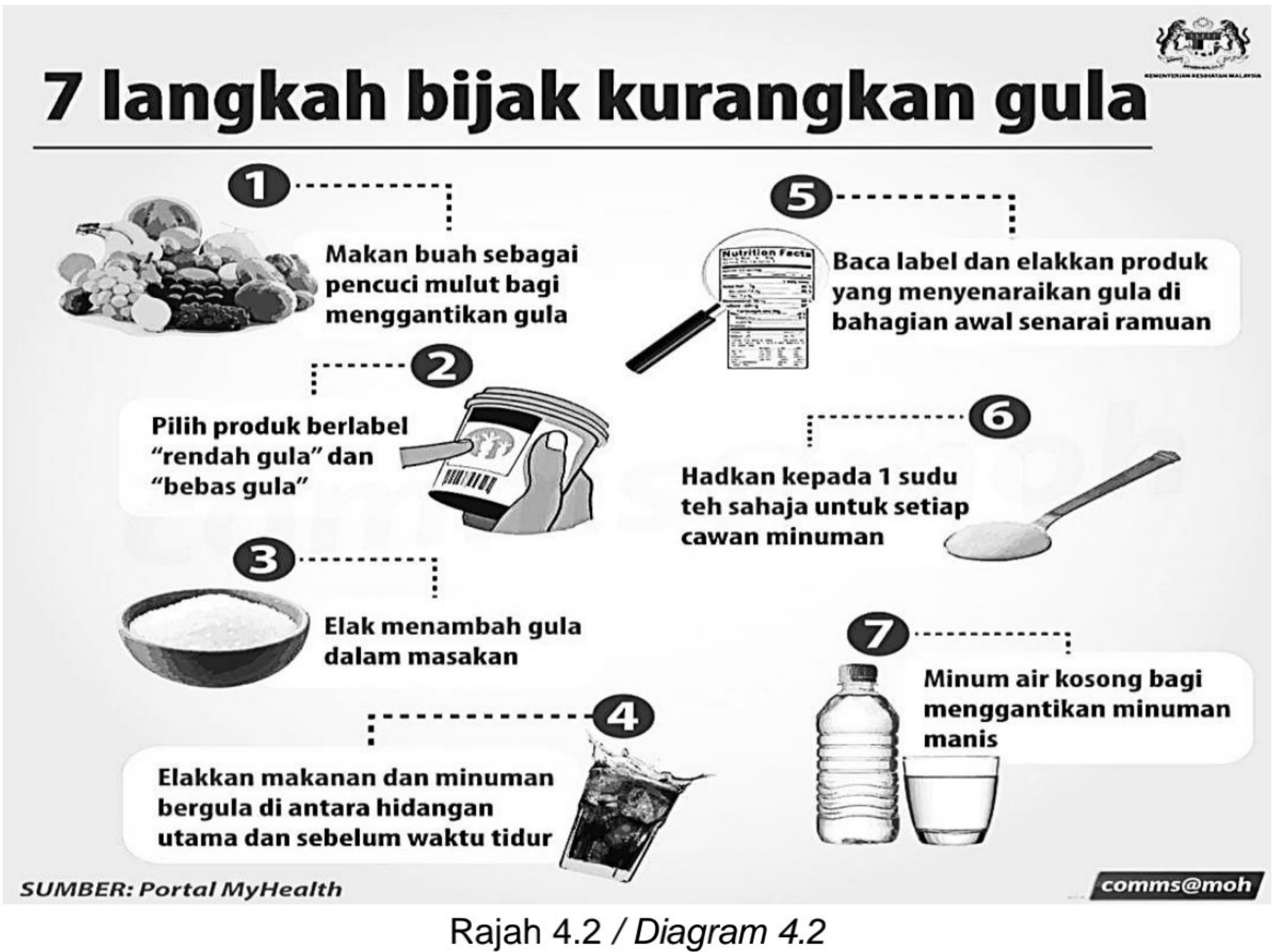
- (d)(i)
Food additives are natural or synthetic substances added to food to prevent spoilage or improve its appearance, taste and texture. Diagram 4.3 shows an example of teenagers' favourite foods (burger, fries, drink). Sodium nitrate is an example of a food additive added to burger meat. State the type of food additive for sodium nitrate.
[1]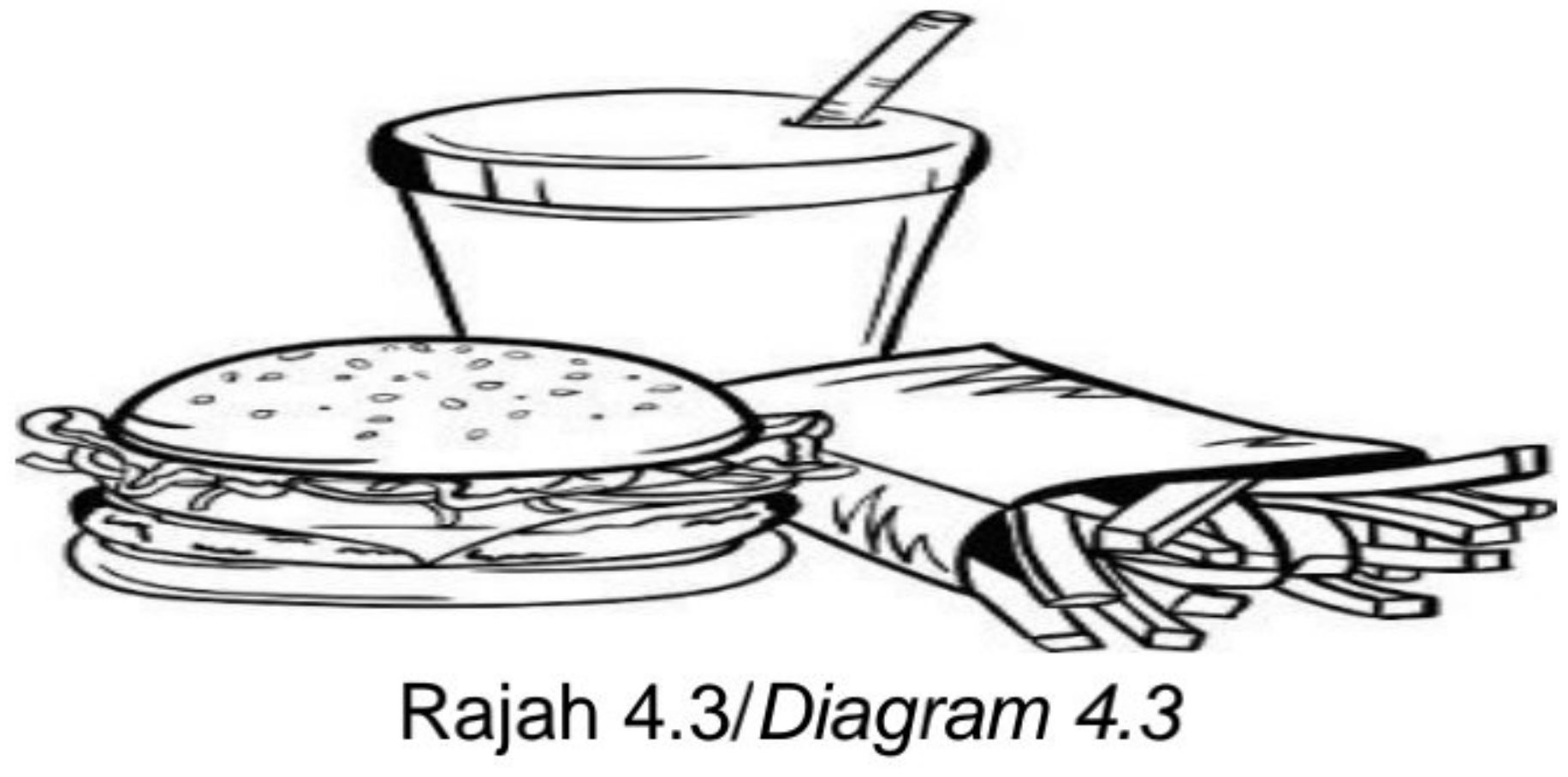
- (d)(ii)
Explain how sodium nitrate acts as a food additive?
[1]
Compound X consists of the elements carbon, hydrogen and oxygen.
Medium8 marks- (a)
What is an element?
[1] - (b)
Complete the table below to determine the empirical formula of a compound X. [Relative atomic mass: H = 1, C = 12, O = 16]. Percentage (%): C 48.65, H 8.11, O 43.24. Rows to complete: number of moles of atoms, mole ratio, simplest mole ratio of atom. Empirical formula: ......
[3]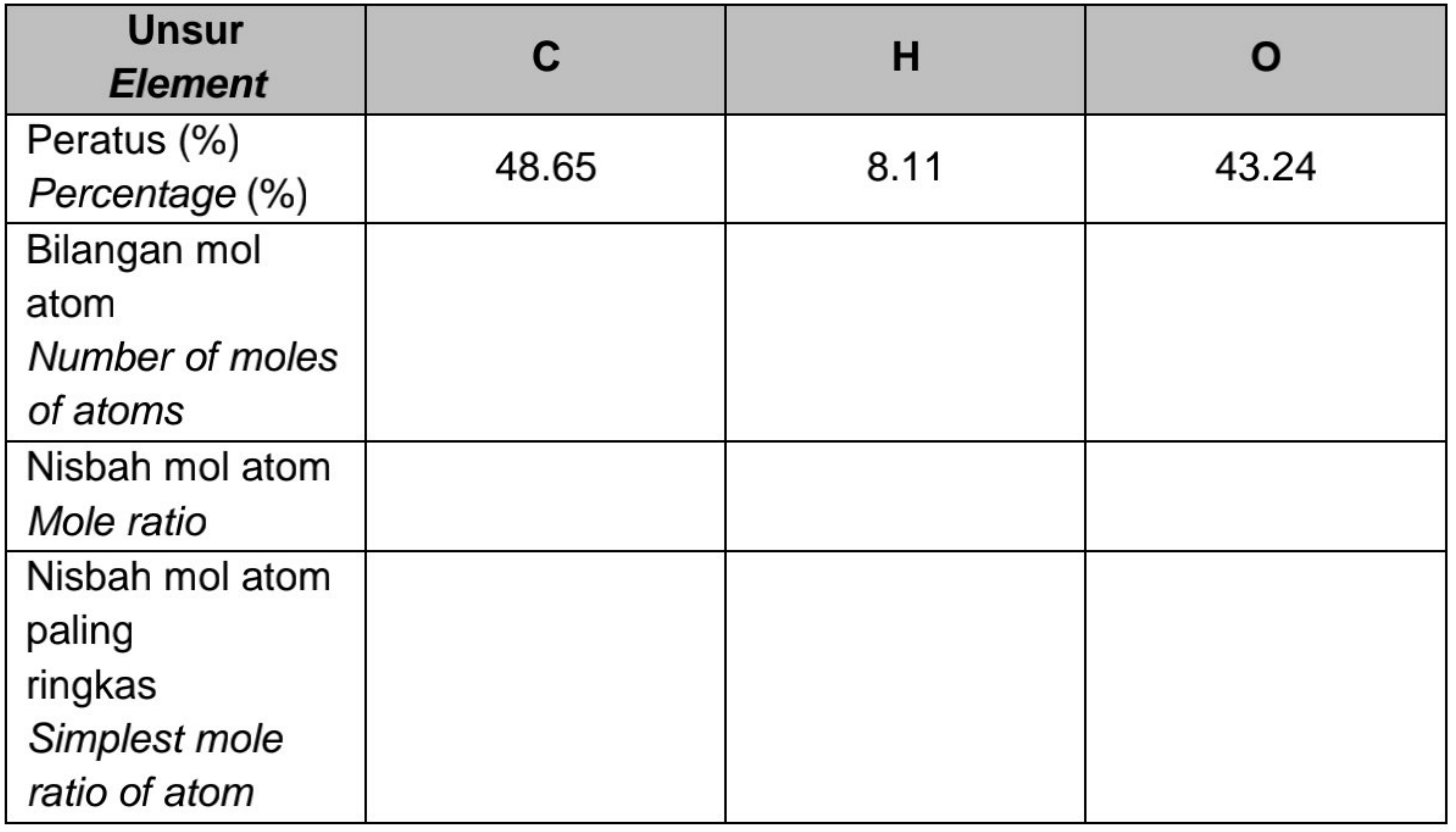
- (c)(i)
An iron nail that is exposed to air and water to form rust, hydrated iron(III) oxide, Fe2O3.H2O. Chemical equation: xFe + yO2 + zH2O → 2Fe2O3.H2O. Balance the chemical equation for the reaction by determine the value of x, y and z.
[2] - (c)(ii)
State the number of moles of iron that is required to produce 1 mole of hydrated iron(III) oxide.
[1] - (c)(iii)
Calculate the relative formula mass of hydrated iron(III) oxide. [Relative atomic mass: H = 1, O = 16, Fe = 56]
[1]
Table 6 shows the electron arrangements of atoms P, Q, R and S: P 2.4; Q 2.8.1; R 2.8.2; S 2.8.7.
Medium9 marks- (a)(i)
Which pair of atoms forms a compound by transferring electrons?
[1]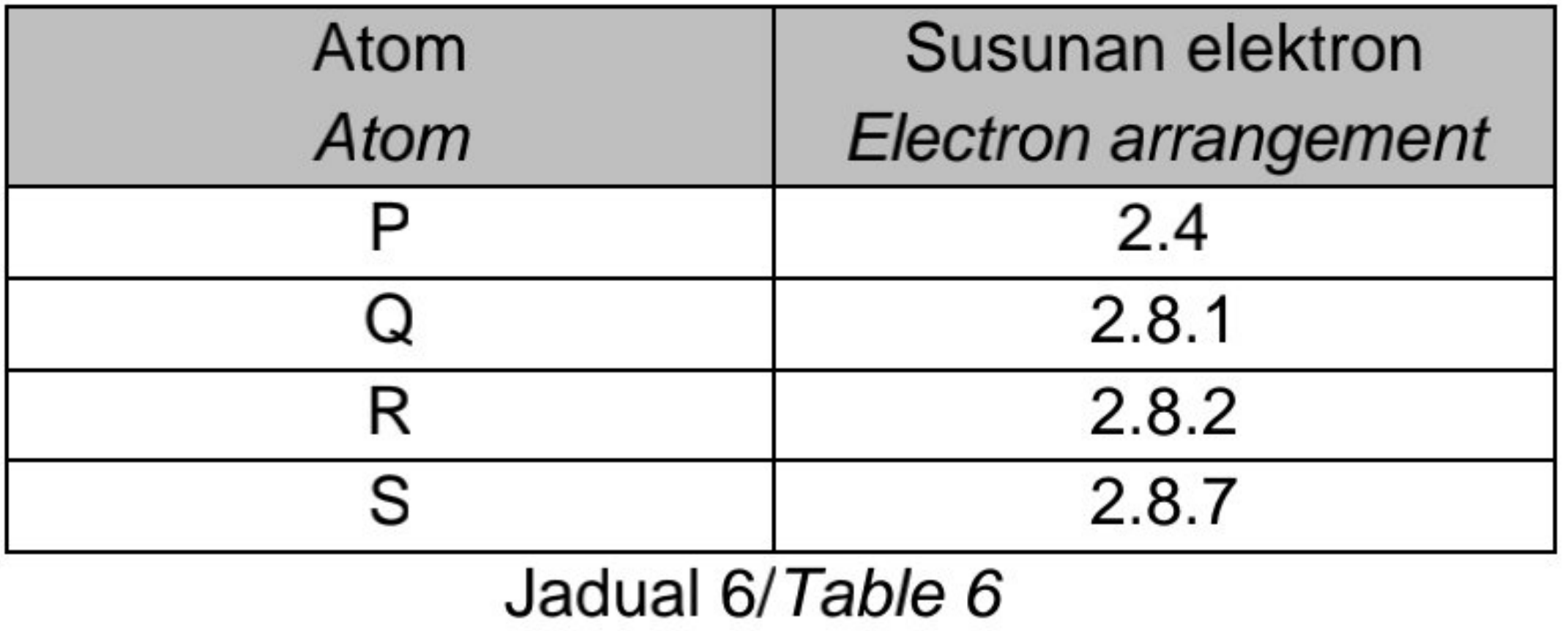
- (a)(ii)
Write the chemical formula of the compound formed in a(i).
[1] - (a)(iii)
Compound formed in a(i) has high melting point. Explain your answer.
[2] - (b)
Atoms of carbon (12/6 C) and hydrogen (1/1 H) are unstable. They react to form a covalent compound which is more stable. Draw the Lewis structure of the formation for the molecule formed in the space below.
[2]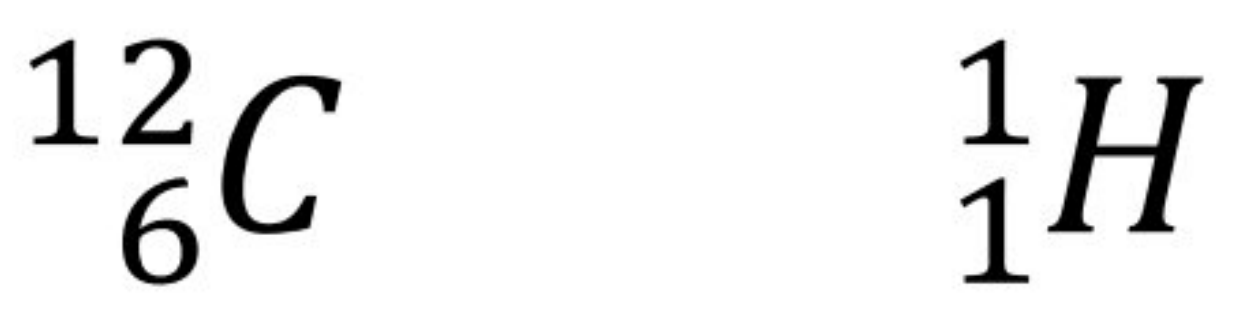
- (c)
Explain the formation of dative bond in ammonium ion, NH4+.
[3]
Diagram 7 shows alcohol P, C4H9OH straight line undergoes reaction I (with acidified KMnO4) to form compound Q. Alcohol P and compound Q together undergo reaction II to form compound R.
Medium10 marks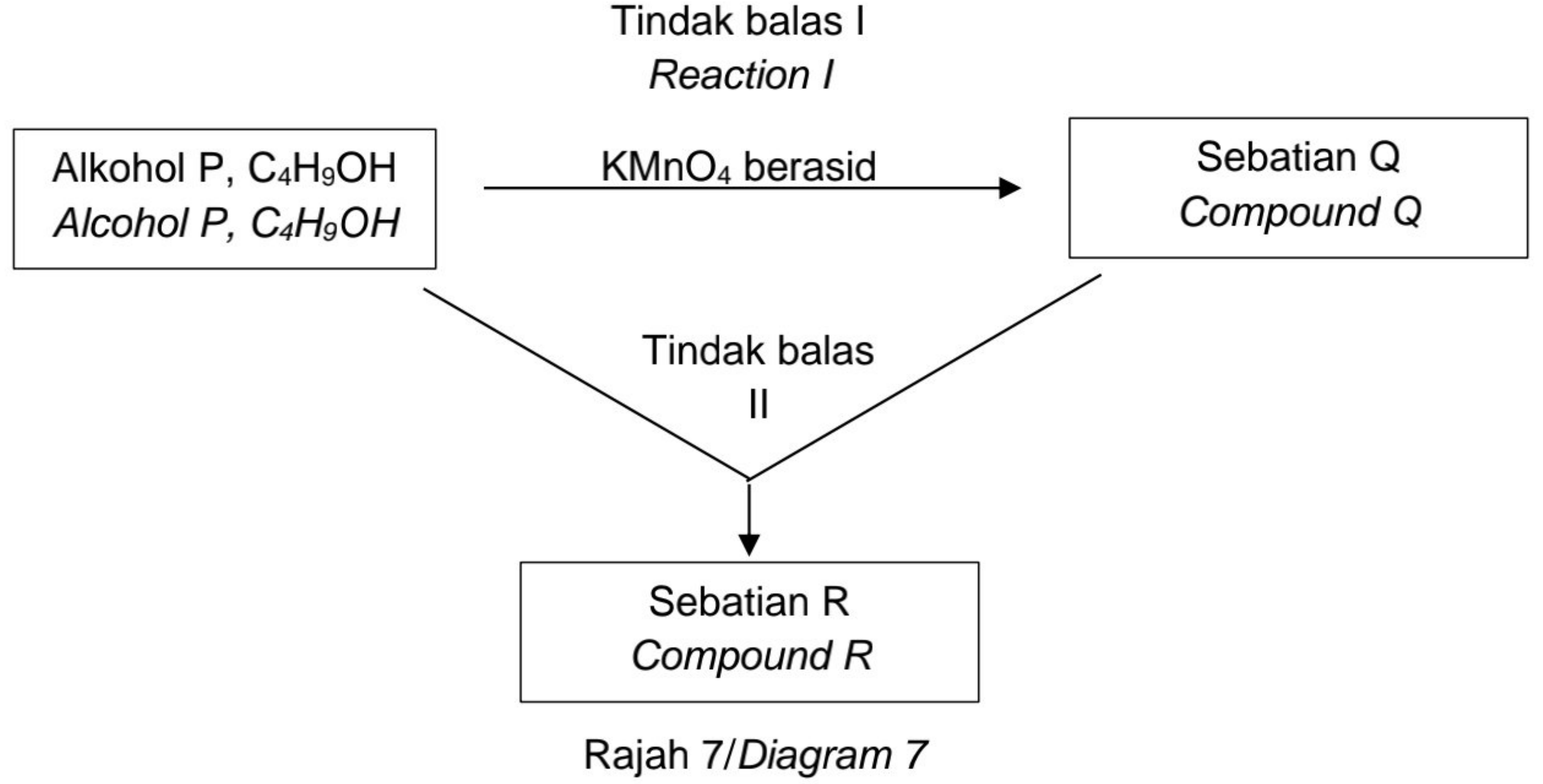
- (a)
State the name for alcohol P, C4H9OH.
[1] - (b)
Draw the structural formulae for two isomers of alcohol P, C4H9OH.
[2] - (c)(i)
State the observation for reaction I.
[1] - (c)(ii)
Name the functional group of compound Q.
[1] - (d)
When compound Q reacts with magnesium, colourless gas is produced. Describe the method to test the presence of this gas.
[2] - (e)(i)
Name reaction II.
[1] - (e)(ii)
Write the balanced chemical equation for reaction II.
[2]
Experiment is carried out to determine the heat of neutralisation between strong acid and strong alkali. 50 cm3 of 0.5 mol dm-3 sodium hydroxide solution is poured into a plastic cup and the initial temperature is recorded. 50 cm3 of 0.5 mol dm-3 nitric acid is then poured into the cup containing the sodium hydroxide solution. The mixture is stirred. The temperature raises by 3 °C. [Specific heat capacity of the solution = 4.2 J g-1 °C-1]
Medium10 marks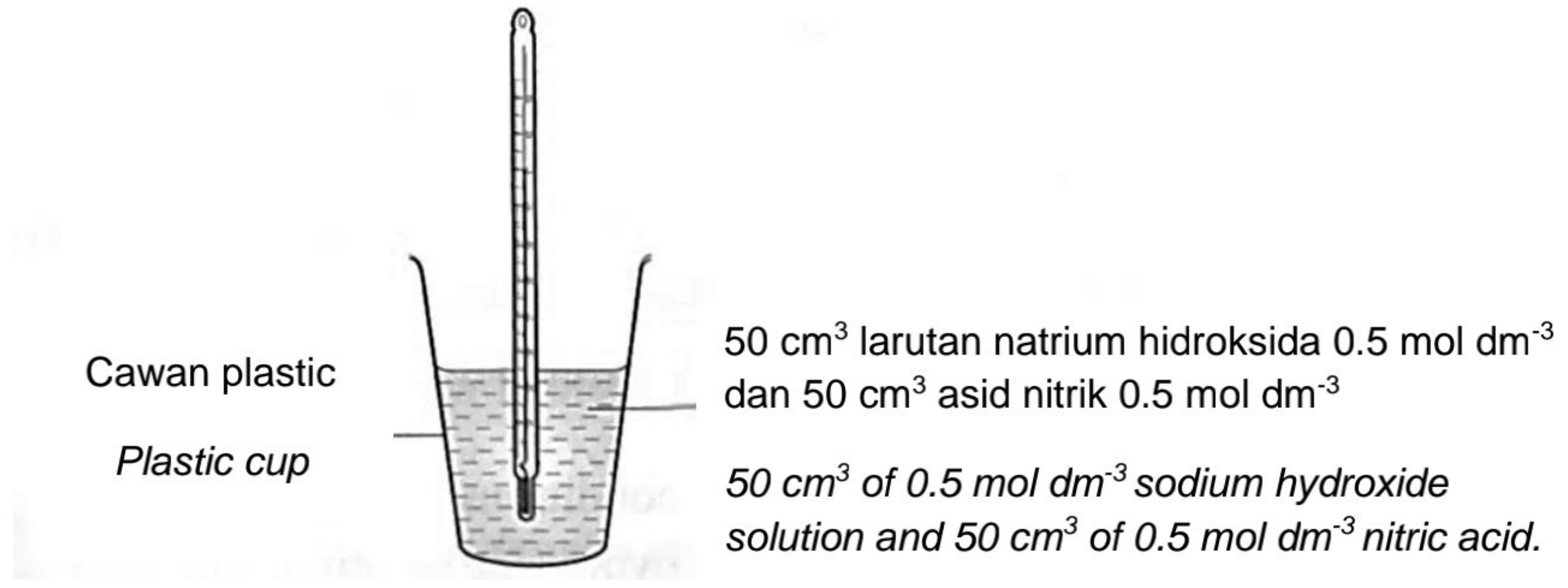
- (a)
What is the meaning of heat of neutralisation of the experiment?
[1] - (b)(i)
Calculate the number of moles of sodium hydroxide that react with nitric acid.
[1] - (b)(ii)
Calculate the heat released in the experiment.
[1] - (b)(iii)
Calculate the heat of neutralisation in this reaction.
[1] - (c)
Write the thermochemical equation for the reaction in the experiment.
[2] - (d)
Construct energy level diagram for the reaction.
[2] - (e)
State two information about the reaction which can be obtained from the above energy level diagram.
[2]
Section B
Answer any one question from Section B (Question 9 or 10).
Medium20 marks- (a)(i)
Diagram 9 shows cellular respiration, the ultimate source of energy in human beings. The food that we consume is converted into energy in mitochondria. During respiration, oxygen is reduced whereas the glucose is oxidised. Reactants: C6H12O6 + 6O2. Products: 6CO2 + 12H2O + Energy (ATP). Based on Diagram 9, state the name of the reaction that takes place for cellular respiration?
[1]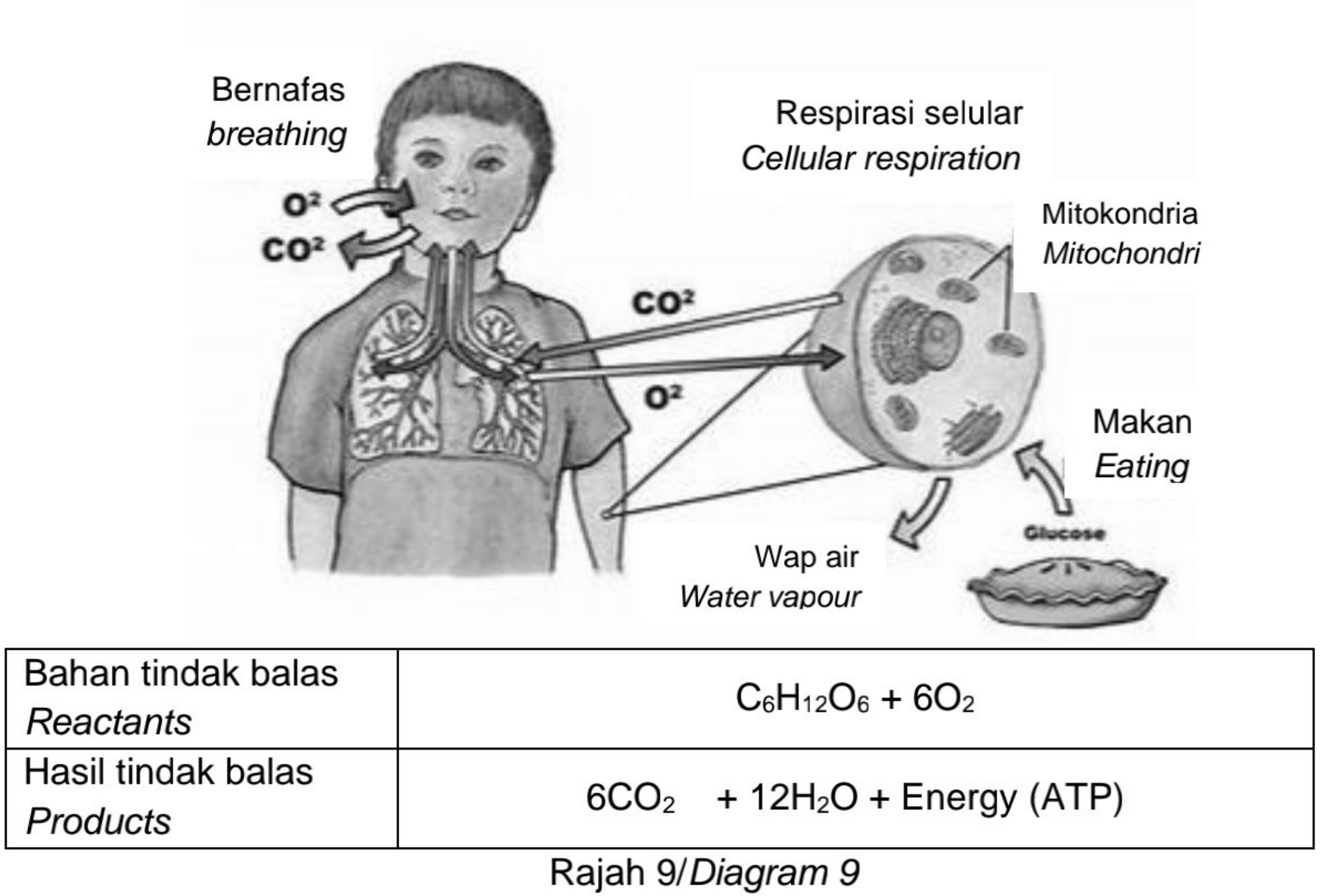
- (a)(ii)
What is the function of oxygen gas and explain why? Calculate the mass of food intake to produce 1000 cm3 of carbon dioxide gas? [Molar volume of gas at room conditions = 24 dm3 mol-1]
[4] - (b)(i)-(ii)
Table 9 shows the observation for the reaction between metal X with two different salt solutions: copper(II) sulphate - brown deposit is formed; zinc sulphate - no change. Salt X sulphate and salt X chloride are insoluble salts. Given standard electrode potentials: Sn2+ + 2e ⇌ Sn, E° = -0.14 V; X2+ + 2e ⇌ X, E° = -0.13 V; Cu2+ + 2e ⇌ Cu, E° = +0.34 V; Zn2+ + 2e ⇌ Zn, E° = -0.76 V. (i) Identify metal X and calculate the theoretical voltage of the cells using standard electrode potential value of the half-cells for the reaction between metal X and copper(II) sulphate solution. (ii) Write the half equation for oxidation reaction, half equation for reduction and the overall ionic equation for this reaction. [5 marks for (i) and (ii) together]
[5]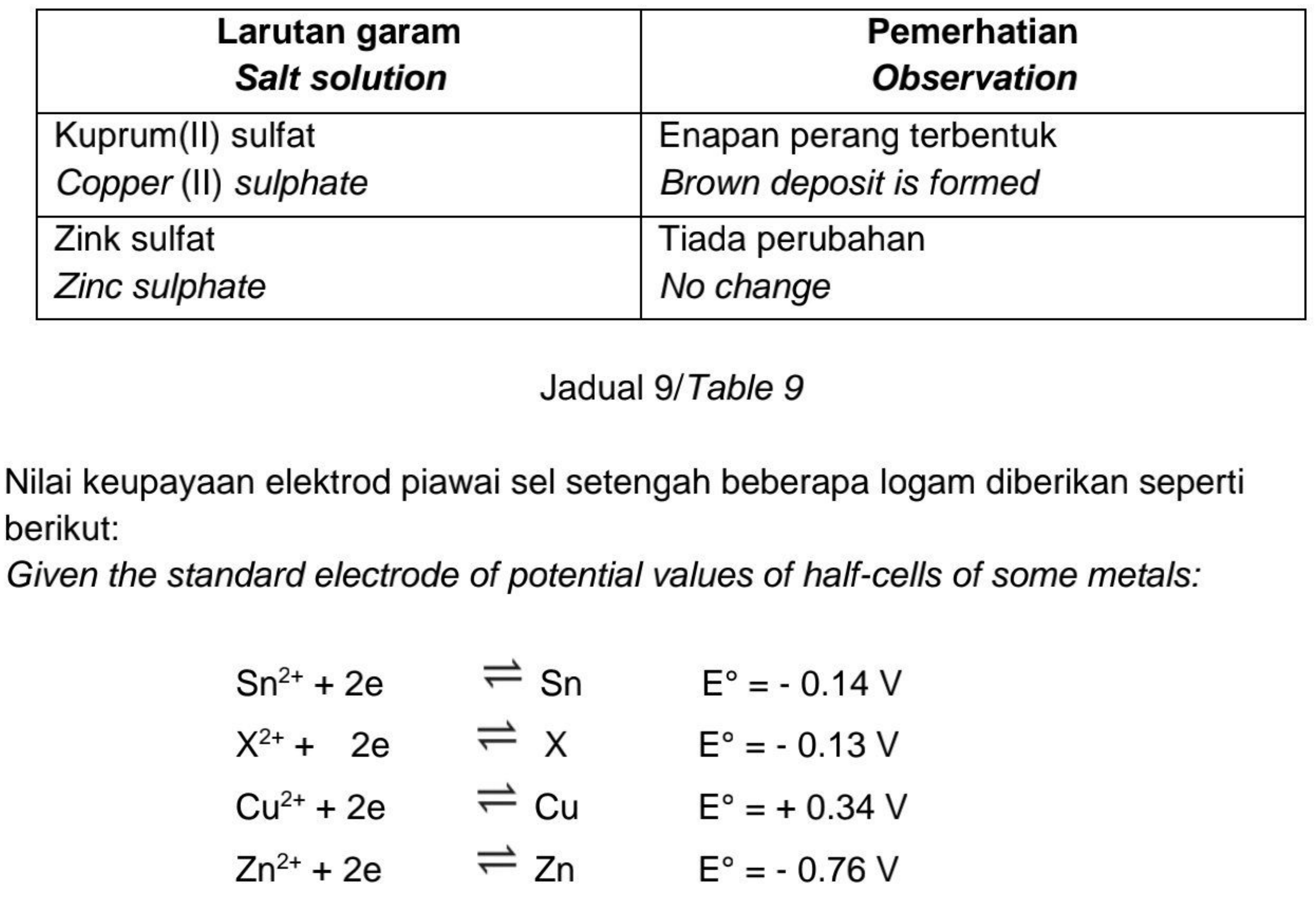
- (b)(iii)
Arrange the ions in order of increasing strength of the oxidizing agent. Arrange the atoms in order of increasing strength of the reducing agent.
[2] - (b)(iv)
Next, explain why there are differences in observation obtained in the Table 9.
[8]
Answer any one question from Section B (Question 9 or 10).
Medium20 marks- (a)
Table 10.1 shows the pH values of ammonia and sodium hydroxide of the same concentration: ammonia 0.5 mol dm-3, pH 11.0; sodium hydroxide 0.5 mol dm-3, pH 14.0. Explain why the pH values of the two alkaline are different.
[4]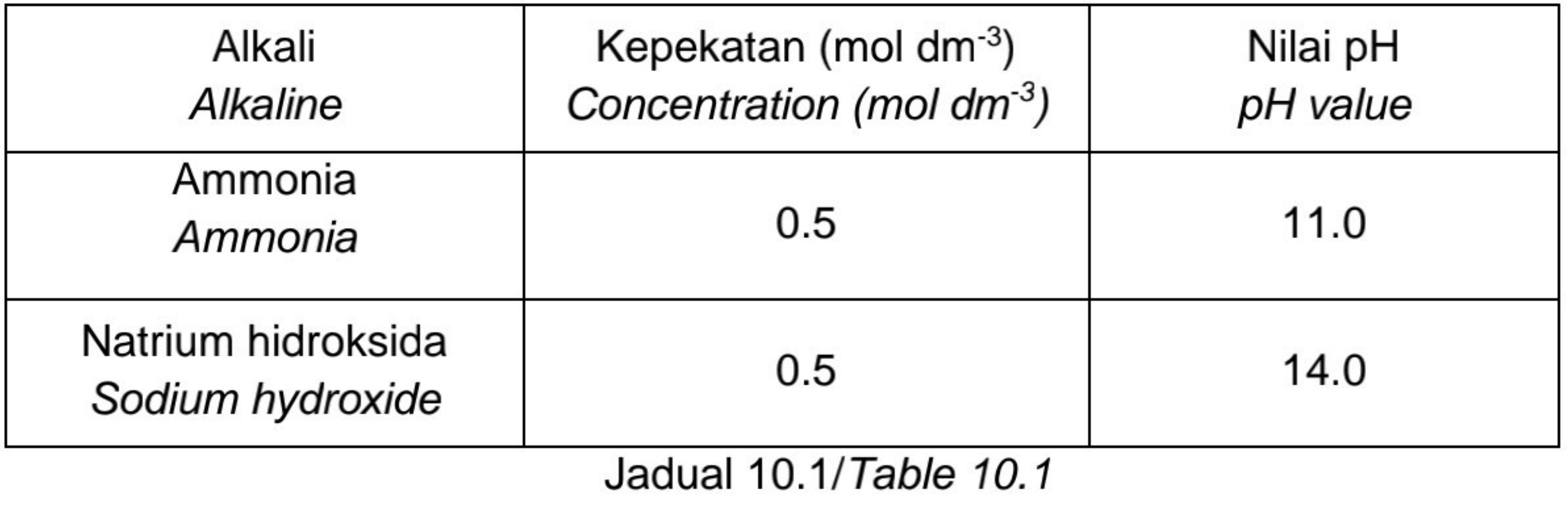
- (b)(i)
Table 10.2 shows the results of titration between 1.0 mol dm-3 sulphuric acid and 25.0 cm3 sodium hydroxide solution (final/initial burette readings: I 9.90/0.00; II 19.90/9.90; III 30.00/19.90). Write the chemical equation for the reaction between sodium hydroxide and sulphuric acid.
[2]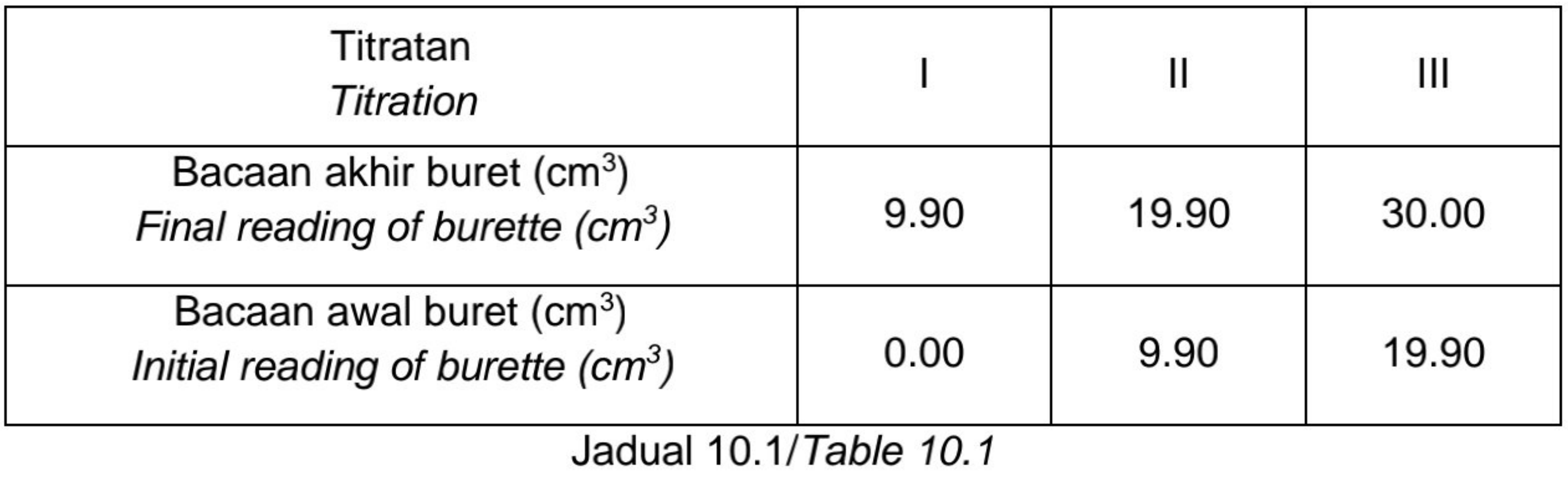
- (b)(ii)
Based on Table 10.2, determine the average volume of sulphuric acid used and hence calculate the molarity of sodium hydroxide solution.
[4] - (c)
The sting of a jelly-fish is alkaline and caused pain. Suggest one substance that can apply to the skin to release the pain without causing further injury. Explain your answer.
[2] - (d)(i)
The equation shows the reaction between magnesium and acid X. Acid X is a diprotic acid. Mg + acid X → Salt Y + H2. Suggest acid X and identify salt Y and write the chemical equation for the reaction.
[4] - (d)(ii)
State the type of Y salt.
[1] - (d)(iii)
100 cm3 of 1.0 mol dm-3 sulphuric acid is reacted with excess magnesium powder. Calculate the volume of hydrogen gas released at room condition. [Molar volume of gas at room condition: 24 dm3 mol-1]
[3]
Section C
Answer all questions from Section C.
Medium20 marks- (a)(i)
Table 11 shows the information obtained from two sets of experiments that investigate the effect of concentration on the rate of reaction between zinc and nitric acid. Set I: excess zinc powder + 50 cm3 nitric acid 0.4 mol dm-3, 30 °C. Set II: excess zinc powder + 50 cm3 nitric acid 0.2 mol dm-3, 30 °C. Write a chemical equation for the reaction and calculate the maximum volume of hydrogen gas collected in set II. [Relative atomic mass: Zn = 65; 1 mol of any gas occupies 24 dm3]
[5]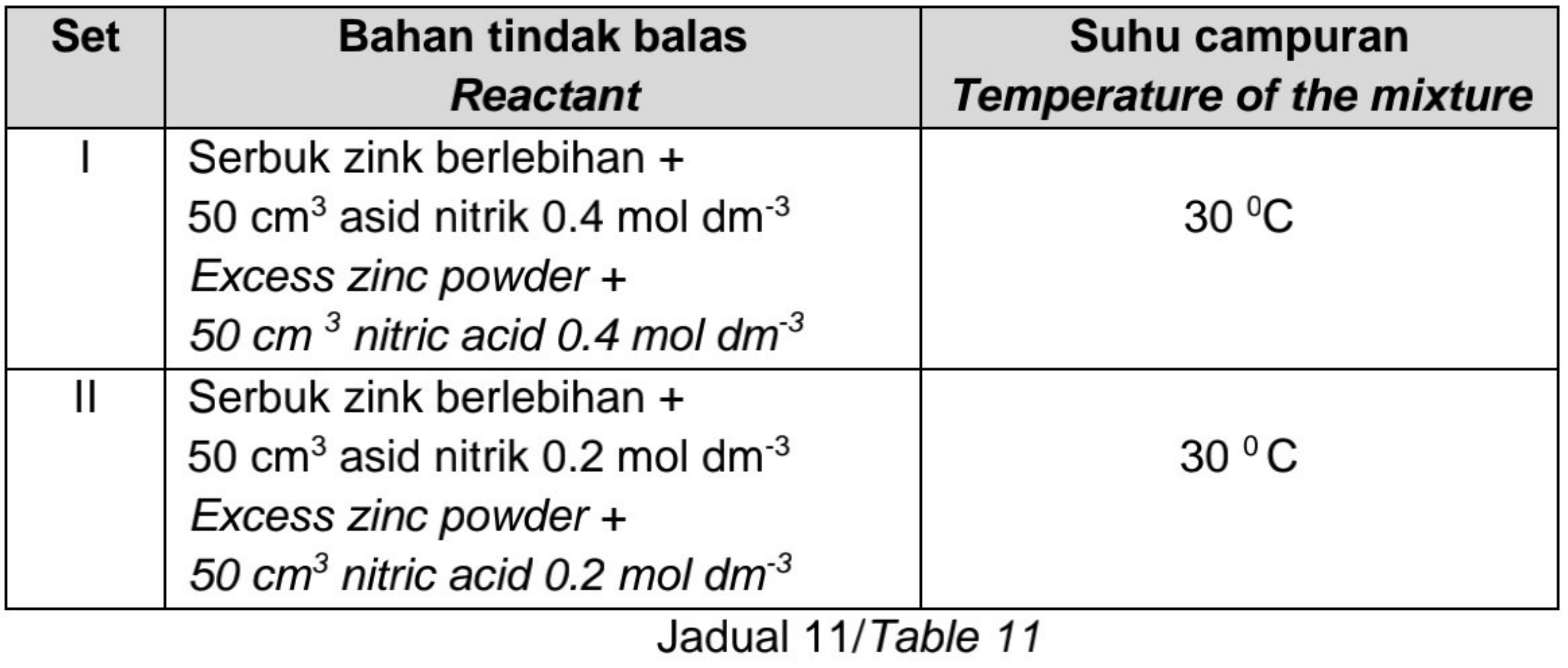
- (a)(ii)
Sketch the graph of volume of hydrogen gas produced against time for both sets of experiment.
[3] - (a)(iii)
Based on the above table, compare the rate of reaction between set I and set II.
[2] - (b)
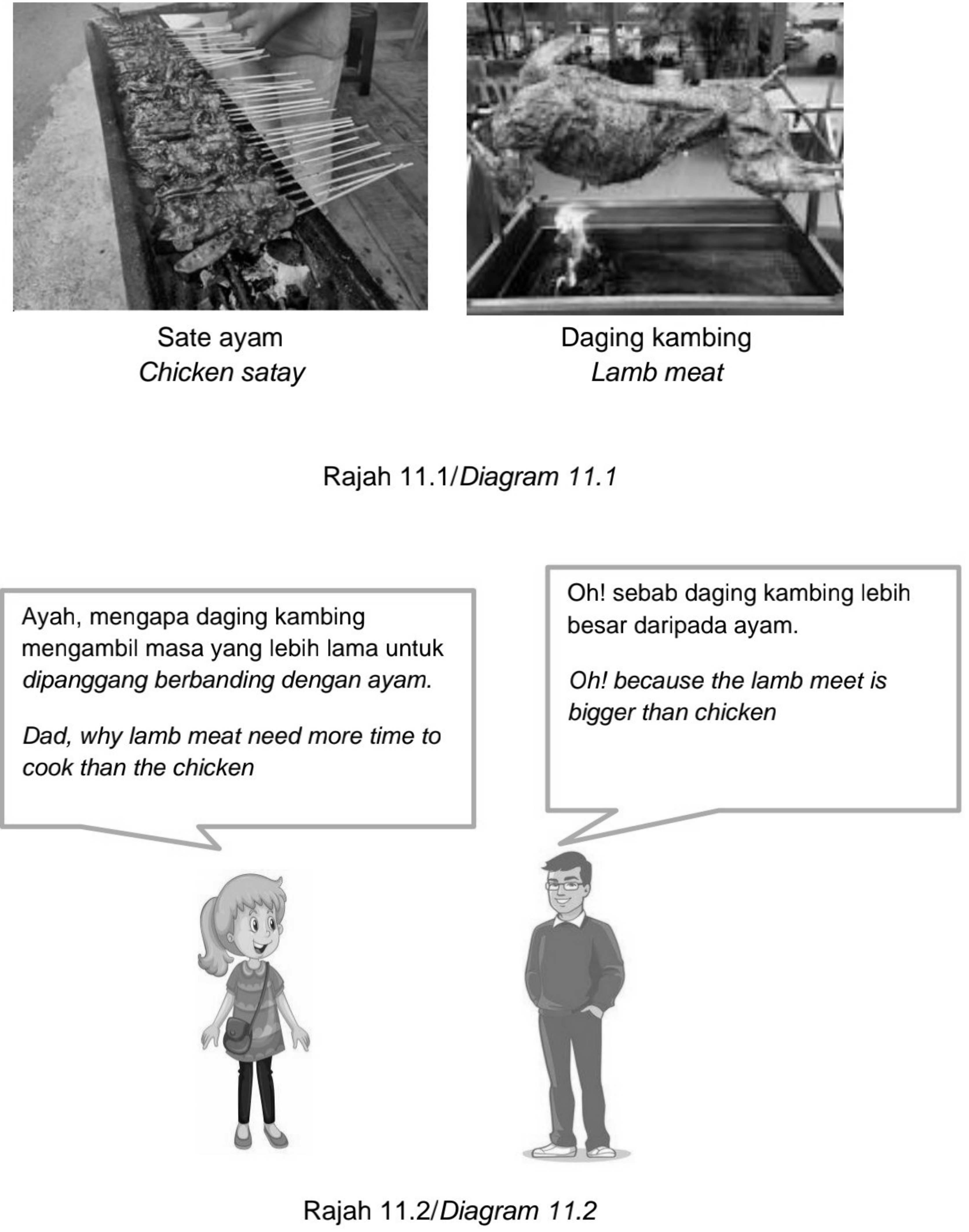
Diagram 11.1 shows chicken satay and lamb meat being grilled. Diagram 11.2: a girl asks "Dad, why lamb meat need more time to cook than the chicken?" and the father answers "Oh! because the lamb meat is bigger than chicken". Referring to the above situation, describe an experiment using the factor that affects the rate of reaction between calcium carbonate and hydrochloric acid. In your description, include: a labeled diagram; procedure of the experiment; ionic equation.
[10]