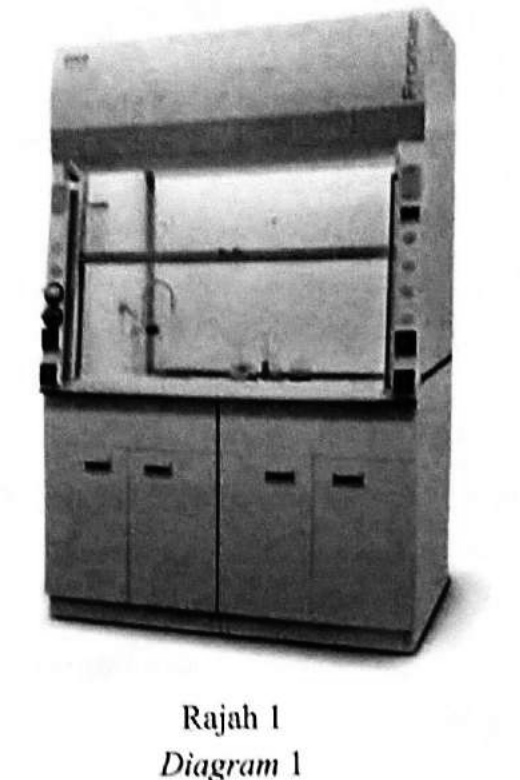
Diagram 1 shows a safety equipment in the laboratory. What is the function of this equipment?
Easy
In the field of chemistry, the unit mole is used to measure the amount of substance. According to the IUPAC, one mole of substance contains a fixed value known as the Avogadro constant, N_A. Which of the following value is the Avogadro number?
Easy
Which of the following is the property of ionic compound?
Easy
Which of the following is the unit for rate of reaction?
Medium
Which of the following is true about reduction reaction?
Medium
Which statement exactly explains the meaning of heat of displacement?
Easy
Which statement explains the effectiveness of cleansing action of detergent?
Medium
A silver atom has 47 protons and its nucleon number is 108. A silver ion, Ag⁺ is formed when a silver atom donates 1 electron. How many neutrons in a silver ion, Ag⁺?
Medium
Chlorine is more reactive than bromine because I chlorine exists as diatomic gas; II valence shell of bromine is further from nucleus compared to chlorine; III chlorine has a stronger nucleus attraction force towards the electrons; IV Van der Waals forces between bromine molecule are stronger
Medium
Which substance has low degree of ionisation when dissolves in water?
Easy
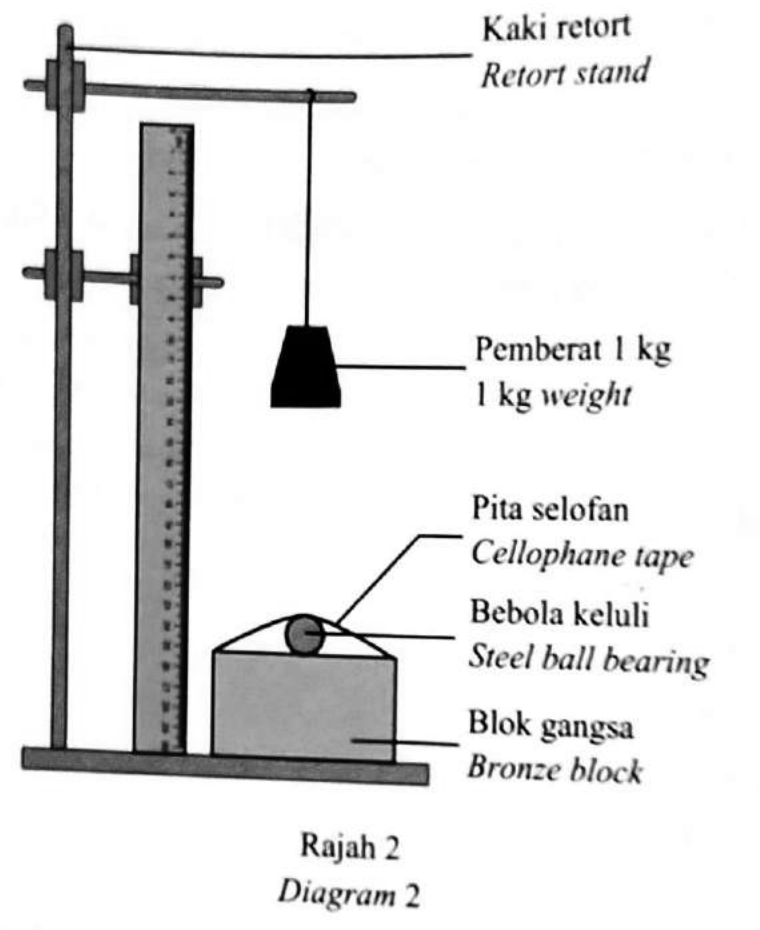
Diagram 2 shows a steel ball bearing on the surface of the bronze block using a cellophane tape; a 1 kg weight is released onto the steel ball bearing and the diameter of the dent formed on the surface of the bronze block is recorded. Which of the following block will form a deeper dent as compared to bronze block?
Medium
Table 1 shows boiling points for 3 alkanes: methane -161.6 °C, ethane -89 °C, propane -42 °C. The boiling point of methane is the lowest. Which statement exactly explains this phenomenon?
Medium
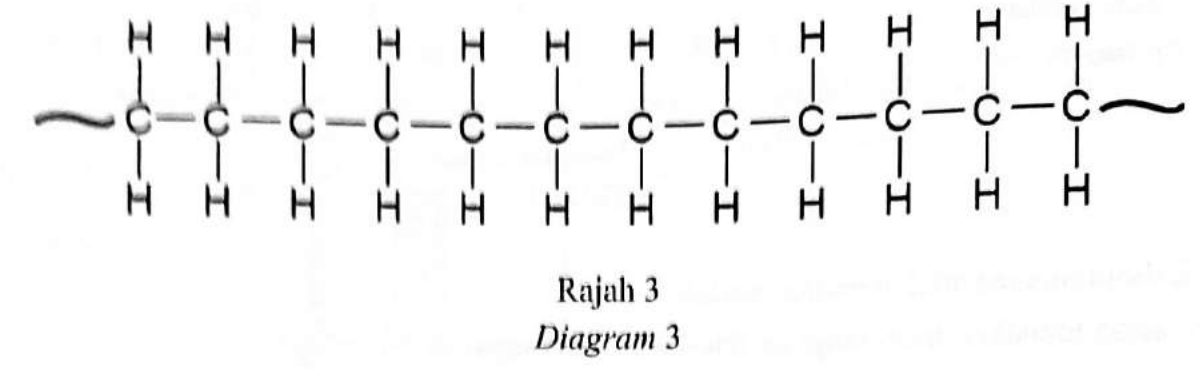
Diagram 3 shows the structural of polythene. How many types of monomers are needed to produce this polymer?
Medium
Statements: Discovered negatively-charged particles called electrons; Atom is a positively-charged sphere with several electrons in it. The statements above show the information of an atomic structure model. Which scientist identified it?
Easy
Argon is Group 18 element. Which of the following is the use of argon in daily life?
Easy
Which of the following reagent is used to test the presence of cations in the salt?
Easy
An alloy is a mixture of two or more elements where the main element is a metal. Scientist changes the elemental composition to produce alloys with different properties. Which of the following elements are found in bronze?
Easy
Which of the following is the molecular formula for butanol?
Medium
Which of the following is the illustration of thermoplastic polymer?
Medium
Chemical equation can be interpreted qualitatively and quantitatively. Which of the following is the balanced chemical equation for the following reaction? Sodium metal reacts with oxygen to form sodium oxide.
Medium
Element P and element Q react to form a covalent compound with formula PQ₂. Which of the following is true? (Electron arrangement of atom P, atom Q)
Medium
What is the yellow precipitate formed when sodium thiosulphate, Na₂S₂O₃ solution reacts with sulphuric acid, H₂SO₄?
Easy
Fe³⁺ ion in solution can be converted to Fe²⁺ ions by adding zinc powder. Which of the following can replace zinc powder in this reaction?
Medium
The following thermochemical equation represents the precipitation reaction between barium ion and sulphate ion. Ba²⁺(aq) + SO₄²⁻(aq) → BaSO₄(s); ΔH = -x kJ mol⁻¹. Which of the following statements is true about the above equation?
Medium
Which of the following statements is correct about fats and oils? I Fats and oils are esters; II Fats and oils are obtained from animal sources; III Fats are solid and oils are liquid at room temperature; IV Unsaturated fats can be converted to saturated fats through the process of oxidation
Medium
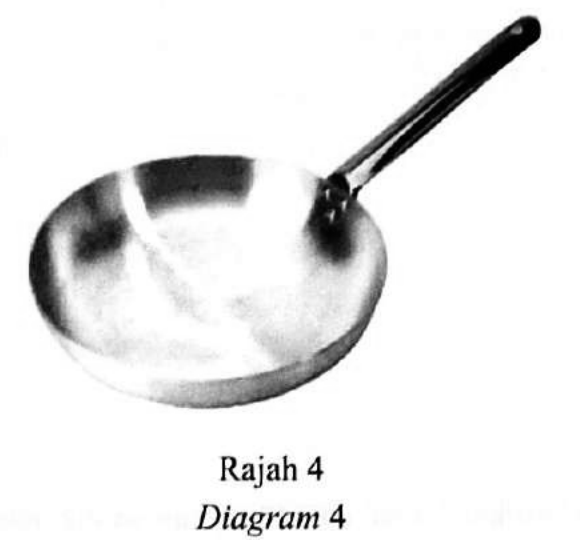
Diagram 4 shows a pot made of stainless steel. Stainless steel contains 73% iron, 1% carbon, 18% chromium and 8% nickel. Calculate the mass of iron required to produce a pot of mass 665 g.
Medium
1.2 g of element X reacts with 0.8 g of element Y to form a compound with the formula XY. What is the relative atomic mass of X? [Relative atomic mass of Y is 16]
Medium
X g of sodium chloride is dissolved in 300 cm³ of distilled water to produce 0.005 mol dm⁻³ of sodium chloride solution. What is X? [Relative atomic mass: Na = 23, Cl = 35.5]
Medium
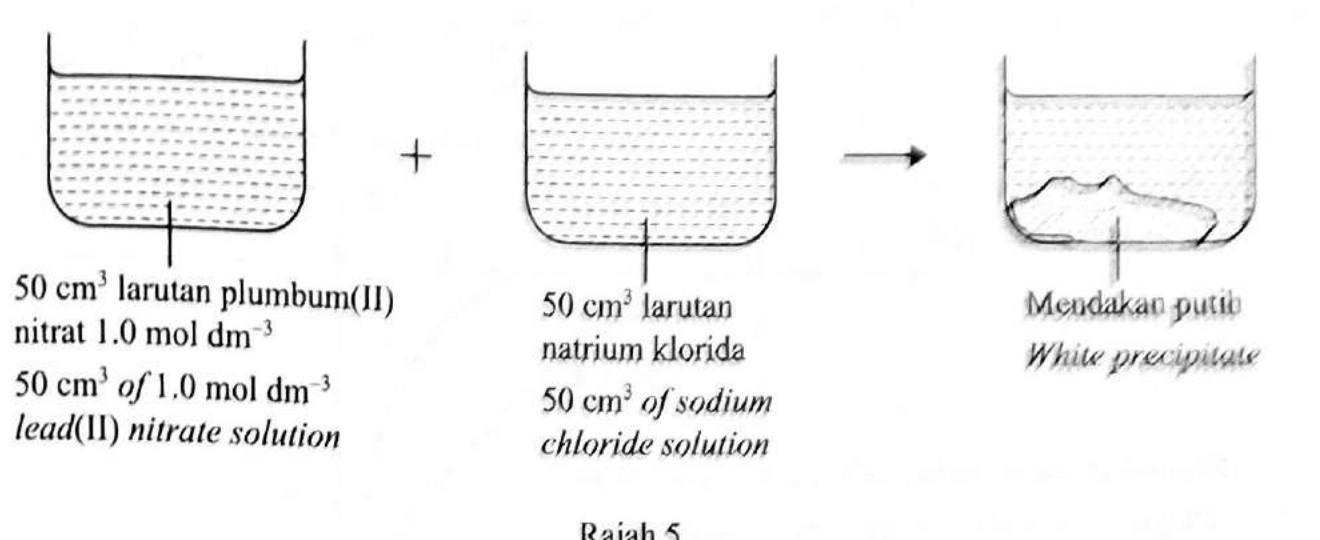
Diagram 5 shows the preparation of lead(II) chloride: 50 cm³ of 1.0 mol dm⁻³ lead(II) nitrate solution is mixed with 50 cm³ of sodium chloride solution to give a white precipitate. What is the concentration of sodium chloride solution needed to react completely with lead(II) nitrate solution?
Medium
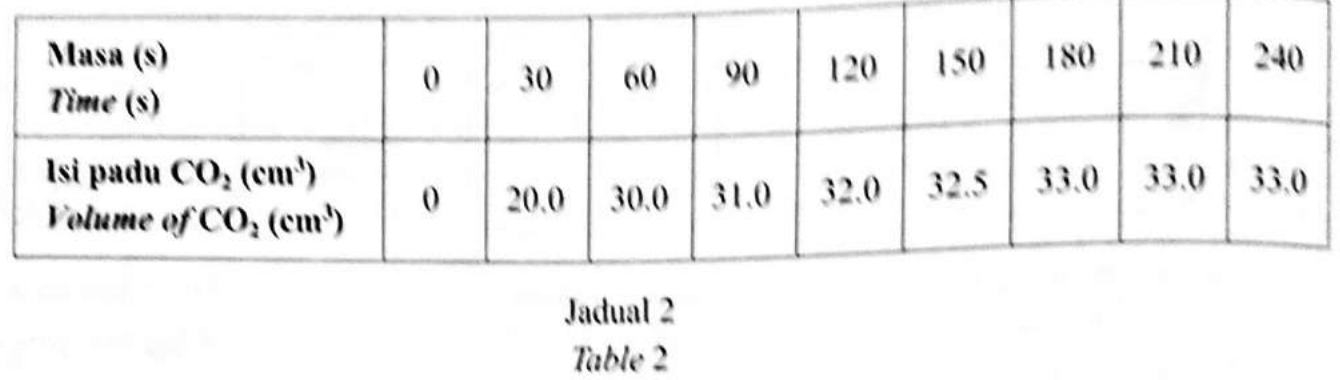
Table 2 shows the volume of carbon dioxide gas collected in an experiment. Time (s): 0, 30, 60, 90, 120, 150, 180, 210, 240; Volume of CO₂ (cm³): 0, 20.0, 30.0, 31.0, 32.0, 32.5, 33.0, 33.0, 33.0. What is the overall average rate of reaction?
Medium
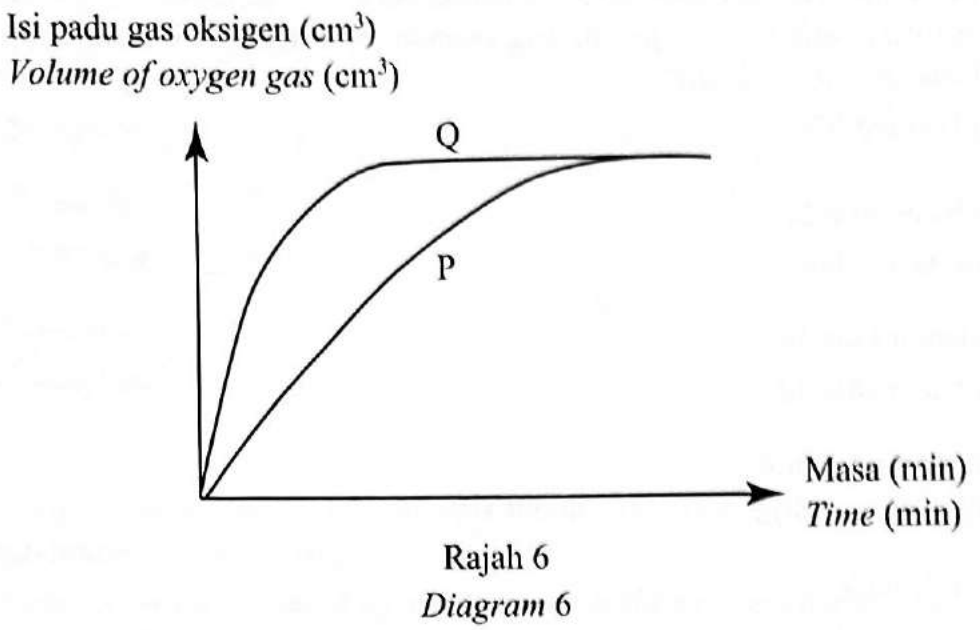
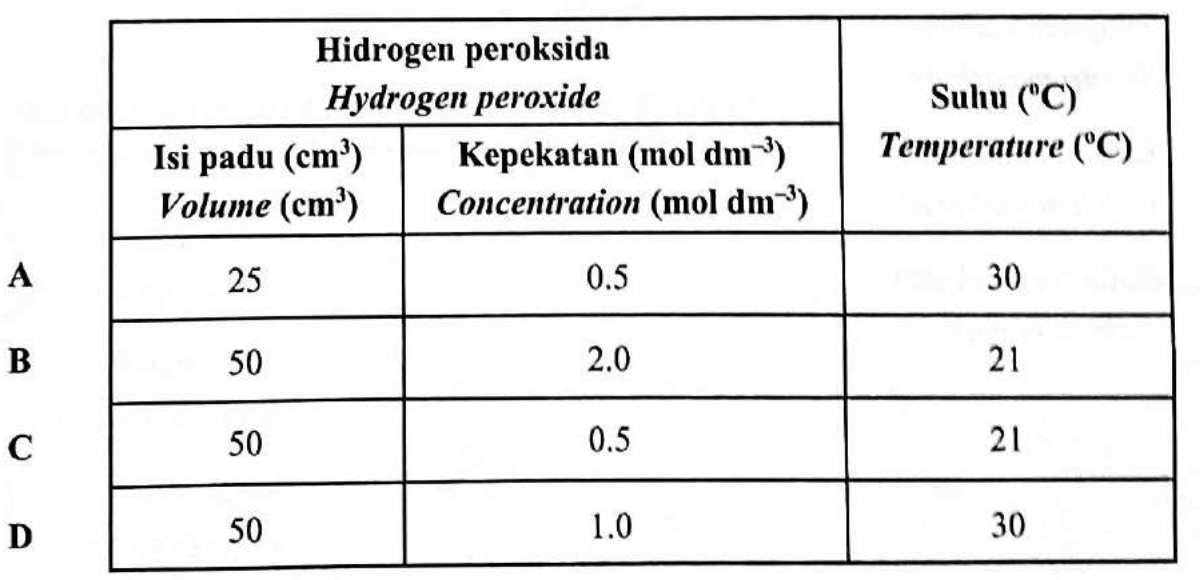
Diagram 6 shows curve P and curve Q obtained for decomposition of hydrogen peroxide solution in the presence of a catalyst. Curve P is obtained by using 50 cm³ of 1.0 mol dm⁻³ hydrogen peroxide solution at temperature 21 °C. Which of the following can produce curve Q? (Volume cm³, concentration mol dm⁻³, temperature °C)
Medium
Ali's leg was injured during loosening the soil in his farm. Ali asked his son to take substance X from the store and mix it into a plastic bag containing water. His son shake the plastic bag and pressed it onto the injured part. What is substance X?
Medium
Which of the following substances is an organic compound?
Easy
Which substance is a natural polymer?
Easy
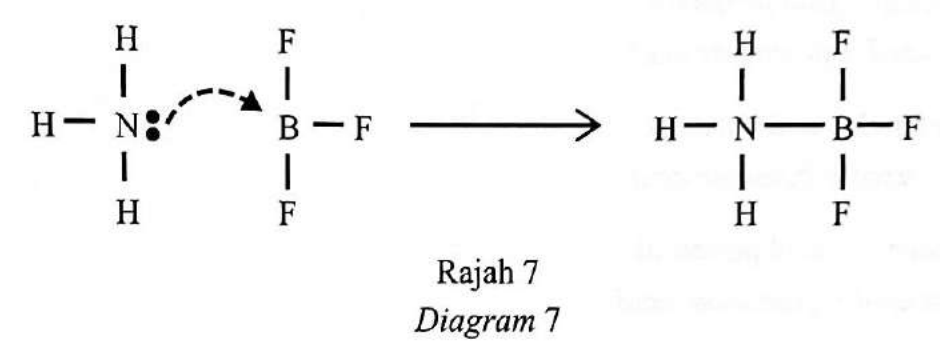
Diagram 7 shows the formation of ammonia boron trifluoride when ammonia, NH₃ reacts with boron trifluoride, BF₃. What is the chemical bond shown in Diagram 7?
Easy
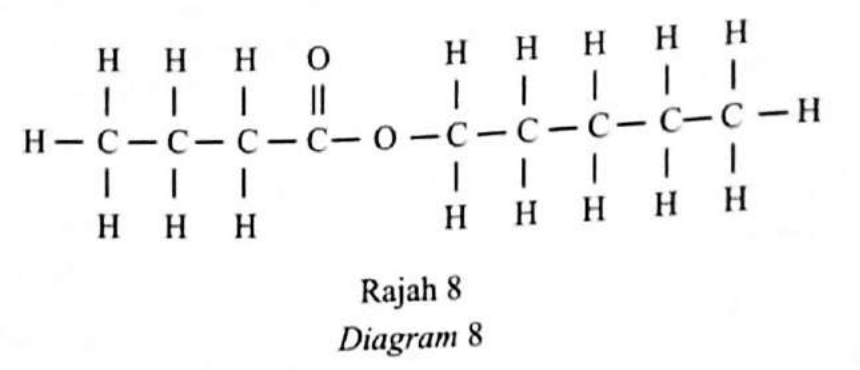
Diagram 8 shows a structural formula of a compound that is used as an artificial banana flavouring. What is the reactants used to produce this compound?
Medium
Ahmad immersed a piece of filter paper into a beaker containing solution P then he used solution Q to write CHEMISTRY on the filter paper after the filter paper was dried. The wording on the filter paper is yellow in colour. Which of the following pairs is solution P and solution Q?
Medium
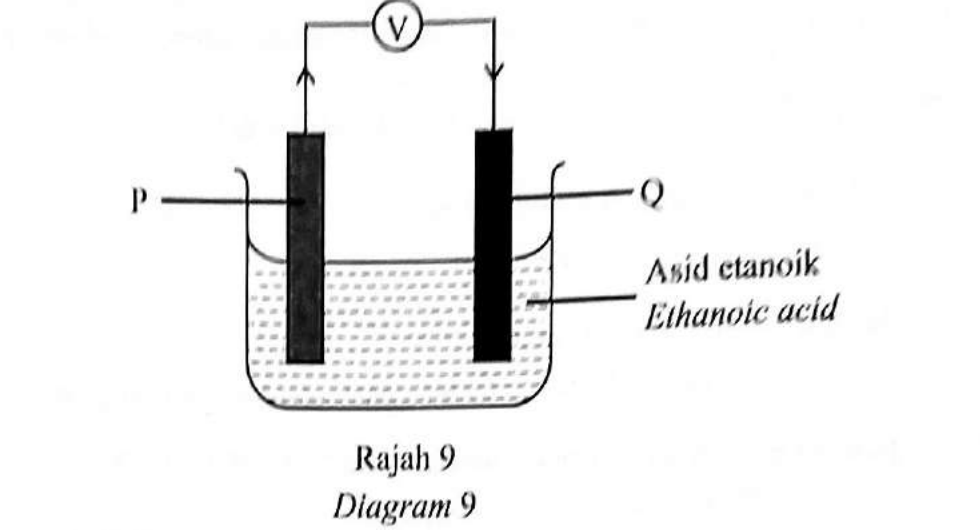
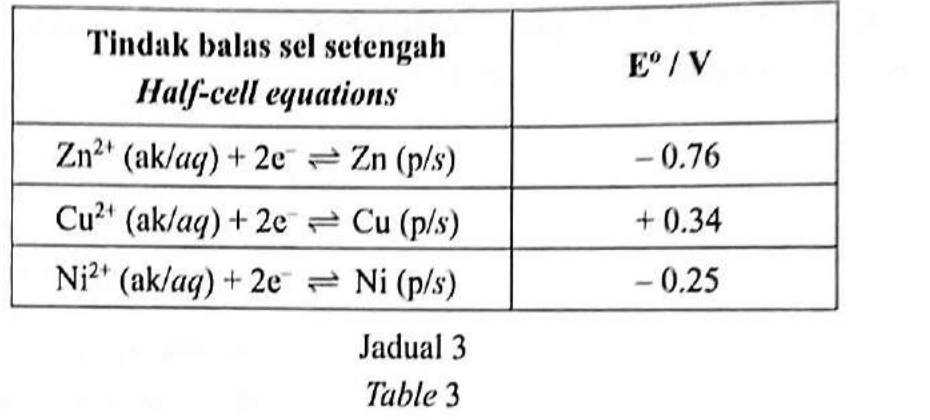
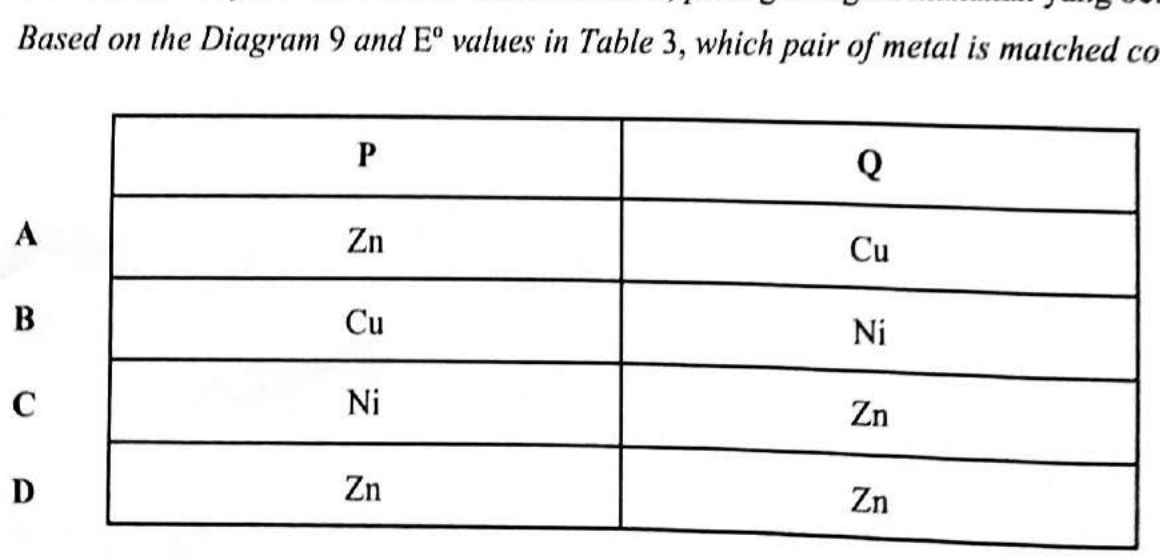
Diagram 9 shows a chemical cell (electrodes P and Q in ethanoic acid, connected to a voltmeter) and Table 3 shows standard electrode potential values: Zn²⁺/Zn -0.76 V, Cu²⁺/Cu +0.34 V, Ni²⁺/Ni -0.25 V. Based on the Diagram 9 and E° values in Table 3, which pair of metal is matched correctly? (P, Q)
Medium
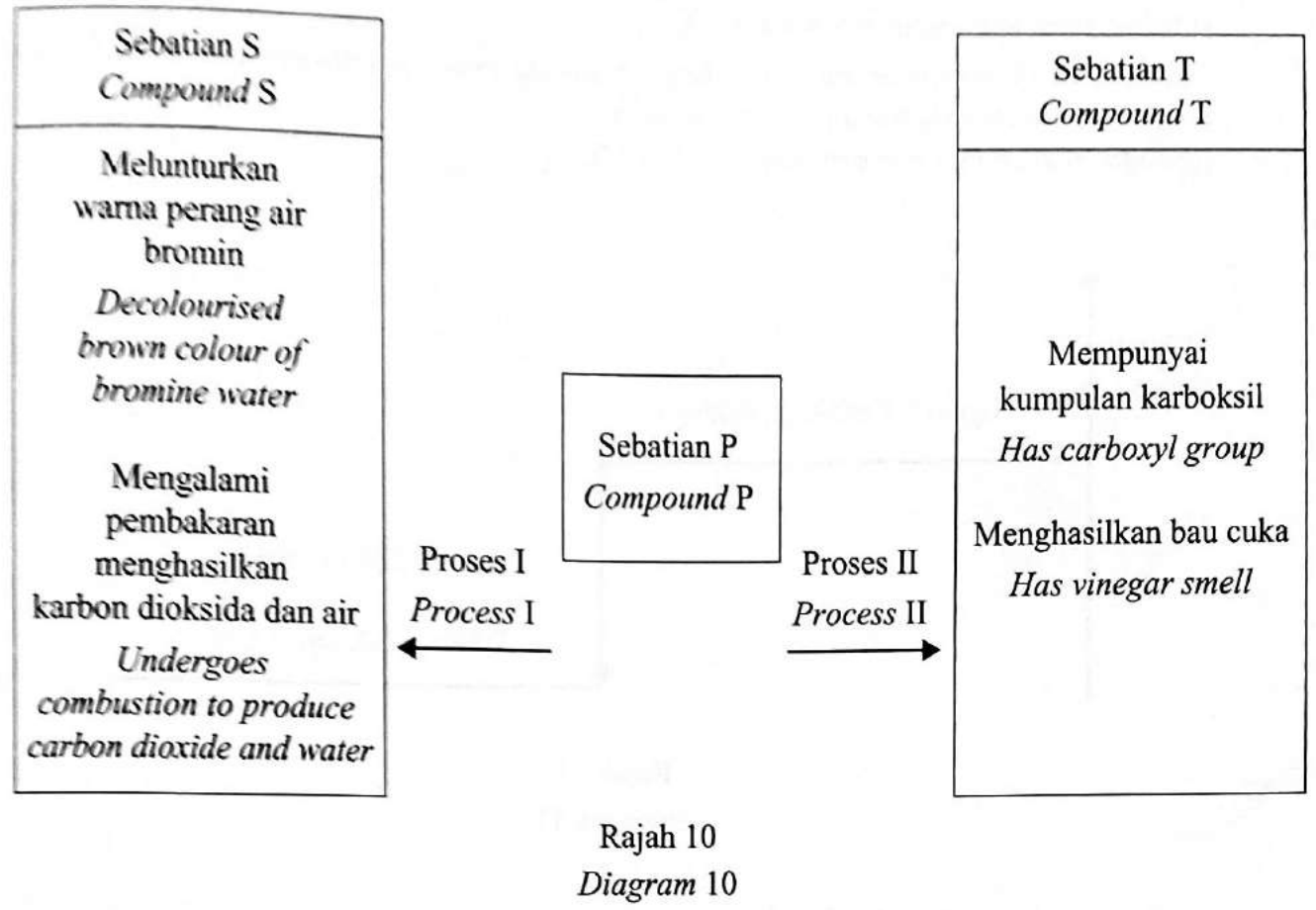
Diagram 10 shows two processes involving compound P. Compound S decolourised brown colour of bromine water and undergoes combustion to produce carbon dioxide and water (Process I from P). Compound T has carboxyl group and has vinegar smell (Process II from P). Which structural formula represents compound P?
Medium
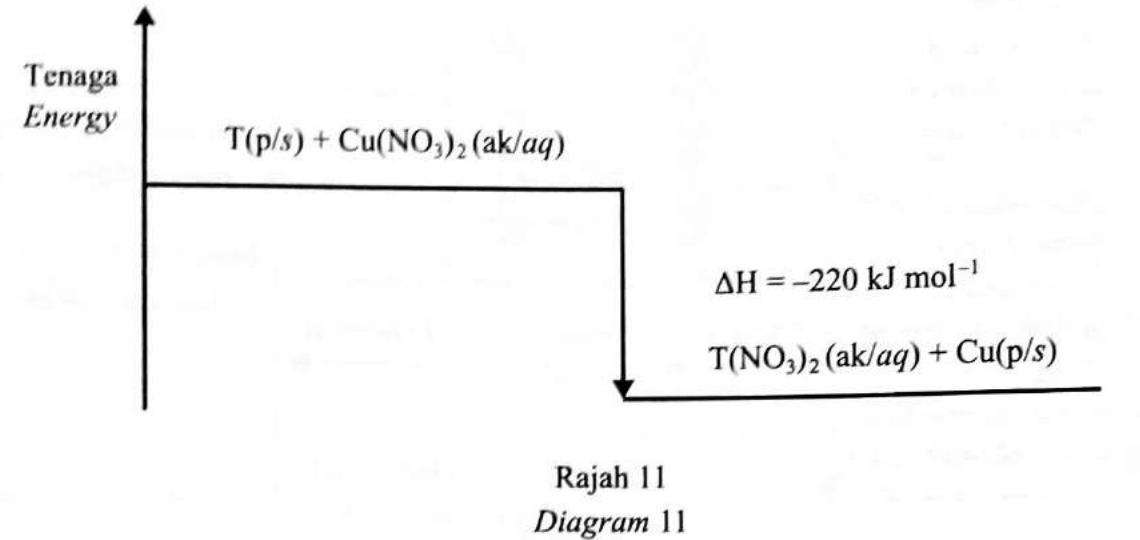
Diagram 11 shows the energy level diagram for the reaction between 50 cm³ of 0.2 mol dm⁻³ copper(II) nitrate solution and excess metal T: T(s) + Cu(NO₃)₂(aq) → T(NO₃)₂(aq) + Cu(s), ΔH = -220 kJ mol⁻¹. [Specific heat capacity of solution = 4.2 J g⁻¹ °C⁻¹] What is the temperature change in the reaction?