Write your answer on paper. Then open the answer to check it.
Section A
Table 1 shows two elements with their proton number and nucleon number: Sodium (proton number 11, nucleon number 23); Oxygen (proton number 8, nucleon number 16).
Medium5 marks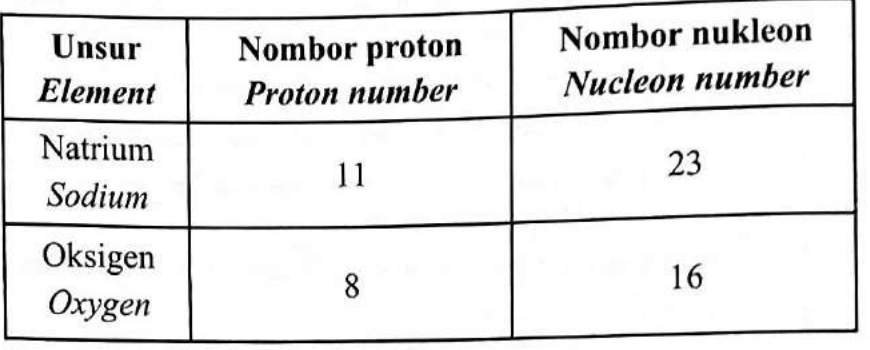
- (a)
What is the meaning of nucleon number?
[1] - (b)
Name the positively charged subatomic particle in the atom.
[1] - (c)(i)
Based on Table 1, write the standard representation for sodium element.
[1] - (c)(ii)
Based on Table 1, write the electron arrangement of oxygen atom.
[1] - (c)(iii)
Based on Table 1, write the chemical formula for sodium oxide.
[1]
Diagram 2 shows the arrangement of atoms in pure copper and bronze (bronze contains larger atoms X among the copper atoms).
Medium5 marks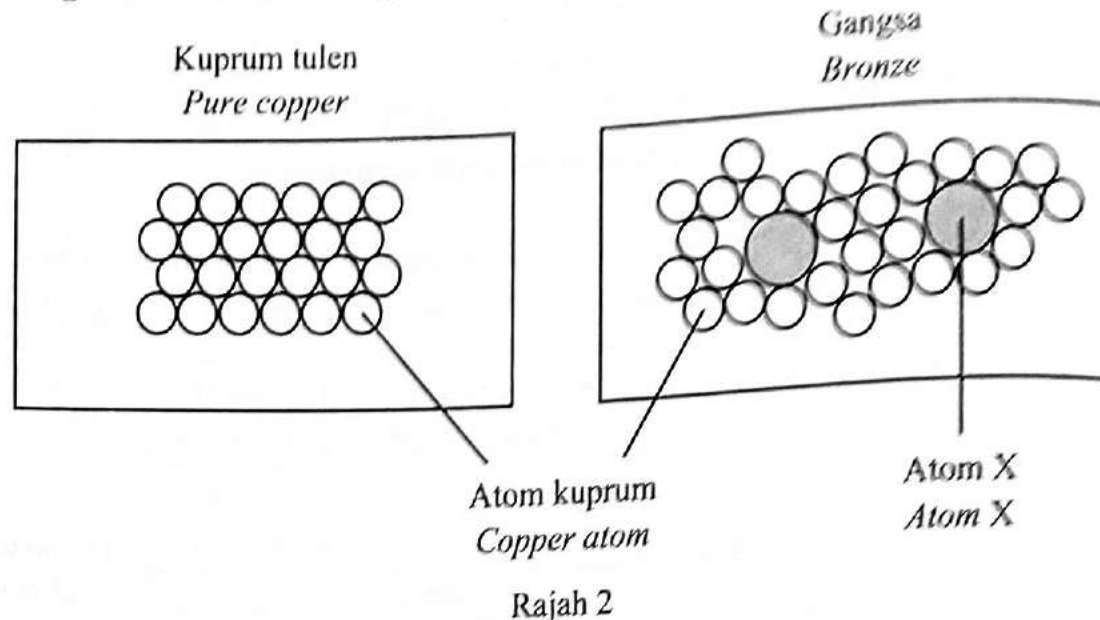
- (a)(i)
State the name of atom X.
[1] - (a)(ii)
Based on Diagram 2, bronze is harder than copper metal. Explain this statement.
[2] - (b)
Table 2 shows information on the two types of glass P and glass Q: P = silica, sodium carbonate, boron oxide and aluminium oxide; Q = silica, sodium carbonate and calcium carbonate. If you want to use glass pot for cooking purpose, suggest which type of glass is suitable to make the pot. Give your reason.
[2]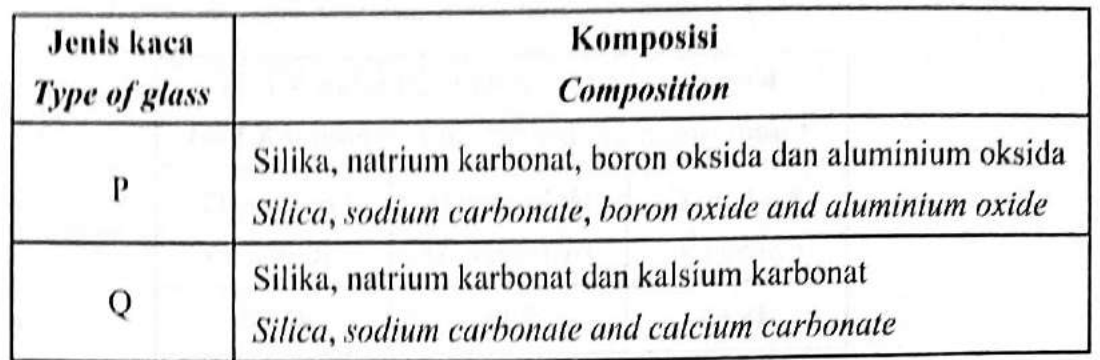
Table 3 shows the composition of compound X: Carbon, C 48.65%; Hydrogen, H 8.11%; Oxygen, O 43.24%.
Medium6 marks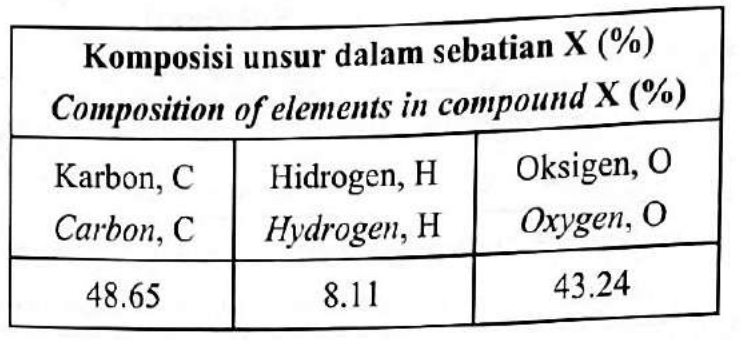
- (a)
What is the meaning of empirical formula?
[1] - (b)(i)
Determine the empirical formula of compound X. [Relative atomic mass: C = 12, H = 1, O = 16]
[3] - (b)(ii)
The relative molecular mass of compound X is 148. Determine the molecular formula of compound X.
[2]
Diagram 4 shows some of the elements in the Periodic Table of Elements represented by the letters U, V, W, X and Y (U top of Group 1; Y below it in Group 1, Period 3; V and W in Period 2 of the right-hand block; X in Group 17, Period 3).
Medium7 marks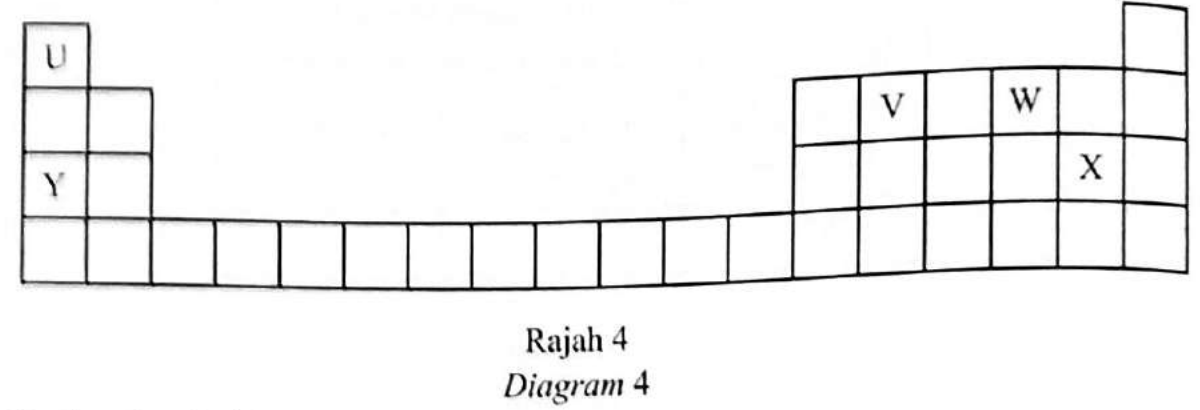
- (a)(i)
State the type of compound that formed between elements V and W.
[1] - (a)(ii)
Draw the electron arrangement of the compound formed in 4(a)(i).
[2] - (b)(i)
Element Y and element X react to produce compound Z. Chemical equation for the formation of compound Z is Y + X₂ → YX. Balance the chemical equation for the formation of compound Z.
[1] - (b)(ii)
0.23 g element Y reacts with excess element X. Calculate the mass of compound Z produced. [Relative atomic mass: Y = 23, X = 35.5]
[3]
Diagram 5.1 shows the structural formula of two different types of rubber (Rubber X changes to Rubber Y through Process Z). Diagram 5.2 shows the monomers for terylene: ethane-1,2-diol (HO-CH₂-CH₂-OH) and benzene-1,4-dicarboxylic acid.
Medium8 marks- (a)(i)
State the types of Rubber X and Rubber Y.
[2]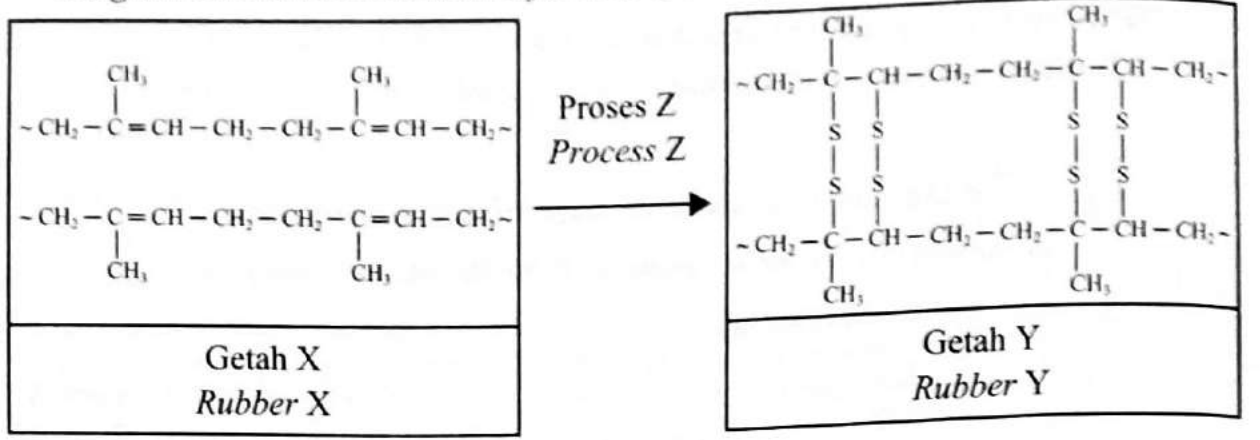
- (a)(ii)
Rubber Y can be produced from Rubber X through Process Z. Name the Process Z and describe briefly how Process Z is carried out.
[2] - (a)(iii)
State one different characteristic between Rubber X and Rubber Y.
[1] - (b)(i)
What is the type of polymerisation for terylene?
[1]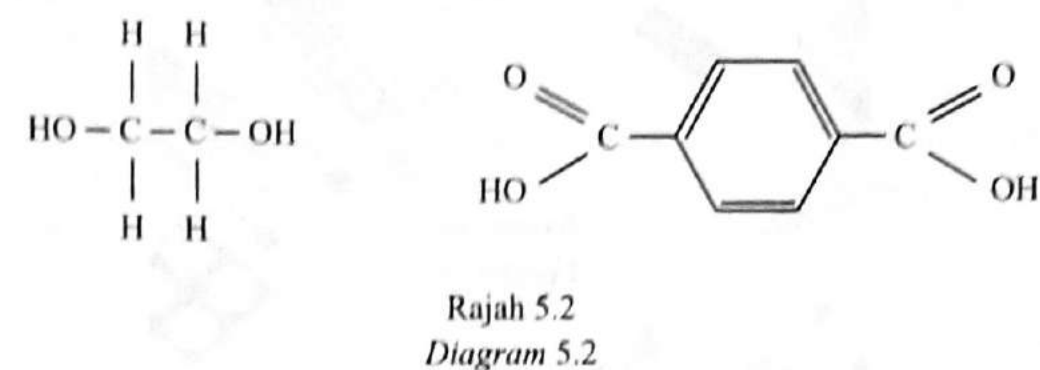
- (b)(ii)
Draw the structural formula for terylene polymer.
[2]
Diagram 6 shows various types of cosmetics found in the market (photograph of cosmetic products).
Medium9 marks- (a)(i)
State the meaning of cosmetics.
[1] - (a)(ii)
State two basic ingredients in cosmetics production.
[2] - (b)(i)
Some of the commercialised cosmetics contain banned chemicals that can cause harm to consumers. State two effects of the use of banned chemicals to consumers.
[2] - (b)(ii)
Suggest one method to prevent the situation in 6(b)(i) from happening.
[1] - (c)(i)
Table 6 shows three types of chemical compounds which are used as food additives: X = benzoic acid (chilli sauces); Y = monosodium glutamate (instant noodles); Z = ascorbic acid (margarine). Explain how benzoic acid acts as food additive X.
[1]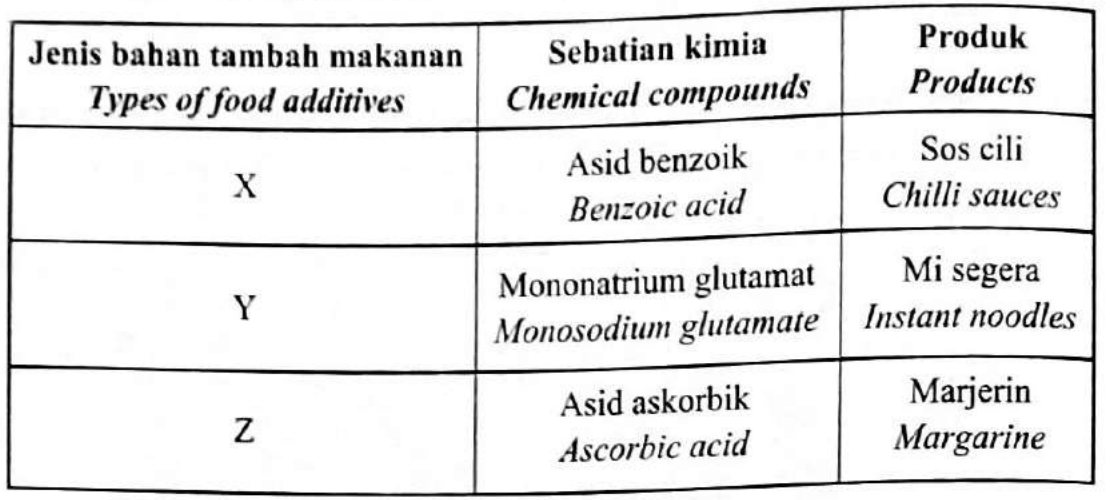
- (c)(ii)
What is the side effect of monosodium glutamate on human health?
[1] - (c)(iii)
What is the function of food additive Z?
[1]
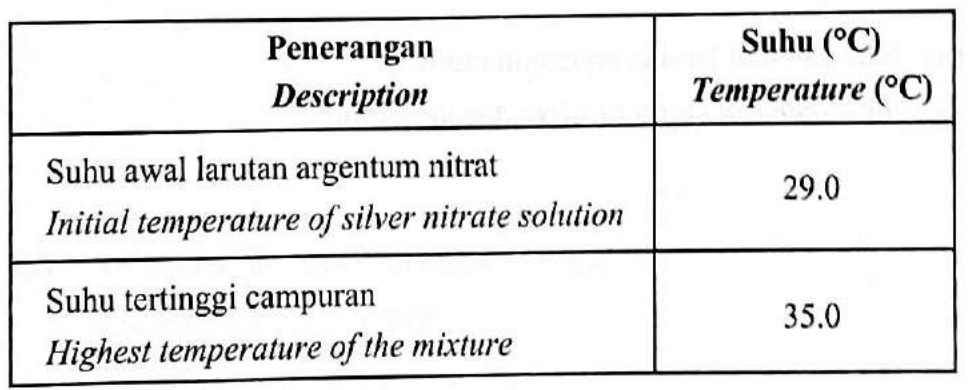
Diagram 7 shows the apparatus set-up of experiment to determine heat of displacement of silver by copper: 50 cm³ of 1.0 mol dm⁻³ silver nitrate solution in a polystyrene cup with excess copper powder, thermometer. Table 7: initial temperature of silver nitrate solution 29.0 °C; highest temperature of the mixture 35.0 °C.
Medium10 marks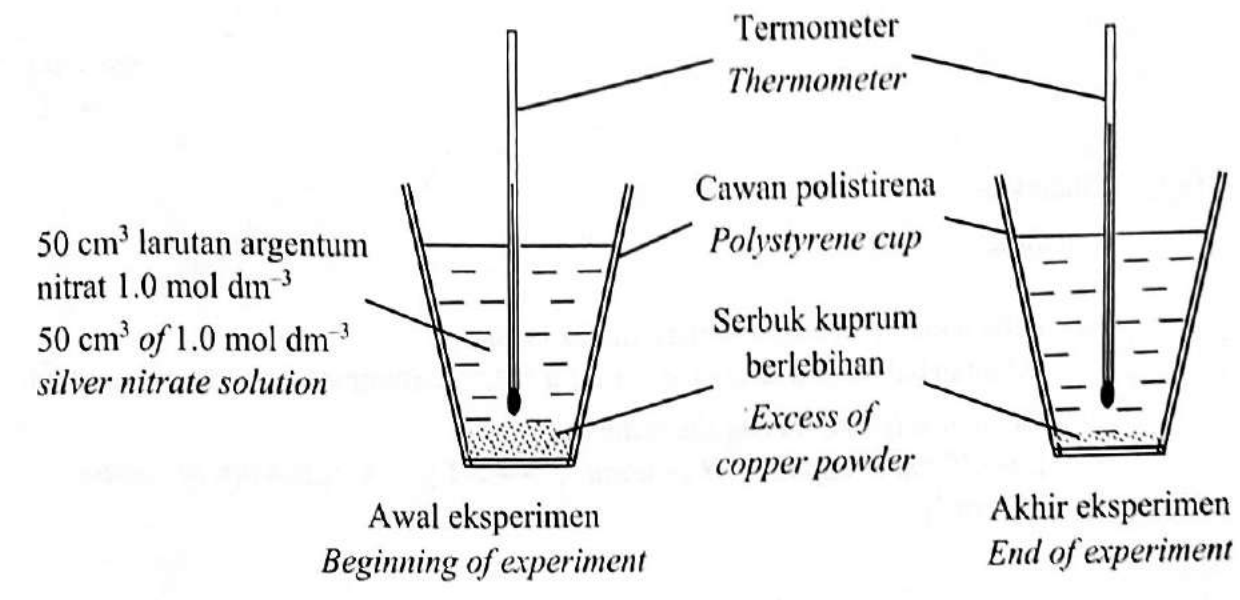
- (a)
Based on the experiment, state the meaning of heat of displacement.
[1] - (b)
Balance the ionic equation for experiment in Diagram 7: Cu + Ag⁺ → Cu²⁺ + Ag
[1] - (c)(i)
Calculate the heat released during the reaction. [Specific heat capacity of solution, c = 4.2 J g⁻¹ °C⁻¹, density of solution = 1 g cm⁻³]
[1] - (c)(ii)
Calculate the number of moles of silver nitrate solution.
[1] - (c)(iii)
Calculate the heat of displacement of silver.
[2] - (d)
Draw an energy level diagram for this reaction.
[2] - (e)(i)
Predict the value of heat of displacement of silver if copper is replaced by zinc.
[1] - (e)(ii)
Explain your answer in 7(e)(i).
[1]
Table 8 shows the apparatus set-up and observation of two sets of experiment: Set I, HCl in solvent X, bulb does not light up; Set II, HCl in solvent Y, bulb lights up (carbon electrodes).
Medium10 marks- (a)(i)
Based on Table 8, suggest solvent Y.
[1]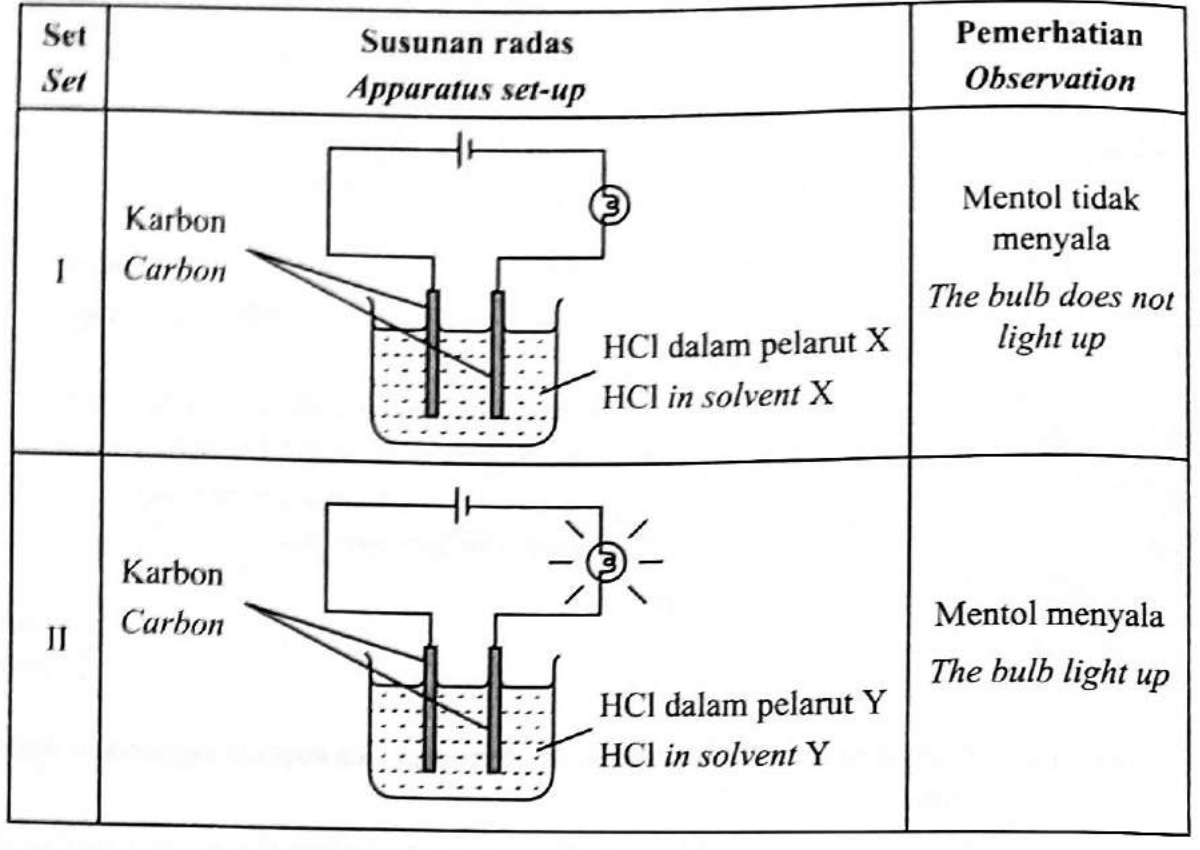
- (a)(ii)
Based on Table 8, explain why the bulb in Set II lights up.
[1] - (b)(i)
Diagram 8 shows titration method carried out by a student: sulphuric acid in the burette, potassium hydroxide solution + phenolphthalein in the conical flask. Write a balanced chemical equation for the neutralisation reaction.
[2]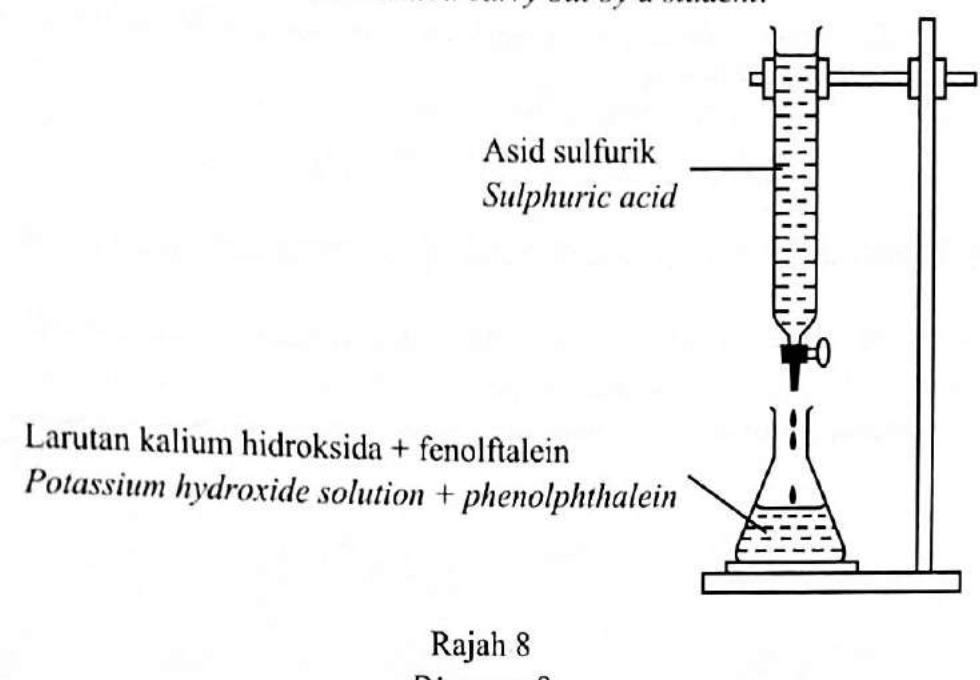
- (b)(ii)
25 cm³ sulphuric acid neutralises 50 cm³ of 0.1 mol dm⁻³ potassium hydroxide solution. Calculate the molarity of sulphuric acid.
[3] - (b)(iii)
Describe chemical test to verify the presence of anion in the product of the neutralisation reaction.
[3]
Section B
Section B: answer one question. Diagram 9 shows types of pieces of chicken to be chosen by Malik for roasting: Type A (small pieces) and Type B (whole chicken).
Medium20 marks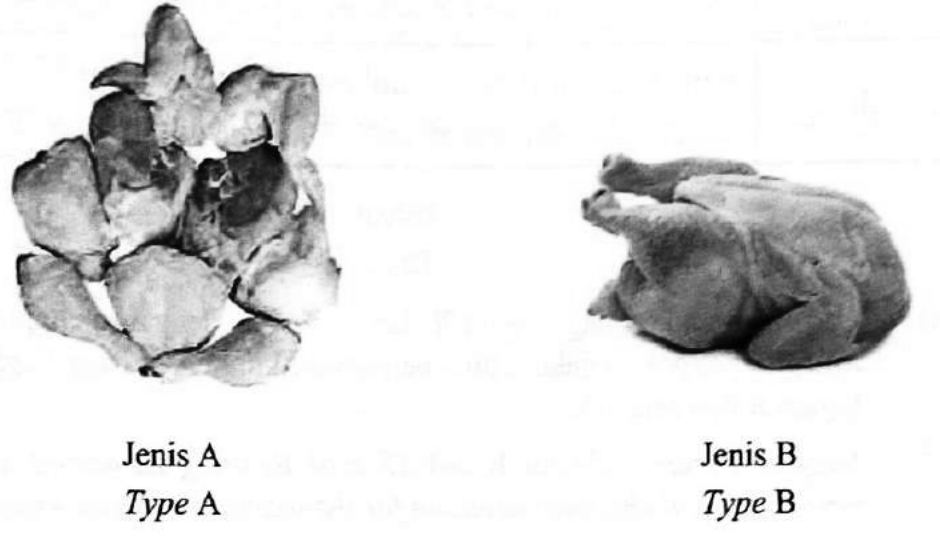
- (a)(i)
State the meaning of rate of reaction.
[1] - (a)(ii)
Which type of chicken pieces should Malik choose? Explain your answer based on the factors that influence the rate of reaction.
[3] - (b)(i)
A group of students carried out experiments to investigate the factor affecting the rate of reaction between metal R and HX acid. Table 9: Experiment I, metal R powder and 50 cm³ of 1.0 mol dm⁻³ HX acid, time taken 10 s; Experiment II, metal R powder and 50 cm³ of 0.5 mol dm⁻³ HX acid, time taken 20 s (time to collect 30 cm³ of hydrogen gas). Suggest the name of metal R and HX acid. By using the named metal R and HX acid, write balanced chemical equation for the reaction between metal R and HX acid.
[4]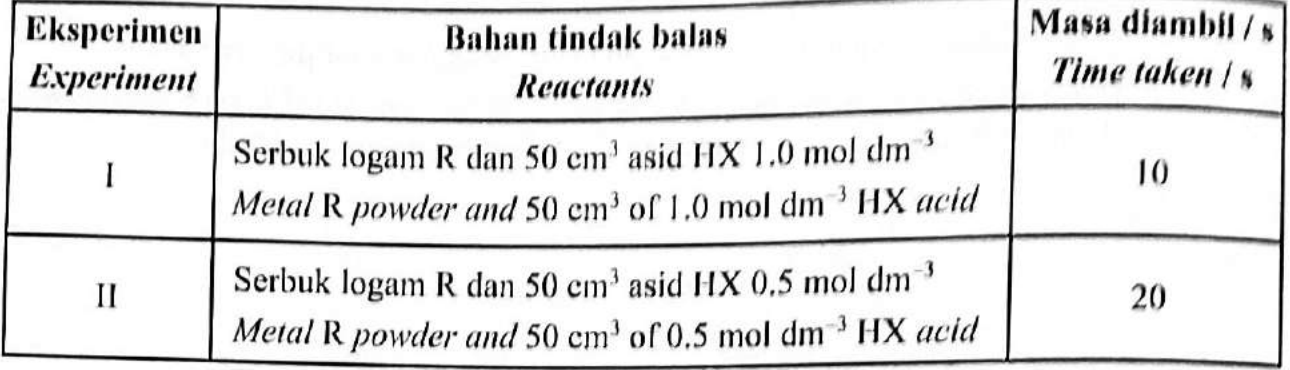
- (b)(ii)
Calculate the average rate of reaction for Experiment I and Experiment II.
[2] - (b)(iii)
By using the collision theory, explain the difference in the rate of reaction between Experiment I and Experiment II.
[5] - (b)(iv)
The group of students wants to repeat Experiment I by adding a substance that can increase the rate of reaction without changing the condition of the reactants in Experiment I. Suggest a suitable substance that can be used. Explain how the substance can increase the rate of reaction.
[5]
Section B: answer one question. Diagram 10.1 shows a structural formula of butene (but-1-ene, CH₂=CH-CH₂-CH₃). Diagram 10.2 shows a flow chart for the conversion of propan-1-ol (C₃H₇OH) to a few organic compounds: Process I gives Compound P (C₃H₆); Process II converts P to Compound Q (C₃H₈); Process III gives Compound R (C₂H₅COOH); Process IV from propan-1-ol and R gives Compound S.
Medium20 marks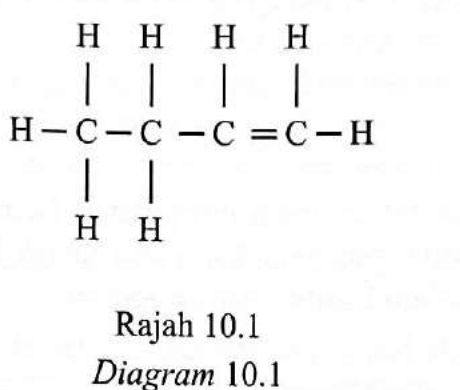
- (a)(i)
State the meaning of isomer.
[1] - (a)(ii)
Draw the structural formulae for another two isomers of butene. Name each isomer according to the IUPAC nomenclature.
[4] - (a)(iii)
Write the balanced chemical equation for the combustion of butene in excess oxygen. If 1 200 cm³ butene gas is used, calculate the volume of oxygen gas needed for the combustion. [1 mol of gas occupies 24 dm³ at room condition]
[5] - (b)
State the name for Process I, Process II, Process III and Process IV. Identify the homologous series for Compound P, Compound Q, Compound R and Compound S. Draw the structural formula for Compound P and Compound S.
[10]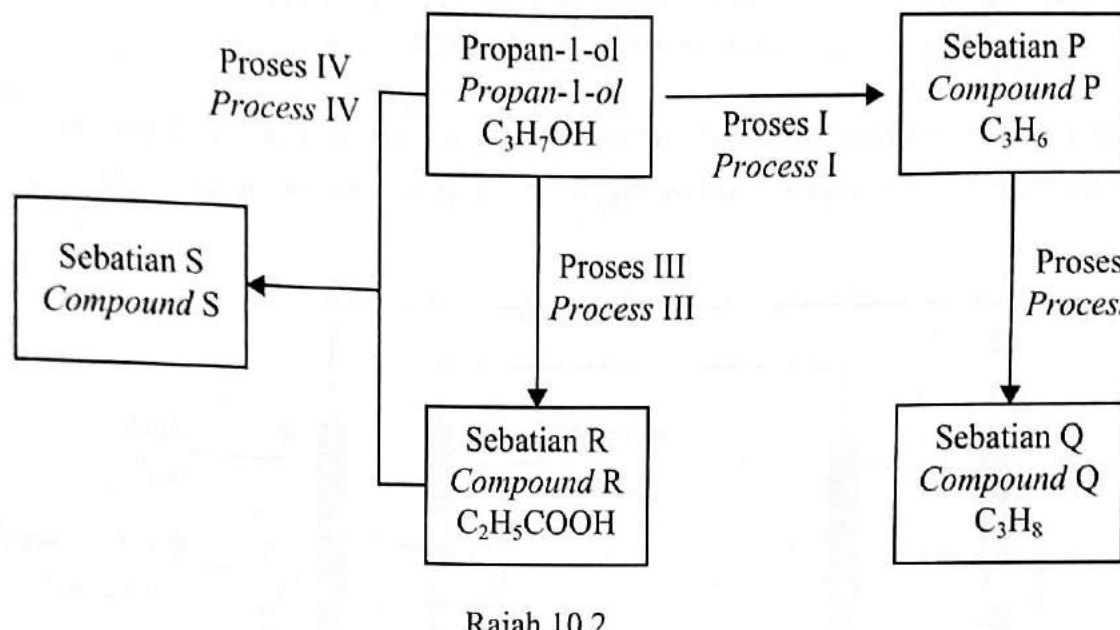
Section C
Diagram 11 shows the apparatus set-up to investigate redox reaction in Cell I and Cell II. Cell I: zinc electrode W in zinc nitrate solution, copper electrode X in copper(II) sulphate solution, porous pot, joined to a voltmeter. Cell II: carbon electrodes Y and Z in copper(II) sulphate solution.
Hard20 marks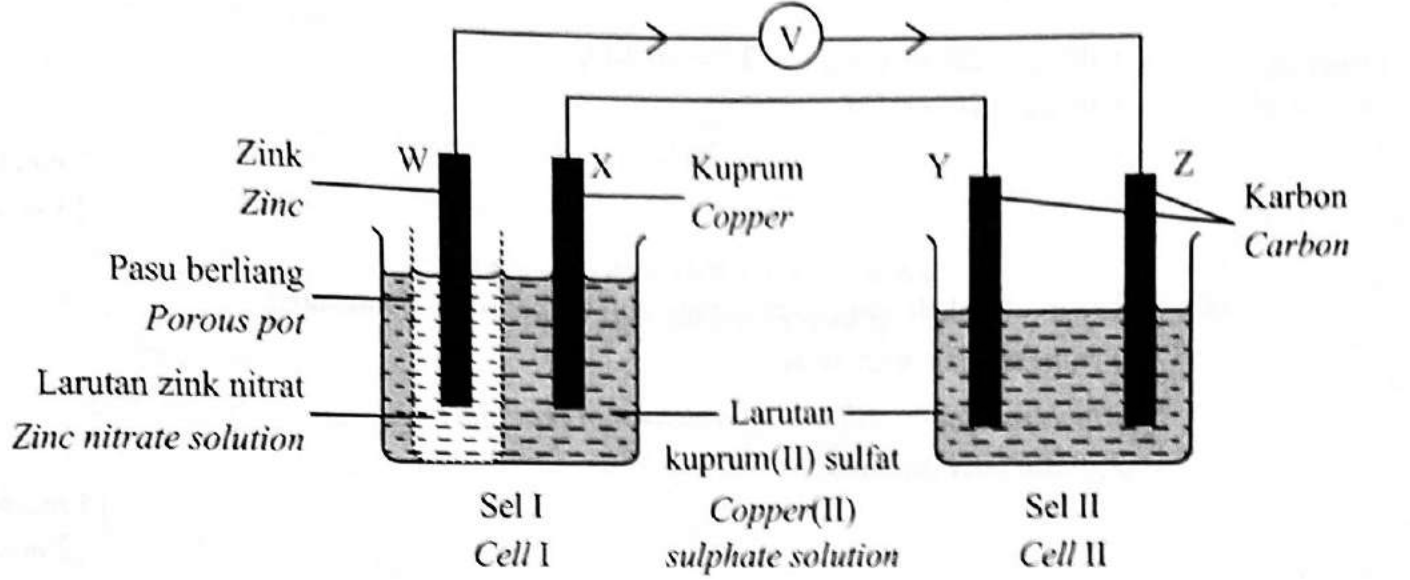
- (a)
What is the meaning of redox reaction? Identify type of Cell I and Cell II.
[3] - (b)(i)
Based on Cell I, write the cell notation that occurs and calculate the value of the voltage produced in the cell. Given: Zn²⁺(aq) + 2e⁻ ⇌ Zn(s), E° = -0.76 V; Cu²⁺(aq) + 2e⁻ ⇌ Cu(s), E° = +0.34 V.
[3] - (b)(ii)
Based on Cell I, which substance will undergo reduction reaction? Explain your answer.
[2] - (c)
Based on Cell II, identify positive terminal and negative terminal. Predict the observation at electrode Y and electrode Z.
[4] - (d)
Electrical energy can be produced by redox reaction. You are supplied with a lemon, a piece of zinc, iron nail, connecting wires and bulb to build a chemical cell to prove the above statement. Draw a labelled diagram and the arrows to show the direction of electron flow. Write suitable half equation and ionic equation. Suggest suitable oxidising agent and reducing agent.
[8]