Which of the following process changes gas into liquid?
Easy
Which of the following scientists discovered electron?
Easy
Which of the following elements is located in Group 18?
Easy
What is the type of chemical bond in sodium carbonate?
Medium
Polyvinyl chloride is a polymer which can be repeatedly remoulded upon heating. What is the type of polymer?
Easy
What is the name for the reaction to prepare soap?
Easy
Which of the following factors can affect the rate of reaction? I Volume of the reactants; II Concentration of the reactants; III Presence of a catalyst; IV Mass of the reactants
Medium
Which of the following statements is correct about empirical formula?
Easy
Which of the following is an oxidation reaction?
Medium
What is the meaning of heat of neutralisation?
Easy
Which of the following statements is correct about isomer?
Easy
Which of the following substances is used in tooth implant?
Easy
Formic acid, HCOOH is a type of acid used in latex coagulation. Which of the following statements is true about the acid?
Medium
Which of the following substances is an isotope of magnesium? I ¹²₂₄Mg; II ¹²₂₆Mg; III ²⁴₁₂Mg; IV ²⁶₁₂Mg
Medium
What is the energy change that happens in a chemical cell?
Easy
Which of the following pairs correctly shows the pH value and the degree of ionisation for sulphuric acid, H₂SO₄? (A: pH 1, High; B: pH 1, Low; C: pH 5, Low; D: pH 5, High)
Medium
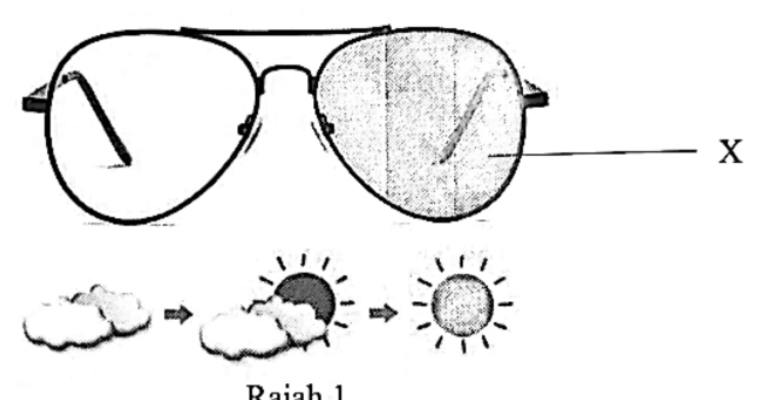
Diagram 1 shows the lens of a spectacle made of substance X. What is X?
Easy
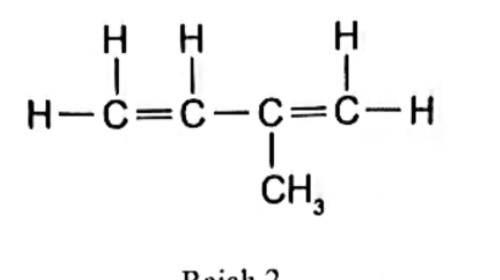
Diagram 2 shows the monomer for natural rubber (CH₂=CH–C(CH₃)=CH₂ drawn as structural formula). What is the name of the monomer following IUPAC nomenclature?
Medium
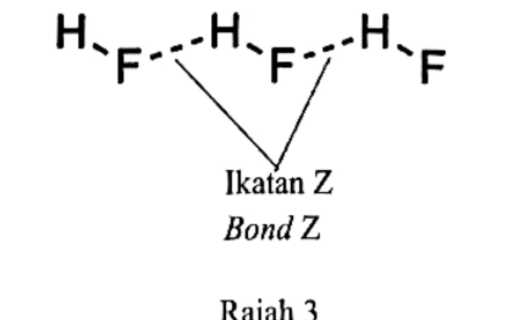
Diagram 3 shows a compound with bond Z (dotted bond between H and F of neighbouring HF molecules). What is bond Z?
Medium
Element K and element S are located in Group 13 and Group 16 of the Periodic Table of Elements. Element K reacts with element S to form a compound. What is the chemical formula of the compound formed?
Medium
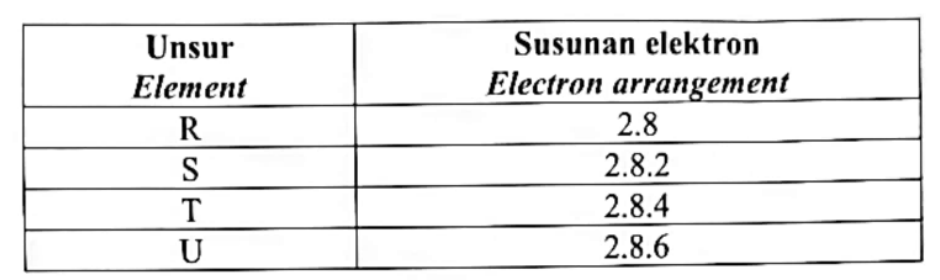
Table 1 shows the electron arrangement of four elements (R 2.8; S 2.8.2; T 2.8.4; U 2.8.6). Which of the following elements will form metallic bond?
Medium
Antiseptic contains substance W that burns with a blue flame. What is the functional group for W?
Medium
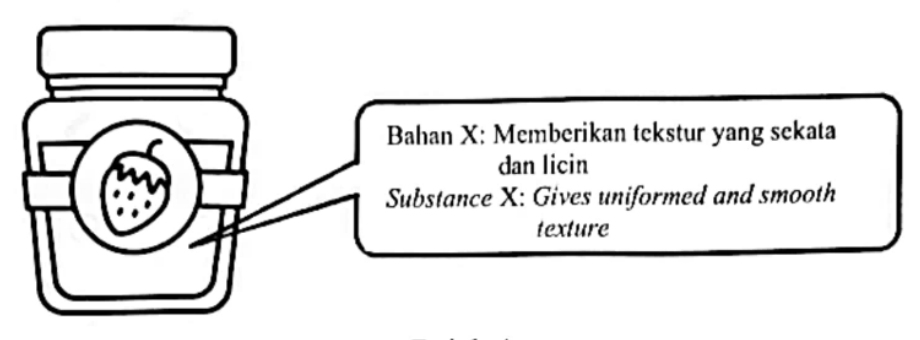
Diagram 4 shows substance X that is added in the making of jam. Substance X: Gives uniformed and smooth texture. What is X?
Easy
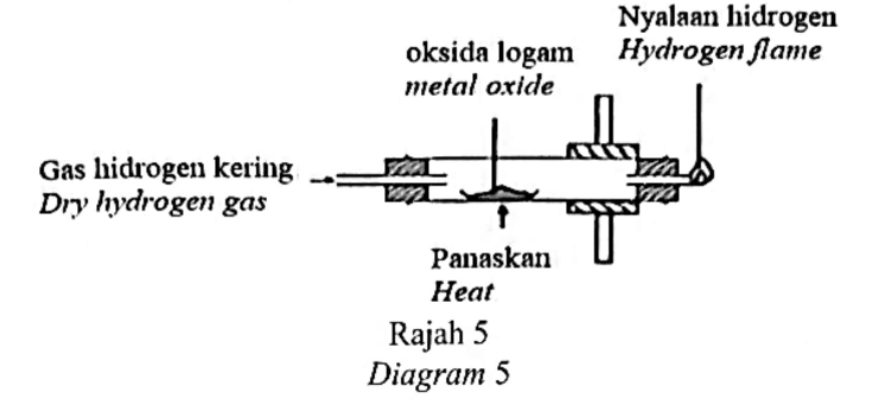
Diagram 5 shows the apparatus set-up to determine the empirical formula of a metal oxide (dry hydrogen gas passed over heated metal oxide, hydrogen flame at the end). Which of the following metal oxides is suitable to be used in this experiment?
Medium
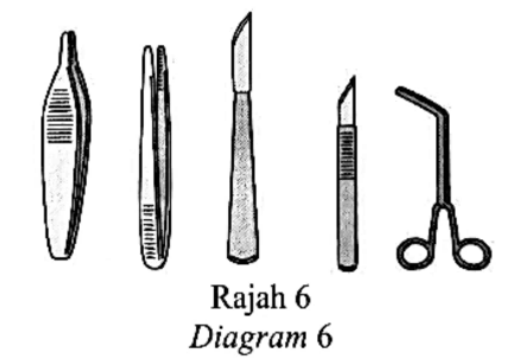
Diagram 6 shows some surgical instruments made from alloy X. What is alloy X?
Easy
Which of the following is an isomer for butanol? I Butan-1-ol; II 2-methylpropan-1-ol; III 2-methylpropan-3-ol; IV 3-methylpropan-1-ol
Medium
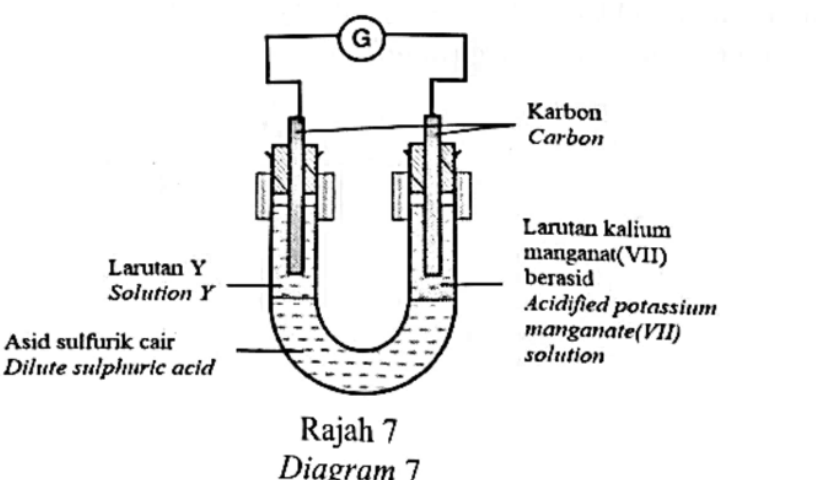
Diagram 7 shows the apparatus set-up to investigate the transfer of electrons at a distance (carbon electrodes, dilute sulphuric acid, acidified potassium manganate(VII) solution on one side, solution Y on the other). What is Y?
Medium
Which of the following is correct about the use of neutralisation in daily life?
Medium
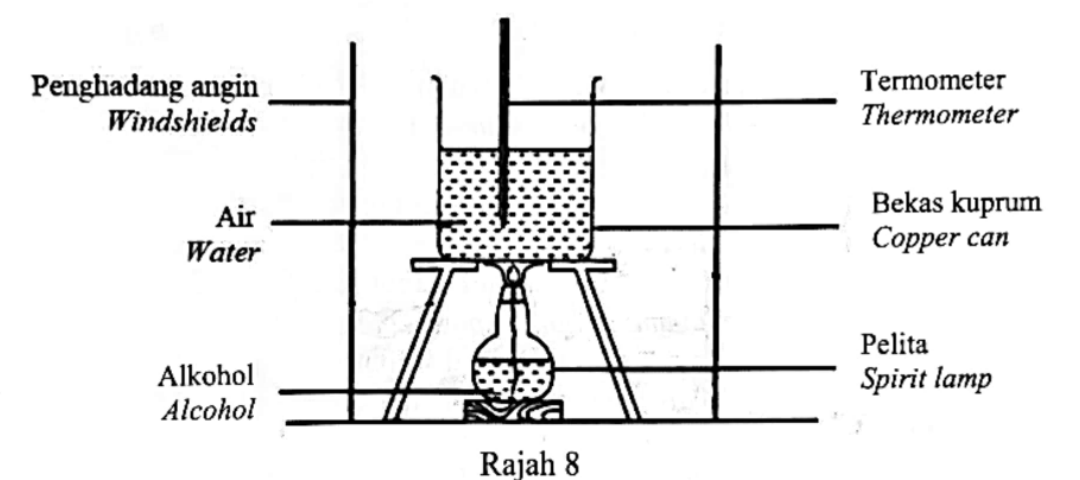
Diagram 8 shows the apparatus set-up to determine the heat of combustion of alcohols. Which of the following alcohol gives the highest value of heat of combustion?
Medium
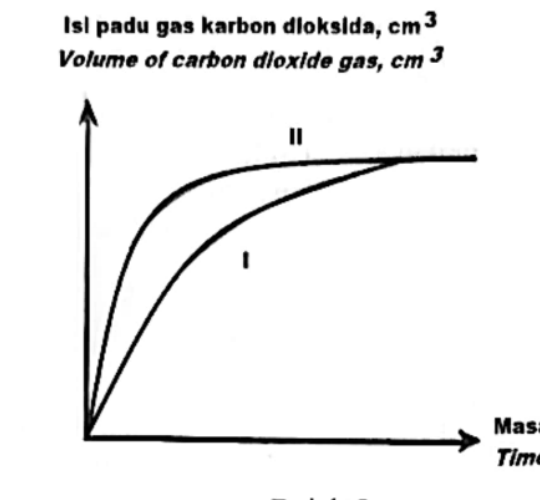
Diagram 9 shows curve I obtained when 1.0 g calcium carbonate chips reacts with excess sulphuric acid at 50 °C (graph of volume of CO₂ gas against time). Which of the following will produce curve II? (Curve II is steeper and reaches the same final volume.)
Medium
Ali used cleansing agent X that contains CH₃(CH₂)₁₆COO⁻ anions to wash his clothes during camping by a river. It was found that he needed a lot of the cleansing agent X when washing his clothes. What does Ali need to do to overcome this problem?
Medium
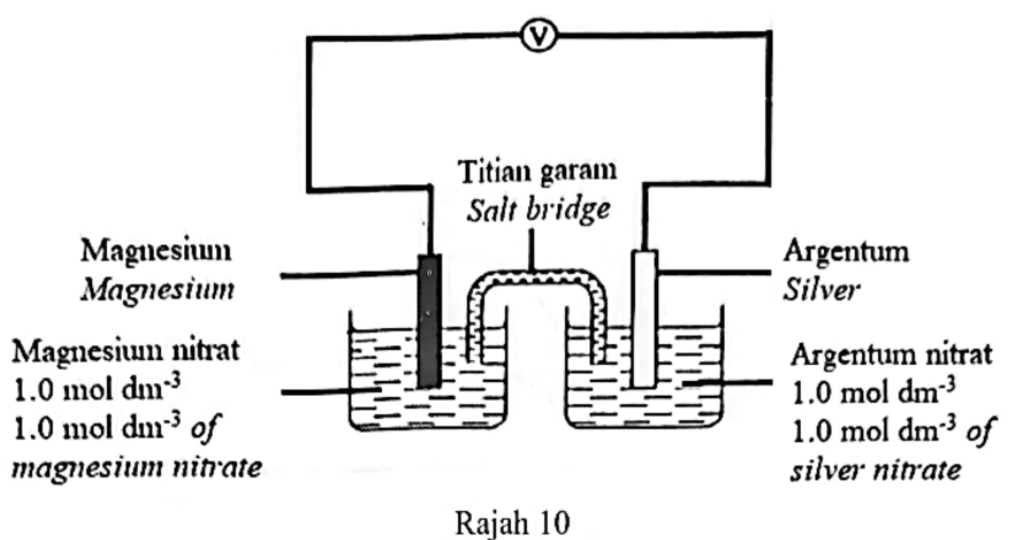
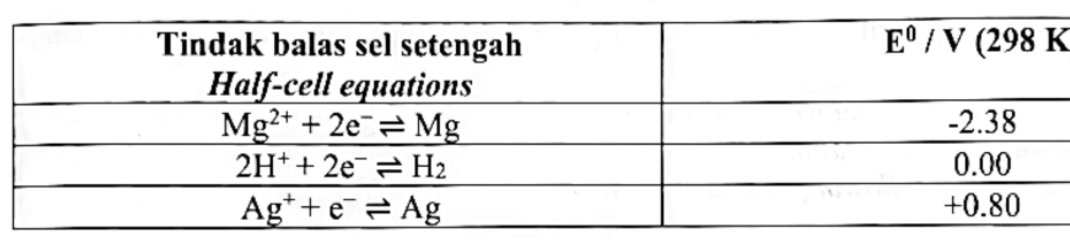
Diagram 10 shows a chemical cell (Mg in 1.0 mol dm⁻³ Mg(NO₃)₂ and Ag in 1.0 mol dm⁻³ AgNO₃, joined by a salt bridge). Standard electrode potentials: Mg²⁺ + 2e⁻ ⇌ Mg, E° = -2.38 V; 2H⁺ + 2e⁻ ⇌ H₂, E° = 0.00 V; Ag⁺ + e⁻ ⇌ Ag, E° = +0.80 V. What is the value of the cell's voltage?
Medium
What is the relative molecular mass of 4-methylpent-2-ene? [Relative atomic mass: H = 1; C = 12]
Medium
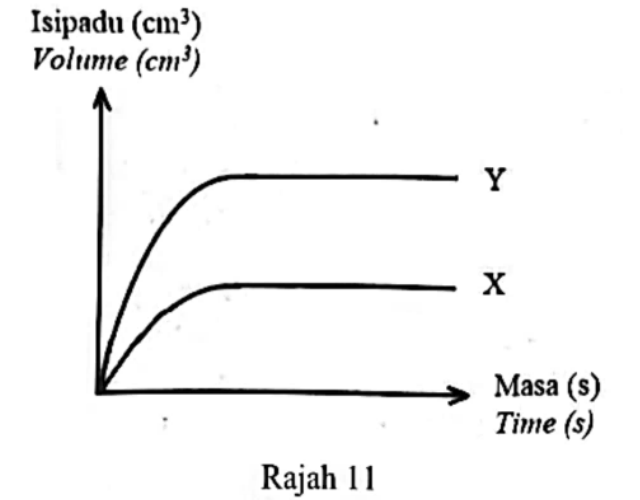
Diagram 11 shows a graph of volume of hydrogen gas against time for the reaction between zinc and sulphuric acid. Curve X is obtained when 25 cm³ of 1 mol dm⁻³ sulphuric acid is added to excess zinc granules in a conical flask. Which of the following should be done to obtain curve Y? (Curve Y has a greater maximum volume of H₂.)
Medium
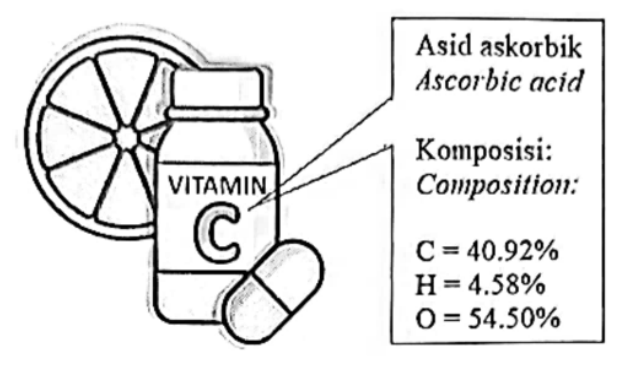
Diagram 12 shows the composition of ascorbic acid in vitamin C serum (C = 40.92%; H = 4.58%; O = 54.50%). What is the empirical formula for ascorbic acid? [Relative atomic mass: H = 1; C = 12; O = 16]
Medium
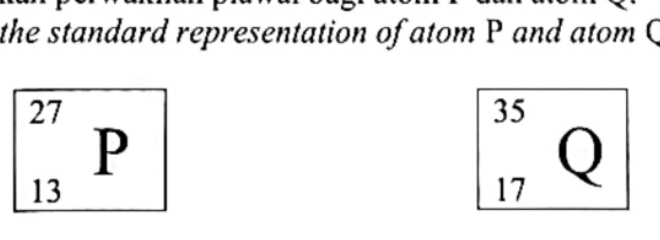
Diagram 13 shows the standard representation of atom P (²⁷₁₃P) and atom Q (³⁵₁₇Q). Calculate the relative molecular mass of the compound formed when atom P forms a bond with atom Q.
Medium
3Cl₂ + 2Fe → 2X, where X is a brown solid. What is the mass of X formed when 120 cm³ of chlorine gas reacted with hot iron wool at room temperature? [Relative atomic mass: Cl = 35.5; Fe = 56; Molar volume of gas at room temperature = 24 dm³ mol⁻¹]
Medium
The equation 4Fe + 3O₂ + 6H₂O → 4Fe(OH)₃ represents a reaction on an iron fence. Which of the following ways can be used to prevent this reaction from occurring? I Plate the fence with zinc; II Plate the fence with copper; III Apply oil on the fence; IV Apply grease on the fence
Medium
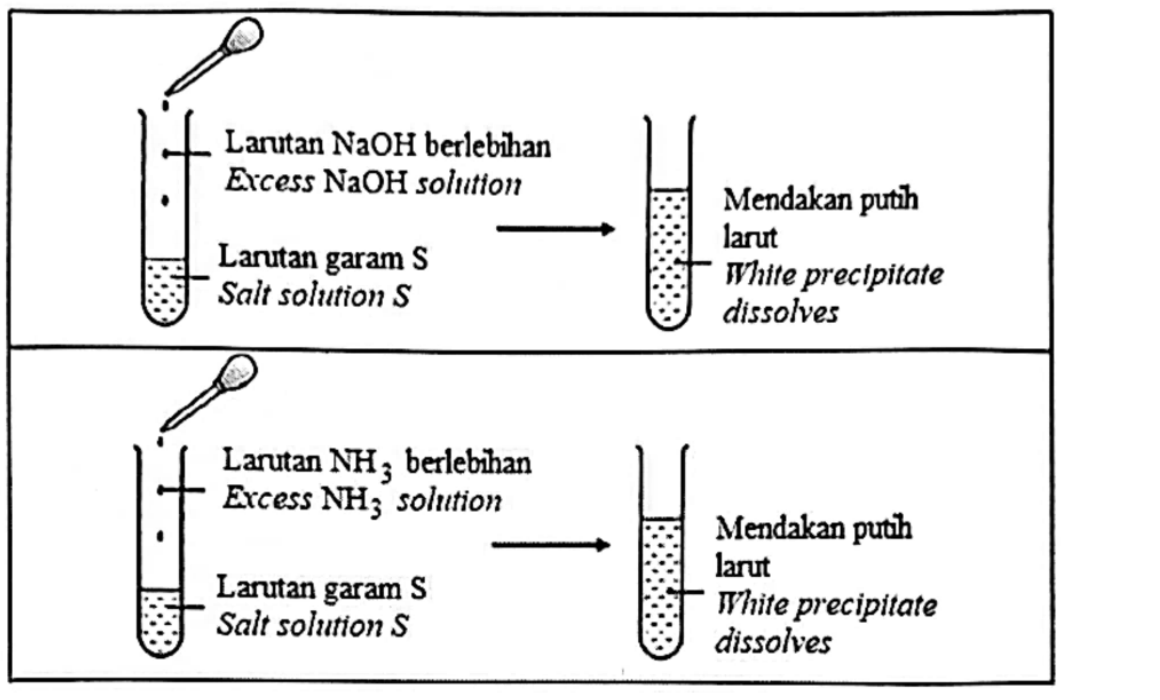
Diagram 14: salt solution S gives a white precipitate that dissolves in excess NaOH solution and in excess NH₃ solution. S is then added with sodium carbonate solution and a white precipitate forms, which is heated strongly. Which pair is correct about the cation in S and the observation for the residue of the heating? (A: Pb²⁺, brown when hot and yellow when cold; B: Zn²⁺, yellow when hot and white when cold; C: Cu²⁺, black solid; D: Al³⁺, white solid)
Medium
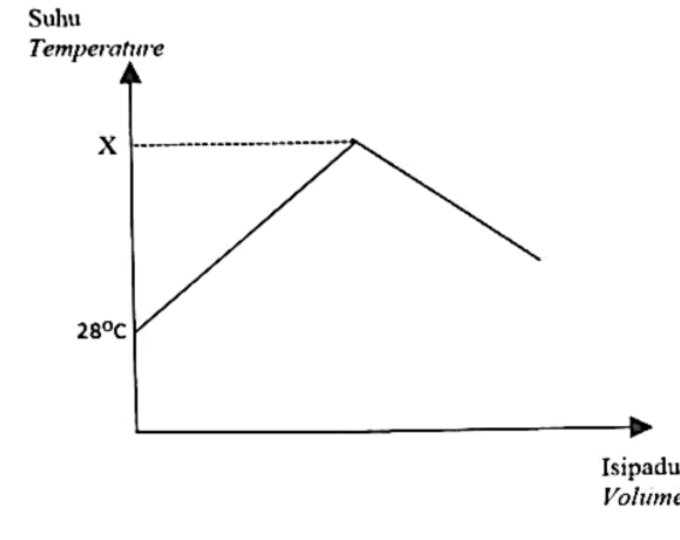
Diagram 15 shows the graph of temperature against volume of acid added for the reaction between sulphuric acid and sodium hydroxide solution that released 5.7 kJ of heat energy (initial temperature 28 °C, maximum X). 50 cm³ of 1 mol dm⁻³ sulphuric acid reacts completely with 100 cm³ of 1.0 mol dm⁻³ sodium hydroxide solution. Which pair is correct about the heat of neutralisation and the value of X? [Specific heat capacity of solution = 4.2 J g⁻¹ °C⁻¹, density of solution = 1.0 g cm⁻³]