Write your answer on paper. Then open the answer to check it.
Section A
Table 1 shows the information about three types of manufactured substances in industry. Substance X: composition concrete and steel bars or wire mesh; uses: construction of bridges, dams and buildings. Advanced ceramics: composition silicon carbide; uses: cutting disc, brake disc, tungsten carbide ring. Substance Y: composition yttrium barium copper oxide, YBCO ceramic; uses: to make electromagnets or supermagnets in particle accelerators, Nuclear Magnetic Resonance machines and Magnetic Resonance Imaging machines. Based on Table 1,
Medium5 marks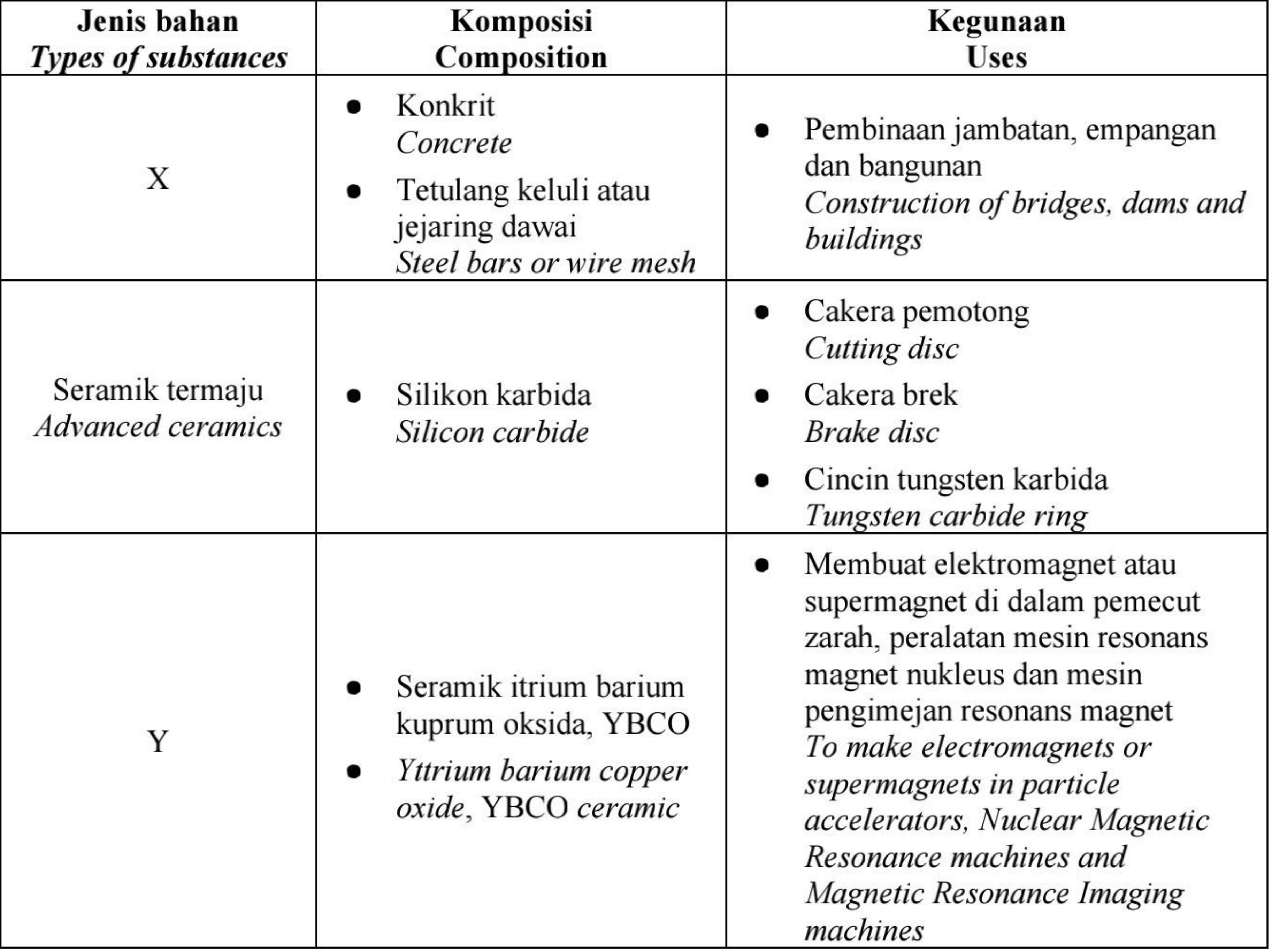
- (a)
Identify substances X and Y.
[2] - (b)
State the matrix substance and strengthening substance used to make substance X.
[2] - (c)
State one characteristic of advanced ceramic such as silicon carbide that makes it suitable to be used to make brake discs.
[1]
P is a substance that has melting point of 43 °C and boiling point 81 °C.
Medium5 marks- (a)
What is meant by melting point?
[1] - (b)
Sketch a graph of temperature against time when substance P is heated from 35 °C to 90 °C. (Blank axes are given.)
[2] - (c)
Draw the arrangement of particles in substance P at 30 °C and 90 °C. (Table with empty boxes for 30 °C and 90 °C.)
[2]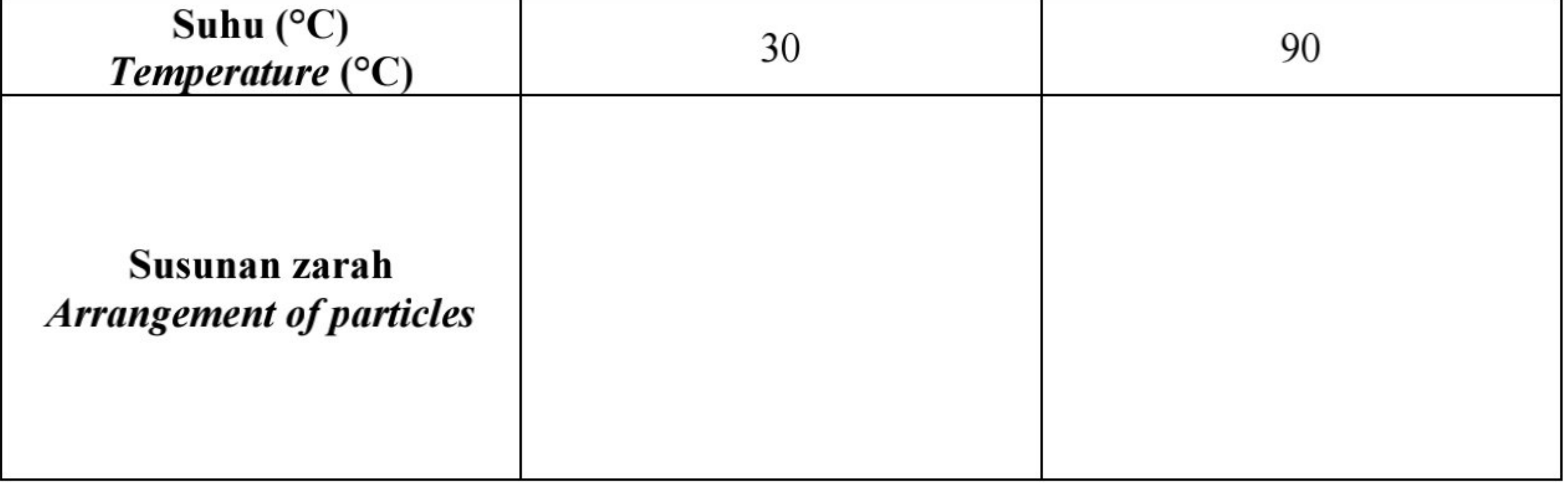
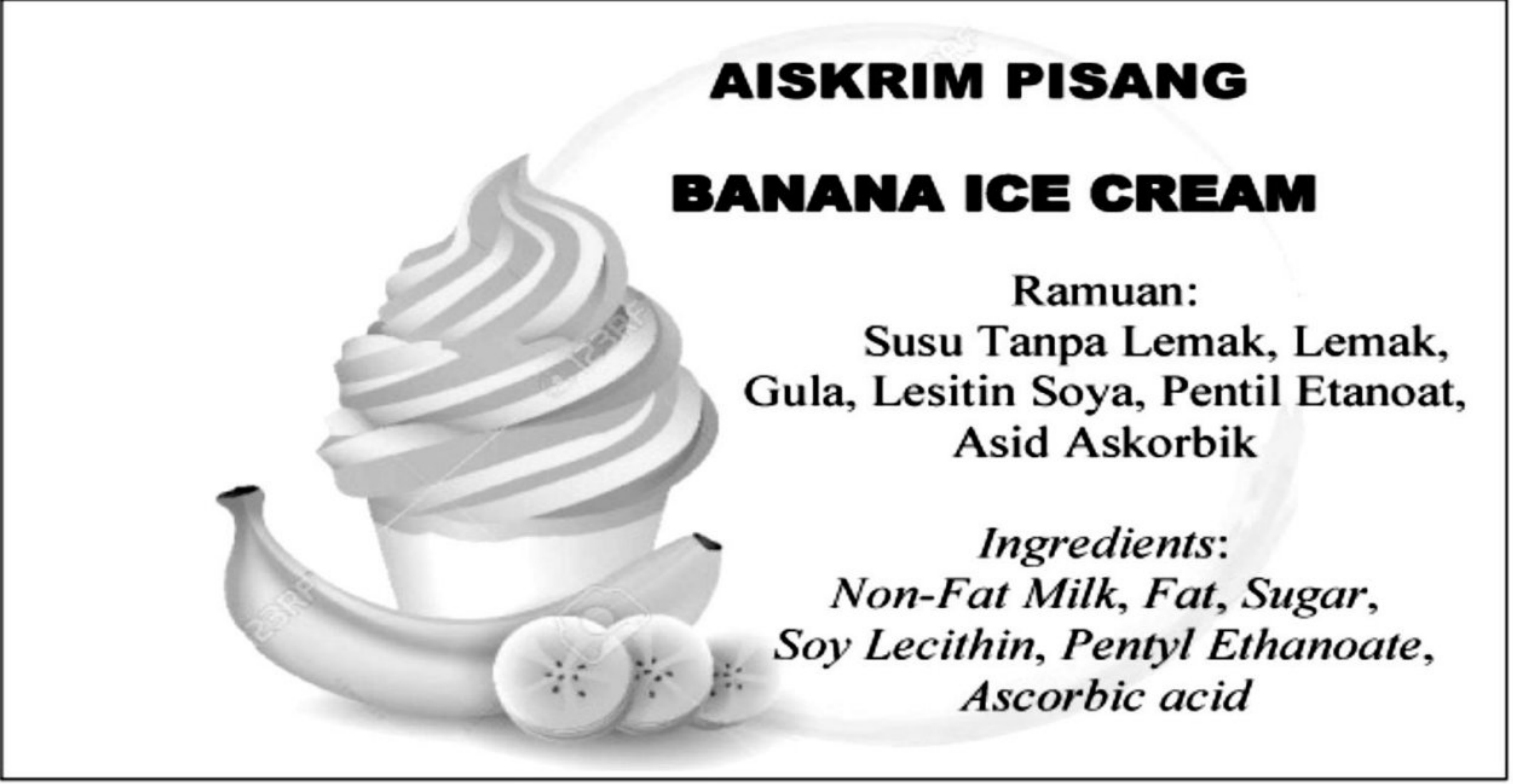
Diagram 3.1 shows the structural formula of a soap anion (a long hydrocarbon chain CH3-(CH2)n ending in -COO⁻). Diagram 3.2 shows a label of a pack of food: Banana ice cream. Ingredients: Non-Fat Milk, Fat, Sugar, Soy Lecithin, Pentyl Ethanoate, Ascorbic acid.
Medium6 marks
- (a)(i)
Circle the part of the soap anion that is soluble in water on Diagram 3.1.
[1] - (a)(ii)
Soap is not effective as a cleaning agent in hard water. Explain.
[2] - (a)(iii)
Soap can form foam with water. What is the function of foam?
[1] - (b)(i)
Based on the information, name the compound which is used as a stabiliser.
[1] - (b)(ii)
What will happen to ice cream when the compound in 3(b)(i) is not added?
[1]
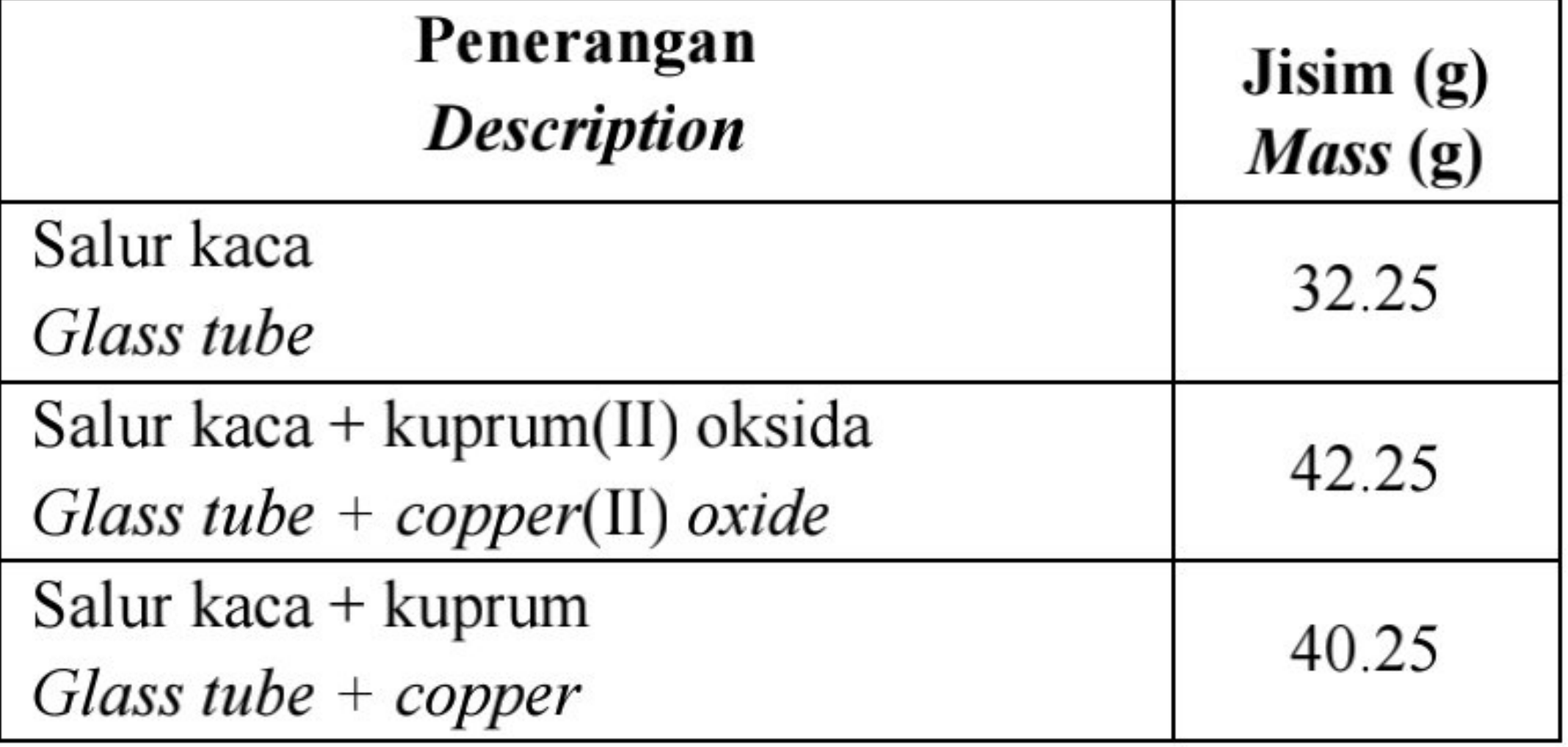
Diagram 4 shows the apparatus set-up to determine the empirical formula of copper(II) oxide (copper(II) oxide powder heated in a glass tube while hydrogen from zinc granules and 1.0 mol dm⁻³ hydrochloric acid passes over it). Table 4 shows the result of this experiment: Glass tube = 32.25 g; Glass tube + copper(II) oxide = 42.25 g; Glass tube + copper = 40.25 g.
Medium7 marks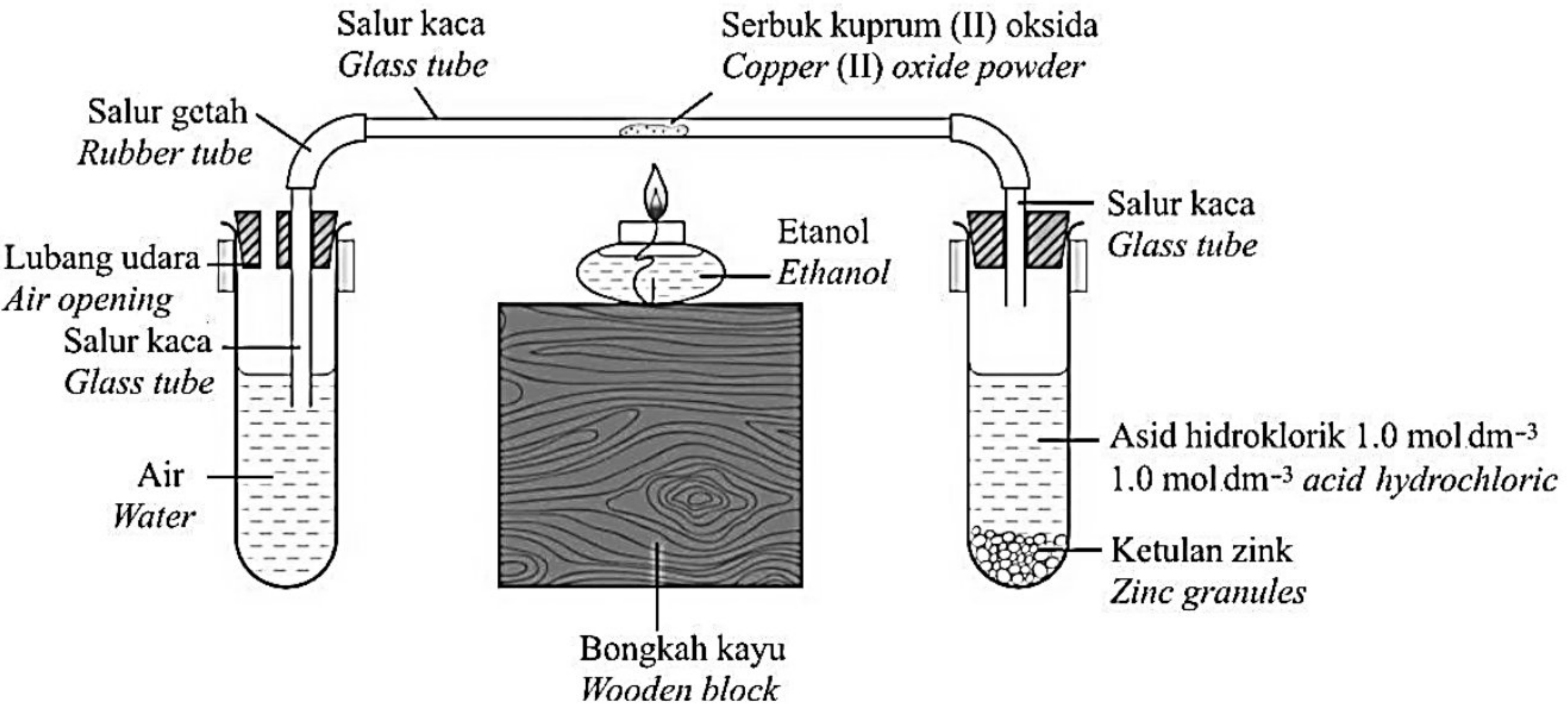
- (a)
What is the meaning of empirical formula?
[1] - (b)(i)
Based on the table above, calculate the mass of: copper; oxygen.
[2] - (b)(ii)
Calculate the ratio of moles of copper atoms to oxygen atoms. [Relative atomic mass: O = 16, Cu = 64]
[2] - (b)(iii)
Determine the empirical formula of copper(II) oxide.
[1] - (c)
State how to determine that the reaction between copper(II) oxide with hydrogen has completed.
[1]
Diagram 5 shows the information for two products using two types of acids, Acid X and Acid Y. Fruit pickles: pickled using Acid X, a monoprotic acid with pH 4.8. Lead acid accumulator: uses Acid Y, a diprotic acid with pH 1.0.
Medium8 marks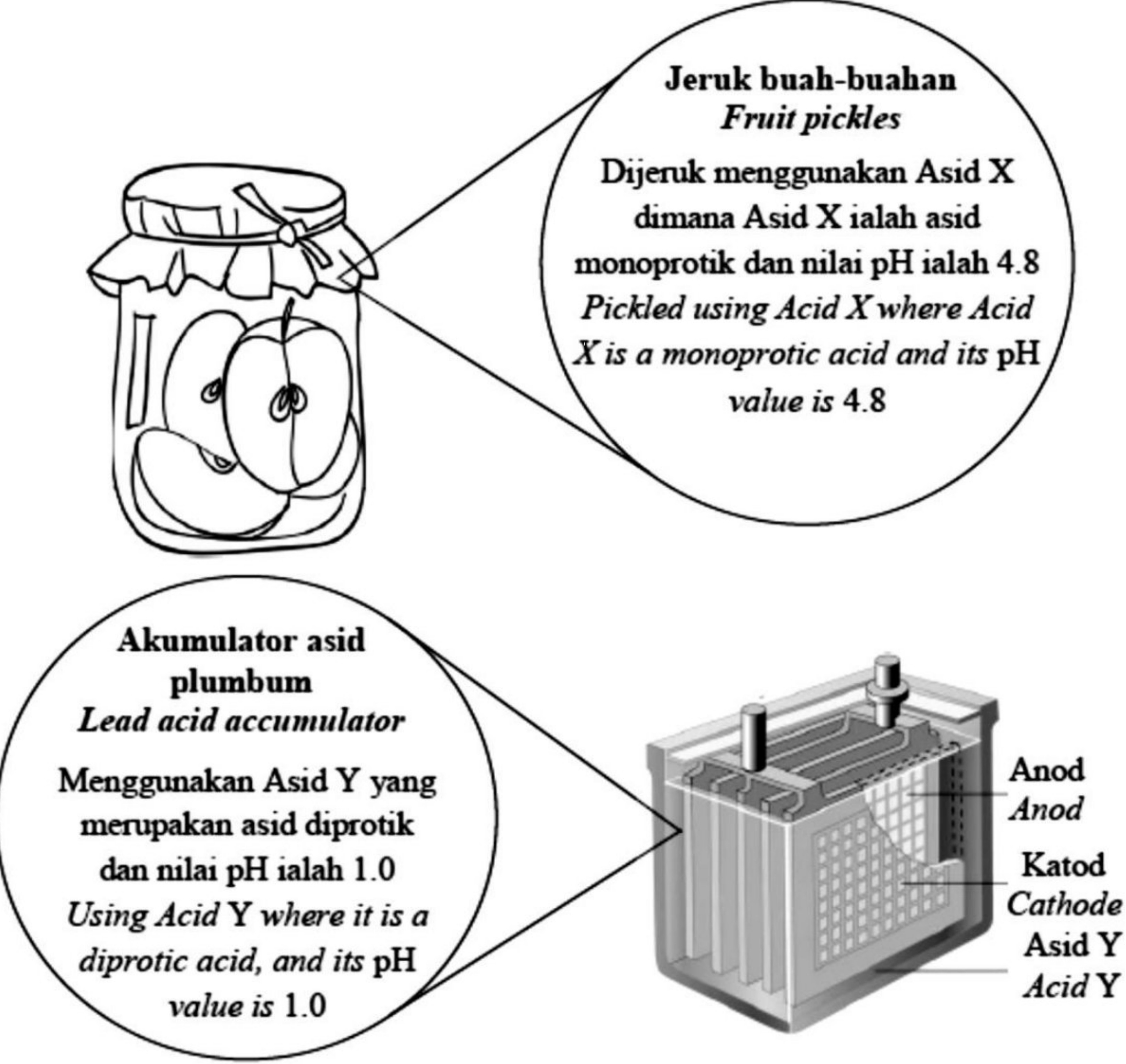
- (a)
State the meaning of acid.
[1] - (b)
Identify Acid Y.
[1] - (c)
Both Acids X and Y have the same concentration. Explain why the pH values for both acids in Diagram 5 are different.
[3] - (d)(i)
When 0.5 mol zinc carbonate is added into excess Acid Y, effervescence occurs. By using Acid Y stated in 5(b), write a chemical equation for the reaction.
[1] - (d)(ii)
Calculate the volume of gas produced at room condition. [Molar volume of gas at room conditions = 24 dm³ mol⁻¹]
[2]
Diagram 6 shows a series of reactions involving compound P, C₂H₅OH. Glucose undergoes Reaction I with yeast to form compound P, C₂H₅OH. Compound P reacts with K₂Cr₂O₇ / H⁺ to form compound S, and undergoes dehydration to form gas R.
Medium9 marks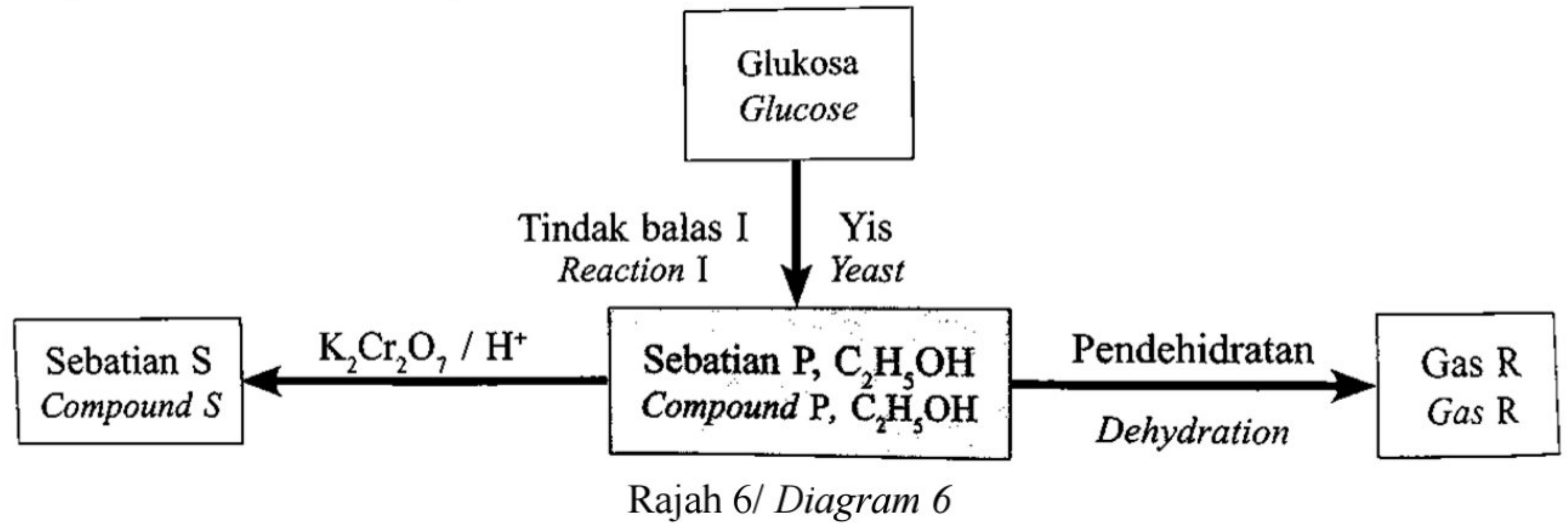
- (a)
State the name of reaction I.
[1] - (b)
State the name of compound P, C₂H₅OH.
[1] - (c)
Write a chemical equation for the complete combustion reaction of compound P.
[2] - (d)(i)
Based on Diagram 6, choose two substances that can react to produce a compound with sweet and fruity smell.
[1] - (d)(ii)
Draw the structural formula for the compound with sweet and fruity smell formed in 6(d)(i).
[1] - (e)
Table 6 shows the observations when gas R and ethane gas are delivered into two test tubes filled with bromine water separately. Gas R: brown colour of bromine water turns colourless. Ethane: brown colour of bromine water remains unchanged. Explain the differences in the observation in Table 6.
[3]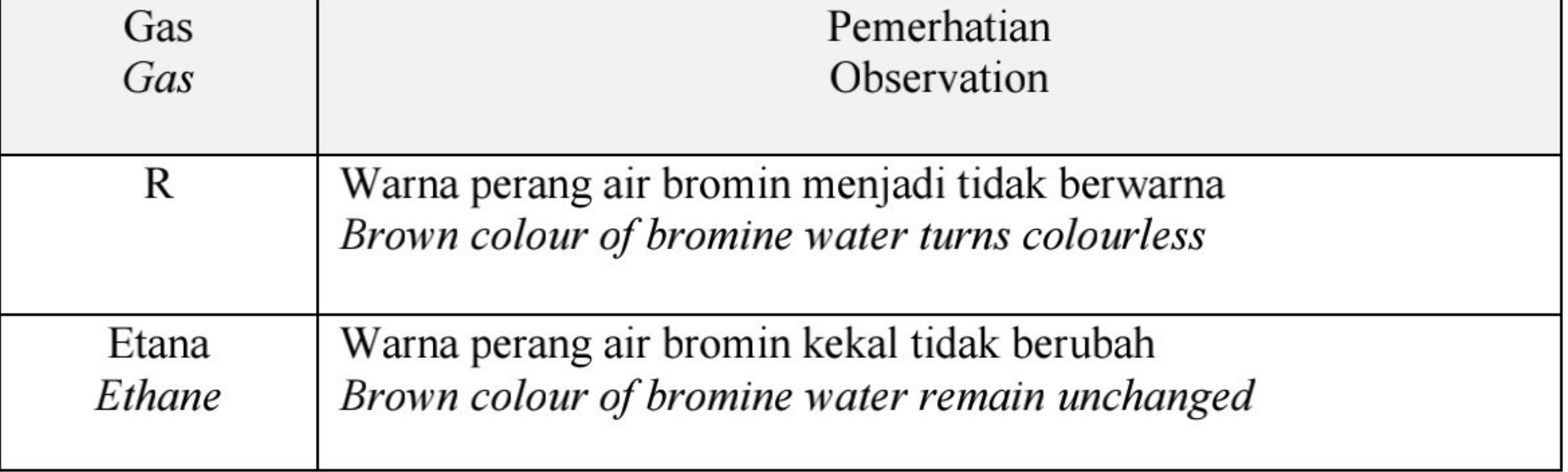
Diagram 7 shows the apparatus set up for electrolysis of 1.0 mol dm⁻³ copper(II) sulphate solution using carbon electrodes X and Y. Table 7 shows part of the standard electrode potential series: 2H⁺ + 2e ⇌ H₂, E° = 0.00 V; Cu²⁺ + 2e ⇌ Cu, E° = +0.34 V; O₂ + 2H₂O + 4e ⇌ 4OH⁻, E° = +0.40 V; S₂O₈²⁻ + 2e ⇌ 2SO₄²⁻, E° = +2.01 V.
Medium10 marks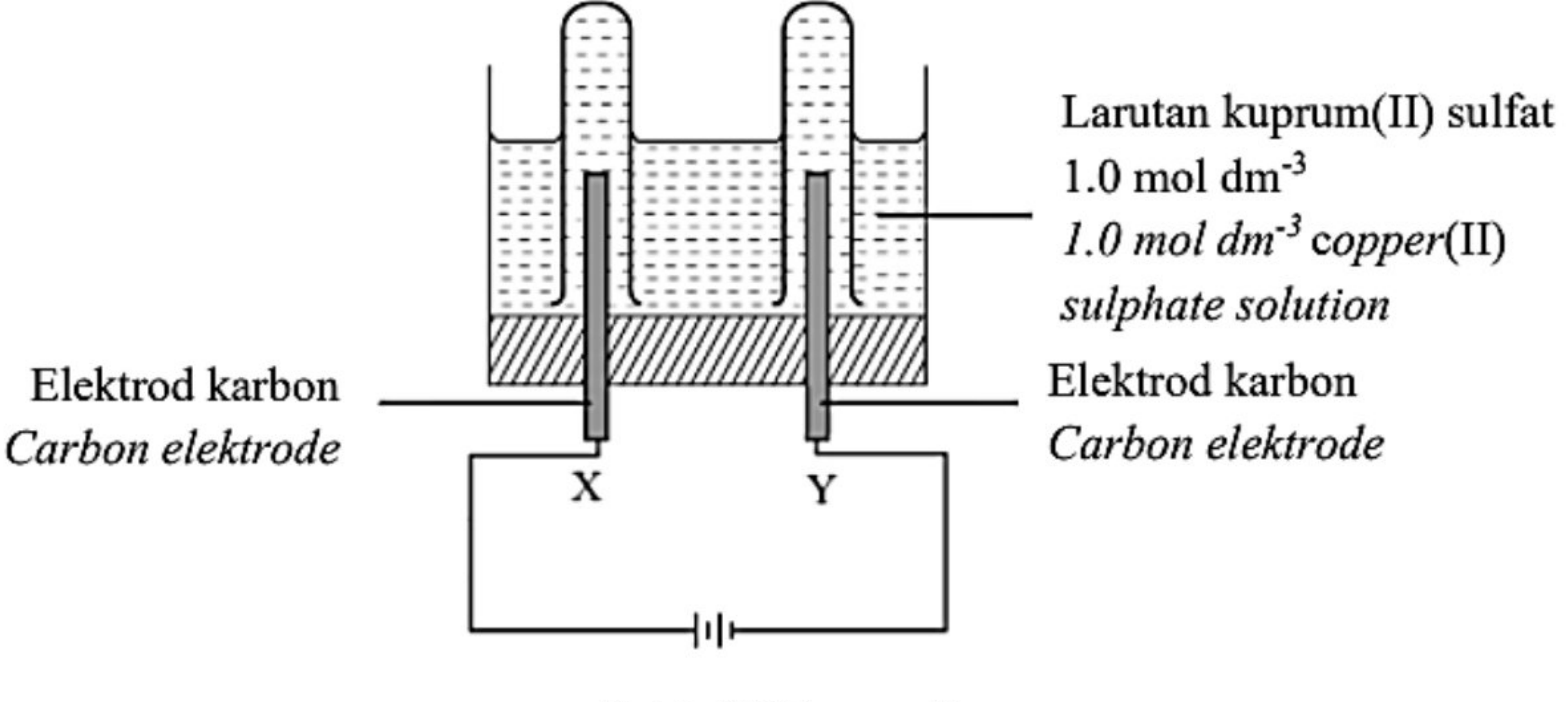
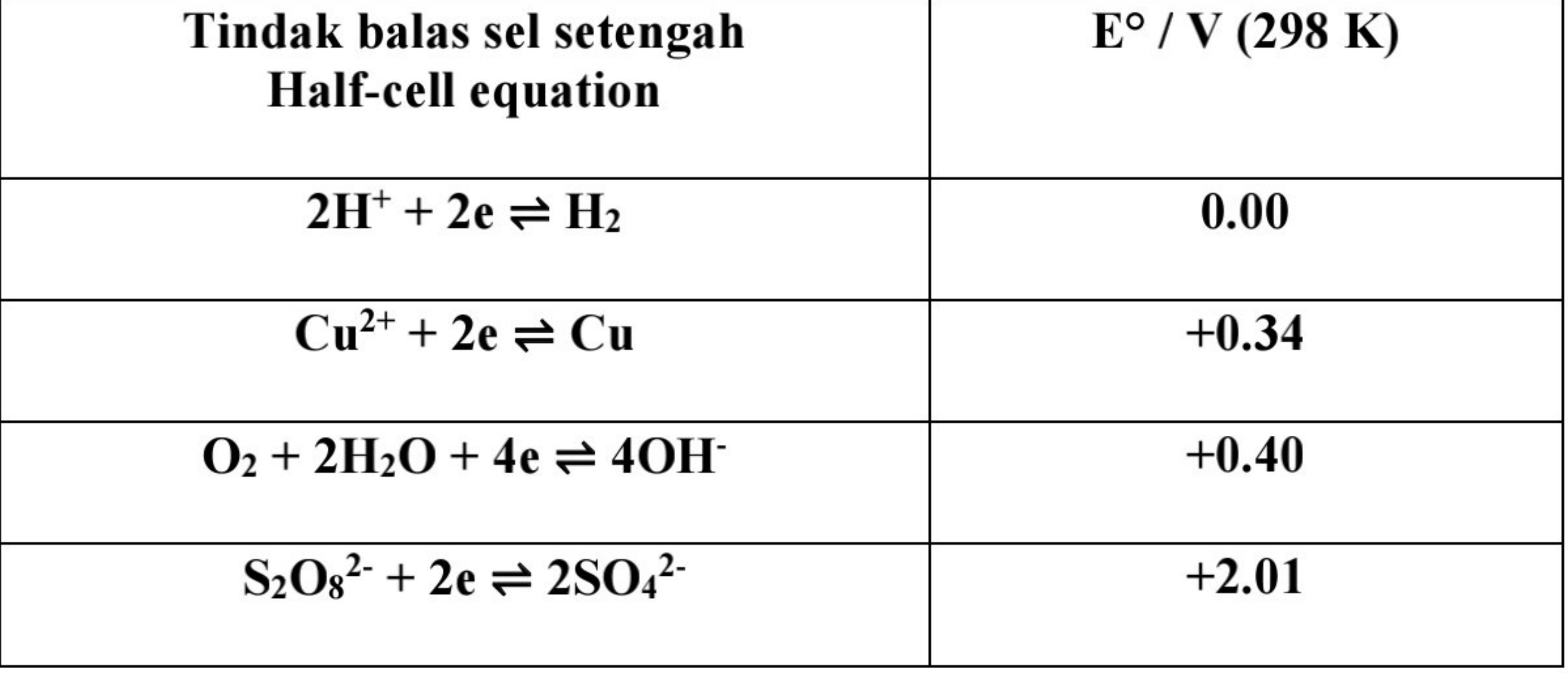
- (a)
State the energy change that take place in electrolysis process.
[1] - (b)
Determine electrode that act as cathode.
[1] - (c)
What can be observed at electrode X? Explain your answer.
[3] - (d)
Write half equation for the reaction that takes place at electrode X and electrode Y.
[2] - (e)(i)
Hilmi wants to electroplate his rusted iron keys with copper metal. By using the knowledge of electrolysis, suggest the name of the process to make the iron key look more attractive and resistant to corrosion.
[1] - (e)(ii)
Draw a suitable apparatus set-up to help Hilmi carry out the process in the laboratory.
[2]
Three sets of experiment are carried out to determine the factors that affect the rate of reaction. Table 8: Set I: excess calcium carbonate powder + 25 cm³ of 0.4 mol dm⁻³ hydrochloric acid. Set II: excess calcium carbonate powder + 25 cm³ of 0.2 mol dm⁻³ hydrochloric acid. Set III: excess calcium carbonate granules + 25 cm³ of 0.2 mol dm⁻³ hydrochloric acid.
Medium10 marks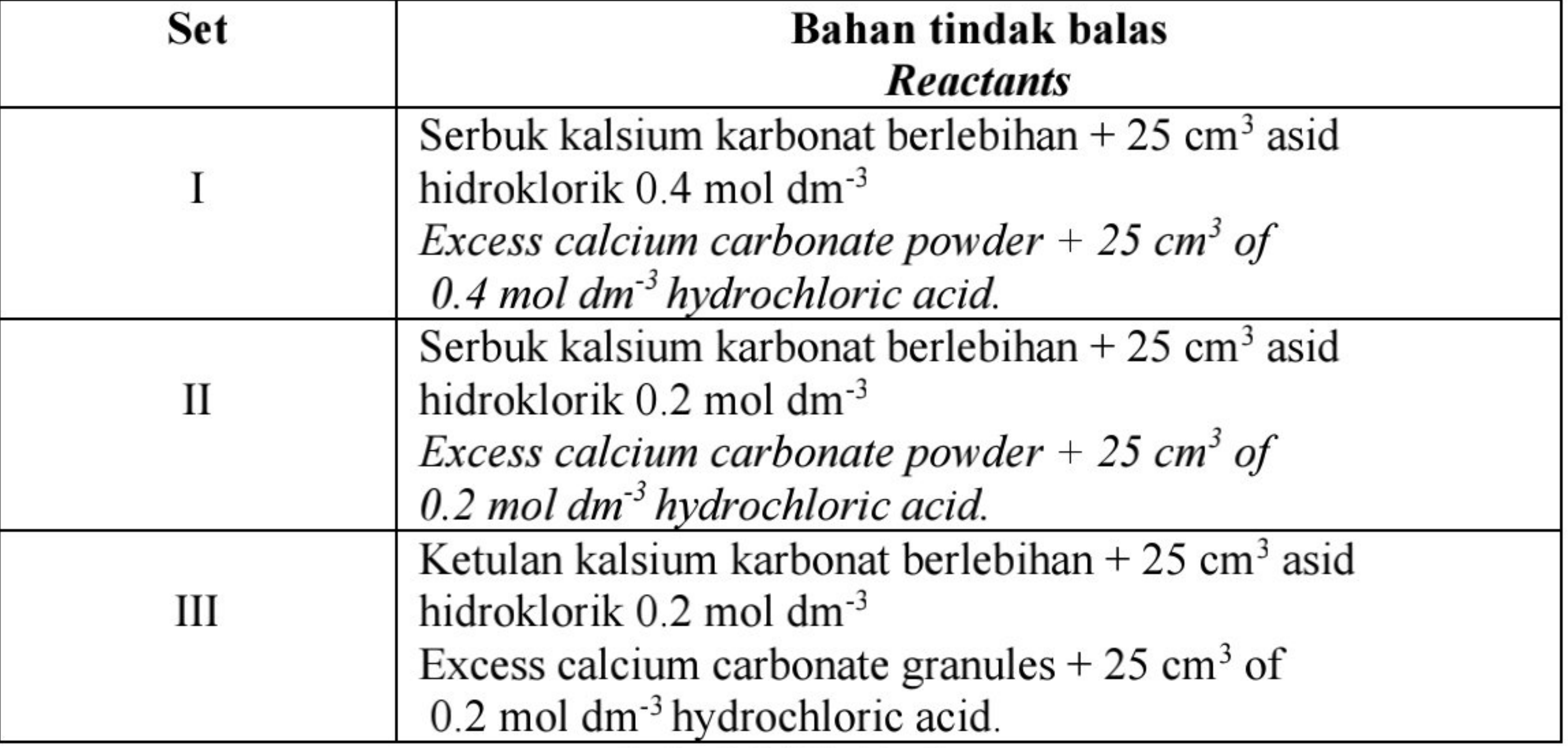
- (a)(i)
State the name of the gas collected.
[1] - (a)(ii)
Based on set I and set II, identify the factor that affects the rate of reaction.
[1] - (a)(iii)
The chemical equation is CaCO₃ + 2HCl → CaCl₂ + CO₂ + H₂O. Calculate the maximum carbon dioxide gas produced in set I at room condition. [1 mol of any gas occupies 24 dm³ at room conditions]
[3] - (a)(iv)
On the same axis, sketch graphs for the volume of gas against time for set I, set II and set III.
[2] - (b)
In your opinion, should smaller potatoes size or larger potatoes size be faster to cook? Justify your answer.
[3]
Section B
Question 9 has parts (a) to (c) (Section B, answer any one of Q9 or Q10).
Hard20 marks- (a)(i)
Table 9.1: Reaction I (occurs all day; heat released to surrounding; C₆H₁₂O₆ + 6O₂ → 6CO₂ + 6H₂O; -x kJ mol⁻¹). Reaction II (occurs in the day only; heat absorbed from surrounding; 6CO₂ + 6H₂O → C₆H₁₂O₆ + 6O₂; +y kJ mol⁻¹). State the type of Reaction I and Reaction II.
[2]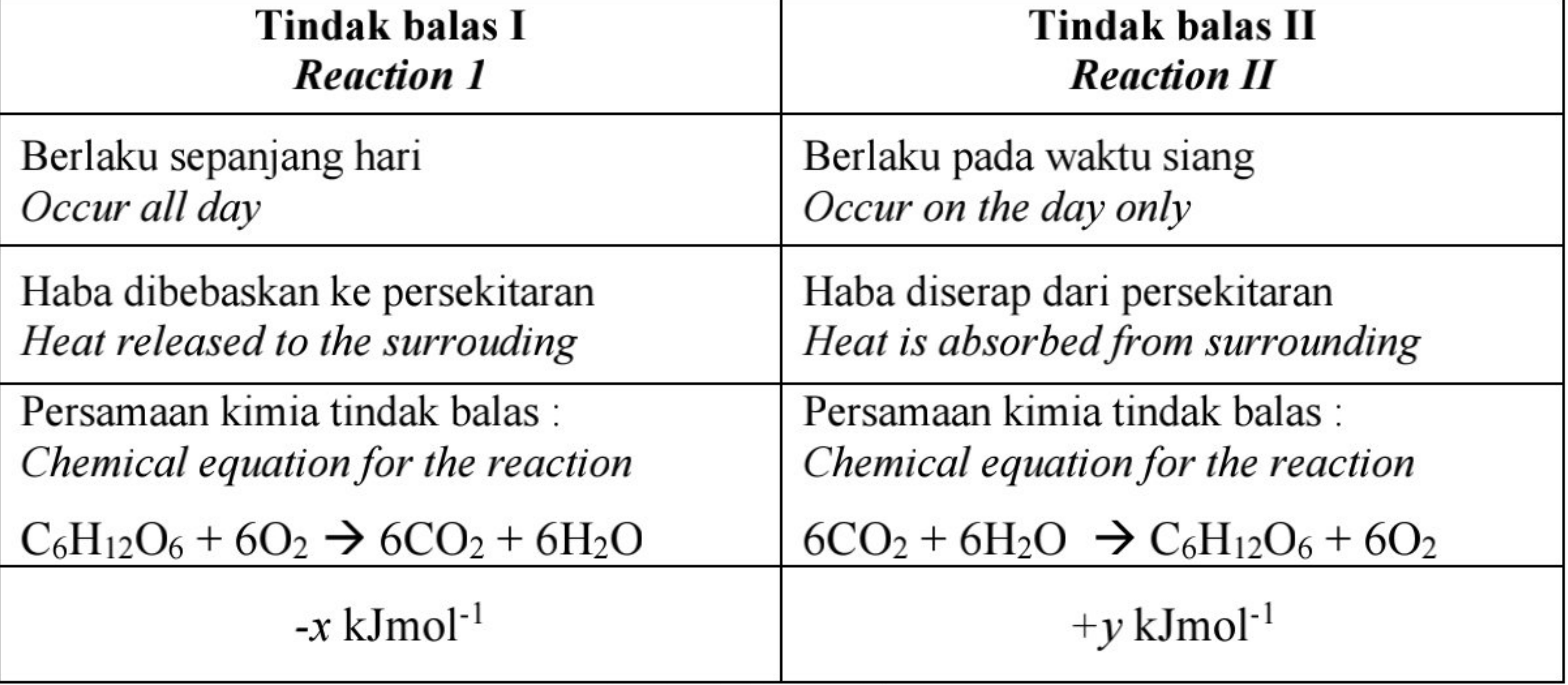
- (a)(ii)
Compare Reaction I and Reaction II in terms of: change in the total energy content of reactants and products; formation and breaking of bonds.
[4] - (b)(i)
The equation Q + Pb(NO₃)₂ → Q(NO₃)₂ + Pb represents a displacement reaction between metal Q and lead(II) nitrate solution. Given: Zn²⁺(aq) + 2e → Zn(s) E° = -0.76 V; Pb²⁺(aq) + 2e → Pb(s) E° = -0.13 V; Cu²⁺(aq) + 2e → Cu(s) E° = +0.34 V. What is meant by heat of displacement?
[1] - (b)(ii)
Suggest metal Q based on E° value above.
[1] - (b)(iii)
The heat of displacement for the reaction is -112 kJ mol⁻¹. Calculate the change in temperature when excess Q powder is added to 100 cm³ of 0.5 mol dm⁻³ lead(II) nitrate solution. [Specific heat capacity of solution = 4.2 J g⁻¹ °C⁻¹; density of solution = 1.0 g cm⁻³]
[3] - (b)(iv)
Draw an energy level diagram for the reaction.
[2] - (c)
Table 9.2 shows the heat of neutralisation for two sets using different monopotic acids reacting with sodium hydroxide: Set I: 50 cm³ of 1.0 mol dm⁻³ acid X + 50 cm³ of 1.0 mol dm⁻³ NaOH, -53.7 kJ mol⁻¹. Set II: 50 cm³ of 1.0 mol dm⁻³ acid Y + 50 cm³ of 1.0 mol dm⁻³ NaOH, -57.3 kJ mol⁻¹. Suggest acid X. Compare and explain the difference in the values of heat of neutralisation for the two sets.
[7]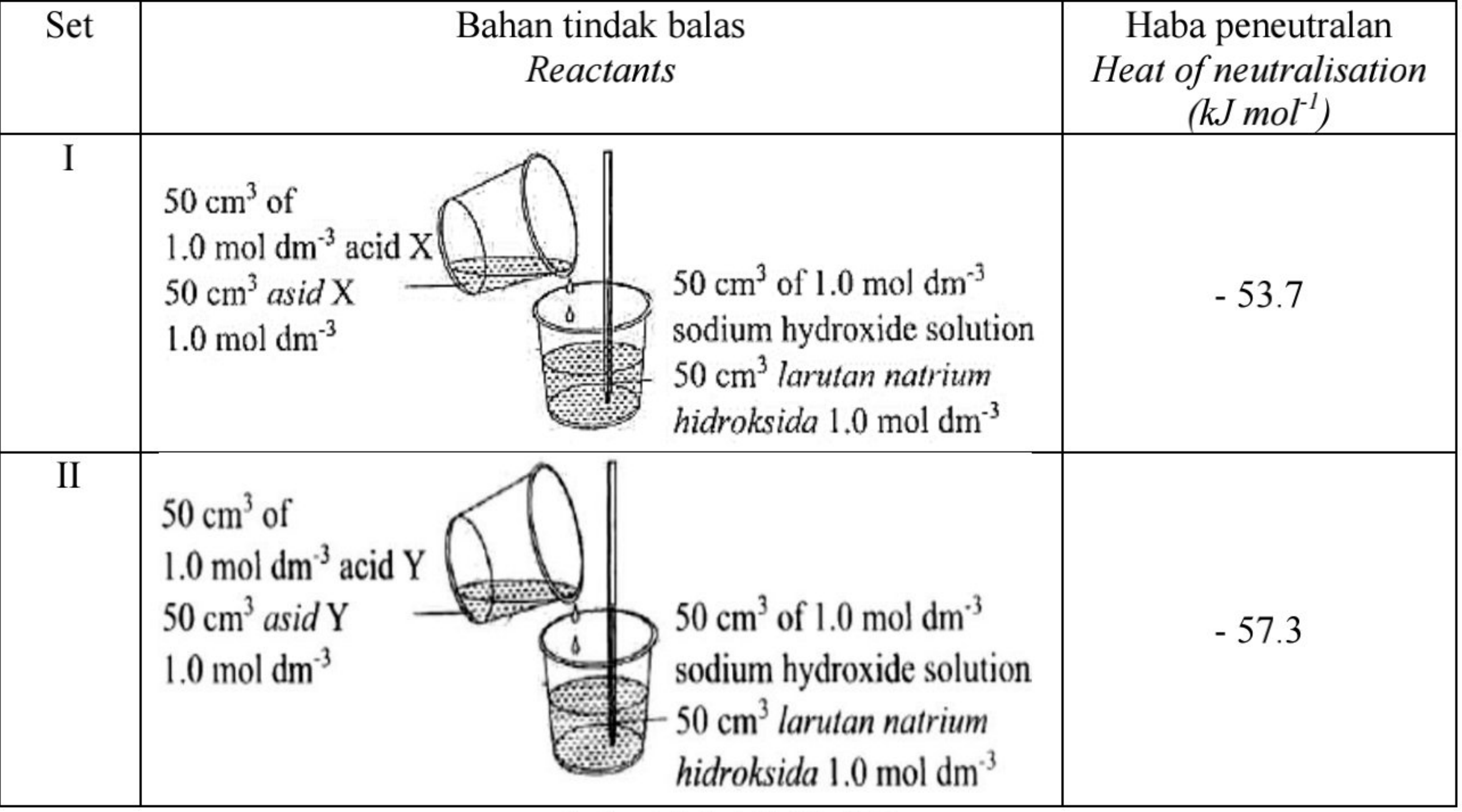
Question 10 has parts (a) to (c) (Section B, answer any one of Q9 or Q10).
Medium20 marks- (a)
Diagram 10.1 shows the electron arrangement for XY compound (X²⁺ with electron arrangement 2.8.8 and Y²⁻ with electron arrangement 2.8.8). Based on diagram 10.1, explain the position of element X in the Periodic Table.
[4]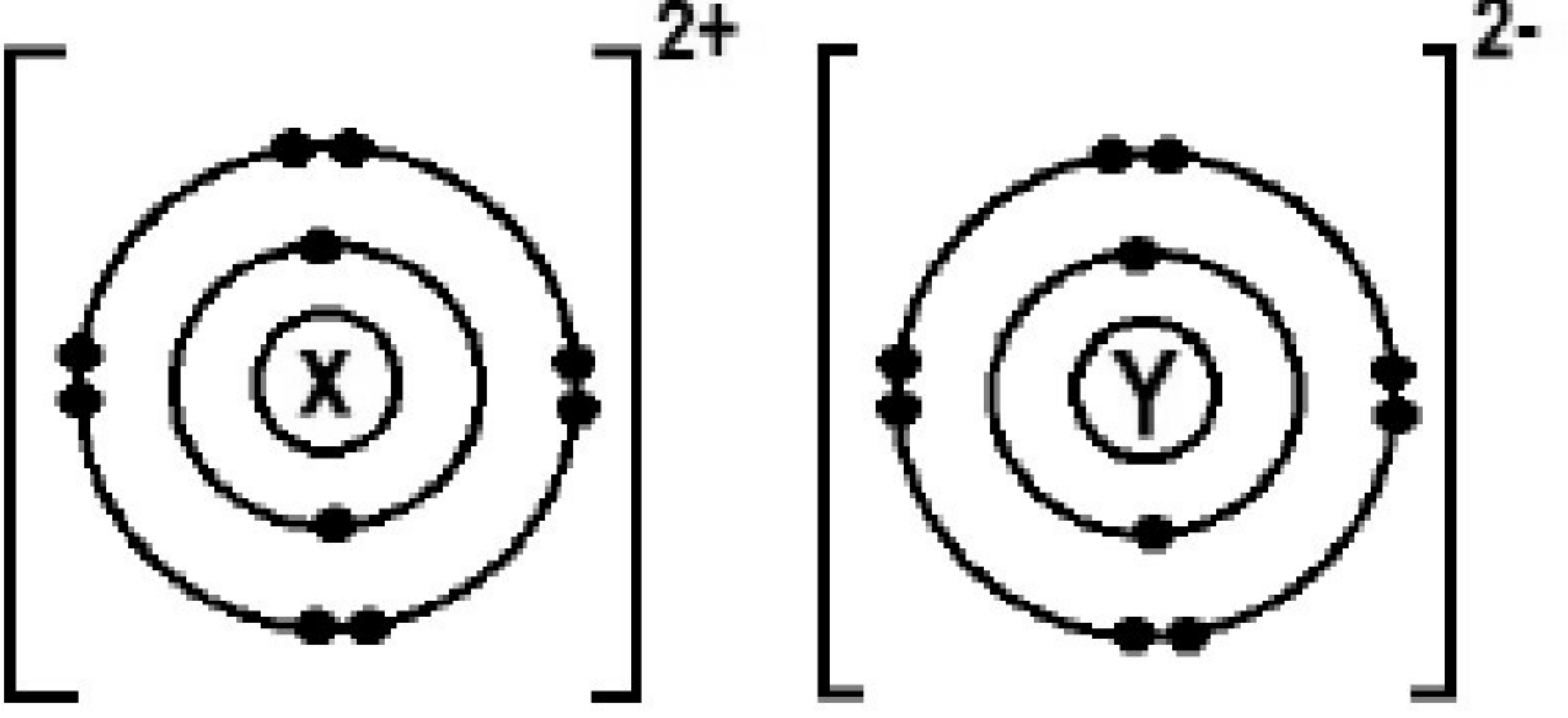
- (b)
Diagram 10.2 shows chemical symbols for three elements: ¹²₆P, ²³₁₁Q, ¹⁶₈R (letters are not actual symbols). (i) Identify two elements that can form a compound that has low melting point. (ii) Explain the formation of compound formed by elements in (b)(i).
[6]
- (c)
Diagram 10.3 and Table 10.1 show the apparatus setup and observations for an experiment to study electrical conductivity and melting point between ionic and covalent compound. Lead(II) bromide, PbBr₂: solid - bulb does not light up; molten - bulb lights up. Naphthalene, C₁₀H₈: solid and molten - bulb does not light up. Based on your observation, explain the difference in observation between the compounds in terms of: electrical conductivity; melting point.
[10]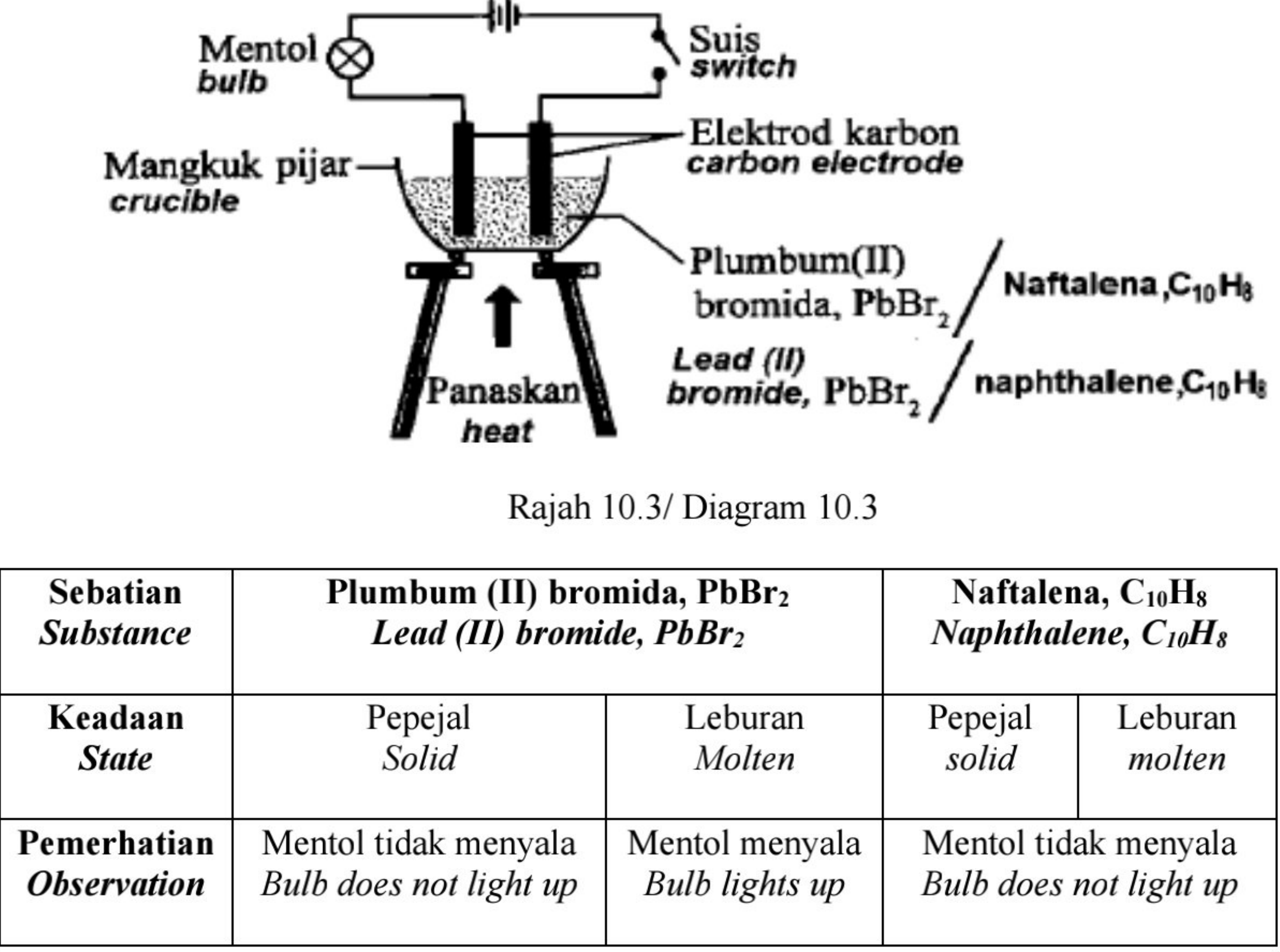
Section C
Question 11 has parts (a) to (c) (Section C).
Hard20 marks- (a)
Solution X is added to solution Y to form barium sulphate. State the name of the reaction and the name of solution X and solution Y. Write the ionic equation for the reaction.
[4] - (b)(i)
Table 11 shows the information on action of heat for lead salt Q: residue R is brown solid when hot, yellow when cold; gas A is brown gas; gas B rekindles glowing splinter. Based on table 11, identify residue R, gas A and gas B. Write the chemical formula for salt Q.
[4]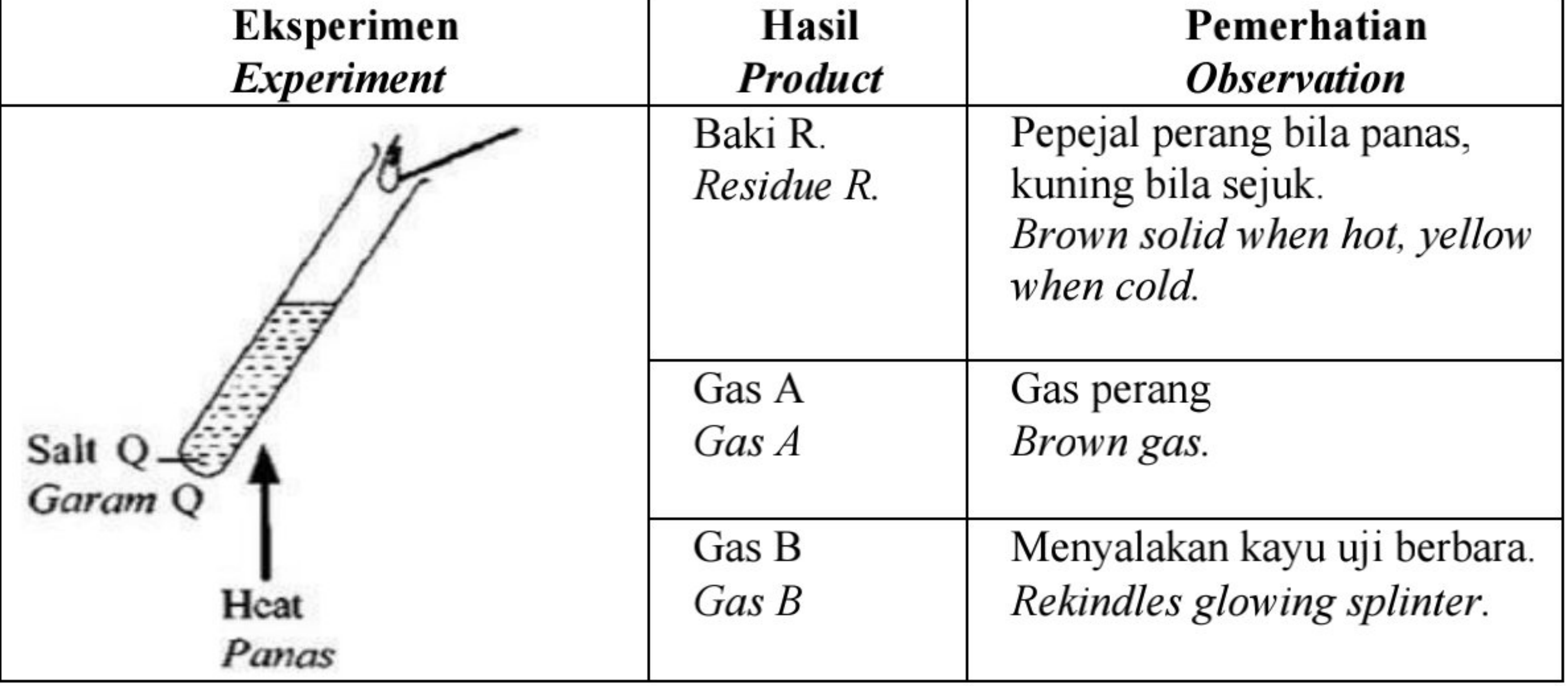
- (b)(ii)
Name the anion present in salt Q and describe a confirmation test for the anion.
[4] - (c)
You are given three chemicals: sodium carbonate solution, dilute sulphuric acid, zinc chloride solution. By using all the three chemicals, describe how to prepare zinc sulphate salt in the laboratory. In your description, include: procedure.
[8]