Write your answer on paper. Then open the answer to check it.
Section A
Helmets and camera lenses are made up of composite material. Diagram 1 shows the magnetic resonance imaging (MRI) equipment used in hospital, which is made of composite material.
Medium5 marks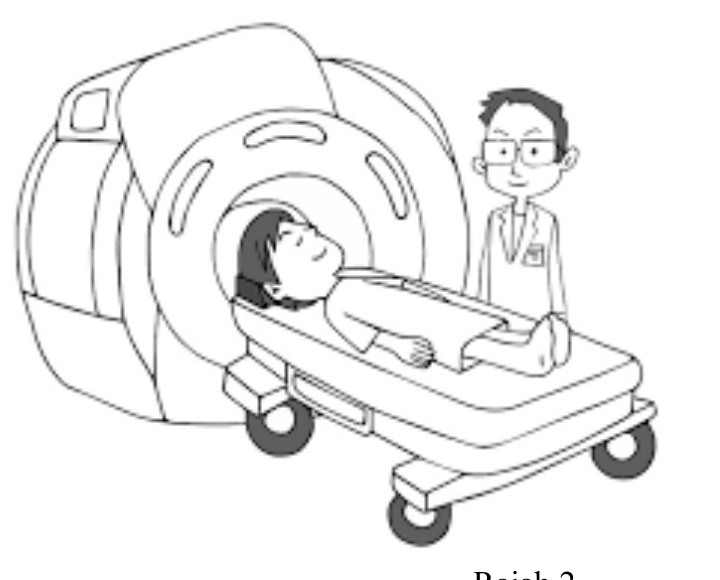
- (a)(i)
What is the meaning of composite material?
[1] - (a)(ii)
What is the composite in: helmet; camera lens?
[2] - (b)(i)
Name the composite material in the device (MRI).
[1] - (b)(ii)
State the reason this composite material is being used.
[1]
Diagram 2 shows a graph of temperature against time for the cooling of naphthalene. The curve falls from K (temperature Y3) to L, stays constant at temperature Y2 from L to M, then falls from M to N (Y1).
Medium5 marks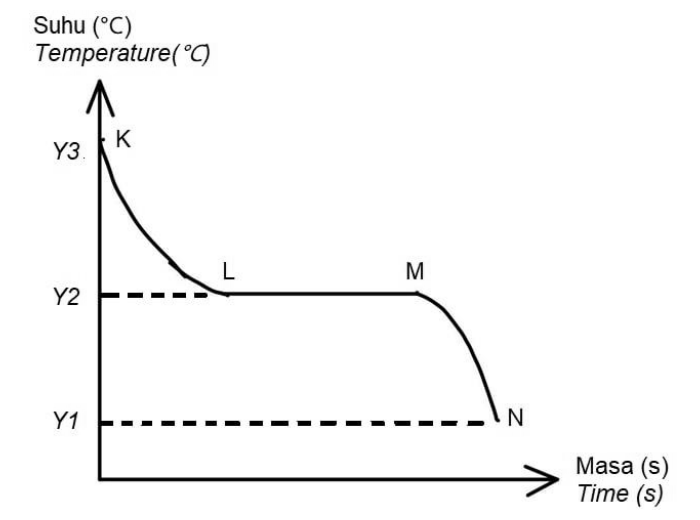
- (a)(i)
What is the meaning of freezing point?
[1] - (a)(ii)
What is the freezing point of naphthalene?
[1] - (a)(iii)
Why does the temperature from L to M remain unchanged?
[1] - (b)(i)
The state of particles at M to N is solid. Draw the arrangement of particles.
[1] - (b)(ii)
State the type of particles of naphthalene.
[1]
Diagram 3 shows the ingredients on the label of a bottle of chilli sauce (chilli, sugar, salt, cornflour, artificial colouring and sodium benzoate) and an ice-cream (milk, propyl ethanoate, sugar, artificial colouring, food additive R).
Medium6 marks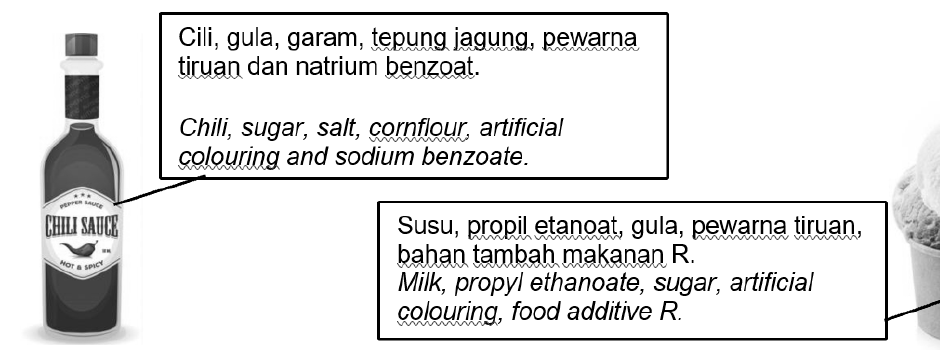
- (a)(i)
State the type of food additive that sodium benzoate is and what is its function.
[2] - (a)(ii)
What is the effect of taking excessive sodium benzoate for a long period of time?
[1] - (a)(iii)
Food additive R gives uniform and smooth texture in ice-cream. State the type of food additive R.
[1] - (a)(iv)
Puan Azwa wants to prepare a dessert without synthetic dyes. Suggest an ingredient she should add instead, and state the benefit of using it.
[2]
(a) Table 1 shows the empirical and molecular formulae of three compounds: X (empirical CH, molecular C6H6); Y (empirical C2H4O, molecular formula blank); Z (empirical Cu(NO3)2, molecular Cu(NO3)2). (b) Diagram 4 shows the set-up of the apparatus to determine the empirical formula of magnesium oxide: magnesium ribbon heated in a crucible with a lid.
Medium7 marks- (a)(i)
State the meaning of molecular formula.
[1]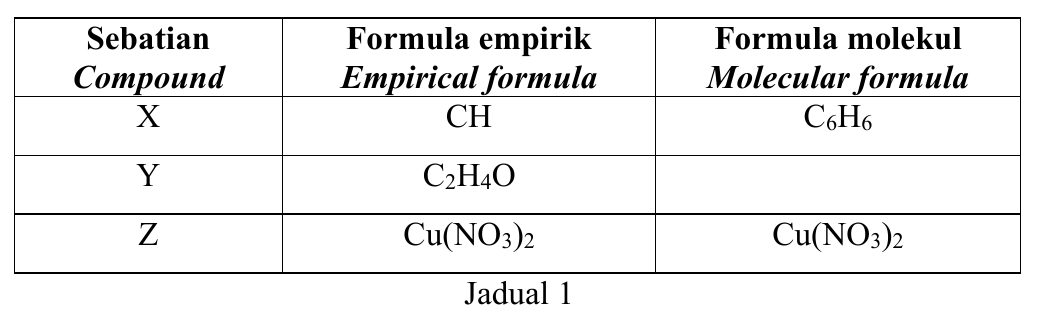
- (a)(ii)
Relative molecular mass of compound Y is 88. Determine the molecular formula of compound Y. [Relative atomic mass: C = 12, H = 1, O = 16]
[2] - (b)(i)-1
How can you determine that the reaction between magnesium and oxygen has completed?
[1]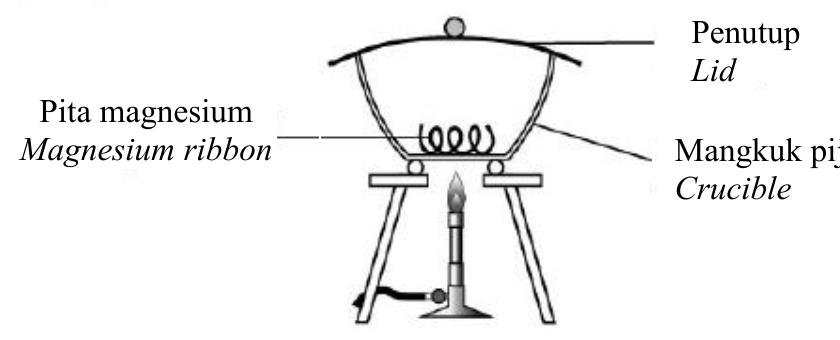
- (b)(i)-2
Why does the lid of the crucible need to be opened once in a while during the experiment?
[1] - (b)(ii)
Write the chemical equation for this reaction.
[2]
Diagram 5 shows an experiment by Mee Ling to construct the ionic equation of an insoluble salt using the continuous variation method: 1, 2, 3, 4, 5, 6, 7 and 8 cm3 of 1 mol dm-3 potassium iodide solution are added to eight test tubes each containing 5 cm3 of 0.5 mol dm-3 lead(II) nitrate solution. The graph shows height of precipitate (cm) against volume of potassium iodide solution: rises from 0 to 5 cm at 5 cm3 then stays constant at 5 cm.
Medium8 marks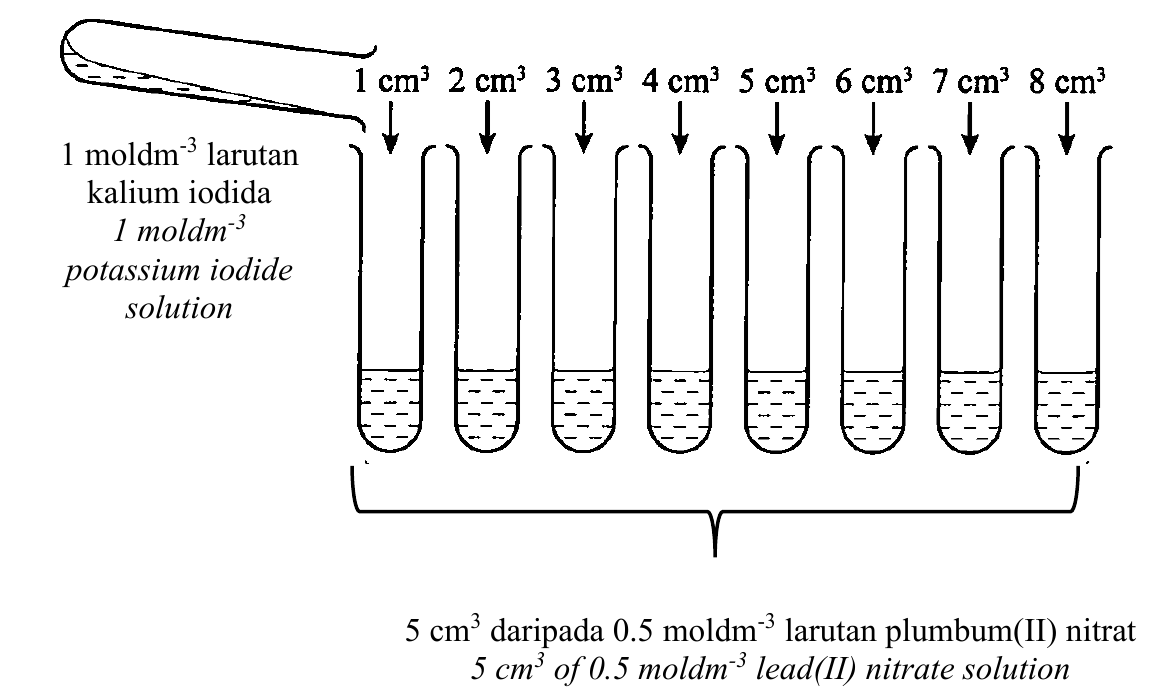
- (a)
Give the meaning of salt.
[1] - (b)
Calculate the number of mol in 5 cm3 of 0.5 mol dm-3 lead(II) nitrate solution.
[1] - (c)(i)
What is the volume of potassium iodide solution needed for complete reaction with the lead(II) nitrate solution?
[1]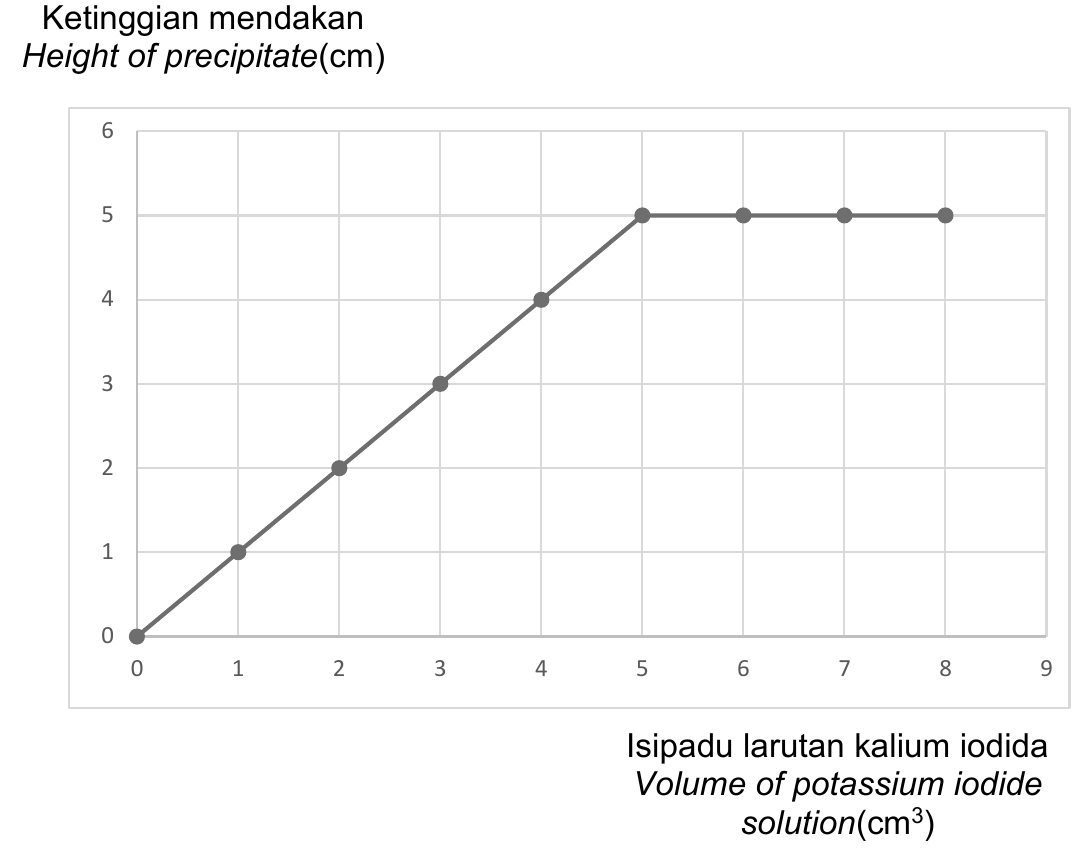
- (c)(ii)
Calculate the number of mol of potassium iodide that reacted with the 0.5 mol dm-3 lead(II) nitrate solution. Then calculate the number of mol of iodide ion, I-, that completely reacted with 1 mol of lead ion, Pb2+.
[3] - (d)
State one similarity and one difference between lead(II) iodide and lead(II) chloride.
[2]
Diagram 6 shows the conversion of compound A (but-1-ene, CH2=CH-CH2-CH3) to compound B (a four-carbon alcohol, butanol, C4H9OH) by reaction I (+ H2O).
Medium9 marks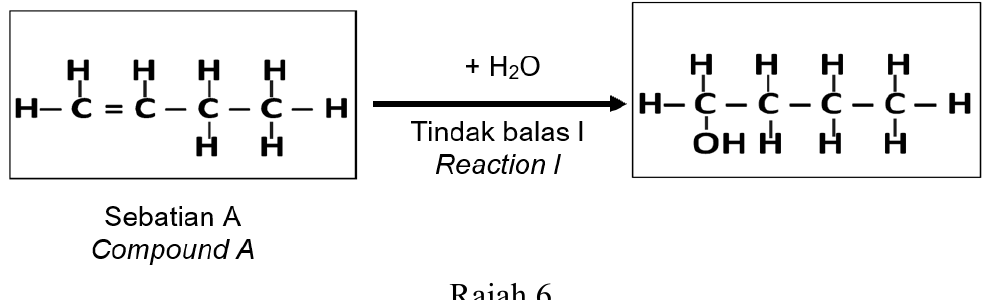
- (a)
Compound A has three isomers. Draw one isomer of compound A other than the structure above. Name the isomer.
[2] - (b)(i)
Name reaction I.
[1] - (b)(ii)
What conditions are needed for reaction I to occur?
[1] - (b)(iii)
Write the chemical equation for the combustion of compound B in air.
[2] - (c)
Describe a chemical test to differentiate between compound A and compound B.
[3]
Diagram 7.1 shows cell X (carbon electrodes P and Q in molten lead(II) iodide, heated, connected to a battery) and cell Y (carbon electrodes R and S in 1.0 mol dm-3 hydrochloric acid). Diagram 7.2 shows a chemical cell: zinc in zinc nitrate solution and copper in copper(II) nitrate solution joined by a salt bridge and voltmeter. Standard electrode potentials: Zn2+ + 2e ⇌ Zn, E° = -0.76 V; Cu2+ + 2e ⇌ Cu, E° = +0.34 V.
Medium10 marks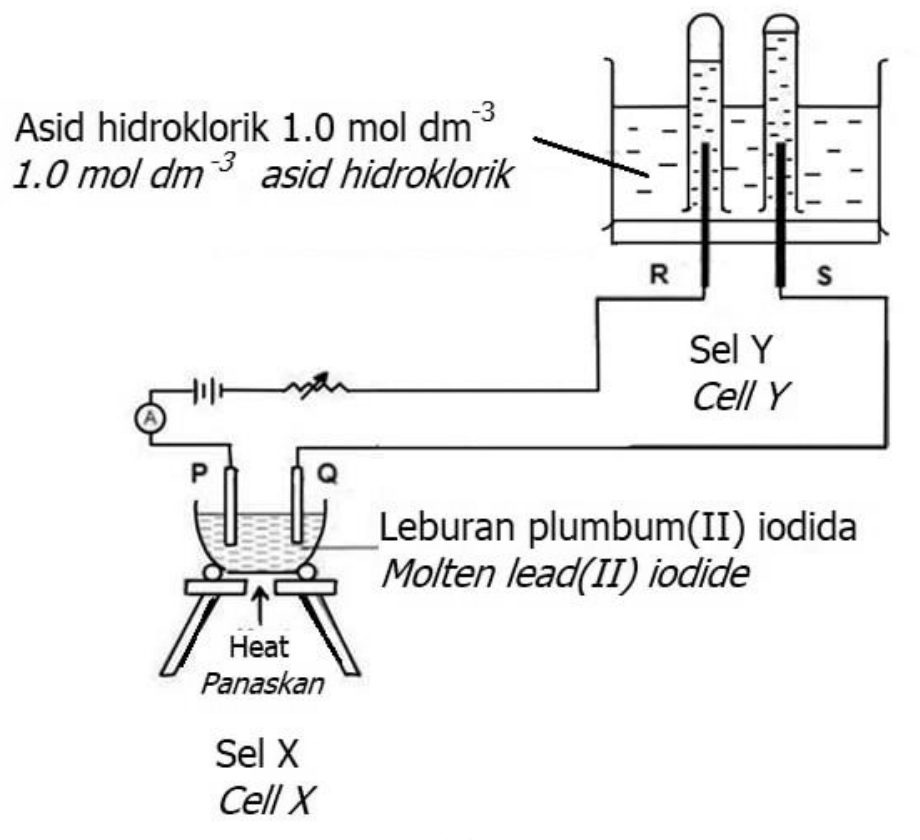
- (a)(i)
Write ionic formulae for all the ions present in molten lead(II) iodide.
[1] - (a)(ii)
State the cathode for cell Y.
[1] - (a)(iii)
Write the half equation for the reaction at electrode P and electrode Q in cell X.
[2] - (a)(iv)
Write the chemical equation when the product at electrode S reacts with water.
[1] - (a)(v)
The solution formed in 7(a)(iv) is tested with test X. State test X and its observation.
[2] - (b)(i)
Based on Diagram 7.2, calculate the voltage of the cell.
[1]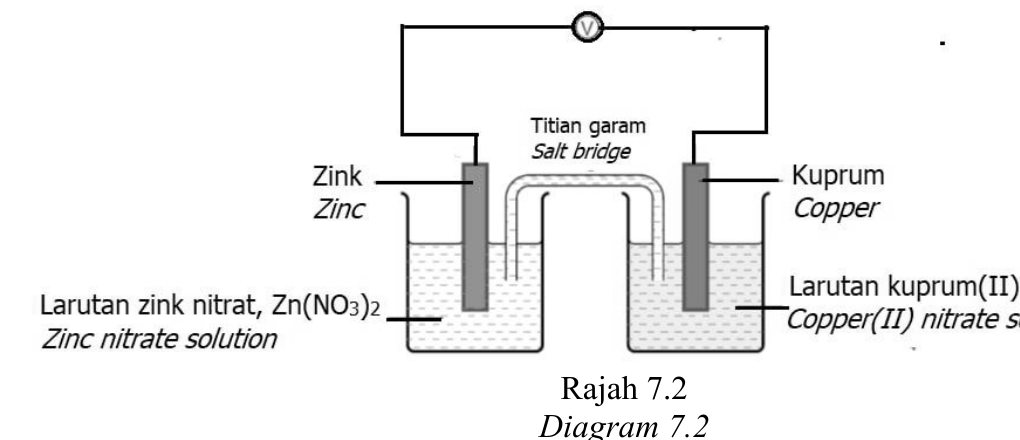
- (b)(iii)
You are provided with a tomato, connecting wire, LED, a magnesium plate and a lead (plumbum) plate. How can you create a simple chemical cell?
[2]
Diagram 8.1 shows apparatus to study the rate of reaction by the decrease in mass of the flask over time: magnesium reacts with 100 cm3 of 0.5 mol dm-3 hydrochloric acid in a conical flask with a cotton wool plug on an electronic balance. Mg(s) + 2HCl(aq) → MgCl2(aq) + H2(g). Table: balance reading (g) 243.0, 241.38, 240.57, 240.57, 240.57 at time (s) 0, 30, 60, 90, 120.
Medium10 marks- (a)(i)
What is the meaning of rate of reaction?
[1]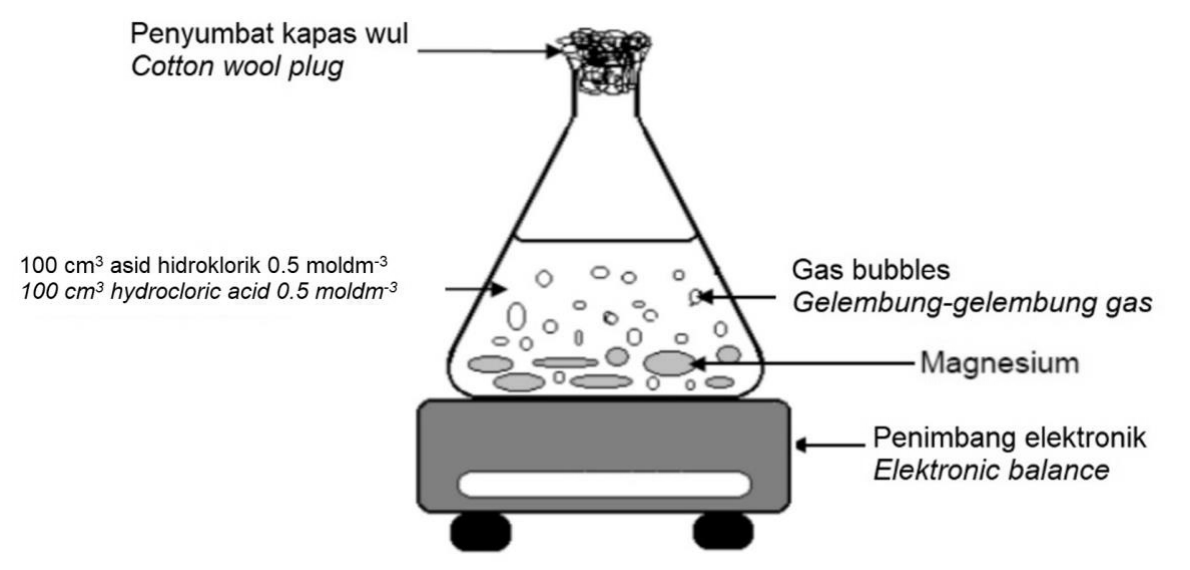
- (a)(ii)
What is the basicity of this acid?
[1] - (b)(i)
Calculate the number of moles present in 0.24 g of Mg. [Relative atomic mass: Mg = 24]
[1]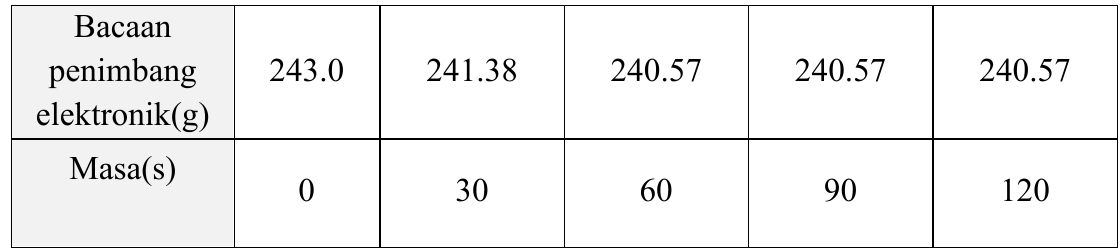
- (b)(ii)
Calculate the average rate of reaction in the first minute.
[2] - (c)
The experiment is repeated using 100 cm3 of 1 mol dm-3 hydrochloric acid. Compare the reaction rates for the two experiments.
[2] - (d)
Diagram 8.2: a student asks why hand sanitiser feels cold on the palm; the teacher says it contains 70% alcohol. Justify the use of alcohol in hand sanitisers. Explain your answer.
[3]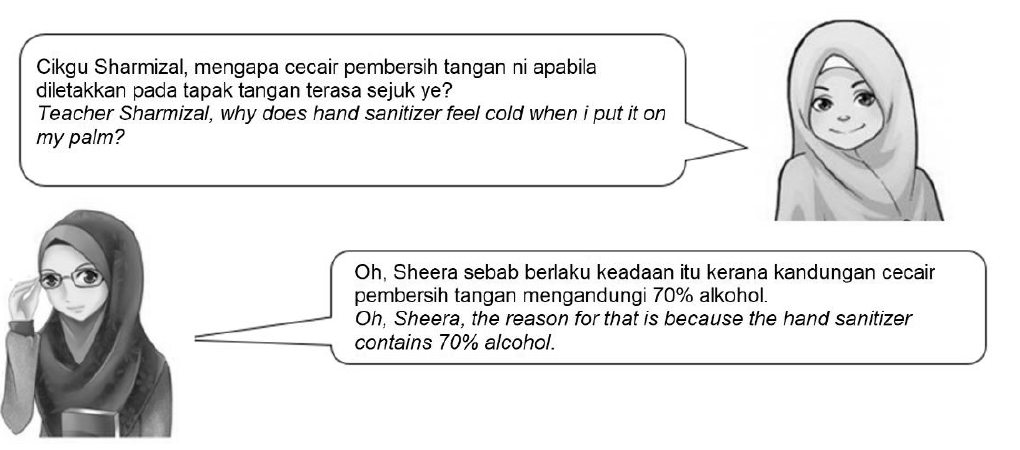
Section B
Table 9.1: Set I: 100 cm3 of 0.1 mol dm-3 sodium carbonate + 100 cm3 of 0.1 mol dm-3 copper(II) sulphate gives green solid Y and sodium sulphate solution; initial temperature 29.0 °C; temperature increase of 4 °C. Set II: 100 cm3 of 0.1 mol dm-3 sodium carbonate + 100 cm3 of 0.1 mol dm-3 magnesium nitrate gives magnesium carbonate and colourless solution Z; initial temperature 29.0 °C; temperature decrease of 3 °C. Table 9.2: Acid X, CH3COOH, heat of neutralisation -57 kJ mol-1; acid Y, HCl, heat of neutralisation -53 kJ mol-1. [Specific heat capacity of solution = 4.2 J g-1 °C-1; density of solution = 1 g cm-3]
Hard20 marks- (a)(i)
What is meant by heat of precipitation, and what is the colour of copper(II) sulphate?
[2] - (a)(ii)
Suggest green solid Y and colourless solution Z.
[2] - (a)(iii)
Calculate the heat of precipitation for set I and set II.
[6] - (b)(ii)
State 1 similarity between acid X and acid Y. Then explain the difference in the heat of neutralisation of the two acids.
[10]
Diagram 10.1 shows the structural formula of paracetamol, C8H9NO2 (a benzene ring with an -OH group and an -NH-CO-CH3 group), used to relieve fever and pain. Diagram 10.2 shows Ali's shirt stained with paint after painting an iron fence. Table 10 shows compound W (soluble in water) and Z (soluble in tetrachloromethane) tested for electrical conductivity (bulb) in molten and aqueous states. Diagram 10.3 shows a copper rod connected to a battery and a bulb that lights up.
Medium20 marks- (a)(i)
The bonds formed in paracetamol are covalent. What happens to the electrons during the formation of the bond?
[1]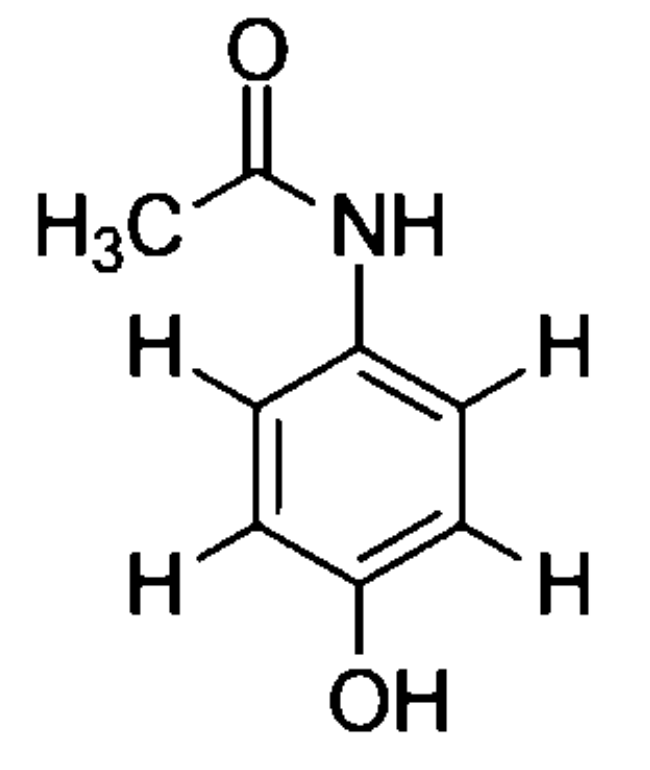
- (a)(ii)
What is meant by the double bond found in this medicine compound?
[1] - (a)(iii)
State the type of medicine and its instructions for use.
[2] - (a)(iv)
Calculate the number of atoms present in 30.2 g of paracetamol, C8H9NO2. [Relative atomic mass: C = 12, H = 1, N = 14, O = 16] [Avogadro constant = 6.02 × 10^23]
[3] - (b)(i)
Diagram 10.2 shows the state of Ali's shirt after painting the iron fence of his friend's house so that it does not rust. If you are Ali's friend, how can you give a solution so that Ali is not scolded by his mother about the condition of his clothes?
[3]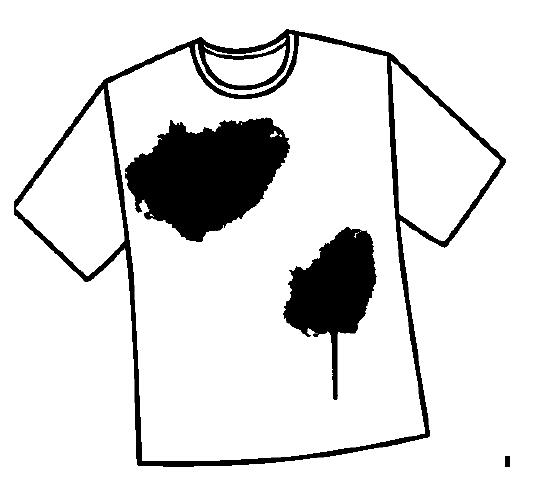
- (c)
Based on Table 10, state the type of compound W and Z. Explain the difference in electrical conductivity of compound W and Z.
[5]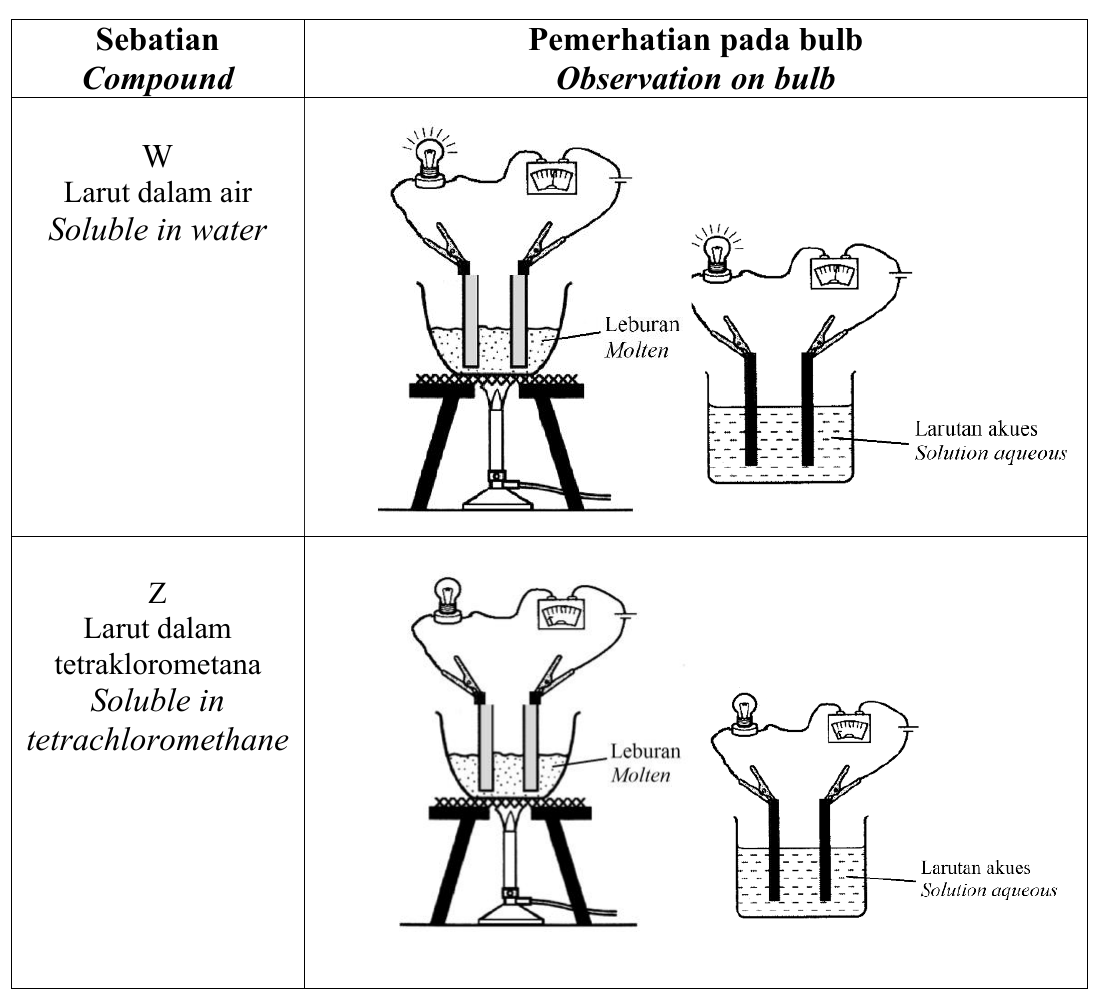
- (d)
Diagram 10.3 shows the apparatus of the Table 10 experiment modified to study the electrical conductivity of a metal. Explain how copper metal in its solid state can conduct electricity.
[5]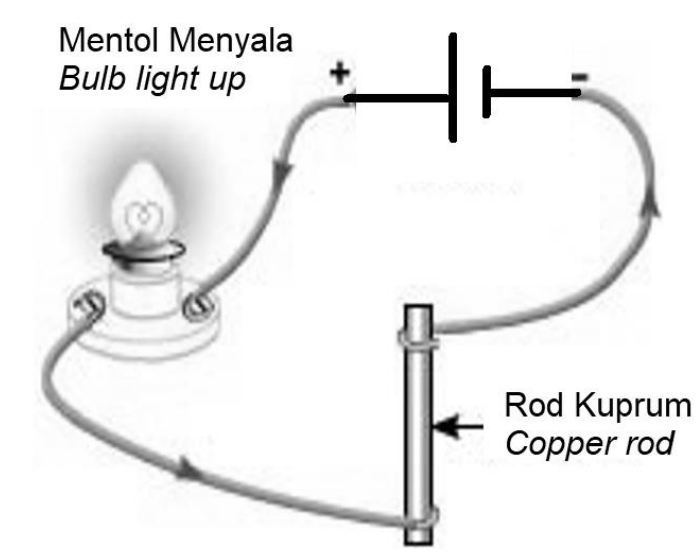
Section C
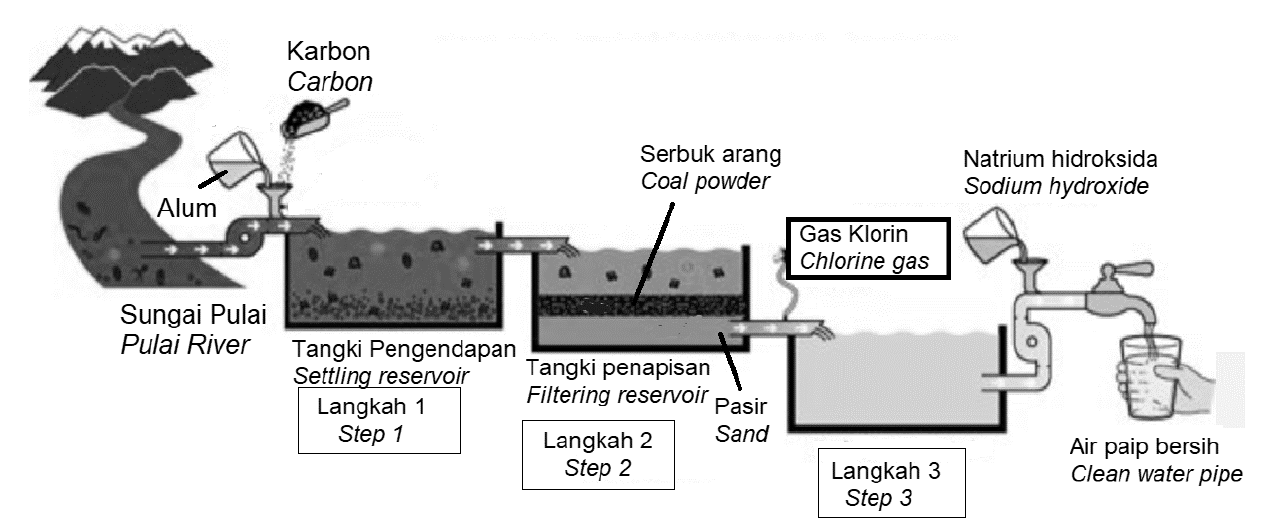
Diagram 11.1: substance X added to latex causes the latex to coagulate (clumps form); substance Y added to latex leaves it as a liquid (no coagulation). Diagram 11.2: vulcanisation of latex polymer (poly(2-methylbuta-1,3-diene) chains) with sulphur. Diagram 11.3: water purification steps (step 1 settling reservoir with alum, step 2 filtering reservoir with sand and coal powder/carbon, step 3 chlorine gas and sodium hydroxide before clean water pipe). Cl2(g) + H2O(l) → HOCl(aq) + HCl(aq).
Medium20 marks- (a)
Latex is a natural polymer. What is the meaning of polymer?
[1]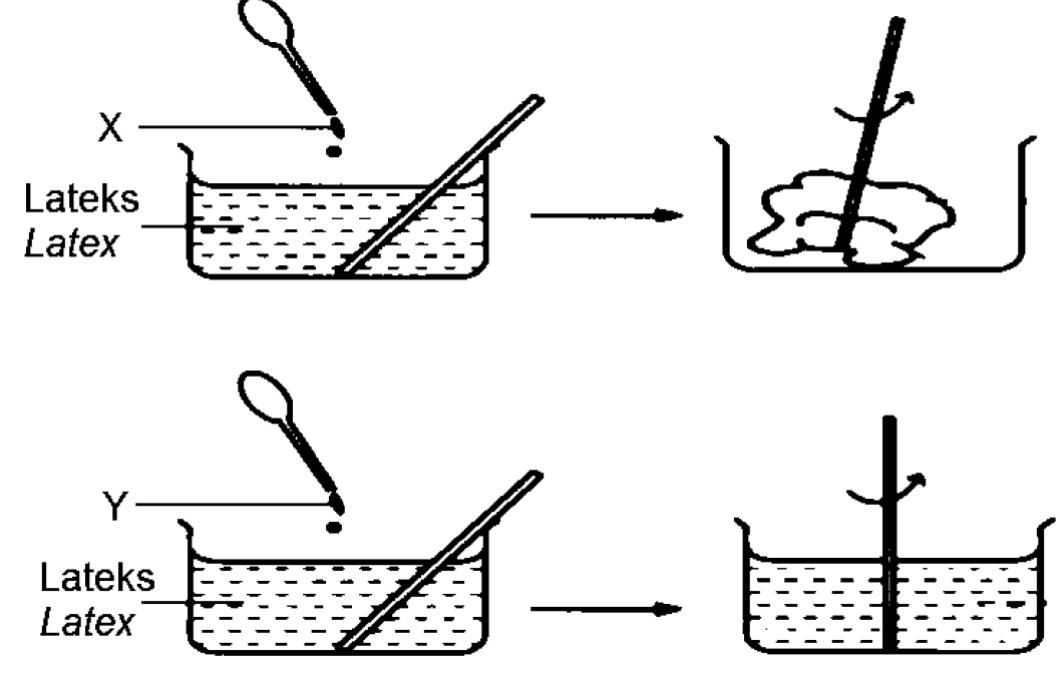
- (b)(i)
Identify X and Y.
[2] - (b)(ii)
State the difference in observations of latex by substance X and substance Y. Explain your answer.
[5] - (b)(iii)
Diagram 11.2 shows the vulcanisation process of latex polymer to make it more elastic and not easily oxidised. Draw and label the structural formula of this latex polymer.
[2]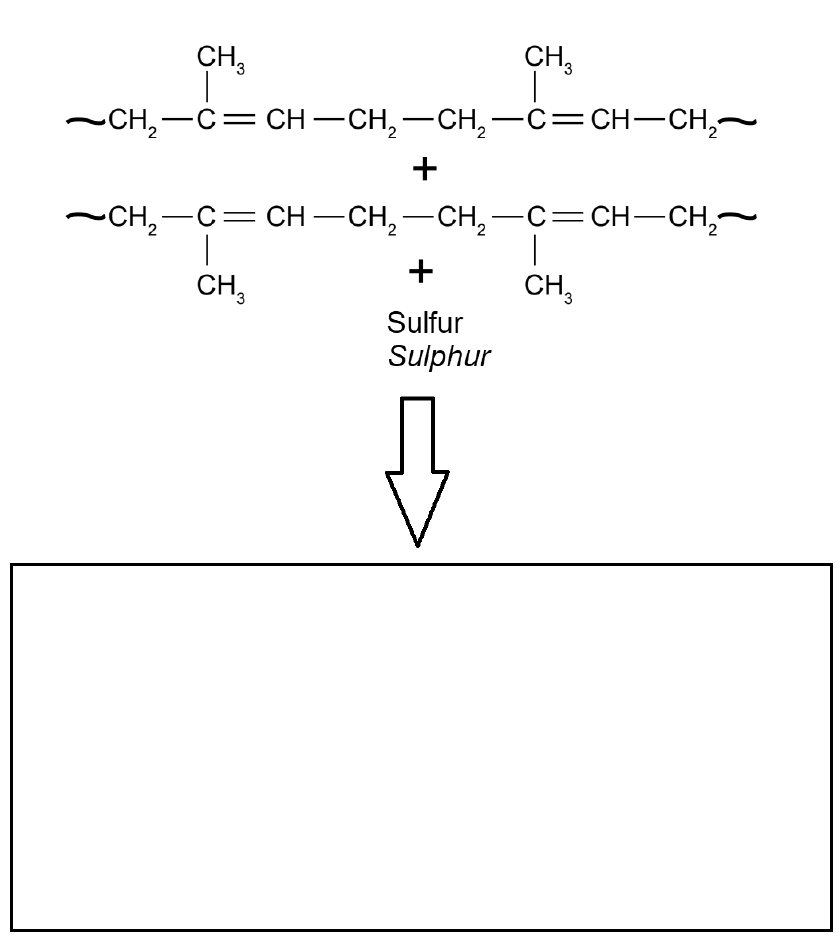
- (b)(iv)
Calculate the pH value of sulphuric acid with a concentration of 0.1 mol dm-3.
[2] - (d)
In step 3 of Diagram 11.3, chlorine gas dissolves and reacts with water: Cl2(g) + H2O(l) → HOCl(aq) + HCl(aq). The hydrochloric acid in tap water must be neutralised by the solution named in step 3 before it reaches the user. Using your knowledge of chemistry, describe how to determine the concentration of hydrochloric acid in the treated water in the laboratory using phenolphthalein solution, conical flask, burette and other materials and apparatus.
[8]