What is the name of Group 1 of the Periodic Table of Elements?
Easy
Which of the following is a synthetic polymer?
Easy
What substance is produced when ethanol burns in excess oxygen?
Easy
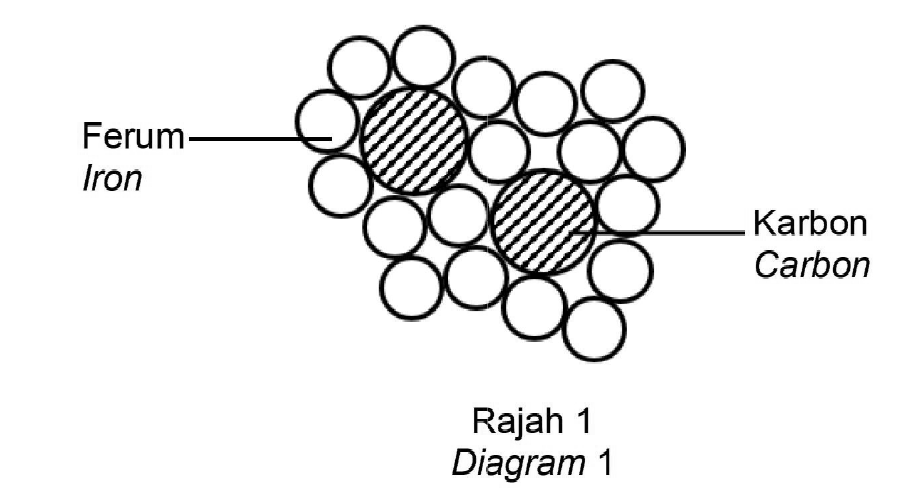
Diagram 1 shows the arrangement of particles in an alloy (iron and carbon atoms). What is the alloy shown in Diagram 1?
Medium
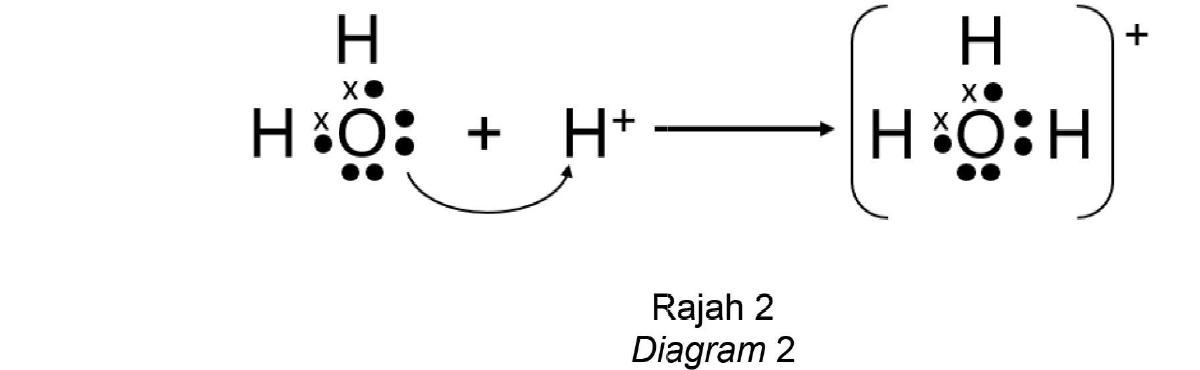
Diagram 2 shows how a chemical bond is formed (H2O + H+ gives H3O+, the lone pair on oxygen is shared with H+). Which of the following statements most accurately defines the chemical bond shown in Diagram 2?
Medium
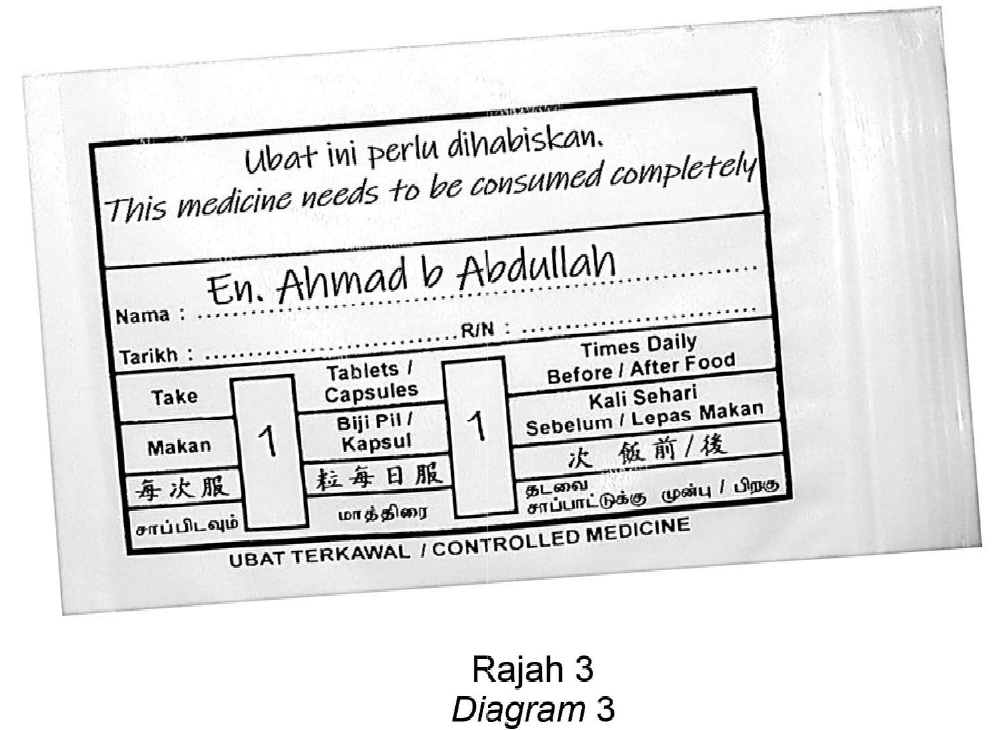
Diagram 3 shows the medicine envelope supplied by the doctor to Mr. Ahmad ('This medicine needs to be consumed completely'). Based on the instruction given on the medicine envelope, what type of medicine was given to Mr. Ahmad?
Easy
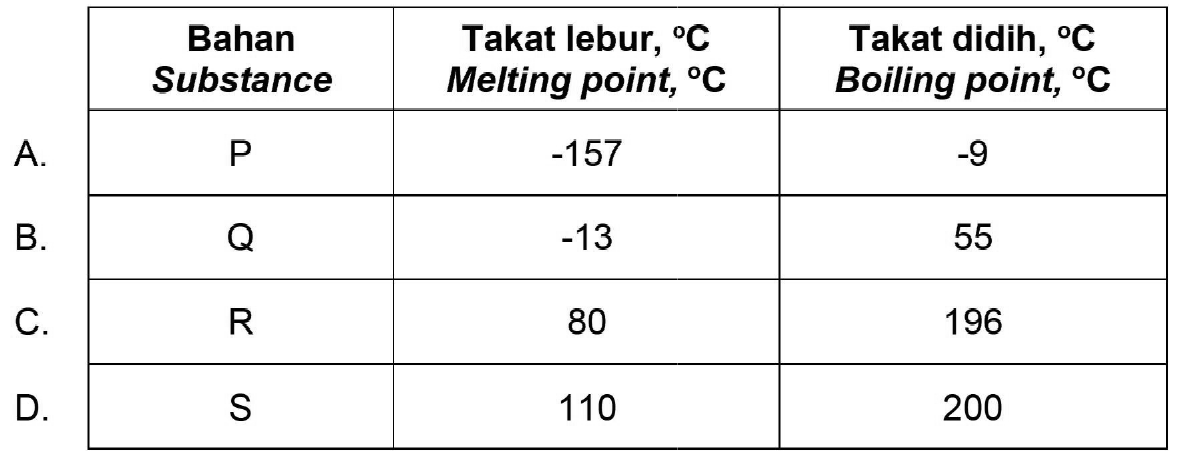
Which of the following substance is a liquid at 100 °C?
Substance / Melting point (°C) / Boiling point (°C): P -157, -9; Q -13, 55; R 80, 196; S 110, 200
Medium
Which of the following is a weak acid?
Easy
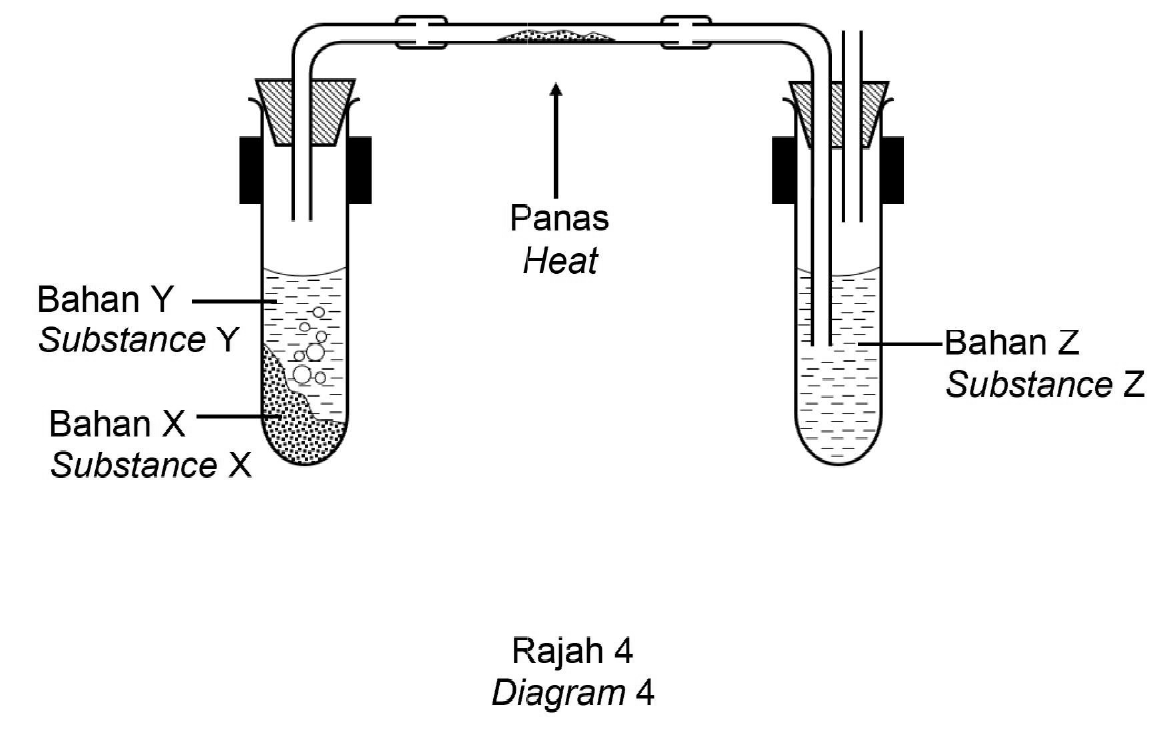
Diagram 4 shows the arrangement of the apparatus used to find the empirical formula for a metal oxide. What is substance P and process X? (The question as printed refers to P and X but the options give Substances X, Y and Z.)
Medium
Unsaturated hydrocarbons can be converted to saturated hydrocarbons through a hydrogen addition reaction using substance X as a catalyst. What is substance X?
Easy
Which physical properties is same for elements in Group 17 in the Periodic Table of the Elements.
Medium
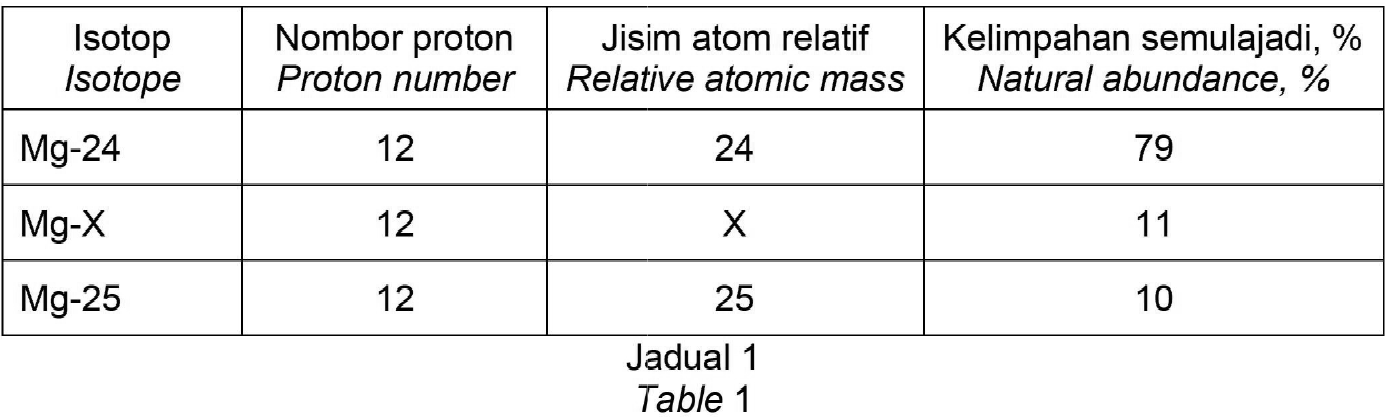
Table 1 shows information for isotopes of magnesium atoms: Mg-24 (proton number 12, RAM 24, abundance 79%); Mg-X (12, X, 11%); Mg-25 (12, 25, 10%). What is value of X? [Relative atomic mass Mg=24]
Medium
Which of the following is a reducing agent?
Medium
Which statement is correct about endothermic reaction?
Medium
Which statement is true about oxidizing agents?
Medium
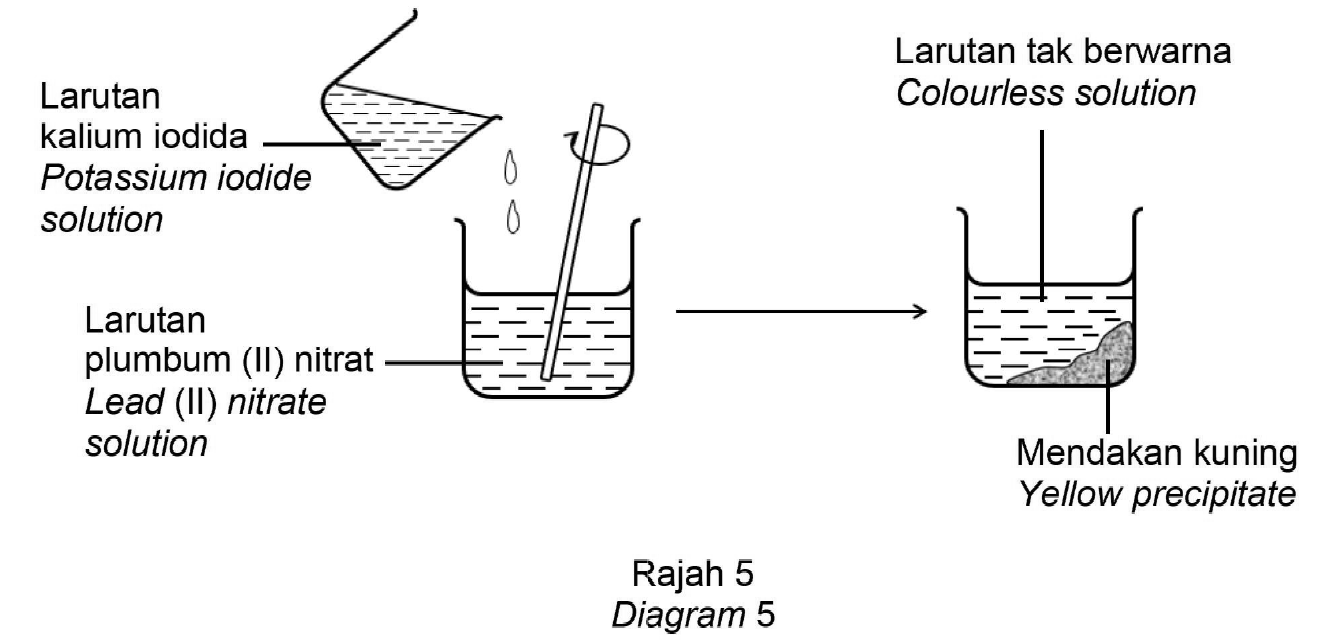
Diagram 5 shows the observation of an experiment carried out by a student in the laboratory: potassium iodide solution is added to lead (II) nitrate solution, giving a colourless solution and a yellow precipitate. Based on Diagram 4 [sic], which statement is most accurate to describe the experiment qualitatively and quantitatively?
Medium
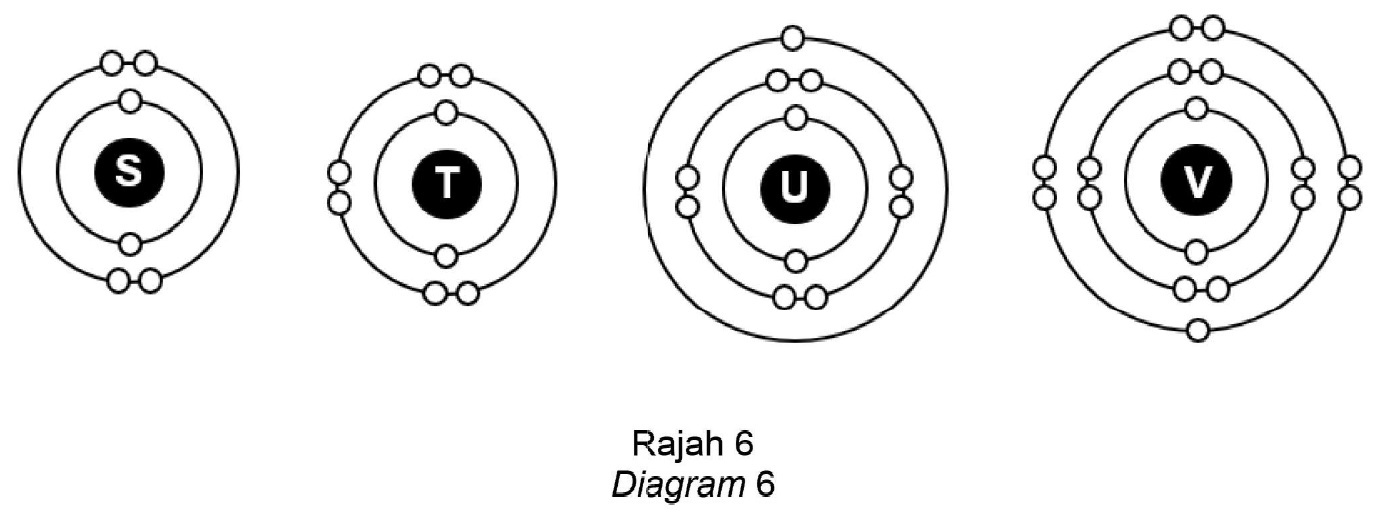
Diagram 6 shows the electron arrangements of atoms S, T, U and V (S, T, U and V are not the actual symbols). Which pair of elements forms a compound that lights up a bulb when in molten state? [printed: 'bulb light up when molten state']
Medium
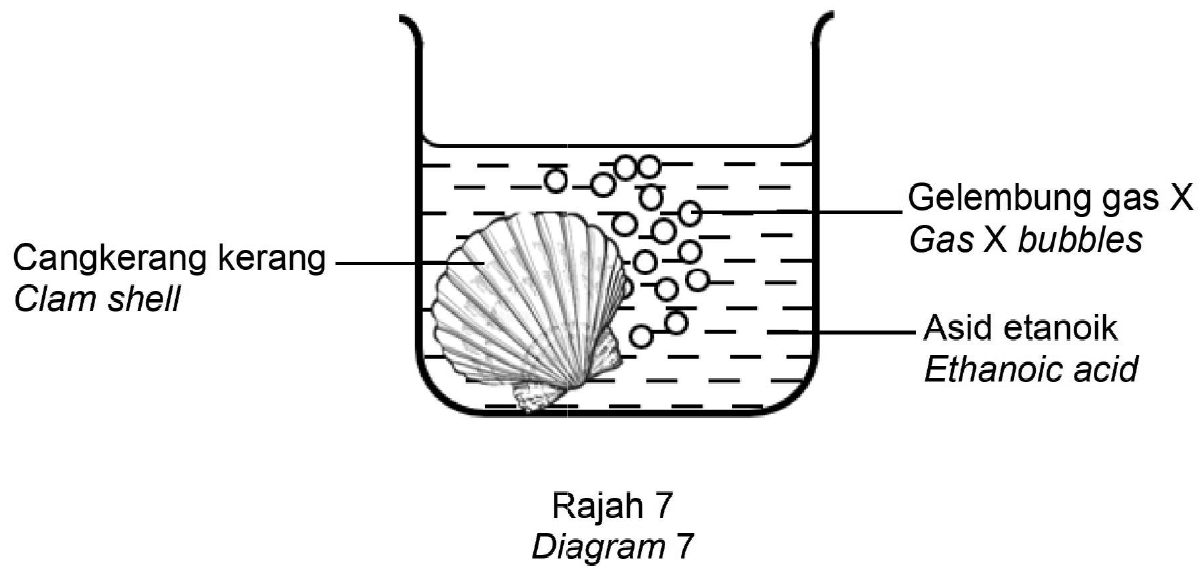
Diagram 7 shows an observation when a cockle shell is put in the beaker containing ethanoic acid (gas X bubbles). What is X?
Easy
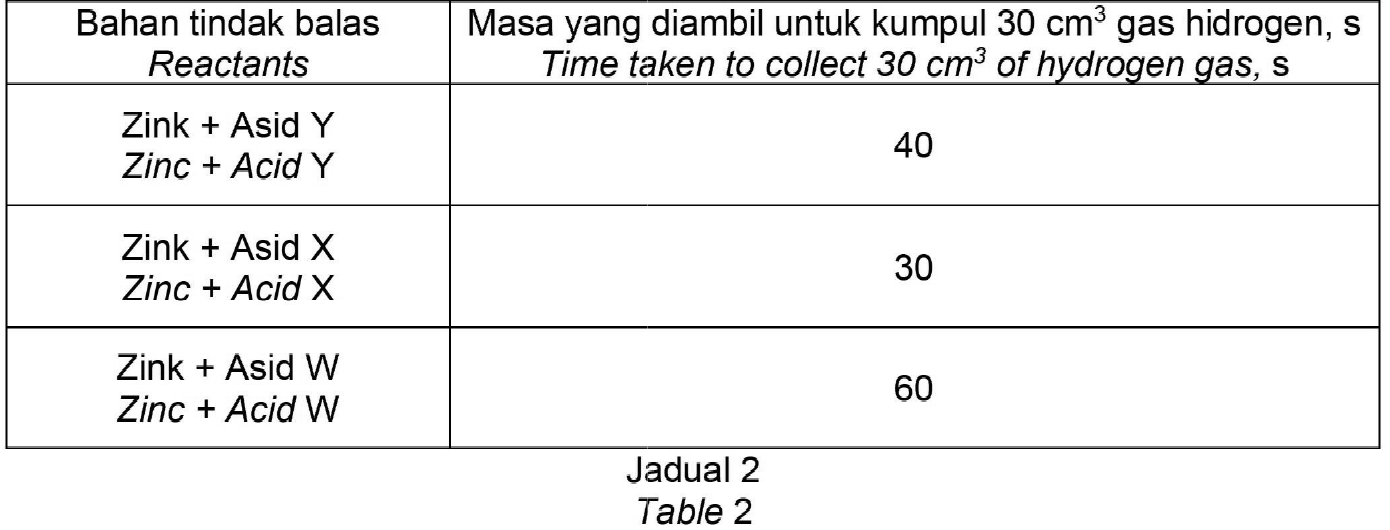
Table 2 shows the time taken to collect 30 cm3 of hydrogen gas when zinc reacts with several different acids: Zinc + Acid Y 40 s; Zinc + Acid X 30 s; Zinc + Acid W 60 s. Based on Table 2, arrange the strength of the acids used in ascending order.
Medium
The following is the thermochemical equation for the combustion of butan-1-ol: C4H9OH + 6O2 → 4CO2 + 5H2O ΔH = -2675 kJ mol⁻¹. What is the fuel value of butan-1-ol? [Relative atomic mass: H=1, C=12, O=16]
Medium
Soda-lime glass is added with substance X in its manufacture so that it becomes a glass that is more resistant to high heat and is chemically inert. What is substance X?
Easy
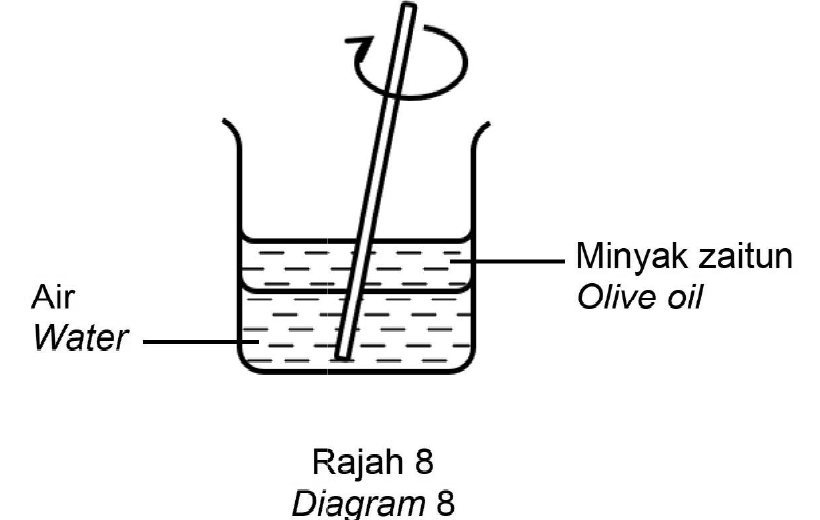
Ain tried to mix olive oil with water as a basic ingredient in the preparation of cosmetics using natural ingredients. Diagram 8 shows that water and olive oil do not mix well. What is the appropriate material used by Ain to ensure that the two basic ingredients are mixed well?
Easy
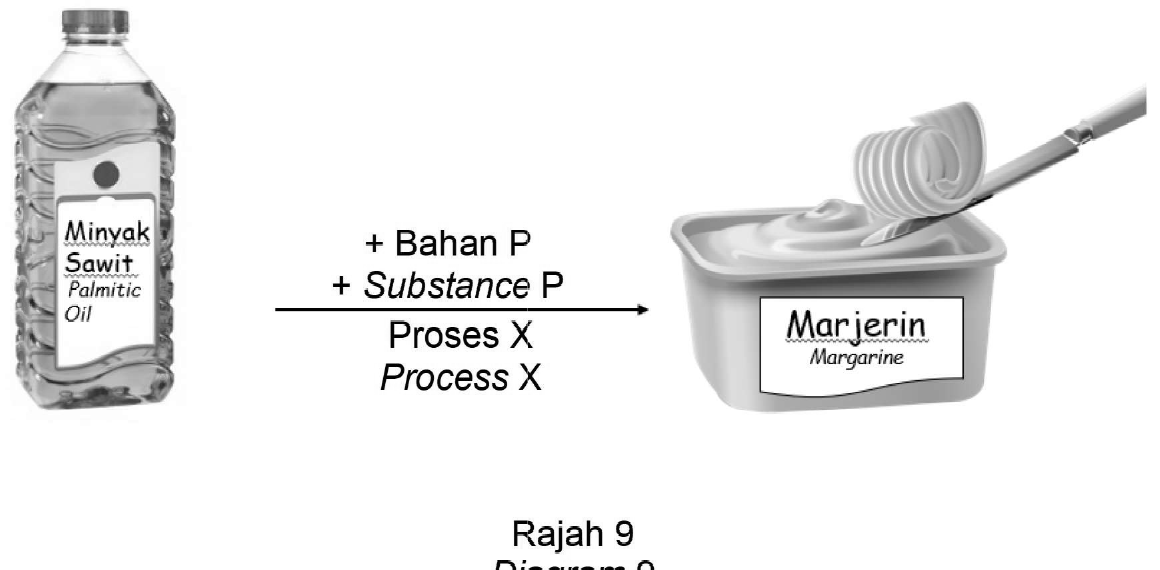
Diagram 9 shows how oil (palm oil) can be converted to margarine: oil + substance P, process X, gives margarine. What is substance P and process X?
Medium
Which of the following solutions have the same number of hydrogen ions, H+, as in 50 cm3 of 0.1 mol dm⁻³ sulphuric acid, H2SO4? [Avogadro constant = 6.02 × 10²³]
I. 100 cm3 of 0.1 mol dm⁻³ ethanoic acid, CH3COOH
II. 50 cm3 of 0.1 mol dm⁻³ phosphoric acid, H3PO4
III. 100 cm3 of 0.1 mol dm⁻³ hydrochloric acid, HCl
IV. 50 cm3 of 0.2 mol dm⁻³ nitric acid, HNO3
Medium
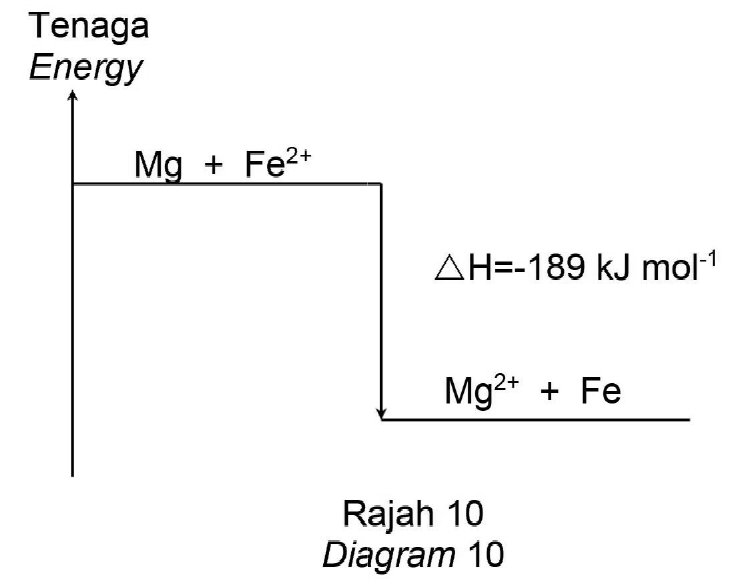
Diagram 10 shows the energy levels for a displacement reaction: Mg + Fe²⁺ at a higher level, Mg²⁺ + Fe lower, ΔH = -189 kJ mol⁻¹. Which of the following is true about the information that can be obtained from the energy level diagram?
I. Exothermic reaction
II. The temperature decrease during reaction
III. The container of mixture become hot
IV. Heat is absorbed more during the formation of new bonds
Medium
Diagram 11 shows brake disc made from advanced ceramic. Which of the following property is most suitable for the use of the brake disc?
Easy
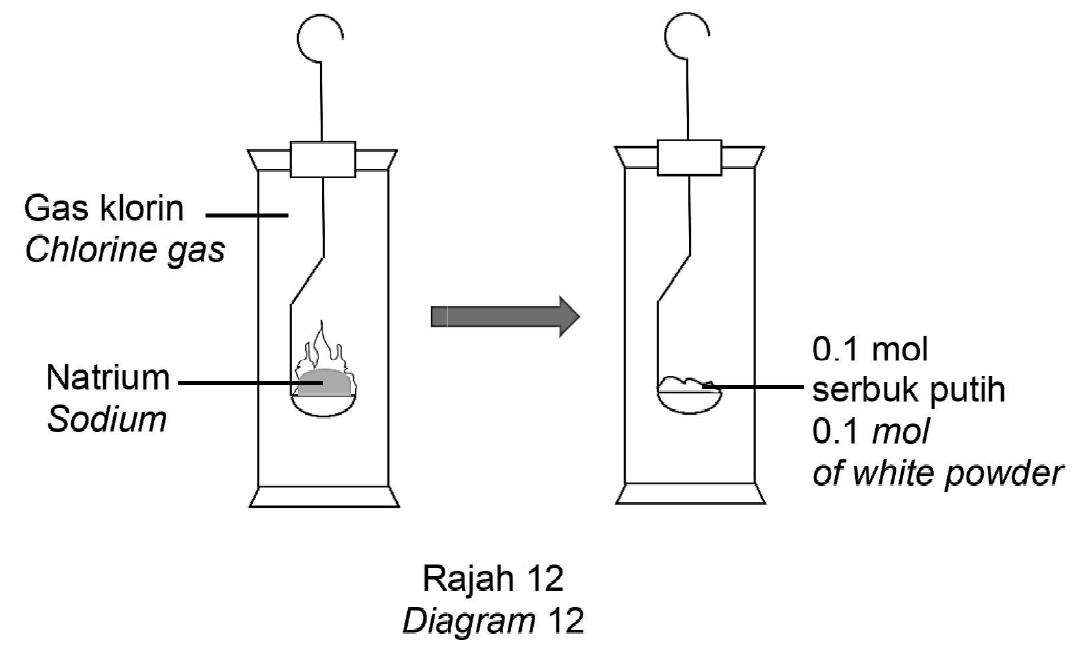
Diagram 12 shows the reaction between sodium and chlorine gas, producing 0.1 mol of white powder. What volume of chlorine gas was used in the reaction? [molar volume of gas at room condition = 24 dm³ mol⁻¹]
Medium
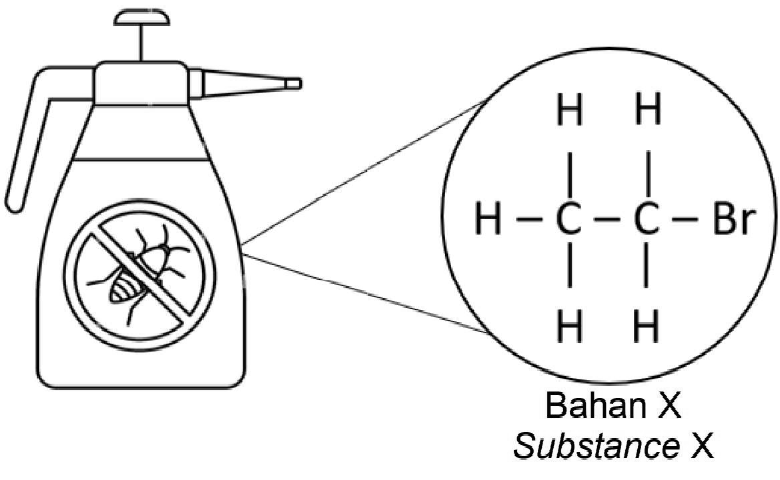
Diagram 13 shows the structural formula of substance X (CH3CH2Br, bromoethane) used in insecticides. Which of the following is a property of substance X?
Medium
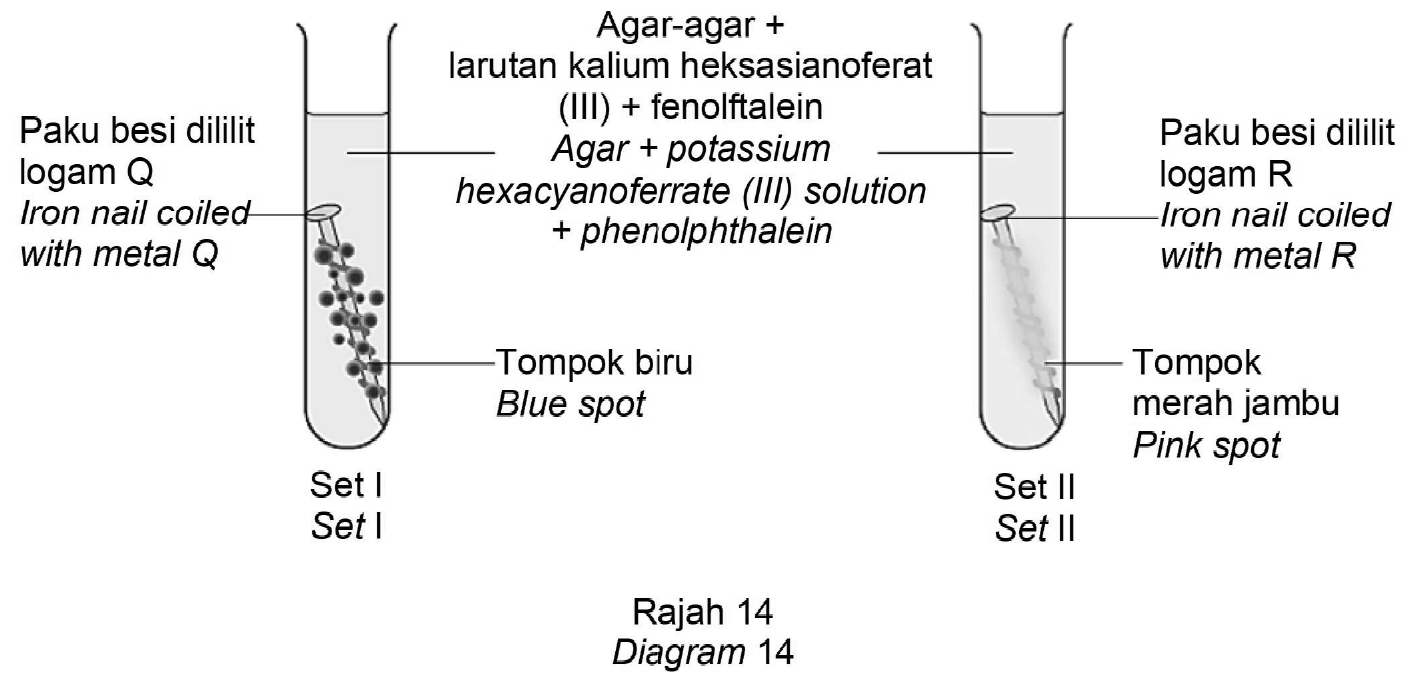
Diagram 14 shows the observation of an experiment to study the effect of metal Q and metal R on the corrosion of iron. Set I: iron nail coiled with metal Q, blue spot. Set II: iron nail coiled with metal R, pink spot. (Agar-agar + potassium hexacyanoferrate(III) solution + phenolphthalein.) Which of the following is true?
Medium
The surface of the frying pan is coated with teflon so that it does not stick. Teflon is a polymer known as polytetrafluoroethene. Diagram 15 shows the surface of the pan coated with teflon. What is the monomer of teflon?
Medium
Table 3 shows the total volume of oxygen gas, O2 collected in the decomposition reaction of hydrogen peroxide, H2O2.
Time, s: 0, 30, 60, 90, 120, 150, 180, 210
Volume of O2, cm3: 0.00, 18.00, 27.50, 35.00, 42.50, 46.50, 50.00, 50.00
What is the average rate of reaction in the second minute?
Medium
4.0 g of shell powder where added to 200 cm3 of 1.0 mol dm⁻³ sulphuric acid. After 4 minutes 0.8 g of shell powder remains as residue. What is the average rate of reaction?
Medium
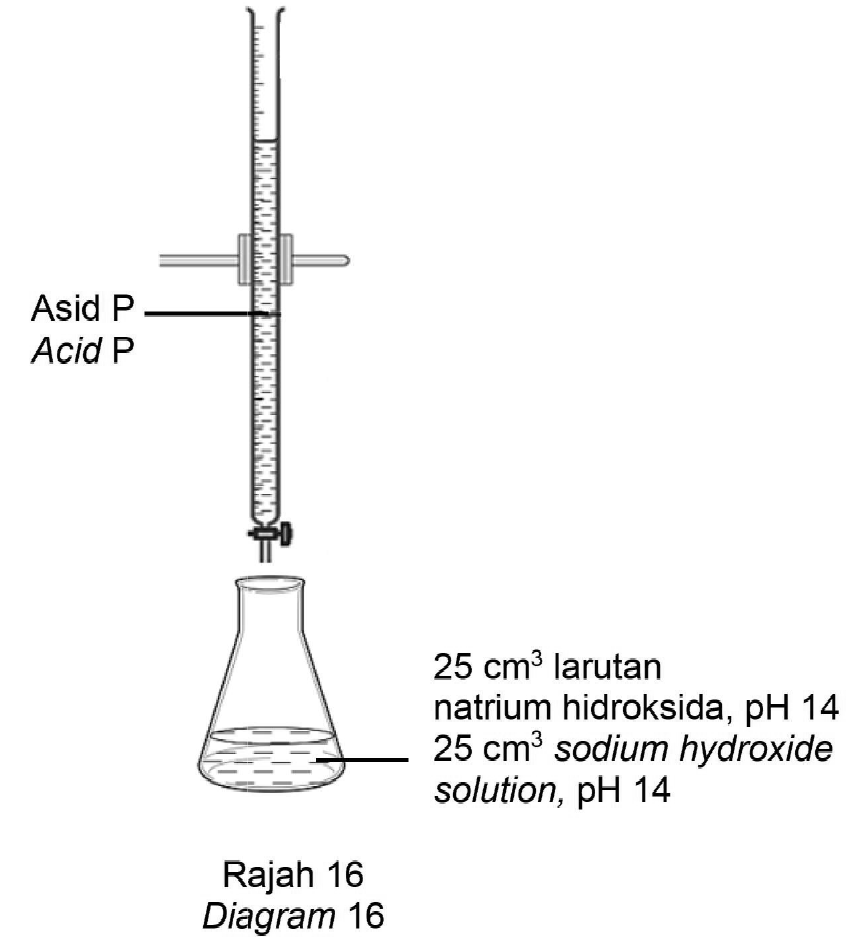
Diagram 16 shows the arrangement of the apparatus used for the neutralization reaction between acid P and sodium hydroxide solution (25 cm3 of sodium hydroxide solution, pH 14, in the conical flask). Which of the following can be acid P so that the sodium hydroxide solution can be neutralized completely?
Medium
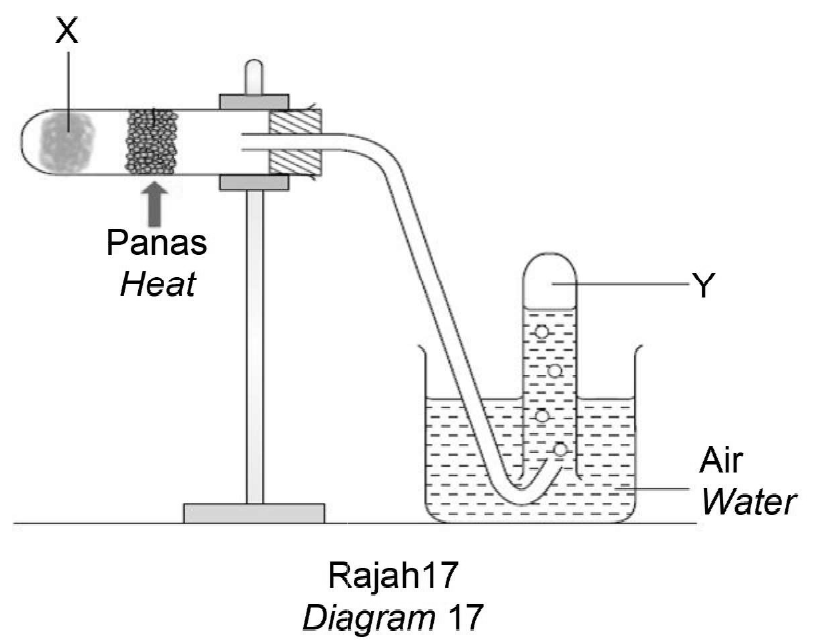
Diagram 17 shows the arrangement of apparatus used in a chemical reaction involving carbon compounds (substance X heated in a boiling tube, gas Y collected over water). What are X, Y and the chemical equation for the reaction shown in Diagram 17?
Medium
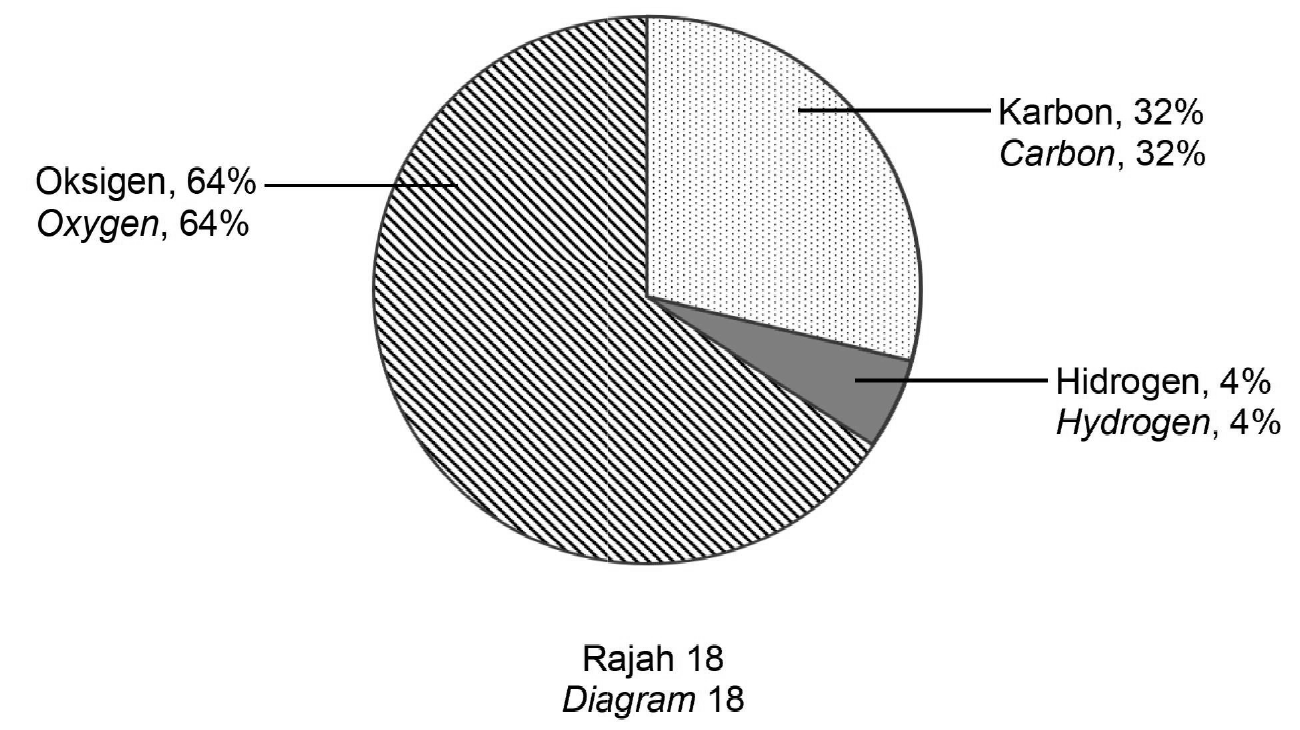
Diagram 18 shows a pie chart of the percentage composition of an organic acid: carbon 32%, hydrogen 4%, oxygen 64%. What is the molecular formula of the organic acid? [Relative atomic mass: H=1, C=12, O=16; Molar mass organic acid = 150 g mol⁻¹]
Medium
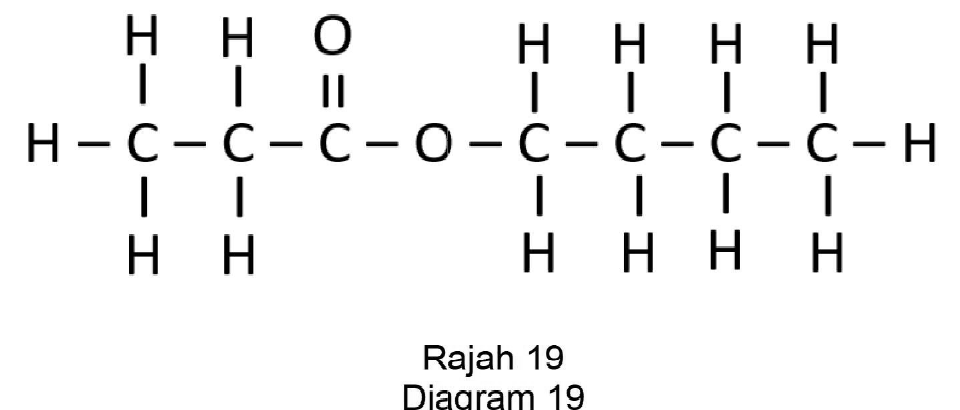
Diagram 19 shows a structural formula of compound P (an ester: CH3CH2COO-CH2CH2CH2CH3). What alcohol is used to prepare compound P?
Medium
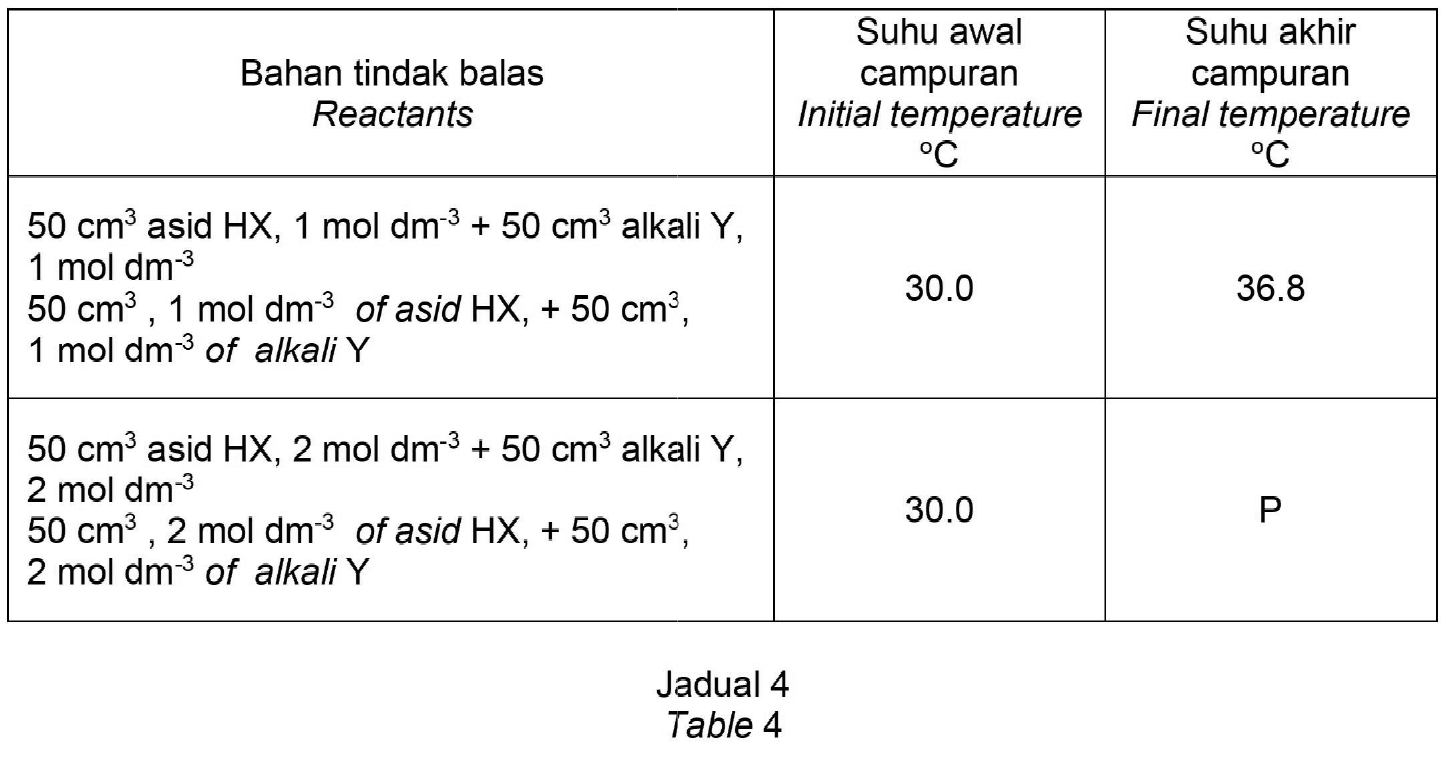
Table 4 compares two neutralization reactions between acid HX and alkali Y. (1) 50 cm3 of 1 mol dm⁻³ HX + 50 cm3 of 1 mol dm⁻³ Y: initial 30.0 °C, final 36.8 °C. (2) 50 cm3 of 2 mol dm⁻³ HX + 50 cm3 of 2 mol dm⁻³ Y: initial 30.0 °C, final P. What is the value of P?
Medium
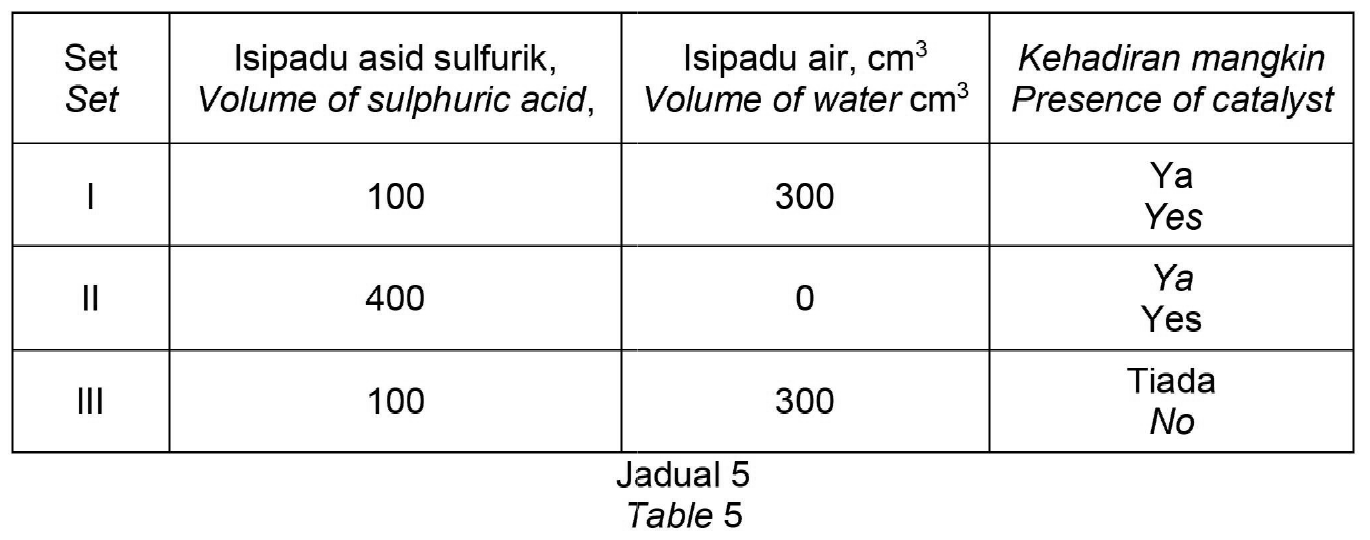
Table 5 shows three sets of experiments using X g of zinc powder with excess sulphuric acid of concentration Y mol dm⁻³. Set I: 100 cm3 acid, 300 cm3 water, catalyst present. Set II: 400 cm3 acid, 0 cm3 water, catalyst present. Set III: 100 cm3 acid, 300 cm3 water, no catalyst. Based on Table 5, which graph shows the correct curve for each set of experiments?
Medium
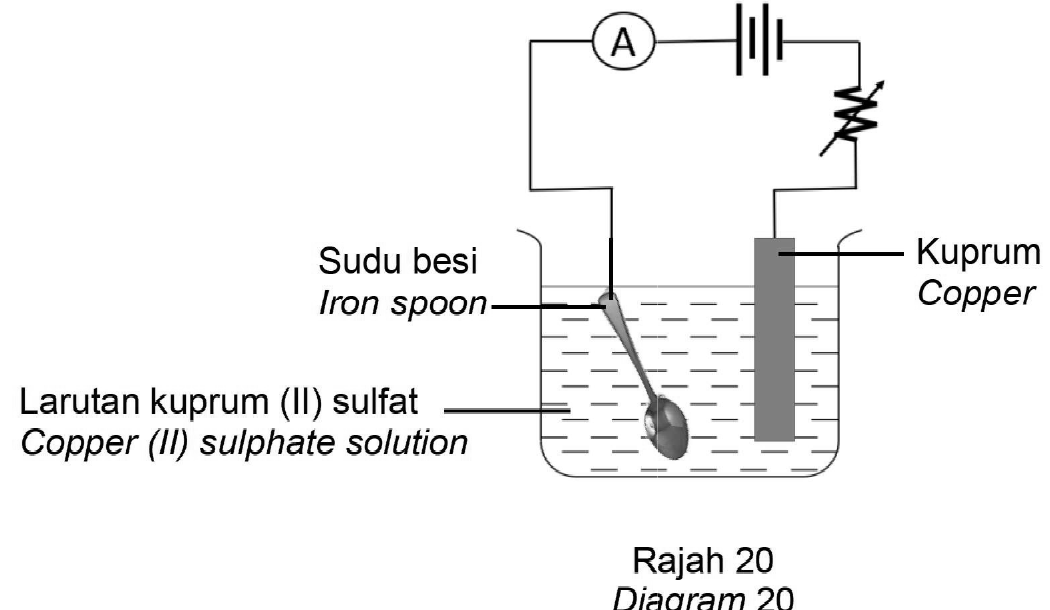
Diagram 20 shows the arrangement of the apparatus used by a student to plate an iron spoon using copper. The student found that plating was not done successfully. What needs to be done so that the plating can be done and the plating happens evenly?
I. Lower the voltage
II. Add the number of dry cells
III. Change the position between the iron spoon and copper
IV. Increase the concentration of copper (II) sulphate solution