Write your answer on paper. Then open the answer to check it.
Section A
Table 1 shows composite materials V, W, X and Y and their uses: V - video camera and cables in computer network; W - NMR and MRI machines; X - car window and camera lens; Y - helmet and car bumper.
Medium5 marks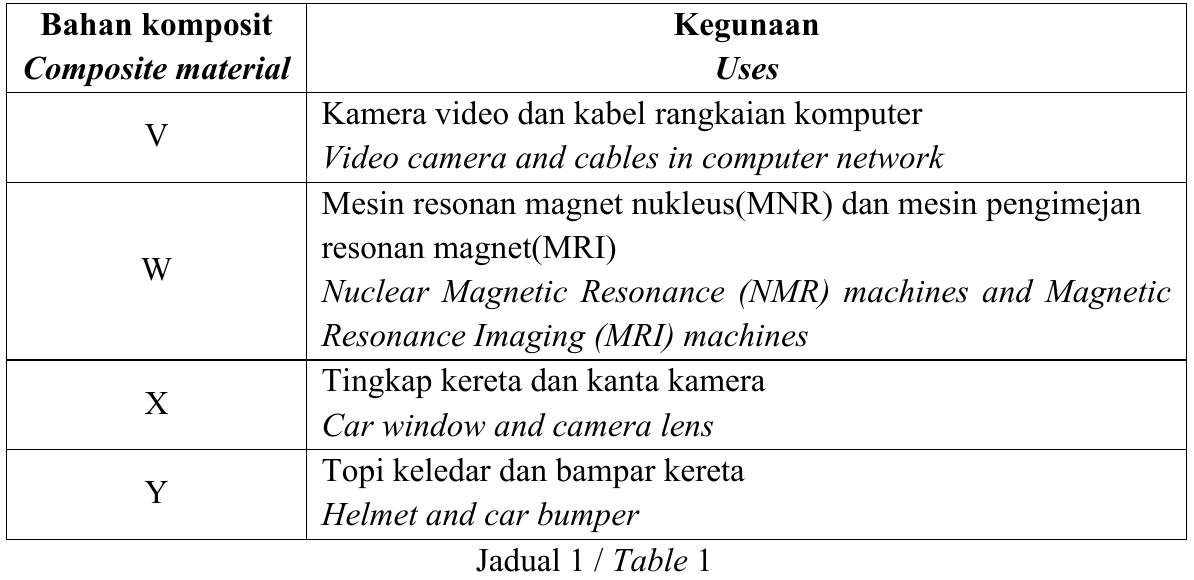
- (a)
State the name of composite materials W and Y.
[2] - (b)
State the special properties of the composite material V and X.
[2] - (c)
Composite material W is known as a very strong magnet. What is the use of composite material W in the transportation field?
[1]
Diagram 1 shows a type of synthetic polymer (PVC pipes).
Medium5 marks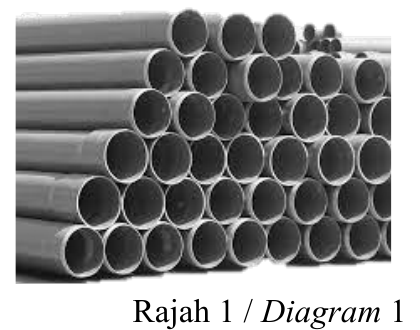
- (a)
What is meant by polymer?
[1] - (b)
The monomer of the polymer in Diagram 1 is chloroethene. Draw a structural formula of the polymer.
[1] - (c)
What is the advantage of using this polymer?
[1] - (d)
Explain how the uncontrolled use of PVC can cause environmental pollution.
[2]
Diagram 2 shows the standard representation of atoms of potassium (39/19 K) and chlorine (35/17 Cl). Potassium atom and chlorine atom can react to form a chemical bond.
Medium6 marks- (a)
State the purpose of formation of chemical bonds.
[1] - (b)
State the type of chemical bond found in a chlorine molecule.
[1] - (c)(i)
Chlorine reacts with potassium to form a compound. State the type of compound formed.
[1] - (c)(ii)
Draw the electron arrangement for the formation of this compound.
[2] - (c)(iii)
Explain why aqueous solution of the compound formed can conduct electricity.
[1]
(a) Table 2 shows the number of protons and neutrons for atoms P (6 protons, 6 neutrons), Q (6 protons, 8 neutrons) and R (11 protons, 12 neutrons). (b) Table 3 shows the results for an experiment to determine the empirical formula of copper oxide: glass tube 43.46 g; glass tube + oxide of copper 47.46 g; glass tube + copper metal 46.66 g.
Medium7 marks- (a)(i)
What is meant by isotopes?
[1]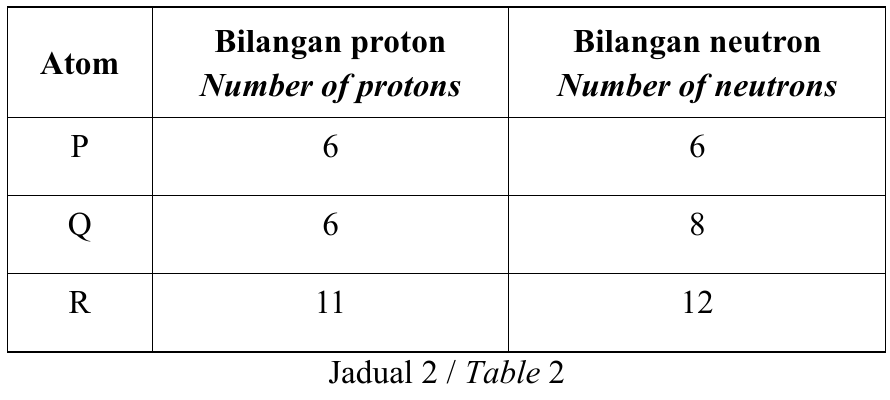
- (a)(ii)
Choose two atoms which are isotopes.
[1] - (a)(iii)
State one use of the Q isotope.
[1] - (b)
Based on the result obtained, determine the empirical formula for copper oxide. [Relative atomic mass: O = 16, Cu = 64]
[4]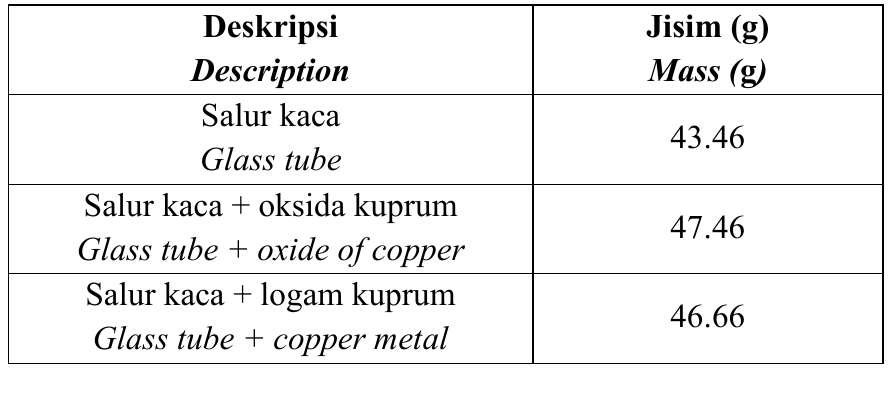
Diagram 3 shows part of the Periodic Table of Elements. P, Q, R, S and T are not the actual symbols of the elements (P is in Group 18 period 1; Q is Group 1, Period 3; R is Group 13, Period 3; S is Group 17, Period 3; T is below Q in Period 4).
Medium8 marks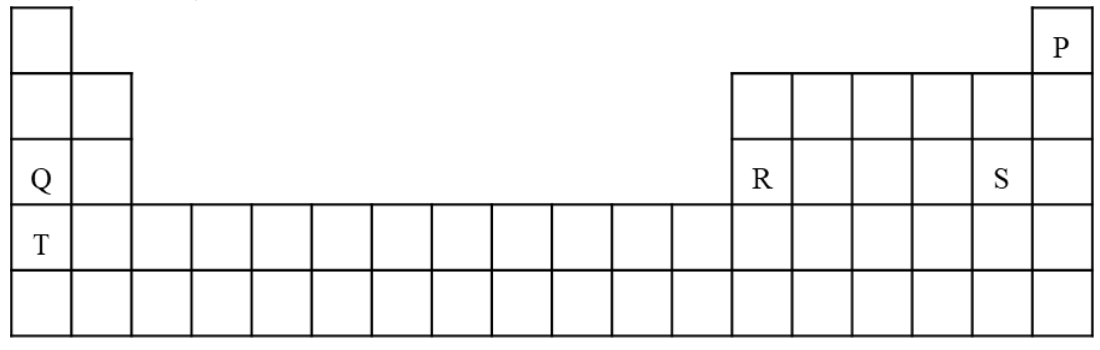
- (a)
State the element that can form an amphoteric oxide.
[1] - (b)
Element P is located in Group 18. State one use of element P.
[1] - (c)(i)
Element Q can react with water to produce a colourless solution. What can be observed when a piece of red litmus paper is dipped in the colourless solution?
[1] - (c)(ii)
Write a chemical equation for the reaction between element Q and water.
[2] - (d)(i)
Arrange the elements Q, R and S according to the descending order of the atomic size.
[1] - (d)(ii)
Explain your answer in 5(d)(i).
[2]
Diagram 4 shows the energy level diagram when ethanol reacts with excess oxygen: ethanol + O2 at a higher energy level; products X + Y lower; ΔH = -1367 kJ mol-1.
Medium9 marks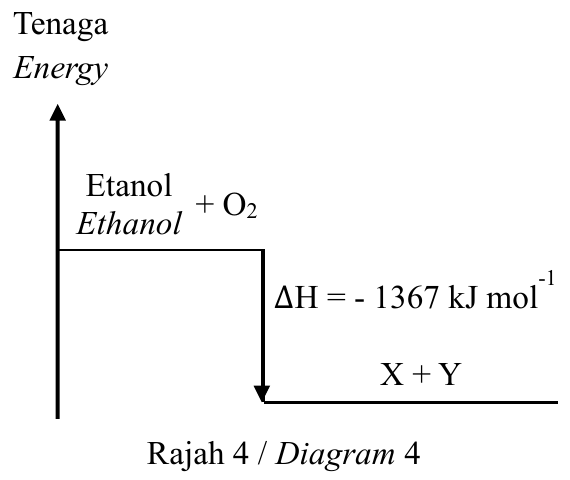
- (a)
Write the chemical formula for ethanol.
[1] - (b)
Based on Diagram 4, state the type of reaction in terms of heat change.
[1] - (c)(i)
Identify gas X and Y.
[2] - (c)(ii)
Write a chemical equation for the reaction.
[2] - (d)
Compare the total energy content of the reactants with the total energy content of the products.
[1] - (e)
4.6 g of ethanol reacted completely in excess oxygen. Calculate the heat released. [Relative atomic mass: H = 1, C = 12, O = 16]
[2]
Diagram 5 shows a chemical reaction for compound M, an unsaturated hydrocarbon with four carbon atoms. Reaction I: M + H2 (Ni, 180 °C) gives compound N. Reaction II: M + H2O (300 °C, 60 atm, H3PO4) gives compound P.
Medium10 marks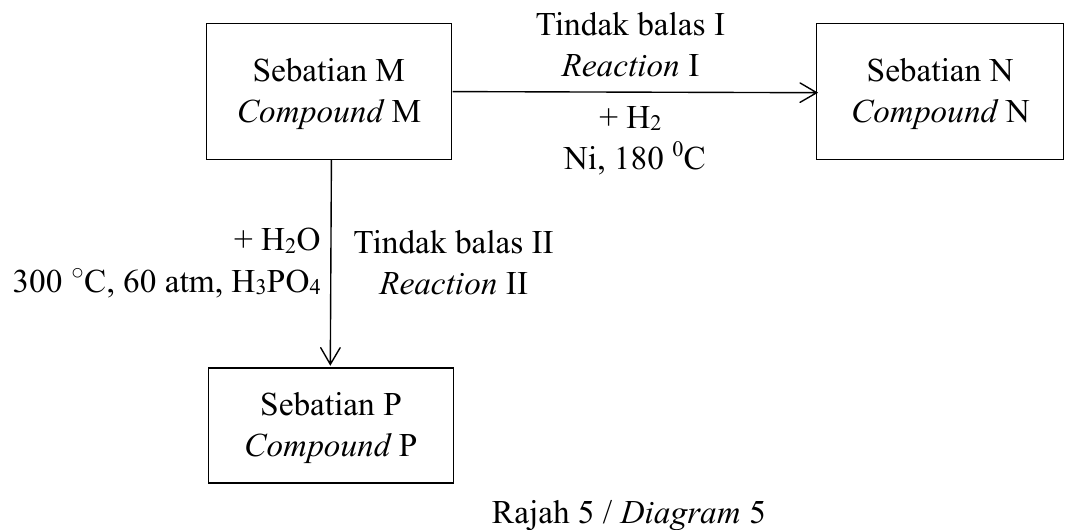
- (a)
What is meant by hydrocarbon?
[1] - (b)(i)
Isomers are molecules that have the same molecular formula but different structural formula. Draw one isomer for compound M.
[1] - (b)(ii)
Identify Reaction I, Reaction II and compound P.
[3] - (c)
The combustion of compound M and compound N produce different amounts of soot. Explain this statement by calculating the percentage of carbon by mass per molecule in each of compound M and compound N. [Relative atomic mass: H = 1, C = 12, O = 16]
[3] - (d)
Both compounds P and M can be used as fuel. Which compound is more environmentally friendly? Explain your answer.
[2]
Diagram 6.1 shows the structural formula of the soap anion (a long hydrocarbon chain Part A, and the carboxylate group -COO- Part B). Diagram 6.2 shows two moisturising creams: A (water, dimethicone, propylene glycol, glycerol) and B (water, aloe vera gel, natural colouring). Diagram 6.3 shows a dialogue among food company staff.
Medium10 marks- (a)(i)
State the name of the process to produce soap.
[1]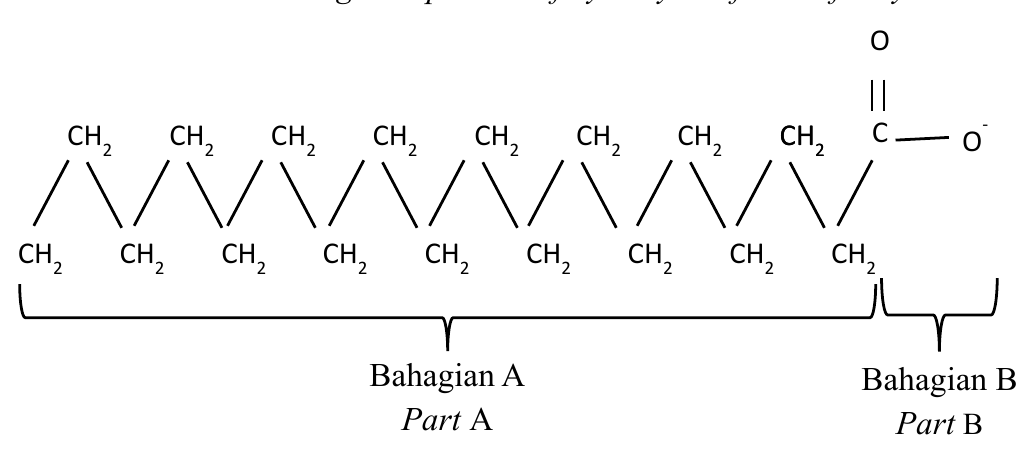
- (a)(ii)
Identify the part that dissolves in water.
[1] - (b)(i)
While trying to light a bonfire, Hisham's hand was burned. State a traditional medicine that can be used to treat Hisham's hand.
[1] - (b)(ii)
Explain how Hisham can use the substance stated in 8(b)(i) to treat his wound.
[2] - (c)
As a consumer, suggest which moisturising cream can be used by Mawar. Justify your answer.
[3]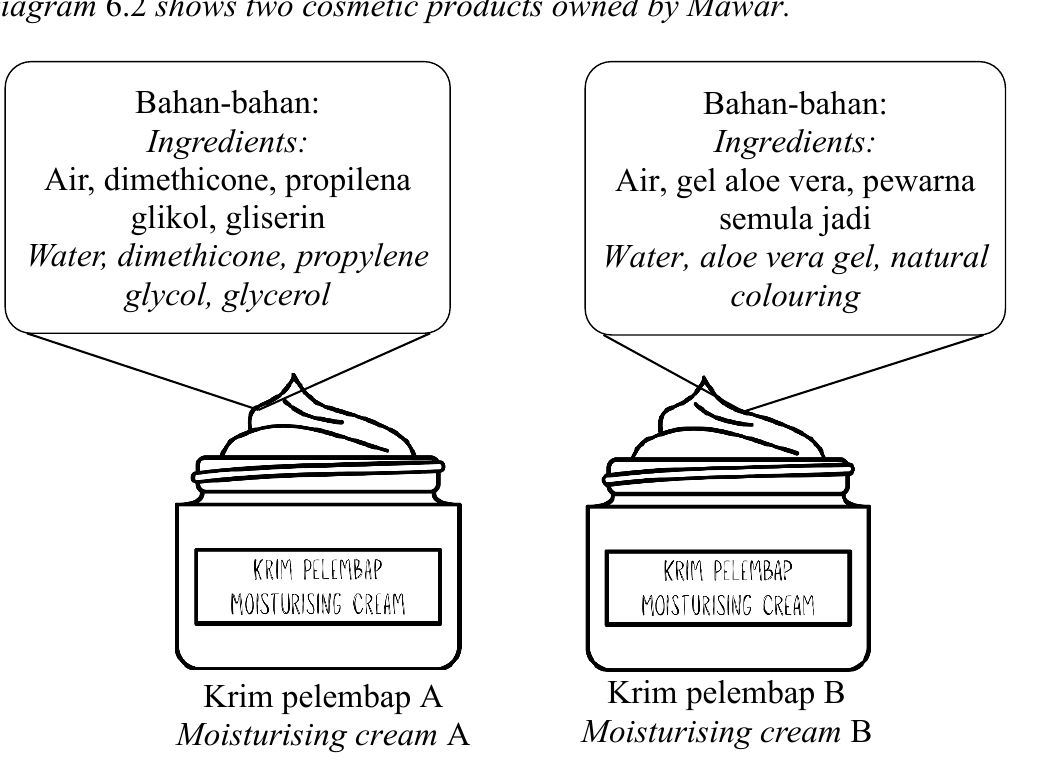
- (d)
Based on Diagram 6.3, identify the type of food additives discussed by the staff.
[2]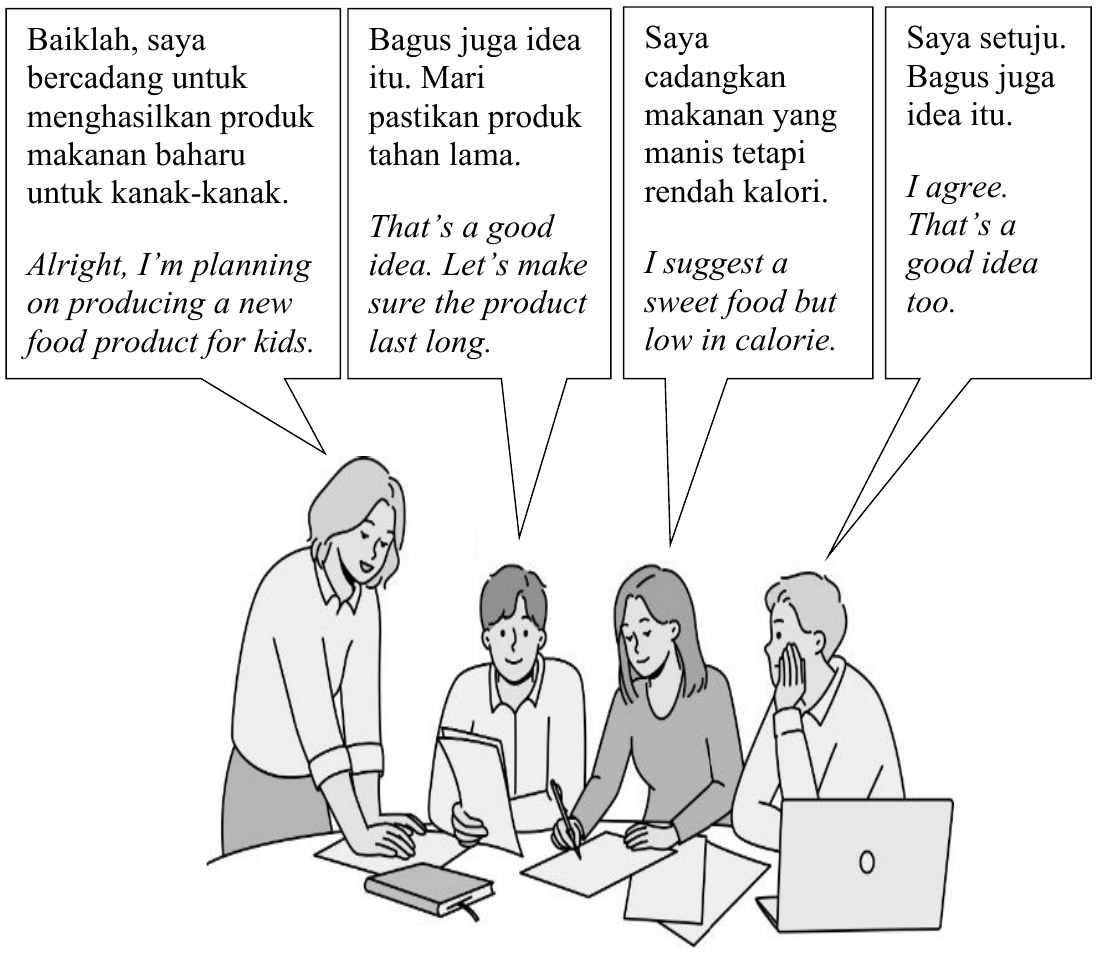
Section B
Answer one question from Section B (Question 9 or 10). Aiman studies the decomposition of hydrogen peroxide, H2O2 and records the volume of oxygen released.
Medium20 marks- (a)
At the 5th minute, Aiman adds one spatula of black powder into the hydrogen peroxide solution. The black powder increases the rate of decomposition. Identify the black powder and state its function.
[2] - (b)(i)
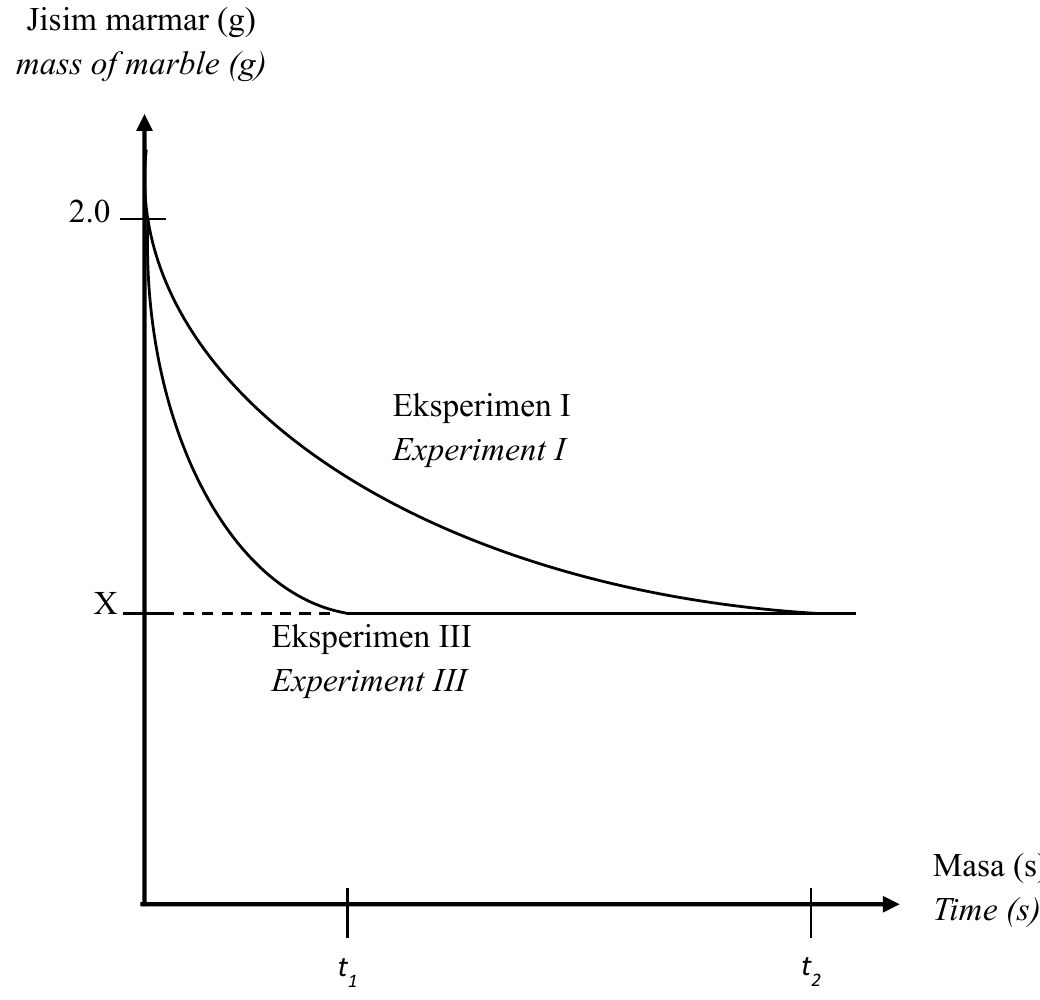
A student carried out three sets of experiments to study the factors affecting the rate of reaction between 2 g of marble and hydrochloric acid. Diagram 7.1: Experiment I - lumps of marble, CaCO3, 15 cm3 1.0 mol dm-3 HCl; Experiment II - lumps of marble, 15 cm3 5.0 mol dm-3 HCl; Experiment III - powdered marble, 15 cm3 1.0 mol dm-3 HCl. Diagram 7.2 shows the mass of marble against time for Experiments I and III (mass falls from 2.0 g to X). Write the chemical equation for the reaction between marble and hydrochloric acid. Calculate the value of X. [Relative mass of marble: 100]
[6]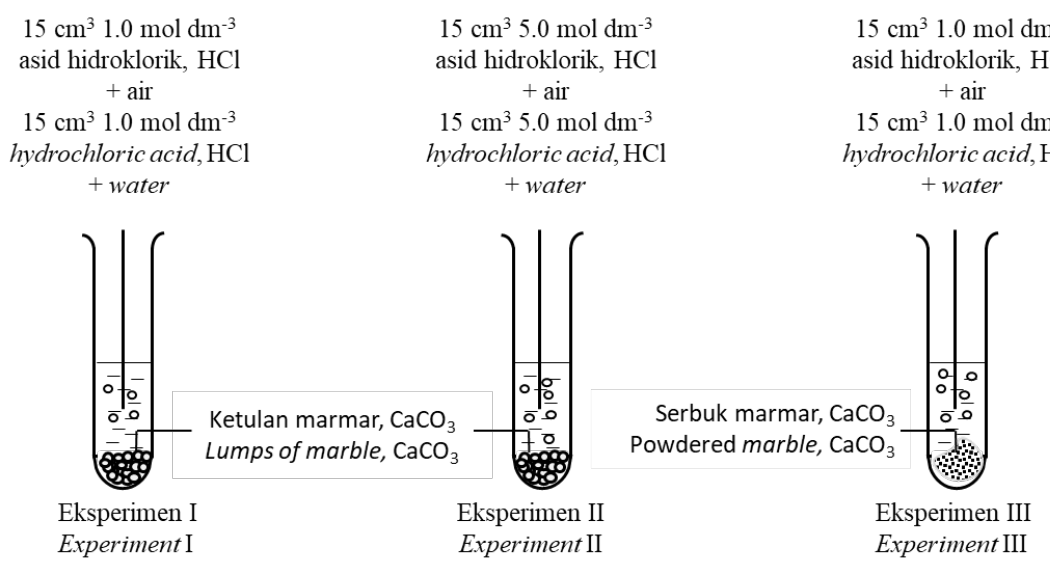
- (b)(ii)
Compare the rate of reaction between (1) Experiment I and Experiment II, and (2) Experiment I and Experiment III. Explain your comparisons with reference to the Collision Theory.
[10] - (c)
When hydrogen gas, H2 reacts with chlorine gas, Cl2 hydrogen chloride gas, HCl is produced. The reactants must collide in the correct orientation for an effective collision. Diagram 7.3 shows the arrangement of atoms of the reactants and product. Draw a labelled diagram to show the orientation of the reactant particles H2 and Cl2 that results in effective collision.
[2]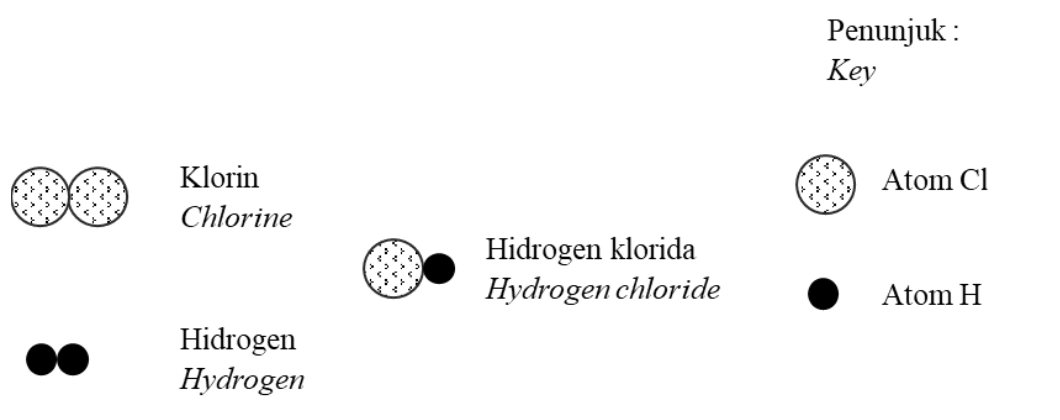
Answer one question from Section B (Question 9 or 10). Diagram 8.1 shows the apparatus set-up to investigate the reduction of copper(II) oxide by hydrogen gas (hydrogen produced from solution X and compound Y). After heating, a brown solid forms in the combustion tube.
Medium20 marks- (a)(i)
State the type of particle present in the hydrogen gas and state the colour of copper(II) oxide.
[2]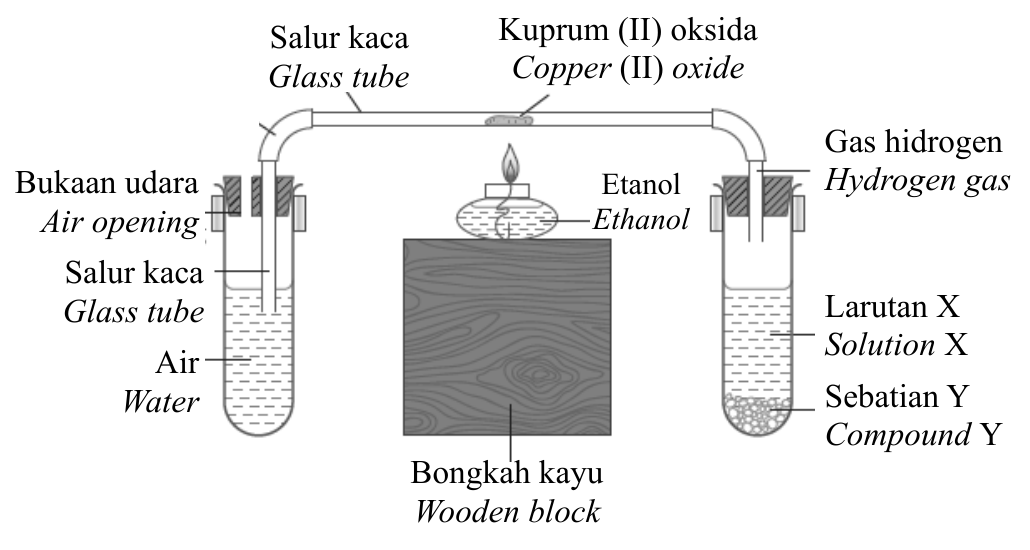
- (a)(ii)
Identify the solution X and compound Y used in Diagram 8.1.
[2] - (a)(iii)
Write a chemical equation for the reaction in Diagram 8.1. Calculate the mass of the brown solid formed when 2 g of copper(II) oxide is heated completely. [Relative atomic mass: H = 1, O = 16, Cu = 64]
[6] - (b)
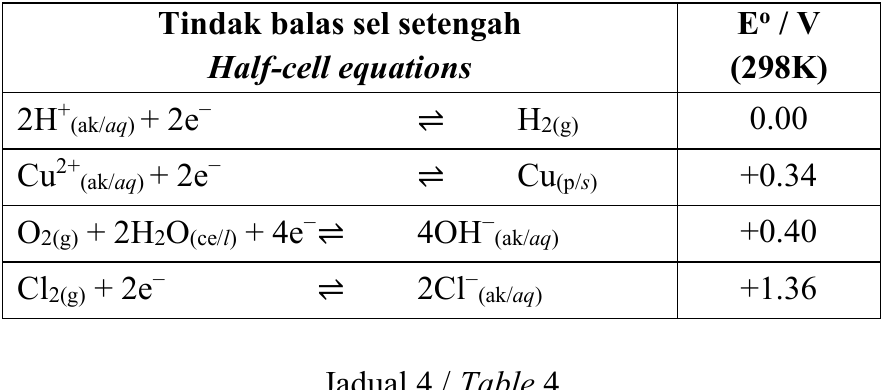
Diagram 8.2 shows three sets of apparatus and observations at the anode and cathode for the electrolysis of copper(II) chloride solution, CuCl2: Set I - carbon electrodes, 0.001 mol dm-3 CuCl2: anode colourless gas, cathode brown solid; Set II - carbon electrodes, 1.0 mol dm-3 CuCl2: anode greenish-yellow gas, cathode brown solid; Set III - copper electrodes, 1.0 mol dm-3 CuCl2: anode copper gets thinner, cathode brown solid. Table 4 (E° / V at 298 K): 2H+ + 2e- ⇌ H2, 0.00; Cu2+ + 2e- ⇌ Cu, +0.34; O2 + 2H2O + 4e- ⇌ 4OH-, +0.40; Cl2 + 2e- ⇌ 2Cl-, +1.36. Based on Diagram 8.2 and Table 4, explain the difference in observations at the anode in Set I, II and III. Write the half-equation for the reaction at the cathode of the three sets.
[10]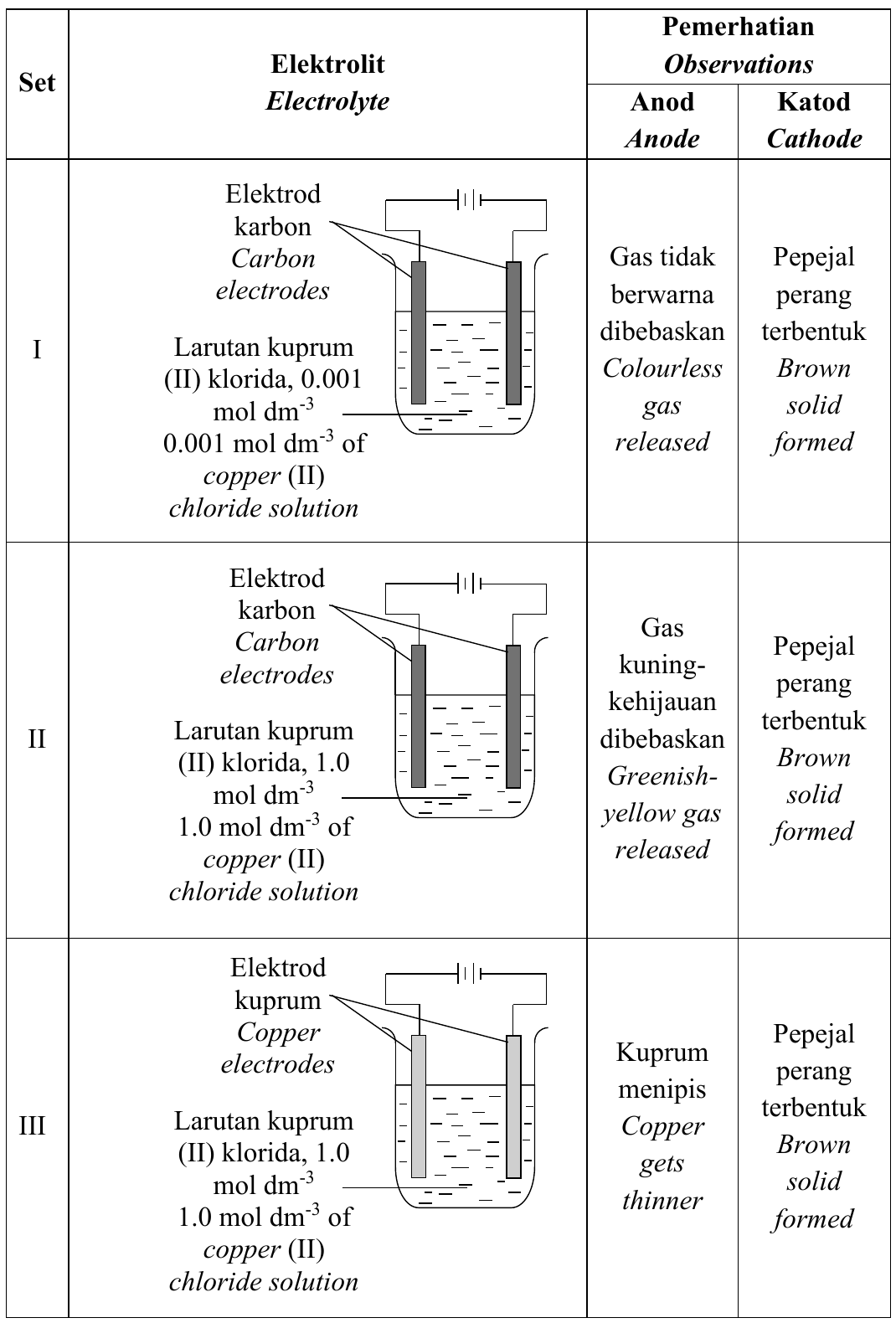
Section C
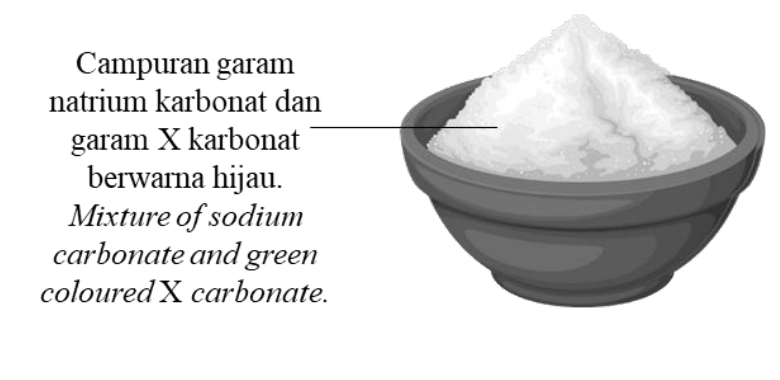
This question must be answered. (a) A student prepared a standard solution using sodium carbonate as shown in Diagram 9.1 (sodium carbonate dissolved in water in a beaker, stirred with a glass rod, transferred into a 250 cm3 volumetric flask; the container and beaker are rinsed with distilled water into the flask).
Medium20 marks- (a)(i)
What is meant by standard solution? Why did the student rinse the container filled with sodium carbonate and the beaker with distilled water? Identify the anion present in the standard solution formed.
[3]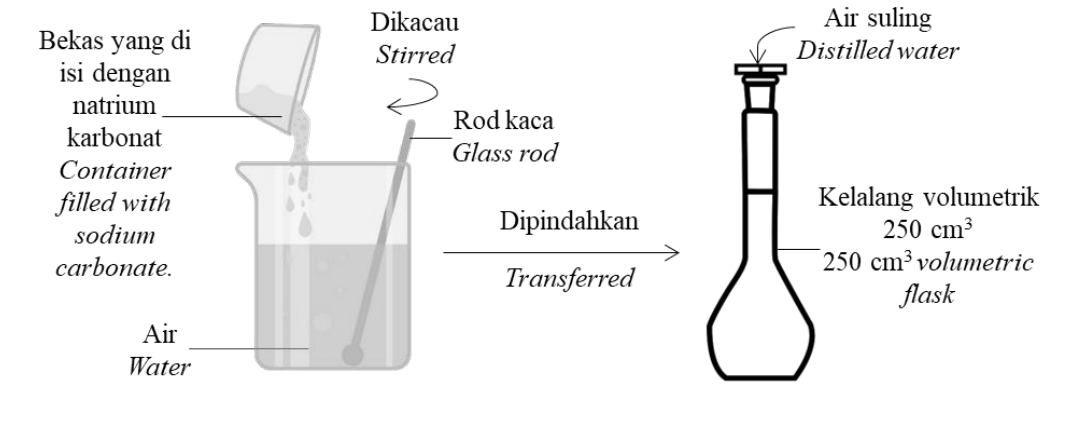
- (a)(ii)
Based on Diagram 9.1, calculate the concentration of the standard solution prepared if 53 g of sodium carbonate is dissolved and poured into the volumetric flask. [Relative mass of sodium carbonate = 106]
[2] - (a)(iii)
Diagram 9.2 shows a flow chart for the reactions when salt G is heated: salt G heated gives solid H + gas I + gas J; salt G + water gives solution G; solution G + sodium carbonate solution (Reaction II) gives solid K + NaNO3. Solid H turns from brown to yellow when cooled, and gas I is brown. Identify salt G, solid H, gas I, gas J and solid K. Write the chemical equation for Reaction II.
[7]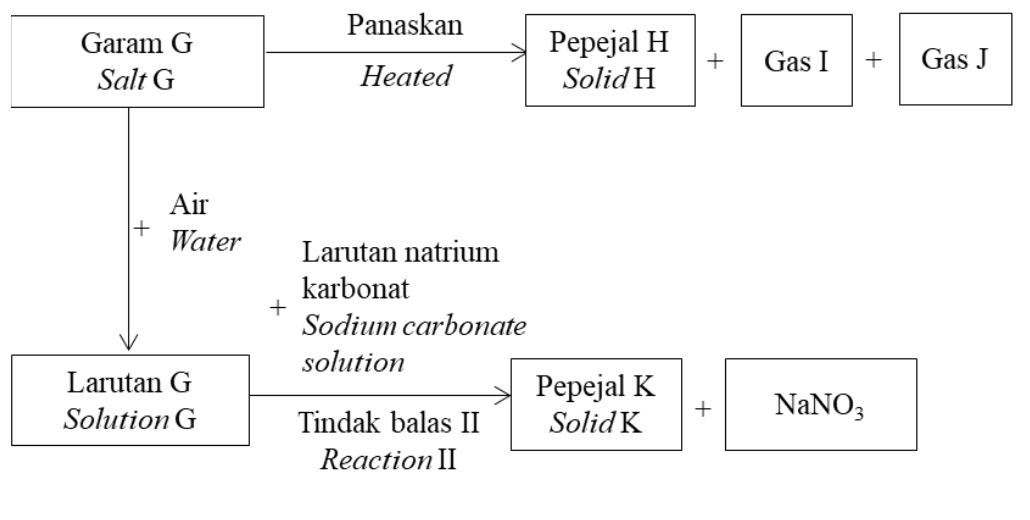
- (b)
A student found that the sodium carbonate he used was spilled and mixed with X carbonate (a green-coloured salt, Diagram 9.3). Describe a method to separate the two carbonate salts. Describe also how the student could verify the presence of cation X in the salt.
[8]