Write your answer on paper. Then open the answer to check it.
Section A
Diagram 1 shows a type of ceramics that is used to construct building's wall.
Medium5 marks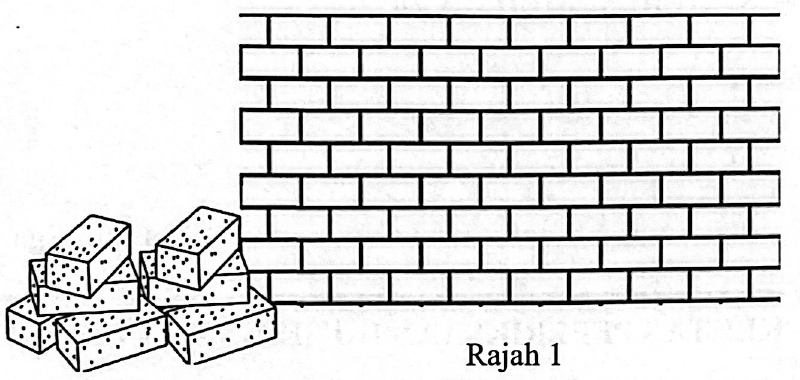
- (a)
State the main material in ceramics.
[1] - (b)
State two characteristic of ceramics.
[2] - (c)
State another type of ceramics.
[1] - (d)
State one uses of the ceramic stated in 1(c).
[1]
Diagram 2 shows the structure of graphene used in an industry.
Easy5 marks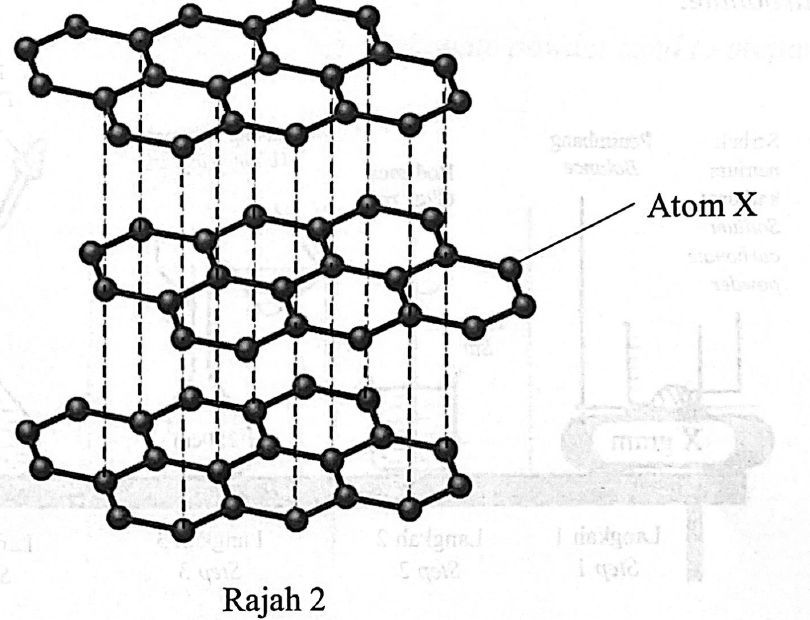
- (a)
Name one field that uses graphene.
[1] - (b)
State one physical property of graphene.
[1] - (c)
What is the special characteristic of graphene that make it suitable for the production of sensors?
[1] - (d)
Based on Diagram 2, name atom X and the type of bond formed.
[2]
Diagram 3 shows the steps taken for preparing a standard solution of sodium carbonate (Step 1: weigh X gram of sodium carbonate powder; Step 2: dissolve and stir with a glass rod; Step 3: transfer into a 250 cm³ volumetric flask; Step 4: add water using a pipette; Step 5: stopper and shake to give 0.05 mol dm⁻³ sodium carbonate solution).
Medium6 marks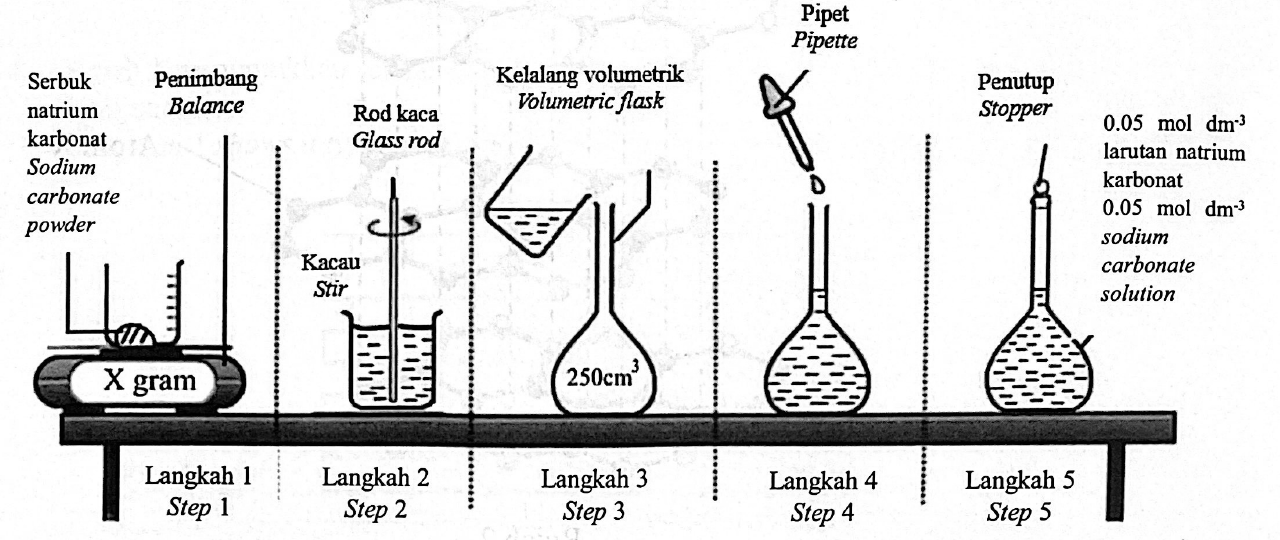
- (a)
What is the meaning of standard solution?
[1] - (b)
Give one reason on why is this method not suitable to prepare standard solution of sodium hydroxide.
[1] - (c)
Calculate the value of X in gram for sodium carbonate powder used to prepare the standard solution. [Relative atomic mass: C=12; O=16; Na=23]
[2] - (d)
Write a balanced chemical equation if titration is carried out using sodium carbonate solution and hydrochloric acid.
[2]
Diagram 4 shows a group of elements: fluorine (¹⁹₉F), chlorine (³⁵₁₇Cl), bromine (⁸⁰₃₅Br) and iodine (¹²⁷₅₃I).
Medium7 marks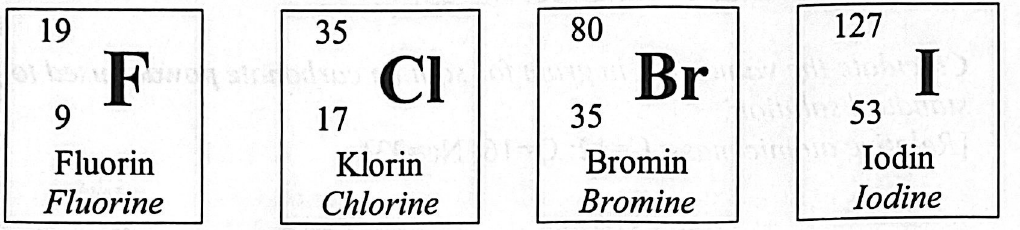
- (a)
State the group of these elements in the Periodic Table of Elements.
[1] - (b)
Write the electron arrangement for fluorine atom.
[1] - (c)
Bromine atom is smaller than iodine atom. Explain why bromine forms a negative ion more easily than iodine.
[2] - (d)(i)
Chlorine reacts with sodium to form a compound. Write a chemical equation for this reaction.
[2] - (d)(ii)
Explain the formation of bond for this compound.
[1]
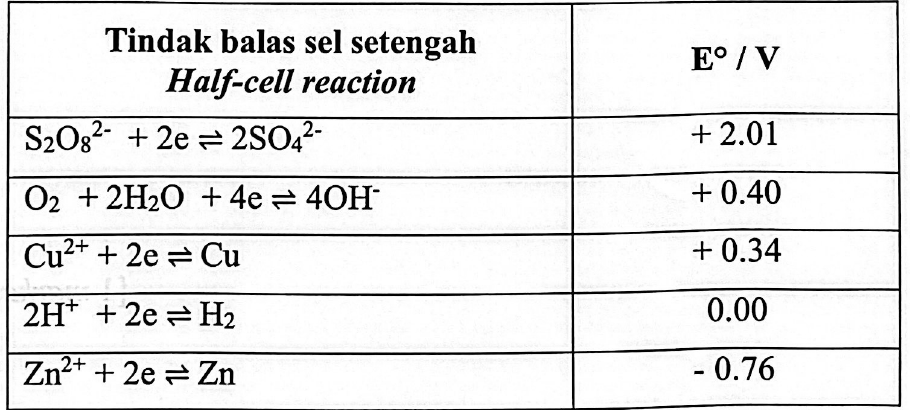
Diagram 5 shows an apparatus to study redox reactions. Cell A has a copper electrode in 1.0 mol dm⁻³ copper(II) sulphate and a zinc electrode in 1.0 mol dm⁻³ zinc sulphate, separated by a porous pot; Cell B has carbon electrodes in 1.0 mol dm⁻³ copper(II) sulphate, with Gas X collected. Table 1 shows the standard electrode potential values: S₂O₈²⁻ + 2e ⇌ 2SO₄²⁻ +2.01 V; O₂ + 2H₂O + 4e ⇌ 4OH⁻ +0.40 V; Cu²⁺ + 2e ⇌ Cu +0.34 V; 2H⁺ + 2e ⇌ H₂ 0.00 V; Zn²⁺ + 2e ⇌ Zn -0.76 V.
Medium8 marks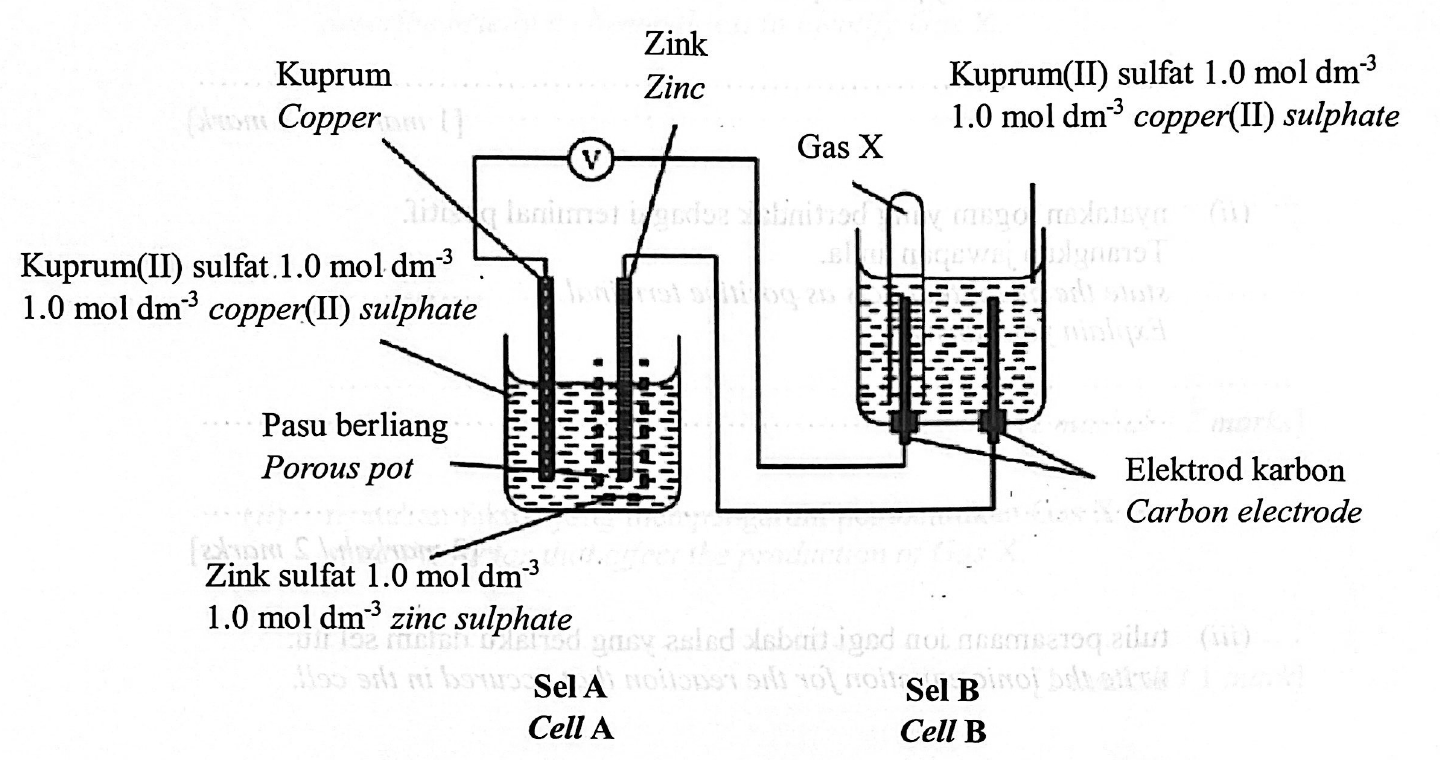
- (a)(i)
Referring to Cell A, what is the use of porous pot?
[1] - (a)(ii)
State the metal that acts as positive terminal. Explain your answer.
[2] - (a)(iii)
Write the ionic equation for the reaction that occured in the cell.
[1] - (a)(iv)
Calculate the voltage of cell, E°cell.
[1] - (b)(i)
Refer to cell B, describe briefly a chemical test to identify Gas X.
[2] - (b)(ii)
State the factor that affect the production of Gas X.
[1]
Table 2 shows two experiments carried out to study the factor that affects rate of reaction. Experiment I: excess zinc granule + 50 cm³ of 1.0 mol dm⁻³ hydrochloric acid, time taken to collect 60 cm³ gas = 80 s. Experiment II: excess zinc powder + 50 cm³ of 1.0 mol dm⁻³ hydrochloric acid, time taken to collect 60 cm³ gas = 30 s.
Medium9 marks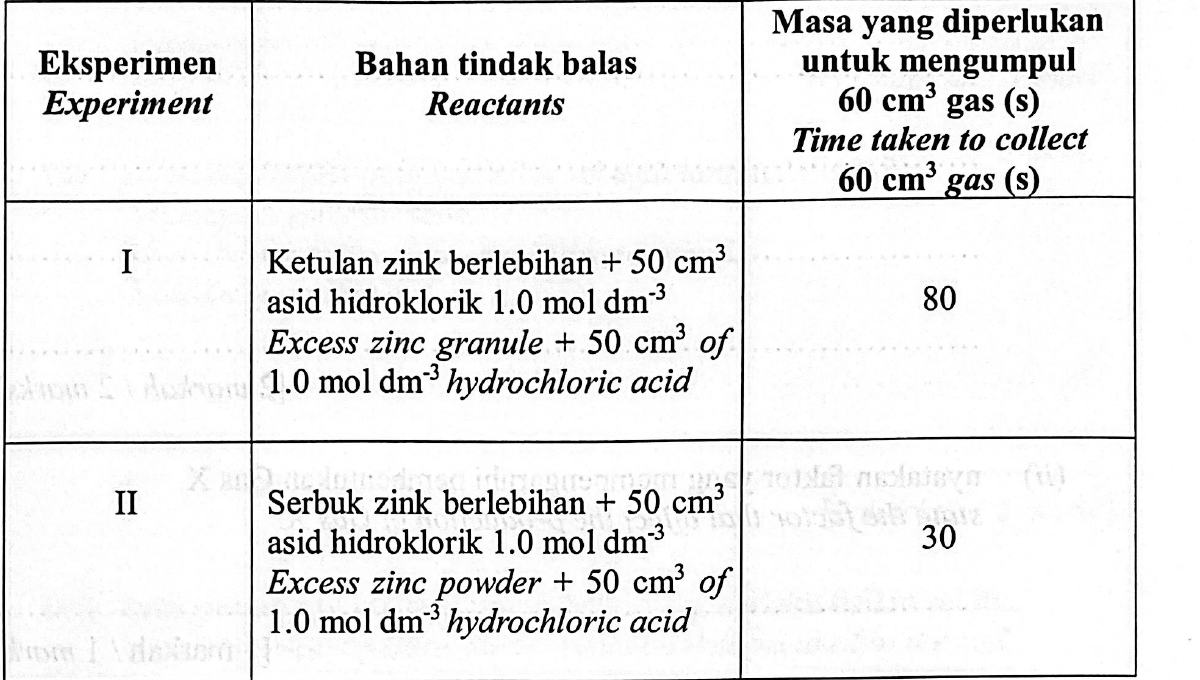
- (a)
State the chemical formula for the acid used.
[1] - (b)
State the factor that affects the rate of reaction in these experiments.
[1] - (c)
Write a balanced chemical equation for the reaction occurred.
[2] - (d)
Calculate the average rate of reaction for experiment I and II.
[2] - (e)
Compare the rate of reaction of experiment I and II. By using collision theory, explain the difference in the rate of reaction for both experiments.
[3]
Diagram 6.1 shows a graph of temperature against time for heating of naphthalene, C₁₀H₈ (flat section PQ at 80 °C, then heating continues up to 110 °C).
Medium10 marks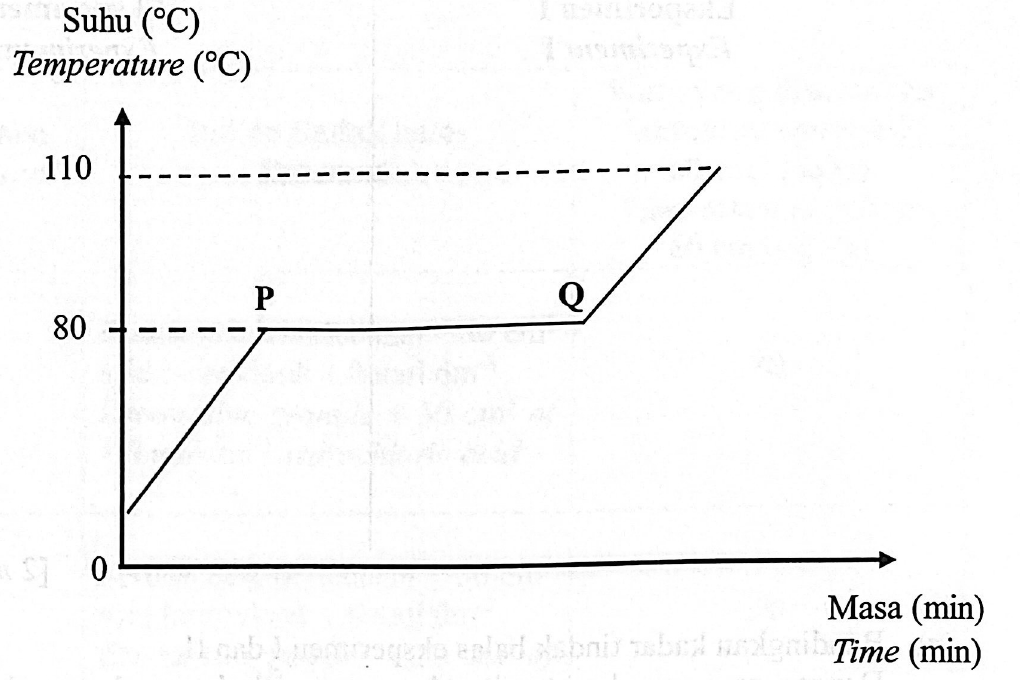
- (a)(i)
What is the type of particle for naphthalene?
[1] - (a)(ii)
Based on Diagram 6.1, determine the melting point of naphthalene.
[1] - (a)(iii)
Explain why there is no increase in temperature from P to Q.
[2] - (b)(i)
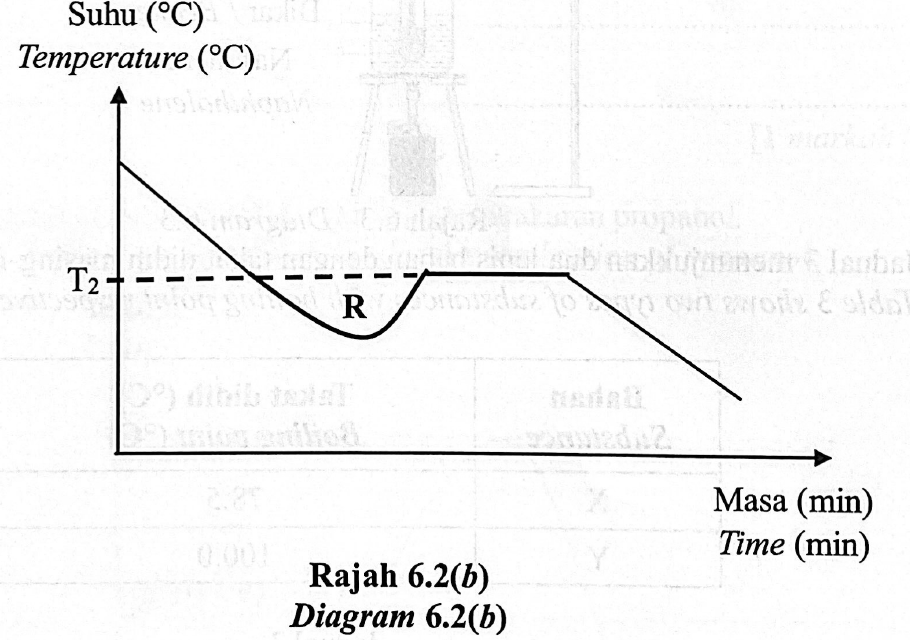
Diagram 6.2(a) and Diagram 6.2(b) shows graphs of cooling curves of naphthalene plotted by two different students. State a significant difference between the two graphs and explain why.
[2]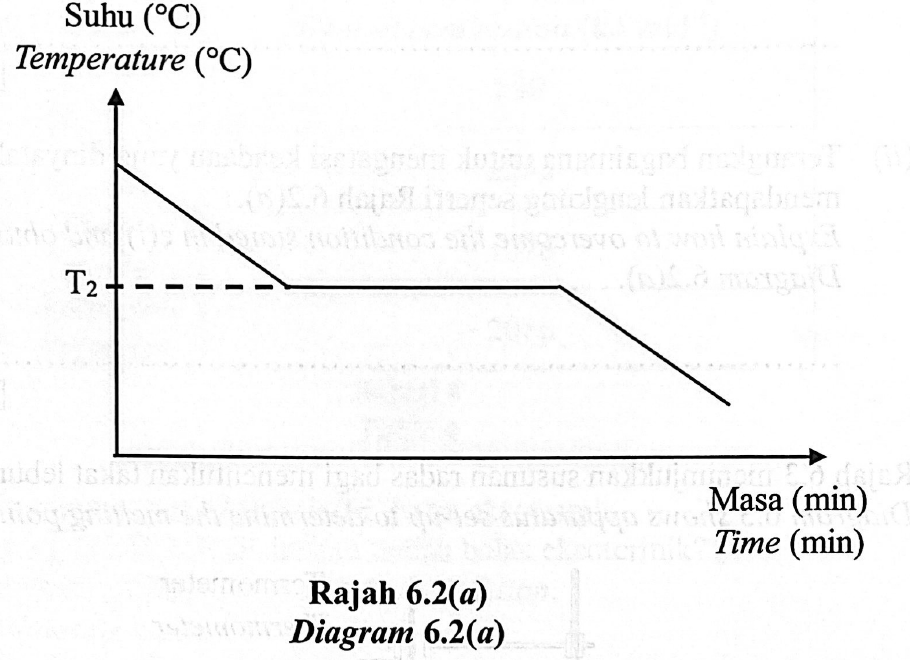
- (c)(i)
Based on Diagram 6.2(b), state the phenomenon that occur at R.
[1] - (c)(ii)
Explain how to overcome the condition stated in c(i) and obtain a curve like Diagram 6.2(a).
[1] - (d)
Diagram 6.3 shows the apparatus set-up to determine the melting point of naphthalene. Table 3 shows two types of substances with boiling point respectively: X 78.5 °C, Y 100.0 °C. Based on Table 3, which substance is suitable to be placed in the beaker? Give one reason.
[2]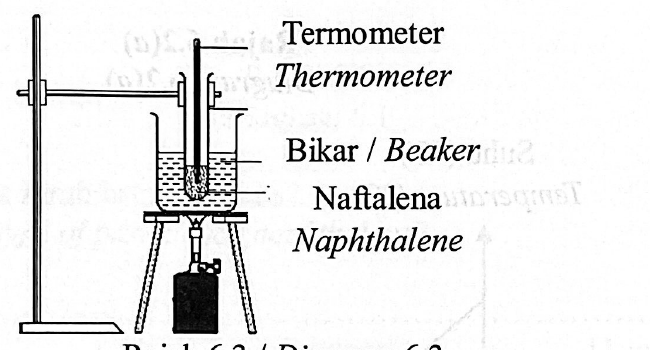
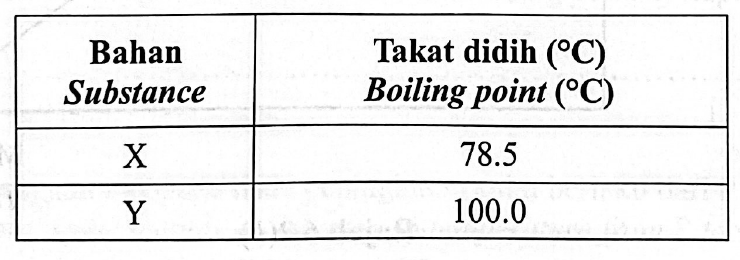
Table 4 shows the heat of combustion of some fuels: methane -890 kJ mol⁻¹; propane -2230 kJ mol⁻¹; ethanol -1376 kJ mol⁻¹; propanol -2016 kJ mol⁻¹.
Medium10 marks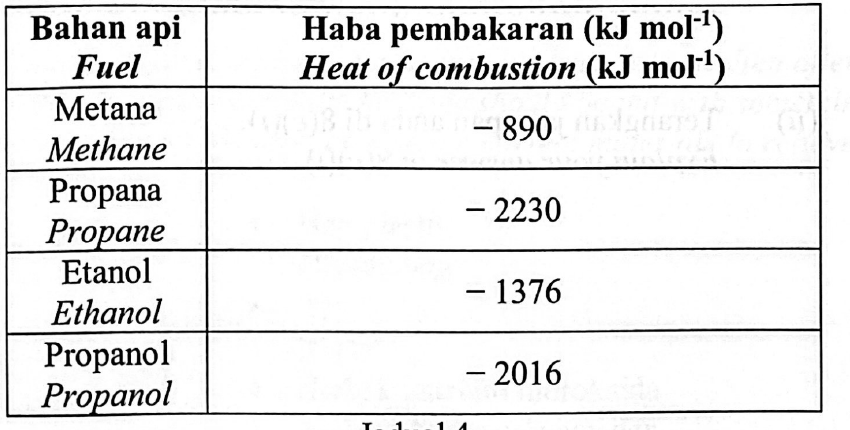
- (a)
The combustion of fuel is an exothermic reaction. What is meant by exothermic reaction?
[1] - (b)
Diagram 7 shows the energy profile for the combustion of propanol (2C₃H₇OH + 9O₂ at higher energy level, 6CO₂ + 8H₂O at lower level, with an activation energy peak). Mark ΔH for the reaction in Diagram 7.
[1] - (c)(i)
Compare the heat of combustion of methane and propane.
[1] - (c)(ii)
Explain your answer in 8(c)(i).
[2] - (d)
Calculate the fuel value of ethanol. [Relative atomic mass: H = 1, C = 12, O = 16]
[2] - (e)
During a football game, a player found that his knee was swollen after being hit by the opponent. To relieve the pain, his knee should be put with something cold. By using chemistry knowledge, choose the correct materials to relieve the player's pain (plastic bag, water, sodium hydroxide powder, ammonium nitrate powder). Describe how the player's pain can be relieved.
[3]
Section B
Answer one question from Section B. (Section B, 20 marks.) Diagram 8.1 shows the apparatus set-up for two experiments to determine the empirical formulae of metal oxide: Experiment I heats metal X in air; Experiment II passes dry hydrogen over heated Y oxide.
Medium20 marks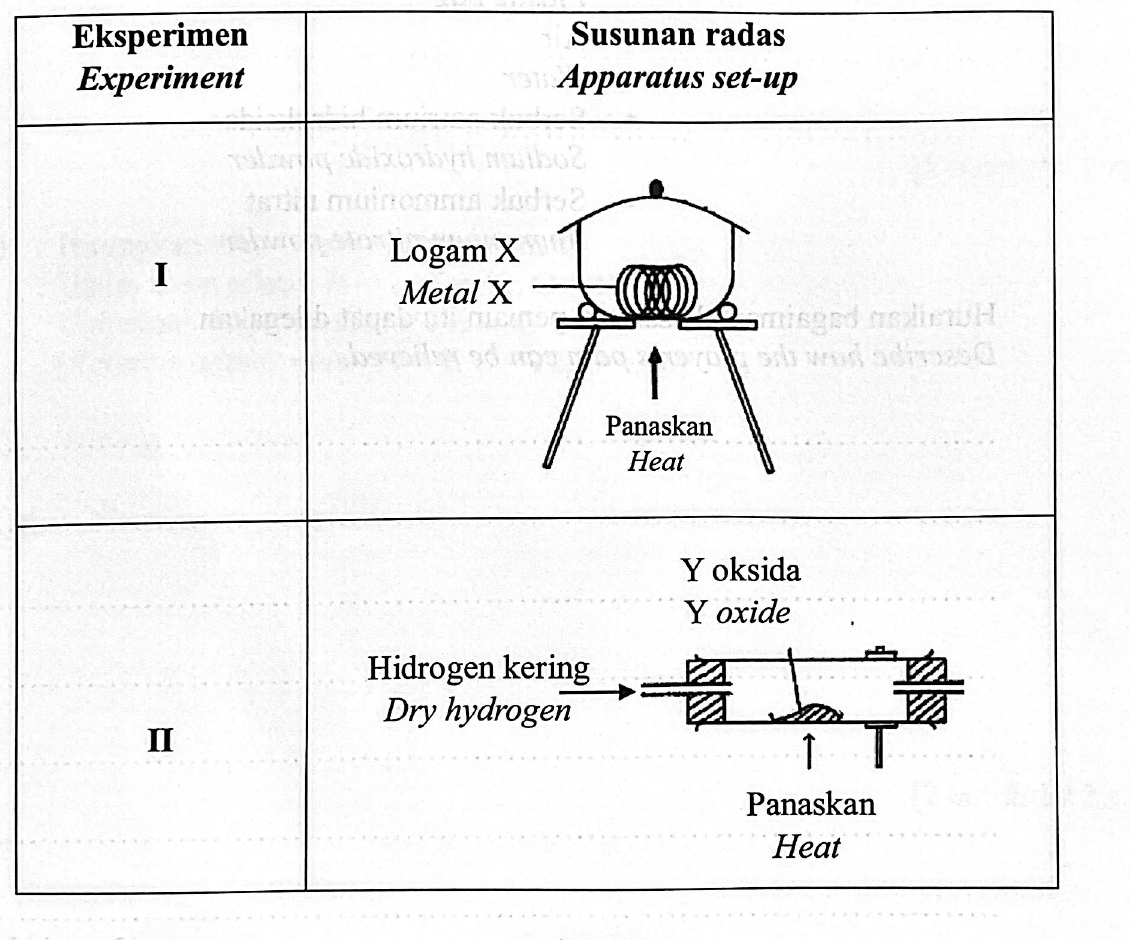
- (a)(i)
State the meaning of empirical formula and molecular formula.
[2] - (a)(ii)
The empirical formula of oxide X can be determined by Experiment I while oxide Y can be determined by Experiment II. Suggest the name of metal X and metal Y. Explain the difference in the chosen method to determine the empirical formula for the two oxides.
[6] - (a)(iii)
Glucose contains 40% carbon, 6.67% hydrogen and 53.33% oxygen by mass. The molar mass of glucose is 180 g mol⁻¹. Determine the molecular formula of glucose. [Relative atomic mass: H = 1; C = 12; O = 16]
[5] - (b)
Diagram 8.2 shows the apparatus set-up for the decomposition of copper(II) nitrate when heated (a wooden splinter is placed at the mouth of the test tube). State three observations from the experiment. Write a balanced chemical equation and state the quantitative information and qualitative information that can be deduced from the equation.
[7]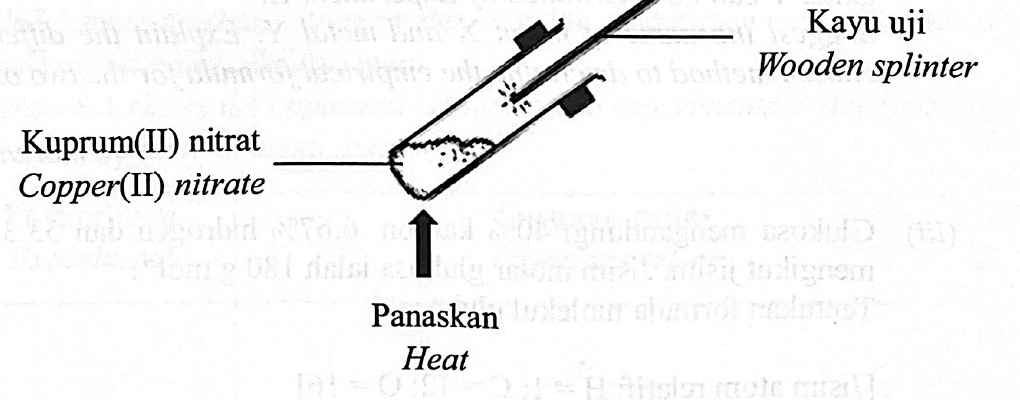
Answer one question from Section B. (Section B, 20 marks.) Diagram 9 shows the structural formulae of hydrocarbon P (ethane, CH₃CH₃) and Q (butane, CH₃CH₂CH₂CH₃).
Medium20 marks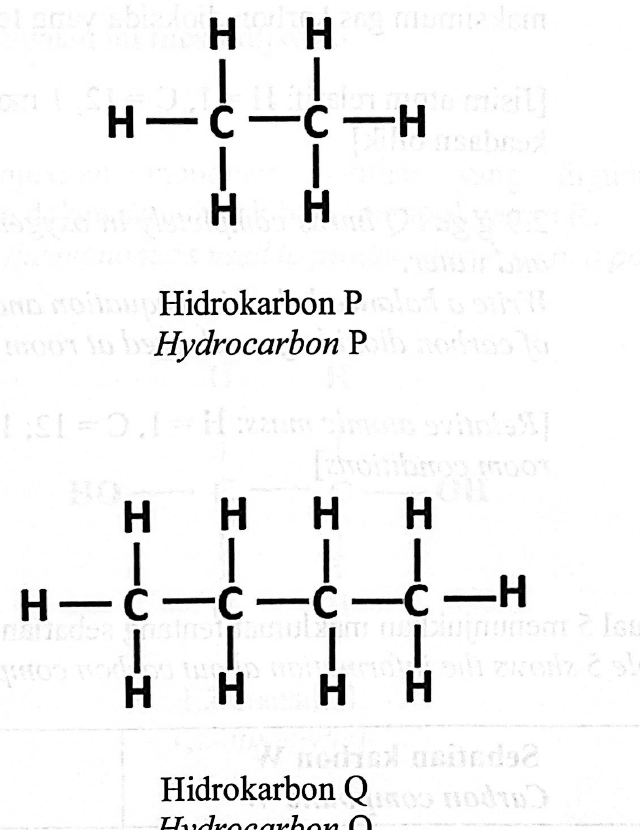
- (a)(i)
Write the molecular formulae for hydrocarbon P and Q. State the homologous series and general formula for both hydrocarbons.
[4] - (a)(ii)
Hydrocarbon Q has another isomer. Draw the structural formula and name the isomer.
[2] - (a)(iii)
Gas P is channelled into chlorine water and put into a closed cupboard. After 2 hours, it was found that the colour of chlorine water remains unchanged. Explain the observation.
[2] - (a)(iv)
2.9 g gas Q burns completely in oxygen gas to produce carbon dioxide and water. Write a balanced chemical equation and calculate the maximum volume of carbon dioxide gas released at room conditions. [Relative atomic mass: H = 1, C = 12; 1 mol of gas occupies 24 dm³ at room conditions]
[6] - (b)
Table 5 shows the information about carbon compound W (has 2 carbon atoms, contains hydroxyl, -OH group) and X (has 3 carbon atoms, contains carboxyl, -COOH group). Name carbon compound W and X. Describe a chemical test to differentiate carbon compound W and X.
[6]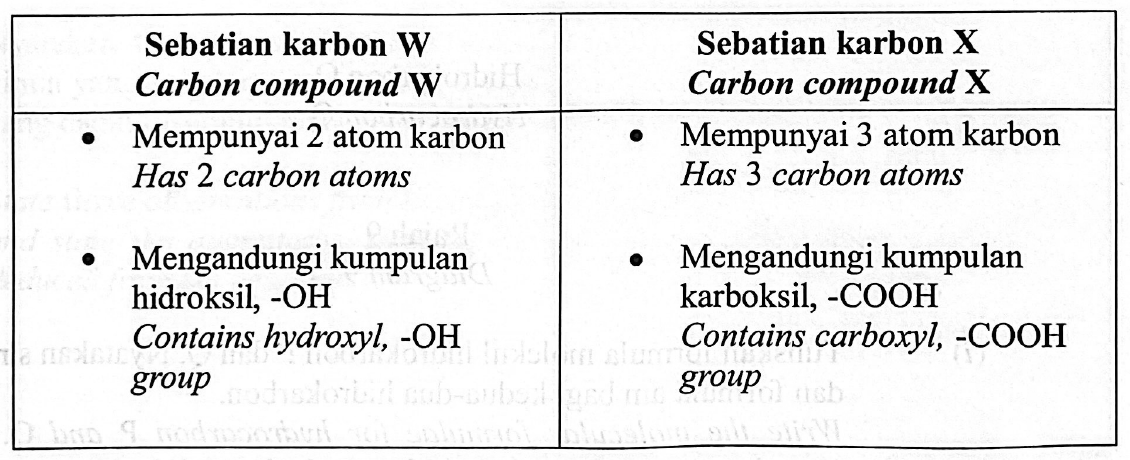
Section C
Section C (20 marks): this question must be answered. Diagram 10.1 shows the monomers used to produce terylene in a polymerisation reaction R: 1,2-ethanediol (HO-CH₂-CH₂-OH) and terephthalic acid (HOOC-C₆H₄-COOH).
Hard20 marks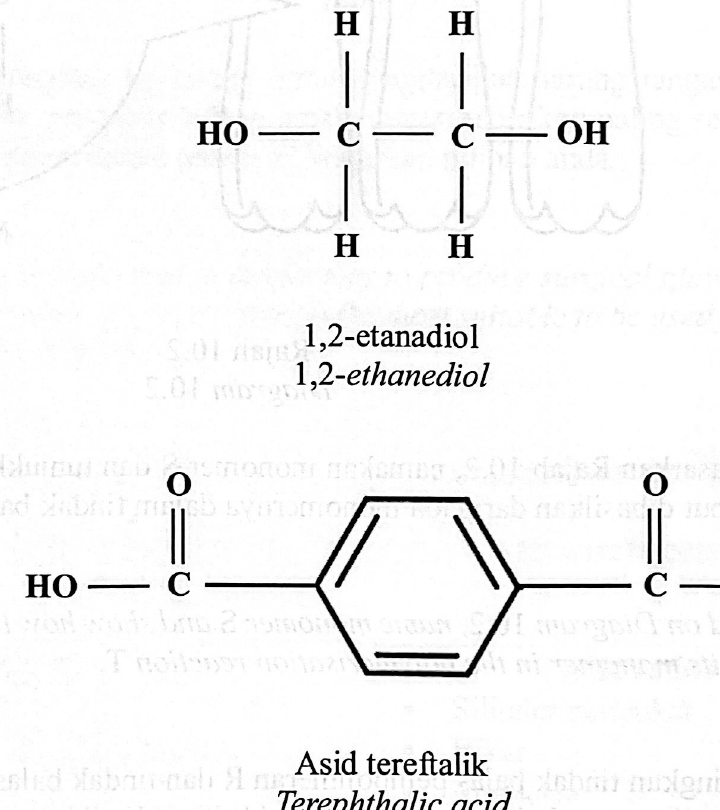
- (a)(i)
Based on Diagram 10.1, state the meaning of polymer, name the product formed besides terylene and name polymerisation reaction R.
[3] - (a)(ii)
Diagram 10.2 shows monomer S (CH₂=CH₂) for the production of plastic products (bottles) through the polymerisation reaction T. Based on Diagram 10.2, name monomer S and show how the polymer is produced from its monomer in the polymerisation reaction T.
[3]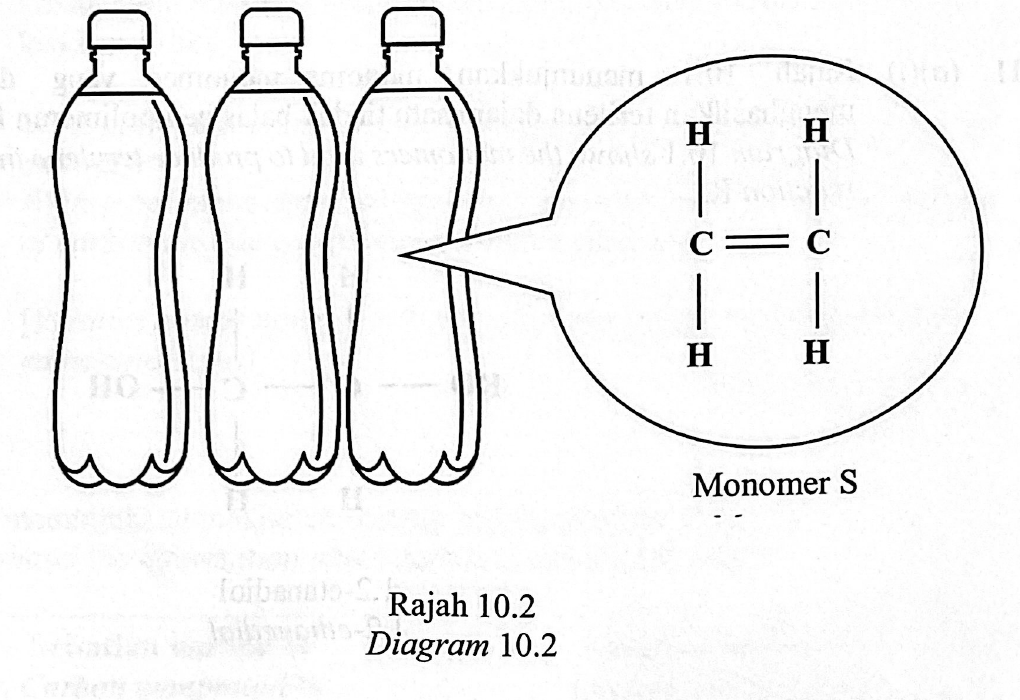
- (a)(iii)
Compare polymerisation reaction R and polymerisation reaction T. Your comparison should include: name of polymerisation reaction; type of monomer; products; another example of polymer.
[4] - (b)
Table 6 shows two situations involving latex: P = latex + coagulant X; Q = latex + anticoagulant Y. Latex needs to be delivered to the factory to produce surgical gloves. As a rubber plantation manager, which situation is the most suitable to be used for the delivery of latex? Justify your choice.
[4]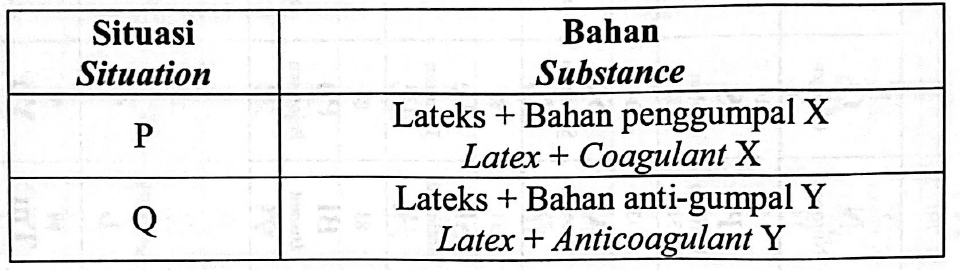
- (c)
Suggest one suitable substance to produce rubber tubes in the laboratory. Briefly describe the preparation of the rubber tube by using following materials and apparatus: Materials: latex, named substance; Apparatus: measuring cylinder, beaker, glass rod.
[6]