Write your answer on paper. Then open the answer to check it.
Section A
Diagram 1 shows the substances produced from polymer S (a plastic bag, plates, cups and cutlery).
Medium5 marks
- (a)
What is polymer?
[1] - (b)
Name polymer S.
[1] - (c)
What is the main source to produce polymer S?
[1] - (d)
State the type of polymerisation reaction to produce polymer S.
[1] - (e)
Draw the structural formula for monomer S.
[1]
Table 2 shows information about some of the elements found in Period 3 of the Periodic Table of Elements. Element (proton number): Sodium 11, Magnesium 12, Aluminium 13, Silicon 14, Chlorine 17.
Medium5 marks- (a)
What is the meaning of period?
[1] - (b)
State the element that exists as diatomic molecule.
[1] - (c)
Write the electron arrangement for aluminium atom.
[1] - (d)
Explain why size of sodium atoms are larger than chlorine atoms.
[2]
Diagram 3 shows the photosynthesis process for the production of glucose, C6H12O6 in green plants (inputs: sunlight, carbon dioxide gas, water; outputs: glucose, oxygen gas).
Medium6 marks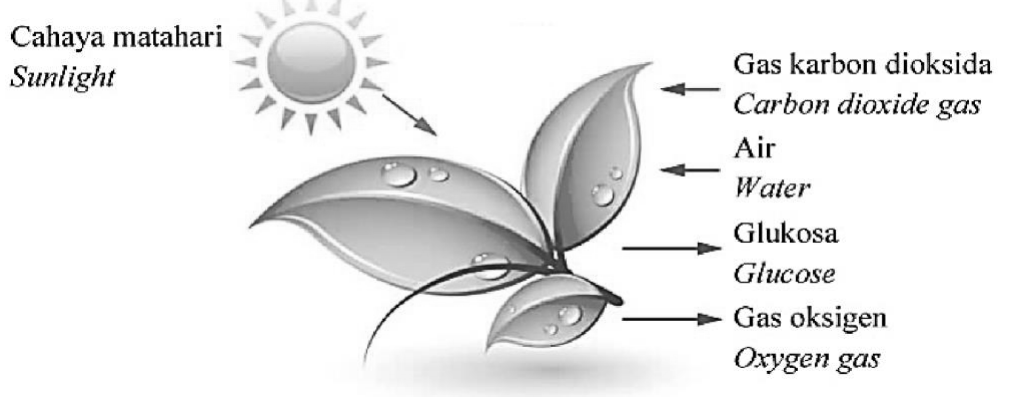
- (a)
Give the definition of empirical formula.
[1] - (b)
Write the empirical formula for glucose.
[1] - (c)
Write a balanced chemical equation for the photosynthesis process.
[2] - (d)
Calculate the percentage of carbon by mass in one glucose molecule. [Relative atomic mass: H=1, C=12, O=16]
[2]
(a) The equation shows the preparation of soap in the laboratory: Lauric acid + Sodium hydroxide → Soap X + Glycerol. (b) Diagram 4.1 shows part of the food content label on Marjerin Lazat packaging. (c) Diagram 4.2 shows the high electricity bill due to the use of air conditioner in Haimy's house.
Medium7 marks- (a)(i)
What is the name of this reaction?
[1] - (a)(ii)
Name the soap X.
[1] - (a)(iii)
Lauric acid from coconut oil is mixed with concentrated sodium hydroxide solution to produce soap X, CH3(CH2)10COONa: CH3(CH2)10COOH + NaOH → CH3(CH2)10COONa + H2O. If 0.1 mole of lauric acid were used, calculate the mass of soap produced. [Molar mass of CH3(CH2)10COONa = 222 g mol-1]
[2] - (b)(i)
What type of food additive is ascorbic acid? (Diagram 4.1 ingredients: vegetable oil, salt, solid milk, emulsifier, ascorbic acid, flavouring and permitted food dyes.)
[1] - (b)(ii)
Identify another food additive in the margarine.
[1] - (c)
Based on your knowledge of green technology applications, state how you can reduce the energy usage in Haimy's house?
[1]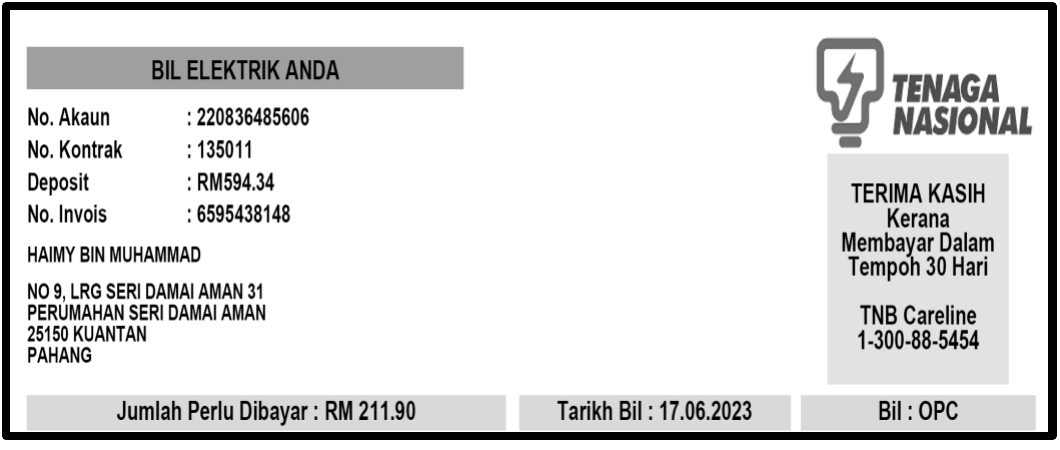
Magnesium consists of three isotopes. Diagram 5 shows the standard representation for magnesium atoms: 24/12 Mg, 25/12 Mg and 26/12 Mg.
Medium8 marks- (a)
What is the meaning of isotope?
[1] - (b)
Draw the atomic structure of magnesium, Mg-24.
[2] - (c)
Magnesium exists naturally as three isotopes: 79.0% of 24Mg, 10.0% of 25Mg and 11.0% of 26Mg. Calculate the relative atomic mass of magnesium.
[2] - (d)
Table 5 shows the bond information found in substances R (strong electrostatic force between ions), S (strong electrostatic force between sea of electrons and metal ions) and T (covalent bonds between carbon atoms, giant structure). Based on Table 5, choose one substance that can conduct electricity in the solid and molten states. Explain how this substance can conduct electricity in the solid and molten states.
[3]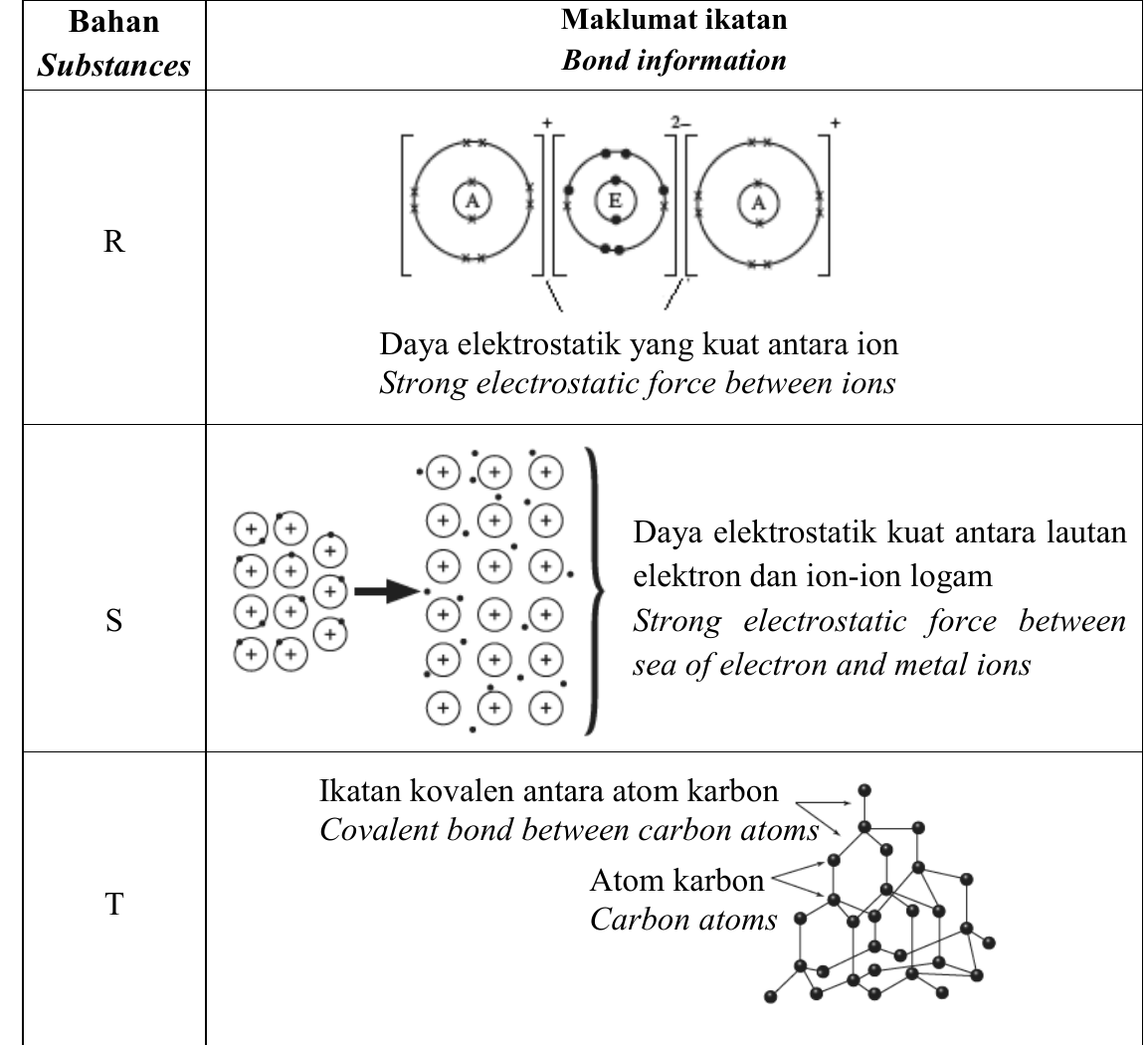
(a) Alloy J which is light but strong is used to make racing bicycles. (b) Advanced ceramics are made from inorganic compounds such as oxides, carbides and nitrides. (c) Composite material W is produced from a combination of matrix substance U and strengthening substance V. Table 6 compares their properties.
Medium9 marks- (a)(i)
State the meaning of alloy.
[1] - (a)(ii)
Identify alloy J.
[1] - (b)
State one use of advanced ceramics in the vehicle manufacturing industry and explain your answer.
[3] - (c)(i)
Identify matrix substance U, strengthening substance V and composite material W.
[3]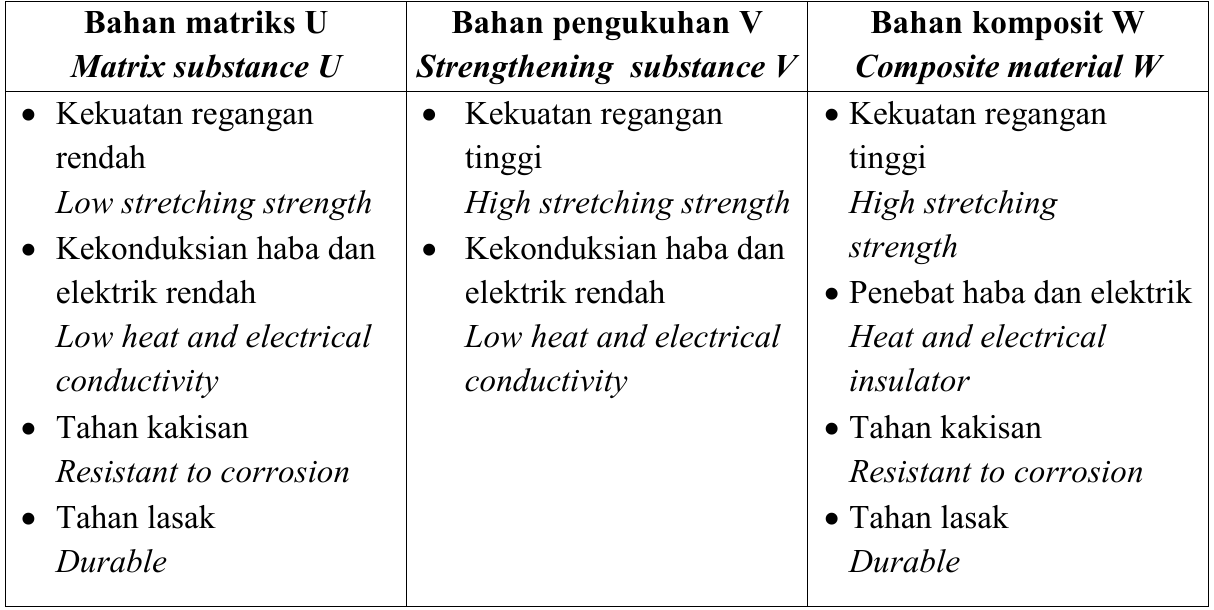
- (c)(ii)
State one use of composite material W in daily life.
[1]
Diagram 7.1 shows the structural formula for carbon compound Z: CH3-C(=O)-O-CH3.
Medium10 marks- (a)(i)
State the meaning of carbon compound.
[1] - (a)(ii)
State the functional group of carbon compound Z.
[1] - (a)(iii)
Compound Z can be produced by the reaction between carboxylic acid X and alcohol Y. Write the chemical equation for the reaction.
[2]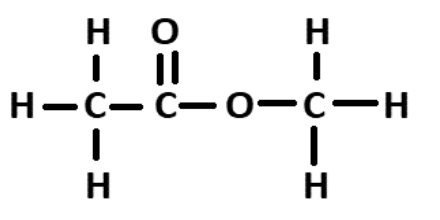
- (b)(i)
Diagram 7.2: compound P (4 carbon atoms, functional group -OH) undergoes Reaction I (dehydration) to give compound Q; Q reacts with H2O (Reaction II) to give P; Q reacts with H2 (Reaction III) to give compound R. Name the homologous series of compound P.
[1]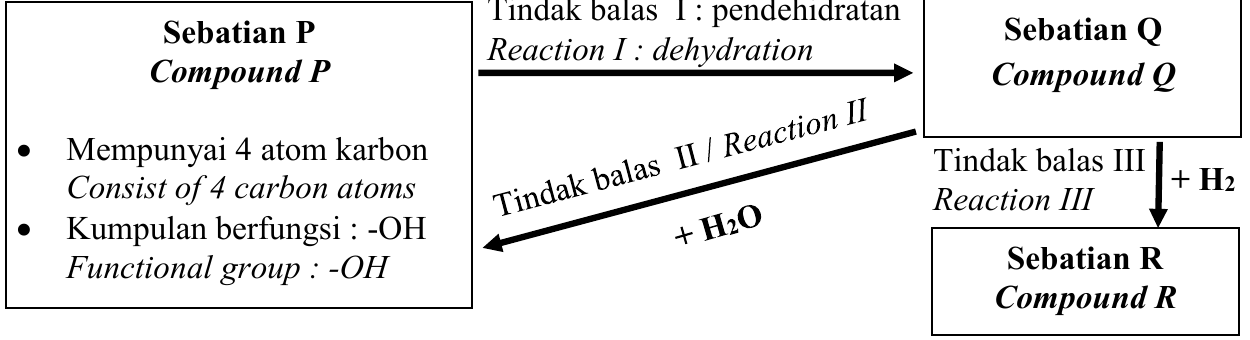
- (b)(ii)
State the general formula of compound Q.
[1] - (b)(iii)
Write the molecular formula of compound R.
[1] - (b)(iv)
Describe a chemical test to differentiate between compound Q and compound R.
[3]
Diagram 8 shows the combination between a chemical cell (Cell II: magnesium rod and copper rod in 1 mol dm-3 copper(II) sulphate solution) and an electrolytic cell (Cell I: two carbon rods in 1 mol dm-3 sodium chloride solution).
Medium10 marks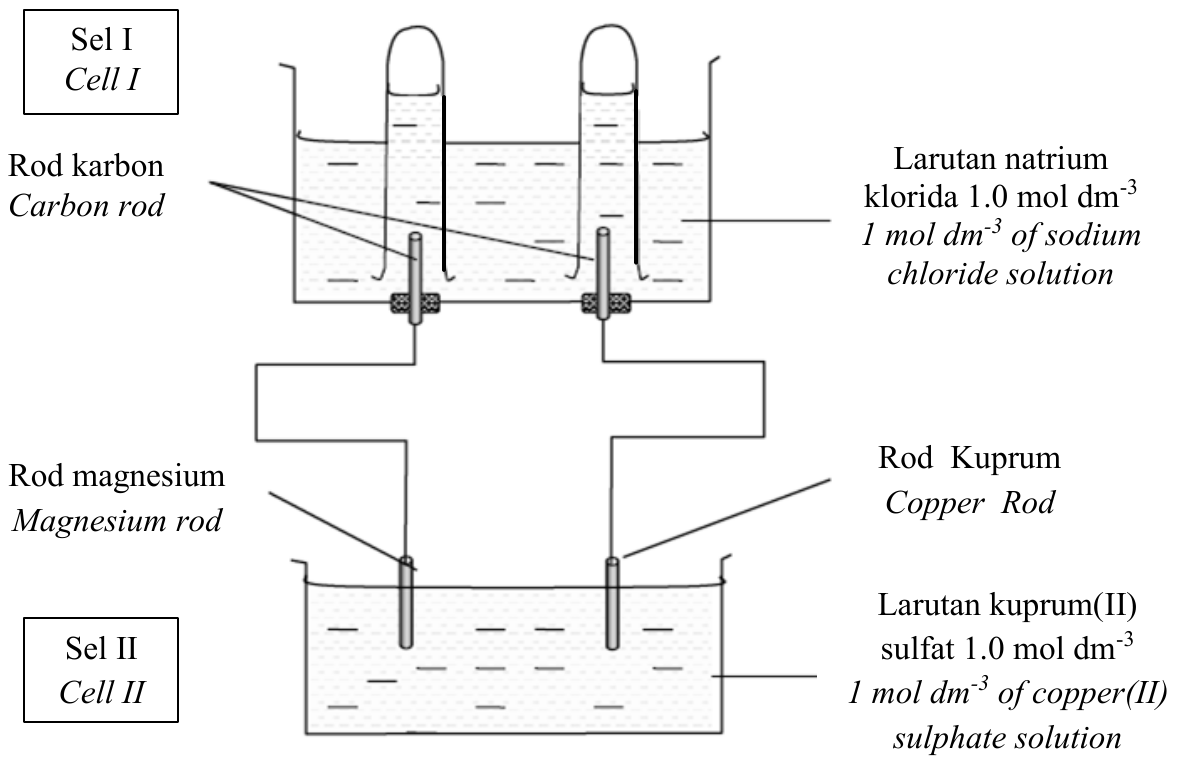
- (a)
What is the meaning of electrolysis?
[1] - (b)(i)
Referring to Cell I, state all the ions present in the sodium chloride solution.
[1] - (b)(ii)
State the observation at anode.
[1] - (c)(i)
Referring to Cell II and standard electrode potential, E° of the half cells: Mg2+ + 2e- ⇌ Mg, E° = -2.38 V; Cu2+ + 2e- ⇌ Cu, E° = +0.34 V. Identify the negative terminal.
[1] - (c)(ii)
Identify the positive terminal.
[1] - (d)(i)
You are provided with a voltmeter and two additional chemicals: 1.0 mol dm-3 magnesium sulphate solution and 1.0 mol dm-3 sulphuric acid. Draw a set-up apparatus diagram by modifying the set-up in Cell II so that it can function as a Daniell cell.
[2] - (d)(ii)
Write the cell notation and calculate the cell voltage for the Daniell cell in (d)(i).
[3]
Section B
(a) Table 9 shows the information for three sets of experiments to investigate the factors that affect the rate of reaction between zinc and sulphuric acid. Set I: 25 cm3 of 0.2 mol dm-3 sulphuric acid + excess zinc powder, 33 s. Set II: 25 cm3 of 0.2 mol dm-3 sulphuric acid + excess zinc granules, 45 s. Set III: 25 cm3 of 0.2 mol dm-3 sulphuric acid + excess zinc powder + copper(II) sulphate solution, 25 s. (Time taken to collect 40 cm3 of hydrogen gas.) Answer any one question from Section B.
Medium20 marks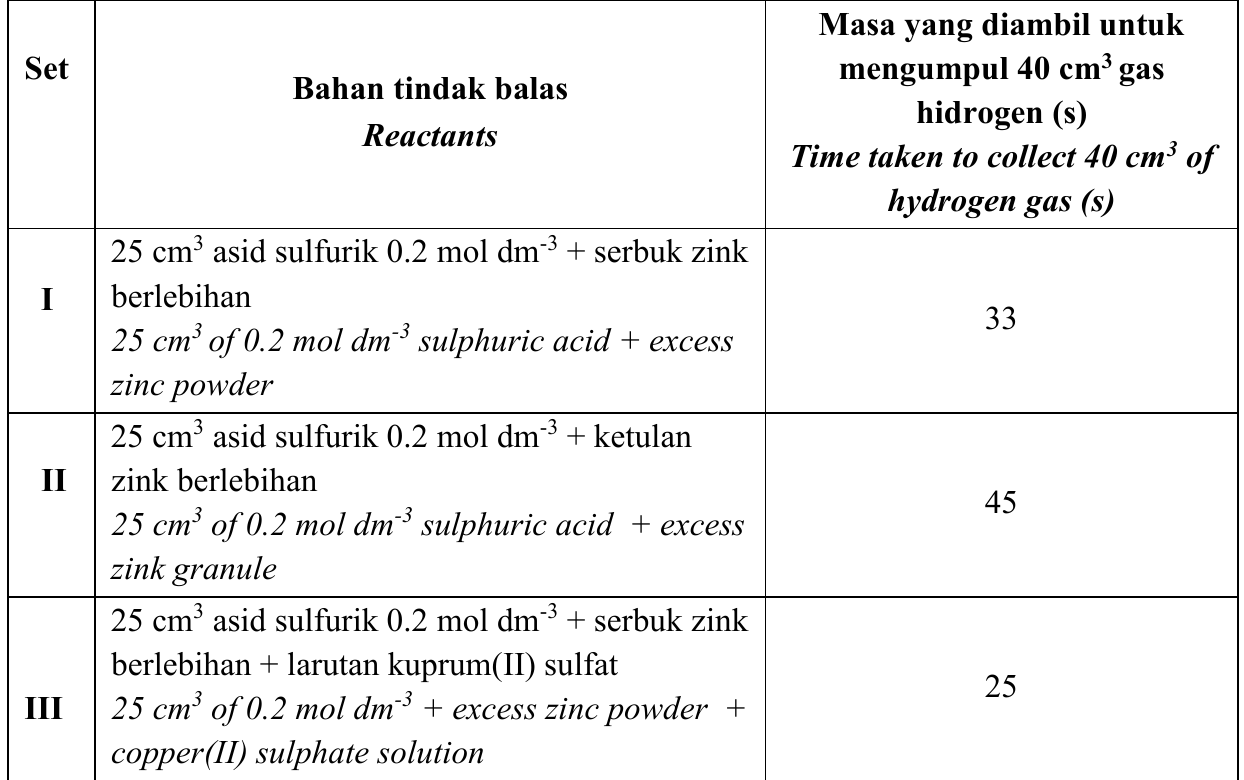
- (a)(i)
State the meaning of rate of reaction.
[1] - (a)(ii)
Based on Table 9, write the ionic equation for the reaction and calculate the rate of reaction in Set I and Set II. Draw the energy profile diagram for Set I and Set III reactions on the same energy axis. Show and label the activation energy of Set I as Ea and Set III as Ea'.
[6] - (a)(iii)
Compare the rate of reaction between Set I and Set II, and between Set I and Set III. Explain your answer based on collision theory.
[10] - (b)
Diagram 9 shows a conversation during an appointment between a doctor and his patient: the doctor gives Uncle Lim calcium carbonate tablets for osteoporosis and tells him to chew the tablet while eating it. Based on Diagram 9 and the factor that affects the rate of reaction, explain why the doctor instructed Uncle Lim to chew the tablet while eating it.
[3]
Answer any one question from Section B. (a) Diagram 10.1 shows the reaction between sulphuric acid, H2SO4 and potassium hydroxide solution, KOH (titration with phenolphthalein). (b) Diagram 10.2 shows a man whose hands were reddened after washing with hand soap X. (c) Diagram 10.3 shows the reaction involving green solid P.
Medium20 marks- (a)(i)
State the meaning of neutralisation and why phenolphthalein is inserted into the conical flask in Diagram 10.1?
[2]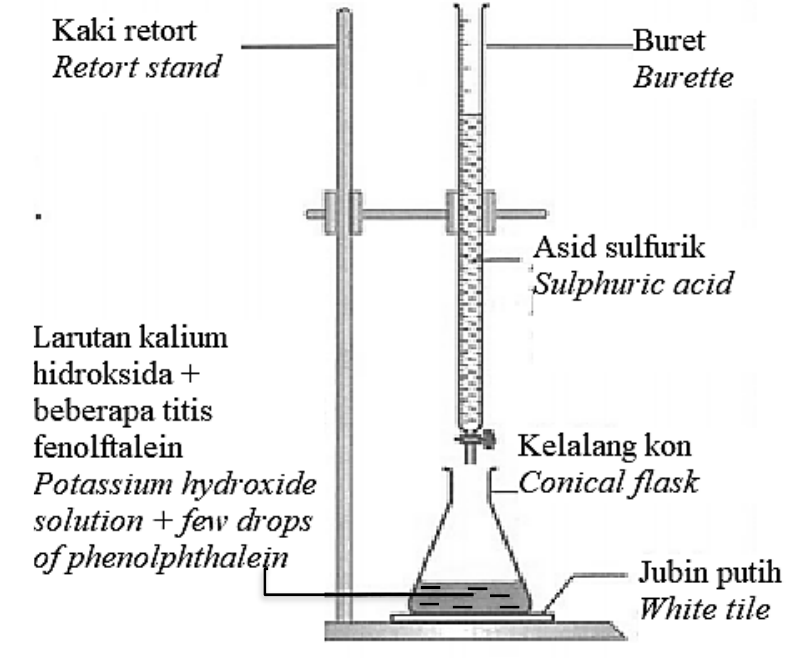
- (a)(ii)
The chemical equation for the reaction is H2SO4 + 2KOH → K2SO4 + 2H2O. Interpret the equation qualitatively and quantitatively. If 0.005 mol of potassium hydroxide solution reacted with 0.2 mol dm-3 of sulphuric acid, calculate the volume of sulphuric acid required for this reaction.
[4] - (b)
State the ingredient in hand soap X and explain how it causes this to happen. Suggest one home ingredient that can be used to help alleviate the effects of excess alkali that causes the redness.
[4]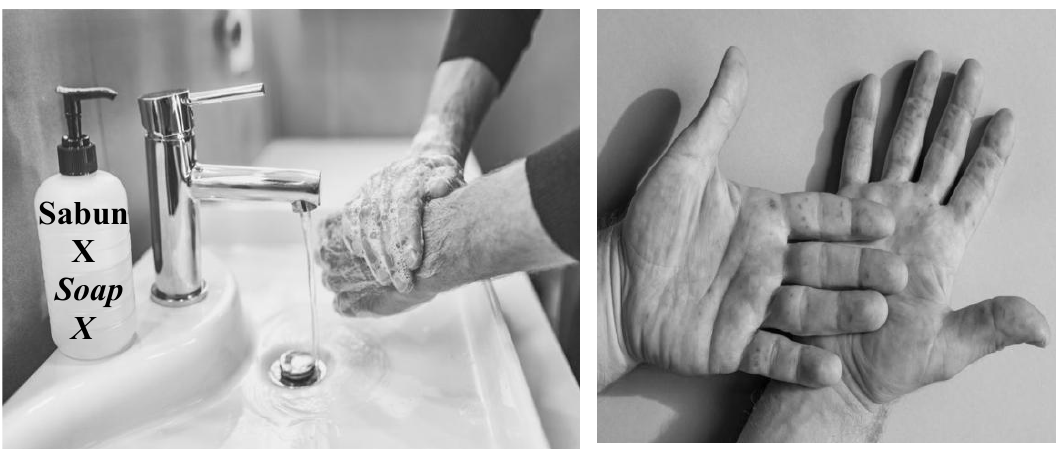
- (c)(i)
Based on Diagram 10.3 (green solid P + nitric acid → blue solution Q + gas R + water; heating green solid P → black solid T + gas R), identify substances P, Q, R and T.
[4]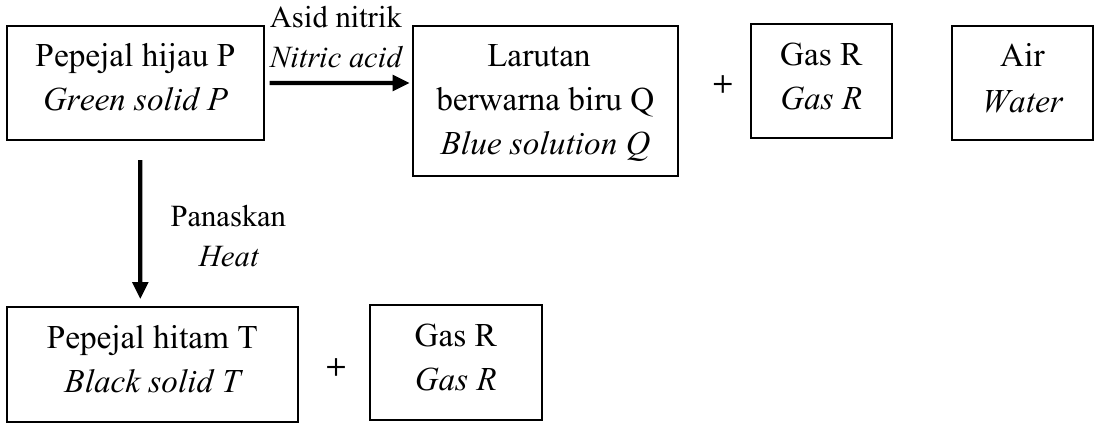
- (c)(ii)
Describe a chemical test to confirm the presence of cations and anions in solution Q.
[6]
Section C
Answer all questions from Section C. (a) Table 11 shows two chemical reactions using two different acids, X and Y, to determine heat of neutralisation: Reaction I, X + NaOH → NaX + H2O, -57.0 kJ mol-1; Reaction II, Y + NaOH → NaY + H2O, -52.0 kJ mol-1. (b) Diagram 11 shows the apparatus set-up for an experiment to determine the heat of combustion of hexane. 3500 kJ of heat was released when 1 mol of hexane is burnt in excess oxygen.
Hard20 marks- (a)(i)
Based on Table 11, state the meaning of heat of neutralisation.
[1]
- (a)(ii)
Suggest acid X and Y. Explain the difference in the heat of neutralisation for reaction II when compared to reaction I.
[4] - (a)(iii)
Draw the energy level diagram for reaction II and deduce one information from the energy level diagram.
[3] - (b)(i)
Suggest one modification that can be made to the apparatus set-up (Diagram 11: copper tin of water heated by a hexane lamp, thermometer, wind shield) to obtain more accurate temperature change. Give a reason for your answer.
[2]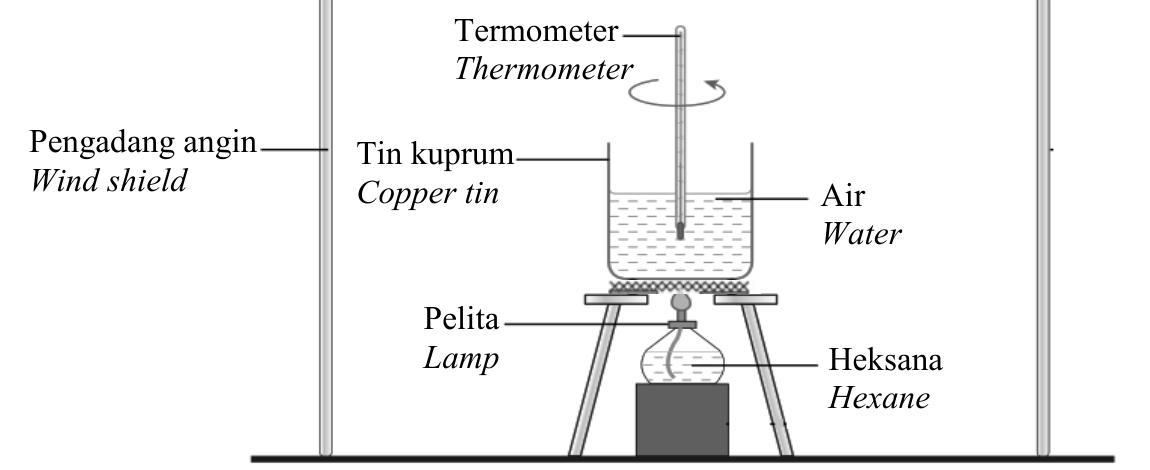
- (b)(ii)
Write the chemical equation for combustion of hexane and calculate the mass of hexane required for combustion to release 630 000 J of heat. [Relative atomic mass: C=12, H=1]
[4] - (c)
You are supplied with potassium hydroxide pellets, ammonium chloride, anhydrous calcium chloride and distilled water. Describe an experiment to determine the temperature change when the substances are dissolved in distilled water. Classify the substances into substances that undergo exothermic reactions and endothermic reactions.
[6]