Table 1 shows the proton number of elements P, Q, R and S. Elements P, Q, R, S have proton numbers 7, 8, 17, 15 respectively. Which pair of elements has the same number of valence electrons?
Medium
Which diagram shows the weakest attraction between particles?
Easy
A patient has been diagnosed with cancer. Which isotope is used to treat cancer?
Easy
Which of the following gases contains 0.6 mol of atoms at room temperature and pressure? [Molar volume of gas = 24 dm³ mol⁻¹ at room conditions]
Medium
Diagram 1 shows the chemical formula of potassium hexacyanoferrate (III) trihydrate: K₄Fe(CN)₆.3H₂O. What is the relative mass of this compound? [Relative atomic mass: H = 1, C = 12, O = 16, K = 39, Fe = 56, N = 14]
Medium
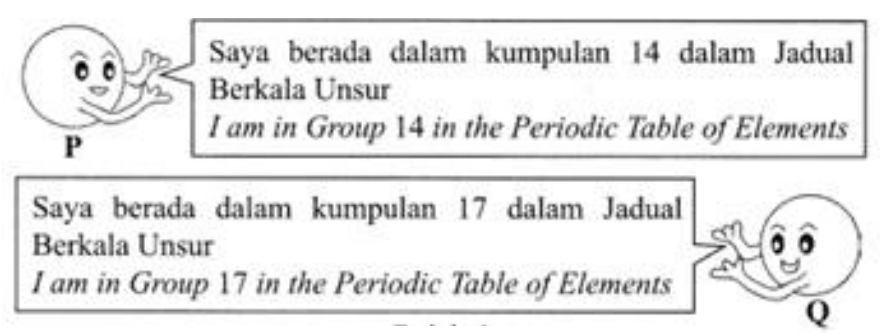
Diagram 2 shows an illustration between atom P and atom Q. Atom P says: 'I am in Group 14 in the Periodic Table of Elements'. Atom Q says: 'I am in Group 17 in the Periodic Table of Elements'. What is the type of chemical bond that will be formed between atom P and atom Q?
Medium
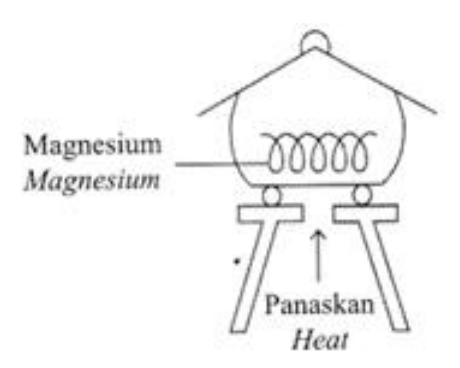
Diagram 3 shows the apparatus set-up to determine the empirical formula of a metal oxide (magnesium heated in a crucible). Which of the following metals uses the same method to determine its empirical formula?
Medium
Which of the following illustrations shows the formation of hydrogen bond between molecules?
Medium
Which of the following particles are formed from a dative bond? I H₃O⁺ II NH₄⁺ III NO₃⁻ IV CH₃COO⁻
Medium
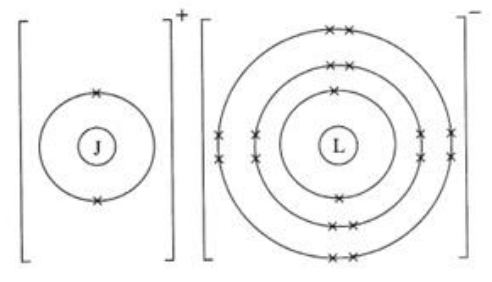
Diagram 4 shows the electron arrangement in compound JL (J⁺ with 2 electrons in one shell; L⁻ with electron arrangement 2.8.8). Which elements are represented by J and L? A J: Lithium, L: Sulphur B J: Lithium, L: Chlorine C J: Beryllium, L: Oxygen D J: Magnesium, L: Oxygen
Medium
Which of the following substances is acidic?
Medium
What ion is produced when a hydrogen ion combines with water molecule?
Easy
Which of the following terminology for chemical substances that ionises partially in water to produce low concentration of hydroxide ions?
Easy
Table 2 shows the pH values of four alkaline solutions: W 8.0, X 9.0, Y 11.0, Z 13.0. Which solution has the highest concentration of hydroxide ion?
Medium
Which of the following is the correct method to calculate the rate of reaction at the third second? (Graphs of volume of gas (cm³) against time (s).)
Medium
Which of the following is a reducing agent?
Medium
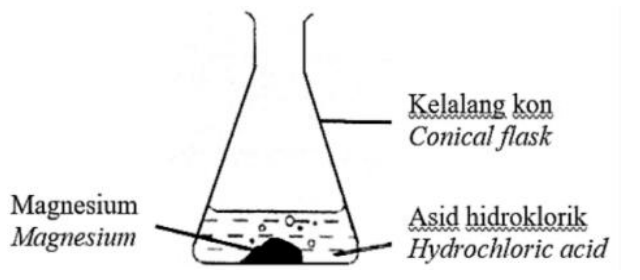
Diagram 5 shows the reaction between magnesium and hydrochloric acid in a conical flask. Which of the following changes can be observed and measured to determine the rate of reaction?
Medium
The following ionic equation represents a chemical reaction: X + Y²⁺ → X²⁺ + Y. Which of the following are correct about the substances? (Oxidised substance / Reduced substance / Oxidising agent / Reducing agent) A Y²⁺, X, X, Y²⁺ B X, Y²⁺, X, Y²⁺ C X²⁺, Y, Y, X²⁺ D X, Y²⁺, Y²⁺, X
Medium
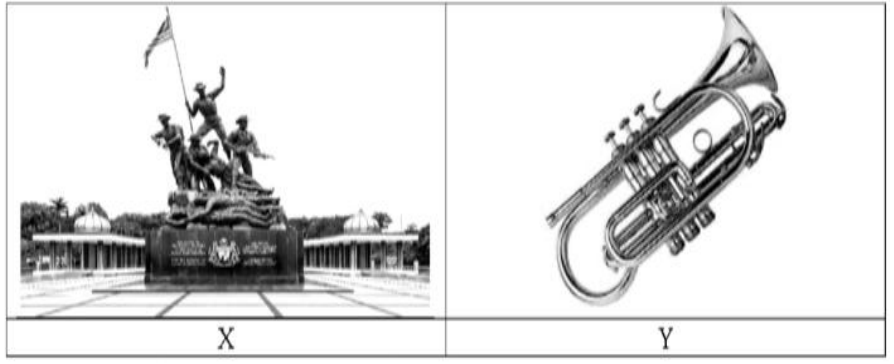
Diagram 6 shows the uses of two different materials X (the National Monument) and Y (a brass instrument). What is the main element in material X and Y?
Easy
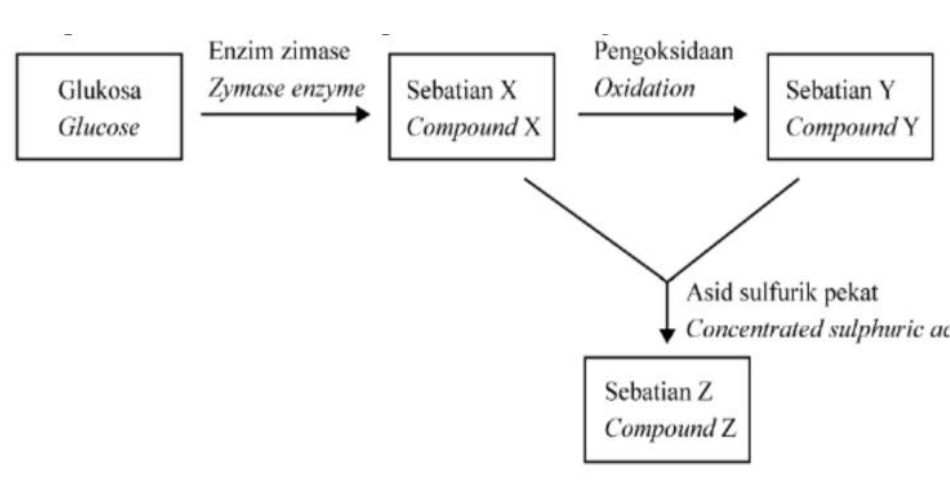
Diagram 7 shows the conversion of glucose (zymase enzyme) to compound X, oxidation of X to compound Y, and reaction of X and Y with concentrated sulphuric acid to give compound Z. Compound X is a colourless liquid, volatile and soluble in water. What is compound Z?
Medium
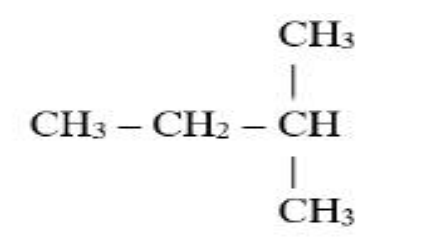
The structural formula of an alkane is shown in Diagram 8: CH₃–CH₂–CH(CH₃)–CH₃ (a CH₃ branch on the third carbon of the chain). What is the IUPAC name of the compound?
Medium
Hydrocarbon is organic compound containing only carbon atom and hydrogen. Based on the statement, which of the following organic compound is hydrocarbon?
Medium
What is the homologous series of propyl propanoate?
Medium
Compound P undergoes combustion in excess oxygen to produce carbon dioxide and water: P + 3O₂ → 2CO₂ + 3H₂O. What is compound P?
Medium
Which of the following absorb heat from the surrounding? I Photosynthesis II Ammonium nitrate dissolves in water III Respiration IV Combustion
Medium
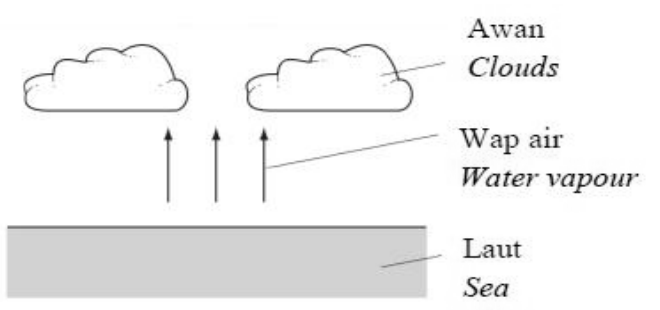
Diagram 9 shows the formation of clouds when water vapour evaporates from the sea. What is the heat change and types of process occurs when water evaporates? A Heat energy given out, Evaporation B Heat energy given out, Condensation C Heat energy absorbed, Evaporation D Heat energy absorbed, Condensation
Easy
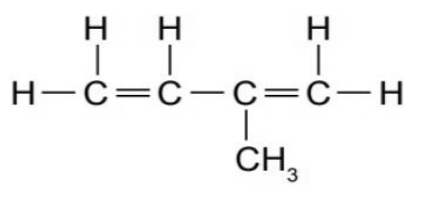
Diagram 10 shows the structural formula of rubber monomer: CH₂=C(CH₃)–CH=CH₂. What is the name of the compound based on the IUPAC nomenclature?
Medium
Which of the following is true to explain the coagulation of latex?
Medium
A woman is diagnosed with a nervous system problem after using a cosmetic product for a while. What is the illegal ingredient used by the cosmetic company?
Easy
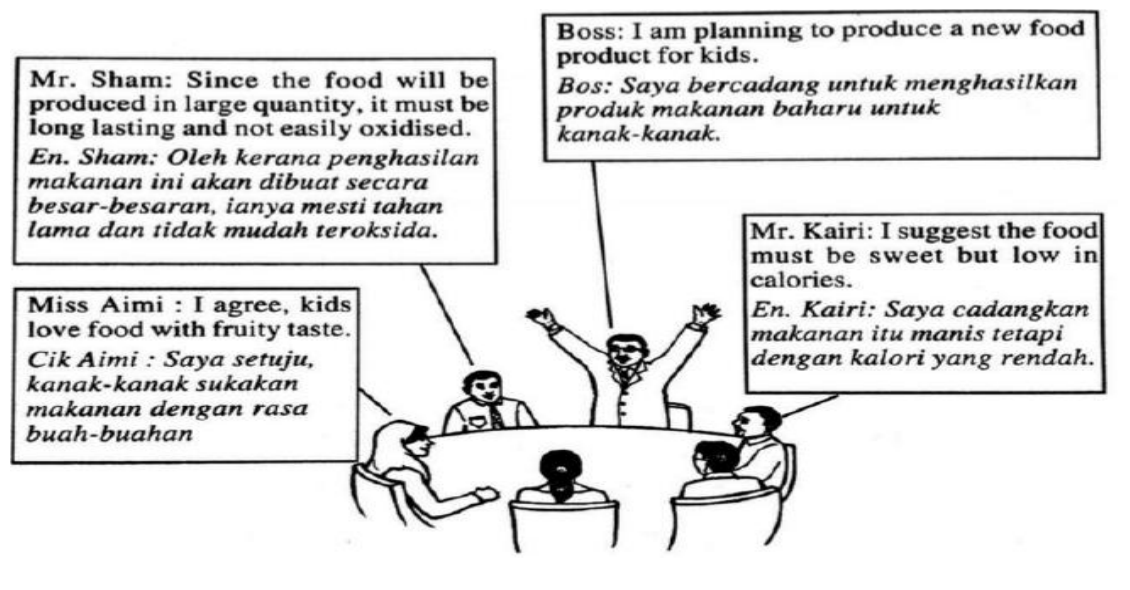
Diagram 11 shows a discussion in a meeting among food manufacturing workers. Boss: planning a new food product for kids. Mr Sham: the food will be produced in large quantity, so it must be long lasting and not easily oxidised. Mr Kairi: the food must be sweet but low in calories. Miss Aimi: kids love food with fruity taste. Which of the following substances are the most suitable to be used in the new food product? I Aspartame II Ascorbic acid III Octyl glutamate IV Azo compounds
Medium
Faizal wants to prepare 250 cm³ of 0.3 mol dm⁻³ sodium hydroxide solution. What is the mass of sodium hydroxide Faizal needs to produce the solution? [Relative atomic mass: Na = 23, O = 16, H = 1]
Medium
Milk of magnesia can relieve gastric pain. It neutralises gastric juice in the stomach. What is the pH value of gastric juice?
Easy
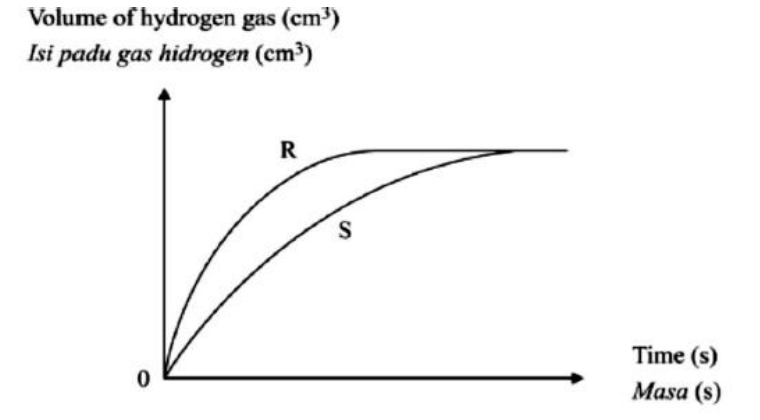
Diagram 12 shows the graph of total volume of hydrogen gas against time for the reaction between zinc and hydrochloric acid for two experiments (curve R is steeper than curve S; both reach the same final volume). Which of the following are correct about the two experiments? I Catalyst is used in experiment R but not used in experiment S II The concentration of acid used in experiment R is lower than the acid used in experiment S III Zinc powder is used in experiment R whereas zinc plate is used in experiment S IV The temperature of acid is higher in experiment R than in experiment S
Medium
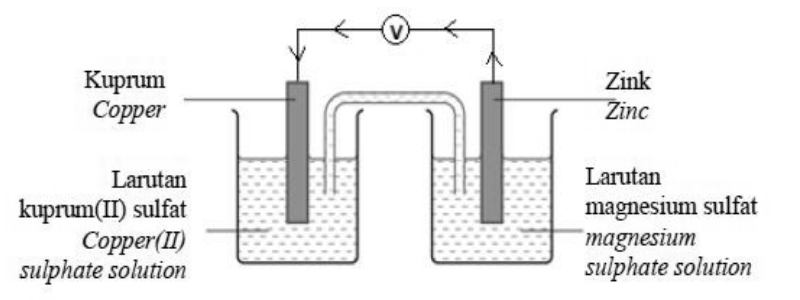
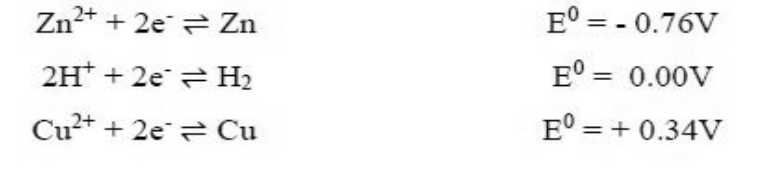
Diagram 13 shows a voltaic cell (copper in copper(II) sulphate solution and zinc in magnesium sulphate solution, joined by a salt bridge). Given the standard electrode potentials: Zn²⁺ + 2e⁻ ⇌ Zn, E° = −0.76 V; 2H⁺ + 2e⁻ ⇌ H₂, E° = 0.00 V; Cu²⁺ + 2e⁻ ⇌ Cu, E° = +0.34 V. What is the voltage for the cell?
Medium
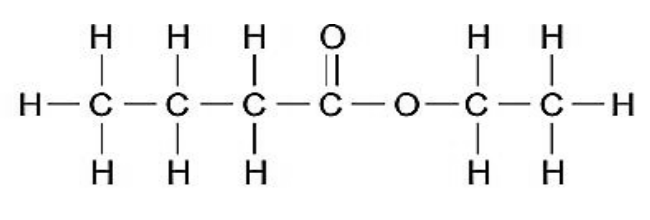
Diagram 14 shows the structural formula of a food flavouring found in fruits: CH₃CH₂CH₂–C(=O)–O–CH₂CH₃. Which of the following can be used to make the food flavouring?
Medium
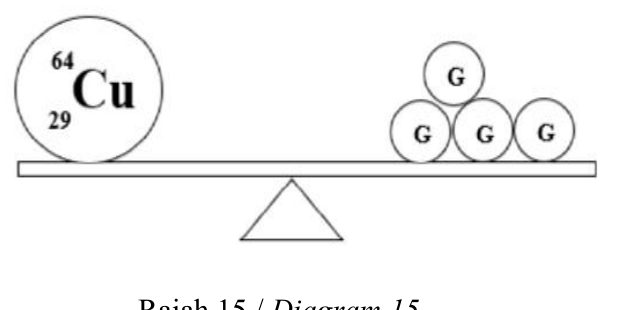
Diagram 15 shows a comparison of mass between one copper atom (⁶⁴₂₉Cu) and four atoms of G on a balance. What is the relative atomic mass of G?
Medium
The thermochemical equation HNO₃(aq) + KOH(aq) → KNO₃(aq) + H₂O(l), ΔH = −57.3 kJ mol⁻¹ represents the neutralisation between 25 cm³ nitric acid and 25 cm³ potassium hydroxide solution of the same molarity. The temperature of the mixture increased by 7.0 °C. [Specific heat capacity of solution = 4.2 J g⁻¹ °C⁻¹, density of solution 1 g cm⁻³] What is the molarity of both solutions?
Hard
The chemical equation 3Cl₂ + 2Fe → 2X represents the reaction between chlorine gas and hot iron wool to produce brown solid X. What is the mass of X produced when 120 cm³ of chlorine gas reacted with hot iron wool at room temperature? [Relative atomic mass Cl = 35.5; Fe = 56; molar volume of gas at room temperature = 24 dm³ mol⁻¹]
Medium
The equation C₄H₉OH + 6O₂ → 4CO₂ + 5H₂O shows the complete combustion of butanol. What is the mass of butanol required to produce 360 cm³ of carbon dioxide gas at room condition? [Molar mass of butanol = 74 g mol⁻¹; molar volume of gas = 24 dm³ mol⁻¹ at room condition]
Medium
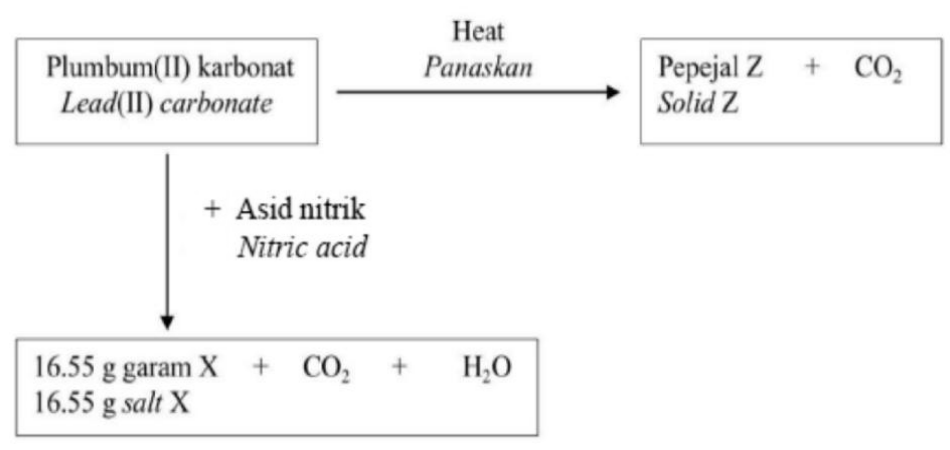
Diagram 16 shows two different reactions of lead(II) carbonate: heating gives solid Z and CO₂; reacting with nitric acid gives 16.55 g salt X, CO₂ and H₂O. What is the mass of solid Z formed when the same mass of lead(II) carbonate is used? [Relative atomic mass: N = 14, O = 16, Pb = 207]