Write your answer on paper. Then open the answer to check it.
Section A
Diagram 1 shows The National Monument and a saxophone. The National Monument is made of alloy Y while the saxophone is made of alloy Z. Both alloys use copper as the main element.
Medium5 marks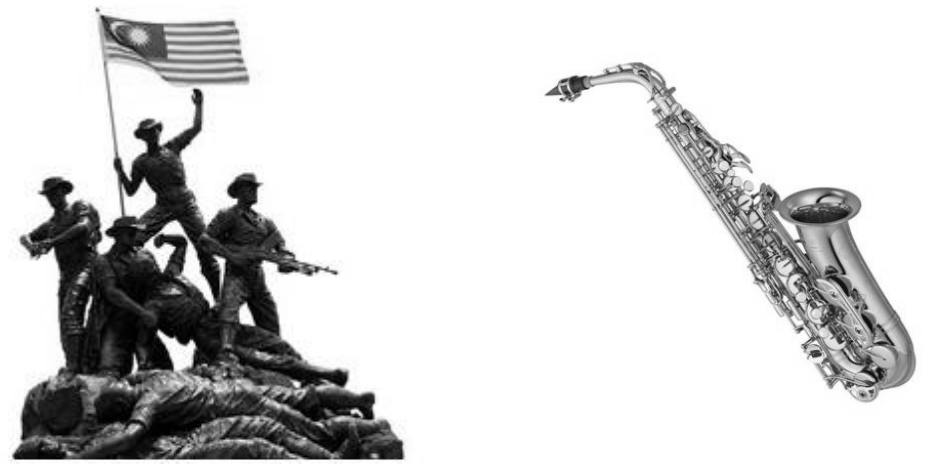
- (a)
What is the meaning of alloy?
[1] - (b)(i)
Identify alloy Z.
[1] - (b)(ii)
State one other element in alloy Y.
[1] - (c)
What are the advantages of The National Monument and the saxophone being produced from alloy, not its pure metal?
[2]
Diagram 2 shows various levels of waste management in Green Technology.
Medium5 marks- (a)
What is the meaning of Green Technology?
[1] - (b)
State one sector in Green Technology and its application.
[2] - (c)
Diagram 2a shows how employees of a solid waste management company collect garbage regularly (an overflowing rubbish bin). There are various wastes in your residential area such as food wastes and plastic bottles. As a student who has knowledge of Green Technology, suggest two methods that can overcome the problem.
[2]
Diagram 3 shows a process of extracting aluminium metal from its ore (molten aluminium oxide + cryolite with carbon electrodes).
Medium6 marks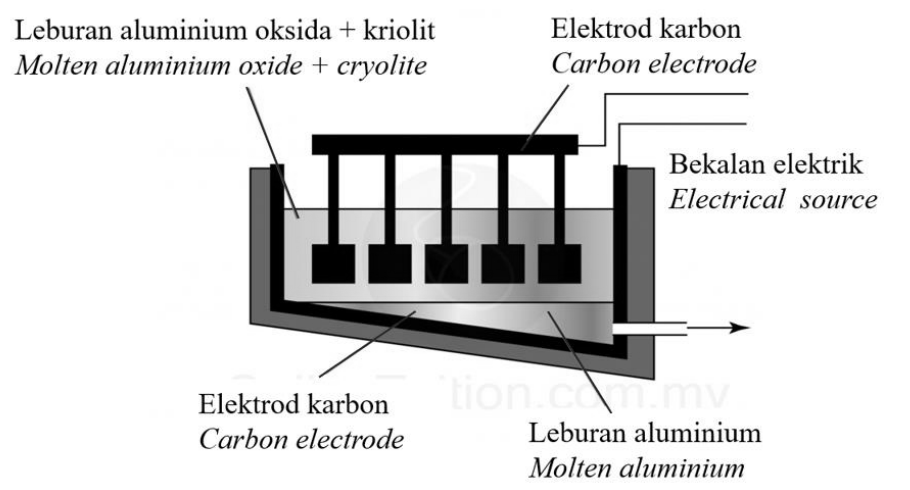
- (a)
What is the name of the method used to extract the aluminium?
[1] - (b)
What is the function of cryolite?
[1] - (c)
Write the half-equation that occurs at the anode.
[1] - (d)(i)
The equation 2Fe₂O₃(s) + 3C(s) → 4Fe(l) + 3CO₂(g) (Diagram 3a) shows the extraction of iron from its ore by carbon reduction. Why can aluminium not be extracted using the reduction reaction by carbon?
[1] - (d)(ii)
Name a metal that can be used to extract copper from copper(II) oxide. Explain your answer.
[2]
Table 4 shows the heats of combustion of some alcohols: ethanol, C₂H₅OH, −1 376 kJ mol⁻¹; propanol, C₃H₇OH, −2 016 kJ mol⁻¹.
Medium7 marks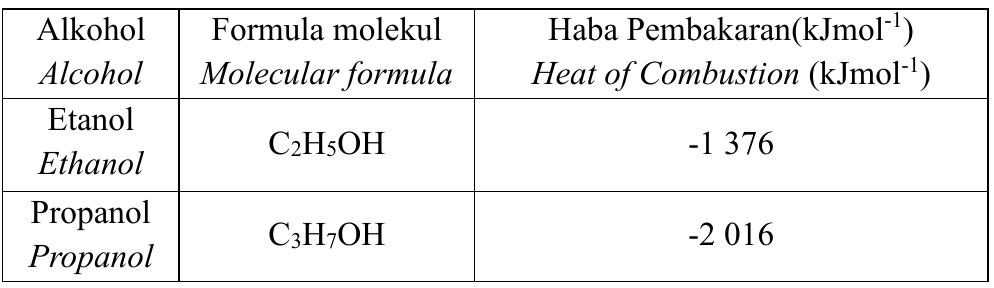
- (a)
What is meant by heat of combustion?
[1] - (b)
Based on the information in Table 4, compare the value of heat of combustion of ethanol and propanol. Explain your answer.
[2] - (c)(i)
The heat released from the complete combustion of 4.6 g ethanol is used to heat 200 cm³ of water. Calculate the heat energy released in this reaction. [Relative atomic mass: C = 12, H = 1, O = 16]
[2] - (c)(ii)
Calculate the temperature change in the reaction. [Specific heat capacity of water: 4.2 J g⁻¹ °C⁻¹]
[2]
Diagram 5.1 shows the apparatus set-up of an experiment to study the properties of hydrogen chloride in two different solvents: Set I (solvent X, zinc strip, gas bubbles seen) and Set II (solvent Y, zinc strip, no bubbles). Diagram 5.2 shows the pH values of two acids: hydrochloric acid 0.1 mol dm⁻³ (pH = Z) and ethanoic acid 0.1 mol dm⁻³ (pH = 4.8). The pH value of Z is lower than the pH value of ethanoic acid.
Medium8 marks- (a)(i)
What is meant by acid?
[1]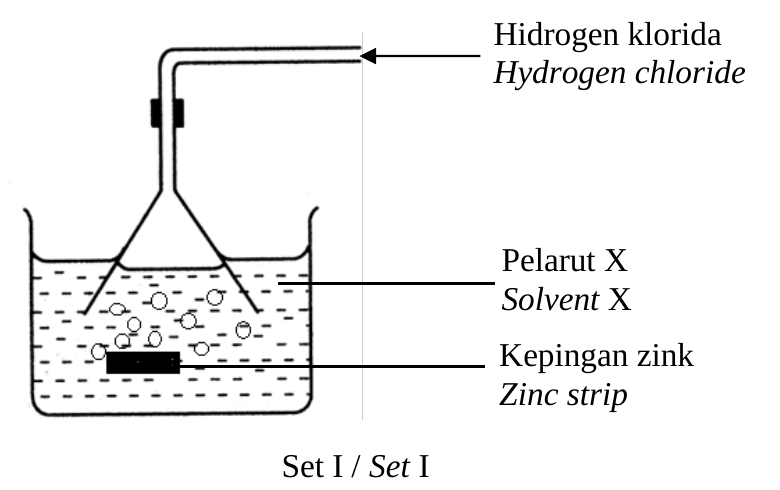
- (a)(ii)
Explain the observations for Set I and Set II.
[2] - (a)(iii)
Write a chemical equation for the reaction that occurs in Set I.
[2] - (b)(i)
Calculate the value of Z.
[1]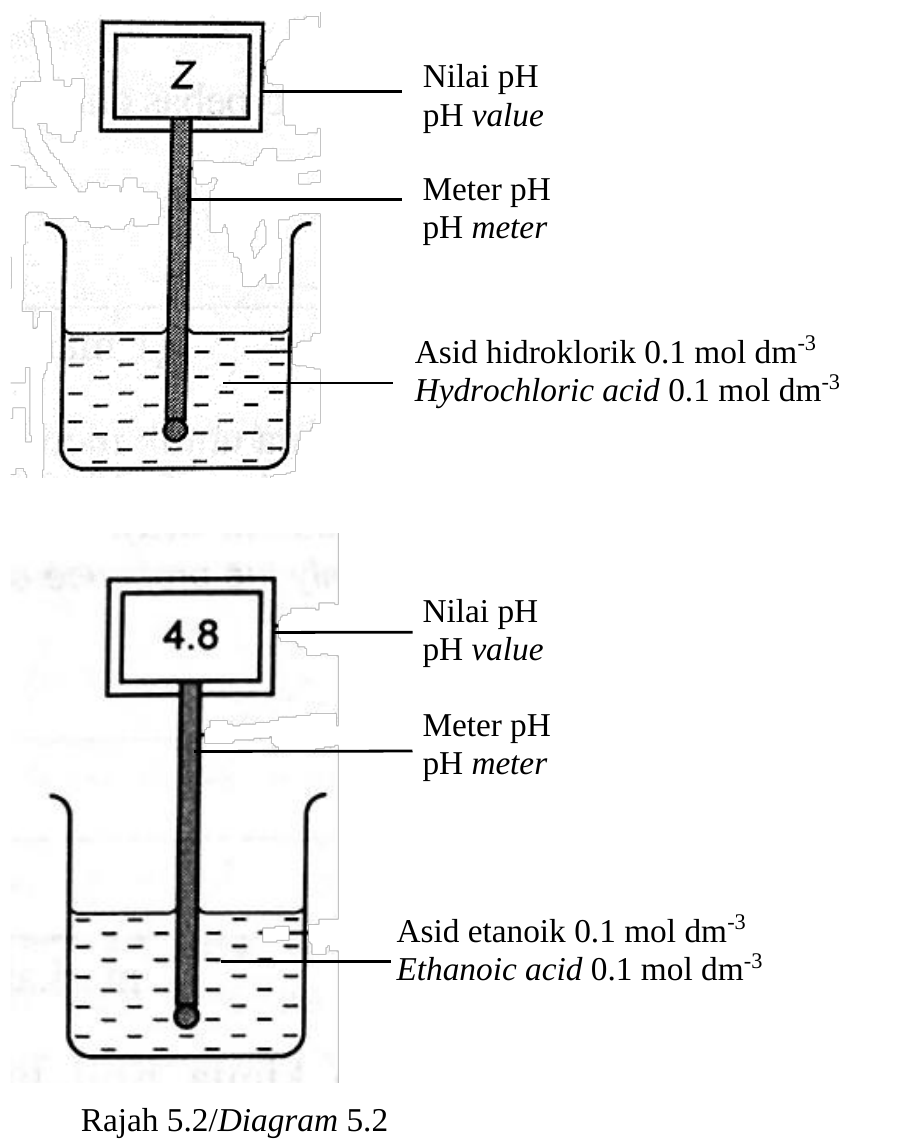
- (b)(ii)
Explain why the pH value of hydrochloric acid is lower compared to the pH value of ethanoic acid.
[2]
Table 6 shows the information of elements in the Periodic Table. The letters shown are not the actual symbols. Element: P Q R S T U V; proton number: 11 12 13 14 15 16 17.
Medium9 marks
- (a)
Based on the table, state the property of oxide for oxide R.
[1] - (b)
Element T reacts with V to form compound X. State the type of bond for compound X.
[1] - (c)(i)
Element P reacts with element V to form compound Y. Write the chemical equation for the formation of compound Y.
[2] - (c)(ii)
0.05 mol P reacts with element V to form compound Y. Calculate the volume of V required. [Molar volume = 24 dm³ mol⁻¹ at room conditions]
[2] - (d)
Diagram 6 Set I and Set II show an apparatus set-up to investigate the electrical conductivity of two different compounds (Set I: bulb lights up; Set II: bulb does not light up). Explain the difference in observation for Set I and Set II.
[3]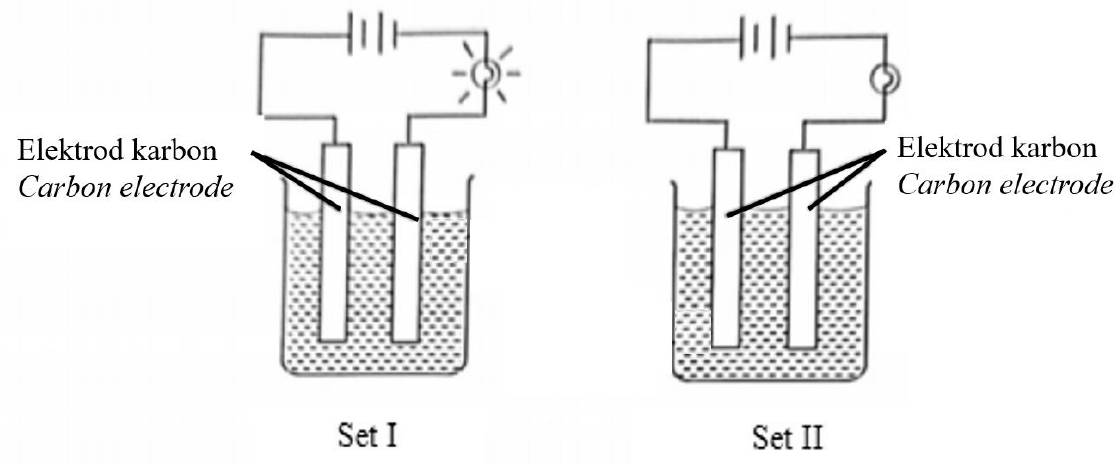
Diagram 7 shows the flow chart for the formation of pineapple flavour using alcohol X and butanoic acid: C₆H₁₂O₆ → (Reaction 1) → alcohol X; alcohol X + butanoic acid → pineapple flavouring.
Medium10 marks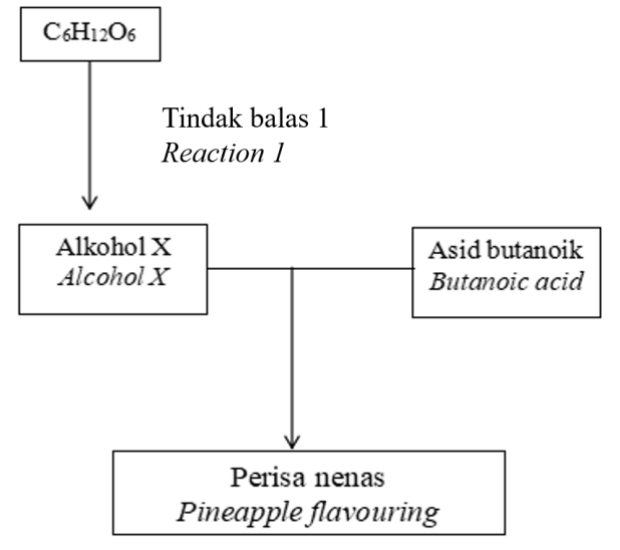
- (a)
State the name for reaction 1.
[1] - (b)
What is the functional group of alcohol X?
[1] - (c)(i)
Alcohol X is burned in excess oxygen to produce gas Y and water. Write a balanced chemical equation for the reaction.
[2] - (c)(ii)
If 2.3 g alcohol X is used, calculate the volume of Y gas produced. [1 mol gas occupies 24 dm³ at room conditions]
[3] - (d)(i)
Pineapple flavour can be produced by the reaction between alcohol X and butanoic acid. Name the ester.
[1] - (d)(ii)
Suggest a product in the food industry that uses the ester in (d)(i).
[1] - (d)(iii)
Justify the use of ester in the food industry.
[1]
Diagram 8 shows an electron arrangement of a compound formed from the reaction between substance X and Y (an X²⁺ ion and a Y²⁻ ion, each with electron arrangement 2.8).
Medium10 marks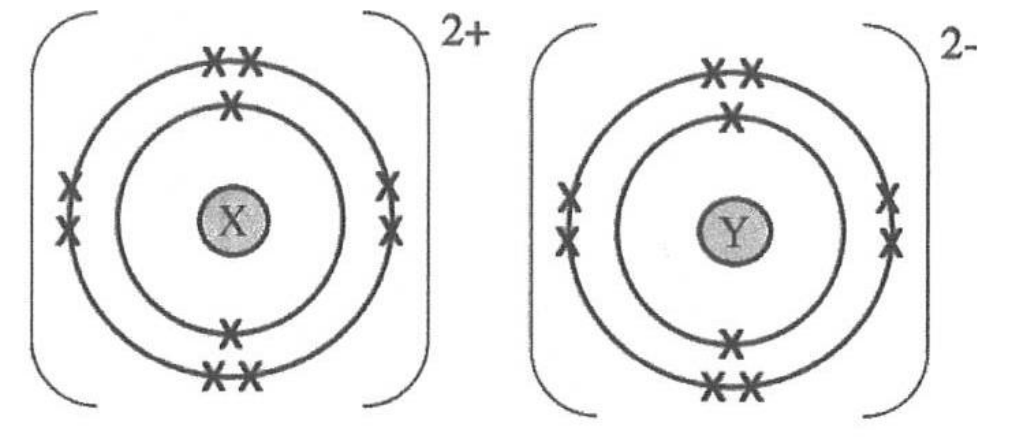
- (a)(i)
Write the electron arrangement of atom X and atom Y.
[2] - (a)(ii)
State the type of forces of attraction between particles in the compound.
[1] - (a)(iii)
Explain the process of formation of the compound in Diagram 8.
[3] - (b)
Puan Juriah puts a white solid in a cupboard to keep cockroaches away. The physical properties of the white solid are: cannot conduct electricity in any state; low melting point and boiling point. Based on the information, identify the type of compound of the white solid and explain each property.
[4]
Section B
Question 9 is in Section B (answer one of Questions 9 and 10).
Hard20 marks- (a)(i)
Table 9.1 shows the effect of heat on two different ionic compounds X and Y. The compounds consist of the same cation. Heating the compounds produces a yellow solid when hot and a white solid when cold. Compound X: gas P turns lime water cloudy (colourless gas P released). Compound Y: gas Q rekindles a glowing wooden splinter (colourless gas Q released); gas R turns blue litmus paper red (brown gas R released). State the name of gas P, Q and R released in reactions I and II. Name compound X and compound Y.
[5]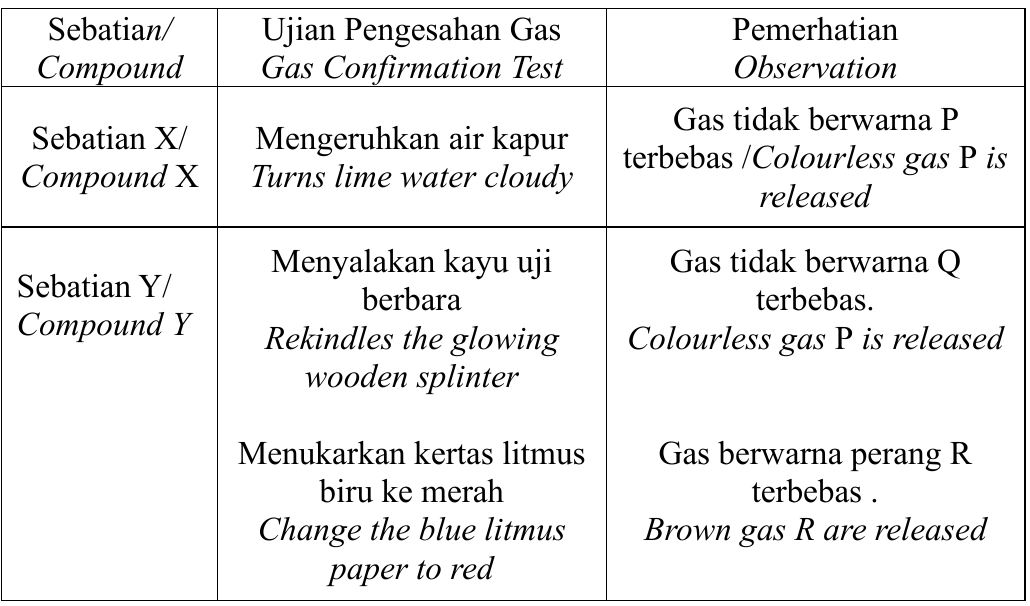
- (a)(ii)
Describe a chemical test to confirm the presence of the cation in compound Y.
[4] - (b)(i)
A student has been given the task of preparing a standard solution using solid sodium hydroxide. What is meant by a standard solution?
[1] - (b)(ii)
Calculate the mass of sodium hydroxide solid that needs to be dissolved in 500 cm³ of distilled water to produce an alkali standard solution with a concentration of 1.0 mol dm⁻³. [Relative atomic mass: Na = 23, O = 16, H = 1]
[2] - (c)
The student was asked to prepare 250 cm³ of 0.5 mol dm⁻³ standard sodium hydroxide solution from a stock solution of 1.0 mol dm⁻³ sodium hydroxide. Name the method to prepare the standard solution. Calculate the volume of stock solution needed.
[3] - (d)(i)
The student uses the standard solution of sodium hydroxide to determine the molarity of sulphuric acid using the apparatus set-up in Diagram 9.2 (burette with 0.5 mol dm⁻³ H₂SO₄ above a conical flask with 25.0 cm³ NaOH and a few drops of methyl orange). Name the method used as shown in the diagram.
[1]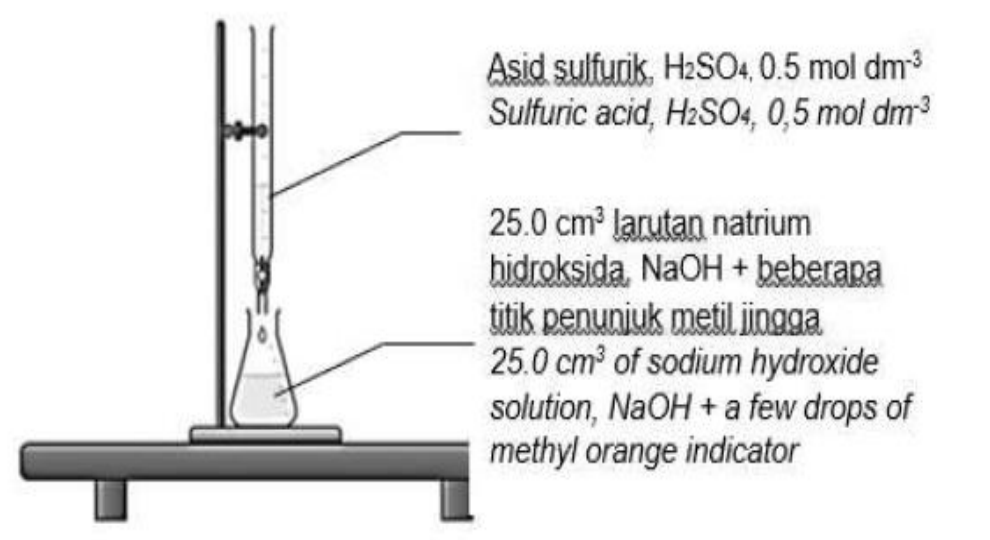
- (d)(ii)
Write the chemical equation for the reaction above. Determine the molarity of the sodium hydroxide solution used if 25 cm³ of 0.5 mol dm⁻³ sulphuric acid is needed to neutralise 25 cm³ sodium hydroxide solution.
[4]
Question 10 is in Section B (answer one of Questions 9 and 10).
Medium20 marks- (a)(i)
Table 10.1 shows two sets of experiments carried out by a student to study the factor that affects the rate of reaction between hydrochloric acid and excess calcium carbonate. Set I: 50 cm³ of 0.1 mol dm⁻³ hydrochloric acid and calcium carbonate granules; 40 cm³ of carbon dioxide gas collected in 50 s. Set II: 50 cm³ of 0.1 mol dm⁻³ hydrochloric acid and calcium carbonate powder; 40 cm³ of gas collected in 20 s (gas collected by displacement of water). State the definition of the rate of reaction.
[1]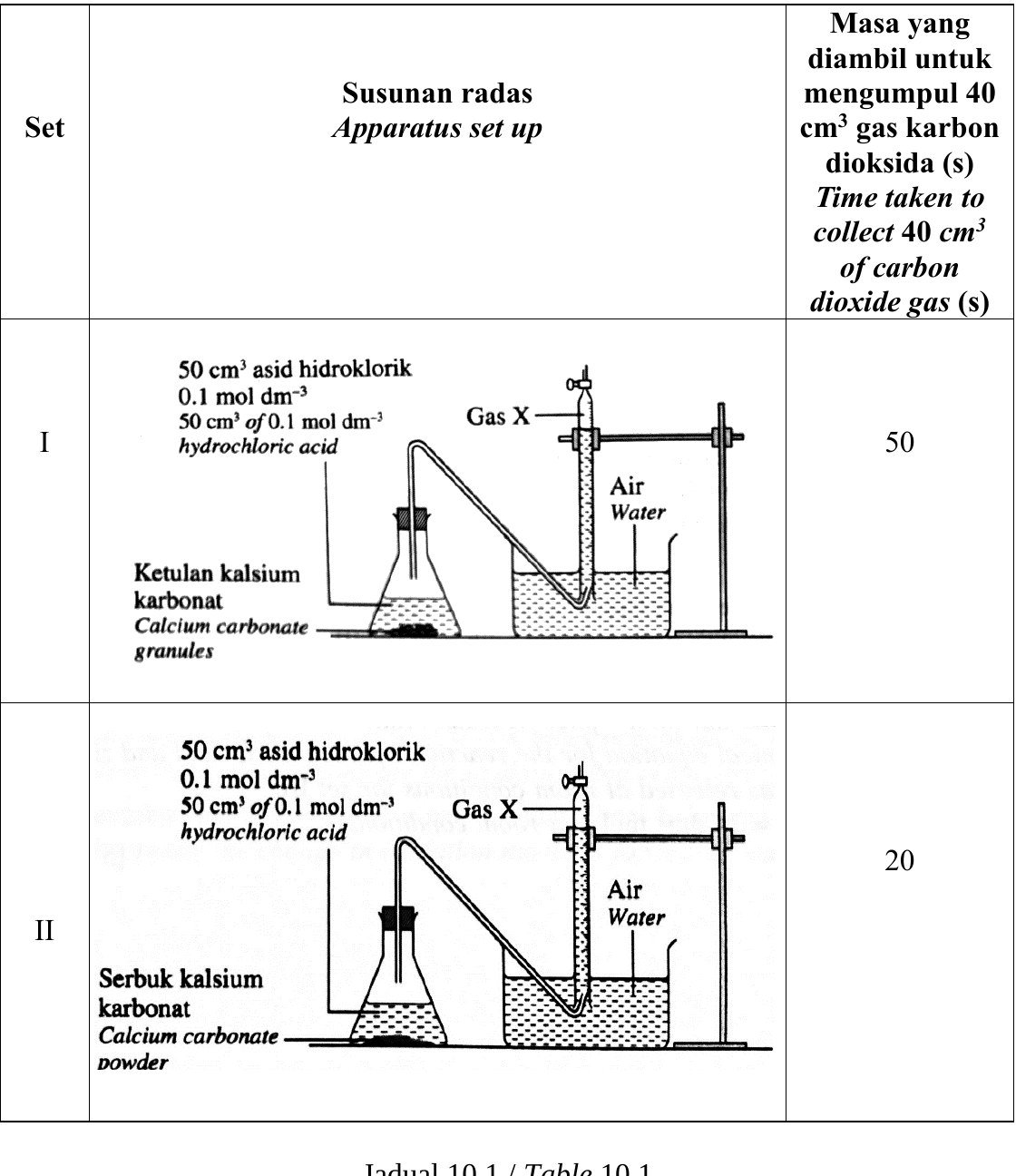
- (a)(ii)
Calculate the average rate of reaction in set I.
[1] - (a)(iii)
Based on the information in Table 10.1, compare the rate of reaction between set I and set II. Explain your answer using the collision theory.
[5] - (a)(iv)
Sketch a graph of the volume of carbon dioxide gas collected against time for the experiments in set I and set II on the same axis.
[2] - (b)(i)
An experiment studies the rate of reaction between zinc and nitric acid. Excess zinc granules react with 25 cm³ of nitric acid in set III and set IV. Table 10.2: Set III: 0.2 mol dm⁻³, 27 °C, rate low; Set IV: 1.0 mol dm⁻³, 37 °C, rate high. Based on Table 10.2, state two factors that affect the rate of reaction. Choose one of the factors and explain your answer using the collision theory.
[6]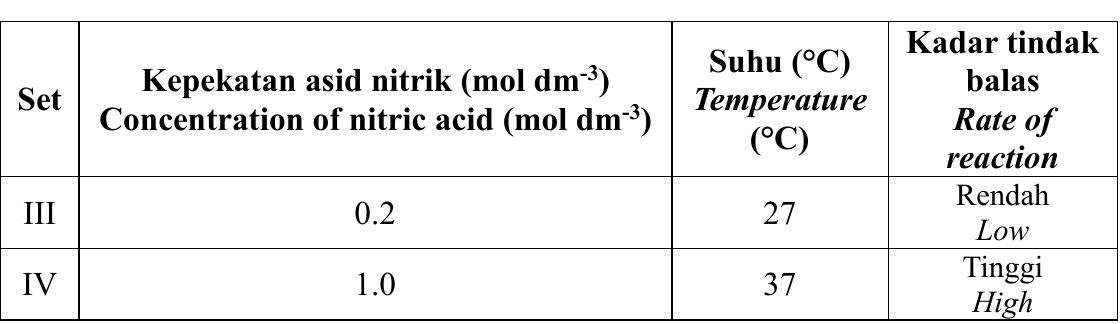
- (b)(ii)
Write a balanced chemical equation for the reaction between nitric acid and zinc. Calculate the maximum volume of gas released at room conditions for set III. [Molar volume of gas = 24 dm³ mol⁻¹ at room conditions]
[5]
Section C
Question 11 is in Section C (compulsory).
Hard20 marks- (a)
Diagram 11.1 shows the apparatus set-up to study the redox reaction (chlorine water added to potassium iodide in Set I and to iron(II) sulphate in Set II). Write the half-equation for the oxidation and reduction that occur in set I and set II, then determine the change in oxidation number of chlorine for both sets.
[4]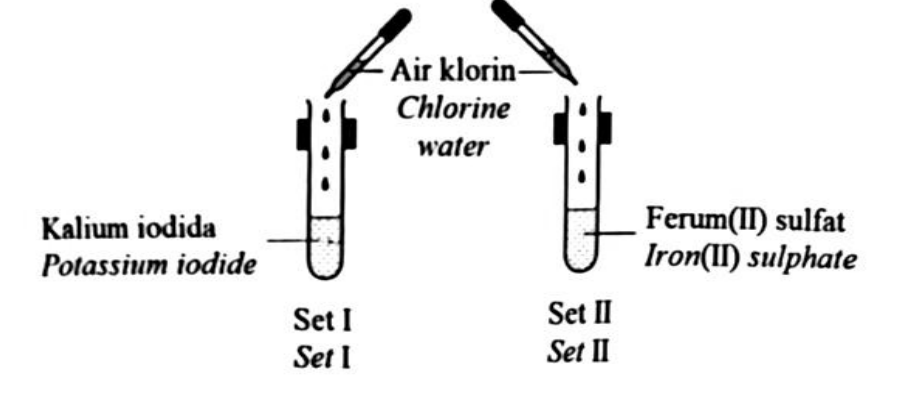
- (b)
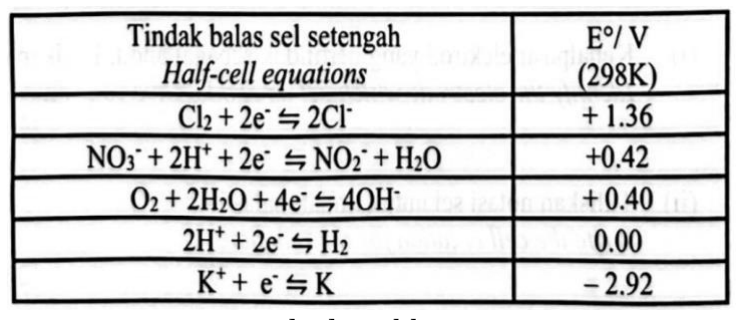
In another experiment, a student investigates the factors affecting the discharge of ions at different electrodes. Diagram 11.2 shows the apparatus (carbon electrodes): Set I uses 1.0 mol dm⁻³ potassium chloride solution; Set II uses 1.0 mol dm⁻³ potassium nitrate solution. Table 11.1 (standard electrode potentials, 298 K): Cl₂ + 2e⁻ ⇌ 2Cl⁻ +1.36 V; NO₃⁻ + 2H⁺ + 2e⁻ ⇌ NO₂⁻ + H₂O +0.42 V; O₂ + 2H₂O + 4e⁻ ⇌ 4OH⁻ +0.40 V; 2H⁺ + 2e⁻ ⇌ H₂ 0.00 V; K⁺ + e⁻ ⇌ K −2.92 V. Compare and contrast set I and set II in terms of: ions attracted to the anode; choice of ion to be oxidised; reason why the ion was chosen to be oxidised; observation at the anode.
[8]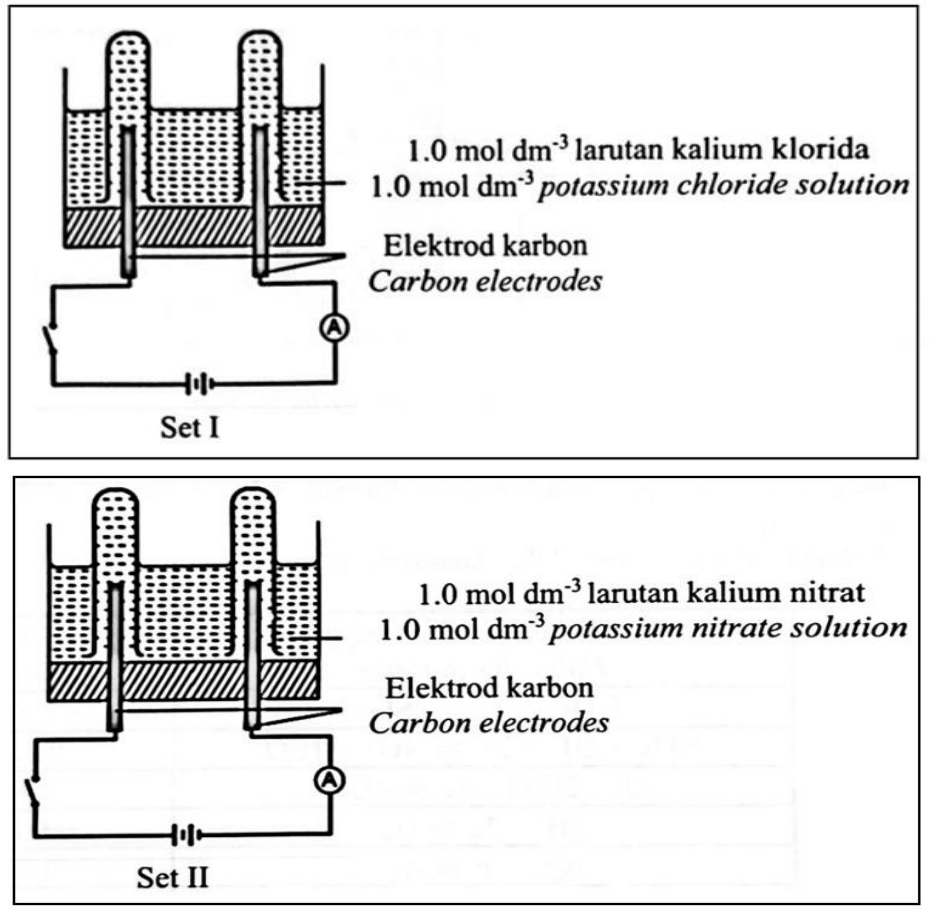
- (c)
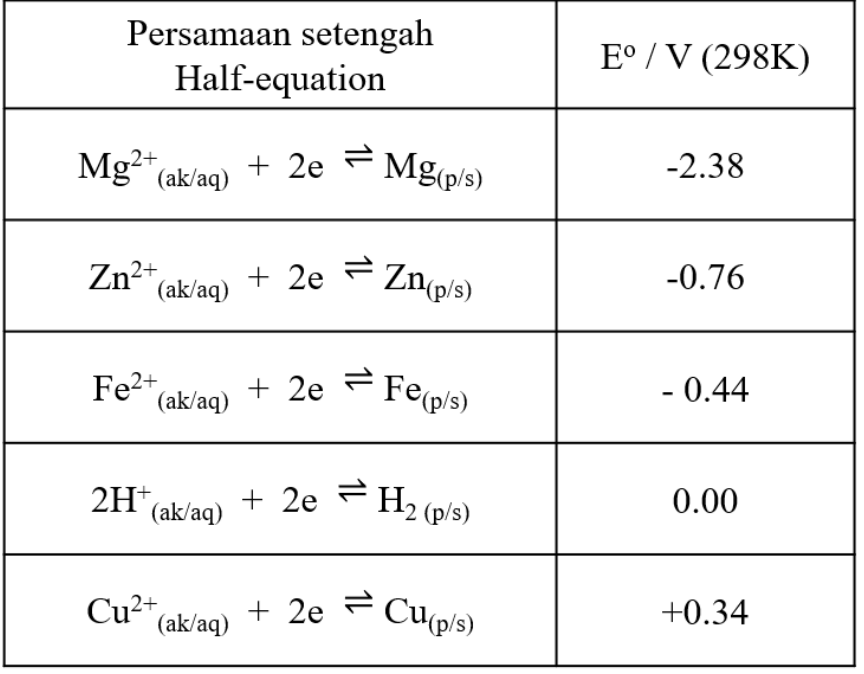
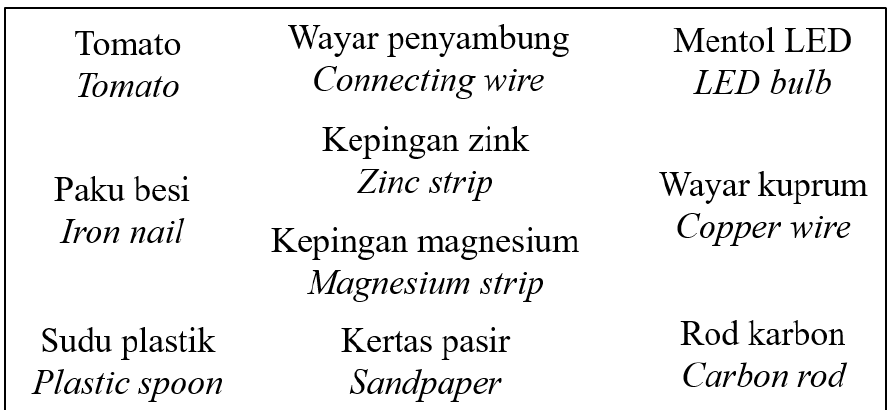
Table 11.2 shows part of the standard electrode potential series: Mg²⁺ + 2e⁻ ⇌ Mg −2.38 V; Zn²⁺ + 2e⁻ ⇌ Zn −0.76 V; Fe²⁺ + 2e⁻ ⇌ Fe −0.44 V; 2H⁺ + 2e⁻ ⇌ H₂ 0.00 V; Cu²⁺ + 2e⁻ ⇌ Cu +0.34 V. Diagram 11.3 lists the materials and apparatus provided to construct a voltaic cell: tomato, connecting wire, LED bulb, iron nail, zinc strip, copper wire, plastic spoon, magnesium strip, sandpaper, carbon rod. Using your chemistry knowledge, draw the apparatus set-up of a voltaic cell that can light up the LED bulb, using suitable materials from Diagram 11.3. Describe briefly the steps of constructing the voltaic cell and explain the redox reaction that takes place. Then determine the voltage reading obtained.
[8]